Lasers
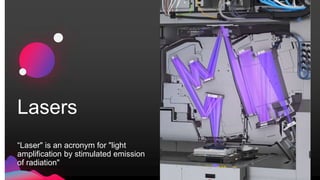
“Laser" is an acronym for "light
amplification by stimulated emission
of radiation"
Jens
Martensson
What is a
laser?
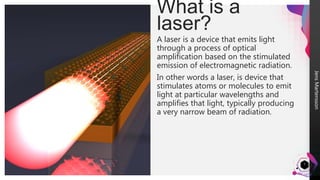
A laser is a device that emits light
through a process of optical
amplification based on the stimulated
emission of electromagnetic radiation.
In other words a laser, is device that
stimulates atoms or molecules to emit
light at particular wavelengths and
amplifies that light, typically producing
a very narrow beam of radiation.
2
Jens
Martensson
3
Laser v/s normal light
• Laser beam is perfectly mono-
chromatic.
• Intensity of laser light is very high due
to very less spreading tendancy.
• Highly coherent in nature.
• The divergence or angular spread of
laser beam is emtremely small.
Ordinary light
• It is strictly non monochromatic.
• Intensity is very less due to spreading.
• It is incoherent light.
• The ordinary light spread out hence it is
highly divergent.
Laser
Jens
Martensson
Types of laser’s
Based on their gain medium, lasers
are classified into five main types:
• Gas Lasers
• Solid-State Lasers
• Fiber Lasers
• Liquid Lasers (Dye Lasers)
• Semiconductor Lasers (Laser Diodes)
4
Jens
Martensson
Working
Principle of a
Lasers
A laser consists of three fundamental
elements:
• an amplifying or gain medium (this
can be a solid, a liquid or a gas).
• a system to excite the amplifying
medium (also called a pumping
system).
• optical resonator
5
Jens
Martensson
Amplifying or gain medium
6
The physical principle involved is called stimulated emission which is the process by which an
incoming photon of a specific frequency can interact with an excited atomic electron (or other
excited molecular state), causing it to drop to a lower energy level. The liberated energy transfers
to the electromagnetic field, creating a new photon with a frequency, polarization, and direction
of travel that are all identical to the photons of the incident wave.
Jens
Martensson
Exciting the amplifying medium
7
This creates the conditions for light amplification by supplying the necessary energy. There are
different kinds of pumping system: optical (the sun, flash lamps, continuous arc lamps or
tungsten-filament lamps, diode or other lasers), electrical (gas discharge tubes, electric current in
semi-conductors) or even chemical.
Jens
Martensson
Optical resonator
8
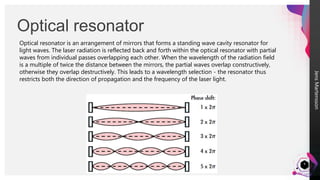
Optical resonator is an arrangement of mirrors that forms a standing wave cavity resonator for
light waves. The laser radiation is reflected back and forth within the optical resonator with partial
waves from individual passes overlapping each other. When the wavelength of the radiation field
is a multiple of twice the distance between the mirrors, the partial waves overlap constructively,
otherwise they overlap destructively. This leads to a wavelength selection - the resonator thus
restricts both the direction of propagation and the frequency of the laser light.
Jens
Martensson
Laser Classifications
9
• Class I - These lasers cannot emit laser radiation at known hazard levels.
• Class I.A. - This is a special designation that applies only to lasers that are "not intended for
viewing," such as a supermarket laser scanner. The upper power limit of Class I.A. is 4.0 mW.
• Class II - These are low-power visible lasers that emit above Class I levels but at a radiant power
not above 1 mW. The concept is that the human aversion reaction to bright light will protect a
person.
• Class IIIA - These are intermediate-power lasers (cw: 1-5 mW), which are hazardous only for
intrabeam viewing. Most pen-like pointing lasers are in this class.
• Class IIIB - These are moderate-power lasers.
• Class IV - These are high-power lasers (cw: 500 mW, pulsed: 10 J/cm2 or the diffuse reflection
limit), which are hazardous to view under any condition (directly or diffusely scattered), and are a
potential fire hazard and a skin hazard. Significant controls are required of Class IV laser facilities.
Jens
Martensson
10
Materials Used
for Lasers
Common materials used for
different types of laser
• Solid-state lasers - ruby or
neodymium:yttrium-aluminum garnet
"Yag“.
• Gas lasers - helium and helium-neon,
HeNe, are the most common gas
lasers.
• Excimer lasers use reactive gases, such
as chlorine and fluorine, mixed with
inert gases such as argon, krypton or
xenon.
Jens
Martensson
Materials Used for Lasers
11
Dye lasers use complex organic dyes, such as rhodamine (orange, 540–680 nm), fluorescein (green,
530–560 nm), coumarin (blue 490–620 nm), stilbene (violet 410–480 nm), umbelliferone (blue, 450–
470 nm), tetracene, malachite green etc.
Semiconductor lasers - Gallium arsenide, indium phosphide, gallium antimonide, and gallium nitride
Jens
Martensson
Material properties required for
semiconductor laser
12
The optical emission from semiconductor lasers arises from the radiative recombination of charge
carrier pairs, i.e., electrons and holes in the active area of the device. The conduction-band electron
fills the valence-band hole by simultaneously transferring the energy difference to the light field, so-
called radiative recombination. Hence, the frequency of the laser light is mainly determined by the
bandgap of the semiconductor laser material. In order to achieve lasing, one needs carrier inversion,
i.e., sufficiently many electrons in the conduction band such that the light absorption probability is
more than compensated by the probability of emission.
A large variety of semiconductor materials has been shown to be suited for semiconductor lasers.
The most stringent requirement for the material is that it has a direct bandgap. With other words,
the maximum of the valence band and the minimum of the conduction band have to be at the same
position in k-space (in the center of the Brillouin zone). This condition excludes the elemental
semiconductors Silicon and Germanium from being used for semiconductor lasers.
Jens
Martensson
Structure of a semiconductor laser
13
A semiconductor laser is basically a p-i-n diode. A p-i-n junction is formed by bringing a p-type and
an n-type semiconductors into contact with each other with an intrinsic active layer between them.
In order to achieve carrier inversion, it is necessary to pump the semiconductor laser, i.e., to excite
sufficiently many electrons from the valence band into the conduction band.
Structurally different types are as follows:
(i) Broad-Area Lasers,
(ii) Gain-Guided Lasers,
(iii) Weekly Index-Guided Lasers,
(iv) Strongly Index-Guided Lasers.
Jens
Martensson
Working of semiconductor lasers
14
When a p-n junction diode is forward biased, the electrons from n – region and the holes from the
p- region cross the junction and recombine with each other. During the recombination process, the
light radiation (photons) is released from a certain specified direct band gap semiconductors like
Ga-As. This light radiation is known as recombination radiation. The photon emitted during
recombination stimulates other electrons and holes to recombine. As a result, stimulated emission
takes place which produces laser.
Jens
Martensson
Working of semiconductor lasers
15
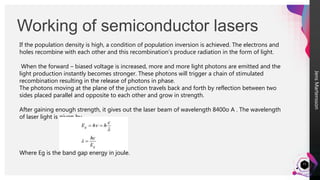
If the population density is high, a condition of population inversion is achieved. The electrons and
holes recombine with each other and this recombination’s produce radiation in the form of light.
When the forward – biased voltage is increased, more and more light photons are emitted and the
light production instantly becomes stronger. These photons will trigger a chain of stimulated
recombination resulting in the release of photons in phase.
The photons moving at the plane of the junction travels back and forth by reflection between two
sides placed parallel and opposite to each other and grow in strength.
After gaining enough strength, it gives out the laser beam of wavelength 8400o A . The wavelength
of laser light is given by
Where Eg is the band gap energy in joule.
Caption lorem ipsum
Jens
Martensson
Advantages of
laser
• It has high information carrying
capacity and hence is used in
communication domain for
transmission of information.
• It is free from electro-magnetic
interference. This phenomenon is
used in optical wireless
communication through free space
for telecommunication as well as
computer networking.
• It has very minimum signal leakage.
17
Jens
Martensson
Advantages
• Laser based fiber optic cables are very light
in weight and hence are used in fiber optic
communication system.
• It is less damaging compare to X-rays and
hence widely used in medical field for
treatment of cancers. It is used to burn small
tumors on eye surface and also on tissue
surface.
• Single laser beam can be focused in areas
smaller than 1 micro diameter. Due to this
fact, laser is being used in laser CDs and
DVDs for data storage in the form of audio,
video, documents etc. 18
Jens
Martensson
Disadvantages
of laser
• It is expensive and hence more
expenditure to the patients requiring
laser based treatments.
• Laser beam is very delicate to handle
in cutting process. The slight mistake
in adjusting distance and
temperature may lead to burning or
discoloring of the metals. Moreover it
requires higher power during the
cutting process.
• Poor Effiencicy.
19
Jens
Martensson
Disadvantages
• It is harmful to human beings and often
burns them during contacts.
• It is costly to maintain.
• Some of the lasers requires expensive Optics
to be effective.
• High power lasers requires active cooling to
stay under operating temperature.
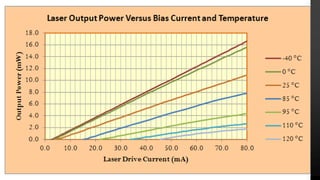
• Efficiency greatly reduces with increase in
temperature. 20
Jens
Martensson
Application of lasers
21
• It is widely used in fiber optic communication
• Lasers can be used studying objects ranging from nanometer scale, via micro- or macroscopic
size, even towards galaxies and the universe.
• Used in read write heads in CD/DVD writers
Jens
Martensson
Applications
22
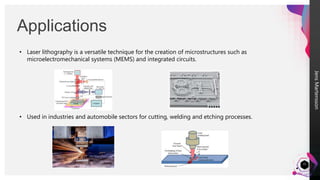
• Laser lithography is a versatile technique for the creation of microstructures such as
microelectromechanical systems (MEMS) and integrated circuits.
• Used in industries and automobile sectors for cutting, welding and etching processes.
Jens
Martensson
Applications
23
• Lasers are used in some of the most accurate clocks in the world by cooling the atoms to near
absolute zero temperature by slowing them with lasers and probing them in atomic fountains in
a microwave-filled cavity.
• The Laser Interferometer Gravitational-Wave Observatory (LIGO) detected the first gravitational
waves
Jens
Martensson
• Device Size and Energy-Efficiency Challenge
The sizes of photonic devices are generally limited by the wavelengths involved. Thus, it
becomes an important challenge to overcome wavelength limits or diffraction limits. The
important questions to ask are whether, how, and to what degree we can break the
diffraction limit to create ever smaller and better optoelectronic devices such as lasers.
• Wavelength or Bandgap Diversity Challenge
All semiconductor photonic devices, including lasers, are based on light–semiconductor interaction
involving either absorption or emission of photons by semiconductors. Important spectral response
(emission, refraction, or absorption) of any semiconductor is ultimately determined by its electronic
bandgap and band structure. Many applications require (or can significantly benefit from) bandgaps
that can be controllably tuned in a wide range, allowing bandgap diversity or flexibility, preferably on
a single substrate or monolithically.2 However, our ability to achieve the required diversity of
bandgap is rather limited, primarily because of the lattice-matching required in typical planar epitaxial
growth of high-quality semiconductors.
Challenges in semiconductor lasers
24
Jens
Martensson
• Integration Challenge
A well-recognized long-term challenge is the achievement of integrated photonics on a
silicon platform. While most passive devices can be fabricated directly on an Si platform,
light sources are still almost exclusively made of III-V materials. Thus, heterogeneous
integration of III-V-based lasers, or gain materials onto Si-waveguides, has become a
prevailing approach
• Miniaturization of Semiconductor Lasers
They are best suited for applications involving on-chip or onboard integration because of their
compact sizes and energy efficiency, and the possibility of operation under the convenient electrical
bias. Such intrinsic advantages are, however, not sufficient to meet the much more stringent
requirements of future optoelectronic-integrated chips. For these and many other reasons, constant
size reduction has been one of the most recognizable features in the development of optoelectronics
via constant inventions of paradigms of laser cavities over the past five decades.
Challenges in semiconductor lasers
25
Jens
Martensson
Laser is recognized as one of the top technological achievements of 20th century and
there are few areas in technology that are not influenced by it. It plays an important
role in, medicine, industry, and entertainment has resulted in fiber-optic
communication, CDs, CD-ROMs, and DVDs. Without lasers there would be no
supermarket bar code readers, certain life-saving cancer treatments, or precise
navigation techniques for commercial aircraft. Laser is acronym of Light Amplification
by Stimulated Emission of Radiation. Laser is a source of light but it is different from
other light sources. Laser makes a high intensity and extremely directional beam which
has a narrow frequency range. Lasers are more used as a strong electromagnetic beam
than a light beam.
Conclusion
26
Thank
You
By –
• Saurav Kumar (2028213)
• Saswat Mohanty (2028210)
• Ayush Raj (2028209)
• Dayaan Bashir (2028207)
• Atul Sambyal (202806)

Lasers

  • 1.
    Lasers “Laser" is anacronym for "light amplification by stimulated emission of radiation"
  • 2.
    Jens Martensson What is a laser? Alaser is a device that emits light through a process of optical amplification based on the stimulated emission of electromagnetic radiation. In other words a laser, is device that stimulates atoms or molecules to emit light at particular wavelengths and amplifies that light, typically producing a very narrow beam of radiation. 2
  • 3.
    Jens Martensson 3 Laser v/s normallight • Laser beam is perfectly mono- chromatic. • Intensity of laser light is very high due to very less spreading tendancy. • Highly coherent in nature. • The divergence or angular spread of laser beam is emtremely small. Ordinary light • It is strictly non monochromatic. • Intensity is very less due to spreading. • It is incoherent light. • The ordinary light spread out hence it is highly divergent. Laser
  • 4.
    Jens Martensson Types of laser’s Basedon their gain medium, lasers are classified into five main types: • Gas Lasers • Solid-State Lasers • Fiber Lasers • Liquid Lasers (Dye Lasers) • Semiconductor Lasers (Laser Diodes) 4
  • 5.
    Jens Martensson Working Principle of a Lasers Alaser consists of three fundamental elements: • an amplifying or gain medium (this can be a solid, a liquid or a gas). • a system to excite the amplifying medium (also called a pumping system). • optical resonator 5
  • 6.
    Jens Martensson Amplifying or gainmedium 6 The physical principle involved is called stimulated emission which is the process by which an incoming photon of a specific frequency can interact with an excited atomic electron (or other excited molecular state), causing it to drop to a lower energy level. The liberated energy transfers to the electromagnetic field, creating a new photon with a frequency, polarization, and direction of travel that are all identical to the photons of the incident wave.
  • 7.
    Jens Martensson Exciting the amplifyingmedium 7 This creates the conditions for light amplification by supplying the necessary energy. There are different kinds of pumping system: optical (the sun, flash lamps, continuous arc lamps or tungsten-filament lamps, diode or other lasers), electrical (gas discharge tubes, electric current in semi-conductors) or even chemical.
  • 8.
    Jens Martensson Optical resonator 8 Optical resonatoris an arrangement of mirrors that forms a standing wave cavity resonator for light waves. The laser radiation is reflected back and forth within the optical resonator with partial waves from individual passes overlapping each other. When the wavelength of the radiation field is a multiple of twice the distance between the mirrors, the partial waves overlap constructively, otherwise they overlap destructively. This leads to a wavelength selection - the resonator thus restricts both the direction of propagation and the frequency of the laser light.
  • 9.
    Jens Martensson Laser Classifications 9 • ClassI - These lasers cannot emit laser radiation at known hazard levels. • Class I.A. - This is a special designation that applies only to lasers that are "not intended for viewing," such as a supermarket laser scanner. The upper power limit of Class I.A. is 4.0 mW. • Class II - These are low-power visible lasers that emit above Class I levels but at a radiant power not above 1 mW. The concept is that the human aversion reaction to bright light will protect a person. • Class IIIA - These are intermediate-power lasers (cw: 1-5 mW), which are hazardous only for intrabeam viewing. Most pen-like pointing lasers are in this class. • Class IIIB - These are moderate-power lasers. • Class IV - These are high-power lasers (cw: 500 mW, pulsed: 10 J/cm2 or the diffuse reflection limit), which are hazardous to view under any condition (directly or diffusely scattered), and are a potential fire hazard and a skin hazard. Significant controls are required of Class IV laser facilities.
  • 10.
    Jens Martensson 10 Materials Used for Lasers Commonmaterials used for different types of laser • Solid-state lasers - ruby or neodymium:yttrium-aluminum garnet "Yag“. • Gas lasers - helium and helium-neon, HeNe, are the most common gas lasers. • Excimer lasers use reactive gases, such as chlorine and fluorine, mixed with inert gases such as argon, krypton or xenon.
  • 11.
    Jens Martensson Materials Used forLasers 11 Dye lasers use complex organic dyes, such as rhodamine (orange, 540–680 nm), fluorescein (green, 530–560 nm), coumarin (blue 490–620 nm), stilbene (violet 410–480 nm), umbelliferone (blue, 450– 470 nm), tetracene, malachite green etc. Semiconductor lasers - Gallium arsenide, indium phosphide, gallium antimonide, and gallium nitride
  • 12.
    Jens Martensson Material properties requiredfor semiconductor laser 12 The optical emission from semiconductor lasers arises from the radiative recombination of charge carrier pairs, i.e., electrons and holes in the active area of the device. The conduction-band electron fills the valence-band hole by simultaneously transferring the energy difference to the light field, so- called radiative recombination. Hence, the frequency of the laser light is mainly determined by the bandgap of the semiconductor laser material. In order to achieve lasing, one needs carrier inversion, i.e., sufficiently many electrons in the conduction band such that the light absorption probability is more than compensated by the probability of emission. A large variety of semiconductor materials has been shown to be suited for semiconductor lasers. The most stringent requirement for the material is that it has a direct bandgap. With other words, the maximum of the valence band and the minimum of the conduction band have to be at the same position in k-space (in the center of the Brillouin zone). This condition excludes the elemental semiconductors Silicon and Germanium from being used for semiconductor lasers.
  • 13.
    Jens Martensson Structure of asemiconductor laser 13 A semiconductor laser is basically a p-i-n diode. A p-i-n junction is formed by bringing a p-type and an n-type semiconductors into contact with each other with an intrinsic active layer between them. In order to achieve carrier inversion, it is necessary to pump the semiconductor laser, i.e., to excite sufficiently many electrons from the valence band into the conduction band. Structurally different types are as follows: (i) Broad-Area Lasers, (ii) Gain-Guided Lasers, (iii) Weekly Index-Guided Lasers, (iv) Strongly Index-Guided Lasers.
  • 14.
    Jens Martensson Working of semiconductorlasers 14 When a p-n junction diode is forward biased, the electrons from n – region and the holes from the p- region cross the junction and recombine with each other. During the recombination process, the light radiation (photons) is released from a certain specified direct band gap semiconductors like Ga-As. This light radiation is known as recombination radiation. The photon emitted during recombination stimulates other electrons and holes to recombine. As a result, stimulated emission takes place which produces laser.
  • 15.
    Jens Martensson Working of semiconductorlasers 15 If the population density is high, a condition of population inversion is achieved. The electrons and holes recombine with each other and this recombination’s produce radiation in the form of light. When the forward – biased voltage is increased, more and more light photons are emitted and the light production instantly becomes stronger. These photons will trigger a chain of stimulated recombination resulting in the release of photons in phase. The photons moving at the plane of the junction travels back and forth by reflection between two sides placed parallel and opposite to each other and grow in strength. After gaining enough strength, it gives out the laser beam of wavelength 8400o A . The wavelength of laser light is given by Where Eg is the band gap energy in joule.
  • 16.
  • 17.
    Jens Martensson Advantages of laser • Ithas high information carrying capacity and hence is used in communication domain for transmission of information. • It is free from electro-magnetic interference. This phenomenon is used in optical wireless communication through free space for telecommunication as well as computer networking. • It has very minimum signal leakage. 17
  • 18.
    Jens Martensson Advantages • Laser basedfiber optic cables are very light in weight and hence are used in fiber optic communication system. • It is less damaging compare to X-rays and hence widely used in medical field for treatment of cancers. It is used to burn small tumors on eye surface and also on tissue surface. • Single laser beam can be focused in areas smaller than 1 micro diameter. Due to this fact, laser is being used in laser CDs and DVDs for data storage in the form of audio, video, documents etc. 18
  • 19.
    Jens Martensson Disadvantages of laser • Itis expensive and hence more expenditure to the patients requiring laser based treatments. • Laser beam is very delicate to handle in cutting process. The slight mistake in adjusting distance and temperature may lead to burning or discoloring of the metals. Moreover it requires higher power during the cutting process. • Poor Effiencicy. 19
  • 20.
    Jens Martensson Disadvantages • It isharmful to human beings and often burns them during contacts. • It is costly to maintain. • Some of the lasers requires expensive Optics to be effective. • High power lasers requires active cooling to stay under operating temperature. • Efficiency greatly reduces with increase in temperature. 20
  • 21.
    Jens Martensson Application of lasers 21 •It is widely used in fiber optic communication • Lasers can be used studying objects ranging from nanometer scale, via micro- or macroscopic size, even towards galaxies and the universe. • Used in read write heads in CD/DVD writers
  • 22.
    Jens Martensson Applications 22 • Laser lithographyis a versatile technique for the creation of microstructures such as microelectromechanical systems (MEMS) and integrated circuits. • Used in industries and automobile sectors for cutting, welding and etching processes.
  • 23.
    Jens Martensson Applications 23 • Lasers areused in some of the most accurate clocks in the world by cooling the atoms to near absolute zero temperature by slowing them with lasers and probing them in atomic fountains in a microwave-filled cavity. • The Laser Interferometer Gravitational-Wave Observatory (LIGO) detected the first gravitational waves
  • 24.
    Jens Martensson • Device Sizeand Energy-Efficiency Challenge The sizes of photonic devices are generally limited by the wavelengths involved. Thus, it becomes an important challenge to overcome wavelength limits or diffraction limits. The important questions to ask are whether, how, and to what degree we can break the diffraction limit to create ever smaller and better optoelectronic devices such as lasers. • Wavelength or Bandgap Diversity Challenge All semiconductor photonic devices, including lasers, are based on light–semiconductor interaction involving either absorption or emission of photons by semiconductors. Important spectral response (emission, refraction, or absorption) of any semiconductor is ultimately determined by its electronic bandgap and band structure. Many applications require (or can significantly benefit from) bandgaps that can be controllably tuned in a wide range, allowing bandgap diversity or flexibility, preferably on a single substrate or monolithically.2 However, our ability to achieve the required diversity of bandgap is rather limited, primarily because of the lattice-matching required in typical planar epitaxial growth of high-quality semiconductors. Challenges in semiconductor lasers 24
  • 25.
    Jens Martensson • Integration Challenge Awell-recognized long-term challenge is the achievement of integrated photonics on a silicon platform. While most passive devices can be fabricated directly on an Si platform, light sources are still almost exclusively made of III-V materials. Thus, heterogeneous integration of III-V-based lasers, or gain materials onto Si-waveguides, has become a prevailing approach • Miniaturization of Semiconductor Lasers They are best suited for applications involving on-chip or onboard integration because of their compact sizes and energy efficiency, and the possibility of operation under the convenient electrical bias. Such intrinsic advantages are, however, not sufficient to meet the much more stringent requirements of future optoelectronic-integrated chips. For these and many other reasons, constant size reduction has been one of the most recognizable features in the development of optoelectronics via constant inventions of paradigms of laser cavities over the past five decades. Challenges in semiconductor lasers 25
  • 26.
    Jens Martensson Laser is recognizedas one of the top technological achievements of 20th century and there are few areas in technology that are not influenced by it. It plays an important role in, medicine, industry, and entertainment has resulted in fiber-optic communication, CDs, CD-ROMs, and DVDs. Without lasers there would be no supermarket bar code readers, certain life-saving cancer treatments, or precise navigation techniques for commercial aircraft. Laser is acronym of Light Amplification by Stimulated Emission of Radiation. Laser is a source of light but it is different from other light sources. Laser makes a high intensity and extremely directional beam which has a narrow frequency range. Lasers are more used as a strong electromagnetic beam than a light beam. Conclusion 26
  • 27.
    Thank You By – • SauravKumar (2028213) • Saswat Mohanty (2028210) • Ayush Raj (2028209) • Dayaan Bashir (2028207) • Atul Sambyal (202806)