Launch: 9/16 4.  How does atomic number vary throughout the periodic table? a. it is fixed and does not change as you move across the periodic table b. it decreases from left to right, and from top to bottom c. it increases from left to right, and from top to bottom d. it increases from right to left, and from top to bottom 1.  All atoms of an element have a. the same number of protons. b. the same number of neutrons. c. the same number of electrons. d. neither mass nor volume.
What is atomic mass? Mr. Heffner Chemistry 9/15/09
What is an element? All atoms in a specific element have the same atomic number Atomic number = # of protons The periodic table is organized by increasing atomic number
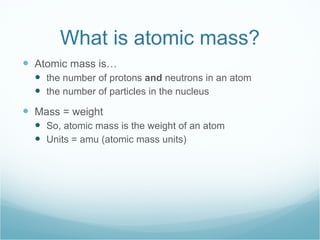
What is atomic mass? Atomic mass is… the number of protons  and  neutrons in an atom the number of particles in the nucleus Mass = weight So, atomic mass is the weight of an atom Units = amu (atomic mass units)
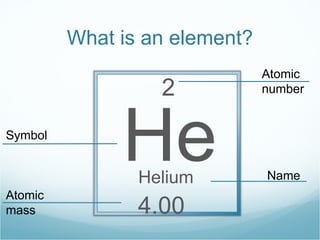
What is an element? Atomic number Symbol Name Atomic mass 4.00 2 He Helium
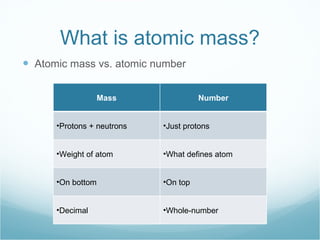
What is atomic mass? Atomic mass vs. atomic number  Mass Number Protons + neutrons Just protons Weight of atom What defines atom On bottom On top Decimal Whole-number
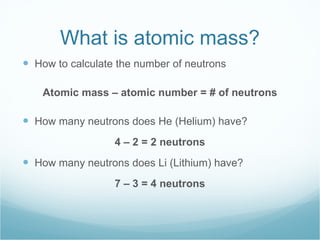
What is atomic mass? How to calculate the number of neutrons Atomic mass – atomic number = # of neutrons How many neutrons does He (Helium) have? 4 – 2 = 2 neutrons How many neutrons does Li (Lithium) have?   7 – 3 = 4 neutrons
Summary Atomic mass is the number of protons and neutrons in an atom Atomic mass – atomic number = # of neutrons
Foldable Fold in half 3X, then unwrap and fold in windows Cut with scissors  3 hole-punch Terms: only 2! Atomic mass Neutron (charge, mass, location) Quiz yourself when finished
Practice Questions Answer the following in complete sentences: What is atomic mass? How is atomic mass different from atomic number? Draw and label the representation of C (Carbon) including atomic mass. How many neutrons do the atoms of the following elements have? N (Nitrogen) Mg (Magnesium) Au (Gold)
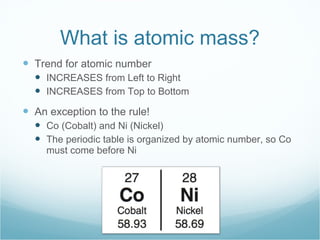
What is atomic mass? Trend for atomic number INCREASES from Left to Right INCREASES from Top to Bottom An exception to the rule! Co (Cobalt) and Ni (Nickel) The periodic table is organized by atomic number, so Co must come before Ni
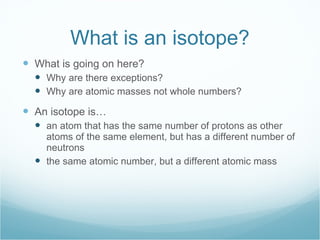
What is an isotope? What is going on here? Why are there exceptions? Why are atomic masses not whole numbers? An isotope is… an atom that has the same number of protons as other atoms of the same element, but has a different number of neutrons the same atomic number, but a different atomic mass
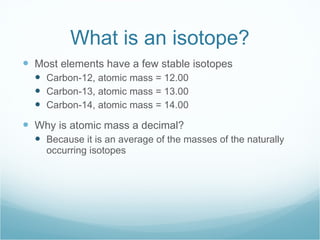
What is an isotope? Most elements have a few stable isotopes Carbon-12, atomic mass = 12.00 Carbon-13, atomic mass = 13.00 Carbon-14, atomic mass = 14.00 Why is atomic mass a decimal? Because it is an average of the masses of the naturally occurring isotopes
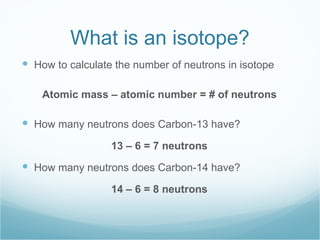
What is an isotope? How to calculate the number of neutrons in isotope Atomic mass – atomic number = # of neutrons How many neutrons does Carbon-13 have? 13 – 6 = 7 neutrons How many neutrons does Carbon-14 have?   14 – 6 = 8 neutrons
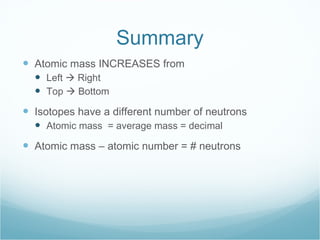
Summary Atomic mass INCREASES from Left    Right Top    Bottom Isotopes have a different number of neutrons Atomic mass  = average mass = decimal Atomic mass – atomic number = # neutrons
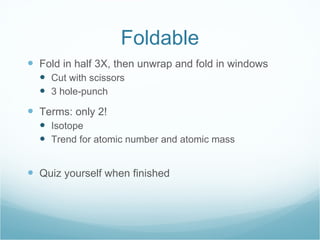
Foldable Fold in half 3X, then unwrap and fold in windows Cut with scissors  3 hole-punch Terms: only 2! Isotope Trend for atomic number and atomic mass Quiz yourself when finished
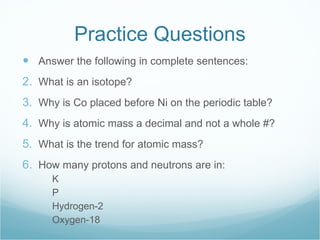
Practice Questions Answer the following in complete sentences: What is an isotope? Why is Co placed before Ni on the periodic table? Why is atomic mass a decimal and not a whole #? What is the trend for atomic mass? How many protons and neutrons are in: K P Hydrogen-2 Oxygen-18
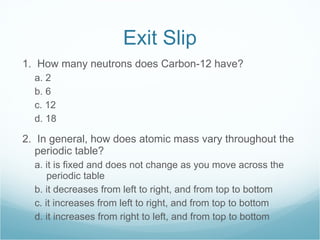
Exit Slip 1.  How many neutrons does Carbon-12 have? a. 2 b. 6 c. 12 d. 18 2.  In general, how does atomic mass vary throughout the periodic table? a. it is fixed and does not change as you move across the periodic table b. it decreases from left to right, and from top to bottom c. it increases from left to right, and from top to bottom d. it increases from right to left, and from top to bottom
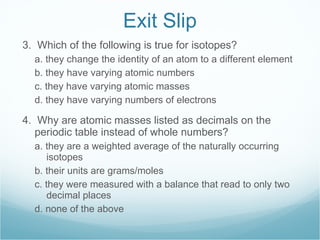
Exit Slip 3.  Which of the following is true for isotopes? a. they change the identity of an atom to a different element b. they have varying atomic numbers c. they have varying atomic masses d. they have varying numbers of electrons 4.  Why are atomic masses listed as decimals on the periodic table instead of whole numbers? a. they are a weighted average of the naturally occurring isotopes b. their units are grams/moles c. they were measured with a balance that read to only two decimal places d. none of the above
Exit Slip 5.  On the periodic table, why is Co (Cobalt) placed before Ni (Nickel) even though Ni has a higher atomic mass? a. Nickel has one more proton b. Cobalt has fewer electrons c. Nickel has a few more electrons d. Cobalt has a lower density
Homework Finish Practice Questions Finish Foldable Textbook: Pg. 86 Practice: #1, 2, 4 Pg. 89 Section Review: #2, 4, 6, 8

What is Atomic Mass?

  • 1.
    Launch: 9/16 4. How does atomic number vary throughout the periodic table? a. it is fixed and does not change as you move across the periodic table b. it decreases from left to right, and from top to bottom c. it increases from left to right, and from top to bottom d. it increases from right to left, and from top to bottom 1. All atoms of an element have a. the same number of protons. b. the same number of neutrons. c. the same number of electrons. d. neither mass nor volume.
  • 2.
    What is atomicmass? Mr. Heffner Chemistry 9/15/09
  • 3.
    What is anelement? All atoms in a specific element have the same atomic number Atomic number = # of protons The periodic table is organized by increasing atomic number
  • 4.
    What is atomicmass? Atomic mass is… the number of protons and neutrons in an atom the number of particles in the nucleus Mass = weight So, atomic mass is the weight of an atom Units = amu (atomic mass units)
  • 5.
    What is anelement? Atomic number Symbol Name Atomic mass 4.00 2 He Helium
  • 6.
    What is atomicmass? Atomic mass vs. atomic number Mass Number Protons + neutrons Just protons Weight of atom What defines atom On bottom On top Decimal Whole-number
  • 7.
    What is atomicmass? How to calculate the number of neutrons Atomic mass – atomic number = # of neutrons How many neutrons does He (Helium) have? 4 – 2 = 2 neutrons How many neutrons does Li (Lithium) have? 7 – 3 = 4 neutrons
  • 8.
    Summary Atomic massis the number of protons and neutrons in an atom Atomic mass – atomic number = # of neutrons
  • 9.
    Foldable Fold inhalf 3X, then unwrap and fold in windows Cut with scissors 3 hole-punch Terms: only 2! Atomic mass Neutron (charge, mass, location) Quiz yourself when finished
  • 10.
    Practice Questions Answerthe following in complete sentences: What is atomic mass? How is atomic mass different from atomic number? Draw and label the representation of C (Carbon) including atomic mass. How many neutrons do the atoms of the following elements have? N (Nitrogen) Mg (Magnesium) Au (Gold)
  • 11.
    What is atomicmass? Trend for atomic number INCREASES from Left to Right INCREASES from Top to Bottom An exception to the rule! Co (Cobalt) and Ni (Nickel) The periodic table is organized by atomic number, so Co must come before Ni
  • 12.
    What is anisotope? What is going on here? Why are there exceptions? Why are atomic masses not whole numbers? An isotope is… an atom that has the same number of protons as other atoms of the same element, but has a different number of neutrons the same atomic number, but a different atomic mass
  • 13.
    What is anisotope? Most elements have a few stable isotopes Carbon-12, atomic mass = 12.00 Carbon-13, atomic mass = 13.00 Carbon-14, atomic mass = 14.00 Why is atomic mass a decimal? Because it is an average of the masses of the naturally occurring isotopes
  • 14.
    What is anisotope? How to calculate the number of neutrons in isotope Atomic mass – atomic number = # of neutrons How many neutrons does Carbon-13 have? 13 – 6 = 7 neutrons How many neutrons does Carbon-14 have? 14 – 6 = 8 neutrons
  • 15.
    Summary Atomic massINCREASES from Left  Right Top  Bottom Isotopes have a different number of neutrons Atomic mass = average mass = decimal Atomic mass – atomic number = # neutrons
  • 16.
    Foldable Fold inhalf 3X, then unwrap and fold in windows Cut with scissors 3 hole-punch Terms: only 2! Isotope Trend for atomic number and atomic mass Quiz yourself when finished
  • 17.
    Practice Questions Answerthe following in complete sentences: What is an isotope? Why is Co placed before Ni on the periodic table? Why is atomic mass a decimal and not a whole #? What is the trend for atomic mass? How many protons and neutrons are in: K P Hydrogen-2 Oxygen-18
  • 18.
    Exit Slip 1. How many neutrons does Carbon-12 have? a. 2 b. 6 c. 12 d. 18 2. In general, how does atomic mass vary throughout the periodic table? a. it is fixed and does not change as you move across the periodic table b. it decreases from left to right, and from top to bottom c. it increases from left to right, and from top to bottom d. it increases from right to left, and from top to bottom
  • 19.
    Exit Slip 3. Which of the following is true for isotopes? a. they change the identity of an atom to a different element b. they have varying atomic numbers c. they have varying atomic masses d. they have varying numbers of electrons 4. Why are atomic masses listed as decimals on the periodic table instead of whole numbers? a. they are a weighted average of the naturally occurring isotopes b. their units are grams/moles c. they were measured with a balance that read to only two decimal places d. none of the above
  • 20.
    Exit Slip 5. On the periodic table, why is Co (Cobalt) placed before Ni (Nickel) even though Ni has a higher atomic mass? a. Nickel has one more proton b. Cobalt has fewer electrons c. Nickel has a few more electrons d. Cobalt has a lower density
  • 21.
    Homework Finish PracticeQuestions Finish Foldable Textbook: Pg. 86 Practice: #1, 2, 4 Pg. 89 Section Review: #2, 4, 6, 8