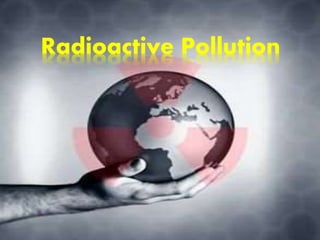

Radioactive Pollution
• Addition of radiation to environment by using radioactive
elements .
What is Radioactive Pollution?
•Radioactive pollution, like any other
kind of pollution, is the release of
something unwanted into the
environment and, in this case, the
unwanted thing is radioactive material.
• Radioactive contamination, also called radiological
contamination, is the deposition of, or presence
of radioactive substances on surfaces or within solids, liquids or
gases (including the human body), where their presence is
unintended or undesirable.
• Such contamination presents a hazard because of the radioactive
decay of the contaminants, which emit harmful ionising radiation such
as alpha or beta particles, gamma rays or neutrons. The degree of
hazard is determined by the concentration of the contaminants, the
energy of the radiation being emitted, the type of radiation, and the
proximity of the contamination to organs of the body. It is important to
be clear that the contamination gives rise to the radiation hazard, and
the terms "radiation" and "contamination" are not interchangeable.
• Contamination may affect a person, a place, an animal, or an object
such as clothing.
• There are many causes of radioactive pollution. The causes are,
as you may have guessed, radioactive substances or, more
accurately, radioactive waste but only when improperly disposed
of. If radioactive waste is disposed of in the appropriate manner
then it does not contribute towards radioactive pollution. The
causes are as follows:
1. Production of nuclear weapons
2. Decommissioning of nuclear weapons
3. Mining of radioactive ore (uranium, phosphate etc.)
4. Coal ash
5. Medical waste
6. Nuclear power plants
Causes
• Radioactive materials used in this production have
high health risks and release a small amount of
pollution. Thanks to good current health-standards this
release is not significant and is not a danger to us
unless an accident occurs.
Production of nuclear weapons
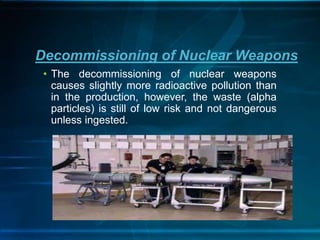
• The decommissioning of nuclear weapons
causes slightly more radioactive pollution than
in the production, however, the waste (alpha
particles) is still of low risk and not dangerous
unless ingested.
Decommissioning of Nuclear Weapons
• Mining these involves crushing
and processing of the radioactive
ores and this generates
radioactive waste which emits
alpha particles. This waste is of
low risk unless ingested.
Mining of radioactive ore
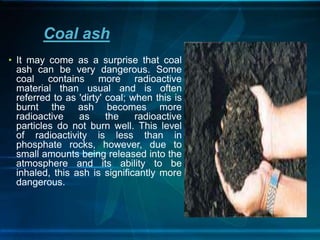
• It may come as a surprise that coal
ash can be very dangerous. Some
coal contains more radioactive
material than usual and is often
referred to as 'dirty' coal; when this is
burnt the ash becomes more
radioactive as the radioactive
particles do not burn well. This level
of radioactivity is less than in
phosphate rocks, however, due to
small amounts being released into the
atmosphere and its ability to be
inhaled, this ash is significantly more
dangerous.
Coal ash
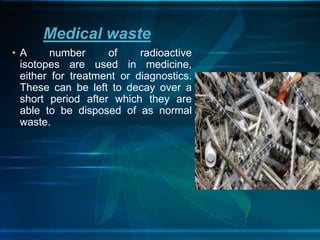
• A number of radioactive
isotopes are used in medicine,
either for treatment or diagnostics.
These can be left to decay over a
short period after which they are
able to be disposed of as normal
waste.
Medical waste
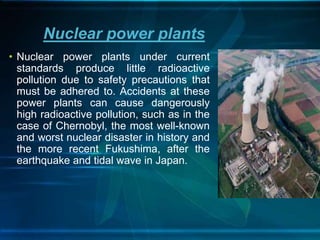
• Nuclear power plants under current
standards produce little radioactive
pollution due to safety precautions that
must be adhered to. Accidents at these
power plants can cause dangerously
high radioactive pollution, such as in the
case of Chernobyl, the most well-known
and worst nuclear disaster in history and
the more recent Fukushima, after the
earthquake and tidal wave in Japan.
Nuclear power plants
• Continuous Pollution: This type of condition
exists in uranium mines, nuclear reactors, test
labs etc. where the humans are under continuous
exposure to radioactive contaminants and
protective clothing is required to avoid radiation
exposure.
• Accidental Pollution: This type of condition
exists during accidental exposure to radiations by
virtue of equipment failure, radiation leak, faulty
protective equipment etc.
• Occasional Pollution: This condition exists
during isolated experiment or test of nuclear
substance.
Type of pollution
•
.► The impact of radioactive pollution on human
beings can vary from mild to fatal; the
magnitude of the adverse effects largely
depends on the level and duration of
exposure to radioactivity. Low levels of
localized exposure may only have a superficial
effect and cause mild skin irritation.
• ► Long-term exposure or exposure to high
amounts of radiation can have far more serious
health effects. Radioactive rays can cause
irreparable damage to DNA molecules and can
lead to a life-threatening condition.
Effects On Human Beings
• The rapidly growing/dividing cells, like those of the skin, bone
marrow, are more sensitive towards radioactive emissions.
On the other hand, cells that do not undergo rapid cell division,
such as bone cells and nervous cells, aren't damaged so easily.
Skin cancer, lung cancer and thyroid cancer are some of the
common types of cancers caused by radiation effect.
• I) Nuclear devices should be exploded under ground.
•
(II) Contaminants may be employed to decrease the
radioactive emissions.
•
(III) Production of radio isotopes should be minimised.
•
(IV) Extreme care should be exercised in the disposal of
industrial wastes contained with radionuclide's.
•
(V) Use of high chimney and ventilations at the working
place where radioactive contamination is high.
Prevention
• (VI) In nuclear reactors, closed cycle coolant system with
gaseous coolants of very high purity may be used to
prevent extraneous activation products.
• (VII) Fission reactions should be minimised.
• (VIII) In nuclear mines, wet drilling may be employed
along with underground drainage.
• (IX) Nuclear medicines and radiation therapy should be
applied when absolutely necessary and earth minimum
doses
END

Radioactive Pollution

  • 1.
  • 2.
    • Addition ofradiation to environment by using radioactive elements . What is Radioactive Pollution?
  • 3.
    •Radioactive pollution, likeany other kind of pollution, is the release of something unwanted into the environment and, in this case, the unwanted thing is radioactive material.
  • 4.
    • Radioactive contamination,also called radiological contamination, is the deposition of, or presence of radioactive substances on surfaces or within solids, liquids or gases (including the human body), where their presence is unintended or undesirable. • Such contamination presents a hazard because of the radioactive decay of the contaminants, which emit harmful ionising radiation such as alpha or beta particles, gamma rays or neutrons. The degree of hazard is determined by the concentration of the contaminants, the energy of the radiation being emitted, the type of radiation, and the proximity of the contamination to organs of the body. It is important to be clear that the contamination gives rise to the radiation hazard, and the terms "radiation" and "contamination" are not interchangeable. • Contamination may affect a person, a place, an animal, or an object such as clothing.
  • 5.
    • There aremany causes of radioactive pollution. The causes are, as you may have guessed, radioactive substances or, more accurately, radioactive waste but only when improperly disposed of. If radioactive waste is disposed of in the appropriate manner then it does not contribute towards radioactive pollution. The causes are as follows: 1. Production of nuclear weapons 2. Decommissioning of nuclear weapons 3. Mining of radioactive ore (uranium, phosphate etc.) 4. Coal ash 5. Medical waste 6. Nuclear power plants Causes
  • 6.
    • Radioactive materialsused in this production have high health risks and release a small amount of pollution. Thanks to good current health-standards this release is not significant and is not a danger to us unless an accident occurs. Production of nuclear weapons
  • 7.
    • The decommissioningof nuclear weapons causes slightly more radioactive pollution than in the production, however, the waste (alpha particles) is still of low risk and not dangerous unless ingested. Decommissioning of Nuclear Weapons
  • 8.
    • Mining theseinvolves crushing and processing of the radioactive ores and this generates radioactive waste which emits alpha particles. This waste is of low risk unless ingested. Mining of radioactive ore
  • 9.
    • It maycome as a surprise that coal ash can be very dangerous. Some coal contains more radioactive material than usual and is often referred to as 'dirty' coal; when this is burnt the ash becomes more radioactive as the radioactive particles do not burn well. This level of radioactivity is less than in phosphate rocks, however, due to small amounts being released into the atmosphere and its ability to be inhaled, this ash is significantly more dangerous. Coal ash
  • 10.
    • A numberof radioactive isotopes are used in medicine, either for treatment or diagnostics. These can be left to decay over a short period after which they are able to be disposed of as normal waste. Medical waste
  • 11.
    • Nuclear powerplants under current standards produce little radioactive pollution due to safety precautions that must be adhered to. Accidents at these power plants can cause dangerously high radioactive pollution, such as in the case of Chernobyl, the most well-known and worst nuclear disaster in history and the more recent Fukushima, after the earthquake and tidal wave in Japan. Nuclear power plants
  • 12.
    • Continuous Pollution:This type of condition exists in uranium mines, nuclear reactors, test labs etc. where the humans are under continuous exposure to radioactive contaminants and protective clothing is required to avoid radiation exposure. • Accidental Pollution: This type of condition exists during accidental exposure to radiations by virtue of equipment failure, radiation leak, faulty protective equipment etc. • Occasional Pollution: This condition exists during isolated experiment or test of nuclear substance. Type of pollution
  • 13.
    • .► The impactof radioactive pollution on human beings can vary from mild to fatal; the magnitude of the adverse effects largely depends on the level and duration of exposure to radioactivity. Low levels of localized exposure may only have a superficial effect and cause mild skin irritation. • ► Long-term exposure or exposure to high amounts of radiation can have far more serious health effects. Radioactive rays can cause irreparable damage to DNA molecules and can lead to a life-threatening condition. Effects On Human Beings
  • 14.
    • The rapidlygrowing/dividing cells, like those of the skin, bone marrow, are more sensitive towards radioactive emissions. On the other hand, cells that do not undergo rapid cell division, such as bone cells and nervous cells, aren't damaged so easily. Skin cancer, lung cancer and thyroid cancer are some of the common types of cancers caused by radiation effect.
  • 15.
    • I) Nucleardevices should be exploded under ground. • (II) Contaminants may be employed to decrease the radioactive emissions. • (III) Production of radio isotopes should be minimised. • (IV) Extreme care should be exercised in the disposal of industrial wastes contained with radionuclide's. • (V) Use of high chimney and ventilations at the working place where radioactive contamination is high. Prevention
  • 16.
    • (VI) Innuclear reactors, closed cycle coolant system with gaseous coolants of very high purity may be used to prevent extraneous activation products. • (VII) Fission reactions should be minimised. • (VIII) In nuclear mines, wet drilling may be employed along with underground drainage. • (IX) Nuclear medicines and radiation therapy should be applied when absolutely necessary and earth minimum doses
  • 17.