RADIOACTIVE
POLLUTION
PREPARED BY,
NAVEENAGIRISH
STUDENTOF CENTRAL UNIVERSITYOF KERALA
KASARAGOD
? ? ?
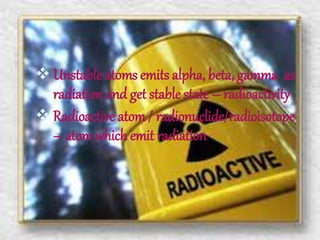
 Unstable atoms emits alpha, beta, gamma as
radiation and get stable state – radioactivity
 Radioactive atom/ radionuclide/radioisotope
– atom which emit radiation
 Radioactive pollution can be defined as the
emission of high energy particles or
radioactive substance into air, water or land
due to human activities in the form of
radioactive waste.
 Radioactive waste is usually the product of a
nuclear process such as nuclear fission, which
is extensively used in nuclear reactors,
nuclear weapons and other nuclear fuel-
cycles the product of a nuclear process
Sources of radioactive
contaminants:
 Production of nuclear fuel
 Nuclear power reactors
 Nuclear tests carried out by Defense
Personnel
 Disposal of nuclear waste
 Uranium Mining
Frequency and Duration of
Radioactive Pollution:
 Continuous pollution:This type of condition exists in
uranium mines, nuclear reactors, test labs etc. where the
humans are under continuous exposure to radioactive
contaminants and protective clothing is required to avoid
radiation exposure.
 Accidental Pollution:This type of condition exists during
accidental exposure to radiations by virtue of equipment
failure, radiation leak, faulty protective equipment etc.
 Occasional Pollution:This condition exists during
isolated experiment or test of nuclear substance.
Radiation
Natural Artificial
Naturalradiation
 Natural - from the beginning of earth-we
are always exposed to it
 Cosmic rays will create +vely charged
particles and high energy photons -it
interact with normal atoms produce radio
nuclides
 It enter to earth
 Uranium 235,238,thorium232,radium
226,potassium 40 etc
 Alpha = helium nuclei 4he2 ,
it can stop by even paper
sheet
 Beta = electrons and
positrons, stopped by glass
wood etc
 Gama rays = high energy
photons, lead or concrete
Measurement SI unit
Becquerel
 1 Bq = 1 disintegration per second
 Half life – time period required to radioisotope
fall in to its half
 Absorbed dose ,D - energy absorbed by unit
mass of materiel , unit – gray
 Dose equivalent ,H – product of absorbed dose
and quality factor(relative biological
effectiveness) sievert is unit
 linear energy transfer = energy deposited unit
length of the track with respect to x – rays
(normalised to 1) – help to know damage
 Radioactive pollution that is spread
through the earth’s atmosphere is called
“Fallout”. The atmospheric nuclear
pollution become prominent during the
world war 2 period when United States,
Britain and Soviet Union started
conducting nuclear tests in the
atmosphere. The best example of fallout is
the nuclear bomb attack on Hiroshima and
Nagasaki, Japan in 1945 by United States
of America during world war 2.
 As a result of nuclear bomb attack, nearly
2,25,000 people had died as a result of
Hiroshima -atom bomb
Man made hazards
 X - ray diagnosis -90%
radiation
 Nuclear technology – nuclear
weapon manufacture, nuclear
fuel cycle
 Each process from mining to
management leads to hazards
 Nuclear reactor –electricity
Biologicaleffects
 Ionization of H2O –H2O2 PRODUCTION
 Cell damage , cell death ,DNA damage,
mutations
 Genes controlling cell division –
disturbed – cancer
 Skin ,gastro intestinal track lining –
speed damage and repair
Biological effect
genetic
Stochastic
gene mutations,
chromosomal
aberrations
Deterministic
Cancer
inducement
somatic
Deterministic
Cell damage
above threshold
level
Deterministic – high amount and
high damage ,e.g. eye lens cataract ,
organ damage
Stochastic (random) – minor damage
and repaired
hiroshima before little boy
Hiroshima after little boy
Fukushima and chernobyl
nuclear disasters
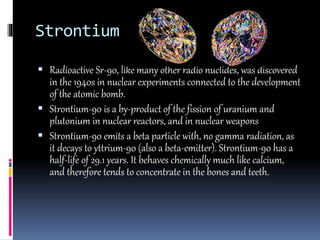
Strontium
 Radioactive Sr-90, like many other radio nuclides, was discovered
in the 1940s in nuclear experiments connected to the development
of the atomic bomb.
 Strontium-90 is a by-product of the fission of uranium and
plutonium in nuclear reactors, and in nuclear weapons
 Strontium-90 emits a beta particle with, no gamma radiation, as
it decays to yttrium-90 (also a beta-emitter). Strontium-90 has a
half-life of 29.1 years. It behaves chemically much like calcium,
and therefore tends to concentrate in the bones and teeth.
 The accident at the
Chernobyl nuclear power plant
also introduced a large
amount of Sr-90 into the
environment
 People may inhale trace
amounts of strontium-90 as a
contaminant in dust. But,
Health Effects of Strontium-
90
 Strontium-90 is chemically similar to
calcium, and tends to deposit in bone
and blood-forming tissue (bone marrow).
Thus, strontium-90 is referred to as a
"bone seeker." Internal exposure to Sr-
90 is linked to bone cancer, cancer of
the soft tissue near the bone, and
leukemia.
 Risk of cancer increases with increased
exposure to Sr-90. The risk depends on
the concentration of Sr-90 in the
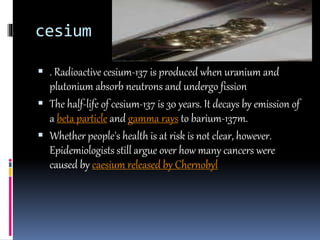
cesium
 . Radioactive cesium-137 is produced when uranium and
plutonium absorb neutrons and undergo fission
 The half-life of cesium-137 is 30 years. It decays by emission of
a beta particle and gamma rays to barium-137m.
 Whether people's health is at risk is not clear, however.
Epidemiologists still argue over how many cancers were
caused by caesium released by Chernobyl
uses
 Cesium-137 is one of the most common radioisotopes used in industry.
Thousands of devices use cesium-137:
 moisture-density gauges, widely used in the construction industry
 leveling gauges, used in industries to detect liquid flow in pipes and tanks
 thickness gauges, for measuring thickness of sheet metal, paper, film and
many other products
 well-logging devices in the drilling industry to help characterize rock strata
 Cesium-137 is also used in medical therapy to treat cancer
•10,50,100 m depth earth
• In boxes &Containers
•Closure &post closure
Waste disposal
THANK YOU

Radioactive pollution

  • 1.
  • 3.
  • 4.
     Unstable atomsemits alpha, beta, gamma as radiation and get stable state – radioactivity  Radioactive atom/ radionuclide/radioisotope – atom which emit radiation
  • 5.
     Radioactive pollutioncan be defined as the emission of high energy particles or radioactive substance into air, water or land due to human activities in the form of radioactive waste.  Radioactive waste is usually the product of a nuclear process such as nuclear fission, which is extensively used in nuclear reactors, nuclear weapons and other nuclear fuel- cycles the product of a nuclear process
  • 6.
    Sources of radioactive contaminants: Production of nuclear fuel  Nuclear power reactors  Nuclear tests carried out by Defense Personnel  Disposal of nuclear waste  Uranium Mining
  • 7.
    Frequency and Durationof Radioactive Pollution:  Continuous pollution:This type of condition exists in uranium mines, nuclear reactors, test labs etc. where the humans are under continuous exposure to radioactive contaminants and protective clothing is required to avoid radiation exposure.  Accidental Pollution:This type of condition exists during accidental exposure to radiations by virtue of equipment failure, radiation leak, faulty protective equipment etc.  Occasional Pollution:This condition exists during isolated experiment or test of nuclear substance.
  • 8.
  • 9.
    Naturalradiation  Natural -from the beginning of earth-we are always exposed to it  Cosmic rays will create +vely charged particles and high energy photons -it interact with normal atoms produce radio nuclides  It enter to earth  Uranium 235,238,thorium232,radium 226,potassium 40 etc
  • 10.
     Alpha =helium nuclei 4he2 , it can stop by even paper sheet  Beta = electrons and positrons, stopped by glass wood etc  Gama rays = high energy photons, lead or concrete
  • 11.
    Measurement SI unit Becquerel 1 Bq = 1 disintegration per second  Half life – time period required to radioisotope fall in to its half  Absorbed dose ,D - energy absorbed by unit mass of materiel , unit – gray  Dose equivalent ,H – product of absorbed dose and quality factor(relative biological effectiveness) sievert is unit  linear energy transfer = energy deposited unit length of the track with respect to x – rays (normalised to 1) – help to know damage
  • 12.
     Radioactive pollutionthat is spread through the earth’s atmosphere is called “Fallout”. The atmospheric nuclear pollution become prominent during the world war 2 period when United States, Britain and Soviet Union started conducting nuclear tests in the atmosphere. The best example of fallout is the nuclear bomb attack on Hiroshima and Nagasaki, Japan in 1945 by United States of America during world war 2.  As a result of nuclear bomb attack, nearly 2,25,000 people had died as a result of
  • 14.
  • 16.
    Man made hazards X - ray diagnosis -90% radiation  Nuclear technology – nuclear weapon manufacture, nuclear fuel cycle  Each process from mining to management leads to hazards  Nuclear reactor –electricity
  • 17.
    Biologicaleffects  Ionization ofH2O –H2O2 PRODUCTION  Cell damage , cell death ,DNA damage, mutations  Genes controlling cell division – disturbed – cancer  Skin ,gastro intestinal track lining – speed damage and repair
  • 18.
  • 19.
    Deterministic – highamount and high damage ,e.g. eye lens cataract , organ damage Stochastic (random) – minor damage and repaired
  • 20.
  • 21.
  • 24.
  • 25.
    Strontium  Radioactive Sr-90,like many other radio nuclides, was discovered in the 1940s in nuclear experiments connected to the development of the atomic bomb.  Strontium-90 is a by-product of the fission of uranium and plutonium in nuclear reactors, and in nuclear weapons  Strontium-90 emits a beta particle with, no gamma radiation, as it decays to yttrium-90 (also a beta-emitter). Strontium-90 has a half-life of 29.1 years. It behaves chemically much like calcium, and therefore tends to concentrate in the bones and teeth.
  • 26.
     The accidentat the Chernobyl nuclear power plant also introduced a large amount of Sr-90 into the environment  People may inhale trace amounts of strontium-90 as a contaminant in dust. But,
  • 27.
    Health Effects ofStrontium- 90  Strontium-90 is chemically similar to calcium, and tends to deposit in bone and blood-forming tissue (bone marrow). Thus, strontium-90 is referred to as a "bone seeker." Internal exposure to Sr- 90 is linked to bone cancer, cancer of the soft tissue near the bone, and leukemia.  Risk of cancer increases with increased exposure to Sr-90. The risk depends on the concentration of Sr-90 in the
  • 29.
    cesium  . Radioactivecesium-137 is produced when uranium and plutonium absorb neutrons and undergo fission  The half-life of cesium-137 is 30 years. It decays by emission of a beta particle and gamma rays to barium-137m.  Whether people's health is at risk is not clear, however. Epidemiologists still argue over how many cancers were caused by caesium released by Chernobyl
  • 30.
    uses  Cesium-137 isone of the most common radioisotopes used in industry. Thousands of devices use cesium-137:  moisture-density gauges, widely used in the construction industry  leveling gauges, used in industries to detect liquid flow in pipes and tanks  thickness gauges, for measuring thickness of sheet metal, paper, film and many other products  well-logging devices in the drilling industry to help characterize rock strata  Cesium-137 is also used in medical therapy to treat cancer
  • 31.
    •10,50,100 m depthearth • In boxes &Containers •Closure &post closure Waste disposal
  • 32.