HBC1011 Biochemistry I
Lecture 12-13 – DNA, RNA and the
flow of genetic information
Ng Chong Han, PhD
ITAR1010, 06-2523751
chng@mmu.edu.my
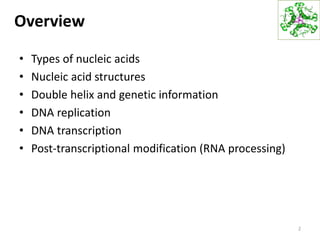
Overview
• Types of nucleic acids
• Nucleic acid structures
• Double helix and genetic information
• DNA replication
• DNA transcription
• Post-transcriptional modification (RNA processing)
2
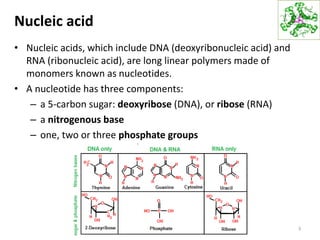
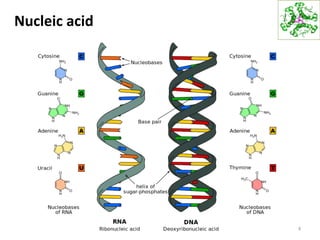
Nucleic acid
• Nucleic acids, which include DNA (deoxyribonucleic acid) and
RNA (ribonucleic acid), are long linear polymers made of
monomers known as nucleotides.
• A nucleotide has three components:
– a 5-carbon sugar: deoxyribose (DNA), or ribose (RNA)
– a nitrogenous base
– one, two or three phosphate groups
3
Nucleic acid
4
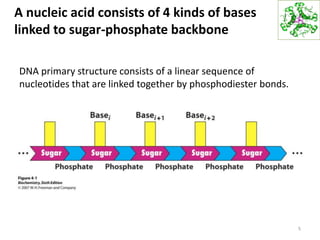
A nucleic acid consists of 4 kinds of bases
linked to sugar-phosphate backbone
5
DNA primary structure consists of a linear sequence of
nucleotides that are linked together by phosphodiester bonds.
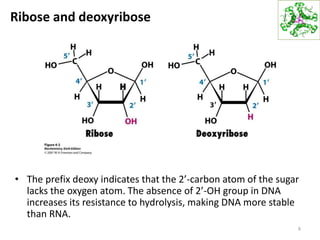
Ribose and deoxyribose
• The prefix deoxy indicates that the 2’-carbon atom of the sugar
lacks the oxygen atom. The absence of 2’-OH group in DNA
increases its resistance to hydrolysis, making DNA more stable
than RNA.
6
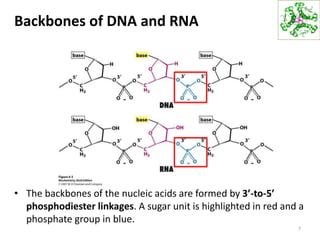
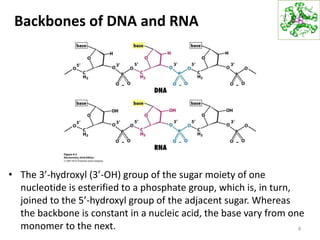
Backbones of DNA and RNA
• The backbones of the nucleic acids are formed by 3’-to-5’
phosphodiester linkages. A sugar unit is highlighted in red and a
phosphate group in blue.
7
Backbones of DNA and RNA
• The 3’-hydroxyl (3’-OH) group of the sugar moiety of one
nucleotide is esterified to a phosphate group, which is, in turn,
joined to the 5’-hydroxyl group of the adjacent sugar. Whereas
the backbone is constant in a nucleic acid, the base vary from one
monomer to the next. 8
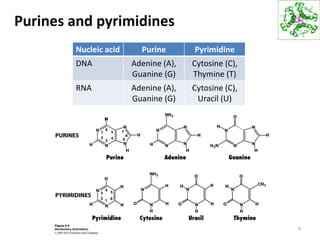
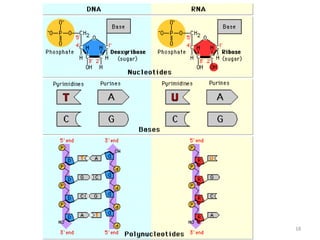
Purines and pyrimidines
9
Nucleic acid Purine Pyrimidine
DNA Adenine (A),
Guanine (G)
Cytosine (C),
Thymine (T)
RNA Adenine (A),
Guanine (G)
Cytosine (C),
Uracil (U)
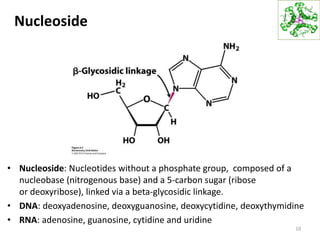
Nucleoside
• Nucleoside: Nucleotides without a phosphate group, composed of a
nucleobase (nitrogenous base) and a 5-carbon sugar (ribose
or deoxyribose), linked via a beta-glycosidic linkage.
• DNA: deoxyadenosine, deoxyguanosine, deoxycytidine, deoxythymidine
• RNA: adenosine, guanosine, cytidine and uridine
10
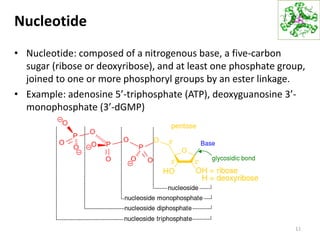
Nucleotide
• Nucleotide: composed of a nitrogenous base, a five-carbon
sugar (ribose or deoxyribose), and at least one phosphate group,
joined to one or more phosphoryl groups by an ester linkage.
• Example: adenosine 5’-triphosphate (ATP), deoxyguanosine 3’-
monophosphate (3’-dGMP)
11
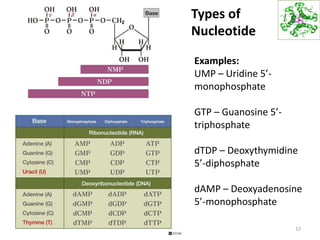
Types of
Nucleotide
12
Examples:
UMP – Uridine 5’-
monophosphate
GTP – Guanosine 5’-
triphosphate
dTDP – Deoxythymidine
5’-diphosphate
dAMP – Deoxyadenosine
5’-monophosphate
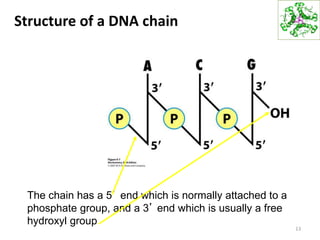
Structure of a DNA chain
13
The chain has a 5’ end which is normally attached to a
phosphate group, and a 3’ end which is usually a free
hydroxyl group
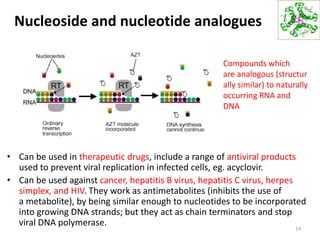
Nucleoside and nucleotide analogues
• Can be used in therapeutic drugs, include a range of antiviral products
used to prevent viral replication in infected cells, eg. acyclovir.
• Can be used against cancer, hepatitis B virus, hepatitis C virus, herpes
simplex, and HIV. They work as antimetabolites (inhibits the use of
a metabolite), by being similar enough to nucleotides to be incorporated
into growing DNA strands; but they act as chain terminators and stop
viral DNA polymerase.
14
Compounds which
are analogous (structur
ally similar) to naturally
occurring RNA and
DNA
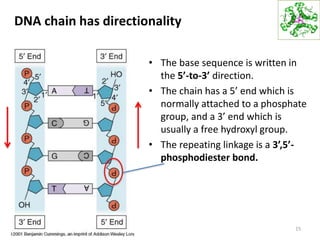
DNA chain has directionality
• The base sequence is written in
the 5’-to-3’ direction.
• The chain has a 5’ end which is
normally attached to a phosphate
group, and a 3’ end which is
usually a free hydroxyl group.
• The repeating linkage is a 3’,5’-
phosphodiester bond.
15
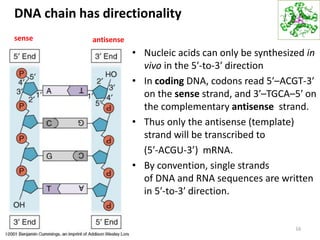
DNA chain has directionality
• Nucleic acids can only be synthesized in
vivo in the 5′-to-3′ direction
• In coding DNA, codons read 5′–ACGT-3′
on the sense strand, and 3′–TGCA–5′ on
the complementary antisense strand.
• Thus only the antisense (template)
strand will be transcribed to
(5′-ACGU-3’) mRNA.
• By convention, single strands
of DNA and RNA sequences are written
in 5′-to-3′ direction.
16
sense antisense
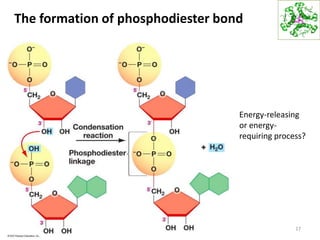
The formation of phosphodiester bond
17
Energy-releasing
or energy-
requiring process?
18
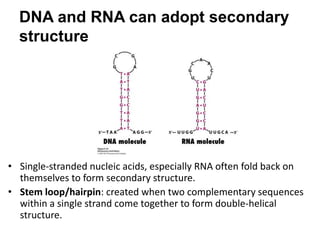
DNA and RNA can adopt secondary
structure
• Single-stranded nucleic acids, especially RNA often fold back on
themselves to form secondary structure.
• Stem loop/hairpin: created when two complementary sequences
within a single strand come together to form double-helical
structure.
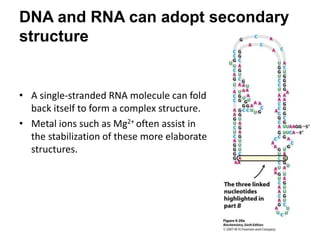
DNA and RNA can adopt secondary
structure
• A single-stranded RNA molecule can fold
back itself to form a complex structure.
• Metal ions such as Mg2+ often assist in
the stabilization of these more elaborate
structures.
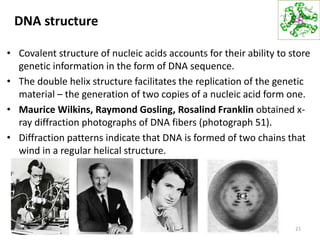
DNA structure
• Covalent structure of nucleic acids accounts for their ability to store
genetic information in the form of DNA sequence.
• The double helix structure facilitates the replication of the genetic
material – the generation of two copies of a nucleic acid form one.
• Maurice Wilkins, Raymond Gosling, Rosalind Franklin obtained x-
ray diffraction photographs of DNA fibers (photograph 51).
• Diffraction patterns indicate that DNA is formed of two chains that
wind in a regular helical structure.
21
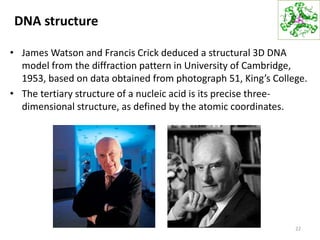
DNA structure
• James Watson and Francis Crick deduced a structural 3D DNA
model from the diffraction pattern in University of Cambridge,
1953, based on data obtained from photograph 51, King’s College.
• The tertiary structure of a nucleic acid is its precise three-
dimensional structure, as defined by the atomic coordinates.
22
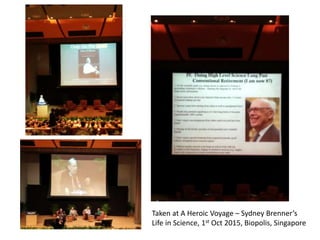
Taken at A Heroic Voyage – Sydney Brenner’s
Life in Science, 1st Oct 2015, Biopolis, Singapore
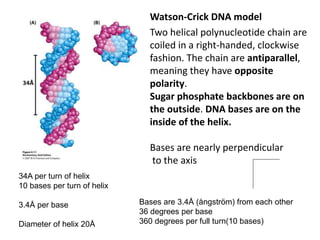
Two helical polynucleotide chain are
coiled in a right-handed, clockwise
fashion. The chain are antiparallel,
meaning they have opposite
polarity.
Sugar phosphate backbones are on
the outside. DNA bases are on the
inside of the helix.
Bases are nearly perpendicular
to the axis
Bases are 3.4Å (ångström) from each other
36 degrees per base
360 degrees per full turn(10 bases)
34A per turn of helix
10 bases per turn of helix
3.4Å per base
Diameter of helix 20Å
Watson-Crick DNA model
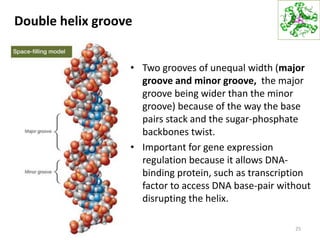
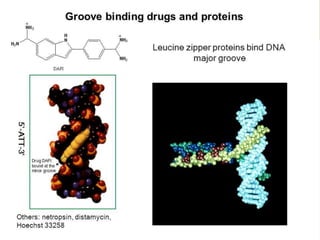
Double helix groove
• Two grooves of unequal width (major
groove and minor groove, the major
groove being wider than the minor
groove) because of the way the base
pairs stack and the sugar-phosphate
backbones twist.
• Important for gene expression
regulation because it allows DNA-
binding protein, such as transcription
factor to access DNA base-pair without
disrupting the helix.
25
Double helix groove
• Two grooves of unequal width (major
groove and minor groove, the major
groove being wider than the minor
groove) because of the way the base
pairs stack and the sugar-phosphate
backbones twist.
• Important for gene expression
regulation because it allows DNA-
binding protein to access DNA base-
pair without disrupting the helix.
26
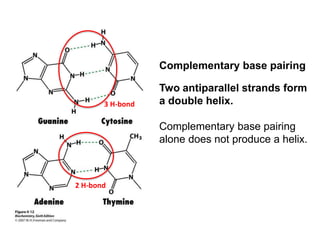
Complementary base pairing
Two antiparallel strands form
a double helix.
Complementary base pairing
alone does not produce a helix.
3 H-bond
2 H-bond
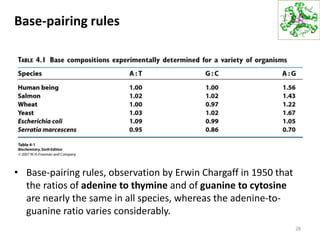
Base-pairing rules
• Base-pairing rules, observation by Erwin Chargaff in 1950 that
the ratios of adenine to thymine and of guanine to cytosine
are nearly the same in all species, whereas the adenine-to-
guanine ratio varies considerably.
28
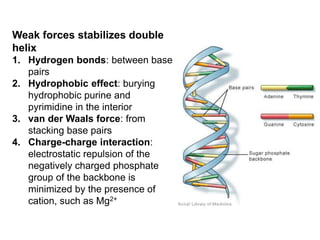
Weak forces stabilizes double
helix
1. Hydrogen bonds: between base
pairs
2. Hydrophobic effect: burying
hydrophobic purine and
pyrimidine in the interior
3. van der Waals force: from
stacking base pairs
4. Charge-charge interaction:
electrostatic repulsion of the
negatively charged phosphate
group of the backbone is
minimized by the presence of
cation, such as Mg2+
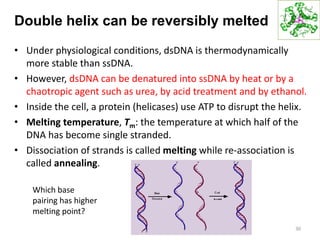
Double helix can be reversibly melted
• Under physiological conditions, dsDNA is thermodynamically
more stable than ssDNA.
• However, dsDNA can be denatured into ssDNA by heat or by a
chaotropic agent such as urea, by acid treatment and by ethanol.
• Inside the cell, a protein (helicases) use ATP to disrupt the helix.
• Melting temperature, Tm: the temperature at which half of the
DNA has become single stranded.
• Dissociation of strands is called melting while re-association is
called annealing.
30
Which base
pairing has higher
melting point?
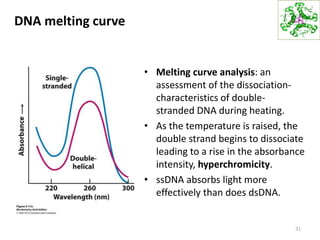
DNA melting curve
• Melting curve analysis: an
assessment of the dissociation-
characteristics of double-
stranded DNA during heating.
• As the temperature is raised, the
double strand begins to dissociate
leading to a rise in the absorbance
intensity, hyperchromicity.
• ssDNA absorbs light more
effectively than does dsDNA.
31
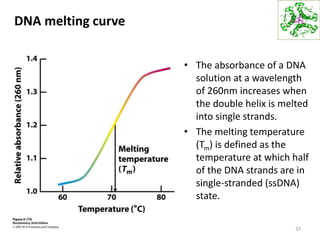
DNA melting curve
• The absorbance of a DNA
solution at a wavelength
of 260nm increases when
the double helix is melted
into single strands.
• The melting temperature
(Tm) is defined as the
temperature at which half
of the DNA strands are in
single-stranded (ssDNA)
state.
32
The function of DNA melting
• This ability to melt and re associate is important for biological
function of nucleic acid
– Replication
– Transcription
– Repair
• In the lab:
– Search for homology between DNA molecules from two
different organisms
• DNA from 2 organisms  melt reanneal if similar
hybrid DNA can form
– Locating genes in a cells DNA that correspond to a particular
RNA
• Use mRNA to probe denatured DNA
– PCR
33
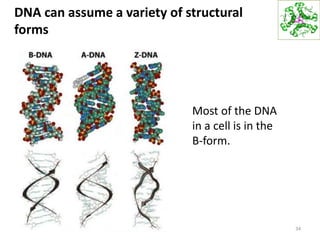
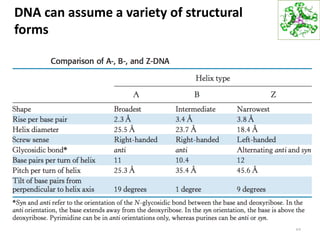
DNA can assume a variety of structural
forms
34
Most of the DNA
in a cell is in the
B-form.
35
DNA can assume a variety of structural
forms
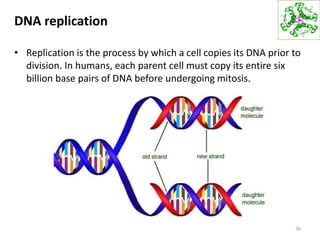
DNA replication
• Replication is the process by which a cell copies its DNA prior to
division. In humans, each parent cell must copy its entire six
billion base pairs of DNA before undergoing mitosis.
36
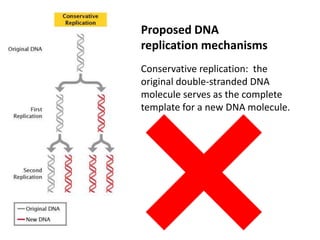
Conservative replication: the
original double-stranded DNA
molecule serves as the complete
template for a new DNA molecule.
Proposed DNA
replication mechanisms
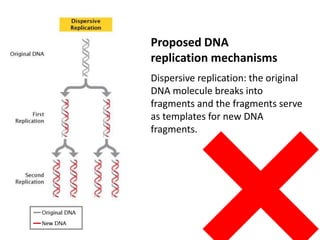
Dispersive replication: the original
DNA molecule breaks into
fragments and the fragments serve
as templates for new DNA
fragments.
Proposed DNA
replication mechanisms
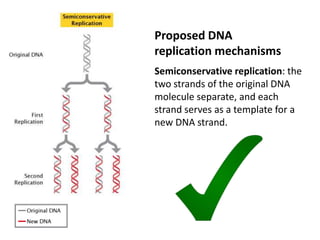
Semiconservative replication: the
two strands of the original DNA
molecule separate, and each
strand serves as a template for a
new DNA strand.
Proposed DNA
replication mechanisms
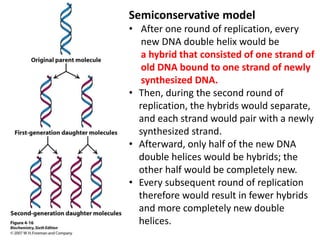
Semiconservative model
• After one round of replication, every
new DNA double helix would be
a hybrid that consisted of one strand of
old DNA bound to one strand of newly
synthesized DNA.
• Then, during the second round of
replication, the hybrids would separate,
and each strand would pair with a newly
synthesized strand.
• Afterward, only half of the new DNA
double helices would be hybrids; the
other half would be completely new.
• Every subsequent round of replication
therefore would result in fewer hybrids
and more completely new double
helices.
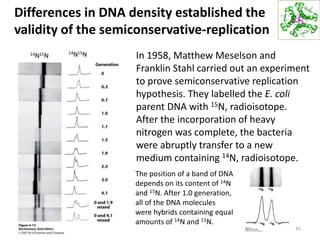
Differences in DNA density established the
validity of the semiconservative-replication
41
In 1958, Matthew Meselson and
Franklin Stahl carried out an experiment
to prove semiconservative replication
hypothesis. They labelled the E. coli
parent DNA with 15N, radioisotope.
After the incorporation of heavy
nitrogen was complete, the bacteria
were abruptly transfer to a new
medium containing 14N, radioisotope.
The position of a band of DNA
depends on its content of 14N
and 15N. After 1.0 generation,
all of the DNA molecules
were hybrids containing equal
amounts of 14N and 15N.
14N15N14N15N
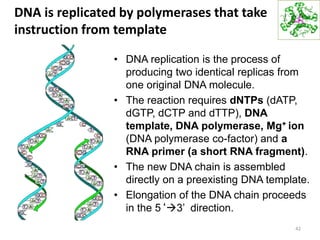
DNA is replicated by polymerases that take
instruction from template
• DNA replication is the process of
producing two identical replicas from
one original DNA molecule.
• The reaction requires dNTPs (dATP,
dGTP, dCTP and dTTP), DNA
template, DNA polymerase, Mg+ ion
(DNA polymerase co-factor) and a
RNA primer (a short RNA fragment).
• The new DNA chain is assembled
directly on a preexisting DNA template.
• Elongation of the DNA chain proceeds
in the 5‘3’ direction.
42
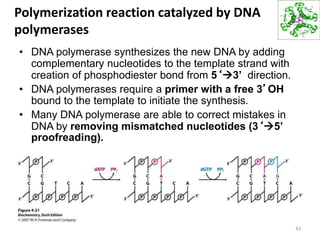
Polymerization reaction catalyzed by DNA
polymerases
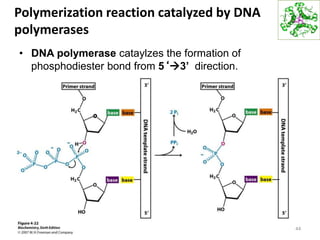
• DNA polymerase synthesizes the new DNA by adding
complementary nucleotides to the template strand with
creation of phosphodiester bond from 5‘3’ direction.
• DNA polymerases require a primer with a free 3’OH
bound to the template to initiate the synthesis.
• Many DNA polymerase are able to correct mistakes in
DNA by removing mismatched nucleotides (3‘5’
proofreading).
43
Polymerization reaction catalyzed by DNA
polymerases
• DNA polymerase cataylzes the formation of
phosphodiester bond from 5‘3’ direction.
44
The genes of some viruses are made of RNA
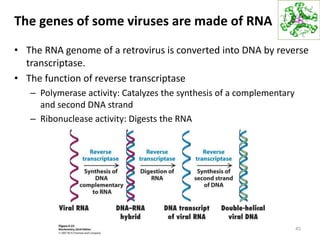
• The RNA genome of a retrovirus is converted into DNA by reverse
transcriptase.
• The function of reverse transcriptase
– Polymerase activity: Catalyzes the synthesis of a complementary
and second DNA strand
– Ribonuclease activity: Digests the RNA
45
Gene expression is the transformation of
DNA into functional molecules
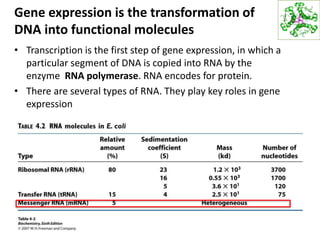
• Transcription is the first step of gene expression, in which a
particular segment of DNA is copied into RNA by the
enzyme RNA polymerase. RNA encodes for protein.
• There are several types of RNA. They play key roles in gene
expression
46
Types of RNA
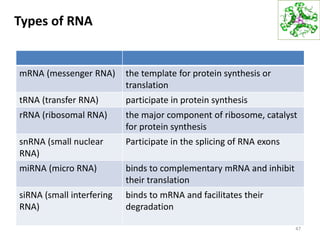
mRNA (messenger RNA) the template for protein synthesis or
translation
tRNA (transfer RNA) participate in protein synthesis
rRNA (ribosomal RNA) the major component of ribosome, catalyst
for protein synthesis
snRNA (small nuclear
RNA)
Participate in the splicing of RNA exons
miRNA (micro RNA) binds to complementary mRNA and inhibit
their translation
siRNA (small interfering
RNA)
binds to mRNA and facilitates their
degradation
47
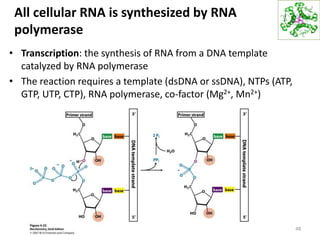
All cellular RNA is synthesized by RNA
polymerase
• Transcription: the synthesis of RNA from a DNA template
catalyzed by RNA polymerase
• The reaction requires a template (dsDNA or ssDNA), NTPs (ATP,
GTP, UTP, CTP), RNA polymerase, co-factor (Mg2+, Mn2+)
48
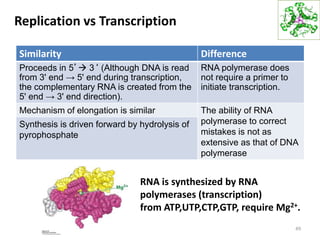
Replication vs Transcription
Similarity Difference
Proceeds in 5’ 3‘ (Although DNA is read
from 3' end → 5' end during transcription,
the complementary RNA is created from the
5' end → 3' end direction).
RNA polymerase does
not require a primer to
initiate transcription.
Mechanism of elongation is similar The ability of RNA
polymerase to correct
mistakes is not as
extensive as that of DNA
polymerase
Synthesis is driven forward by hydrolysis of
pyrophosphate
49
RNA is synthesized by RNA
polymerases (transcription)
from ATP,UTP,CTP,GTP, require Mg2+.
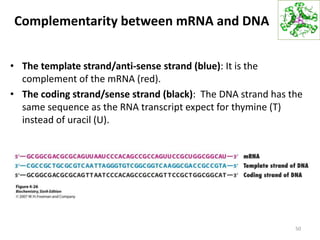
Complementarity between mRNA and DNA
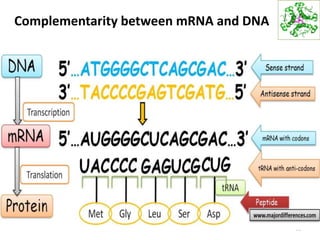
• The template strand/anti-sense strand (blue): It is the
complement of the mRNA (red).
• The coding strand/sense strand (black): The DNA strand has the
same sequence as the RNA transcript expect for thymine (T)
instead of uracil (U).
50
Complementarity between mRNA and DNA
51
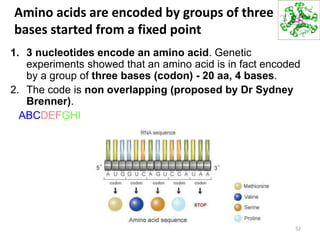
Amino acids are encoded by groups of three
bases started from a fixed point
1. 3 nucleotides encode an amino acid. Genetic
experiments showed that an amino acid is in fact encoded
by a group of three bases (codon) - 20 aa, 4 bases.
2. The code is non overlapping (proposed by Dr Sydney
Brenner).
ABCDEFGHI
52
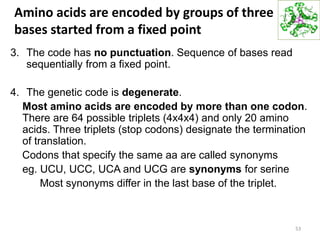
Amino acids are encoded by groups of three
bases started from a fixed point
3. The code has no punctuation. Sequence of bases read
sequentially from a fixed point.
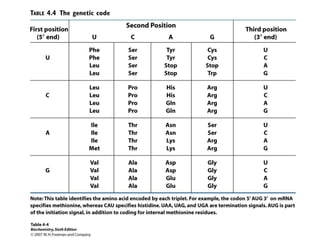
4. The genetic code is degenerate.
Most amino acids are encoded by more than one codon.
There are 64 possible triplets (4x4x4) and only 20 amino
acids. Three triplets (stop codons) designate the termination
of translation.
Codons that specify the same aa are called synonyms
eg. UCU, UCC, UCA and UCG are synonyms for serine
Most synonyms differ in the last base of the triplet.
53
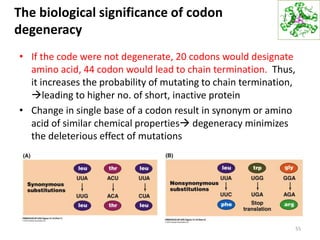
The biological significance of codon
degeneracy
• If the code were not degenerate, 20 codons would designate
amino acid, 44 codon would lead to chain termination. Thus,
it increases the probability of mutating to chain termination,
leading to higher no. of short, inactive protein
• Change in single base of a codon result in synonym or amino
acid of similar chemical properties degeneracy minimizes
the deleterious effect of mutations
55
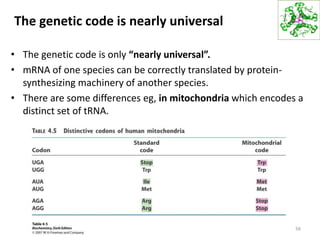
The genetic code is nearly universal
• The genetic code is only “nearly universal”.
• mRNA of one species can be correctly translated by protein-
synthesizing machinery of another species.
• There are some differences eg, in mitochondria which encodes a
distinct set of tRNA.
56
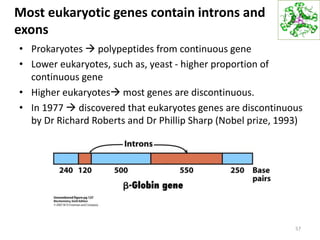
Most eukaryotic genes contain introns and
exons
• Prokaryotes  polypeptides from continuous gene
• Lower eukaryotes, such as, yeast - higher proportion of
continuous gene
• Higher eukaryotes most genes are discontinuous.
• In 1977  discovered that eukaryotes genes are discontinuous
by Dr Richard Roberts and Dr Phillip Sharp (Nobel prize, 1993)
57
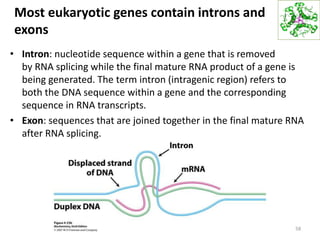
Most eukaryotic genes contain introns and
exons
• Intron: nucleotide sequence within a gene that is removed
by RNA splicing while the final mature RNA product of a gene is
being generated. The term intron (intragenic region) refers to
both the DNA sequence within a gene and the corresponding
sequence in RNA transcripts.
• Exon: sequences that are joined together in the final mature RNA
after RNA splicing.
58
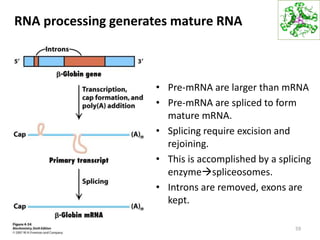
RNA processing generates mature RNA
• Pre-mRNA are larger than mRNA
• Pre-mRNA are spliced to form
mature mRNA.
• Splicing require excision and
rejoining.
• This is accomplished by a splicing
enzymespliceosomes.
• Introns are removed, exons are
kept.
59
Evolution and intron
• Prokaryotes  split genes are very rare, continuous
gene
• Lower eukaryotes such as yeast higher proportion of
continuous gene
• Eukaryotes most genes are split
• Have the introns been inserted in eukaryotes with
evolution? Or removed from genes?
• Studies suggest that introns were present in ancestral
genes
• Lost in evolution of organism that have become
optimized for very rapid growth, such as prokaryotes
60
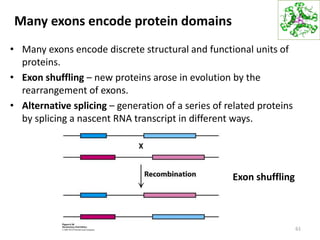
Many exons encode protein domains
• Many exons encode discrete structural and functional units of
proteins.
• Exon shuffling – new proteins arose in evolution by the
rearrangement of exons.
• Alternative splicing – generation of a series of related proteins
by splicing a nascent RNA transcript in different ways.
61
Exon shuffling
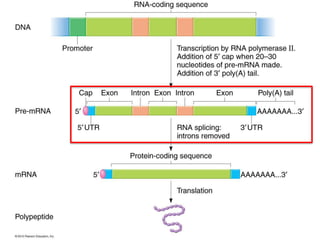
Post-transcriptional modification:
RNA processing
• In eukaryotic cells, primary transcript RNA (pre-mRNA) is
converted into mature RNA.
• 5' capping - the addition of 7-methylguanosine (m7G) to the 5'
end.
• 3’ cleavage and polyadenylation - cleavage of its 3' end and then
the addition of about 250 adenine residues to form a poly(A) tail.
• RNA splicing - the process by which introns are removed from
the pre-mRNA
62
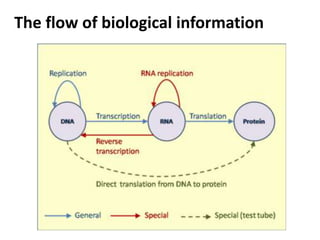
The flow of biological information
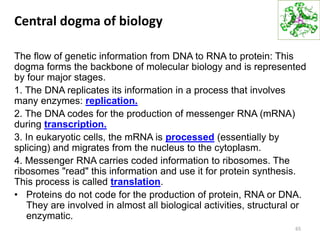
Central dogma of biology
The flow of genetic information from DNA to RNA to protein: This
dogma forms the backbone of molecular biology and is represented
by four major stages.
1. The DNA replicates its information in a process that involves
many enzymes: replication.
2. The DNA codes for the production of messenger RNA (mRNA)
during transcription.
3. In eukaryotic cells, the mRNA is processed (essentially by
splicing) and migrates from the nucleus to the cytoplasm.
4. Messenger RNA carries coded information to ribosomes. The
ribosomes "read" this information and use it for protein synthesis.
This process is called translation.
• Proteins do not code for the production of protein, RNA or DNA.
They are involved in almost all biological activities, structural or
enzymatic.
65
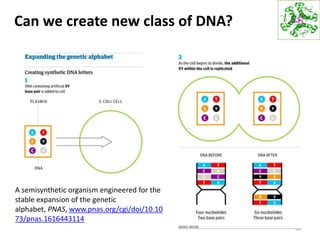
Can we create new class of DNA?
66
A semisynthetic organism engineered for the
stable expansion of the genetic
alphabet, PNAS, www.pnas.org/cgi/doi/10.10
73/pnas.1616443114
Summary
1. A nucleic acid consists of four kinds of bases linked to a sugar-
phosphate backbone.
2. A pair of nucleic acid chains with complementary sequences can
form a double helix.
3. The double helix facilitates the accurate transmission of
hereditary information.
4. DNA is replicated by polymerases that take instructions from
templates.
5. Gene expression is the transformation of DNA information into
functional molecules.
6. Amino acids are encoded by groups of three bases starting from a
fixed point.
7. Most eukaryotic genes contains introns and exons. 67
Study questions
1. What are the components of a nucleotide?
2. What are the similarities and difference between DNA and RNA?
3. What is the DNA directionality?
4. What are the nucleic acid structures?
5. What is the chemical bond joining DNA nucleotides?
6. What are the main features of DNA double helix?
7. What chemical forces are involved in stablization of DNA double helix?
8. Why is it important for DNA to be able to dissociate and associate?
9. What is a DNA semiconservative replication?
10. What are the similarities and difference between DNA replication and
DNA transcription?
11. Name the types of RNA.
12. What is the codon degeneracy?
13. What are three major steps involved in RNA processing?
68

220739 lecture 12 13

  • 1.
    HBC1011 Biochemistry I Lecture12-13 – DNA, RNA and the flow of genetic information Ng Chong Han, PhD ITAR1010, 06-2523751 chng@mmu.edu.my
  • 2.
    Overview • Types ofnucleic acids • Nucleic acid structures • Double helix and genetic information • DNA replication • DNA transcription • Post-transcriptional modification (RNA processing) 2
  • 3.
    Nucleic acid • Nucleicacids, which include DNA (deoxyribonucleic acid) and RNA (ribonucleic acid), are long linear polymers made of monomers known as nucleotides. • A nucleotide has three components: – a 5-carbon sugar: deoxyribose (DNA), or ribose (RNA) – a nitrogenous base – one, two or three phosphate groups 3
  • 4.
  • 5.
    A nucleic acidconsists of 4 kinds of bases linked to sugar-phosphate backbone 5 DNA primary structure consists of a linear sequence of nucleotides that are linked together by phosphodiester bonds.
  • 6.
    Ribose and deoxyribose •The prefix deoxy indicates that the 2’-carbon atom of the sugar lacks the oxygen atom. The absence of 2’-OH group in DNA increases its resistance to hydrolysis, making DNA more stable than RNA. 6
  • 7.
    Backbones of DNAand RNA • The backbones of the nucleic acids are formed by 3’-to-5’ phosphodiester linkages. A sugar unit is highlighted in red and a phosphate group in blue. 7
  • 8.
    Backbones of DNAand RNA • The 3’-hydroxyl (3’-OH) group of the sugar moiety of one nucleotide is esterified to a phosphate group, which is, in turn, joined to the 5’-hydroxyl group of the adjacent sugar. Whereas the backbone is constant in a nucleic acid, the base vary from one monomer to the next. 8
  • 9.
    Purines and pyrimidines 9 Nucleicacid Purine Pyrimidine DNA Adenine (A), Guanine (G) Cytosine (C), Thymine (T) RNA Adenine (A), Guanine (G) Cytosine (C), Uracil (U)
  • 10.
    Nucleoside • Nucleoside: Nucleotideswithout a phosphate group, composed of a nucleobase (nitrogenous base) and a 5-carbon sugar (ribose or deoxyribose), linked via a beta-glycosidic linkage. • DNA: deoxyadenosine, deoxyguanosine, deoxycytidine, deoxythymidine • RNA: adenosine, guanosine, cytidine and uridine 10
  • 11.
    Nucleotide • Nucleotide: composedof a nitrogenous base, a five-carbon sugar (ribose or deoxyribose), and at least one phosphate group, joined to one or more phosphoryl groups by an ester linkage. • Example: adenosine 5’-triphosphate (ATP), deoxyguanosine 3’- monophosphate (3’-dGMP) 11
  • 12.
    Types of Nucleotide 12 Examples: UMP –Uridine 5’- monophosphate GTP – Guanosine 5’- triphosphate dTDP – Deoxythymidine 5’-diphosphate dAMP – Deoxyadenosine 5’-monophosphate
  • 13.
    Structure of aDNA chain 13 The chain has a 5’ end which is normally attached to a phosphate group, and a 3’ end which is usually a free hydroxyl group
  • 14.
    Nucleoside and nucleotideanalogues • Can be used in therapeutic drugs, include a range of antiviral products used to prevent viral replication in infected cells, eg. acyclovir. • Can be used against cancer, hepatitis B virus, hepatitis C virus, herpes simplex, and HIV. They work as antimetabolites (inhibits the use of a metabolite), by being similar enough to nucleotides to be incorporated into growing DNA strands; but they act as chain terminators and stop viral DNA polymerase. 14 Compounds which are analogous (structur ally similar) to naturally occurring RNA and DNA
  • 15.
    DNA chain hasdirectionality • The base sequence is written in the 5’-to-3’ direction. • The chain has a 5’ end which is normally attached to a phosphate group, and a 3’ end which is usually a free hydroxyl group. • The repeating linkage is a 3’,5’- phosphodiester bond. 15
  • 16.
    DNA chain hasdirectionality • Nucleic acids can only be synthesized in vivo in the 5′-to-3′ direction • In coding DNA, codons read 5′–ACGT-3′ on the sense strand, and 3′–TGCA–5′ on the complementary antisense strand. • Thus only the antisense (template) strand will be transcribed to (5′-ACGU-3’) mRNA. • By convention, single strands of DNA and RNA sequences are written in 5′-to-3′ direction. 16 sense antisense
  • 17.
    The formation ofphosphodiester bond 17 Energy-releasing or energy- requiring process?
  • 18.
  • 19.
    DNA and RNAcan adopt secondary structure • Single-stranded nucleic acids, especially RNA often fold back on themselves to form secondary structure. • Stem loop/hairpin: created when two complementary sequences within a single strand come together to form double-helical structure.
  • 20.
    DNA and RNAcan adopt secondary structure • A single-stranded RNA molecule can fold back itself to form a complex structure. • Metal ions such as Mg2+ often assist in the stabilization of these more elaborate structures.
  • 21.
    DNA structure • Covalentstructure of nucleic acids accounts for their ability to store genetic information in the form of DNA sequence. • The double helix structure facilitates the replication of the genetic material – the generation of two copies of a nucleic acid form one. • Maurice Wilkins, Raymond Gosling, Rosalind Franklin obtained x- ray diffraction photographs of DNA fibers (photograph 51). • Diffraction patterns indicate that DNA is formed of two chains that wind in a regular helical structure. 21
  • 22.
    DNA structure • JamesWatson and Francis Crick deduced a structural 3D DNA model from the diffraction pattern in University of Cambridge, 1953, based on data obtained from photograph 51, King’s College. • The tertiary structure of a nucleic acid is its precise three- dimensional structure, as defined by the atomic coordinates. 22
  • 23.
    Taken at AHeroic Voyage – Sydney Brenner’s Life in Science, 1st Oct 2015, Biopolis, Singapore
  • 24.
    Two helical polynucleotidechain are coiled in a right-handed, clockwise fashion. The chain are antiparallel, meaning they have opposite polarity. Sugar phosphate backbones are on the outside. DNA bases are on the inside of the helix. Bases are nearly perpendicular to the axis Bases are 3.4Å (ångström) from each other 36 degrees per base 360 degrees per full turn(10 bases) 34A per turn of helix 10 bases per turn of helix 3.4Å per base Diameter of helix 20Å Watson-Crick DNA model
  • 25.
    Double helix groove •Two grooves of unequal width (major groove and minor groove, the major groove being wider than the minor groove) because of the way the base pairs stack and the sugar-phosphate backbones twist. • Important for gene expression regulation because it allows DNA- binding protein, such as transcription factor to access DNA base-pair without disrupting the helix. 25
  • 26.
    Double helix groove •Two grooves of unequal width (major groove and minor groove, the major groove being wider than the minor groove) because of the way the base pairs stack and the sugar-phosphate backbones twist. • Important for gene expression regulation because it allows DNA- binding protein to access DNA base- pair without disrupting the helix. 26
  • 27.
    Complementary base pairing Twoantiparallel strands form a double helix. Complementary base pairing alone does not produce a helix. 3 H-bond 2 H-bond
  • 28.
    Base-pairing rules • Base-pairingrules, observation by Erwin Chargaff in 1950 that the ratios of adenine to thymine and of guanine to cytosine are nearly the same in all species, whereas the adenine-to- guanine ratio varies considerably. 28
  • 29.
    Weak forces stabilizesdouble helix 1. Hydrogen bonds: between base pairs 2. Hydrophobic effect: burying hydrophobic purine and pyrimidine in the interior 3. van der Waals force: from stacking base pairs 4. Charge-charge interaction: electrostatic repulsion of the negatively charged phosphate group of the backbone is minimized by the presence of cation, such as Mg2+
  • 30.
    Double helix canbe reversibly melted • Under physiological conditions, dsDNA is thermodynamically more stable than ssDNA. • However, dsDNA can be denatured into ssDNA by heat or by a chaotropic agent such as urea, by acid treatment and by ethanol. • Inside the cell, a protein (helicases) use ATP to disrupt the helix. • Melting temperature, Tm: the temperature at which half of the DNA has become single stranded. • Dissociation of strands is called melting while re-association is called annealing. 30 Which base pairing has higher melting point?
  • 31.
    DNA melting curve •Melting curve analysis: an assessment of the dissociation- characteristics of double- stranded DNA during heating. • As the temperature is raised, the double strand begins to dissociate leading to a rise in the absorbance intensity, hyperchromicity. • ssDNA absorbs light more effectively than does dsDNA. 31
  • 32.
    DNA melting curve •The absorbance of a DNA solution at a wavelength of 260nm increases when the double helix is melted into single strands. • The melting temperature (Tm) is defined as the temperature at which half of the DNA strands are in single-stranded (ssDNA) state. 32
  • 33.
    The function ofDNA melting • This ability to melt and re associate is important for biological function of nucleic acid – Replication – Transcription – Repair • In the lab: – Search for homology between DNA molecules from two different organisms • DNA from 2 organisms  melt reanneal if similar hybrid DNA can form – Locating genes in a cells DNA that correspond to a particular RNA • Use mRNA to probe denatured DNA – PCR 33
  • 34.
    DNA can assumea variety of structural forms 34 Most of the DNA in a cell is in the B-form.
  • 35.
    35 DNA can assumea variety of structural forms
  • 36.
    DNA replication • Replicationis the process by which a cell copies its DNA prior to division. In humans, each parent cell must copy its entire six billion base pairs of DNA before undergoing mitosis. 36
  • 37.
    Conservative replication: the originaldouble-stranded DNA molecule serves as the complete template for a new DNA molecule. Proposed DNA replication mechanisms
  • 38.
    Dispersive replication: theoriginal DNA molecule breaks into fragments and the fragments serve as templates for new DNA fragments. Proposed DNA replication mechanisms
  • 39.
    Semiconservative replication: the twostrands of the original DNA molecule separate, and each strand serves as a template for a new DNA strand. Proposed DNA replication mechanisms
  • 40.
    Semiconservative model • Afterone round of replication, every new DNA double helix would be a hybrid that consisted of one strand of old DNA bound to one strand of newly synthesized DNA. • Then, during the second round of replication, the hybrids would separate, and each strand would pair with a newly synthesized strand. • Afterward, only half of the new DNA double helices would be hybrids; the other half would be completely new. • Every subsequent round of replication therefore would result in fewer hybrids and more completely new double helices.
  • 41.
    Differences in DNAdensity established the validity of the semiconservative-replication 41 In 1958, Matthew Meselson and Franklin Stahl carried out an experiment to prove semiconservative replication hypothesis. They labelled the E. coli parent DNA with 15N, radioisotope. After the incorporation of heavy nitrogen was complete, the bacteria were abruptly transfer to a new medium containing 14N, radioisotope. The position of a band of DNA depends on its content of 14N and 15N. After 1.0 generation, all of the DNA molecules were hybrids containing equal amounts of 14N and 15N. 14N15N14N15N
  • 42.
    DNA is replicatedby polymerases that take instruction from template • DNA replication is the process of producing two identical replicas from one original DNA molecule. • The reaction requires dNTPs (dATP, dGTP, dCTP and dTTP), DNA template, DNA polymerase, Mg+ ion (DNA polymerase co-factor) and a RNA primer (a short RNA fragment). • The new DNA chain is assembled directly on a preexisting DNA template. • Elongation of the DNA chain proceeds in the 5‘3’ direction. 42
  • 43.
    Polymerization reaction catalyzedby DNA polymerases • DNA polymerase synthesizes the new DNA by adding complementary nucleotides to the template strand with creation of phosphodiester bond from 5‘3’ direction. • DNA polymerases require a primer with a free 3’OH bound to the template to initiate the synthesis. • Many DNA polymerase are able to correct mistakes in DNA by removing mismatched nucleotides (3‘5’ proofreading). 43
  • 44.
    Polymerization reaction catalyzedby DNA polymerases • DNA polymerase cataylzes the formation of phosphodiester bond from 5‘3’ direction. 44
  • 45.
    The genes ofsome viruses are made of RNA • The RNA genome of a retrovirus is converted into DNA by reverse transcriptase. • The function of reverse transcriptase – Polymerase activity: Catalyzes the synthesis of a complementary and second DNA strand – Ribonuclease activity: Digests the RNA 45
  • 46.
    Gene expression isthe transformation of DNA into functional molecules • Transcription is the first step of gene expression, in which a particular segment of DNA is copied into RNA by the enzyme RNA polymerase. RNA encodes for protein. • There are several types of RNA. They play key roles in gene expression 46
  • 47.
    Types of RNA mRNA(messenger RNA) the template for protein synthesis or translation tRNA (transfer RNA) participate in protein synthesis rRNA (ribosomal RNA) the major component of ribosome, catalyst for protein synthesis snRNA (small nuclear RNA) Participate in the splicing of RNA exons miRNA (micro RNA) binds to complementary mRNA and inhibit their translation siRNA (small interfering RNA) binds to mRNA and facilitates their degradation 47
  • 48.
    All cellular RNAis synthesized by RNA polymerase • Transcription: the synthesis of RNA from a DNA template catalyzed by RNA polymerase • The reaction requires a template (dsDNA or ssDNA), NTPs (ATP, GTP, UTP, CTP), RNA polymerase, co-factor (Mg2+, Mn2+) 48
  • 49.
    Replication vs Transcription SimilarityDifference Proceeds in 5’ 3‘ (Although DNA is read from 3' end → 5' end during transcription, the complementary RNA is created from the 5' end → 3' end direction). RNA polymerase does not require a primer to initiate transcription. Mechanism of elongation is similar The ability of RNA polymerase to correct mistakes is not as extensive as that of DNA polymerase Synthesis is driven forward by hydrolysis of pyrophosphate 49 RNA is synthesized by RNA polymerases (transcription) from ATP,UTP,CTP,GTP, require Mg2+.
  • 50.
    Complementarity between mRNAand DNA • The template strand/anti-sense strand (blue): It is the complement of the mRNA (red). • The coding strand/sense strand (black): The DNA strand has the same sequence as the RNA transcript expect for thymine (T) instead of uracil (U). 50
  • 51.
  • 52.
    Amino acids areencoded by groups of three bases started from a fixed point 1. 3 nucleotides encode an amino acid. Genetic experiments showed that an amino acid is in fact encoded by a group of three bases (codon) - 20 aa, 4 bases. 2. The code is non overlapping (proposed by Dr Sydney Brenner). ABCDEFGHI 52
  • 53.
    Amino acids areencoded by groups of three bases started from a fixed point 3. The code has no punctuation. Sequence of bases read sequentially from a fixed point. 4. The genetic code is degenerate. Most amino acids are encoded by more than one codon. There are 64 possible triplets (4x4x4) and only 20 amino acids. Three triplets (stop codons) designate the termination of translation. Codons that specify the same aa are called synonyms eg. UCU, UCC, UCA and UCG are synonyms for serine Most synonyms differ in the last base of the triplet. 53
  • 55.
    The biological significanceof codon degeneracy • If the code were not degenerate, 20 codons would designate amino acid, 44 codon would lead to chain termination. Thus, it increases the probability of mutating to chain termination, leading to higher no. of short, inactive protein • Change in single base of a codon result in synonym or amino acid of similar chemical properties degeneracy minimizes the deleterious effect of mutations 55
  • 56.
    The genetic codeis nearly universal • The genetic code is only “nearly universal”. • mRNA of one species can be correctly translated by protein- synthesizing machinery of another species. • There are some differences eg, in mitochondria which encodes a distinct set of tRNA. 56
  • 57.
    Most eukaryotic genescontain introns and exons • Prokaryotes  polypeptides from continuous gene • Lower eukaryotes, such as, yeast - higher proportion of continuous gene • Higher eukaryotes most genes are discontinuous. • In 1977  discovered that eukaryotes genes are discontinuous by Dr Richard Roberts and Dr Phillip Sharp (Nobel prize, 1993) 57
  • 58.
    Most eukaryotic genescontain introns and exons • Intron: nucleotide sequence within a gene that is removed by RNA splicing while the final mature RNA product of a gene is being generated. The term intron (intragenic region) refers to both the DNA sequence within a gene and the corresponding sequence in RNA transcripts. • Exon: sequences that are joined together in the final mature RNA after RNA splicing. 58
  • 59.
    RNA processing generatesmature RNA • Pre-mRNA are larger than mRNA • Pre-mRNA are spliced to form mature mRNA. • Splicing require excision and rejoining. • This is accomplished by a splicing enzymespliceosomes. • Introns are removed, exons are kept. 59
  • 60.
    Evolution and intron •Prokaryotes  split genes are very rare, continuous gene • Lower eukaryotes such as yeast higher proportion of continuous gene • Eukaryotes most genes are split • Have the introns been inserted in eukaryotes with evolution? Or removed from genes? • Studies suggest that introns were present in ancestral genes • Lost in evolution of organism that have become optimized for very rapid growth, such as prokaryotes 60
  • 61.
    Many exons encodeprotein domains • Many exons encode discrete structural and functional units of proteins. • Exon shuffling – new proteins arose in evolution by the rearrangement of exons. • Alternative splicing – generation of a series of related proteins by splicing a nascent RNA transcript in different ways. 61 Exon shuffling
  • 62.
    Post-transcriptional modification: RNA processing •In eukaryotic cells, primary transcript RNA (pre-mRNA) is converted into mature RNA. • 5' capping - the addition of 7-methylguanosine (m7G) to the 5' end. • 3’ cleavage and polyadenylation - cleavage of its 3' end and then the addition of about 250 adenine residues to form a poly(A) tail. • RNA splicing - the process by which introns are removed from the pre-mRNA 62
  • 64.
    The flow ofbiological information
  • 65.
    Central dogma ofbiology The flow of genetic information from DNA to RNA to protein: This dogma forms the backbone of molecular biology and is represented by four major stages. 1. The DNA replicates its information in a process that involves many enzymes: replication. 2. The DNA codes for the production of messenger RNA (mRNA) during transcription. 3. In eukaryotic cells, the mRNA is processed (essentially by splicing) and migrates from the nucleus to the cytoplasm. 4. Messenger RNA carries coded information to ribosomes. The ribosomes "read" this information and use it for protein synthesis. This process is called translation. • Proteins do not code for the production of protein, RNA or DNA. They are involved in almost all biological activities, structural or enzymatic. 65
  • 66.
    Can we createnew class of DNA? 66 A semisynthetic organism engineered for the stable expansion of the genetic alphabet, PNAS, www.pnas.org/cgi/doi/10.10 73/pnas.1616443114
  • 67.
    Summary 1. A nucleicacid consists of four kinds of bases linked to a sugar- phosphate backbone. 2. A pair of nucleic acid chains with complementary sequences can form a double helix. 3. The double helix facilitates the accurate transmission of hereditary information. 4. DNA is replicated by polymerases that take instructions from templates. 5. Gene expression is the transformation of DNA information into functional molecules. 6. Amino acids are encoded by groups of three bases starting from a fixed point. 7. Most eukaryotic genes contains introns and exons. 67
  • 68.
    Study questions 1. Whatare the components of a nucleotide? 2. What are the similarities and difference between DNA and RNA? 3. What is the DNA directionality? 4. What are the nucleic acid structures? 5. What is the chemical bond joining DNA nucleotides? 6. What are the main features of DNA double helix? 7. What chemical forces are involved in stablization of DNA double helix? 8. Why is it important for DNA to be able to dissociate and associate? 9. What is a DNA semiconservative replication? 10. What are the similarities and difference between DNA replication and DNA transcription? 11. Name the types of RNA. 12. What is the codon degeneracy? 13. What are three major steps involved in RNA processing? 68