An Introduction to HMM


        Browny
       2010.07.21
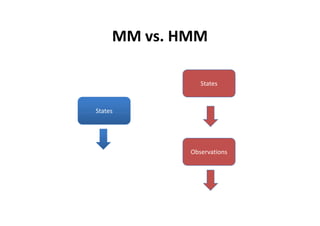
MM vs. HMM

                States


States


             Observations
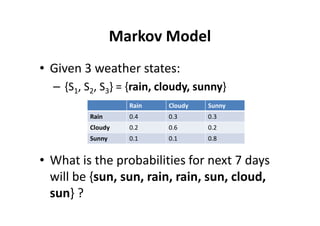
Markov Model
• Given 3 weather states:
  – {S1, S2, S3} = {rain, cloudy, sunny}
                    Rain   Cloudy   Sunny
          Rain      0.4    0.3      0.3
          Cloudy    0.2    0.6      0.2
          Sunny     0.1    0.1      0.8


• What is the probabilities for next 7 days
  will be {sun, sun, rain, rain, sun, cloud,
  sun} ?
Hidden Markov Model
• The states
  – We don’t understand, Hidden!
  – But it can be indirectly observed


• Example
  – 北極or赤道(model), Hot/Cold(state), 1/2/3
    ice cream(observation)
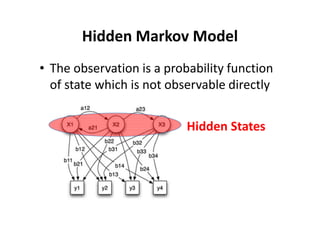
Hidden Markov Model
• The observation is a probability function
  of state which is not observable directly


                           Hidden States
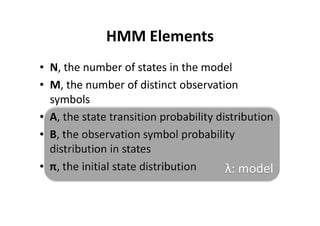
HMM Elements
• N, the number of states in the model
• M, the number of distinct observation
  symbols
• A, the state transition probability distribution
• B, the observation symbol probability
  distribution in states
• π, the initial state distribution     λ: model
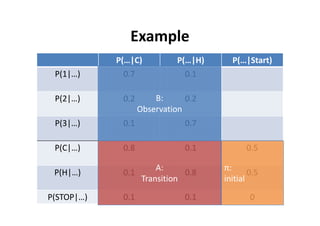
Example
            P(…|C)           P(…|H)     P(…|Start)
 P(1|…)       0.7              0.1

 P(2|…)      0.2       B:      0.2
                   Observation
 P(3|…)      0.1               0.7

 P(C|…)      0.8               0.1           0.5

                        A:            π:
 P(H|…)      0.1               0.8            0.5
                    Transition        initial

P(STOP|…)    0.1               0.1            0
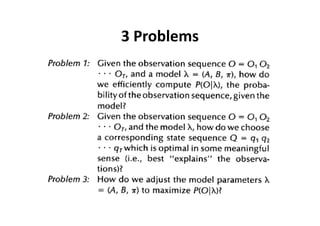
3 Problems
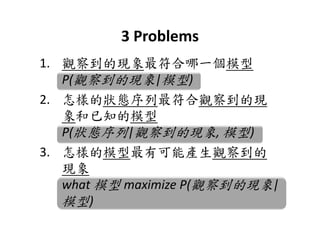
3 Problems
1. 觀察到的現象最符合哪一個模型
   P(觀察到的現象|模型)
2. 怎樣的狀態序列最符合觀察到的現
   象和已知的模型
   P(狀態序列|觀察到的現象, 模型)
3. 怎樣的模型最有可能產生觀察到的
   現象
   what 模型 maximize P(觀察到的現象|
   模型)
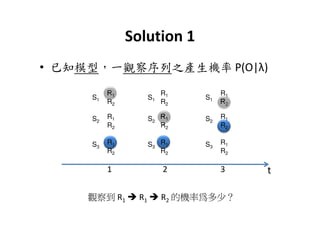
Solution 1
• 已知模型,一觀察序列之產生機率 P(O|λ)
          R1               R1         R1
     S1               S1         S1
          R2               R2         R2

     S2   R1          S2 R1      S2   R1
          R2             R2           R2

     S3   R1          S3 R1      S3   R1
          R2             R2           R2

          1                2          3    t

     觀察到 R1      R1        R2 的機率為多少?
Solution 1
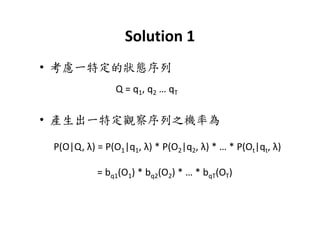
• 考慮一特定的狀態序列
                Q = q1, q2 … qT

• 產生出一特定觀察序列之機率為

 P(O|Q, λ) = P(O1|q1, λ) * P(O2|q2, λ) * … * P(Ot|qt, λ)

           = bq1(O1) * bq2(O2) * … * bqT(OT)
Solution 1
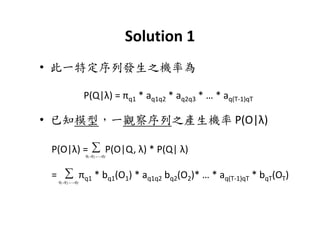
• 此一特定序列發生之機率為

               P(Q|λ) = πq1 * aq1q2 * aq2q3 * … * aq(T-1)qT

• 已知模型,一觀察序列之產生機率 P(O|λ)

 P(O|λ) = ,q∑ q P(O|Q, λ) * P(Q| λ)
         q  ,...,
               1   2   T


 = q ,q∑ q πq1 * bq1(O1) * aq1q2 bq2(O2)* … * aq(T-1)qT * bqT(OT)
       ,...,
   1   2   T
Solution 1
                 狀態的數量)
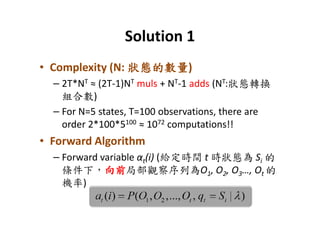
• Complexity (N: 狀態的數量
  – 2T*NT ≈ (2T-1)NT muls + NT-1 adds (NT:狀態轉換
    組合數)
  – For N=5 states, T=100 observations, there are
    order 2*100*5100 ≈ 1072 computations!!
• Forward Algorithm
  – Forward variable αt(i) (給定時間 t 時狀態為 Si 的
    條件下,向前   向前局部觀察序列為O1, O2, O3…, Ot 的
             向前
    機率)
           at (i ) = P(O1 , O2 ,..., Ot , qt = Si | λ )
Solution 1
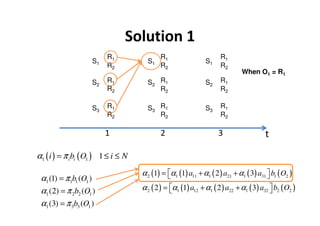
                          R1                R1                       R1
                    S1                 S1                      S1
                          R2                R2                       R2
                                                                              When O1 = R1
                    S2    R1           S2 R1                   S2    R1
                          R2              R2                         R2

                    S3    R1           S3 R1                   S3    R1
                          R2              R2                         R2

                         1                  2                       3                   t

α1 ( i ) = π i bi ( O1 ) 1 ≤ i ≤ N
                                     α 2 (1) = α1 (1) a11 + α1 ( 2 ) a21 + α1 ( 3) a31  b1 ( O2 )
                                                                                       
 α1 (1) = π 1b1 (O1 )
 α1 (2) = π 2b2 (O1 )                α 2 ( 2 ) = α1 (1) a12 + α1 ( 2 ) a22 + α1 ( 3) a32  b2 ( O2 )
                                                                                         
 α1 (3) = π 3b3 (O1 )
Forward Algorithm
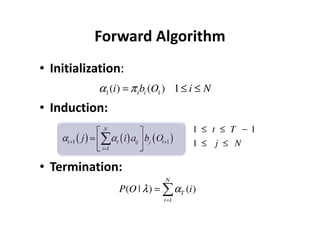
• Initialization:
                  α1 (i ) = π i bi (O1 ) 1 ≤ i ≤ N
• Induction:
                  N                             1 ≤ t ≤ T −1
    αt +1 ( j ) = ∑αt ( i ) aij  bj ( Ot +1 )   1 ≤ j ≤ N
                   i=1          

• Termination:
                                            N
                          P(O | λ ) = ∑ αT (i )
                                           i =1
Backward Algorithm
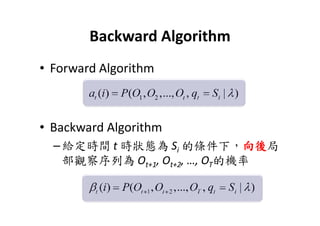
• Forward Algorithm
        at (i ) = P(O1 , O2 ,..., Ot , qt = Si | λ )


• Backward Algorithm
  – 給定時間 t 時狀態為 Si 的條件下,向後    向後局
                              向後
    部觀察序列為 Ot+1, Ot+2, …, OT的機率

        βt (i ) = P(Ot +1 , Ot + 2 ,..., OT , qt = Si | λ )
Backward Algorithm
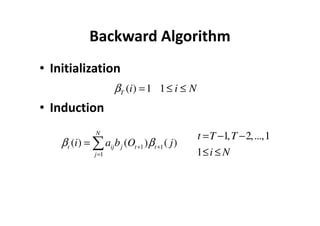
• Initialization
                      βT (i ) = 1 1 ≤ i ≤ N
• Induction
                N
                                                t = T −1, T − 2, ...,1
    βt (i ) = ∑ aij b j (Ot +1 ) β t +1 ( j )
               j =1                             1≤ i ≤ N
Backward Algorithm
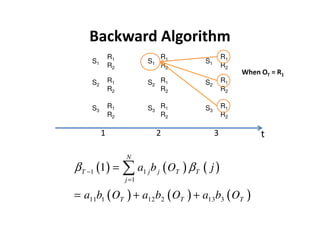
             R1               R1             R1
    S1                   S1         S1
             R2               R2             R2
                                                  When OT = R1
    S2       R1          S2 R1      S2       R1
             R2             R2               R2

    S3       R1          S3 R1      S3       R1
             R2             R2               R2

         1                    2          3             t

                  N
β T −1 (1) = ∑ a1 j b j ( OT ) β T ( j )
                  j =1

= a11b1 ( OT ) + a12 b2 ( OT ) + a13b3 ( OT )
Solution 2
• 怎樣的狀態序列最能解釋觀察到的現
  象和已知的模型
  P(狀態序列|觀察到的現象, 模型)

• 無精確解,有很多種方式解此問題,
  對狀態序列的不同限制有不同的解法
  對狀態序列的不同限制
Solution 2
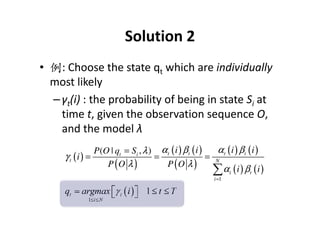
• 例: Choose the state qt which are individually
  most likely
  – γt(i) : the probability of being in state Si at
    time t, given the observation sequence O,
    and the model λ
                P (O | qt = Si , λ ) α t ( i ) βt ( i )    α t ( i ) βt ( i )
     γ t (i ) =                     =                   = N
                    P (O λ )           P (O λ )
                                                         ∑ α t ( i ) βt ( i )
                                                           i =1

     qt = argmax γ t ( i )  1 ≤ t ≤ T
                           
             1≤i ≤ N
Viterbi algorithm
• The most widely used criteria is to find
  the “single best state sequence”
     maxmize P ( Q | O, λ ) ≈ maxmize P ( Q, O | λ )


• A formal technique exists, based on
  dynamic programming methods, and is
  called the Viterbi algorithm
Viterbi algorithm
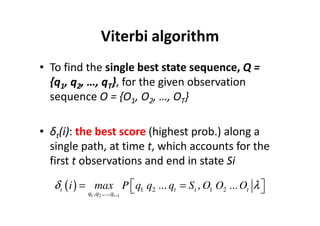
• To find the single best state sequence, Q =
  {q1, q2, …, qT}, for the given observation
  sequence O = {O1, O2, …, OT}

• δt(i): the best score (highest prob.) along a
  single path, at time t, which accounts for the
  first t observations and end in state Si
   δ t ( i ) = max P  q1 q2 ... qt = Si , O1 O2 ... Ot λ 
                                                         
            1 q , q ,..., q
                2   t −1
Viterbi algorithm
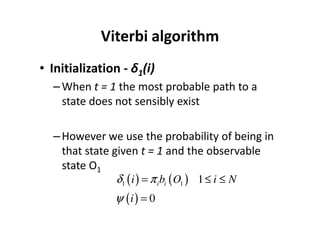
• Initialization - δ1(i)
  – When t = 1 the most probable path to a
    state does not sensibly exist

  – However we use the probability of being in
    that state given t = 1 and the observable
    state O1
                δ1 ( i ) = π i bi ( O1 ) 1 ≤ i ≤ N
               ψ (i ) = 0
Viterbi algorithm
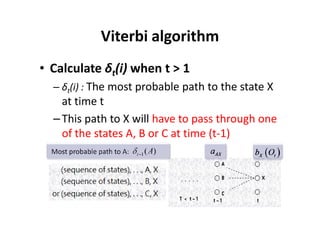
• Calculate δt(i) when t > 1
  – δt(i) : The most probable path to the state X
    at time t
  – This path to X will have to pass through one
    of the states A, B or C at time (t-1)
  Most probable path to A: δ t −1 ( A)   a AX   bX ( Ot )
Viterbi algorithm
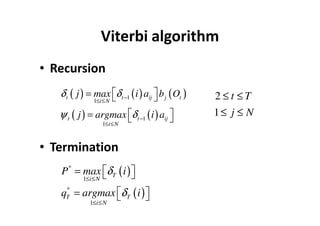
• Recursion
   δ t ( j ) = max δ t −1 ( i ) aij  b j ( Ot )
                                                  2≤t ≤T
               1≤ i ≤ N

   ψ t ( j ) = argmax δ t −1 ( i ) aij            1≤ j ≤ N
                      
                     1≤ i ≤ N
                                        

• Termination
   P* = max δ T ( i ) 
                      
           1≤i ≤ N

   q = argmax δ T ( i ) 
     *
     T                  
             1≤i ≤ N
Viterbi algorithm
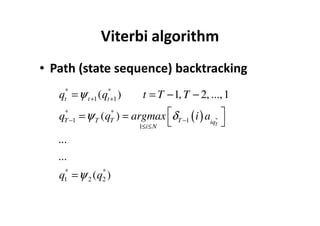
• Path (state sequence) backtracking
   qt* = ψ t +1 (qt*+1 )   t = T − 1, T − 2, ..., 1
   qT −1 = ψ T (qT ) = argmax δ T −1 ( i ) aiq* 
    *            *

                        1≤i ≤ N               T 


   ...
   ...
    *         *
   q1 = ψ 2 (q2 )
Solution 3
• 怎樣的模型 λ = (A, B, π) 最有可能產生
  觀察到的現象
   what 模型 maximize P(觀察到的現象|
  模型)
• There is no known analytic solution. We
  can choose λ = (A, B, π) such that P(O| λ)
  is locally maximized using an iterative
  procedure
Baum-Welch Method
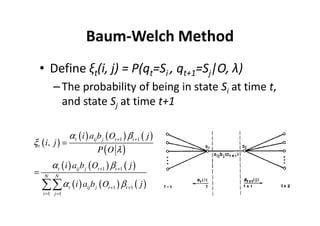
    • Define ξt(i, j) = P(qt=Si , qt+1=Sj|O, λ)
         – The probability of being in state Si at time t,
           and state Sj at time t+1

              α t ( i ) aij b j ( Ot +1 ) βt +1 ( j )
ξt ( i, j ) =
                            P (O λ )
         α t ( i ) aij b j ( Ot +1 ) βt +1 ( j )
=    N    N

    ∑∑ α ( i ) a b ( O ) β ( j )
    i =1 j =1
                t        ij   j    t +1    t +1
Baum-Welch Method
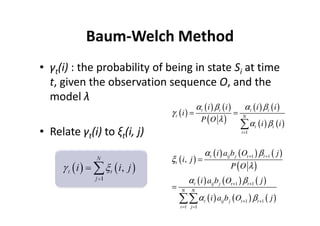
• γt(i) : the probability of being in state Si at time
  t, given the observation sequence O, and the
  model λ
                                              α t ( i ) βt ( i )    α ( i ) βt ( i )
                                 γ t (i ) =                      = N t
                                                P (O λ )
                                                                  ∑ α t ( i ) βt ( i )
• Relate γt(i) to ξt(i, j)                                         i =1


                                               α t ( i ) aij b j ( Ot +1 ) βt +1 ( j )
                N                ξt ( i, j ) =
     γ t ( i ) = ∑ ξt ( i, j )                               P (O λ )
                j =1                     α t ( i ) aij b j ( Ot +1 ) βt +1 ( j )
                                 =   N    N

                                     ∑∑ α ( i ) a b ( O ) β ( j )
                                     i =1 j =1
                                                 t       ij   j    t +1    t +1
Baum-Welch Method
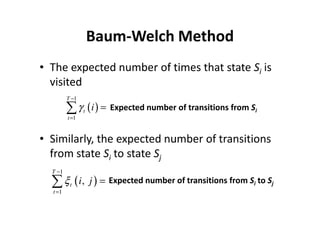
• The expected number of times that state Si is
  visited
         T −1

         ∑ γ ( i ) = Expected number of transitions from Si
         t =1
                t


• Similarly, the expected number of transitions
  from state Si to state Sj
  T −1

  ∑ ξ ( i, j ) = Expected number of transitions from S to S
  t =1
          t                                               i   j
Baum-Welch Method
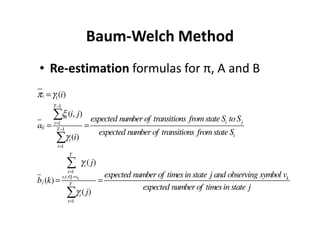
• Re-estimation formulas for π, A and B
π i = γ1(i)
        T −1

        ∑ξ (i, j)
        t =1
                 t
                                     expected number of transitions from state Si to S j
aij =     T −1
                                 =
                                        expected number of transitions from state Si
         ∑γt (i)
          t =1
                     T

                  ∑t =1
                             γ t ( j)
               s.t. Ot =vk                expected number of times in state j and observing symbol vk
b j (k) =           T
                                        =
                                                     expected number of times in state j
                  ∑γ ( j)
                     t =1
                             t
Baum-Welch Method
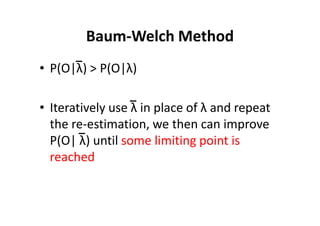
• P(O|λ) > P(O|λ)

• Iteratively use λ in place of λ and repeat
  the re-estimation, we then can improve
  P(O| λ) until some limiting point is
  reached

An Introduction to Hidden Markov Model

  • 1.
    An Introduction toHMM Browny 2010.07.21
  • 2.
    MM vs. HMM States States Observations
  • 3.
    Markov Model • Given3 weather states: – {S1, S2, S3} = {rain, cloudy, sunny} Rain Cloudy Sunny Rain 0.4 0.3 0.3 Cloudy 0.2 0.6 0.2 Sunny 0.1 0.1 0.8 • What is the probabilities for next 7 days will be {sun, sun, rain, rain, sun, cloud, sun} ?
  • 4.
    Hidden Markov Model •The states – We don’t understand, Hidden! – But it can be indirectly observed • Example – 北極or赤道(model), Hot/Cold(state), 1/2/3 ice cream(observation)
  • 5.
    Hidden Markov Model •The observation is a probability function of state which is not observable directly Hidden States
  • 6.
    HMM Elements • N,the number of states in the model • M, the number of distinct observation symbols • A, the state transition probability distribution • B, the observation symbol probability distribution in states • π, the initial state distribution λ: model
  • 7.
    Example P(…|C) P(…|H) P(…|Start) P(1|…) 0.7 0.1 P(2|…) 0.2 B: 0.2 Observation P(3|…) 0.1 0.7 P(C|…) 0.8 0.1 0.5 A: π: P(H|…) 0.1 0.8 0.5 Transition initial P(STOP|…) 0.1 0.1 0
  • 8.
  • 9.
    3 Problems 1. 觀察到的現象最符合哪一個模型 P(觀察到的現象|模型) 2. 怎樣的狀態序列最符合觀察到的現 象和已知的模型 P(狀態序列|觀察到的現象, 模型) 3. 怎樣的模型最有可能產生觀察到的 現象 what 模型 maximize P(觀察到的現象| 模型)
  • 10.
    Solution 1 • 已知模型,一觀察序列之產生機率P(O|λ) R1 R1 R1 S1 S1 S1 R2 R2 R2 S2 R1 S2 R1 S2 R1 R2 R2 R2 S3 R1 S3 R1 S3 R1 R2 R2 R2 1 2 3 t 觀察到 R1 R1 R2 的機率為多少?
  • 11.
    Solution 1 • 考慮一特定的狀態序列 Q = q1, q2 … qT • 產生出一特定觀察序列之機率為 P(O|Q, λ) = P(O1|q1, λ) * P(O2|q2, λ) * … * P(Ot|qt, λ) = bq1(O1) * bq2(O2) * … * bqT(OT)
  • 12.
    Solution 1 • 此一特定序列發生之機率為 P(Q|λ) = πq1 * aq1q2 * aq2q3 * … * aq(T-1)qT • 已知模型,一觀察序列之產生機率 P(O|λ) P(O|λ) = ,q∑ q P(O|Q, λ) * P(Q| λ) q ,..., 1 2 T = q ,q∑ q πq1 * bq1(O1) * aq1q2 bq2(O2)* … * aq(T-1)qT * bqT(OT) ,..., 1 2 T
  • 13.
    Solution 1 狀態的數量) • Complexity (N: 狀態的數量 – 2T*NT ≈ (2T-1)NT muls + NT-1 adds (NT:狀態轉換 組合數) – For N=5 states, T=100 observations, there are order 2*100*5100 ≈ 1072 computations!! • Forward Algorithm – Forward variable αt(i) (給定時間 t 時狀態為 Si 的 條件下,向前 向前局部觀察序列為O1, O2, O3…, Ot 的 向前 機率) at (i ) = P(O1 , O2 ,..., Ot , qt = Si | λ )
  • 14.
    Solution 1 R1 R1 R1 S1 S1 S1 R2 R2 R2 When O1 = R1 S2 R1 S2 R1 S2 R1 R2 R2 R2 S3 R1 S3 R1 S3 R1 R2 R2 R2 1 2 3 t α1 ( i ) = π i bi ( O1 ) 1 ≤ i ≤ N α 2 (1) = α1 (1) a11 + α1 ( 2 ) a21 + α1 ( 3) a31  b1 ( O2 )   α1 (1) = π 1b1 (O1 ) α1 (2) = π 2b2 (O1 ) α 2 ( 2 ) = α1 (1) a12 + α1 ( 2 ) a22 + α1 ( 3) a32  b2 ( O2 )   α1 (3) = π 3b3 (O1 )
  • 15.
    Forward Algorithm • Initialization: α1 (i ) = π i bi (O1 ) 1 ≤ i ≤ N • Induction: N  1 ≤ t ≤ T −1 αt +1 ( j ) = ∑αt ( i ) aij  bj ( Ot +1 ) 1 ≤ j ≤ N  i=1  • Termination: N P(O | λ ) = ∑ αT (i ) i =1
  • 16.
    Backward Algorithm • ForwardAlgorithm at (i ) = P(O1 , O2 ,..., Ot , qt = Si | λ ) • Backward Algorithm – 給定時間 t 時狀態為 Si 的條件下,向後 向後局 向後 部觀察序列為 Ot+1, Ot+2, …, OT的機率 βt (i ) = P(Ot +1 , Ot + 2 ,..., OT , qt = Si | λ )
  • 17.
    Backward Algorithm • Initialization βT (i ) = 1 1 ≤ i ≤ N • Induction N t = T −1, T − 2, ...,1 βt (i ) = ∑ aij b j (Ot +1 ) β t +1 ( j ) j =1 1≤ i ≤ N
  • 18.
    Backward Algorithm R1 R1 R1 S1 S1 S1 R2 R2 R2 When OT = R1 S2 R1 S2 R1 S2 R1 R2 R2 R2 S3 R1 S3 R1 S3 R1 R2 R2 R2 1 2 3 t N β T −1 (1) = ∑ a1 j b j ( OT ) β T ( j ) j =1 = a11b1 ( OT ) + a12 b2 ( OT ) + a13b3 ( OT )
  • 19.
    Solution 2 • 怎樣的狀態序列最能解釋觀察到的現 象和已知的模型 P(狀態序列|觀察到的現象, 模型) • 無精確解,有很多種方式解此問題, 對狀態序列的不同限制有不同的解法 對狀態序列的不同限制
  • 20.
    Solution 2 • 例:Choose the state qt which are individually most likely – γt(i) : the probability of being in state Si at time t, given the observation sequence O, and the model λ P (O | qt = Si , λ ) α t ( i ) βt ( i ) α t ( i ) βt ( i ) γ t (i ) = = = N P (O λ ) P (O λ ) ∑ α t ( i ) βt ( i ) i =1 qt = argmax γ t ( i )  1 ≤ t ≤ T   1≤i ≤ N
  • 21.
    Viterbi algorithm • Themost widely used criteria is to find the “single best state sequence” maxmize P ( Q | O, λ ) ≈ maxmize P ( Q, O | λ ) • A formal technique exists, based on dynamic programming methods, and is called the Viterbi algorithm
  • 22.
    Viterbi algorithm • Tofind the single best state sequence, Q = {q1, q2, …, qT}, for the given observation sequence O = {O1, O2, …, OT} • δt(i): the best score (highest prob.) along a single path, at time t, which accounts for the first t observations and end in state Si δ t ( i ) = max P  q1 q2 ... qt = Si , O1 O2 ... Ot λ    1 q , q ,..., q 2 t −1
  • 23.
    Viterbi algorithm • Initialization- δ1(i) – When t = 1 the most probable path to a state does not sensibly exist – However we use the probability of being in that state given t = 1 and the observable state O1 δ1 ( i ) = π i bi ( O1 ) 1 ≤ i ≤ N ψ (i ) = 0
  • 24.
    Viterbi algorithm • Calculateδt(i) when t > 1 – δt(i) : The most probable path to the state X at time t – This path to X will have to pass through one of the states A, B or C at time (t-1) Most probable path to A: δ t −1 ( A) a AX bX ( Ot )
  • 25.
    Viterbi algorithm • Recursion δ t ( j ) = max δ t −1 ( i ) aij  b j ( Ot )   2≤t ≤T 1≤ i ≤ N ψ t ( j ) = argmax δ t −1 ( i ) aij  1≤ j ≤ N  1≤ i ≤ N  • Termination P* = max δ T ( i )    1≤i ≤ N q = argmax δ T ( i )  * T   1≤i ≤ N
  • 26.
    Viterbi algorithm • Path(state sequence) backtracking qt* = ψ t +1 (qt*+1 ) t = T − 1, T − 2, ..., 1 qT −1 = ψ T (qT ) = argmax δ T −1 ( i ) aiq*  * * 1≤i ≤ N  T  ... ... * * q1 = ψ 2 (q2 )
  • 27.
    Solution 3 • 怎樣的模型λ = (A, B, π) 最有可能產生 觀察到的現象 what 模型 maximize P(觀察到的現象| 模型) • There is no known analytic solution. We can choose λ = (A, B, π) such that P(O| λ) is locally maximized using an iterative procedure
  • 28.
    Baum-Welch Method • Define ξt(i, j) = P(qt=Si , qt+1=Sj|O, λ) – The probability of being in state Si at time t, and state Sj at time t+1 α t ( i ) aij b j ( Ot +1 ) βt +1 ( j ) ξt ( i, j ) = P (O λ ) α t ( i ) aij b j ( Ot +1 ) βt +1 ( j ) = N N ∑∑ α ( i ) a b ( O ) β ( j ) i =1 j =1 t ij j t +1 t +1
  • 29.
    Baum-Welch Method • γt(i): the probability of being in state Si at time t, given the observation sequence O, and the model λ α t ( i ) βt ( i ) α ( i ) βt ( i ) γ t (i ) = = N t P (O λ ) ∑ α t ( i ) βt ( i ) • Relate γt(i) to ξt(i, j) i =1 α t ( i ) aij b j ( Ot +1 ) βt +1 ( j ) N ξt ( i, j ) = γ t ( i ) = ∑ ξt ( i, j ) P (O λ ) j =1 α t ( i ) aij b j ( Ot +1 ) βt +1 ( j ) = N N ∑∑ α ( i ) a b ( O ) β ( j ) i =1 j =1 t ij j t +1 t +1
  • 30.
    Baum-Welch Method • Theexpected number of times that state Si is visited T −1 ∑ γ ( i ) = Expected number of transitions from Si t =1 t • Similarly, the expected number of transitions from state Si to state Sj T −1 ∑ ξ ( i, j ) = Expected number of transitions from S to S t =1 t i j
  • 31.
    Baum-Welch Method • Re-estimationformulas for π, A and B π i = γ1(i) T −1 ∑ξ (i, j) t =1 t expected number of transitions from state Si to S j aij = T −1 = expected number of transitions from state Si ∑γt (i) t =1 T ∑t =1 γ t ( j) s.t. Ot =vk expected number of times in state j and observing symbol vk b j (k) = T = expected number of times in state j ∑γ ( j) t =1 t
  • 32.
    Baum-Welch Method • P(O|λ)> P(O|λ) • Iteratively use λ in place of λ and repeat the re-estimation, we then can improve P(O| λ) until some limiting point is reached