한국정보과학회)|
                   한국정보과학회
KISS ILVB Tutorial(한국정보과학회 2005.04.16 |Seoul


    Introduction to Hidden Markov Model
    and Its Application


                                April 16, 2005

                            Dr. Sung-Jung Cho
                       sung-jung.cho@samsung.com
               Samsung Advanced Institute of Technology (SAIT)


April 16, 2005, S.-J. Cho                                        1


Contents
•   Introduction
•   Markov Model
•   Hidden Markov model (HMM)
•   Three algorithms of HMM
     – Model evaluation
     – Most probable path decoding
     – Model training
• Pattern classification by HMM
• Application of HMM to on-line handwriting recognition
  with HMM toolbox for Matlab
• Summary
• References

April 16, 2005, S.-J. Cho                                        2
Sequential Data
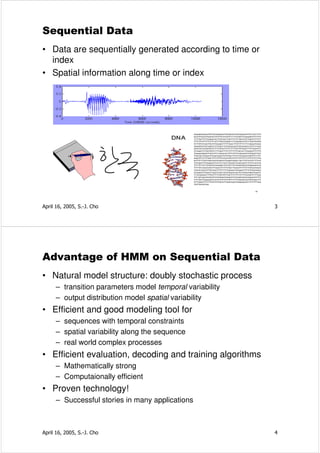
• Data are sequentially generated according to time or
  index
• Spatial information along time or index


April 16, 2005, S.-J. Cho                                  3


Advantage of HMM on Sequential Data
• Natural model structure: doubly stochastic process
     – transition parameters model temporal variability
     – output distribution model spatial variability
• Efficient and good modeling tool for
     – sequences with temporal constraints
     – spatial variability along the sequence
     – real world complex processes
• Efficient evaluation, decoding and training algorithms
     – Mathematically strong
     – Computaionally efficient
• Proven technology!
     – Successful stories in many applications


April 16, 2005, S.-J. Cho                                  4
Successful Application Areas of HMM
•   On-line handwriting recognition
•   Speech recognition
•   Gesture recognition
•   Language modeling
•   Motion video analysis and tracking
•   Protein sequence/gene sequence alignment
•   Stock price prediction
•   …


April 16, 2005, S.-J. Cho                                 5


What’s HMM?


                   Hidden Markov Model


             Hidden         +     Markov Model


       What is ‘hidden’?        What is ‘Markov model’?


April 16, 2005, S.-J. Cho                                 6
Markov Model


           •    Scenario
           •    Graphical representation
           •    Definition
           •    Sequence probability
           •    State probability


April 16, 2005, S.-J. Cho                                    7


Markov Model: Scenario
• Classify a weather into three states
     – State 1: rain or snow
     – State 2: cloudy
     – State 3: sunny
• By carefully examining the weather of some city for a
  long time, we found following weather change pattern
                                        Tomorrow
                            Rain/snow      Cloudy   Sunny
    Tod        Rain/Snow       0.4          0.3       0.3
     ay
                Cloudy         0.2          0.6       0.2
                 Sunny         0.1          0.1       0.8

   Assumption: tomorrow weather depends only on today one!

April 16, 2005, S.-J. Cho                                    8
Markov Model: Graphical Representation
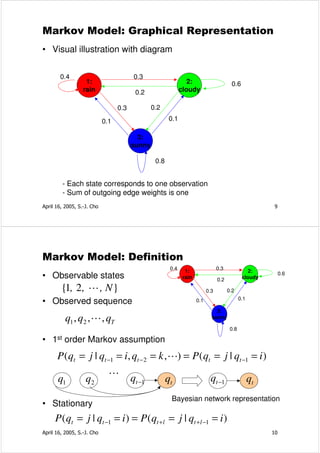
• Visual illustration with diagram


       0.4                               0.3
                   1:                                            2:                      0.6
                  rain                   0.2                  cloudy

                                  0.3           0.2

                            0.1                         0.1

                                          3:
                                        sunny

                                                 0.8


        - Each state corresponds to one observation
        - Sum of outgoing edge weights is one
April 16, 2005, S.-J. Cho                                                                                  9


Markov Model: Definition
                                                        0.4     1:                0.3              2:          0.6
• Observable states                                            rain               0.2           cloudy

        {1, 2 , L , N }                                                     0.3         0.2
                                                                                               0.1
• Observed sequence                                                   0.1

                                                                                3:
          q1 , q2 , L , qT                                                    sunny

                                                                                         0.8

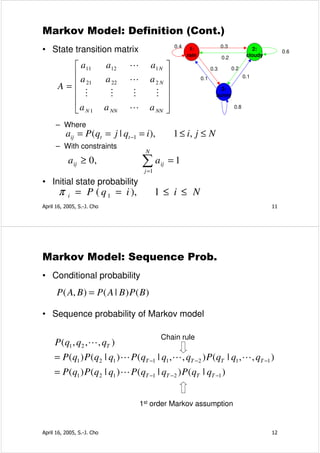
• 1st order Markov assumption
      P (qt = j | qt −1 = i, qt − 2 = k , L) = P ( qt = j | qt −1 = i )
                              L         qt −1                                qt −1
      q1           q2                                  qt                                            qt
                                                        Bayesian network representation
• Stationary
     P (qt = j | qt −1 = i ) = P ( qt +l = j | qt +l −1 = i )
April 16, 2005, S.-J. Cho                                                                                 10
Markov Model: Definition (Cont.)
                                                         0.4                      0.3
• State transition matrix                                       1:                                 2:         0.6
                                                               rain               0.2           cloudy

           a11             a12    L        a1 N                           0.3         0.2
          a                a 22   L        a2 N                     0.1                      0.1

      A =  21                                                                 3:
           M                 M    M          M                              sunny
                                                    
          a N1             a NN   L        a NN                                        0.8


     – Where
           aij = P (qt = j | qt −1 = i ),                1 ≤ i, j ≤ N
     – With constraints
                                        N
           a ij ≥ 0,                   ∑a
                                        j =1
                                                ij   =1

• Initial state probability
       π   i   = P ( q 1 = i ),                1≤ i ≤ N
April 16, 2005, S.-J. Cho                                                                                11


Markov Model: Sequence Prob.
• Conditional probability
      P ( A, B ) = P ( A | B ) P ( B )

• Sequence probability of Markov model

                                                Chain rule
     P ( q1 , q2 , L , qT )
     = P ( q1 ) P (q2 | q1 ) L P (qT −1 | q1 , L , qT − 2 ) P (qT | q1 , L , qT −1 )
     = P ( q1 ) P (q2 | q1 ) L P (qT −1 | qT − 2 ) P ( qT | qT −1 )


                                       1st order Markov assumption


April 16, 2005, S.-J. Cho                                                                                12
Markov Model: Sequence Prob. (Cont.)
• Question: What is the probability that the weather for the
  next 7 days will be “sun-sun-rain-rain-sun-cloudy-sun”
  when today is sunny?
   S1 : rain, S 2 : cloudy , S 3 : sunny
  P (O | model) = P ( S 3 , S 3 , S 3 , S1 , S1 , S 3 , S 2 , S 3 | model)
                      = P ( S 3 ) ⋅ P ( S 3 | S 3 ) ⋅ P ( S 3 | S 3 ) ⋅ P ( S1 | S 3 )
                        ⋅ P ( S1 | S1 ) P ( S 3 | S1 ) P ( S 2 | S 3 ) P ( S 3 | S 2 )
                      = π 3 ⋅ a33 ⋅ a33 ⋅ a31 ⋅ a11 ⋅ a13 ⋅ a32 ⋅ a23
                      = 1 ⋅ (0.8)(0.8)(0.1)(0.4)(0.3)(0.1)(0.2)
                      = 1.536 × 10 − 4                         0.4    1:
                                                                     rain
                                                                                         0.3              2:
                                                                                                       cloudy
                                                                                                                     0.6
                                                                                         0.2
                                                                                  0.3          0.2
                                                                            0.1                       0.1
                                                                                      3:
                                                                                    sunny

April 16, 2005, S.-J. Cho                                                                       0.8             13


Markov Model: State Probability
• State probability at time t : P ( qt = i )
           1      2         3          ...       t

   S1

   S2
    ...

    SN


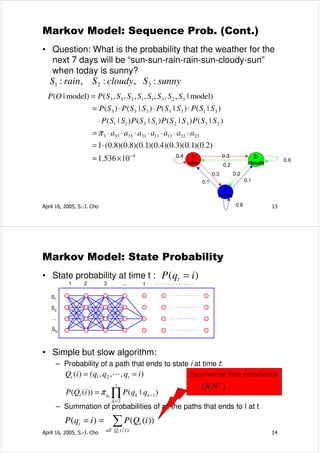
• Simple but slow algorithm:
      – Probability of a path that ends to state i at time t:
          Qt (i ) = ( q1 , q2 , L , qt = i )                          Exponential time complexity:
                                 t
                                                                            O( N t )
          P (Qt (i )) = π q1 ∏ P (qk | qk −1 )
                                k =2
      – Summation of probabilities of all the paths that ends to I at t
          P ( qt = i ) =        ∑ P(Q (i))
                            all Qt ( i )'s
                                             t
April 16, 2005, S.-J. Cho                                                                                       14
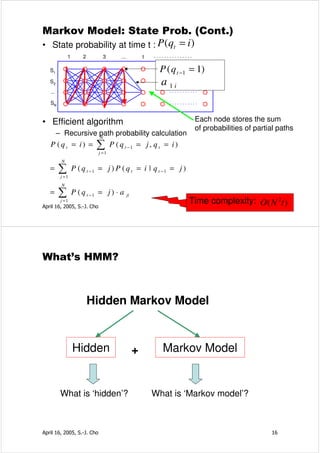
Markov Model: State Prob. (Cont.)
• State probability at time t : P ( qt = i )
              1       2       3        ...            t

   S1                                                      P ( q t −1 = 1)
   S2                                                       a 1i
   ...

   SN


• Efficient algorithm                                                 Each node stores the sum
                                                                      of probabilities of partial paths
         – Recursive path probability calculation
                     N
   P (qt = i) =            ∑j =1
                                   P ( q t −1 = j , q t = i )

          N
   =     ∑j =1
                  P ( q t −1 = j ) P ( q t = i | q t −1 = j )

          N
   =     ∑        P ( q t −1 = j ) ⋅ a       ji
          j =1                                                      Time complexity: O ( N 2t )
April 16, 2005, S.-J. Cho                                                                15


What’s HMM?


                          Hidden Markov Model


                  Hidden                          +         Markov Model


          What is ‘hidden’?                               What is ‘Markov model’?


April 16, 2005, S.-J. Cho                                                                      16
Hidden Markov Model


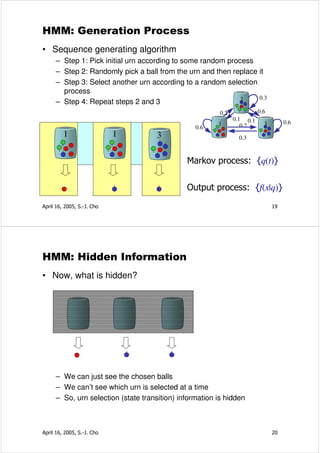
           •    Example
           •    Generation process
           •    Definition
           •    Model evaluation algorithm
           •    Path decoding algorithm
           •    Training algorithm
April 16, 2005, S.-J. Cho                                       17


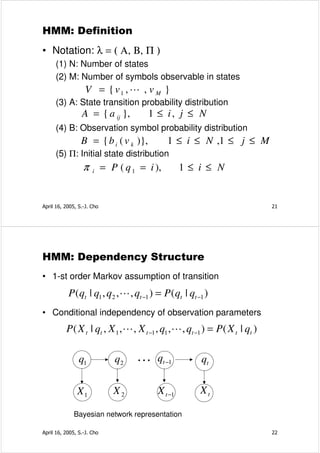
Hidden Markov Model: Example


                                        2           0.3

                            0.2                     0.6
                                  0.1         0.1
                        1                             3   0.6
         0.6                            0.2

                                    0.3


          • N urns containing color balls
          • M distinct colors
          • Each urn contains different number of color balls


April 16, 2005, S.-J. Cho                                       18
HMM: Generation Process
• Sequence generating algorithm
     – Step 1: Pick initial urn according to some random process
     – Step 2: Randomly pick a ball from the urn and then replace it
     – Step 3: Select another urn according to a random selection
       process
                                                             2    0.3
     – Step 4: Repeat steps 2 and 3
                                                         0.2             0.6
                                                               0.1 0.1
                                                        1                  3        0.6
                                                 0.6              0.2
         1                  1        3                          0.3


                                              Markov process: {q(t)}

                                              Output process: {f(x|q)}

April 16, 2005, S.-J. Cho                                                      19


HMM: Hidden Information
• Now, what is hidden?


     – We can just see the chosen balls
     – We can’t see which urn is selected at a time
     – So, urn selection (state transition) information is hidden


April 16, 2005, S.-J. Cho                                                      20
HMM: Definition
• Notation: λ = ( Α, Β, Π )
     (1) N: Number of states
     (2) M: Number of symbols observable in states
                   V = { v1 , L , v M }
     (3) A: State transition probability distribution
                 A = { a ij },          1 ≤ i, j ≤ N
     (4) B: Observation symbol probability distribution
                 B = { b i ( v k )},           1 ≤ i ≤ N ,1 ≤ j ≤ M
     (5) Π: Initial state distribution
                  π   i     = P ( q 1 = i ),        1≤ i ≤ N


April 16, 2005, S.-J. Cho                                                       21


HMM: Dependency Structure
• 1-st order Markov assumption of transition
           P ( qt | q1 , q2 , L , qt −1 ) = P ( qt | qt −1 )
• Conditional independency of observation parameters
          P ( X t | qt , X 1 , L , X t −1 , q1 , L , qt −1 ) = P ( X t | qt )

                q1             q2    L     qt −1         qt


               X1              X2          X t −1        Xt

              Bayesian network representation

April 16, 2005, S.-J. Cho                                                       22
HMM: Example Revisited
                                                                                       2                 0.3
• # of states: N=3
• # of observation: M=3                                                    0.2                         0.6
         V = { R, G, B }                                                            0.1 0.1
                                                                          1                                  3                 0.6
•        Initial state distribution                                0.6                 0.2

         π = { P ( q 1 = i )} = [1 , 0 , 0 ]                                          0.3
• State transition probability distribution
                            0 .6                  0 .2   0 .2 
            A = { a ij } =  0 . 1
                                                  0 .3   0 .6 
                                                               
                            0 .3
                                                  0 .1   0 .6 
                                                               
• Observation symbol probability distribution
•              3 / 6 2 / 6 1 / 6 
     B = { b i ( v k )} =  1 / 6
                                             3/6         2 / 6
                                                               
                          1 / 6
                                             1/6         4 / 6
                                                               
April 16, 2005, S.-J. Cho                                                                                          23


                                                                                                             0.3
HMM: Three Problems                                                                            2
                                                                                    0.2         0.6
                                                                                        0.1 0.1                             0.6
• What is the probability of generating                                  0.6        1     0.2     3

  an observation sequence?                                                                     0.3
                                                                           P(                                          )?
         – Model evaluation
    P ( X = x1 , x 2 , L , x T | λ ) = ?                                                           2             0.3
                                                                                     0.2         0.6
                                                                                         0.1 0.1                               0.6
• Given observation, what is the most                                     0.6        1     0.2     3

  probable transition sequence?                                                                    0.3

         – Segmentation or path analysis
     *
Q = arg max                 Q = ( q 1 ,L , q T )   P (Q , X | λ )               2          2                 2             2


• How do we estimate or optimize
  the parameters of an HMM?
                                                                                                         2
         – Training problem
P ( X | λ = ( A , B , π )) < P ( X | λ ' = ( A ' , B ' , π ' ))                        1                               3
April 16, 2005, S.-J. Cho                                                                                          24
Model Evaluation


                                    Forward algorithm
                                   Backward algorithm


April 16, 2005, S.-J. Cho                                                        25


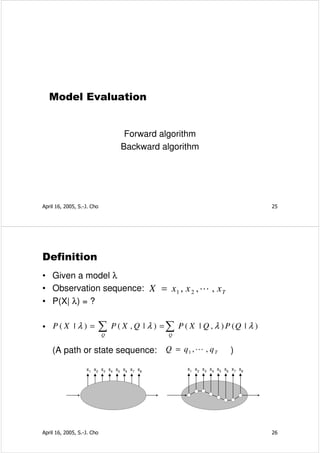
Definition
• Given a model λ
• Observation sequence: X = x 1 , x 2 , L , x T
• P(X| λ) = ?

• P(X | λ) =            ∑   Q
                                P ( X , Q | λ ) = ∑ P ( X | Q , λ ) P (Q | λ )
                                                  Q


    (A path or state sequence: Q = q 1 , L , q T                        )

                   x1 x2 x3 x4 x5 x6 x7 x8             x1 x2 x3 x4 x5 x6 x7 x8


April 16, 2005, S.-J. Cho                                                        26
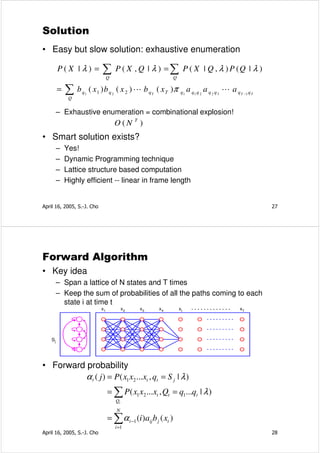
Solution
• Easy but slow solution: exhaustive enumeration

         P(X | λ) =          ∑    Q
                                      P ( X , Q | λ ) = ∑ P ( X | Q , λ ) P (Q | λ )
                                                                  Q

         =   ∑b
              Q
                  q1   ( x 1 ) b q 2 ( x 2 ) L b q T ( x T ) π q 1 a q 1 q 2 a q 2 q 3 L a q T −1 q T

         – Exhaustive enumeration = combinational explosion!
                                      O(N T )
• Smart solution exists?
         –   Yes!
         –   Dynamic Programming technique
         –   Lattice structure based computation
         –   Highly efficient -- linear in frame length


April 16, 2005, S.-J. Cho                                                                               27


Forward Algorithm
• Key idea
         – Span a lattice of N states and T times
         – Keep the sum of probabilities of all the paths coming to each
           state i at time t
                             x1            x2   x3      x4            xt                      xT


    Sj


• Forward probability
         α t ( j ) = P( x1 x2 ...xt , qt = S j | λ )
                                  = ∑ P( x1 x2 ...xt , Qt = q1...qt | λ )
                                      Qt
                                      N
                                  = ∑ α t −1 (i )aij b j ( xt )
                                      i =1
April 16, 2005, S.-J. Cho                                                                               28
Forward Algorithm
• Initialization
          α1 (i ) = π i bi (x1 )                        1≤ i ≤ N

• Induction
                            N
           α t ( j ) = ∑ α t −1 (i)aij b j (x t )                 1 ≤ j ≤ N , t = 2, 3, L, T
                        i =1

• Termination
                                N
           P ( X | λ ) = ∑ α T (i )
                                i =1       x1      x2        x3       x4        xt                    xT


                Sj


April 16, 2005, S.-J. Cho                                                                                  29


Numerical Example: P(RRGB|λ) [신봉기 03]


   π =[1 0 0]T
                                       R                 R                  G                B

 .5           R .6
              G .2          1×.6                .5×.6               .5×.2            .5×.2
                                           .6             .18                .018            .0018
              B .2
      .4                                         .4×.2              .4×.5            .4×.3
 .6        .1 .2
                            0×.2                .6×.2         .6×.5          .6×.3
              .5                           .0           .048          .0504         .01123
              .3                                    .1×.0       .1×.3          .1×.7
      .4                                        .4×.0        .4×.3          .4×.7
                 .0         0×.0
                 .3                        .0                .0             .01116           .01537
                 .7


April 16, 2005, S.-J. Cho                                                                                  30
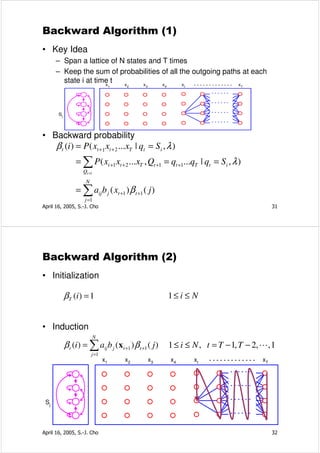
Backward Algorithm (1)
• Key Idea
      – Span a lattice of N states and T times
      – Keep the sum of probabilities of all the outgoing paths at each
        state i at time t
                      x    x     x     x      x               x
                                      1   2      3        4        t                 T


       Sj


• Backward probability
   β t (i ) = P( xt +1 xt + 2 ...xT | qt = Si , λ )
                 = ∑ P( xt +1 xt + 2 ...xT , Qt +1 = qt +1...qT | qt = Si , λ )
                    Qt +1
                      N
                 = ∑ aij b j ( xt +1 ) β t +1 ( j )
                   j =1
April 16, 2005, S.-J. Cho                                                                       31


Backward Algorithm (2)
• Initialization

            β T (i ) = 1                                      1≤ i ≤ N


• Induction
                            N
            β t (i ) = ∑ aij b j (x t +1 ) β t +1 ( j )       1 ≤ i ≤ N , t = T − 1, T − 2, L, 1
                          j =1
                                 x1       x2         x3       x4       xt                  xT


 Sj


April 16, 2005, S.-J. Cho                                                                       32
The Most Probable Path Decoding


                                State sequence
                                  Optimal path
                                Viterbi algorithm
                             Sequence segmentation


April 16, 2005, S.-J. Cho                                               33


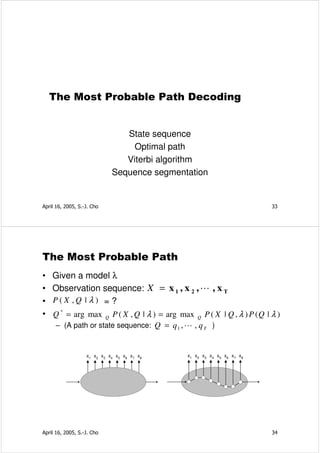
The Most Probable Path
•   Given a model λ
•   Observation sequence: X = x 1 , x 2 , L , x T
•   P(X ,Q | λ) = ?
•   Q * = arg max Q P ( X , Q | λ ) = arg max Q P ( X | Q , λ ) P ( Q | λ )
     – (A path or state sequence: Q = q 1 , L , q T )


                   x1 x2 x3 x4 x5 x6 x7 x8    x1 x2 x3 x4 x5 x6 x7 x8


April 16, 2005, S.-J. Cho                                               34
Viterbi Algorithm
• Purpose
     – An analysis for internal processing result
     – The best, the most likely state sequence
     – Internal segmentation


• Viterbi Algorithm
     – Alignment of observation and state transition
     – Dynamic programming technique


April 16, 2005, S.-J. Cho                                                                35


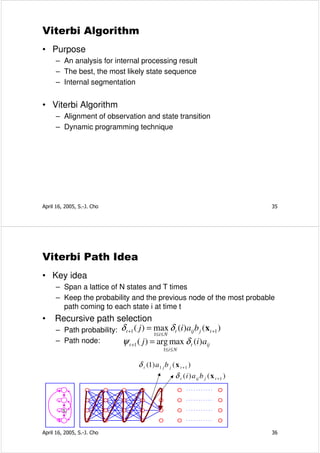
Viterbi Path Idea
• Key idea
     – Span a lattice of N states and T times
     – Keep the probability and the previous node of the most probable
       path coming to each state i at time t
•    Recursive path selection
     – Path probability: δ t +1 ( j ) = max δ t (i ) aij b j ( x t +1 )
                                              1≤ i ≤ N
     – Path node:              ψ t +1 ( j ) = arg max δ t (i)aij
                                                   1≤ i ≤ N


                                      δ t (1) a1 j b j ( x t + 1 )
                                       t       t+1
                                                        δ t ( i ) a ij b j ( x t + 1 )


        Sj


April 16, 2005, S.-J. Cho                                                                36
Viterbi Algorithm
• Introduction:                                δ 1 (i ) = π i bi (x1 )
                                               ψ 1 (i ) = 0
• Recursion:
                                               δ t +1 ( j ) = max δ t (i )aij b j (x t +1 )
                                                              1≤ i ≤ N
                                               ψ t +1 ( j ) = arg max δ t (i)aij
                                                                        1≤ i ≤ N

• Termination:                                 P ∗ = max δ T (i )
                                                     1≤i ≤ N
                                                ∗
                                               qT = arg max δ T (i )
                                                              1≤i ≤ N
• Path backtracking:                           q = ψ t +1 (qt∗+1 ), t = T − 1,K ,1
                                                 ∗
                                                 t


                            1

               states       2
                            3

April 16, 2005, S.-J. Cho                                                                              37


Numerical Example: P(RRGB,Q*|λ) [신봉기 03]


   π =[1 0 0]T
                                   R                 R                       G                B

 .5           R .6
              G .2          1×.6            .5×.6                .5×.2                .5×.2
                                       .6            .18                       .018           .0018
              B .2
      .4                                     .4×.2                .4×.5               .4×.3
 .6        .1 .2
                            0×.2            .6×.2         .6×.5         .6×.3
              .5                       .0           .048          .036         .00648
              .3                                .1×.0       .1×.3         .1×.7
      .4                                    .4×.0        .4×.3         .4×.7
                 .0         0×.0
                 .3                    .0                .0                  .00576           .01008
                 .7


April 16, 2005, S.-J. Cho                                                                              38
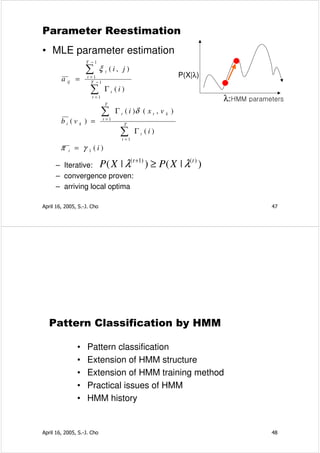
Parameter Reestimation

                               HMM training algorithm
                            Maximum likelihood estimation
                             Baum-Welch reestimation


April 16, 2005, S.-J. Cho                                                       39


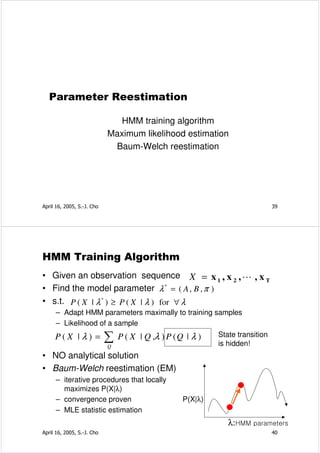
HMM Training Algorithm
• Given an observation sequence X = x 1 , x 2 , L , x T
• Find the model parameter λ * = ( A , B , π )
• s.t. P ( X | λ * ) ≥ P ( X | λ ) for ∀ λ
     – Adapt HMM parameters maximally to training samples
     – Likelihood of a sample
     P(X | λ) =             ∑
                            Q
                                P ( X | Q ,λ ) P ( Q | λ )   State transition
                                                             is hidden!
• NO analytical solution
• Baum-Welch reestimation (EM)
     – iterative procedures that locally
       maximizes P(X|λ)
     – convergence proven                           P(X|λ)
     – MLE statistic estimation
                                                                λ:HMM parameters
April 16, 2005, S.-J. Cho                                                       40
Maximum Likelihood Estimation
• MLE “selects those parameters that maximizes the
  probability function of the observed sample.”

• [Definition] Maximum Likelihood Estimate
     – Θ: a set of distribution parameters
     – Given X, Θ* is maximum likelihood estimate of Θ if
     –        f(X|Θ*) = maxΘ f(X|Θ)


April 16, 2005, S.-J. Cho                                   41


MLE Example
• Scenario
     – Known: 3 balls inside urn
     –   (some red; some white)
     – Unknown: R = # red balls
     – Observation:      (two reds)


• Two models                  2  1    3 1
     –P (          |R=2) =  2   0 
                                       =
                                          2 3
                                       
                             3     3
     –P (          |R=3) =  
                                     =1
                                     2
                             2      
• Which model?
     – L (λ R = 3 ) > L (λ R = 2 )
     – Model(R=3) is our choice

April 16, 2005, S.-J. Cho                                   42
MLE Example (Cont.)
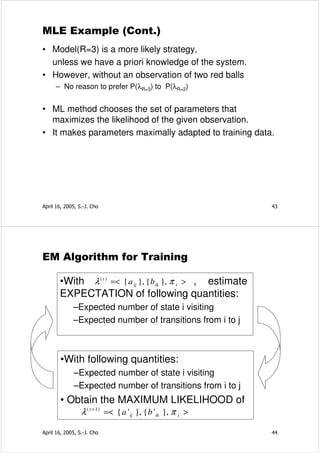
• Model(R=3) is a more likely strategy,
  unless we have a priori knowledge of the system.
• However, without an observation of two red balls
     – No reason to prefer P(λR=3) to P(λR=2)


• ML method chooses the set of parameters that
  maximizes the likelihood of the given observation.
• It makes parameters maximally adapted to training data.


April 16, 2005, S.-J. Cho                                       43


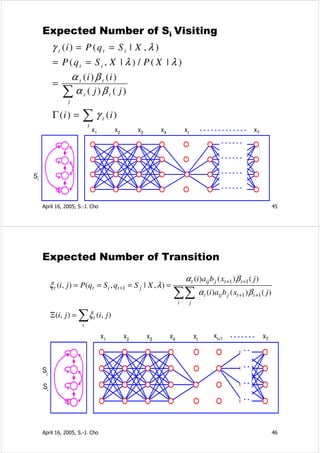
EM Algorithm for Training

       •With λ ( t ) =< { a ij }, { b ik }, π i > , estimate
       EXPECTATION of following quantities:
             –Expected number of state i visiting
             –Expected number of transitions from i to j


        •With following quantities:
              –Expected number of state i visiting
              –Expected number of transitions from i to j
        • Obtain the MAXIMUM LIKELIHOOD of
                 λ ( t + 1 ) =< { a ' ij }, { b ' ik }, π i >

April 16, 2005, S.-J. Cho                                       44
Expected Number of Si Visiting
          γ t (i ) = P ( q t = S i | X , λ )
          = P (qt = S i , X | λ ) / P ( X | λ )
                  α t (i ) β t (i )
          =
              ∑ α t ( j)β t ( j)
                 j

           Γ (i ) =      ∑γ  t
                                      t    (i )
                                 x1           x2        x3        x4            xt                                  xT


Si


     April 16, 2005, S.-J. Cho                                                                                                    45


     Expected Number of Transition

                                                                                α t (i )aij b j ( xt +1 ) β t +1 ( j )
          ξ t (i, j ) = P(qt = S i , qt +1 = S j | X , λ ) =
                                                                        ∑∑ α (i)a b ( x
                                                                            i        j
                                                                                              i     ij j   t +1 ) β t +1 (   j)

          Ξ (i, j ) =   ∑ξ (i, j)
                         t
                                 t


                                      x1           x2        x3        x4                xt       xt+1                   xT


     Sj

     Si


     April 16, 2005, S.-J. Cho                                                                                                    46
Parameter Reestimation
• MLE parameter estimation
                    T −1

                    ∑
                    t =1
                            ξ t (i, j )
                                                                  P(X|λ)
        a ij =        T −1

                     ∑        Γt (i)
                      t =1
                              T
                                                                              λ:HMM parameters
                             ∑
                             t =1
                                    Γ t ( i )δ ( x t , v k )
        bi (v k ) =                    T

                                      ∑
                                      t =1
                                               Γt (i)

        π   i   = γ 1 (i)
                                             ( t +1)
     – Iterative: P ( X | λ                            ) ≥ P ( X | λ( t ) )
     – convergence proven:
     – arriving local optima

April 16, 2005, S.-J. Cho                                                                 47


  Pattern Classification by HMM

                •   Pattern classification
                •   Extension of HMM structure
                •   Extension of HMM training method
                •   Practical issues of HMM
                •   HMM history


April 16, 2005, S.-J. Cho                                                                 48
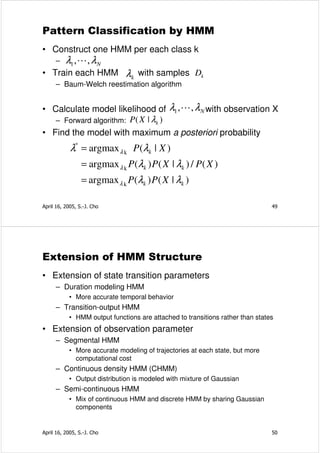
Pattern Classification by HMM
• Construct one HMM per each class k
     –    λ1 ,L , λN
• Train each HMM              λk with samples Dk
     – Baum-Welch reestimation algorithm


• Calculate model likelihood of λ1 , L , λN with observation X
   – Forward algorithm: P ( X | λk )
• Find the model with maximum a posteriori probability
            λ* = argmax λ k P(λk | X )
               = argmax λ k P(λk ) P ( X | λk ) / P( X )
               = argmax λ k P(λk ) P ( X | λk )

April 16, 2005, S.-J. Cho                                                      49


Extension of HMM Structure
• Extension of state transition parameters
     – Duration modeling HMM
           • More accurate temporal behavior
     – Transition-output HMM
           • HMM output functions are attached to transitions rather than states
• Extension of observation parameter
     – Segmental HMM
           • More accurate modeling of trajectories at each state, but more
             computational cost
     – Continuous density HMM (CHMM)
           • Output distribution is modeled with mixture of Gaussian
     – Semi-continuous HMM
           • Mix of continuous HMM and discrete HMM by sharing Gaussian
             components


April 16, 2005, S.-J. Cho                                                      50
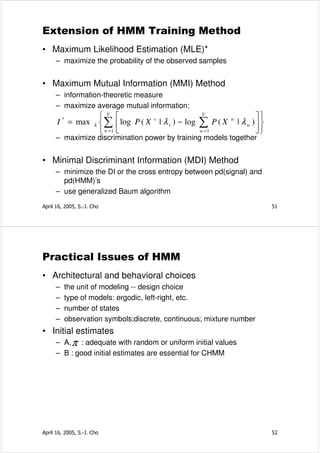
Extension of HMM Training Method
• Maximum Likelihood Estimation (MLE)*
     – maximize the probability of the observed samples


• Maximum Mutual Information (MMI) Method
     – information-theoretic measure
     – maximize average mutual information:
                 V                                   V
                                                                         
      I = max λ  ∑  log P ( X
         *                         v
                                       | λ v ) − log   ∑ P(X   w
                                                                   | λw ) 
                 ν =1                                w =1              
     – maximize discrimination power by training models together


• Minimal Discriminant Information (MDI) Method
     – minimize the DI or the cross entropy between pd(signal) and
       pd(HMM)’s
     – use generalized Baum algorithm
April 16, 2005, S.-J. Cho                                                      51


Practical Issues of HMM
• Architectural and behavioral choices
     –   the unit of modeling -- design choice
     –   type of models: ergodic, left-right, etc.
     –   number of states
     –   observation symbols;discrete, continuous; mixture number
• Initial estimates
     – A, π : adequate with random or uniform initial values
     – B : good initial estimates are essential for CHMM


April 16, 2005, S.-J. Cho                                                      52
Practical Issues of HMM (Cont.)
• Scaling
                         t −1                 t
            α t (i ) =   ∏
                         s =1
                                a s , s +1   ∏b (x )
                                             s =1
                                                    s   s


     – heads exponentially to zero: --> scale by 1 / Si=1,…,N at(i)
• Multiple observation sequences
     – accumulate the expected freq. with weight P(X(k)|l)
• Insufficient training data
     – deleted interpolation with desired model & small model
     – output prob. smoothing (by local perturbation of symbols)
     – output probability tying between different states


April 16, 2005, S.-J. Cho                                             53


HMM History [Roweis]
• Markov(’13) and Shannon (’48, ’51) studied Markov
  chains
• Baum et. Al (BP’66, BE’67 …) developed many theories
  of “probabilistic functions of Markov chains”
• Viterbi (’67) developed an efficient optimal state search
  algorithm
• Application to speech recognition started
     – Baker(’75) at CMU
     – Jelinek’s group (’75) at IBM
• Dempster, Laird & Rubin ('77) recognized a general form
  of the Baum-Welch algorithm


April 16, 2005, S.-J. Cho                                             54
Application of HMM to on-line
  handwriting recognition with HMM SW
               • SW tools for HMM
               • Introduction to on-line handwriting
                 recognition
               • Data preparation
               • Training & testing


April 16, 2005, S.-J. Cho                                                  55


SW Tools for HMM
• HMM toolbox for Matlab
     –   Developed by Kevin Murphy
     –   Freely downloadable SW written in Matlab (Hmm… Matlab is not free!)
     –   Easy-to-use: flexible data structure and fast prototyping by Matlab
     –   Somewhat slow performance due to Matlab
     –   Download: http://www.cs.ubc.ca/~murphyk/Software/HMM/hmm.html


• HTK (Hidden Markov toolkit)
     – Developed by Speech Vision and Robotics Group of Cambridge
       University
     – Freely downloadable SW written in C
     – Useful for speech recognition research: comprehensive set of programs
       for training, recognizing and analyzing speech signals
     – Powerful and comprehensive, but somewhat complicate and heavy
       package
     – Download: http://htk.eng.cam.ac.uk/

April 16, 2005, S.-J. Cho                                                  56
SW Tools: HMM Toolbox for Matlab
• Support training and decoding for
     – Discrete HMMs
     – Continuous HMMs with full, diagonal, or spherical covariance
       matrix
• 3 Algorithms for discrete HMM
     – Model evaluation (Forward algorithm)
           • Log_likelihood = dhmm_logprob(data, initial state probability, transition
             probability matrix, observation probability matrix)
     – Viterbi decoding algorithm
           • 1) B = multinomial_prob(data, observation matrix);
                                         B(i,t) = P(y_t | Q_t=i) for all t,i:
           • 2) [path, log_likelihood] = viterbi_path(initial state probability, transition
             matrix, B)
     – Baum-Welch algorithm
           • [LL, prior2, transmat2, obsmat2] = dhmm_em(data, prior1, transmat1,
             obsmat1, 'max_iter', 5);


April 16, 2005, S.-J. Cho                                                                 57


On-line Handwriting Recognition [Sin]
• Handwriting
     – Natural input method to human
     – Sequence of some writing units
     – Temporally ordered
           • Time series of (X,Y) ink points on tablet


• Recognition flow
                                                            Input Feature
      Input                 Pre-processing
                                                              Encoding


      Result                Post-processing                  Classification


April 16, 2005, S.-J. Cho     Dictionary                         Model                    58
Data Preparation
                                                                                   12 15 14
                                                                            11                15
                                                                          10                    16
                                                                          9                      1
                                                                           8                    2
                                                                               7              3
                                                                                   6 5   4


• Chaincode data set for class ‘0’
     – data0{1} = [9 8 8 7 7 7 6 6 6 5 5 5 4 4 3 2 1 16 15 15 15 15 14 14 14 13
       13 13 12 12 11 10 9 9 8 ]
     – data0{2} = [8 8 7 7 7 6 6 5 5 5 5 4 4 3 2 1 1 16 15 15 15 15 15 14 14 14
       14 13 12 11 10 10 9 9 9 ]
     – data0{3} = [7 6 6 6 6 6 6 5 5 5 4 3 2 1 16 16 16 15 15 15 15 14 14 14 14
       14 14 13 11 10 9 9 8 8 8 8 7 7 6 6 ]
•    Chaincode data set for class ‘1’
     – data1{1} = [5 5 5 5 5 5 5 5 5 5 5 4 ]
     – data1{2} = [5 6 6 6 6 6 6 6 6 5 5 4 ]
     – data1{3} = [5 5 5 6 6 6 6 6 6 7 6 4 3]

April 16, 2005, S.-J. Cho                                                                    59


HMM Initialization
• HMM for class ‘0’ and randomly initialization
     – hmm0.prior = [1 0 0];
     – hmm0.transmat = rand(3,3); % 3 by 3 transition matrix
     – hmm0.transmat(2,1) =0; hmm0.transmat(3,1) = 0; hmm0.transmat(3,2) = 0;
     – hmm0.transmat = mk_stochastic(hmm0.transmat);
     – hmm0.transmat
     0.20 0.47 0.33
     0 0.45 0.55                                           1          2           3

     0 0.00 1.00
     – hmm0.obsmat = rand(3, 16); % # of states * # of observation
     – hmm0.obsmat = mk_stochastic(hmm0.obsmat)
     0.02 0.04 0.05 0.00 0.12 0.11 0.13 0.00 0.06 0.09 0.02 0.11 0.06 0.05 0.04 0.08
     0.12 0.04 0.07 0.06 0.03 0.03 0.08 0.02 0.11 0.04 0.02 0.06 0.06 0.11 0.01 0.12
     0.05 0.04 0.01 0.11 0.02 0.08 0.11 0.10 0.09 0.02 0.05 0.10 0.06 0.00 0.09 0.07


April 16, 2005, S.-J. Cho                                                                    60
HMM Initialization (Cont.)
• HMM for class ‘1’ and randomly initialization
     – hmm1.prior = [1 0];
     – hmm1.transmat = rand(2,2); % 2 by 2 transition matrix
     – hmm1.transmat(2,1) =0;
     – hmm1.transmat = mk_stochastic(hmm1.transmat);
     – hmm1.transmat
                                                                        1          2
      0.03 0.97
       0 1.00
     – hmm1.obsmat = rand(2, 16); % # of states * # of observation
     – hmm1.obsmat = mk_stochastic(hmm1.obsmat)
     0.05 0.10 0.01 0.06 0.02 0.09 0.06 0.02 0.10 0.04 0.12 0.11 0.03 0.01 0.09 0.11
     0.08 0.09 0.06 0.05 0.09 0.10 0.07 0.06 0.12 0.03 0.03 0.12 0.03 0.01 0.03 0.02


April 16, 2005, S.-J. Cho                                                              61


HMM Training
• Training of model 0
     – [LL0, hmm0.prior, hmm0.transmat, hmm0.obsmat] = dhmm_em(data0,
       hmm0.prior, hmm0.transmat, hmm0.obsmat)
         iteration 1, loglik = -365.390770
                                                   0.91     0.93    1
         iteration 2, loglik = -251.112160
         …                                           0.09      0.07
         iteration 9, loglik = -210.991114       1        2         3

• Trained result                                                  0
     - hmm0.transmat
          0.91 0.09 0.00
          0.00 0.93 0.07
          0.00 0.00 1.00
     - hmm0.obsmat
     0.00 0.00 0.00 0.00 0.30 0.33 0.21 0.12 0.03 0.00 0.00 0.00 0.00 0.00 0.00 0.00
     0.09 0.07 0.07 0.11 0.00 0.00 0.00 0.00 0.00 0.00 0.00 0.00 0.00 0.28 0.28 0.11
     0.00 0.00 0.00 0.00 0.00 0.06 0.06 0.16 0.23 0.13 0.10 0.10 0.16 0.00 0.00 0.00


April 16, 2005, S.-J. Cho                                                              62
HMM Training (Cont.)
• Training of model 1
     – [LL1, hmm1.prior, hmm1.transmat, hmm1.obsmat] = dhmm_em(data1,
       hmm1.prior, hmm1.transmat, hmm1.obsmat)
                                                   0.79    1
         • iteration 1, loglik = -95.022843
         • …                                          0.21
                                                1          2
         • iteration 10, loglik = -30.742533
• Trained model
     – hmm1.transmat
     0.79 0.21
     0.00 1.00
     – hmm1.obsmat
     0.00 0.00 0.00 0.00 1.00 0.00 0.00 0.00 0.00 0.00 0.00 0.00 0.00 0.00 0.00 0.00
     0.00 0.00 0.04 0.13 0.12 0.66 0.04 0.00 0.00 0.00 0.00 0.00 0.00 0.00 0.00 0.00


April 16, 2005, S.-J. Cho                                                              63


HMM Evaluation
• Evaluation of data 0
     – for dt =1:length(data0)
     –     loglike0 = dhmm_logprob(data0{dt}, hmm0.prior, hmm0.transmat,
        hmm0.obsmat);
     –     loglike1 = dhmm_logprob(data0{dt}, hmm1.prior, hmm1.transmat,
        hmm1.obsmat);
     –     disp(sprintf('[class 0: %d-th data] model 0: %.3f, model 1: %.3f',dt,
        loglike0, loglike1));
     – end
     [class 0: 1-th data] model 0: -68.969, model 1: -289.652
     [class 0: 2-th data] model 0: -66.370, model 1: -291.671
     [class 0: 3-th data] model 0: -75.649, model 1: -310.484
• Evaluation of data 1
     [class 0: 1-th data] model 0: -18.676, model 1: -5.775
     [class 0: 2-th data] model 0: -17.914, model 1: -11.162
     [class 0: 3-th data] model 0: -21.193, model 1: -13.037

April 16, 2005, S.-J. Cho                                                              64
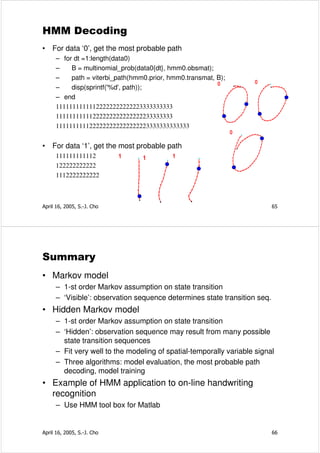
HMM Decoding
• For data ‘0’, get the most probable path
     – for dt =1:length(data0)
     –    B = multinomial_prob(data0{dt}, hmm0.obsmat);
     –    path = viterbi_path(hmm0.prior, hmm0.transmat, B);
     –    disp(sprintf('%d', path));
     – end
     11111111111122222222222223333333333
     11111111111222222222222222233333333
     1111111111222222222222222223333333333333


• For data ‘1’, get the most probable path
     111111111112
     122222222222
     1112222222222


April 16, 2005, S.-J. Cho                                                 65


Summary
• Markov model
     – 1-st order Markov assumption on state transition
     – ‘Visible’: observation sequence determines state transition seq.
• Hidden Markov model
     – 1-st order Markov assumption on state transition
     – ‘Hidden’: observation sequence may result from many possible
       state transition sequences
     – Fit very well to the modeling of spatial-temporally variable signal
     – Three algorithms: model evaluation, the most probable path
       decoding, model training
• Example of HMM application to on-line handwriting
  recognition
     – Use HMM tool box for Matlab


April 16, 2005, S.-J. Cho                                                 66
References
• Hidden Markov Model
     – L.R. Rabiner, “A Tutorial to Hidden Markov Models and Selected
       Applications in Speech Recognition”, IEEE Proc. pp. 267-295,
       1989
     – L.R. Bahl et. al, “A Maximum Likelihood Approach to Continuous
       Speech Recognition”, IEEE PAMI, pp. 179-190, May. 1983
     – M. Ostendorf, “From HMM’s to Segment Models: a Unified View
       of Stochastic Modeling for Speech Recognition”, IEEE SPA, pp
       360-378, Sep., 1996
• HMM Tutorials
     – 신봉기, “HMM Theory and Applications “, 2003컴퓨터비젼및패턴
          인식연구회 춘계워크샵 튜토리얼
     – Sam Roweis, “Hidden Markov Models (SCIA Tutorial 2003)”,
       http://www.cs.toronto.edu/~roweis/notes/scia03h.pdf
     – Andrew Moore, “Hidden Markov Models”,
       http://www-2.cs.cmu.edu/~awm/tutorials/hmm.html

April 16, 2005, S.-J. Cho                                                    67


References (Cont.)
• HMM SW
     – Kevin Murphy, “HMM toolbox for Matlab”, freely downloadable SW
       written in Matlab,
       http://www.cs.ubc.ca/~murphyk/Software/HMM/hmm.html
     – Speech Vision and Robotics Group of Cambridge University, “HTK
       (Hidden Markov toolkit)”, freely downloadable SW written in C,
       http://htk.eng.cam.ac.uk/
• Online Character Recognition
     – C.C. Tappert et. al, “The state of the Art in On-Line Handwriting
       Recognition”, IEEE PAMI, pp. 787-808, Aug, 1990
     – B.K. Sin and J.H. Kim, “Ligature Modeling for Online Cursive Script
       Recognition”, IEEE PAMI, pp. 623-633,Jun, 1997
     – S.-J. Cho and J.H. Kim, “Bayesian Network Modeling of Character
       Components and Their Relationships for On-line Handwriting
       Recognition”, Pattern Recognition, pp253-264, Feb. 2004
     – J. Hu, et. al, “Writer Independent On-line Handwriting Recognition Using
       an HMM Approach”, Pattern Recognition, pp 133-147, 2000

April 16, 2005, S.-J. Cho                                                    68
Appendix: Matlab Code (I)
% chaincode data set for class '0'
data0{1} = [9 8 8 7 7 7 6 6 6 5 5 5 4 4 3 2 1 16 15 15 15 15 14 14 14 13 13 13 12 12 11
    10 9 9 8 ];
data0{2} = [8 8 7 7 7 6 6 5 5 5 5 4 4 3 2 1 1 16 15 15 15 15 15 14 14 14 14 13 12 11 10
    10 9 9 9 ];
data0{3} = [7 6 6 6 6 6 6 5 5 5 4 3 2 1 16 16 16 15 15 15 15 14 14 14 14 14 14 13 11 10
    9 9 8 8 8 8 7 7 6 6 ];
% chaincode data set for class ‘1’
data1{1} = [5 5 5 5 5 5 5 5 5 5 5 4 ];
data1{2} = [5 6 6 6 6 6 6 6 6 5 5 4 ];
data1{3} = [5 5 5 6 6 6 6 6 6 7 6 4 3];

% HMM for class '0' and random initialization of parameters
hmm0.prior = [1 0 0];
hmm0.transmat = rand(3,3); % 3 by 3 transition matrix
hmm0.transmat(2,1) =0; hmm0.transmat(3,1) = 0; hmm0.transmat(3,2) = 0;
hmm0.transmat = mk_stochastic(hmm0.transmat);
hmm0.transmat
hmm0.obsmat = rand(3, 16); % # of states * # of observation
hmm0.obsmat = mk_stochastic(hmm0.obsmat)

April 16, 2005, S.-J. Cho                                                             69


Appendix: Matlab Code (2)
% HMM for class '1' and random initialiation of parameters
hmm1.prior = [1 0 ];
hmm1.transmat = rand(2,2); % 2 by 2 transition matrix
hmm1.transmat(2,1) =0;
hmm1.transmat = mk_stochastic(hmm1.transmat);
hmm1.transmat

hmm1.obsmat = rand(2, 16); % # of states * # of observation
hmm1.obsmat = mk_stochastic(hmm1.obsmat)

% Training of HMM model 0 (Baum-Welch algorithm)
[LL0, hmm0.prior, hmm0.transmat, hmm0.obsmat] = dhmm_em(data0, hmm0.prior,
    hmm0.transmat, hmm0.obsmat)
% smoothing of HMM observation parameter: set floor value 1.0e-5
hmm0.obsmat = max(hmm0.obsmat, 1.0e-5);

% Training of HMM model 1 (Baum-Welch algorithm)
[LL1, hmm1.prior, hmm1.transmat, hmm1.obsmat] = dhmm_em(data1, hmm1.prior,
    hmm1.transmat, hmm1.obsmat)
% smoothing of HMM observation parameter: set floor value 1.0e-5
hmm1.obsmat = max(hmm1.obsmat, 1.0e-5);
April 16, 2005, S.-J. Cho                                                             70
Appendix: Matlab Code(3)
% Compare model likelihood
%Evaluation of class '0' data
for dt =1:length(data0)
   loglike0 = dhmm_logprob(data0{dt}, hmm0.prior, hmm0.transmat, hmm0.obsmat);
   loglike1 = dhmm_logprob(data0{dt}, hmm1.prior, hmm1.transmat, hmm1.obsmat);
   disp(sprintf('[class 0: %d-th data] model 0: %.3f, model 1: %.3f',dt, loglike0, loglike1));
end

for dt =1:length(data1)
   loglike0 = dhmm_logprob(data1{dt}, hmm0.prior, hmm0.transmat, hmm0.obsmat);
   loglike1 = dhmm_logprob(data1{dt}, hmm1.prior, hmm1.transmat, hmm1.obsmat);
   disp(sprintf('[class 1: %d-th data] model 0: %.3f, model 1: %.3f',dt, loglike0, loglike1));
end


April 16, 2005, S.-J. Cho                                                                   71


Appendix: Matlab Code (4)
%Viterbi path decoding
%First you need to evaluate B(i,t) = P(y_t | Q_t=i) for all t,i:
path0 = cell(1, length(data0));
for dt =1:length(data0)
   B = multinomial_prob(data0{dt}, hmm0.obsmat);
   path0{dt} = viterbi_path(hmm0.prior, hmm0.transmat, B);
   disp(sprintf('%d', path0{dt}));
end

path1 = cell(1, length(data1));
for dt =1:length(data1)
   B = multinomial_prob(data1{dt}, hmm1.obsmat);
   path1{dt} = viterbi_path(hmm1.prior, hmm1.transmat, B);
   disp(sprintf('%d', path1{dt}));
end


April 16, 2005, S.-J. Cho                                                                   72

Hidden markovmodel

  • 1.
    한국정보과학회)| 한국정보과학회 KISS ILVB Tutorial(한국정보과학회 2005.04.16 |Seoul Introduction to Hidden Markov Model and Its Application April 16, 2005 Dr. Sung-Jung Cho sung-jung.cho@samsung.com Samsung Advanced Institute of Technology (SAIT) April 16, 2005, S.-J. Cho 1 Contents • Introduction • Markov Model • Hidden Markov model (HMM) • Three algorithms of HMM – Model evaluation – Most probable path decoding – Model training • Pattern classification by HMM • Application of HMM to on-line handwriting recognition with HMM toolbox for Matlab • Summary • References April 16, 2005, S.-J. Cho 2
  • 2.
    Sequential Data • Dataare sequentially generated according to time or index • Spatial information along time or index April 16, 2005, S.-J. Cho 3 Advantage of HMM on Sequential Data • Natural model structure: doubly stochastic process – transition parameters model temporal variability – output distribution model spatial variability • Efficient and good modeling tool for – sequences with temporal constraints – spatial variability along the sequence – real world complex processes • Efficient evaluation, decoding and training algorithms – Mathematically strong – Computaionally efficient • Proven technology! – Successful stories in many applications April 16, 2005, S.-J. Cho 4
  • 3.
    Successful Application Areasof HMM • On-line handwriting recognition • Speech recognition • Gesture recognition • Language modeling • Motion video analysis and tracking • Protein sequence/gene sequence alignment • Stock price prediction • … April 16, 2005, S.-J. Cho 5 What’s HMM? Hidden Markov Model Hidden + Markov Model What is ‘hidden’? What is ‘Markov model’? April 16, 2005, S.-J. Cho 6
  • 4.
    Markov Model • Scenario • Graphical representation • Definition • Sequence probability • State probability April 16, 2005, S.-J. Cho 7 Markov Model: Scenario • Classify a weather into three states – State 1: rain or snow – State 2: cloudy – State 3: sunny • By carefully examining the weather of some city for a long time, we found following weather change pattern Tomorrow Rain/snow Cloudy Sunny Tod Rain/Snow 0.4 0.3 0.3 ay Cloudy 0.2 0.6 0.2 Sunny 0.1 0.1 0.8 Assumption: tomorrow weather depends only on today one! April 16, 2005, S.-J. Cho 8
  • 5.
    Markov Model: GraphicalRepresentation • Visual illustration with diagram 0.4 0.3 1: 2: 0.6 rain 0.2 cloudy 0.3 0.2 0.1 0.1 3: sunny 0.8 - Each state corresponds to one observation - Sum of outgoing edge weights is one April 16, 2005, S.-J. Cho 9 Markov Model: Definition 0.4 1: 0.3 2: 0.6 • Observable states rain 0.2 cloudy {1, 2 , L , N } 0.3 0.2 0.1 • Observed sequence 0.1 3: q1 , q2 , L , qT sunny 0.8 • 1st order Markov assumption P (qt = j | qt −1 = i, qt − 2 = k , L) = P ( qt = j | qt −1 = i ) L qt −1 qt −1 q1 q2 qt qt Bayesian network representation • Stationary P (qt = j | qt −1 = i ) = P ( qt +l = j | qt +l −1 = i ) April 16, 2005, S.-J. Cho 10
  • 6.
    Markov Model: Definition(Cont.) 0.4 0.3 • State transition matrix 1: 2: 0.6 rain 0.2 cloudy  a11 a12 L a1 N  0.3 0.2 a a 22 L a2 N  0.1 0.1 A =  21  3:  M M M M  sunny   a N1 a NN L a NN  0.8 – Where aij = P (qt = j | qt −1 = i ), 1 ≤ i, j ≤ N – With constraints N a ij ≥ 0, ∑a j =1 ij =1 • Initial state probability π i = P ( q 1 = i ), 1≤ i ≤ N April 16, 2005, S.-J. Cho 11 Markov Model: Sequence Prob. • Conditional probability P ( A, B ) = P ( A | B ) P ( B ) • Sequence probability of Markov model Chain rule P ( q1 , q2 , L , qT ) = P ( q1 ) P (q2 | q1 ) L P (qT −1 | q1 , L , qT − 2 ) P (qT | q1 , L , qT −1 ) = P ( q1 ) P (q2 | q1 ) L P (qT −1 | qT − 2 ) P ( qT | qT −1 ) 1st order Markov assumption April 16, 2005, S.-J. Cho 12
  • 7.
    Markov Model: SequenceProb. (Cont.) • Question: What is the probability that the weather for the next 7 days will be “sun-sun-rain-rain-sun-cloudy-sun” when today is sunny? S1 : rain, S 2 : cloudy , S 3 : sunny P (O | model) = P ( S 3 , S 3 , S 3 , S1 , S1 , S 3 , S 2 , S 3 | model) = P ( S 3 ) ⋅ P ( S 3 | S 3 ) ⋅ P ( S 3 | S 3 ) ⋅ P ( S1 | S 3 ) ⋅ P ( S1 | S1 ) P ( S 3 | S1 ) P ( S 2 | S 3 ) P ( S 3 | S 2 ) = π 3 ⋅ a33 ⋅ a33 ⋅ a31 ⋅ a11 ⋅ a13 ⋅ a32 ⋅ a23 = 1 ⋅ (0.8)(0.8)(0.1)(0.4)(0.3)(0.1)(0.2) = 1.536 × 10 − 4 0.4 1: rain 0.3 2: cloudy 0.6 0.2 0.3 0.2 0.1 0.1 3: sunny April 16, 2005, S.-J. Cho 0.8 13 Markov Model: State Probability • State probability at time t : P ( qt = i ) 1 2 3 ... t S1 S2 ... SN • Simple but slow algorithm: – Probability of a path that ends to state i at time t: Qt (i ) = ( q1 , q2 , L , qt = i ) Exponential time complexity: t O( N t ) P (Qt (i )) = π q1 ∏ P (qk | qk −1 ) k =2 – Summation of probabilities of all the paths that ends to I at t P ( qt = i ) = ∑ P(Q (i)) all Qt ( i )'s t April 16, 2005, S.-J. Cho 14
  • 8.
    Markov Model: StateProb. (Cont.) • State probability at time t : P ( qt = i ) 1 2 3 ... t S1 P ( q t −1 = 1) S2 a 1i ... SN • Efficient algorithm Each node stores the sum of probabilities of partial paths – Recursive path probability calculation N P (qt = i) = ∑j =1 P ( q t −1 = j , q t = i ) N = ∑j =1 P ( q t −1 = j ) P ( q t = i | q t −1 = j ) N = ∑ P ( q t −1 = j ) ⋅ a ji j =1 Time complexity: O ( N 2t ) April 16, 2005, S.-J. Cho 15 What’s HMM? Hidden Markov Model Hidden + Markov Model What is ‘hidden’? What is ‘Markov model’? April 16, 2005, S.-J. Cho 16
  • 9.
    Hidden Markov Model • Example • Generation process • Definition • Model evaluation algorithm • Path decoding algorithm • Training algorithm April 16, 2005, S.-J. Cho 17 Hidden Markov Model: Example 2 0.3 0.2 0.6 0.1 0.1 1 3 0.6 0.6 0.2 0.3 • N urns containing color balls • M distinct colors • Each urn contains different number of color balls April 16, 2005, S.-J. Cho 18
  • 10.
    HMM: Generation Process •Sequence generating algorithm – Step 1: Pick initial urn according to some random process – Step 2: Randomly pick a ball from the urn and then replace it – Step 3: Select another urn according to a random selection process 2 0.3 – Step 4: Repeat steps 2 and 3 0.2 0.6 0.1 0.1 1 3 0.6 0.6 0.2 1 1 3 0.3 Markov process: {q(t)} Output process: {f(x|q)} April 16, 2005, S.-J. Cho 19 HMM: Hidden Information • Now, what is hidden? – We can just see the chosen balls – We can’t see which urn is selected at a time – So, urn selection (state transition) information is hidden April 16, 2005, S.-J. Cho 20
  • 11.
    HMM: Definition • Notation:λ = ( Α, Β, Π ) (1) N: Number of states (2) M: Number of symbols observable in states V = { v1 , L , v M } (3) A: State transition probability distribution A = { a ij }, 1 ≤ i, j ≤ N (4) B: Observation symbol probability distribution B = { b i ( v k )}, 1 ≤ i ≤ N ,1 ≤ j ≤ M (5) Π: Initial state distribution π i = P ( q 1 = i ), 1≤ i ≤ N April 16, 2005, S.-J. Cho 21 HMM: Dependency Structure • 1-st order Markov assumption of transition P ( qt | q1 , q2 , L , qt −1 ) = P ( qt | qt −1 ) • Conditional independency of observation parameters P ( X t | qt , X 1 , L , X t −1 , q1 , L , qt −1 ) = P ( X t | qt ) q1 q2 L qt −1 qt X1 X2 X t −1 Xt Bayesian network representation April 16, 2005, S.-J. Cho 22
  • 12.
    HMM: Example Revisited 2 0.3 • # of states: N=3 • # of observation: M=3 0.2 0.6 V = { R, G, B } 0.1 0.1 1 3 0.6 • Initial state distribution 0.6 0.2 π = { P ( q 1 = i )} = [1 , 0 , 0 ] 0.3 • State transition probability distribution  0 .6 0 .2 0 .2  A = { a ij } =  0 . 1  0 .3 0 .6    0 .3  0 .1 0 .6   • Observation symbol probability distribution • 3 / 6 2 / 6 1 / 6  B = { b i ( v k )} =  1 / 6  3/6 2 / 6  1 / 6  1/6 4 / 6  April 16, 2005, S.-J. Cho 23 0.3 HMM: Three Problems 2 0.2 0.6 0.1 0.1 0.6 • What is the probability of generating 0.6 1 0.2 3 an observation sequence? 0.3 P( )? – Model evaluation P ( X = x1 , x 2 , L , x T | λ ) = ? 2 0.3 0.2 0.6 0.1 0.1 0.6 • Given observation, what is the most 0.6 1 0.2 3 probable transition sequence? 0.3 – Segmentation or path analysis * Q = arg max Q = ( q 1 ,L , q T ) P (Q , X | λ ) 2 2 2 2 • How do we estimate or optimize the parameters of an HMM? 2 – Training problem P ( X | λ = ( A , B , π )) < P ( X | λ ' = ( A ' , B ' , π ' )) 1 3 April 16, 2005, S.-J. Cho 24
  • 13.
    Model Evaluation Forward algorithm Backward algorithm April 16, 2005, S.-J. Cho 25 Definition • Given a model λ • Observation sequence: X = x 1 , x 2 , L , x T • P(X| λ) = ? • P(X | λ) = ∑ Q P ( X , Q | λ ) = ∑ P ( X | Q , λ ) P (Q | λ ) Q (A path or state sequence: Q = q 1 , L , q T ) x1 x2 x3 x4 x5 x6 x7 x8 x1 x2 x3 x4 x5 x6 x7 x8 April 16, 2005, S.-J. Cho 26
  • 14.
    Solution • Easy butslow solution: exhaustive enumeration P(X | λ) = ∑ Q P ( X , Q | λ ) = ∑ P ( X | Q , λ ) P (Q | λ ) Q = ∑b Q q1 ( x 1 ) b q 2 ( x 2 ) L b q T ( x T ) π q 1 a q 1 q 2 a q 2 q 3 L a q T −1 q T – Exhaustive enumeration = combinational explosion! O(N T ) • Smart solution exists? – Yes! – Dynamic Programming technique – Lattice structure based computation – Highly efficient -- linear in frame length April 16, 2005, S.-J. Cho 27 Forward Algorithm • Key idea – Span a lattice of N states and T times – Keep the sum of probabilities of all the paths coming to each state i at time t x1 x2 x3 x4 xt xT Sj • Forward probability α t ( j ) = P( x1 x2 ...xt , qt = S j | λ ) = ∑ P( x1 x2 ...xt , Qt = q1...qt | λ ) Qt N = ∑ α t −1 (i )aij b j ( xt ) i =1 April 16, 2005, S.-J. Cho 28
  • 15.
    Forward Algorithm • Initialization α1 (i ) = π i bi (x1 ) 1≤ i ≤ N • Induction N α t ( j ) = ∑ α t −1 (i)aij b j (x t ) 1 ≤ j ≤ N , t = 2, 3, L, T i =1 • Termination N P ( X | λ ) = ∑ α T (i ) i =1 x1 x2 x3 x4 xt xT Sj April 16, 2005, S.-J. Cho 29 Numerical Example: P(RRGB|λ) [신봉기 03] π =[1 0 0]T R R G B .5 R .6 G .2 1×.6 .5×.6 .5×.2 .5×.2 .6 .18 .018 .0018 B .2 .4 .4×.2 .4×.5 .4×.3 .6 .1 .2 0×.2 .6×.2 .6×.5 .6×.3 .5 .0 .048 .0504 .01123 .3 .1×.0 .1×.3 .1×.7 .4 .4×.0 .4×.3 .4×.7 .0 0×.0 .3 .0 .0 .01116 .01537 .7 April 16, 2005, S.-J. Cho 30
  • 16.
    Backward Algorithm (1) •Key Idea – Span a lattice of N states and T times – Keep the sum of probabilities of all the outgoing paths at each state i at time t x x x x x x 1 2 3 4 t T Sj • Backward probability β t (i ) = P( xt +1 xt + 2 ...xT | qt = Si , λ ) = ∑ P( xt +1 xt + 2 ...xT , Qt +1 = qt +1...qT | qt = Si , λ ) Qt +1 N = ∑ aij b j ( xt +1 ) β t +1 ( j ) j =1 April 16, 2005, S.-J. Cho 31 Backward Algorithm (2) • Initialization β T (i ) = 1 1≤ i ≤ N • Induction N β t (i ) = ∑ aij b j (x t +1 ) β t +1 ( j ) 1 ≤ i ≤ N , t = T − 1, T − 2, L, 1 j =1 x1 x2 x3 x4 xt xT Sj April 16, 2005, S.-J. Cho 32
  • 17.
    The Most ProbablePath Decoding State sequence Optimal path Viterbi algorithm Sequence segmentation April 16, 2005, S.-J. Cho 33 The Most Probable Path • Given a model λ • Observation sequence: X = x 1 , x 2 , L , x T • P(X ,Q | λ) = ? • Q * = arg max Q P ( X , Q | λ ) = arg max Q P ( X | Q , λ ) P ( Q | λ ) – (A path or state sequence: Q = q 1 , L , q T ) x1 x2 x3 x4 x5 x6 x7 x8 x1 x2 x3 x4 x5 x6 x7 x8 April 16, 2005, S.-J. Cho 34
  • 18.
    Viterbi Algorithm • Purpose – An analysis for internal processing result – The best, the most likely state sequence – Internal segmentation • Viterbi Algorithm – Alignment of observation and state transition – Dynamic programming technique April 16, 2005, S.-J. Cho 35 Viterbi Path Idea • Key idea – Span a lattice of N states and T times – Keep the probability and the previous node of the most probable path coming to each state i at time t • Recursive path selection – Path probability: δ t +1 ( j ) = max δ t (i ) aij b j ( x t +1 ) 1≤ i ≤ N – Path node: ψ t +1 ( j ) = arg max δ t (i)aij 1≤ i ≤ N δ t (1) a1 j b j ( x t + 1 ) t t+1 δ t ( i ) a ij b j ( x t + 1 ) Sj April 16, 2005, S.-J. Cho 36
  • 19.
    Viterbi Algorithm • Introduction: δ 1 (i ) = π i bi (x1 ) ψ 1 (i ) = 0 • Recursion: δ t +1 ( j ) = max δ t (i )aij b j (x t +1 ) 1≤ i ≤ N ψ t +1 ( j ) = arg max δ t (i)aij 1≤ i ≤ N • Termination: P ∗ = max δ T (i ) 1≤i ≤ N ∗ qT = arg max δ T (i ) 1≤i ≤ N • Path backtracking: q = ψ t +1 (qt∗+1 ), t = T − 1,K ,1 ∗ t 1 states 2 3 April 16, 2005, S.-J. Cho 37 Numerical Example: P(RRGB,Q*|λ) [신봉기 03] π =[1 0 0]T R R G B .5 R .6 G .2 1×.6 .5×.6 .5×.2 .5×.2 .6 .18 .018 .0018 B .2 .4 .4×.2 .4×.5 .4×.3 .6 .1 .2 0×.2 .6×.2 .6×.5 .6×.3 .5 .0 .048 .036 .00648 .3 .1×.0 .1×.3 .1×.7 .4 .4×.0 .4×.3 .4×.7 .0 0×.0 .3 .0 .0 .00576 .01008 .7 April 16, 2005, S.-J. Cho 38
  • 20.
    Parameter Reestimation HMM training algorithm Maximum likelihood estimation Baum-Welch reestimation April 16, 2005, S.-J. Cho 39 HMM Training Algorithm • Given an observation sequence X = x 1 , x 2 , L , x T • Find the model parameter λ * = ( A , B , π ) • s.t. P ( X | λ * ) ≥ P ( X | λ ) for ∀ λ – Adapt HMM parameters maximally to training samples – Likelihood of a sample P(X | λ) = ∑ Q P ( X | Q ,λ ) P ( Q | λ ) State transition is hidden! • NO analytical solution • Baum-Welch reestimation (EM) – iterative procedures that locally maximizes P(X|λ) – convergence proven P(X|λ) – MLE statistic estimation λ:HMM parameters April 16, 2005, S.-J. Cho 40
  • 21.
    Maximum Likelihood Estimation •MLE “selects those parameters that maximizes the probability function of the observed sample.” • [Definition] Maximum Likelihood Estimate – Θ: a set of distribution parameters – Given X, Θ* is maximum likelihood estimate of Θ if – f(X|Θ*) = maxΘ f(X|Θ) April 16, 2005, S.-J. Cho 41 MLE Example • Scenario – Known: 3 balls inside urn – (some red; some white) – Unknown: R = # red balls – Observation: (two reds) • Two models  2  1  3 1 –P ( |R=2) =  2   0      = 2 3      3 3 –P ( |R=3) =       =1 2 2   • Which model? – L (λ R = 3 ) > L (λ R = 2 ) – Model(R=3) is our choice April 16, 2005, S.-J. Cho 42
  • 22.
    MLE Example (Cont.) •Model(R=3) is a more likely strategy, unless we have a priori knowledge of the system. • However, without an observation of two red balls – No reason to prefer P(λR=3) to P(λR=2) • ML method chooses the set of parameters that maximizes the likelihood of the given observation. • It makes parameters maximally adapted to training data. April 16, 2005, S.-J. Cho 43 EM Algorithm for Training •With λ ( t ) =< { a ij }, { b ik }, π i > , estimate EXPECTATION of following quantities: –Expected number of state i visiting –Expected number of transitions from i to j •With following quantities: –Expected number of state i visiting –Expected number of transitions from i to j • Obtain the MAXIMUM LIKELIHOOD of λ ( t + 1 ) =< { a ' ij }, { b ' ik }, π i > April 16, 2005, S.-J. Cho 44
  • 23.
    Expected Number ofSi Visiting γ t (i ) = P ( q t = S i | X , λ ) = P (qt = S i , X | λ ) / P ( X | λ ) α t (i ) β t (i ) = ∑ α t ( j)β t ( j) j Γ (i ) = ∑γ t t (i ) x1 x2 x3 x4 xt xT Si April 16, 2005, S.-J. Cho 45 Expected Number of Transition α t (i )aij b j ( xt +1 ) β t +1 ( j ) ξ t (i, j ) = P(qt = S i , qt +1 = S j | X , λ ) = ∑∑ α (i)a b ( x i j i ij j t +1 ) β t +1 ( j) Ξ (i, j ) = ∑ξ (i, j) t t x1 x2 x3 x4 xt xt+1 xT Sj Si April 16, 2005, S.-J. Cho 46
  • 24.
    Parameter Reestimation • MLEparameter estimation T −1 ∑ t =1 ξ t (i, j ) P(X|λ) a ij = T −1 ∑ Γt (i) t =1 T λ:HMM parameters ∑ t =1 Γ t ( i )δ ( x t , v k ) bi (v k ) = T ∑ t =1 Γt (i) π i = γ 1 (i) ( t +1) – Iterative: P ( X | λ ) ≥ P ( X | λ( t ) ) – convergence proven: – arriving local optima April 16, 2005, S.-J. Cho 47 Pattern Classification by HMM • Pattern classification • Extension of HMM structure • Extension of HMM training method • Practical issues of HMM • HMM history April 16, 2005, S.-J. Cho 48
  • 25.
    Pattern Classification byHMM • Construct one HMM per each class k – λ1 ,L , λN • Train each HMM λk with samples Dk – Baum-Welch reestimation algorithm • Calculate model likelihood of λ1 , L , λN with observation X – Forward algorithm: P ( X | λk ) • Find the model with maximum a posteriori probability λ* = argmax λ k P(λk | X ) = argmax λ k P(λk ) P ( X | λk ) / P( X ) = argmax λ k P(λk ) P ( X | λk ) April 16, 2005, S.-J. Cho 49 Extension of HMM Structure • Extension of state transition parameters – Duration modeling HMM • More accurate temporal behavior – Transition-output HMM • HMM output functions are attached to transitions rather than states • Extension of observation parameter – Segmental HMM • More accurate modeling of trajectories at each state, but more computational cost – Continuous density HMM (CHMM) • Output distribution is modeled with mixture of Gaussian – Semi-continuous HMM • Mix of continuous HMM and discrete HMM by sharing Gaussian components April 16, 2005, S.-J. Cho 50
  • 26.
    Extension of HMMTraining Method • Maximum Likelihood Estimation (MLE)* – maximize the probability of the observed samples • Maximum Mutual Information (MMI) Method – information-theoretic measure – maximize average mutual information:  V  V  I = max λ  ∑  log P ( X * v | λ v ) − log ∑ P(X w | λw )   ν =1  w =1  – maximize discrimination power by training models together • Minimal Discriminant Information (MDI) Method – minimize the DI or the cross entropy between pd(signal) and pd(HMM)’s – use generalized Baum algorithm April 16, 2005, S.-J. Cho 51 Practical Issues of HMM • Architectural and behavioral choices – the unit of modeling -- design choice – type of models: ergodic, left-right, etc. – number of states – observation symbols;discrete, continuous; mixture number • Initial estimates – A, π : adequate with random or uniform initial values – B : good initial estimates are essential for CHMM April 16, 2005, S.-J. Cho 52
  • 27.
    Practical Issues ofHMM (Cont.) • Scaling t −1 t α t (i ) = ∏ s =1 a s , s +1 ∏b (x ) s =1 s s – heads exponentially to zero: --> scale by 1 / Si=1,…,N at(i) • Multiple observation sequences – accumulate the expected freq. with weight P(X(k)|l) • Insufficient training data – deleted interpolation with desired model & small model – output prob. smoothing (by local perturbation of symbols) – output probability tying between different states April 16, 2005, S.-J. Cho 53 HMM History [Roweis] • Markov(’13) and Shannon (’48, ’51) studied Markov chains • Baum et. Al (BP’66, BE’67 …) developed many theories of “probabilistic functions of Markov chains” • Viterbi (’67) developed an efficient optimal state search algorithm • Application to speech recognition started – Baker(’75) at CMU – Jelinek’s group (’75) at IBM • Dempster, Laird & Rubin ('77) recognized a general form of the Baum-Welch algorithm April 16, 2005, S.-J. Cho 54
  • 28.
    Application of HMMto on-line handwriting recognition with HMM SW • SW tools for HMM • Introduction to on-line handwriting recognition • Data preparation • Training & testing April 16, 2005, S.-J. Cho 55 SW Tools for HMM • HMM toolbox for Matlab – Developed by Kevin Murphy – Freely downloadable SW written in Matlab (Hmm… Matlab is not free!) – Easy-to-use: flexible data structure and fast prototyping by Matlab – Somewhat slow performance due to Matlab – Download: http://www.cs.ubc.ca/~murphyk/Software/HMM/hmm.html • HTK (Hidden Markov toolkit) – Developed by Speech Vision and Robotics Group of Cambridge University – Freely downloadable SW written in C – Useful for speech recognition research: comprehensive set of programs for training, recognizing and analyzing speech signals – Powerful and comprehensive, but somewhat complicate and heavy package – Download: http://htk.eng.cam.ac.uk/ April 16, 2005, S.-J. Cho 56
  • 29.
    SW Tools: HMMToolbox for Matlab • Support training and decoding for – Discrete HMMs – Continuous HMMs with full, diagonal, or spherical covariance matrix • 3 Algorithms for discrete HMM – Model evaluation (Forward algorithm) • Log_likelihood = dhmm_logprob(data, initial state probability, transition probability matrix, observation probability matrix) – Viterbi decoding algorithm • 1) B = multinomial_prob(data, observation matrix); B(i,t) = P(y_t | Q_t=i) for all t,i: • 2) [path, log_likelihood] = viterbi_path(initial state probability, transition matrix, B) – Baum-Welch algorithm • [LL, prior2, transmat2, obsmat2] = dhmm_em(data, prior1, transmat1, obsmat1, 'max_iter', 5); April 16, 2005, S.-J. Cho 57 On-line Handwriting Recognition [Sin] • Handwriting – Natural input method to human – Sequence of some writing units – Temporally ordered • Time series of (X,Y) ink points on tablet • Recognition flow Input Feature Input Pre-processing Encoding Result Post-processing Classification April 16, 2005, S.-J. Cho Dictionary Model 58
  • 30.
    Data Preparation 12 15 14 11 15 10 16 9 1 8 2 7 3 6 5 4 • Chaincode data set for class ‘0’ – data0{1} = [9 8 8 7 7 7 6 6 6 5 5 5 4 4 3 2 1 16 15 15 15 15 14 14 14 13 13 13 12 12 11 10 9 9 8 ] – data0{2} = [8 8 7 7 7 6 6 5 5 5 5 4 4 3 2 1 1 16 15 15 15 15 15 14 14 14 14 13 12 11 10 10 9 9 9 ] – data0{3} = [7 6 6 6 6 6 6 5 5 5 4 3 2 1 16 16 16 15 15 15 15 14 14 14 14 14 14 13 11 10 9 9 8 8 8 8 7 7 6 6 ] • Chaincode data set for class ‘1’ – data1{1} = [5 5 5 5 5 5 5 5 5 5 5 4 ] – data1{2} = [5 6 6 6 6 6 6 6 6 5 5 4 ] – data1{3} = [5 5 5 6 6 6 6 6 6 7 6 4 3] April 16, 2005, S.-J. Cho 59 HMM Initialization • HMM for class ‘0’ and randomly initialization – hmm0.prior = [1 0 0]; – hmm0.transmat = rand(3,3); % 3 by 3 transition matrix – hmm0.transmat(2,1) =0; hmm0.transmat(3,1) = 0; hmm0.transmat(3,2) = 0; – hmm0.transmat = mk_stochastic(hmm0.transmat); – hmm0.transmat 0.20 0.47 0.33 0 0.45 0.55 1 2 3 0 0.00 1.00 – hmm0.obsmat = rand(3, 16); % # of states * # of observation – hmm0.obsmat = mk_stochastic(hmm0.obsmat) 0.02 0.04 0.05 0.00 0.12 0.11 0.13 0.00 0.06 0.09 0.02 0.11 0.06 0.05 0.04 0.08 0.12 0.04 0.07 0.06 0.03 0.03 0.08 0.02 0.11 0.04 0.02 0.06 0.06 0.11 0.01 0.12 0.05 0.04 0.01 0.11 0.02 0.08 0.11 0.10 0.09 0.02 0.05 0.10 0.06 0.00 0.09 0.07 April 16, 2005, S.-J. Cho 60
  • 31.
    HMM Initialization (Cont.) •HMM for class ‘1’ and randomly initialization – hmm1.prior = [1 0]; – hmm1.transmat = rand(2,2); % 2 by 2 transition matrix – hmm1.transmat(2,1) =0; – hmm1.transmat = mk_stochastic(hmm1.transmat); – hmm1.transmat 1 2 0.03 0.97 0 1.00 – hmm1.obsmat = rand(2, 16); % # of states * # of observation – hmm1.obsmat = mk_stochastic(hmm1.obsmat) 0.05 0.10 0.01 0.06 0.02 0.09 0.06 0.02 0.10 0.04 0.12 0.11 0.03 0.01 0.09 0.11 0.08 0.09 0.06 0.05 0.09 0.10 0.07 0.06 0.12 0.03 0.03 0.12 0.03 0.01 0.03 0.02 April 16, 2005, S.-J. Cho 61 HMM Training • Training of model 0 – [LL0, hmm0.prior, hmm0.transmat, hmm0.obsmat] = dhmm_em(data0, hmm0.prior, hmm0.transmat, hmm0.obsmat) iteration 1, loglik = -365.390770 0.91 0.93 1 iteration 2, loglik = -251.112160 … 0.09 0.07 iteration 9, loglik = -210.991114 1 2 3 • Trained result 0 - hmm0.transmat 0.91 0.09 0.00 0.00 0.93 0.07 0.00 0.00 1.00 - hmm0.obsmat 0.00 0.00 0.00 0.00 0.30 0.33 0.21 0.12 0.03 0.00 0.00 0.00 0.00 0.00 0.00 0.00 0.09 0.07 0.07 0.11 0.00 0.00 0.00 0.00 0.00 0.00 0.00 0.00 0.00 0.28 0.28 0.11 0.00 0.00 0.00 0.00 0.00 0.06 0.06 0.16 0.23 0.13 0.10 0.10 0.16 0.00 0.00 0.00 April 16, 2005, S.-J. Cho 62
  • 32.
    HMM Training (Cont.) •Training of model 1 – [LL1, hmm1.prior, hmm1.transmat, hmm1.obsmat] = dhmm_em(data1, hmm1.prior, hmm1.transmat, hmm1.obsmat) 0.79 1 • iteration 1, loglik = -95.022843 • … 0.21 1 2 • iteration 10, loglik = -30.742533 • Trained model – hmm1.transmat 0.79 0.21 0.00 1.00 – hmm1.obsmat 0.00 0.00 0.00 0.00 1.00 0.00 0.00 0.00 0.00 0.00 0.00 0.00 0.00 0.00 0.00 0.00 0.00 0.00 0.04 0.13 0.12 0.66 0.04 0.00 0.00 0.00 0.00 0.00 0.00 0.00 0.00 0.00 April 16, 2005, S.-J. Cho 63 HMM Evaluation • Evaluation of data 0 – for dt =1:length(data0) – loglike0 = dhmm_logprob(data0{dt}, hmm0.prior, hmm0.transmat, hmm0.obsmat); – loglike1 = dhmm_logprob(data0{dt}, hmm1.prior, hmm1.transmat, hmm1.obsmat); – disp(sprintf('[class 0: %d-th data] model 0: %.3f, model 1: %.3f',dt, loglike0, loglike1)); – end [class 0: 1-th data] model 0: -68.969, model 1: -289.652 [class 0: 2-th data] model 0: -66.370, model 1: -291.671 [class 0: 3-th data] model 0: -75.649, model 1: -310.484 • Evaluation of data 1 [class 0: 1-th data] model 0: -18.676, model 1: -5.775 [class 0: 2-th data] model 0: -17.914, model 1: -11.162 [class 0: 3-th data] model 0: -21.193, model 1: -13.037 April 16, 2005, S.-J. Cho 64
  • 33.
    HMM Decoding • Fordata ‘0’, get the most probable path – for dt =1:length(data0) – B = multinomial_prob(data0{dt}, hmm0.obsmat); – path = viterbi_path(hmm0.prior, hmm0.transmat, B); – disp(sprintf('%d', path)); – end 11111111111122222222222223333333333 11111111111222222222222222233333333 1111111111222222222222222223333333333333 • For data ‘1’, get the most probable path 111111111112 122222222222 1112222222222 April 16, 2005, S.-J. Cho 65 Summary • Markov model – 1-st order Markov assumption on state transition – ‘Visible’: observation sequence determines state transition seq. • Hidden Markov model – 1-st order Markov assumption on state transition – ‘Hidden’: observation sequence may result from many possible state transition sequences – Fit very well to the modeling of spatial-temporally variable signal – Three algorithms: model evaluation, the most probable path decoding, model training • Example of HMM application to on-line handwriting recognition – Use HMM tool box for Matlab April 16, 2005, S.-J. Cho 66
  • 34.
    References • Hidden MarkovModel – L.R. Rabiner, “A Tutorial to Hidden Markov Models and Selected Applications in Speech Recognition”, IEEE Proc. pp. 267-295, 1989 – L.R. Bahl et. al, “A Maximum Likelihood Approach to Continuous Speech Recognition”, IEEE PAMI, pp. 179-190, May. 1983 – M. Ostendorf, “From HMM’s to Segment Models: a Unified View of Stochastic Modeling for Speech Recognition”, IEEE SPA, pp 360-378, Sep., 1996 • HMM Tutorials – 신봉기, “HMM Theory and Applications “, 2003컴퓨터비젼및패턴 인식연구회 춘계워크샵 튜토리얼 – Sam Roweis, “Hidden Markov Models (SCIA Tutorial 2003)”, http://www.cs.toronto.edu/~roweis/notes/scia03h.pdf – Andrew Moore, “Hidden Markov Models”, http://www-2.cs.cmu.edu/~awm/tutorials/hmm.html April 16, 2005, S.-J. Cho 67 References (Cont.) • HMM SW – Kevin Murphy, “HMM toolbox for Matlab”, freely downloadable SW written in Matlab, http://www.cs.ubc.ca/~murphyk/Software/HMM/hmm.html – Speech Vision and Robotics Group of Cambridge University, “HTK (Hidden Markov toolkit)”, freely downloadable SW written in C, http://htk.eng.cam.ac.uk/ • Online Character Recognition – C.C. Tappert et. al, “The state of the Art in On-Line Handwriting Recognition”, IEEE PAMI, pp. 787-808, Aug, 1990 – B.K. Sin and J.H. Kim, “Ligature Modeling for Online Cursive Script Recognition”, IEEE PAMI, pp. 623-633,Jun, 1997 – S.-J. Cho and J.H. Kim, “Bayesian Network Modeling of Character Components and Their Relationships for On-line Handwriting Recognition”, Pattern Recognition, pp253-264, Feb. 2004 – J. Hu, et. al, “Writer Independent On-line Handwriting Recognition Using an HMM Approach”, Pattern Recognition, pp 133-147, 2000 April 16, 2005, S.-J. Cho 68
  • 35.
    Appendix: Matlab Code(I) % chaincode data set for class '0' data0{1} = [9 8 8 7 7 7 6 6 6 5 5 5 4 4 3 2 1 16 15 15 15 15 14 14 14 13 13 13 12 12 11 10 9 9 8 ]; data0{2} = [8 8 7 7 7 6 6 5 5 5 5 4 4 3 2 1 1 16 15 15 15 15 15 14 14 14 14 13 12 11 10 10 9 9 9 ]; data0{3} = [7 6 6 6 6 6 6 5 5 5 4 3 2 1 16 16 16 15 15 15 15 14 14 14 14 14 14 13 11 10 9 9 8 8 8 8 7 7 6 6 ]; % chaincode data set for class ‘1’ data1{1} = [5 5 5 5 5 5 5 5 5 5 5 4 ]; data1{2} = [5 6 6 6 6 6 6 6 6 5 5 4 ]; data1{3} = [5 5 5 6 6 6 6 6 6 7 6 4 3]; % HMM for class '0' and random initialization of parameters hmm0.prior = [1 0 0]; hmm0.transmat = rand(3,3); % 3 by 3 transition matrix hmm0.transmat(2,1) =0; hmm0.transmat(3,1) = 0; hmm0.transmat(3,2) = 0; hmm0.transmat = mk_stochastic(hmm0.transmat); hmm0.transmat hmm0.obsmat = rand(3, 16); % # of states * # of observation hmm0.obsmat = mk_stochastic(hmm0.obsmat) April 16, 2005, S.-J. Cho 69 Appendix: Matlab Code (2) % HMM for class '1' and random initialiation of parameters hmm1.prior = [1 0 ]; hmm1.transmat = rand(2,2); % 2 by 2 transition matrix hmm1.transmat(2,1) =0; hmm1.transmat = mk_stochastic(hmm1.transmat); hmm1.transmat hmm1.obsmat = rand(2, 16); % # of states * # of observation hmm1.obsmat = mk_stochastic(hmm1.obsmat) % Training of HMM model 0 (Baum-Welch algorithm) [LL0, hmm0.prior, hmm0.transmat, hmm0.obsmat] = dhmm_em(data0, hmm0.prior, hmm0.transmat, hmm0.obsmat) % smoothing of HMM observation parameter: set floor value 1.0e-5 hmm0.obsmat = max(hmm0.obsmat, 1.0e-5); % Training of HMM model 1 (Baum-Welch algorithm) [LL1, hmm1.prior, hmm1.transmat, hmm1.obsmat] = dhmm_em(data1, hmm1.prior, hmm1.transmat, hmm1.obsmat) % smoothing of HMM observation parameter: set floor value 1.0e-5 hmm1.obsmat = max(hmm1.obsmat, 1.0e-5); April 16, 2005, S.-J. Cho 70
  • 36.
    Appendix: Matlab Code(3) %Compare model likelihood %Evaluation of class '0' data for dt =1:length(data0) loglike0 = dhmm_logprob(data0{dt}, hmm0.prior, hmm0.transmat, hmm0.obsmat); loglike1 = dhmm_logprob(data0{dt}, hmm1.prior, hmm1.transmat, hmm1.obsmat); disp(sprintf('[class 0: %d-th data] model 0: %.3f, model 1: %.3f',dt, loglike0, loglike1)); end for dt =1:length(data1) loglike0 = dhmm_logprob(data1{dt}, hmm0.prior, hmm0.transmat, hmm0.obsmat); loglike1 = dhmm_logprob(data1{dt}, hmm1.prior, hmm1.transmat, hmm1.obsmat); disp(sprintf('[class 1: %d-th data] model 0: %.3f, model 1: %.3f',dt, loglike0, loglike1)); end April 16, 2005, S.-J. Cho 71 Appendix: Matlab Code (4) %Viterbi path decoding %First you need to evaluate B(i,t) = P(y_t | Q_t=i) for all t,i: path0 = cell(1, length(data0)); for dt =1:length(data0) B = multinomial_prob(data0{dt}, hmm0.obsmat); path0{dt} = viterbi_path(hmm0.prior, hmm0.transmat, B); disp(sprintf('%d', path0{dt})); end path1 = cell(1, length(data1)); for dt =1:length(data1) B = multinomial_prob(data1{dt}, hmm1.obsmat); path1{dt} = viterbi_path(hmm1.prior, hmm1.transmat, B); disp(sprintf('%d', path1{dt})); end April 16, 2005, S.-J. Cho 72