International Journal of Mathematics and Statistics Invention (IJMSI) 
E-ISSN: 2321 – 4767 P-ISSN: 2321 - 4759 
www.ijmsi.org Volume 2 Issue 8 || August. 2014 || PP-36-46 
www.ijmsi.org 36 | P a g e 
On optimal computational algorithm and transition cardinalities 
for solution matrices of single–delaylinear neutral scalar 
differential equations. 
Ukwu Chukwunenye 
Department of Mathematics University of Jos P.M.B 2084 Jos, Nigeria 
ABSTRACT : This paper established an optimal computationalalgorithm for solution matrices of single–delay 
autonomous linear neutral equations based on the established expressions of such matrices on a horizon of 
length equal to five times the delay. The development of the solution matrices exploited the continuity of these 
matrices for positive time periods, the method of steps, change of variablesand theory of linear difference 
equations to obtain these matrices on successive intervals of length equal to the delay h. 
KEYWORDS: Algorithm, Equations, Matrices, Neutral, Solution. 
I. INTRODUCTION 
Solution matrices are integral components of variation of constants formulas in the computations of 
solutions of linear and perturbed linear functional differential equations, Ukwu [1]. But quite curiously, no 
other author has made any serious attemptto investigate the existence or otherwise of their general expressions 
for various classes of these equations. Effort has usually focused on the single – delay model and the approach 
has been to start from the interval [0,h] , compute the solution matrices and solutions for given problem 
instances and then use the method of steps to extend these to the intervals [kh, (k 1)h], for positive 
integral k , not exceeding 2, for the most part. Such approach is rather restrictive and doomed to failure in terms 
of structure for arbitrary k . In other words such approach fails to address the issue of the structure of solution 
matrices and solutions quite vital for real-world applications.With a view to addressing such short-comings, 
Ukwu and Garba[2] blazed the trail by consideringthe class of double – delay scalar differential equations: 
x(t)  ax(t) bx(t  h)  cx(t  2h), t R, 
where a, b and c are arbitrary real constants. By deploying ingenious combinations of summation notations, 
multinomial distribution, greatest integer functions, change of variables techniques, multiple integrals, as well as 
the method of steps, the paperderived the following optimal expressions for the solution matrices: 
  
    
0 
2 2 
( ) [ 2 ] ) 
1 1 0 
, ; 
( ) 
[ 2 ] ; , 1 
! ! ! 
at 
k 
i k j i j k 
at i a t ih i j a t i j h 
k 
i j i 
e t J 
Y t 
t ih b c 
e b e t i j h e t J k 
i i j 
  
     
    
   
  
 
   
       
 
   
where [ , ( 1) ], {0,1, },   denotes the greatest integer function, and ( ) denotes a generic 
solution matrix of the above class of equations for . See also [3]. 
. k J kh k h k Y t 
t 
   
 
   
R 
This article makes a positive contribution to knowledge bydevising a computational algorithmfor the solution 
matrices of linear neutral equations on ,.
On Optimal Computational Algorithm… 
www.ijmsi.org 37 | P a g e 
II. RESULTS AND DISCUSSIONS 
       
2 2 
[ 2 ] ) 
0 0 
Observe that the above piece-wise expressions for ( )may be restated more compactly in the form 
( ) [ 2 ] sgn max 1,0 ; , 0 
where , 0, , 
! ! 
k 
k j 
i j a t i j h 
i j k 
j i 
i j 
i j 
Y t 
Y t d t i j h e k t J k 
b c 
d j 
i j 
  
     
   
  
      
  
  
 , 0, , 2  
2 
k 
i k j 
   
     
   
 
Let ( ) k i Y t ih   be a solution matrix of 
1 0 1 x(t) a x(t h) a x(t) a x(t h), (1)         
on the interval [( ) , ( 1 ) ], {0,1, }, {0,1, 2}, where k i J k i h k i h k i         
1, 0 
( ) (2) 
0, 0 
t 
Y t 
t 
  
  
  
Note thatY(t) is a generic solution matrix for any tR. 
The coefficients 1 0 1 a , a , a  and the associated functions are all from the real domain. 
The following theorem is preliminary to the devising/construction of an optimal computational algorithm for 
Y(t). 
  
  
       
       
         
  
  
0 
0 0 
0 
1 0 1 
1 
1 1 0 1 
2 2 3 
1 1 0 1 
3 
3 
1 1 0 1 
1 
[ 1] 
1 
2.1 Theorem on ( ) 
For , 0,1,2,3,4,5 , 
( ) sgn max 0, 
! 
( [ 1] ) sgn max 0, 1 
3 sgn max 0, 2 
4 3 
3 2 
k 
i 
k 
i 
i 
i 
a t h 
a t a t ih 
k 
a t i h 
i 
Y t 
t J k 
a a a 
Y t e t ih e k 
i 
a a a a t i h e k 
a a a a t h e k 
t h 
a a a a 
 
 
  
 
  
  
 
 
  
 
  
 
   
     
    
 
   
 
 
         
  
  
        
     
0 
0 
2 2 2 4 
1 1 0 1 
4 
4 
1 1 0 1 5 
2 3 2 3 2 2 
1 1 0 1 1 1 0 1 
4 sgn max 0, 3 
5 
8 sgn max 0, 4 
5 2 5 
a t h 
a t h 
a a a a t h e k 
t h 
a a a a 
e k 
a a a a t h a a a a t h 
 
  
   
    
  
     
  
   
   
    
         
Proof 
  0 
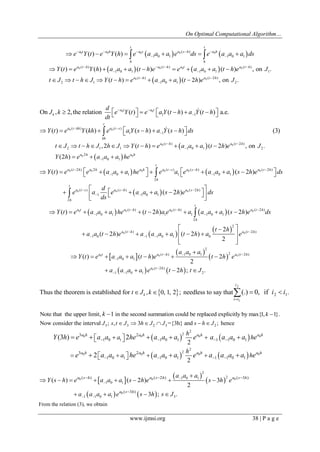
0 0 1 On 0, , ( ) 0 ( ) ( ) a.e. on [0, ] ( ) ( ) ; (0) 1 1 a t h  J Y t h  Y t  a Y t h Y t Y t  e C Y  C  
0 
0 ( ) on [0, ], a t Y t  e J  h as in the single - and double - delay systems. 
Consider the interval (h, 2h). Then 
0 ( ) 0 ( )   0 ( ) 
0 0 1 0 1 [0, ] ( ) ( ) ( ) ( ) a t h a t h a t h t h h Y t h e Y t h A e Y t a Y t a a a e    
               
0 0   0 ( ) 
0 1 0 1 ( ) ( ) ( ) a t a t a t h d 
e Y t e Y t a Y t a a a e 
dt 
   
            

On Optimal Computational Algorithm… 
www.ijmsi.org 38 | P a g e 
0 0 0   0 ( ) 0   
1 0 1 1 0 1 ( ) ( ) 
t t 
a t a h a s a s h a h 
h h 
e Y t e Y h e a a a e ds e a a a ds      
          
    
  
0 0 0 0 
0 0 
( ) ( ) ( ) 
1 0 1 1 0 1 1 
( ) ( 2 ) 
2 1 1 0 1 2 
( ) ( ) ( ) ( ) , on . 
( ) ( 2 ) , on . 
a t h a t h a t a t h 
a t h a t h 
Y t e Y h a a a t h e e a a a t h e J 
t J t h J Y t h e a a a t h e J 
    
  
  
 
         
          
0 0 
0 0 
1 1 
( ) ( ) 
1 1 
On , 2, the relation ( ) ( ) ( ) a.e. 
( ) ( ) ( ) ( ) (3) 
a t a t 
k 
t 
a t kh a t s 
kh 
d 
J k e Y t e a Y t h a Y t h 
dt 
Y t e Y kh e a Y s h a Y s h ds 
  
 
  
 
           
         
 
 
  
  
0 0 
0 0 
( ) ( 2 ) 
2 1 1 1 0 1 2 
2 
1 0 1 
,2 ( ) ( 2 ) , on . 
(2 ) 
a t h a t h 
a h a h 
t J t h J h J Y t h e a a a t h e J 
Y h e a a a he 
  
 
 
           
   
    
  
0 0 0 0 0 0 
0 0 0 
( 2 ) 2 ( ) ( ) ( 2 ) 
1 0 1 1 1 0 1 
2 
( ) ( ) ( 2 ) 
1 1 0 1 
2 
( ) ( 2 ) 
( 2 ) 
t 
a t h a h a h a t s a s h a s h 
h 
t 
a t s a s h a s h 
h 
Y t e e a a a he e a e a a a s h e ds 
d 
e a e a a a s h e ds 
ds 
    
  
   
  
                
  
         
  
 
 
    
  
  
0 0 0 0 
0 0 
( ) ( ) ( 2 ) 
1 0 1 1 1 1 0 1 
2 
2 
( ) ( 2 ) 
1 0 1 1 0 1 0 
( ) ( 2 ) ( 2 ) 
2 
( 2 ) ( 2 ) 
2 
t 
a t a t h a t h a t h 
h 
a t h a t h 
Y t e a a a he t h a e a a a a s h e ds 
t h 
a a t h e a a a a t h a e 
   
  
  
   
         
   
        
  
 
  
  
  
    
0 0 0 
0 
2 
( ) 1 0 1 2 ( 2 ) 
1 0 1 
( 2 ) 
1 1 0 1 2 
( ) ( ) 2 
2 
2 ; . 
a t a t h a t h 
a t h 
a a a 
Y t e a a a t h e t h e 
a a a a e t h t J 
   
 
 
  
 
       
    
  
2 
1 
2 1 Thus the theorem is established for , 0, 1, 2 ; needless to say that (.) 0, if . 
 
 k     
i 
i i 
t J k i i 
Note that the upper limit, k 1 in the second summation could be replaced explicitly by max{1, k 1}. 
3 3 2 3 2 Now consider the interval J ; s, t  J 3h J  J ={3h} and s  h J ; hence 
    
    
0 0 0 0 
0 0 0 0 
2 
2 
1 
2 
2 
1 
3 2 
1 0 1 0 1 1 1 0 1 
3 2 
1 0 1 0 1 1 1 0 1 
2 
2 
(3 ) 2 
2 
a h a h a h a h 
a h a h a h a h 
h 
a h 
h 
a h 
Y h e a a he a a a e a a a a e 
e a a he a a a e a a a a e 
    
    
    
      
     
   
  
  
  
    
0 0 0 
0 
2 
1 0 1 2 
1 0 1 
1 1 0 1 3 
( ) ( 2 ) ( 3 ) 
( 3 ) 
( ) ( 2 ) 3 
2 
3 ; . 
a s h a s h a s h 
a s h 
a a a 
Y s h e a a a s h e s h e 
a a a a e s h s J 
 
 
  
   
 
 
        
    
From the relation (3), we obtain
On Optimal Computational Algorithm… 
www.ijmsi.org 39 | P a g e 
    
  
  
  
   
0 
0 0 0 
0 
0 
0 0 0 
2 
( 2 ( 2 ( 2 
1 
2 
( ) ( 2 ) 1 0 1 2 ( 3 ) 
( ) 1 0 1 
1 
3 ( 3 ) 
1 1 0 1 
) ) ) 
1 0 1 0 1 1 1 0 1 ( ) 2 
2 
( 2 ) 3 
2 
3 
a t t t t 
t a s h a s h a s h 
a t s 
h a s h 
a h h a h a h 
Y t e a h 
a a a 
e a a a s h e s h e 
a e ds 
a a a a s h e 
a a he a a a e a a a a e    
    
  
 
  
           
   
       
   
      
  
 
  
  
  
   
0 0 0 
0 
0 
2 
( ) ( 2 ) 1 0 1 2 ( 3 ) 
( ) 1 0 1 
1 
3 ( 3 ) 
1 1 0 1 
( 2 ) 3 
2 
3 
t a s h a s h a s h 
a t s 
h a s h 
a a a 
d e a a a s h e s h e 
a e ds 
ds 
a a a a s h e 
    
  
 
 
  
   
       
   
      
 
    
    
  
  
  
0 
0 0 
0 
0 0 
0 0 0 
2 
( 2 ( 2 ( 2 
1 
2 ( 2 ) 2 ( 2 ) 
( ) 
1 1 1 0 1 1 1 0 1 
2 2 
1 0 1 3 ( 3 ) 1 1 1 0 1 ( 
1 
) ) ) 
1 0 1 0 1 1 1 0 1 ( ) 2 
2 
( 2 ) 
( 3 ) 
2 2 
( 3 ) 
3 
3! 2 
a t t t t 
a t h a t h 
a t h 
a t h a t 
a h h a h a h 
Y t e a h 
t h e h e 
a t h e a a a a a a a a 
a a a a a a a a t h 
a t h e e 
a a he a a a e a a a a e    
  
 
  
    
            
 
      
   
   
  
3h) 
  
  
    
  
  
  
0 0 0 
0 0 
0 
2 
( ) ( 2 ) 1 0 1 0 1 ( 2 ) 
1 0 1 1 0 1 
2 2 3 
1 0 1 0 1 ( 2 ) 1 1 0 1 2 ( 3 ) 
0 
2 
2 ( 3 ) 
1 1 0 1 0 
( 2 ) 
( 3 ) ( 3 ) 
2 
3 
3 
2 2 3 
( 3 ) 
3 
2! 
a t h a t h a t h 
a t h a t h 
a t h 
a a a a a t h 
a a t h e a a a a t h e e 
a a a a a h a a a a t h 
e t h a e 
t h 
a a a a t h a e 
     
   
      
 
  
  
      
     
      
  
   
      
  
The evaluation of the integrals and skillful collection of like terms result in the following expression for Y(t) : 
  
  
  
  
       
    
0 0 0 
0 0 0 
0 
2 
( ) 1 0 1 2 ( 2 ) 
1 0 1 
3 
1 0 1 3 ( 3 ) ( 2 ) 2 ( 3 ) 
1 1 0 1 1 1 0 1 
2 2 ( 3 ) 
1 1 0 1 
( ) ( ) 2 
2! 
3 2 ( 3 ) 
3! 
3 
a t a t h a t h 
a t h a t h a t h 
a t h 
a a a 
Y t e a a a t h e t h e 
a a a 
t h e a a a a t h e a a a a t h e 
a a a a t h e 
   
 
    
    
 
  
 
      
 
        
   
Observe that for {0,1,2,3} and , k k  tJ 
  
       
       
     
0 0 
0 
0 
1 0 1 
1 
1 
1 1 0 1 
1 
2 2 
1 1 0 1 
[ 1] 
( 3 ) 
( ) sgn max 0, 
! 
( [ 1] ) sgn max 0, 1 
( 3 ) sgn max 0, 2 (4) 
i 
k 
a t i 
i 
k 
i 
i 
a t ih 
a t i h 
a t h 
a a a 
Y t e t ih e k 
i 
a a a a t i h e k 
a a a a t h e k 
 
 
 
  
 
  
 
  
 
   
     
  
  
     
    
 
 
A definite pattern is yet to emerge; so the process continues. 
4 4 3 4 3 Now consider the interval J ; s, t  J  4h J  J ={4h} and s  h J ; hence
On Optimal Computational Algorithm… 
www.ijmsi.org 40 | P a g e 
  
        
  
0 
0 
3 
1 0 1 
1 0 1 
1 
2 
1 0 1 
0 0 
0 
2 
4 
( 4 ) 1 
1 
2 
1 
4 [3 ] 
the relation (3) implies that 
4 3 
( ) ! 
i 
i 
i 
a h i 
a t h 
i 
h 
a i h a i h 
a 
a a a 
i h a a a i h 
i 
a a a 
e e a e 
Y t e 
a h e 
 
 
 
 
  
  
 
 
   
   
 
  
    
   
     
  
    
      
      
0 4 
0 4 
4 4 
0 4 
0 0 
3 
1 0 1 
4 
( ) 1 
1 4 
4 2 2 2 
1 1 0 1 4 1 1 0 1 4 
1 
1 
[ 2] ( 4 ) 
1 
! 
( [ 2] ) ( 4 ) 
i 
a s h i 
t 
a t s i 
h 
i 
i 
a s i h 
a s i h a s h 
a a a 
e s i h e 
i 
a e ds 
a a a a s i h e a a a a s h e 
    
  
    
 
  
   
     
       
         
        
  
 
 
 
    
      
      
0 4 
0 4 
4 4 
0 4 
0 0 
3 
1 0 1 
4 
( ) 1 
1 4 
4 4 2 2 2 
1 1 0 1 4 1 1 0 1 4 
1 
1 
[ 2] ( 4 ) 
1 
! 
( [ 2] ) ( 4 ) 
i 
a s h i 
t 
a t s i 
h 
i 
i 
a s i h 
a s i h a s h 
a a a 
e s i h e 
d i 
a e ds 
ds 
a a a a s i h e a a a a s h e 
    
  
 
    
 
  
   
     
       
         
        
  
 
 
 
  
        
  
0 
3 
1 0 1 
1 0 1 
1 
2 
1 0 1 
0 0 
0 
2 
( ) 
1 
1 
2 ( 3 ) 
1 
[ 1] 
4 3 
! 
( ) 
i 
i 
i 
a t t ih i 
i 
t h 
a a t i h 
a 
a a a 
i h a a a i h 
i 
a a a 
Y t e e a e 
a h e 
 
 
 
 
 
 
 
 
 
   
   
 
    
 
  
  
  
      
  
      
  
  
  
0 0 
0 
0 
0 
3 
( ) 1 1 0 1 1 
1 
1 
3 2 2 
1 1 0 1 1 
1 1 1 0 1 
1 1 
2 2 
1 1 1 0 1 1 1 1 
1 
1 
[ 2] 
1 
2 
4 1 
( 1)! 
( [ 2] ) 
[3 ] 
( 1)! 2 
([2 ] ) 
2 
i 
a t h i 
i 
i 
i i 
i i 
i 
i 
a t i h 
a t i h 
a t i h 
a t i h 
a a a a 
a t h e t i h e 
i 
a a a a t i h e 
i h e a a a a a 
i 
i h e 
a a a a a a a a 
     
 
    
  
  
  
    
 
  
  
  
  
 
     
 
   
    
 
 
   
 
  
   0 
3 
2 
0 1 
( 4 ) ( 4 ) 
3 
t h a t h 
a a e   
 
  
  
        
     0 0 0 
3 3 
( ) 1 1 0 1 1 1 0 1 
1 0 
1 1 
1 1 
4 1 3 
! ! 
i i 
a t h i i 
i i 
a a a a a t i h a a a a a t i h 
a a t h e t i h e i h e 
i i 
         
 
  
      
       
  
  
        
  
   0 0   
3 3 
1 0 1 1 1 0 1 1 
1 0 1 0 
1 1 
1 1 
1 3 
1 ! 1 ! 
i i 
i i 
i i 
a a a a t i h a a a a t i h 
a a t i h e a a i h e 
i i 
        
  
  
      
     
    
      
      
  
         
  
  
0 0 
0 0 
0 
2 
2 2 
1 1 
1 1 0 1 1 0 1 0 1 
1 1 
2 
2 
1 2 2 2 
1 0 1 0 1 1 1 0 1 
1 
3 
2 2 
1 0 1 0 1 
[ 2] [ 2] 
[ 2] ( 4 ) 
( 4 ) 
2 
( 4 ) 
2 
2 
4 
2 
4 
3 
i i 
i i 
i 
i 
a t i h a t i h 
a t i h a t h 
a t h 
t i h 
a a a a t h e a a a a a e 
i h 
a a a a a e a a a a t h e 
t h 
a a a a a e 
  
    
  
 
    
 
  
    
   
 
  
     
 
     
 
  
  
 
It is evident from change of variables and grouping techniques that
On Optimal Computational Algorithm… 
www.ijmsi.org 41 | P a g e 
  
        
  
      
    
  
   
  
  
0 
0 0 
3 
1 0 1 
1 
0 0 
0 
0 
3 3 
1 1 0 1 1 1 0 1 1 
1 0 
1 1 
( ) ( ) ( ) 
1 1 0 
3 
1 1 0 1 1 
1 
1 1 
[ 1 
4 
! 
1 1 
( 1)! 1 ! 
4 4 
[3 ] 
( 1)! 
i 
i 
i 
i i 
a t i i 
i i 
a t h a t h t ih 
i 
i 
i 
a t i h a t i h 
a 
a t i 
a a a 
i h 
i 
a a a a a a a 
e t i h e a a t i h e 
i i 
a t h e a a t h e e 
a a a a 
i h e 
i 
 
 
        
 
  
   
 
  
 
    
  
 
 
  
      
  
     
 
  
 
 
  
     
  
       
  
    0 
0 
0 
3 
1 0 1 1 1 
1 0 
1 
4 
1 0 1 
1 
] 
3 
1 ! 
; (5) 
! 
i 
i t i 
i 
i 
a t i 
i 
h a h 
a t ih 
a a a 
a a i h e 
i 
a a a 
e t ih e 
i 
    
 
 
 
 
 
 
  
 
 
   
 
 
  
  
  
      
  
      
    
  
  
0 
0 
0 0 
0 
2 
2 2 2 
1 
1 1 1 0 1 1 0 1 0 1 
1 1 
2 2 
2 2 2 
1 1 0 1 1 1 0 1 
2 2 
2 
1 1 0 1 
1 
[ 2] 
[ 2] 
3 4 
[ 2] 
( [ 2] ) 2 
2 2 
3 4 
(6) 
2 2 
( [ 2] ) 
; 
2 
i i 
i i 
i 
i 
a t i h 
a t i h 
a t h a t h 
a t i h 
t i h e t i h 
a a a a a a a a a a e 
t h t h 
a a a a e a a a a e 
t i h e 
a a a a 
 
    
  
    
  
 
  
  
  
  
    
   
  
    
  
  
  
 
    
  
  
       
2 
1 0 1 
2 
2 
1 0 1 
0 
0 
0 0 
2 2 
2 ( 3 ) 
1 1 1 1 0 1 
1 
2 
2 
1 ( 3 ) 
1 0 1 0 1 1 
1 
2 
[ 2] 
Also, 
2 
([2 ] ) 
2 
2 
(7) 
2 
t h i 
i 
i t h 
i 
a t i h 
a 
a t i h a 
a a a 
h 
a a a 
i h e 
a h e a a a a a 
i h 
a a a a a e a e 
 
 
  
 
   
 
  
   
 
  
  
 
 
 
  
 
   
 
 
       
        
  
    
    
1 0 1 
0 0 
0 0 
0 
2 3 
2 
1 1 1 1 0 1 
1 
2 
1 2 2 2 
1 1 0 1 1 1 0 1 
1 
3 
3 
2 2 1 1 0 1 
1 0 1 0 1 
1 
[ 1] ( 4 ) 
[ 2] ( 4 ) 
( 4 ) 
Furthermore, 
3 
( 4 ) 
3 
( 4 ) 4 
4 
1 
3 ! 
i 
i 
i 
i 
i 
i 
i 
a t i h a t h 
a t i h a t h 
a t h 
a a a i h 
t h 
a e a a a a a e 
a a a a t h e a a a a t h e 
t h a a a a 
a a a a a e t i h e 
i 
    
 
 
    
 
  
  
 
   
   
 
  
 
  
      
  
     
 
 
   
  
     
            
      
  
1 0 1 
0 
0 
0 0 
0 0 
0 
3 
1 1 0 1 
1 
4 1 
2 2 
1 1 1 0 1 
1 
3 
2 2 2 3 
1 1 0 1 1 1 0 1 
2 
2 
1` 1 0 1 
1 
1 
[ 1] ( 3 ) 
( 4 ) ( 4 ) 
( 3 ) 
3 
! 
1 
1 3 
2 
( 4 ) 
4 
2 
2 
i 
i 
i 
i 
i 
a t i h 
a t i h 
a t i h a t h 
a t h a t h 
a t h 
a a a 
a a a a 
i h e 
i 
a t i h e a a a a t h e 
t h 
a a a a t h e a a a a e 
h 
a a a a e 
 
  
    
 
 
   
 
    
  
  
  
   
  
 
 
 
  
      
 
     
  
 
 
(8)
On Optimal Computational Algorithm… 
www.ijmsi.org 42 | P a g e 
Adding up expressions (5), (6), (7) and (8) yields 
  
    
      
    
0 0 
0 0 
0 
4 
1 0 1 
1 
4 1 
2 2 
1 1 0 1 1 1 0 1 
1 
3 
3 2 2 2 
1 1 0 1 1 1 0 1 
[ 1] ( 3 ) 
( 4 ) 
( ) 
! 
( [ 1] ) ( 3 ) 
( 4 ) 3 
( 4 ) (9) 
2 2 
i 
a t i 
i 
i 
i 
a t ih 
a t i h a t h 
a t h 
a a a 
Y t e t ih e 
i 
a a a a t i h e a a a a t h e 
t h 
a a a a a a a a t h e 
 
 
 
    
 
    
 
   
 
   
     
  
  
       
   
       
  
 
 
Hence for , 0, 1, 2, 3, 4, k tJ k 
  
       
       
     
    
0 0 
0 
0 
0 
1 0 1 
1 
1 
1 1 0 1 
1 
2 2 
1 1 0 1 
3 
3 2 2 2 
1 1 0 1 1 1 0 1 
[ 1] 
( 3 ) 
( ) sgn max 0, 
! 
( [ 1] ) sgn max 0, 1 
( 3 ) sgn max 0, 2 
( 4 ) 3 
( 4 ) 
2 2 
i 
k 
a t i 
i 
k 
i 
i 
a t ih 
a t i h 
a t h 
a 
a a a 
Y t e t ih e k 
i 
a a a a t i h e k 
a a a a t h e k 
t h 
a a a a a a a a t h e 
 
 
 
  
 
  
    
 
  
 
   
     
  
  
     
    
   
       
  
 
 
   ( 4 ) sgn max 0, 3 (10) t h k   
    
  
  
0 1 
1 
1 
Observe that for , , 1,2, , ; and 1, 1,2, , 1 . The transformation 
! 
from ( ) to ( ) requires only the computations of , for 1,2, , 1 2 , 
2,3, , 1 , 3, such that 1, sin 
k j i 
k k i j 
t J c j k c i k 
j 
Y t Y t c i k 
j k i k i j k 
 
      
   
       
  
 
 1 
1 2 1 3 2 1 2 
ce is already known for each . Therefore 
one need only determine 1 new values, namely , , , , . 
i 
i j k k k k 
c i 
k c c c c c      
On a positive note, the author has successfully devised an optimal computational algorithm for the 
solution matrices without recourse to the class of differential equations (1) and expression (3), usi 
1( ) as a starting point. This is the focus of the next res t. 
ng 
Y t ul 
1 1  3. Main Result: A computational Algorithm for transiting from ( ) to ( ),  k k Y t Y t k 
    1 2 1 1 0 1 Let , let , 0,1 . Suppose that 0. k t J a a a a         
  
  
    
       
  
2 
1 2 
1 2 
2 
1 2 
1 2 
2 
1 
0 
0 
1 0 1 
1 1 1 
1 1 2 
1 
1 
1 0 1 1 
1 
1 1 2 
1 0 1 
1 
2 2 
[ 1] 
[ 2] 
( ) ( ) ( ) [ 1] 
! 
( [ 1] ) sgn max 0, 1 
1 
( [ 
1 ( 1)sgn( ) 
j 
k 
j 
k 
j 
k 
i 
i 
j 
i 
i j 
a t j h 
a t i h 
a a a 
Y t Y t Y t a t j h e 
j 
a a a 
a t i h e k 
a a a 
c a t i j 
j 
 
  
  
 
  
  
 
 
 
 
  
 
  
  
   
 
 
   
 
   
 
  
 
  
  
 
     
 
 
    
 
 
    
   
  
  
     2 
1 2 
0 
2 
1 1 2 
[ 1] 
1] ) sgn max 0, 2 (11) 
for some real positive constants secured from ( ),with the process initiated at 1. 
k k i 
j 
i j 
i j k 
a t i j h 
h e k 
c Y t k 
 
  
  
 
    
   
 
 
  
3.1 Remarks on the optimal computational algorithm
On Optimal Computational Algorithm… 
www.ijmsi.org 43 | P a g e 
       
2 
1 2 
1 2 
0 
1 
1 1 
1 
1 0 1 
1 
1 0 1 2 
[ 1] 
Observe that for , ( ) can be expressed in the equivalent form 
( ) ( ) 
( [ 1] ) sgn max 0, 1 (12) 
1 sgn( ) 
for some real posit 
k k 
k 
j 
k k i 
i j 
i j 
i j 
a t i j h 
t J Y t 
Y t Y t 
a a a 
c a t i j h e k 
j 
 
  
   
 
 
 
  
   
 
    
   
 
 
 
     
   
    
0 1 
ive constants secured from ( ),with the process initiated at 1. 
1 
Moreover , 1,2, , 1 ; 1, 1,2, , and the transformation from ( ) 
! 
i j k 
j i k 
c Y t k 
c j k c i k Y t 
j 
 
       
    1 
1 2 1 3 2 1 2 
to ( ) requires only the computations of for 1,2, , 1 2 , 2,3, , 1 , 
3, such that 1.Therefore one need only determine 1 new values, namely 
, , , , . 
 
   
      
      
  
 
k i j 
i j 
k k k k 
Y t c i k j k i 
k i j k k c 
c c c c 
3.2 Interpretation of the computational algorithm for Y(t) 
  1 1 Stage 1:Transiting from ( ) to ( ), 1, 2, 3, k k Y t Y Y t k     
 0  Perform the following operations on each term of ( ) : a t 
k Y t e 
  
      1 0 1  1 0 1  0   0   
-1 1 0 1 
power of power of [.] [.] 
Increment each power of by 1; preserve the power of 
Let 
(i) a 
(ii) [.] [.] ; 
a a a a a a a t h a t h h 
a a a 
t h t h h e e   
 
     
 
     
     0  The operations i and ii yield exactly the same number of terms as in ( ) a t 
k Y t e 
  
            
1 0 1 1 
1 0 1 1 0 1 0 0 exponent of 1+ old exponent of [.] [.] 
(iii) Increment each exponent of by 1; preserve the exponent of 
(iv) Let [.] [.] ; 
(v) Divide each term by the new e 
a a a a a a a t h a t h h 
a a a a 
t h t h h e e 
  
       
 
     
  
    
    
1 0 1 
1 0 1 1 0 1 
1 0 1 1 0 1 
xponent of resulting from operation (iii), 
where new exponent of 1 old (preceding) exponent of , that is 
new exponent of exponent of from the resulting term in 
a a a 
a a a a a a 
a a a a a a 
 
  
  
 
    
   
  
1 
1 0 1 
( ) 
1 exponent of from the term operated on, in ( ) 
k 
k 
Y t 
a a a Y t 
 
 
   
      0 The operations iii , (iv) and v yield exactly the same number of terms as in ( ) a t 
k Y t  e 
   1 1 0 1 
(vi) Aggregate all terms resulting from operations (i) to (v) through appropriate groupings 
of common factors of powers of a and a a a . 
  
 
    1 1 1 Stage 2: Transiting from ( ) to ( ), 1,2, 3, k k Y Y t Y t k      
 0    
1 1 
1 1 
Secure by adding to the aggregated terms in (vi); in order words 
the resultant expressions from the application of the algorithm to 
( ) ( ) 
1, 2,3, 
( ) ( ) 
( ) ; 
k 
k a t 
k 
Y t Y t 
Y k 
Y t Y t 
t e 
 
  
  
   
   
  
 
3.3 Cardinality and CardinalityTransition Analyses on ( ) k Y t 
    1 Denote the cardinality of . by . . Then ( ) ( ) 1 is the resulting autonomous     k k Y t Y t k 
nonhomogeneous linear difference equation, for k1, 2, 3,. Hence 
   
  1 1 
1 2 
( ) 1 , 0, 2, 3, ,noting that ( ) 2. 
2  
  
     k 
k k 
Y t k Y t
On Optimal Computational Algorithm… 
www.ijmsi.org 44 | P a g e 
    
      
  
0 
0 
1 1 
Furthermore, for 1,2, , the number of terms that need to be aggregated from ( ) 
to secure ( ) ( ) is 1 ,derived from the fact that there are 2 ( ) 
2 ( ) 1 such terms. Therefore 
 
  
   
  
 a t 
k 
a t 
k k 
k 
k Y t e 
Y t Y t k k Y t e 
Y t k2 
1 
2 terms must be aggregated in the transition from 
( ) to ( ).  
  
k k 
k 
Y t Y t 
3.4 Verification and illustrations of Algorithm 3 
0 
0 
0 0 0 
0 
1 1 ([ ] ) 
([ ] ) 1 0 1 
2 2 1 1 1 0 1 
( ) ([ ] ) 
2 1 0 1 1 1 0 1 
1 1 1 1 ([ ] ) 
1 0 1 
( ) ([ ] ) 
( ) ( ) ( )([ ] ) 
1 1 
( ) ( )( ) ( )([ ] ) 
( ) ([ ] ) 
1 1 
a t h h 
a t h h 
a t a t h a t h h 
a t h h 
a a a t h h e 
t J Y t Y t a a a a t h h e 
Y t e a a a t h e a a a a t h h e 
a a a t h h e 
   
   
  
   
   
    
 
   
        
 
        
   
 
 
     
0 
0 0 
2 1 1 ([ ] ) 
1 0 1 2 
1 1 0 1 2 
1 
( ) ( ) 
( ) ( 2 ) , . 
! 
i a t h h 
a t a t h 
i 
a a a t ih e 
Y t e a a a a t h e t J 
i 
   
  
  
 
  
      
  3 4 
It is straight-forward and easy to check that the algorithm verifies the rest of the computation 
( ), for 3 ,5 
s for 
. 
Y t tJ J  h h 
  5 Finally, we apply the algorithm to extend the solution matrices to the interval J  5h,6h . 
    1 4 23 32 
4 5 
To achieve this, set 4, so that 1 5; so we need only obtain the 1 4 1 3 
new coefficients , for 1,2,3 , 2, ,5 : 1, namely , and . 
The application of the algorithm from to yie 
i j 
k k k 
c i j i i j k c c c 
J J 
       
       
5 lds the following expression for Y(t), tJ : 
  
    
      
    
  
0 
0 0 
0 
4 
1 0 1 
1 1 
1 
4 1 
1 2 2 2 
1 1 0 1 1 1 0 1 
1 
3 
2 3 3 2 2 
1 1 0 1 1 1 0 1 
1 0 1 
[ 1] 
[ 1] ( 4 ) 
( 5 ) 
( ) ( ) [ 1] 
! 
( [ 1] ) ( 4 ) 
( 5 ) 3 
( 5 ) 
2 2 
 
 
 
 
 
    
 
    
 
  
   
 
   
      
  
  
       
   
       
  
 
 
 
 
j 
j 
j 
i 
i 
a t j h 
a t i h a t h 
a t h 
a a a 
Y t Y t a t j h e 
j 
a a a a t i h e a a a a t h e 
t h 
a a a a a a a a t h e 
a a a 
  
    
      
    
0 
0 0 
0 
1 
4 
1 
2 3 
4 1 
1 0 1 1 0 1 2 
1 1 
1 
4 
4 2 3 2 
1 1 0 1 1 1 0 1 
[ 1] 
[ 1] ( 4 ) 
( 5 ) 
[ 1] 
1 ! 
( [ 2] ) ( 4 ) 
2 3 
( 4 ) 3 
( 5 ) 
2(4) 2(3) 
 
 
 
  
  
 
    
  
   
 
  
    
   
  
  
     
   
       
  
 
 
j 
j 
j 
i 
i 
a t j h 
a t i h a t h 
a t h 
t j h e 
j j 
a a a a a a 
a t i h e a t h e 
t h 
a a a a a a a a t h e 
1 0 5 4 1 
1 
Aggregation of like terms: ( ) the terms with 1 4, together with , 1, 
5! 
evaluate to 
Y t   i  j  c  c 
On Optimal Computational Algorithm… 
www.ijmsi.org 45 | P a g e 
  
        
      
0 0 0 
0 0 
5 5 1 
1 0 1 
1 1 0 1 
1 1 
3 
2 2 3 2 2 2 
1 1 0 1 1 1 0 1 1 1 0 1 
[ 1] 
( 3 ) ( 4 ) 
( [ 1] ) 
! 
( 4 ) 3 
( 3 ) ( 4 ) 
2 2 
 
 
  
  
      
   
  
   
        
  
  
   
          
  
  
j 
a t j i 
j i 
a t jh a t i h 
a t h a t h 
a a a 
e t jh e a a a a t i h e 
j 
t h 
a a a a t h e a a a a a a a a t h e 
14 23 
23 1 4 2 3 32 
It follows from the aggregated terms that the values of the remaining three coefficients , and 
1 1 1 1 3 1 1 
are , and respectively. Therefore , 1 and 2. Hence 
4! 8 2 2 2 2 6 
c c 
c    c  c  c  
  
        
      
  
0 0 0 
0 0 
5 5 1 
1 0 1 
1 1 0 1 
1 1 
3 
2 2 3 2 2 2 
1 1 0 1 1 1 0 1 1 1 0 1 
4 
4 
1 1 0 1 
[ 1] 
( 3 ) ( 4 ) 
( ) ( [ 1] ) 
! 
( 4 ) 3 
( 3 ) ( 4 ) 
2 2 
( 4 ) 
3! 
 
 
  
  
      
   
   
  
   
         
  
  
   
          
  
 
   
  
j 
a t j i 
j i 
a t jh a t i h 
a t h a t h 
a a a 
Y t e t jh e a a a a t i h e 
j 
t h 
a a a a t h e a a a a a a a a t h e 
t h 
a a a a a     0 
2 3 3 3 2 2 
1 1 0 1 1 1 0 1 5 
( 5 ) ( 5 ) 2 ( 5 ) ; .    
   
        
  
a t h a a a t h a a a a t h e t J 
5 
0 
Moreover the general expresion for ( ), can be stated as follows: k 
k 
Y t t J 
 
 
  
      
      
    
    
0 0 
0 
0 
0 
5 
1 0 1 
1 
5 1 
1 1 0 1 
1 
2 2 
1 1 0 1 
3 
3 2 2 2 
1 1 0 1 1 1 0 1 
[ 1] 
( 3 ) 
( 4 ) 
( ) max ,0 
! 
( [ 1] ) max 1,0 
( 3 ) max 2,0 
( 4 ) 3 
( 4 ) max 
2 2 
j 
a t j 
j 
i 
i 
a t jh 
a t i h 
a t h 
a t h 
a a a 
Y t e t jh e k 
j 
a a a a t i h e k 
a a a a t h e k 
t h 
a a a a a a a a t h e 
 
 
 
  
 
  
    
 
  
 
 
   
     
  
  
     
    
   
       
  
 
 
  
    
  
0   
4 
4 2 3 3 
1 1 0 1 1 1 0 1 
3 2 2 
1 1 0 1 
( 5 ) 
3,0 
( 4 ) 
( 5 ) 
3! max 4,0 . 
2 ( 5 ) 
a t h 
k 
t h 
a a a a a a a a t h 
e k 
a a a a t h 
    
  
 
 
   
      
    
      
IV. CONCLUSION 
This article obtained an optimal computational schemefor the structure of the solution matrices of 
single-delay linear neutral differential equations by leveraging on the established expressions for such matrices 
on the time interval of length equal to five times the delay, starting from time zero. The scheme is iteratively 
based on transitions fromone time interval of length equal to the delay to the next contiguous intervalof 
length h , with the coefficients from the preceding interval preserved, two new coefficients updatedand the rest 
obtained from the aggregation of the components resulting from the afore-mentioned transitions. This algorithm 
alleviates the computational burden associated with relying on the equation (1) and the expression (3) fraught 
with proneness to computational errors and resolves to a great extent the lack of a general expression for the 
solution matrices.The structure of the algorithm is so simple that the solution matrix transitions from one 
interval to the next contiguous interval can be obtained by inspection and addition of two terms for each new 
coefficient.
On Optimal Computational Algorithm… 
www.ijmsi.org 46 | P a g e 
REFERENCES [1] Ukwu, C. (1987). Compactness of cores of targets for linear delay systems., J. Math. Analy.and Appl., Vol. 125, No. 2, August 1. pp. 323-330. [2] Ukwu, C. and Garba, E.J.D. (2014w).Construction of optimal expressions for transition matrices of a class of double – delay scalar differential equations. African Journal of Natural Sciences (AJNS). Vol. 16, 2014. [3] Ukwu, C. and E. J. D. Garba (2014e). Derivation of an optimal expression for solution matrices of a class of single-delay scalar differential equations. Journal of Nigerian Association of Mathematical Physics. Vol. 26, March 2014.

D028036046

  • 1.
    International Journal ofMathematics and Statistics Invention (IJMSI) E-ISSN: 2321 – 4767 P-ISSN: 2321 - 4759 www.ijmsi.org Volume 2 Issue 8 || August. 2014 || PP-36-46 www.ijmsi.org 36 | P a g e On optimal computational algorithm and transition cardinalities for solution matrices of single–delaylinear neutral scalar differential equations. Ukwu Chukwunenye Department of Mathematics University of Jos P.M.B 2084 Jos, Nigeria ABSTRACT : This paper established an optimal computationalalgorithm for solution matrices of single–delay autonomous linear neutral equations based on the established expressions of such matrices on a horizon of length equal to five times the delay. The development of the solution matrices exploited the continuity of these matrices for positive time periods, the method of steps, change of variablesand theory of linear difference equations to obtain these matrices on successive intervals of length equal to the delay h. KEYWORDS: Algorithm, Equations, Matrices, Neutral, Solution. I. INTRODUCTION Solution matrices are integral components of variation of constants formulas in the computations of solutions of linear and perturbed linear functional differential equations, Ukwu [1]. But quite curiously, no other author has made any serious attemptto investigate the existence or otherwise of their general expressions for various classes of these equations. Effort has usually focused on the single – delay model and the approach has been to start from the interval [0,h] , compute the solution matrices and solutions for given problem instances and then use the method of steps to extend these to the intervals [kh, (k 1)h], for positive integral k , not exceeding 2, for the most part. Such approach is rather restrictive and doomed to failure in terms of structure for arbitrary k . In other words such approach fails to address the issue of the structure of solution matrices and solutions quite vital for real-world applications.With a view to addressing such short-comings, Ukwu and Garba[2] blazed the trail by consideringthe class of double – delay scalar differential equations: x(t)  ax(t) bx(t  h)  cx(t  2h), t R, where a, b and c are arbitrary real constants. By deploying ingenious combinations of summation notations, multinomial distribution, greatest integer functions, change of variables techniques, multiple integrals, as well as the method of steps, the paperderived the following optimal expressions for the solution matrices:       0 2 2 ( ) [ 2 ] ) 1 1 0 , ; ( ) [ 2 ] ; , 1 ! ! ! at k i k j i j k at i a t ih i j a t i j h k i j i e t J Y t t ih b c e b e t i j h e t J k i i j                                where [ , ( 1) ], {0,1, },   denotes the greatest integer function, and ( ) denotes a generic solution matrix of the above class of equations for . See also [3]. . k J kh k h k Y t t        R This article makes a positive contribution to knowledge bydevising a computational algorithmfor the solution matrices of linear neutral equations on ,.
  • 2.
    On Optimal ComputationalAlgorithm… www.ijmsi.org 37 | P a g e II. RESULTS AND DISCUSSIONS        2 2 [ 2 ] ) 0 0 Observe that the above piece-wise expressions for ( )may be restated more compactly in the form ( ) [ 2 ] sgn max 1,0 ; , 0 where , 0, , ! ! k k j i j a t i j h i j k j i i j i j Y t Y t d t i j h e k t J k b c d j i j                        , 0, , 2  2 k i k j             Let ( ) k i Y t ih   be a solution matrix of 1 0 1 x(t) a x(t h) a x(t) a x(t h), (1)         on the interval [( ) , ( 1 ) ], {0,1, }, {0,1, 2}, where k i J k i h k i h k i         1, 0 ( ) (2) 0, 0 t Y t t       Note thatY(t) is a generic solution matrix for any tR. The coefficients 1 0 1 a , a , a  and the associated functions are all from the real domain. The following theorem is preliminary to the devising/construction of an optimal computational algorithm for Y(t).                                0 0 0 0 1 0 1 1 1 1 0 1 2 2 3 1 1 0 1 3 3 1 1 0 1 1 [ 1] 1 2.1 Theorem on ( ) For , 0,1,2,3,4,5 , ( ) sgn max 0, ! ( [ 1] ) sgn max 0, 1 3 sgn max 0, 2 4 3 3 2 k i k i i i a t h a t a t ih k a t i h i Y t t J k a a a Y t e t ih e k i a a a a t i h e k a a a a t h e k t h a a a a                                                              0 0 2 2 2 4 1 1 0 1 4 4 1 1 0 1 5 2 3 2 3 2 2 1 1 0 1 1 1 0 1 4 sgn max 0, 3 5 8 sgn max 0, 4 5 2 5 a t h a t h a a a a t h e k t h a a a a e k a a a a t h a a a a t h                                       Proof   0 0 0 1 On 0, , ( ) 0 ( ) ( ) a.e. on [0, ] ( ) ( ) ; (0) 1 1 a t h  J Y t h  Y t  a Y t h Y t Y t  e C Y  C  0 0 ( ) on [0, ], a t Y t  e J  h as in the single - and double - delay systems. Consider the interval (h, 2h). Then 0 ( ) 0 ( )   0 ( ) 0 0 1 0 1 [0, ] ( ) ( ) ( ) ( ) a t h a t h a t h t h h Y t h e Y t h A e Y t a Y t a a a e                   0 0   0 ( ) 0 1 0 1 ( ) ( ) ( ) a t a t a t h d e Y t e Y t a Y t a a a e dt                
  • 3.
    On Optimal ComputationalAlgorithm… www.ijmsi.org 38 | P a g e 0 0 0   0 ( ) 0   1 0 1 1 0 1 ( ) ( ) t t a t a h a s a s h a h h h e Y t e Y h e a a a e ds e a a a ds                      0 0 0 0 0 0 ( ) ( ) ( ) 1 0 1 1 0 1 1 ( ) ( 2 ) 2 1 1 0 1 2 ( ) ( ) ( ) ( ) , on . ( ) ( 2 ) , on . a t h a t h a t a t h a t h a t h Y t e Y h a a a t h e e a a a t h e J t J t h J Y t h e a a a t h e J                             0 0 0 0 1 1 ( ) ( ) 1 1 On , 2, the relation ( ) ( ) ( ) a.e. ( ) ( ) ( ) ( ) (3) a t a t k t a t kh a t s kh d J k e Y t e a Y t h a Y t h dt Y t e Y kh e a Y s h a Y s h ds                                 0 0 0 0 ( ) ( 2 ) 2 1 1 1 0 1 2 2 1 0 1 ,2 ( ) ( 2 ) , on . (2 ) a t h a t h a h a h t J t h J h J Y t h e a a a t h e J Y h e a a a he                         0 0 0 0 0 0 0 0 0 ( 2 ) 2 ( ) ( ) ( 2 ) 1 0 1 1 1 0 1 2 ( ) ( ) ( 2 ) 1 1 0 1 2 ( ) ( 2 ) ( 2 ) t a t h a h a h a t s a s h a s h h t a t s a s h a s h h Y t e e a a a he e a e a a a s h e ds d e a e a a a s h e ds ds                                                   0 0 0 0 0 0 ( ) ( ) ( 2 ) 1 0 1 1 1 1 0 1 2 2 ( ) ( 2 ) 1 0 1 1 0 1 0 ( ) ( 2 ) ( 2 ) 2 ( 2 ) ( 2 ) 2 t a t a t h a t h a t h h a t h a t h Y t e a a a he t h a e a a a a s h e ds t h a a t h e a a a a t h a e                                            0 0 0 0 2 ( ) 1 0 1 2 ( 2 ) 1 0 1 ( 2 ) 1 1 0 1 2 ( ) ( ) 2 2 2 ; . a t a t h a t h a t h a a a Y t e a a a t h e t h e a a a a e t h t J                      2 1 2 1 Thus the theorem is established for , 0, 1, 2 ; needless to say that (.) 0, if .   k     i i i t J k i i Note that the upper limit, k 1 in the second summation could be replaced explicitly by max{1, k 1}. 3 3 2 3 2 Now consider the interval J ; s, t  J 3h J  J ={3h} and s  h J ; hence         0 0 0 0 0 0 0 0 2 2 1 2 2 1 3 2 1 0 1 0 1 1 1 0 1 3 2 1 0 1 0 1 1 1 0 1 2 2 (3 ) 2 2 a h a h a h a h a h a h a h a h h a h h a h Y h e a a he a a a e a a a a e e a a he a a a e a a a a e                                     0 0 0 0 2 1 0 1 2 1 0 1 1 1 0 1 3 ( ) ( 2 ) ( 3 ) ( 3 ) ( ) ( 2 ) 3 2 3 ; . a s h a s h a s h a s h a a a Y s h e a a a s h e s h e a a a a e s h s J                      From the relation (3), we obtain
  • 4.
    On Optimal ComputationalAlgorithm… www.ijmsi.org 39 | P a g e              0 0 0 0 0 0 0 0 0 2 ( 2 ( 2 ( 2 1 2 ( ) ( 2 ) 1 0 1 2 ( 3 ) ( ) 1 0 1 1 3 ( 3 ) 1 1 0 1 ) ) ) 1 0 1 0 1 1 1 0 1 ( ) 2 2 ( 2 ) 3 2 3 a t t t t t a s h a s h a s h a t s h a s h a h h a h a h Y t e a h a a a e a a a s h e s h e a e ds a a a a s h e a a he a a a e a a a a e                                                       0 0 0 0 0 2 ( ) ( 2 ) 1 0 1 2 ( 3 ) ( ) 1 0 1 1 3 ( 3 ) 1 1 0 1 ( 2 ) 3 2 3 t a s h a s h a s h a t s h a s h a a a d e a a a s h e s h e a e ds ds a a a a s h e                                             0 0 0 0 0 0 0 0 0 2 ( 2 ( 2 ( 2 1 2 ( 2 ) 2 ( 2 ) ( ) 1 1 1 0 1 1 1 0 1 2 2 1 0 1 3 ( 3 ) 1 1 1 0 1 ( 1 ) ) ) 1 0 1 0 1 1 1 0 1 ( ) 2 2 ( 2 ) ( 3 ) 2 2 ( 3 ) 3 3! 2 a t t t t a t h a t h a t h a t h a t a h h a h a h Y t e a h t h e h e a t h e a a a a a a a a a a a a a a a a t h a t h e e a a he a a a e a a a a e                                        3h)               0 0 0 0 0 0 2 ( ) ( 2 ) 1 0 1 0 1 ( 2 ) 1 0 1 1 0 1 2 2 3 1 0 1 0 1 ( 2 ) 1 1 0 1 2 ( 3 ) 0 2 2 ( 3 ) 1 1 0 1 0 ( 2 ) ( 3 ) ( 3 ) 2 3 3 2 2 3 ( 3 ) 3 2! a t h a t h a t h a t h a t h a t h a a a a a t h a a t h e a a a a t h e e a a a a a h a a a a t h e t h a e t h a a a a t h a e                                                  The evaluation of the integrals and skillful collection of like terms result in the following expression for Y(t) :                    0 0 0 0 0 0 0 2 ( ) 1 0 1 2 ( 2 ) 1 0 1 3 1 0 1 3 ( 3 ) ( 2 ) 2 ( 3 ) 1 1 0 1 1 1 0 1 2 2 ( 3 ) 1 1 0 1 ( ) ( ) 2 2! 3 2 ( 3 ) 3! 3 a t a t h a t h a t h a t h a t h a t h a a a Y t e a a a t h e t h e a a a t h e a a a a t h e a a a a t h e a a a a t h e                                   Observe that for {0,1,2,3} and , k k  tJ                      0 0 0 0 1 0 1 1 1 1 1 0 1 1 2 2 1 1 0 1 [ 1] ( 3 ) ( ) sgn max 0, ! ( [ 1] ) sgn max 0, 1 ( 3 ) sgn max 0, 2 (4) i k a t i i k i i a t ih a t i h a t h a a a Y t e t ih e k i a a a a t i h e k a a a a t h e k                                    A definite pattern is yet to emerge; so the process continues. 4 4 3 4 3 Now consider the interval J ; s, t  J  4h J  J ={4h} and s  h J ; hence
  • 5.
    On Optimal ComputationalAlgorithm… www.ijmsi.org 40 | P a g e             0 0 3 1 0 1 1 0 1 1 2 1 0 1 0 0 0 2 4 ( 4 ) 1 1 2 1 4 [3 ] the relation (3) implies that 4 3 ( ) ! i i i a h i a t h i h a i h a i h a a a a i h a a a i h i a a a e e a e Y t e a h e                                                  0 4 0 4 4 4 0 4 0 0 3 1 0 1 4 ( ) 1 1 4 4 2 2 2 1 1 0 1 4 1 1 0 1 4 1 1 [ 2] ( 4 ) 1 ! ( [ 2] ) ( 4 ) i a s h i t a t s i h i i a s i h a s i h a s h a a a e s i h e i a e ds a a a a s i h e a a a a s h e                                                                   0 4 0 4 4 4 0 4 0 0 3 1 0 1 4 ( ) 1 1 4 4 4 2 2 2 1 1 0 1 4 1 1 0 1 4 1 1 [ 2] ( 4 ) 1 ! ( [ 2] ) ( 4 ) i a s h i t a t s i h i i a s i h a s i h a s h a a a e s i h e d i a e ds ds a a a a s i h e a a a a s h e                                                                0 3 1 0 1 1 0 1 1 2 1 0 1 0 0 0 2 ( ) 1 1 2 ( 3 ) 1 [ 1] 4 3 ! ( ) i i i a t t ih i i t h a a t i h a a a a i h a a a i h i a a a Y t e e a e a h e                                                0 0 0 0 0 3 ( ) 1 1 0 1 1 1 1 3 2 2 1 1 0 1 1 1 1 1 0 1 1 1 2 2 1 1 1 0 1 1 1 1 1 1 [ 2] 1 2 4 1 ( 1)! ( [ 2] ) [3 ] ( 1)! 2 ([2 ] ) 2 i a t h i i i i i i i i i a t i h a t i h a t i h a t i h a a a a a t h e t i h e i a a a a t i h e i h e a a a a a i i h e a a a a a a a a                                                       0 3 2 0 1 ( 4 ) ( 4 ) 3 t h a t h a a e                     0 0 0 3 3 ( ) 1 1 0 1 1 1 0 1 1 0 1 1 1 1 4 1 3 ! ! i i a t h i i i i a a a a a t i h a a a a a t i h a a t h e t i h e i h e i i                                           0 0   3 3 1 0 1 1 1 0 1 1 1 0 1 0 1 1 1 1 1 3 1 ! 1 ! i i i i i i a a a a t i h a a a a t i h a a t i h e a a i h e i i                                                       0 0 0 0 0 2 2 2 1 1 1 1 0 1 1 0 1 0 1 1 1 2 2 1 2 2 2 1 0 1 0 1 1 1 0 1 1 3 2 2 1 0 1 0 1 [ 2] [ 2] [ 2] ( 4 ) ( 4 ) 2 ( 4 ) 2 2 4 2 4 3 i i i i i i a t i h a t i h a t i h a t h a t h t i h a a a a t h e a a a a a e i h a a a a a e a a a a t h e t h a a a a a e                                            It is evident from change of variables and grouping techniques that
  • 6.
    On Optimal ComputationalAlgorithm… www.ijmsi.org 41 | P a g e                                0 0 0 3 1 0 1 1 0 0 0 0 3 3 1 1 0 1 1 1 0 1 1 1 0 1 1 ( ) ( ) ( ) 1 1 0 3 1 1 0 1 1 1 1 1 [ 1 4 ! 1 1 ( 1)! 1 ! 4 4 [3 ] ( 1)! i i i i i a t i i i i a t h a t h t ih i i i a t i h a t i h a a t i a a a i h i a a a a a a a e t i h e a a t i h e i i a t h e a a t h e e a a a a i h e i                                                                       0 0 0 3 1 0 1 1 1 1 0 1 4 1 0 1 1 ] 3 1 ! ; (5) ! i i t i i i a t i i h a h a t ih a a a a a i h e i a a a e t ih e i                                                0 0 0 0 0 2 2 2 2 1 1 1 1 0 1 1 0 1 0 1 1 1 2 2 2 2 2 1 1 0 1 1 1 0 1 2 2 2 1 1 0 1 1 [ 2] [ 2] 3 4 [ 2] ( [ 2] ) 2 2 2 3 4 (6) 2 2 ( [ 2] ) ; 2 i i i i i i a t i h a t i h a t h a t h a t i h t i h e t i h a a a a a a a a a a e t h t h a a a a e a a a a e t i h e a a a a                                                          2 1 0 1 2 2 1 0 1 0 0 0 0 2 2 2 ( 3 ) 1 1 1 1 0 1 1 2 2 1 ( 3 ) 1 0 1 0 1 1 1 2 [ 2] Also, 2 ([2 ] ) 2 2 (7) 2 t h i i i t h i a t i h a a t i h a a a a h a a a i h e a h e a a a a a i h a a a a a e a e                                                        1 0 1 0 0 0 0 0 2 3 2 1 1 1 1 0 1 1 2 1 2 2 2 1 1 0 1 1 1 0 1 1 3 3 2 2 1 1 0 1 1 0 1 0 1 1 [ 1] ( 4 ) [ 2] ( 4 ) ( 4 ) Furthermore, 3 ( 4 ) 3 ( 4 ) 4 4 1 3 ! i i i i i i i a t i h a t h a t i h a t h a t h a a a i h t h a e a a a a a e a a a a t h e a a a a t h e t h a a a a a a a a a e t i h e i                                                                          1 0 1 0 0 0 0 0 0 0 3 1 1 0 1 1 4 1 2 2 1 1 1 0 1 1 3 2 2 2 3 1 1 0 1 1 1 0 1 2 2 1` 1 0 1 1 1 [ 1] ( 3 ) ( 4 ) ( 4 ) ( 3 ) 3 ! 1 1 3 2 ( 4 ) 4 2 2 i i i i i a t i h a t i h a t i h a t h a t h a t h a t h a a a a a a a i h e i a t i h e a a a a t h e t h a a a a t h e a a a a e h a a a a e                                                  (8)
  • 7.
    On Optimal ComputationalAlgorithm… www.ijmsi.org 42 | P a g e Adding up expressions (5), (6), (7) and (8) yields                 0 0 0 0 0 4 1 0 1 1 4 1 2 2 1 1 0 1 1 1 0 1 1 3 3 2 2 2 1 1 0 1 1 1 0 1 [ 1] ( 3 ) ( 4 ) ( ) ! ( [ 1] ) ( 3 ) ( 4 ) 3 ( 4 ) (9) 2 2 i a t i i i i a t ih a t i h a t h a t h a a a Y t e t ih e i a a a a t i h e a a a a t h e t h a a a a a a a a t h e                                                   Hence for , 0, 1, 2, 3, 4, k tJ k                          0 0 0 0 0 1 0 1 1 1 1 1 0 1 1 2 2 1 1 0 1 3 3 2 2 2 1 1 0 1 1 1 0 1 [ 1] ( 3 ) ( ) sgn max 0, ! ( [ 1] ) sgn max 0, 1 ( 3 ) sgn max 0, 2 ( 4 ) 3 ( 4 ) 2 2 i k a t i i k i i a t ih a t i h a t h a a a a Y t e t ih e k i a a a a t i h e k a a a a t h e k t h a a a a a a a a t h e                                                       ( 4 ) sgn max 0, 3 (10) t h k           0 1 1 1 Observe that for , , 1,2, , ; and 1, 1,2, , 1 . The transformation ! from ( ) to ( ) requires only the computations of , for 1,2, , 1 2 , 2,3, , 1 , 3, such that 1, sin k j i k k i j t J c j k c i k j Y t Y t c i k j k i k i j k                      1 1 2 1 3 2 1 2 ce is already known for each . Therefore one need only determine 1 new values, namely , , , , . i i j k k k k c i k c c c c c      On a positive note, the author has successfully devised an optimal computational algorithm for the solution matrices without recourse to the class of differential equations (1) and expression (3), usi 1( ) as a starting point. This is the focus of the next res t. ng Y t ul 1 1  3. Main Result: A computational Algorithm for transiting from ( ) to ( ),  k k Y t Y t k     1 2 1 1 0 1 Let , let , 0,1 . Suppose that 0. k t J a a a a                          2 1 2 1 2 2 1 2 1 2 2 1 0 0 1 0 1 1 1 1 1 1 2 1 1 1 0 1 1 1 1 1 2 1 0 1 1 2 2 [ 1] [ 2] ( ) ( ) ( ) [ 1] ! ( [ 1] ) sgn max 0, 1 1 ( [ 1 ( 1)sgn( ) j k j k j k i i j i i j a t j h a t i h a a a Y t Y t Y t a t j h e j a a a a t i h e k a a a c a t i j j                                                                        2 1 2 0 2 1 1 2 [ 1] 1] ) sgn max 0, 2 (11) for some real positive constants secured from ( ),with the process initiated at 1. k k i j i j i j k a t i j h h e k c Y t k                  3.1 Remarks on the optimal computational algorithm
  • 8.
    On Optimal ComputationalAlgorithm… www.ijmsi.org 43 | P a g e        2 1 2 1 2 0 1 1 1 1 1 0 1 1 1 0 1 2 [ 1] Observe that for , ( ) can be expressed in the equivalent form ( ) ( ) ( [ 1] ) sgn max 0, 1 (12) 1 sgn( ) for some real posit k k k j k k i i j i j i j a t i j h t J Y t Y t Y t a a a c a t i j h e k j                                      0 1 ive constants secured from ( ),with the process initiated at 1. 1 Moreover , 1,2, , 1 ; 1, 1,2, , and the transformation from ( ) ! i j k j i k c Y t k c j k c i k Y t j             1 1 2 1 3 2 1 2 to ( ) requires only the computations of for 1,2, , 1 2 , 2,3, , 1 , 3, such that 1.Therefore one need only determine 1 new values, namely , , , , .                    k i j i j k k k k Y t c i k j k i k i j k k c c c c c 3.2 Interpretation of the computational algorithm for Y(t)   1 1 Stage 1:Transiting from ( ) to ( ), 1, 2, 3, k k Y t Y Y t k      0  Perform the following operations on each term of ( ) : a t k Y t e         1 0 1  1 0 1  0   0   -1 1 0 1 power of power of [.] [.] Increment each power of by 1; preserve the power of Let (i) a (ii) [.] [.] ; a a a a a a a t h a t h h a a a t h t h h e e                    0  The operations i and ii yield exactly the same number of terms as in ( ) a t k Y t e               1 0 1 1 1 0 1 1 0 1 0 0 exponent of 1+ old exponent of [.] [.] (iii) Increment each exponent of by 1; preserve the exponent of (iv) Let [.] [.] ; (v) Divide each term by the new e a a a a a a a t h a t h h a a a a t h t h h e e                          1 0 1 1 0 1 1 0 1 1 0 1 1 0 1 xponent of resulting from operation (iii), where new exponent of 1 old (preceding) exponent of , that is new exponent of exponent of from the resulting term in a a a a a a a a a a a a a a a                1 1 0 1 ( ) 1 exponent of from the term operated on, in ( ) k k Y t a a a Y t            0 The operations iii , (iv) and v yield exactly the same number of terms as in ( ) a t k Y t  e    1 1 0 1 (vi) Aggregate all terms resulting from operations (i) to (v) through appropriate groupings of common factors of powers of a and a a a .        1 1 1 Stage 2: Transiting from ( ) to ( ), 1,2, 3, k k Y Y t Y t k       0    1 1 1 1 Secure by adding to the aggregated terms in (vi); in order words the resultant expressions from the application of the algorithm to ( ) ( ) 1, 2,3, ( ) ( ) ( ) ; k k a t k Y t Y t Y k Y t Y t t e               3.3 Cardinality and CardinalityTransition Analyses on ( ) k Y t     1 Denote the cardinality of . by . . Then ( ) ( ) 1 is the resulting autonomous     k k Y t Y t k nonhomogeneous linear difference equation, for k1, 2, 3,. Hence      1 1 1 2 ( ) 1 , 0, 2, 3, ,noting that ( ) 2. 2         k k k Y t k Y t
  • 9.
    On Optimal ComputationalAlgorithm… www.ijmsi.org 44 | P a g e             0 0 1 1 Furthermore, for 1,2, , the number of terms that need to be aggregated from ( ) to secure ( ) ( ) is 1 ,derived from the fact that there are 2 ( ) 2 ( ) 1 such terms. Therefore          a t k a t k k k k Y t e Y t Y t k k Y t e Y t k2 1 2 terms must be aggregated in the transition from ( ) to ( ).    k k k Y t Y t 3.4 Verification and illustrations of Algorithm 3 0 0 0 0 0 0 1 1 ([ ] ) ([ ] ) 1 0 1 2 2 1 1 1 0 1 ( ) ([ ] ) 2 1 0 1 1 1 0 1 1 1 1 1 ([ ] ) 1 0 1 ( ) ([ ] ) ( ) ( ) ( )([ ] ) 1 1 ( ) ( )( ) ( )([ ] ) ( ) ([ ] ) 1 1 a t h h a t h h a t a t h a t h h a t h h a a a t h h e t J Y t Y t a a a a t h h e Y t e a a a t h e a a a a t h h e a a a t h h e                                                  0 0 0 2 1 1 ([ ] ) 1 0 1 2 1 1 0 1 2 1 ( ) ( ) ( ) ( 2 ) , . ! i a t h h a t a t h i a a a t ih e Y t e a a a a t h e t J i                   3 4 It is straight-forward and easy to check that the algorithm verifies the rest of the computation ( ), for 3 ,5 s for . Y t tJ J  h h   5 Finally, we apply the algorithm to extend the solution matrices to the interval J  5h,6h .     1 4 23 32 4 5 To achieve this, set 4, so that 1 5; so we need only obtain the 1 4 1 3 new coefficients , for 1,2,3 , 2, ,5 : 1, namely , and . The application of the algorithm from to yie i j k k k c i j i i j k c c c J J               5 lds the following expression for Y(t), tJ :                   0 0 0 0 4 1 0 1 1 1 1 4 1 1 2 2 2 1 1 0 1 1 1 0 1 1 3 2 3 3 2 2 1 1 0 1 1 1 0 1 1 0 1 [ 1] [ 1] ( 4 ) ( 5 ) ( ) ( ) [ 1] ! ( [ 1] ) ( 4 ) ( 5 ) 3 ( 5 ) 2 2                                                          j j j i i a t j h a t i h a t h a t h a a a Y t Y t a t j h e j a a a a t i h e a a a a t h e t h a a a a a a a a t h e a a a                 0 0 0 0 1 4 1 2 3 4 1 1 0 1 1 0 1 2 1 1 1 4 4 2 3 2 1 1 0 1 1 1 0 1 [ 1] [ 1] ( 4 ) ( 5 ) [ 1] 1 ! ( [ 2] ) ( 4 ) 2 3 ( 4 ) 3 ( 5 ) 2(4) 2(3)                                                   j j j i i a t j h a t i h a t h a t h t j h e j j a a a a a a a t i h e a t h e t h a a a a a a a a t h e 1 0 5 4 1 1 Aggregation of like terms: ( ) the terms with 1 4, together with , 1, 5! evaluate to Y t   i  j  c  c 
  • 10.
    On Optimal ComputationalAlgorithm… www.ijmsi.org 45 | P a g e                 0 0 0 0 0 5 5 1 1 0 1 1 1 0 1 1 1 3 2 2 3 2 2 2 1 1 0 1 1 1 0 1 1 1 0 1 [ 1] ( 3 ) ( 4 ) ( [ 1] ) ! ( 4 ) 3 ( 3 ) ( 4 ) 2 2                                                  j a t j i j i a t jh a t i h a t h a t h a a a e t jh e a a a a t i h e j t h a a a a t h e a a a a a a a a t h e 14 23 23 1 4 2 3 32 It follows from the aggregated terms that the values of the remaining three coefficients , and 1 1 1 1 3 1 1 are , and respectively. Therefore , 1 and 2. Hence 4! 8 2 2 2 2 6 c c c    c  c  c                    0 0 0 0 0 5 5 1 1 0 1 1 1 0 1 1 1 3 2 2 3 2 2 2 1 1 0 1 1 1 0 1 1 1 0 1 4 4 1 1 0 1 [ 1] ( 3 ) ( 4 ) ( ) ( [ 1] ) ! ( 4 ) 3 ( 3 ) ( 4 ) 2 2 ( 4 ) 3!                                                          j a t j i j i a t jh a t i h a t h a t h a a a Y t e t jh e a a a a t i h e j t h a a a a t h e a a a a a a a a t h e t h a a a a a     0 2 3 3 3 2 2 1 1 0 1 1 1 0 1 5 ( 5 ) ( 5 ) 2 ( 5 ) ; .                 a t h a a a t h a a a a t h e t J 5 0 Moreover the general expresion for ( ), can be stated as follows: k k Y t t J                         0 0 0 0 0 5 1 0 1 1 5 1 1 1 0 1 1 2 2 1 1 0 1 3 3 2 2 2 1 1 0 1 1 1 0 1 [ 1] ( 3 ) ( 4 ) ( ) max ,0 ! ( [ 1] ) max 1,0 ( 3 ) max 2,0 ( 4 ) 3 ( 4 ) max 2 2 j a t j j i i a t jh a t i h a t h a t h a a a Y t e t jh e k j a a a a t i h e k a a a a t h e k t h a a a a a a a a t h e                                                             0   4 4 2 3 3 1 1 0 1 1 1 0 1 3 2 2 1 1 0 1 ( 5 ) 3,0 ( 4 ) ( 5 ) 3! max 4,0 . 2 ( 5 ) a t h k t h a a a a a a a a t h e k a a a a t h                            IV. CONCLUSION This article obtained an optimal computational schemefor the structure of the solution matrices of single-delay linear neutral differential equations by leveraging on the established expressions for such matrices on the time interval of length equal to five times the delay, starting from time zero. The scheme is iteratively based on transitions fromone time interval of length equal to the delay to the next contiguous intervalof length h , with the coefficients from the preceding interval preserved, two new coefficients updatedand the rest obtained from the aggregation of the components resulting from the afore-mentioned transitions. This algorithm alleviates the computational burden associated with relying on the equation (1) and the expression (3) fraught with proneness to computational errors and resolves to a great extent the lack of a general expression for the solution matrices.The structure of the algorithm is so simple that the solution matrix transitions from one interval to the next contiguous interval can be obtained by inspection and addition of two terms for each new coefficient.
  • 11.
    On Optimal ComputationalAlgorithm… www.ijmsi.org 46 | P a g e REFERENCES [1] Ukwu, C. (1987). Compactness of cores of targets for linear delay systems., J. Math. Analy.and Appl., Vol. 125, No. 2, August 1. pp. 323-330. [2] Ukwu, C. and Garba, E.J.D. (2014w).Construction of optimal expressions for transition matrices of a class of double – delay scalar differential equations. African Journal of Natural Sciences (AJNS). Vol. 16, 2014. [3] Ukwu, C. and E. J. D. Garba (2014e). Derivation of an optimal expression for solution matrices of a class of single-delay scalar differential equations. Journal of Nigerian Association of Mathematical Physics. Vol. 26, March 2014.