Movement
disorders
Basal
ganglia
Cerebellum
Hypokinetic Hyperkinetic Ataxia
Range of diseases
Myoclonus Ballismus Tics Chorea Athetosis Dystonia
Movements become
less violent smoother & more
sustained
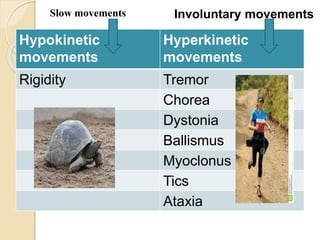
Hypokinetic
movements
Hyperkinetic
movements
Rigidity Tremor
Chorea
Dystonia
Ballismus
Myoclonus
Tics
Ataxia
Slow movements Involuntary movements
 Tremor
 Choreoathetosis
Huntington’s chorea
Sydenham’s chorea
Wilson disease
 Hemibalismus
 Myoclonus
 Drug induced
Dystonia
Tardive dyskinasia
 Parkinson’s disease
 Tourette’s syndrome(tics)
 Alternating contractions of agonist and
antagonist muscles in an oscillating,
rhythmic manner
 Causes:
drugs
Thyrotoxicosis
cerebellar lesion
parkinsonism
essential tremor
 Chorea:
irregular, brief , jerky
,unintentional movements ,
affecting differing parts
randomly
 Athetosis:
slower more writhing
movements than chorea
 The two often co-exist
 Chorea
Dopamine receptor blockers
Riluzole :corticostrial glutamate
release inhibitor
Remacemide:glutamate/NMDA
receptor antagonist
Anti-convulsants:valproate
 Inherited in autosomal dominant
pattern
 Triad of motor ,cognitive and
psychiatric symptoms
 Mainly in children/adolescents
 Complication of previous group A
streptococcal infection resulting in
Rheumatic fever
 Usually remits spontaneously
 Degeneration of basal ganglia
accompanied by cirrhosis of the liver.
 Due to inborn defect in the metabolism of
copper
 Asymmetrical variable
tremor
 Dystonia
 Choreoathetoid
movements
Kayser-fleischer ring
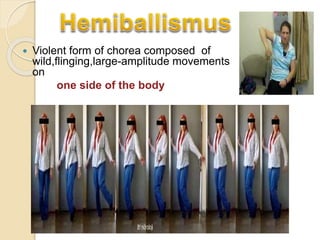
 Violent form of chorea composed of
wild,flinging,large-amplitude movements
on
one side of the body
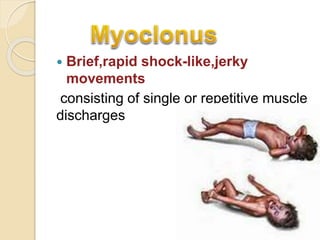
 Brief,rapid shock-like,jerky
movements
consisting of single or repetitive muscle
discharges
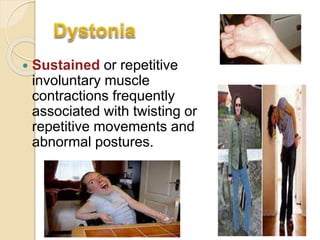
 Sustained or repetitive
involuntary muscle
contractions frequently
associated with twisting or
repetitive movements and
abnormal postures.
 Dystonia
Botulinum toxins
Dopa depleting agents
Dopa antagonists
Anticholinergics
Beclofen
Anticonvulsants
Surgical methods
 Associated
with chronic
use of
neuroleptics
 Lingual
facial buccal
chewing
type
movements
Rx Tardive Dyskinasia
 Stop the causative drug
 Reduce the dose of causative drug
 Switch into alternative therapies ex:
clozapine
 Other drugs:
 Benzodiazepines
 anti-cholinergics
 suppliments –
vitamine E
Branched chain amino acids
PARKINSON’S DISEASE
 Pathology
Two balanced systems are in place for
extra pyramidal control of motor
activity at the level of corpus striatum
& substantia nigra
Cholinergic Dopaminergic
 In parkinson’s disease,there is
degeneration of nigrostriatal
dopaminergic neurones with depletion
of dopamine
Acetyl choline
Dopamine
Normal
dopamin
e level
Low level
of
dopamine
Basal ganglia
 Group of the neuclei located subcortically
 Take part in motor movements of body
 Unilateral onset, involves both sides of the
body as the age advances
 Bradykinesia
 Resting Tremor/pill rolling tremor
 Rigidity
 Posture- instability,
falls
flexion attitude
difficulty initiating or stopping
 Masked face
Rigidity
 Drugs to replenish depleted dopamine
 levodopa + dopa decarboxylase inhibitors
Carbidopa(sinemet) & madopar
 Drugs to reduce the metabolism of dopamine
COMT inhibitors-entacapone
MAO-B inhibitors-selegiline,rasagiline
 Dopamine agonists
Bromocriptine
Pergolide
Ropinirole
Pramipexole
Lisuride
 Drugs releasing dopamine
Amantidine
 Ach receptor antagonists
Benzatropine
 Childhood Tic disorder
 Tic: sudden repetitive non rhythmic
movement or vocalization involving
discrete muscle groups
 Tics
Education
Clonidine
Guanafacine
Atypical
neuroleptics(resperidone,olanzapine)
Typical
neuroleptics(haloperidol,fluphenazine)
Presentation1

Presentation1