Multiple System Atrophy
Ade Wijaya, MD
Introduction
 Adult-onset, fatal neurodegenerative
disease
 First coined in 1969
 Parkinsonian Vs Cerebellar Type
Fanciulli, A., & Wenning, G. K. (2015). Multiple-system atrophy. New England Journal of Medicine, 372(3), 249-263.
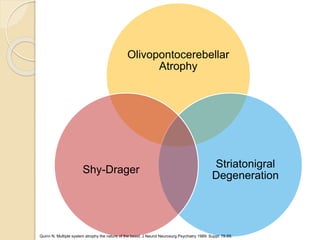
Olivopontocerebellar
Atrophy
Striatonigral
Degeneration
Shy-Drager
Quinn N. Multiple system atrophy the nature of the beast. J Neurol Neurosurg Psychiatry 1989; Suppl: 78-89.
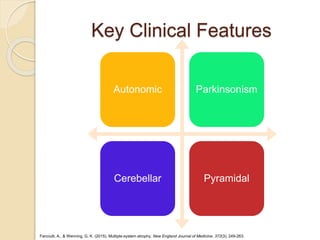
Key Clinical Features
Autonomic Parkinsonism
Cerebellar Pyramidal
Fanciulli, A., & Wenning, G. K. (2015). Multiple-system atrophy. New England Journal of Medicine, 372(3), 249-263.
Epidemiology
 The estimated mean incidence is 0.6
to 0.7 cases per 100,000 person-
years, with a range of 0.1 to 2.4 cases
per 100,000 person-years
 The estimated point prevalence is 3.4
to 4.9 cases per 100,000 population,
increasing to 7.8 per 100,000 among
persons older than 40 years of age
Bower JH, Maraganore DM, McDonnell SK, Rocca WA. Incidence of progressive supranuclear palsy and multiple system atrophy in Olmsted County,
Minnesota, 1976 to 1990. Neurology 1997;49:1284-8.
Schrag A, Ben-Shlomo Y, Quinn NP.Prevalence of progressive supranuclear palsy and multiple system atrophy: a crosssectional study. Lancet
1999;354:1771-5.
Epidemiology
 Parkinsonian:cerebellar subtype = 2:1 – 4:1
 Cerebellar subtype is more frequent in Japan
 Onset: 6th decade of life; M ~ F
 Survival: 6-10 years
Fanciulli, A., & Wenning, G. K. (2015). Multiple-system atrophy. New England Journal of Medicine, 372(3), 249-263.
Etiology
 Sporadic
 Autosomal dominant
 A loss-of-function mutation in COQ2,
encoding the coenzyme Q10
synthesizing enzyme
 A discordant loss of copy number of
SHC2
 Mutations, duplications, and triplications
of SNCA, encoding α-synuclein
 Two single-nucleotide polymorphisms of
the SNCA locus
 A G51D SNCA mutation
Fanciulli, A., & Wenning, G. K. (2015). Multiple-system atrophy. New England Journal of Medicine, 372(3), 249-263.
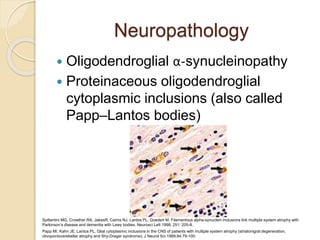
Neuropathology
 Oligodendroglial α-synucleinopathy
 Proteinaceous oligodendroglial
cytoplasmic inclusions (also called
Papp–Lantos bodies)
Papp MI, Kahn JE, Lantos PL. Glial cytoplasmic inclusions in the CNS of patients with multiple system atrophy (striatonigral degeneration,
olivopontocerebellar atrophy and Shy-Drager syndrome). J Neurol Sci 1989;94:79-100.
Spillantini MG, Crowther RA, JakesR, Cairns NJ, Lantos PL, Goedert M. Filamentous alpha-synuclein inclusions link multiple system atrophy with
Parkinson’s disease and dementia with Lewy bodies. Neurosci Lett 1998; 251: 205-8.
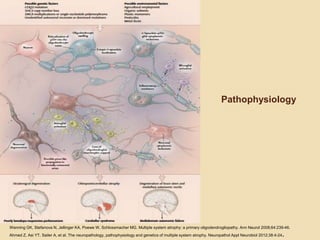
Pathophysiology
Ahmed Z, Asi YT, Sailer A, et al. The neuropathology, pathophysiology and genetics of multiple system atrophy. Neuropathol Appl Neurobiol 2012;38:4-24.
Wenning GK, Stefanova N, Jellinger KA, Poewe W, Schlossmacher MG. Multiple system atrophy: a primary oligodendrogliopathy. Ann Neurol 2008;64:239-46.
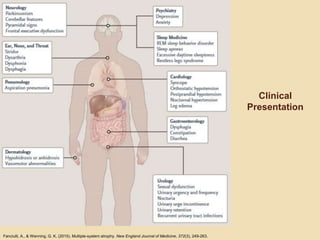
Clinical
Presentation
Fanciulli, A., & Wenning, G. K. (2015). Multiple-system atrophy. New England Journal of Medicine, 372(3), 249-263.
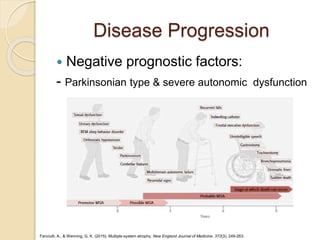
Disease Progression
 Negative prognostic factors:
- Parkinsonian type & severe autonomic dysfunction
Fanciulli, A., & Wenning, G. K. (2015). Multiple-system atrophy. New England Journal of Medicine, 372(3), 249-263.
Diagnostic Criteria
Definite MSA
Neuropathological findings during
postmortem examination must include the
following:
 Widespread and abundant cerebral α-
synuclein–positive GCIs
 Neurodegenerative changes in striatonigral
or olivopontocerebellar region
Gilman S, Wenning GK, Low PA, et al. econd consensus statement on the diagnosis of multiple system atrophy. Neurology 2008;71:670-6.
Diagnostic Criteria
Probable MSA
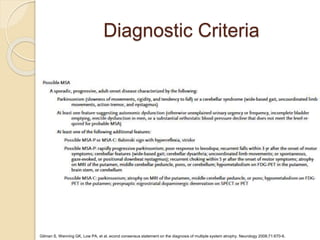
Sporadic, progressive disease in adults (onset after 30 yr
of age) characterized by autonomic failure, including
urinary incontinence (with erectile dysfunction in men),
or an orthostatic decrease in blood pressure by at least
30 mm Hg systolic or 15 mm Hg diastolic within 3 min of
standing, plus one of the following:
 Parkinsonism (slowness of movements, rigidity, and
tendency to fall) with poor response to levodopa
(parkinsonian subtype [MSA-P])
 A cerebellar syndrome (wide-based gait, uncoordinated
limb movements, action tremor, and nystagmus)
(cerebellar subtype [MSA-C])
Gilman S, Wenning GK, Low PA, et al. econd consensus statement on the diagnosis of multiple system atrophy. Neurology 2008;71:670-6.
Diagnostic Criteria
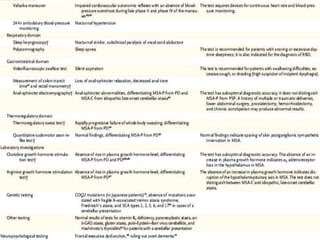
Gilman S, Wenning GK, Low PA, et al. econd consensus statement on the diagnosis of multiple system atrophy. Neurology 2008;71:670-6.
Diagnostic Criteria
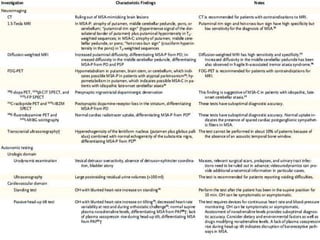
Gilman S, Wenning GK, Low PA, et al. econd consensus statement on the diagnosis of multiple system atrophy. Neurology 2008;71:670-6.
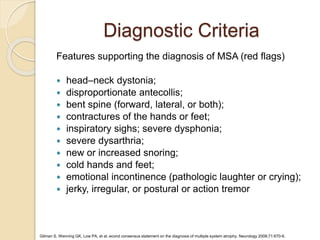
Features supporting the diagnosis of MSA (red flags)
 head–neck dystonia;
 disproportionate antecollis;
 bent spine (forward, lateral, or both);
 contractures of the hands or feet;
 inspiratory sighs; severe dysphonia;
 severe dysarthria;
 new or increased snoring;
 cold hands and feet;
 emotional incontinence (pathologic laughter or crying);
 jerky, irregular, or postural or action tremor
Diagnostic Criteria
Gilman S, Wenning GK, Low PA, et al. econd consensus statement on the diagnosis of multiple system atrophy. Neurology 2008;71:670-6.
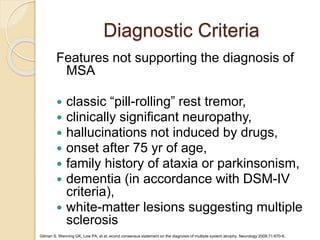
Features not supporting the diagnosis of
MSA
 classic “pill-rolling” rest tremor,
 clinically significant neuropathy,
 hallucinations not induced by drugs,
 onset after 75 yr of age,
 family history of ataxia or parkinsonism,
 dementia (in accordance with DSM-IV
criteria),
 white-matter lesions suggesting multiple
sclerosis
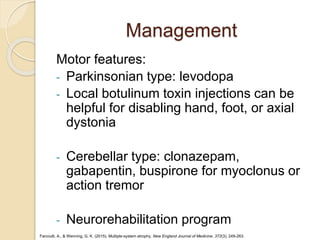
Management
Motor features:
- Parkinsonian type: levodopa
- Local botulinum toxin injections can be
helpful for disabling hand, foot, or axial
dystonia
- Cerebellar type: clonazepam,
gabapentin, buspirone for myoclonus or
action tremor
- Neurorehabilitation program
Fanciulli, A., & Wenning, G. K. (2015). Multiple-system atrophy. New England Journal of Medicine, 372(3), 249-263.
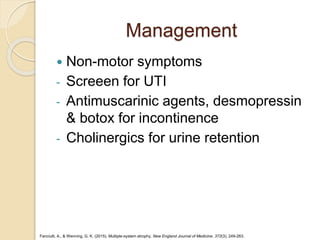
Management
 Non-motor symptoms
- Screeen for UTI
- Antimuscarinic agents, desmopressin
& botox for incontinence
- Cholinergics for urine retention
Fanciulli, A., & Wenning, G. K. (2015). Multiple-system atrophy. New England Journal of Medicine, 372(3), 249-263.
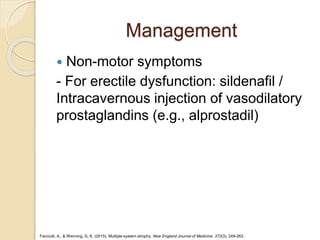
Management
 Non-motor symptoms
- For erectile dysfunction: sildenafil /
Intracavernous injection of vasodilatory
prostaglandins (e.g., alprostadil)
Fanciulli, A., & Wenning, G. K. (2015). Multiple-system atrophy. New England Journal of Medicine, 372(3), 249-263.
Management
 Non-motor symptoms
For orthostatic symptoms:
- Midodrine and droxidopa,
sympathomimetic agents that increase
arteriolar tone, are specifically licensed
by the Food and Drug Administration for
the symptomatic treatment of neurogenic
orthostatic hypotension
- Fludrocortisone
- Avoid hypotensive agents
- Education
Fanciulli, A., & Wenning, G. K. (2015). Multiple-system atrophy. New England Journal of Medicine, 372(3), 249-263.
Management
 Non-motor symptoms
- CPAP, botox, tracheostomy  OSA
- Oral glycopyrrolate, botox  drooling
- PEG for dysphagia
- Low-dose clonazepam  RBD
- SSRI / TCA  cognitive impairment
Fanciulli, A., & Wenning, G. K. (2015). Multiple-system atrophy. New England Journal of Medicine, 372(3), 249-263.
Summary
 Adult-onset, fatal neurodegenerative
disease
 Autonomic symptoms
 Parkinsonian Vs Cerebellar
 Treatment: supportive
THANK YOU

Multiple System Atrophy

  • 1.
  • 2.
    Introduction  Adult-onset, fatalneurodegenerative disease  First coined in 1969  Parkinsonian Vs Cerebellar Type Fanciulli, A., & Wenning, G. K. (2015). Multiple-system atrophy. New England Journal of Medicine, 372(3), 249-263.
  • 3.
    Olivopontocerebellar Atrophy Striatonigral Degeneration Shy-Drager Quinn N. Multiplesystem atrophy the nature of the beast. J Neurol Neurosurg Psychiatry 1989; Suppl: 78-89.
  • 4.
    Key Clinical Features AutonomicParkinsonism Cerebellar Pyramidal Fanciulli, A., & Wenning, G. K. (2015). Multiple-system atrophy. New England Journal of Medicine, 372(3), 249-263.
  • 5.
    Epidemiology  The estimatedmean incidence is 0.6 to 0.7 cases per 100,000 person- years, with a range of 0.1 to 2.4 cases per 100,000 person-years  The estimated point prevalence is 3.4 to 4.9 cases per 100,000 population, increasing to 7.8 per 100,000 among persons older than 40 years of age Bower JH, Maraganore DM, McDonnell SK, Rocca WA. Incidence of progressive supranuclear palsy and multiple system atrophy in Olmsted County, Minnesota, 1976 to 1990. Neurology 1997;49:1284-8. Schrag A, Ben-Shlomo Y, Quinn NP.Prevalence of progressive supranuclear palsy and multiple system atrophy: a crosssectional study. Lancet 1999;354:1771-5.
  • 6.
    Epidemiology  Parkinsonian:cerebellar subtype= 2:1 – 4:1  Cerebellar subtype is more frequent in Japan  Onset: 6th decade of life; M ~ F  Survival: 6-10 years Fanciulli, A., & Wenning, G. K. (2015). Multiple-system atrophy. New England Journal of Medicine, 372(3), 249-263.
  • 7.
    Etiology  Sporadic  Autosomaldominant  A loss-of-function mutation in COQ2, encoding the coenzyme Q10 synthesizing enzyme  A discordant loss of copy number of SHC2  Mutations, duplications, and triplications of SNCA, encoding α-synuclein  Two single-nucleotide polymorphisms of the SNCA locus  A G51D SNCA mutation Fanciulli, A., & Wenning, G. K. (2015). Multiple-system atrophy. New England Journal of Medicine, 372(3), 249-263.
  • 8.
    Neuropathology  Oligodendroglial α-synucleinopathy Proteinaceous oligodendroglial cytoplasmic inclusions (also called Papp–Lantos bodies) Papp MI, Kahn JE, Lantos PL. Glial cytoplasmic inclusions in the CNS of patients with multiple system atrophy (striatonigral degeneration, olivopontocerebellar atrophy and Shy-Drager syndrome). J Neurol Sci 1989;94:79-100. Spillantini MG, Crowther RA, JakesR, Cairns NJ, Lantos PL, Goedert M. Filamentous alpha-synuclein inclusions link multiple system atrophy with Parkinson’s disease and dementia with Lewy bodies. Neurosci Lett 1998; 251: 205-8.
  • 9.
    Pathophysiology Ahmed Z, AsiYT, Sailer A, et al. The neuropathology, pathophysiology and genetics of multiple system atrophy. Neuropathol Appl Neurobiol 2012;38:4-24. Wenning GK, Stefanova N, Jellinger KA, Poewe W, Schlossmacher MG. Multiple system atrophy: a primary oligodendrogliopathy. Ann Neurol 2008;64:239-46.
  • 10.
    Clinical Presentation Fanciulli, A., &Wenning, G. K. (2015). Multiple-system atrophy. New England Journal of Medicine, 372(3), 249-263.
  • 11.
    Disease Progression  Negativeprognostic factors: - Parkinsonian type & severe autonomic dysfunction Fanciulli, A., & Wenning, G. K. (2015). Multiple-system atrophy. New England Journal of Medicine, 372(3), 249-263.
  • 12.
    Diagnostic Criteria Definite MSA Neuropathologicalfindings during postmortem examination must include the following:  Widespread and abundant cerebral α- synuclein–positive GCIs  Neurodegenerative changes in striatonigral or olivopontocerebellar region Gilman S, Wenning GK, Low PA, et al. econd consensus statement on the diagnosis of multiple system atrophy. Neurology 2008;71:670-6.
  • 13.
    Diagnostic Criteria Probable MSA Sporadic,progressive disease in adults (onset after 30 yr of age) characterized by autonomic failure, including urinary incontinence (with erectile dysfunction in men), or an orthostatic decrease in blood pressure by at least 30 mm Hg systolic or 15 mm Hg diastolic within 3 min of standing, plus one of the following:  Parkinsonism (slowness of movements, rigidity, and tendency to fall) with poor response to levodopa (parkinsonian subtype [MSA-P])  A cerebellar syndrome (wide-based gait, uncoordinated limb movements, action tremor, and nystagmus) (cerebellar subtype [MSA-C]) Gilman S, Wenning GK, Low PA, et al. econd consensus statement on the diagnosis of multiple system atrophy. Neurology 2008;71:670-6.
  • 14.
    Diagnostic Criteria Gilman S,Wenning GK, Low PA, et al. econd consensus statement on the diagnosis of multiple system atrophy. Neurology 2008;71:670-6.
  • 15.
    Diagnostic Criteria Gilman S,Wenning GK, Low PA, et al. econd consensus statement on the diagnosis of multiple system atrophy. Neurology 2008;71:670-6. Features supporting the diagnosis of MSA (red flags)  head–neck dystonia;  disproportionate antecollis;  bent spine (forward, lateral, or both);  contractures of the hands or feet;  inspiratory sighs; severe dysphonia;  severe dysarthria;  new or increased snoring;  cold hands and feet;  emotional incontinence (pathologic laughter or crying);  jerky, irregular, or postural or action tremor
  • 16.
    Diagnostic Criteria Gilman S,Wenning GK, Low PA, et al. econd consensus statement on the diagnosis of multiple system atrophy. Neurology 2008;71:670-6. Features not supporting the diagnosis of MSA  classic “pill-rolling” rest tremor,  clinically significant neuropathy,  hallucinations not induced by drugs,  onset after 75 yr of age,  family history of ataxia or parkinsonism,  dementia (in accordance with DSM-IV criteria),  white-matter lesions suggesting multiple sclerosis
  • 19.
    Management Motor features: - Parkinsoniantype: levodopa - Local botulinum toxin injections can be helpful for disabling hand, foot, or axial dystonia - Cerebellar type: clonazepam, gabapentin, buspirone for myoclonus or action tremor - Neurorehabilitation program Fanciulli, A., & Wenning, G. K. (2015). Multiple-system atrophy. New England Journal of Medicine, 372(3), 249-263.
  • 20.
    Management  Non-motor symptoms -Screeen for UTI - Antimuscarinic agents, desmopressin & botox for incontinence - Cholinergics for urine retention Fanciulli, A., & Wenning, G. K. (2015). Multiple-system atrophy. New England Journal of Medicine, 372(3), 249-263.
  • 21.
    Management  Non-motor symptoms -For erectile dysfunction: sildenafil / Intracavernous injection of vasodilatory prostaglandins (e.g., alprostadil) Fanciulli, A., & Wenning, G. K. (2015). Multiple-system atrophy. New England Journal of Medicine, 372(3), 249-263.
  • 22.
    Management  Non-motor symptoms Fororthostatic symptoms: - Midodrine and droxidopa, sympathomimetic agents that increase arteriolar tone, are specifically licensed by the Food and Drug Administration for the symptomatic treatment of neurogenic orthostatic hypotension - Fludrocortisone - Avoid hypotensive agents - Education Fanciulli, A., & Wenning, G. K. (2015). Multiple-system atrophy. New England Journal of Medicine, 372(3), 249-263.
  • 23.
    Management  Non-motor symptoms -CPAP, botox, tracheostomy  OSA - Oral glycopyrrolate, botox  drooling - PEG for dysphagia - Low-dose clonazepam  RBD - SSRI / TCA  cognitive impairment Fanciulli, A., & Wenning, G. K. (2015). Multiple-system atrophy. New England Journal of Medicine, 372(3), 249-263.
  • 24.
    Summary  Adult-onset, fatalneurodegenerative disease  Autonomic symptoms  Parkinsonian Vs Cerebellar  Treatment: supportive
  • 25.