Extrapyramidal lesion - Basal
Ganglia Disorders
Introduction
 Extrapyramidal system consists of basal
ganglia (caudate, putamen, and Globus
pallidus) and substantia nigra, sub thalamic
nucleus, red nucleus and the cerebellum.
extrapyramidal conditions
 Movement disorders are referred to as
the CNS disorders characterized by either
diminished or excessive movements.
 They are divided in two major categories.
extrapyramidal conditions
 Hyperkinetic Movement disorders:
 They refer to excessive, often repetitive,
involuntary movements that interfere with
the normal flow of motor function.
 This category includes chorea, athetosis,
dystonia, myoclonus, tics and tremor.
extrapyramidal conditions
 Hypokinetic Movement disorders:
 These refers to diminished movement
causing limitations in normal motor
functions.
 These are akinesia, hypokinesia (reduced
amplitude of movement), bradykinesia (slow
movement), and rigidity.
 Parkinsonism is the primary hypokinetic
movement disorders.
Basal Ganglia Disorders
Function of basal ganglia
 The “basal ganglia” refers to a group of
subcortical nuclei responsible primarily
for motor control, as well as other roles such
as motor learning, executive functions and
behaviours, and emotions.
 Basal ganglia receive input signals from
cortex & also return signal to cortex.
 Controls automatic & associated movement
 Red nucleus is center of righting reflex
 Substantia nigra is center of co ordination
of skill movement
Associated function
 Planning of multiple, parallel & sequential
patterns of movement that the mind must put
together to accomplish a purposeful task
8 May 2023 9
basal ganglia lesion
 Athetosis
 Tics
 Dystonia
 Bradykinesia/ akinesia
 Rigidity
 Tremor
 Postural instability
 Gait abnormalities
 Hemiballismus
 Chorea
8 May 2023 10
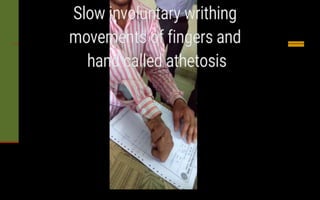
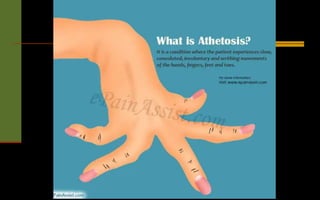
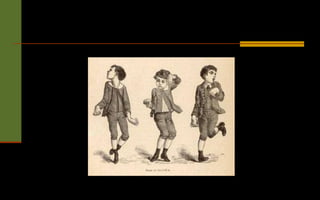
Athetosis
 It describes the slow writhing movements
that predominantly affects distal limbs, neck
& head
 It can be generalized or unilateral
 Hypertonia or hypotonia may be present
 It is related to chorea or dystonia
 It results from excess co contraction of
antagonist
8 May 2023 11
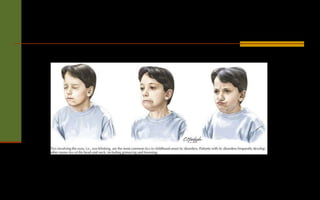
Tics
 They are quick, brief, stereotyped
repetitive movements
 Commonly involve face, neck, shoulders
such as blinking, smacking & shrugging
8 May 2023 14
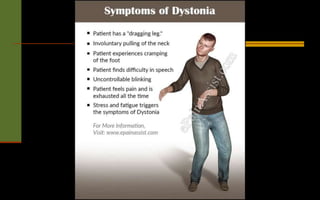
Dystonia
 Dystonia is a movement disorder that causes
the muscles to contract involuntarily. This can
cause repetitive or twisting movements. The
condition can affect one part of your body
(focal dystonia), two or more adjacent parts
(segmental dystonia), or all parts of your body
(general dystonia).
 They are usually long standing disorders
8 May 2023 16
Bradykinesia
 Characterizes by inability to initiate a
movement or perform a purposeful movement
 Due to decrease activation of the
supplementary motor cortex, pre-motor cortex
& motor cortex
 Complex movements are more effected than the
simple ones
 Sequential movement becomes more impaired
 It is not due to rigidity or inability to relax
8 May 2023 18
Rigidity
 It can be of two types
 Lead pipe
 Cog wheel
 It is increase resistance to movement
throughout the range in both direction
8 May 2023 19
Tremor
 Rhythmic and sinusoidal
 There will be resting tremor which
decreases during movement
8 May 2023 20
Postural instability
 It is one of the serious problem that leads
to increased episodes of falling
 Due to deficits in processing of kinesthetic
& proprioceptive sensations
 Also due to inflexibility & also interaction
with rigidity and bradykinesia
8 May 2023 21
Gait abnormalities
 Festinating or short shuffling gait
 Due to decrease equilibrium response:
chase of COG
 Inability to step over obstacles & walk on
carpeted surface
8 May 2023 22
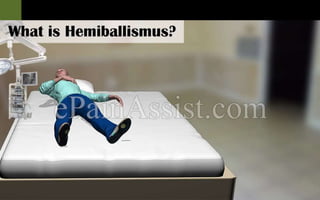
Hemiballismus
 If there is a lesion in subthalamus or its
connection with the Globus pallidus, the
patient develops a wild swinging movement
of arm and leg of opposite side of the body
termed as hemiballisums.
 It mostly improves with time.
8 May 2023 23
Chorea
 Involuntary rapid irregular & jerky movements
 Involvement of the face, tongue and the limbs
 Usually seen with athetosis (chorea athetosis)
8 May 2023 25
Diseases affecting bg
 Parkinson’s disease
 Huntingtons disease
 Wilson’s disease
Parkinsonism
 “Parkinsonism” is a general term used to
describe a group of central nervous system
disorders that shows similar movement
problems and occur due to pathology in
dopaminergic system of the substantia nigra.
 They are classified as Primary Parkinsonism,
Secondary Parkinsonism, Parkinson’s plus
syndromes.
Classification
 Primary Parkinsonism: Also known as Parkinson’s
disease. It is the most common type seen in the
patients. Aetiology is idiopathic.
 Secondary Parkinsonism: It is associated with a
causative factor. The causes can be viral infection,
vascular, metabolic, etc.
 Parkinson plus syndromes : They show similar
symptoms such as Parkinson’s disease, but these symptoms
are attributed to other neurodegenerative disease, such
as multiple system atrophy, progressive supranuclear
palsy, corticobasal degeneration & dementia with Lewy
bodies)
Parkinson’s disease
 It is a Progressive degenerative disease of
the CNS affecting mainly basal ganglia
characterized by rigidity, tremor,
bradykinesia & postural instability
 Also called primary or idiopathic parkinsonism
 Also called paralysis agitans or shaking palsy
Epidemiology
 Occurs in 1% of population older than 50
years of age & 2.6% of population by 85 years
 Males are slightly at more risk than females
Pathophysiology
 Degeneration of dopaminergic neurons that produce
dopamine
 Dopamine is the main neurotransmitter of the
nigrostriatal pathway (substantia nigra to striatum).
 Pathology of the Parkinson’s disease involves
reduction in dopamine due to degeneration of
dopaminergic neurons present in the substantia nigra.
 As disease progress & neurons degenerate they
develop characteristic cytoplasmic inclusion bodies
called Lewy’s body
 Dopamine also inhibits the corpus striatum
(stimulates release of acetyle choline)
 In parkinson’s when dopaminergic cells are
degenerated there is no inhibition of corpus
striatum
 Production of more acetyle choline increased
skeletal muscle activity rigidity & tremor
Clinical manifestations
 Rigidity: lead pipe or cog wheel type
 Akinesia/ Bradykinesia
 Tremor: pill rolling or drum beating
 Postural instability & imbalance
 Musculoskeletal changes: kyphosis/ scoliosis, Fatigue
 Gait: festinating, Loss of reciprocal arm swing
 Dysphagia, sialorrhoea, hypokinetic dysarthria,
mutism
 Mask like face
 Akathesia (extreme motor restlessness)
 Visual & sensory: blurring of vision, paraesthesia, pain
 Bradyphrenia (disorder of intellectual dysfunction) &
Dementia
 Autonomic dysfunction
 Cardiopulmonary dysfunction
 Micrographia
Diagnosis
 It is made on the basis of clinical findings & history
 Handwriting samples, speech analysis & physical
analysis are use to detect early manifestations of the
disease
 There is no definite test or group of test to diagnose
PD
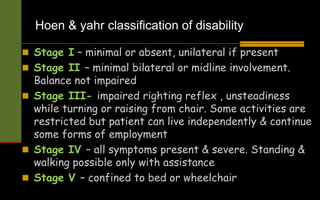
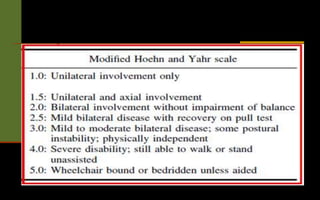
Hoen & yahr classification of disability
 Stage I – minimal or absent, unilateral if present
 Stage II – minimal bilateral or midline involvement.
Balance not impaired
 Stage III- impaired righting reflex , unsteadiness
while turning or raising from chair. Some activities are
restricted but patient can live independently & continue
some forms of employment
 Stage IV – all symptoms present & severe. Standing &
walking possible only with assistance
 Stage V – confined to bed or wheelchair
PT assessment
 History – gradual onset of signs & symptoms, initial
difficulty in fine motor movement & presence of
resting tremor
 Cognitive asst – is assessed by MMSE.
memory, attention, orientation, problem solving,
communication
 Late stage dementia
 Dysarthria & hypophonia
 Micrographia
 Pain asst – postural stress syndrome,
paraesthesia
 Burning & Aching pains, numbness, tingling or
abnormal heat & cold sensations
 Intense pain during “off” period
 Visual function – impairment in acquity, peripheral
vision, tracking,
 Cranial nerve integrity –
 Dysphagia (swallowing difficulty) (IX & XI)
 Dysarthria (slurred speech) (IX, XI, & XII)
 Sialorrhea (excessive increase of saliva) due to ANS
dysfunction
 Sensory integrity
 May have impaired proprioceptive & kinaesthetic
sensation
 Motor Function
 Demonstrate increased resistance to passive
movements throughout ROM (leadpipe or cogwheel
rigidity)
 Initiating or stopping movement difficulties
 Bradykinesia, Resting tremor
 Weakness due to deconditioning
 Reflex integrity
 Increased or normal DTR
 Impaired, delayed, or absent equilibrium &
protective extension reactions
 ROM & joint integrity
 limited joint play movement due to rigidity
 Posture
 Universal flexed posture, scoliosis
 Kyphosis with forward head
 Asymmetry (leaning to one side)
 Gait, Locomotion, and Balance
 Impaired static or dynamic balance
 festinating gait (rapid, small steps)
 Shuffling gait (dragging feet)
 Difficulty turning & changing directions
 Initiating or stopping difficulties
 Freezing at a doorway
 Frequent falls & fear of falls
 Bowel & bladder function
 Constipation, urinary dysfunction (frequency,
hesitency), sexual dysfunction
 Aerobic Capacity/Endurance
 Low resting blood pressure
 Impaired cardiac & pulmonary responses to
exercise
 Decreased endurance
 Fatigue:
 It is very common.
 The patients complains of “heaviness” and
“stiffness” of the limbs while moving due to
rigidity which increases energy expenditure and
induces fatigue.
 “Fatigue severity scale” is used to assess fatigue.
 Autonomic changes
 excessive drooling of saliva , sweating
 Ventilation & respiration
 Decreased tidal volume & vital capacity due to stooped
posture
 Low voice volume due to decreased tidal volume
 Impaired pulmonary responses to exercise
 Impaired cough
 Skin integrity – bruising, skin breakdown
 Excessive sweating
 Seborrhoea (a skin condition characterized by greasy
or dry, white, flaking scales over reddish patches)
 Functional status –
 Varies from mild functional difficulty to complete
dependence
 Disease specific measure – unified PD rating
scale, PDQ- 39
PT management
 The stages described in modified Hoehn-Yahr
can broadly help the physical therapists to
plan the goals of physiotherapy management.
PT management
 In early phase – (stage 1-2.5)
 Prevention of inactivity
 Prevention of fear to fall or move
 Preserving & improving physical activity
 In the mid phase (stage 2.5-4)
 Preserve & improve activities in 5 core areas
 Transfer, body posture, reaching, grasping, balance &
gait
 In the late phase (stage 5)
 Preserve vital function& prevent pressure sores
Treatment strategies
 Strategies to reduce rigidity
 Large amplitude movements of extremities
and trunk along with rotational components
such as PNF pattern are found to be
beneficial.
Treatment strategies
 Patient education
 Relaxation strategies
 Gentle rocking & rotational exercise
 Slow rhythmic & rotational movement
 Deep BE, meditation, Jacobson's relaxation
exercise
 Slow steady stretching
 Flexibility exercise
 Active & passive ROM ex
 PNF patterns of movement targeting till the
end range
 Hold relax & contract relax
 Passive positioning in lengthen position
 ROM ex combined with rotational movement
 Mechanical stretching ex
 Mobility exercise
 Focus on functional movement pattern
 Bed mobility activities, weight shifting, UL
reaching exercise
 Rocking chair to facilitate independent sit to
stand
 Adequate strength training
 Mobilization of facial muscles – massage,
stretching
 Balance exercise
 Weight shifting in both sitting & standing
 Progress shifting with UL activities
 Balance exercise on gym ball with induced
perturbations
 Balance board exercise
 Reaching exercise
 Gait training
 Goals to lengthen stride length, broaden BOS,
improve stepping, increase trunk movement &
arm swing
 Marching in place emphasizing on high stepping
 Reciprocal arm swing
 Visual cue & brisk march music enhance gait
performance
 Functional adaptation
 Loose fitting cloths, Velcro closures can optimize
dressing
 Stable & firm mattress can facilitate rolling &
ease of getting out
 Chair with arm rest with help in sit to stand
 Festinating gait will be alleviated with use of
heel or shoe wedge
 Assistive aids will improve ambulation
Respiratory exercise
 Respiratory exercise
 DBE, & exercise that recruit neck, shoulder &
trunk muscles
 Upper body resistance exercise may improve
respiratory efficiency
 Exercise in unsupported sitting to improve
trunk stabilization
 Improve trunk extension & prevent from
becoming kyphotic
 Aerobic conditioning
 Submaximal intensities (50- 70% ) are
indicated to improve CV response
 Training modes include UL & LL ergometer,
walking
 Regular exercise is recommended
 Group & home exercise
 Benefit from positive support & communication
among group
 Select Pt with similar level of disability
 Regular exercise is started but avoid over
exercise
 Early morning calisthenics will help in reducing
morning stiffness
 Patient & family education
 Education about medications (purpose, dosage)
 Assist in decision making & behavioral skills to
promote optimal self care
 Caregivers should be advised not to give too
much of assistance & give room for
independent performance
 Information is given regarding community
support groups
PARKINSON PLUS
SYNDROME
Definition
 A group of neurodegenerative disease that
can affect the basal ganglia & produce
parkinson like syndrome with other
neurological disease
Examples
 Striatonigral syndrome
 Shy-dragger syndrome
 Progressive supranuclear palsy
 Olivopontine cerebellar atrophy
 Corticobasal ganglionic degeneration
 Others
 Multi infarct vascular disease
 Normal pressure hydrocephalus
 Multi system atrophy
 Multiple sclerosis
Early signs
 Rigidity
 Bradykinesia
 Cognitive impairment
 Other non extrapyramidal symptoms that
do not improve with dopamine agonist or
L-dopa
THANK YOU

Basal ganglia disorders.ppt

  • 1.
    Extrapyramidal lesion -Basal Ganglia Disorders
  • 2.
    Introduction  Extrapyramidal systemconsists of basal ganglia (caudate, putamen, and Globus pallidus) and substantia nigra, sub thalamic nucleus, red nucleus and the cerebellum.
  • 3.
    extrapyramidal conditions  Movementdisorders are referred to as the CNS disorders characterized by either diminished or excessive movements.  They are divided in two major categories.
  • 4.
    extrapyramidal conditions  HyperkineticMovement disorders:  They refer to excessive, often repetitive, involuntary movements that interfere with the normal flow of motor function.  This category includes chorea, athetosis, dystonia, myoclonus, tics and tremor.
  • 5.
    extrapyramidal conditions  HypokineticMovement disorders:  These refers to diminished movement causing limitations in normal motor functions.  These are akinesia, hypokinesia (reduced amplitude of movement), bradykinesia (slow movement), and rigidity.  Parkinsonism is the primary hypokinetic movement disorders.
  • 6.
  • 7.
    Function of basalganglia  The “basal ganglia” refers to a group of subcortical nuclei responsible primarily for motor control, as well as other roles such as motor learning, executive functions and behaviours, and emotions.  Basal ganglia receive input signals from cortex & also return signal to cortex.
  • 8.
     Controls automatic& associated movement  Red nucleus is center of righting reflex  Substantia nigra is center of co ordination of skill movement
  • 9.
    Associated function  Planningof multiple, parallel & sequential patterns of movement that the mind must put together to accomplish a purposeful task 8 May 2023 9
  • 10.
    basal ganglia lesion Athetosis  Tics  Dystonia  Bradykinesia/ akinesia  Rigidity  Tremor  Postural instability  Gait abnormalities  Hemiballismus  Chorea 8 May 2023 10
  • 11.
    Athetosis  It describesthe slow writhing movements that predominantly affects distal limbs, neck & head  It can be generalized or unilateral  Hypertonia or hypotonia may be present  It is related to chorea or dystonia  It results from excess co contraction of antagonist 8 May 2023 11
  • 14.
    Tics  They arequick, brief, stereotyped repetitive movements  Commonly involve face, neck, shoulders such as blinking, smacking & shrugging 8 May 2023 14
  • 16.
    Dystonia  Dystonia isa movement disorder that causes the muscles to contract involuntarily. This can cause repetitive or twisting movements. The condition can affect one part of your body (focal dystonia), two or more adjacent parts (segmental dystonia), or all parts of your body (general dystonia).  They are usually long standing disorders 8 May 2023 16
  • 18.
    Bradykinesia  Characterizes byinability to initiate a movement or perform a purposeful movement  Due to decrease activation of the supplementary motor cortex, pre-motor cortex & motor cortex  Complex movements are more effected than the simple ones  Sequential movement becomes more impaired  It is not due to rigidity or inability to relax 8 May 2023 18
  • 19.
    Rigidity  It canbe of two types  Lead pipe  Cog wheel  It is increase resistance to movement throughout the range in both direction 8 May 2023 19
  • 20.
    Tremor  Rhythmic andsinusoidal  There will be resting tremor which decreases during movement 8 May 2023 20
  • 21.
    Postural instability  Itis one of the serious problem that leads to increased episodes of falling  Due to deficits in processing of kinesthetic & proprioceptive sensations  Also due to inflexibility & also interaction with rigidity and bradykinesia 8 May 2023 21
  • 22.
    Gait abnormalities  Festinatingor short shuffling gait  Due to decrease equilibrium response: chase of COG  Inability to step over obstacles & walk on carpeted surface 8 May 2023 22
  • 23.
    Hemiballismus  If thereis a lesion in subthalamus or its connection with the Globus pallidus, the patient develops a wild swinging movement of arm and leg of opposite side of the body termed as hemiballisums.  It mostly improves with time. 8 May 2023 23
  • 25.
    Chorea  Involuntary rapidirregular & jerky movements  Involvement of the face, tongue and the limbs  Usually seen with athetosis (chorea athetosis) 8 May 2023 25
  • 27.
    Diseases affecting bg Parkinson’s disease  Huntingtons disease  Wilson’s disease
  • 28.
    Parkinsonism  “Parkinsonism” isa general term used to describe a group of central nervous system disorders that shows similar movement problems and occur due to pathology in dopaminergic system of the substantia nigra.  They are classified as Primary Parkinsonism, Secondary Parkinsonism, Parkinson’s plus syndromes.
  • 29.
    Classification  Primary Parkinsonism:Also known as Parkinson’s disease. It is the most common type seen in the patients. Aetiology is idiopathic.  Secondary Parkinsonism: It is associated with a causative factor. The causes can be viral infection, vascular, metabolic, etc.  Parkinson plus syndromes : They show similar symptoms such as Parkinson’s disease, but these symptoms are attributed to other neurodegenerative disease, such as multiple system atrophy, progressive supranuclear palsy, corticobasal degeneration & dementia with Lewy bodies)
  • 30.
    Parkinson’s disease  Itis a Progressive degenerative disease of the CNS affecting mainly basal ganglia characterized by rigidity, tremor, bradykinesia & postural instability  Also called primary or idiopathic parkinsonism  Also called paralysis agitans or shaking palsy
  • 31.
    Epidemiology  Occurs in1% of population older than 50 years of age & 2.6% of population by 85 years  Males are slightly at more risk than females
  • 32.
    Pathophysiology  Degeneration ofdopaminergic neurons that produce dopamine  Dopamine is the main neurotransmitter of the nigrostriatal pathway (substantia nigra to striatum).  Pathology of the Parkinson’s disease involves reduction in dopamine due to degeneration of dopaminergic neurons present in the substantia nigra.  As disease progress & neurons degenerate they develop characteristic cytoplasmic inclusion bodies called Lewy’s body
  • 33.
     Dopamine alsoinhibits the corpus striatum (stimulates release of acetyle choline)  In parkinson’s when dopaminergic cells are degenerated there is no inhibition of corpus striatum  Production of more acetyle choline increased skeletal muscle activity rigidity & tremor
  • 34.
    Clinical manifestations  Rigidity:lead pipe or cog wheel type  Akinesia/ Bradykinesia  Tremor: pill rolling or drum beating  Postural instability & imbalance  Musculoskeletal changes: kyphosis/ scoliosis, Fatigue  Gait: festinating, Loss of reciprocal arm swing  Dysphagia, sialorrhoea, hypokinetic dysarthria, mutism
  • 35.
     Mask likeface  Akathesia (extreme motor restlessness)  Visual & sensory: blurring of vision, paraesthesia, pain  Bradyphrenia (disorder of intellectual dysfunction) & Dementia  Autonomic dysfunction  Cardiopulmonary dysfunction  Micrographia
  • 36.
    Diagnosis  It ismade on the basis of clinical findings & history  Handwriting samples, speech analysis & physical analysis are use to detect early manifestations of the disease  There is no definite test or group of test to diagnose PD
  • 37.
    Hoen & yahrclassification of disability  Stage I – minimal or absent, unilateral if present  Stage II – minimal bilateral or midline involvement. Balance not impaired  Stage III- impaired righting reflex , unsteadiness while turning or raising from chair. Some activities are restricted but patient can live independently & continue some forms of employment  Stage IV – all symptoms present & severe. Standing & walking possible only with assistance  Stage V – confined to bed or wheelchair
  • 40.
    PT assessment  History– gradual onset of signs & symptoms, initial difficulty in fine motor movement & presence of resting tremor  Cognitive asst – is assessed by MMSE. memory, attention, orientation, problem solving, communication  Late stage dementia  Dysarthria & hypophonia  Micrographia
  • 41.
     Pain asst– postural stress syndrome, paraesthesia  Burning & Aching pains, numbness, tingling or abnormal heat & cold sensations  Intense pain during “off” period  Visual function – impairment in acquity, peripheral vision, tracking,
  • 42.
     Cranial nerveintegrity –  Dysphagia (swallowing difficulty) (IX & XI)  Dysarthria (slurred speech) (IX, XI, & XII)  Sialorrhea (excessive increase of saliva) due to ANS dysfunction  Sensory integrity  May have impaired proprioceptive & kinaesthetic sensation
  • 43.
     Motor Function Demonstrate increased resistance to passive movements throughout ROM (leadpipe or cogwheel rigidity)  Initiating or stopping movement difficulties  Bradykinesia, Resting tremor  Weakness due to deconditioning
  • 44.
     Reflex integrity Increased or normal DTR  Impaired, delayed, or absent equilibrium & protective extension reactions
  • 45.
     ROM &joint integrity  limited joint play movement due to rigidity  Posture  Universal flexed posture, scoliosis  Kyphosis with forward head  Asymmetry (leaning to one side)
  • 46.
     Gait, Locomotion,and Balance  Impaired static or dynamic balance  festinating gait (rapid, small steps)  Shuffling gait (dragging feet)  Difficulty turning & changing directions  Initiating or stopping difficulties  Freezing at a doorway  Frequent falls & fear of falls
  • 47.
     Bowel &bladder function  Constipation, urinary dysfunction (frequency, hesitency), sexual dysfunction  Aerobic Capacity/Endurance  Low resting blood pressure  Impaired cardiac & pulmonary responses to exercise  Decreased endurance
  • 48.
     Fatigue:  Itis very common.  The patients complains of “heaviness” and “stiffness” of the limbs while moving due to rigidity which increases energy expenditure and induces fatigue.  “Fatigue severity scale” is used to assess fatigue.
  • 49.
     Autonomic changes excessive drooling of saliva , sweating
  • 50.
     Ventilation &respiration  Decreased tidal volume & vital capacity due to stooped posture  Low voice volume due to decreased tidal volume  Impaired pulmonary responses to exercise  Impaired cough
  • 51.
     Skin integrity– bruising, skin breakdown  Excessive sweating  Seborrhoea (a skin condition characterized by greasy or dry, white, flaking scales over reddish patches)  Functional status –  Varies from mild functional difficulty to complete dependence  Disease specific measure – unified PD rating scale, PDQ- 39
  • 52.
    PT management  Thestages described in modified Hoehn-Yahr can broadly help the physical therapists to plan the goals of physiotherapy management.
  • 53.
    PT management  Inearly phase – (stage 1-2.5)  Prevention of inactivity  Prevention of fear to fall or move  Preserving & improving physical activity  In the mid phase (stage 2.5-4)  Preserve & improve activities in 5 core areas  Transfer, body posture, reaching, grasping, balance & gait  In the late phase (stage 5)  Preserve vital function& prevent pressure sores
  • 54.
    Treatment strategies  Strategiesto reduce rigidity  Large amplitude movements of extremities and trunk along with rotational components such as PNF pattern are found to be beneficial.
  • 55.
    Treatment strategies  Patienteducation  Relaxation strategies  Gentle rocking & rotational exercise  Slow rhythmic & rotational movement  Deep BE, meditation, Jacobson's relaxation exercise  Slow steady stretching
  • 56.
     Flexibility exercise Active & passive ROM ex  PNF patterns of movement targeting till the end range  Hold relax & contract relax  Passive positioning in lengthen position  ROM ex combined with rotational movement  Mechanical stretching ex
  • 57.
     Mobility exercise Focus on functional movement pattern  Bed mobility activities, weight shifting, UL reaching exercise  Rocking chair to facilitate independent sit to stand  Adequate strength training  Mobilization of facial muscles – massage, stretching
  • 58.
     Balance exercise Weight shifting in both sitting & standing  Progress shifting with UL activities  Balance exercise on gym ball with induced perturbations  Balance board exercise  Reaching exercise
  • 59.
     Gait training Goals to lengthen stride length, broaden BOS, improve stepping, increase trunk movement & arm swing  Marching in place emphasizing on high stepping  Reciprocal arm swing  Visual cue & brisk march music enhance gait performance
  • 60.
     Functional adaptation Loose fitting cloths, Velcro closures can optimize dressing  Stable & firm mattress can facilitate rolling & ease of getting out  Chair with arm rest with help in sit to stand  Festinating gait will be alleviated with use of heel or shoe wedge  Assistive aids will improve ambulation
  • 61.
    Respiratory exercise  Respiratoryexercise  DBE, & exercise that recruit neck, shoulder & trunk muscles  Upper body resistance exercise may improve respiratory efficiency  Exercise in unsupported sitting to improve trunk stabilization  Improve trunk extension & prevent from becoming kyphotic
  • 62.
     Aerobic conditioning Submaximal intensities (50- 70% ) are indicated to improve CV response  Training modes include UL & LL ergometer, walking  Regular exercise is recommended
  • 63.
     Group &home exercise  Benefit from positive support & communication among group  Select Pt with similar level of disability  Regular exercise is started but avoid over exercise  Early morning calisthenics will help in reducing morning stiffness
  • 64.
     Patient &family education  Education about medications (purpose, dosage)  Assist in decision making & behavioral skills to promote optimal self care  Caregivers should be advised not to give too much of assistance & give room for independent performance  Information is given regarding community support groups
  • 66.
  • 67.
    Definition  A groupof neurodegenerative disease that can affect the basal ganglia & produce parkinson like syndrome with other neurological disease
  • 68.
    Examples  Striatonigral syndrome Shy-dragger syndrome  Progressive supranuclear palsy  Olivopontine cerebellar atrophy  Corticobasal ganglionic degeneration  Others  Multi infarct vascular disease  Normal pressure hydrocephalus  Multi system atrophy  Multiple sclerosis
  • 69.
    Early signs  Rigidity Bradykinesia  Cognitive impairment  Other non extrapyramidal symptoms that do not improve with dopamine agonist or L-dopa
  • 70.