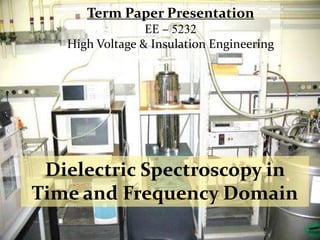
Dielectric Spectroscopy in
Time and Frequency Domain
Term Paper Presentation
EE – 5232
High Voltage & Insulation Engineering
Presented by:
Girish Gupta
Roll no. 15082023
Power System
M. Tech
Vivek Kumar
Roll no. 15082020
Power System
M. Tech
Presented to:
Dr. J C Pandey,
Assistant Professor,
Department of Electrical Engineering,
IIT-BHU
CONTENTS
Need for Dielectric Spectroscopy
Why Dielectric Spectroscopy
Dielectric Response
What is Dielectric Spectroscopy
Frequency Domain Spectroscopy
Time Domain Spectroscopy
Results from Spectroscopy
Precautions
 Most dangerous breakdowns are caused by the aging
effects of HV insulation systems used within HV
components.
 Traditionally to avoid any damage to the equipments
Time Based Maintenance have been used which is
costly in nature.
 Now there is a move towards Condition Based
Maintenance which reduces the maintenance cost and
increases the life of the equipments.
 For CBM, the actual conditions of equipments must be
known.
 For knowing the actual conditions, Dielectric
Spectroscopy is used as a powerful tool.
1. NEED FOR DIELECTRIC SPECTROSCOPY
 Dielectric properties are dependent on many factors,
e.g. on frequency, time, temperature, chemical
composition of an individual dielectric, or on the
structure of an insulation system composed of
different dielectrics.
 Most of the above factors are measured and analyzed
using standardized test but they are performed at
power frequency only.
 The above quantities at single frequency is insufficient
to find changes is dielectric properties of materials.
 So Dielectric Spectroscopy is used.
2. WHY DIELECTRIC SPECTROSCOPY
 Every kind of insulation material consists, at an atomic
level, of negative and positive charges balancing each
other.
 When a material is exposed to an electric field the
positive and negative charges become oriented thus
forming different kinds of dipoles even on atomic
scales.
 These dipoles leads to Dipole Moment which can be
written as
P = α E
where α = Polarizability
E = applied Electric Field
P = Dipole Moment / Polarizability
3. DIELECTRIC RESPONSE
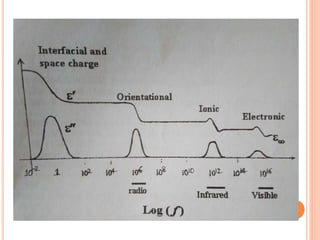
 Different types of Polarization are :-
a. Electron polarization - the displacement of nuclear and
electrons in the atom under the influence of external
electric field. It is effective up to optical frequencies and is
very fast.
b. Atomic polarization - the displacement of atoms or atom
groups in the molecule under the influence of external
electric field. It can be polarized up to Infra Red
frequencies.
c. Dipolar polarization – materials containing molecules
with permanent dipole moments with orientations
statistically distributed due to the action of thermal
energy. It follow frequency up to MHz or GHz.
d. Interfacial polarization – is effective in insulating
materials composed of different dielectric materials. It
occurs in Power frequency and below.
 In summary, the dielectric polarization is the result of
a relative shift of positive and negative charges in a
material.
 During all of these processes, the electric field is not
able to force the charges to escape from the material,
which would cause inherent electric conduction in
Dielectric or Insulator.
 For insulators Polarization P and electric field E is
related as
P = χ ε E
where χ = susceptibility ( relating to all process)
ε = permittivity of free space.
 Now usual sense says that when applied Electric field
should be made zero, Polarization should also become
zero i.e. Depolarization should happen.
 But in reality that do not happen. There is a delay in
the whole depolarization process which is known as
relaxation time.
 So longer the relaxation time, lesser the quality of
Insulator.
 Similarly there is polarization time also for a material.
 Dielectric Spectroscopy picks the above said points for
the analysis.
 Also as all dielectric quantities depends on
temperature also, it is also taken into account during
the process.
 Dielectric spectroscopy measures the dielectric
properties of a medium as a function of frequency
or time.
 It is also known as Impedance Spectroscopy or
Electrochemical Impedance Spectroscopy(EIS).
 It is based on the interaction of an external field with
the electric dipole moment of the sample, often
expressed by permittivity.
 This technique measures the impedance of a system
over a range of frequencies, and so the frequency
response of the system, including the energy storage
and dissipation properties, is revealed.
4. WHAT IS DIELECTRIC SPECTROSCOPY
 Often, data obtained by EIS is expressed
graphically in a Bode plot or a Nyquist plot. It can
also be expressed as logarithmic function of
frequency also.
 It is of two types:- Frequency Domain and Time
Domain.
 It is also an experimental method of characterizing
electrochemical systems.
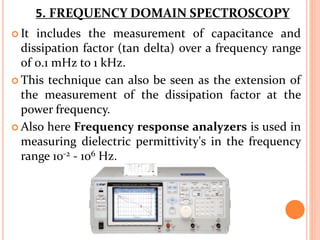
 It includes the measurement of capacitance and
dissipation factor (tan delta) over a frequency range
of 0.1 mHz to 1 kHz.
 This technique can also be seen as the extension of
the measurement of the dissipation factor at the
power frequency.
 Also here Frequency response analyzers is used in
measuring dielectric permittivity's in the frequency
range 10-2 - 106 Hz.
5. FREQUENCY DOMAIN SPECTROSCOPY
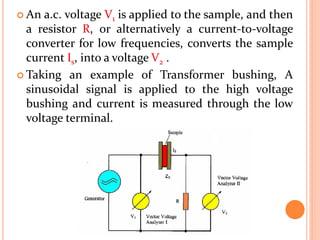
 An a.c. voltage V1 is applied to the sample, and then
a resistor R, or alternatively a current-to-voltage
converter for low frequencies, converts the sample
current Is, into a voltage V2 .
 Taking an example of Transformer bushing, A
sinusoidal signal is applied to the high voltage
bushing and current is measured through the low
voltage terminal.
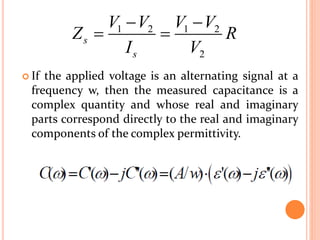
 If the applied voltage is an alternating signal at a
frequency w, then the measured capacitance is a
complex quantity and whose real and imaginary
parts correspond directly to the real and imaginary
components of the complex permittivity.
1 2 1 2
2
s
s
V V V V
Z R
I V
 
 
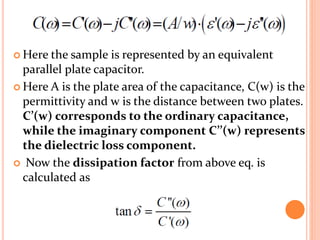
 Here the sample is represented by an equivalent
parallel plate capacitor.
 Here A is the plate area of the capacitance, C(w) is the
permittivity and w is the distance between two plates.
C’(w) corresponds to the ordinary capacitance,
while the imaginary component C’’(w) represents
the dielectric loss component.
 Now the dissipation factor from above eq. is
calculated as
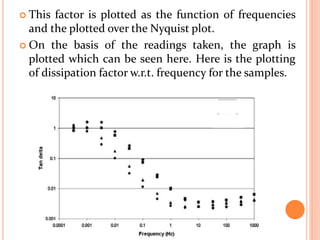
 This factor is plotted as the function of frequencies
and the plotted over the Nyquist plot.
 On the basis of the readings taken, the graph is
plotted which can be seen here. Here is the plotting
of dissipation factor w.r.t. frequency for the samples.
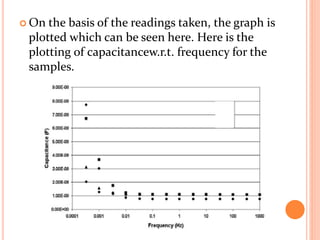
 On the basis of the readings taken, the graph is
plotted which can be seen here. Here is the
plotting of capacitancew.r.t. frequency for the
samples.
 Here the measurement of polarization and
depolarization currents (PDC) following a dc voltage
step is done.
 It is made sure that voltage source free from any
ripple and noise is taken to measure the above
currents with sufficient accuracy.
 The procedure consists in applying a dc charging
voltage of certain magnitude to the test object for a
long time (e.g., 10,000 s).
 As each type of polarization have different time
periods from short to large, that’s why such a large
time is taken.
5. TIME DOMAIN SPECTROSCOPY
 As
P = χ ε E
and all the polarization are time dependent, the
susceptibility in the above eq. is treated as a function of
time to do the analysis.
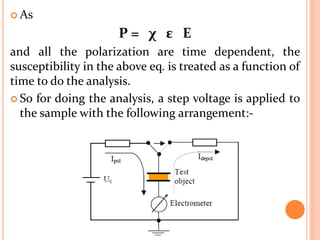
 So for doing the analysis, a step voltage is applied to
the sample with the following arrangement:-
 Here DC supply upto 1000 volts can be used and
current is in picoamperes measured by
electrometers.
 In the above, Ipol is measured until it decays down to
zero or takes a steady state value of low magnitude
for considerable larger time.
 Now after the constant value of polarization current,
sample is short circuited to measure the
depolarization current.
 The same procedure is applied for the depolarization
current also so as to measure the time taken by the
sample to depolarize completely.
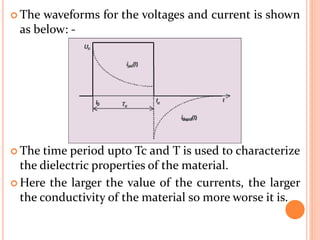
 The waveforms for the voltages and current is shown
as below: -
 The time period upto Tc and T is used to characterize
the dielectric properties of the material.
 Here the larger the value of the currents, the larger
the conductivity of the material so more worse it is.
 Many a times when the dielectric spectroscopy have
been used, certain conclusions have been found out
about the samples which are:-
 polarisation and depolarisation currents increase with
temperature increase.
 Both currents also increase with the moisture content
around the sample.
 temperature, ageing and water content caused a higher
increase of dissipation factor and capacitance at lower
frequencies.
5. RESULTS FROM SPECTROSCOPY
 The equipment in operation must be removed from
service before performing measurements using this
technique.
 Dielectric measurements require constant insulation
temperatures during application for accurateness, as
the polarization phenomena are temperature
dependent. So temperature must be kept constant
during the test.
 The charging time period should be large enough to
complete all the polarization and depolarization
technicques.
 Moisture content around sample should be controlled
and measured for getting precise data.
6. PRECAUTIONS
 Electromagnetic devices should be avoided at all cost
as it can disrupt the devices used.

Dielectric Spectroscopy in Time and Frequency Domain

  • 1.
    Dielectric Spectroscopy in Timeand Frequency Domain Term Paper Presentation EE – 5232 High Voltage & Insulation Engineering
  • 2.
    Presented by: Girish Gupta Rollno. 15082023 Power System M. Tech Vivek Kumar Roll no. 15082020 Power System M. Tech Presented to: Dr. J C Pandey, Assistant Professor, Department of Electrical Engineering, IIT-BHU
  • 3.
    CONTENTS Need for DielectricSpectroscopy Why Dielectric Spectroscopy Dielectric Response What is Dielectric Spectroscopy Frequency Domain Spectroscopy Time Domain Spectroscopy Results from Spectroscopy Precautions
  • 4.
     Most dangerousbreakdowns are caused by the aging effects of HV insulation systems used within HV components.  Traditionally to avoid any damage to the equipments Time Based Maintenance have been used which is costly in nature.  Now there is a move towards Condition Based Maintenance which reduces the maintenance cost and increases the life of the equipments.  For CBM, the actual conditions of equipments must be known.  For knowing the actual conditions, Dielectric Spectroscopy is used as a powerful tool. 1. NEED FOR DIELECTRIC SPECTROSCOPY
  • 5.
     Dielectric propertiesare dependent on many factors, e.g. on frequency, time, temperature, chemical composition of an individual dielectric, or on the structure of an insulation system composed of different dielectrics.  Most of the above factors are measured and analyzed using standardized test but they are performed at power frequency only.  The above quantities at single frequency is insufficient to find changes is dielectric properties of materials.  So Dielectric Spectroscopy is used. 2. WHY DIELECTRIC SPECTROSCOPY
  • 6.
     Every kindof insulation material consists, at an atomic level, of negative and positive charges balancing each other.  When a material is exposed to an electric field the positive and negative charges become oriented thus forming different kinds of dipoles even on atomic scales.  These dipoles leads to Dipole Moment which can be written as P = α E where α = Polarizability E = applied Electric Field P = Dipole Moment / Polarizability 3. DIELECTRIC RESPONSE
  • 7.
     Different typesof Polarization are :- a. Electron polarization - the displacement of nuclear and electrons in the atom under the influence of external electric field. It is effective up to optical frequencies and is very fast. b. Atomic polarization - the displacement of atoms or atom groups in the molecule under the influence of external electric field. It can be polarized up to Infra Red frequencies. c. Dipolar polarization – materials containing molecules with permanent dipole moments with orientations statistically distributed due to the action of thermal energy. It follow frequency up to MHz or GHz. d. Interfacial polarization – is effective in insulating materials composed of different dielectric materials. It occurs in Power frequency and below.
  • 9.
     In summary,the dielectric polarization is the result of a relative shift of positive and negative charges in a material.  During all of these processes, the electric field is not able to force the charges to escape from the material, which would cause inherent electric conduction in Dielectric or Insulator.  For insulators Polarization P and electric field E is related as P = χ ε E where χ = susceptibility ( relating to all process) ε = permittivity of free space.
  • 10.
     Now usualsense says that when applied Electric field should be made zero, Polarization should also become zero i.e. Depolarization should happen.  But in reality that do not happen. There is a delay in the whole depolarization process which is known as relaxation time.  So longer the relaxation time, lesser the quality of Insulator.  Similarly there is polarization time also for a material.  Dielectric Spectroscopy picks the above said points for the analysis.  Also as all dielectric quantities depends on temperature also, it is also taken into account during the process.
  • 11.
     Dielectric spectroscopymeasures the dielectric properties of a medium as a function of frequency or time.  It is also known as Impedance Spectroscopy or Electrochemical Impedance Spectroscopy(EIS).  It is based on the interaction of an external field with the electric dipole moment of the sample, often expressed by permittivity.  This technique measures the impedance of a system over a range of frequencies, and so the frequency response of the system, including the energy storage and dissipation properties, is revealed. 4. WHAT IS DIELECTRIC SPECTROSCOPY
  • 12.
     Often, dataobtained by EIS is expressed graphically in a Bode plot or a Nyquist plot. It can also be expressed as logarithmic function of frequency also.  It is of two types:- Frequency Domain and Time Domain.  It is also an experimental method of characterizing electrochemical systems.
  • 13.
     It includesthe measurement of capacitance and dissipation factor (tan delta) over a frequency range of 0.1 mHz to 1 kHz.  This technique can also be seen as the extension of the measurement of the dissipation factor at the power frequency.  Also here Frequency response analyzers is used in measuring dielectric permittivity's in the frequency range 10-2 - 106 Hz. 5. FREQUENCY DOMAIN SPECTROSCOPY
  • 14.
     An a.c.voltage V1 is applied to the sample, and then a resistor R, or alternatively a current-to-voltage converter for low frequencies, converts the sample current Is, into a voltage V2 .  Taking an example of Transformer bushing, A sinusoidal signal is applied to the high voltage bushing and current is measured through the low voltage terminal.
  • 15.
     If theapplied voltage is an alternating signal at a frequency w, then the measured capacitance is a complex quantity and whose real and imaginary parts correspond directly to the real and imaginary components of the complex permittivity. 1 2 1 2 2 s s V V V V Z R I V    
  • 16.
     Here thesample is represented by an equivalent parallel plate capacitor.  Here A is the plate area of the capacitance, C(w) is the permittivity and w is the distance between two plates. C’(w) corresponds to the ordinary capacitance, while the imaginary component C’’(w) represents the dielectric loss component.  Now the dissipation factor from above eq. is calculated as
  • 17.
     This factoris plotted as the function of frequencies and the plotted over the Nyquist plot.  On the basis of the readings taken, the graph is plotted which can be seen here. Here is the plotting of dissipation factor w.r.t. frequency for the samples.
  • 18.
     On thebasis of the readings taken, the graph is plotted which can be seen here. Here is the plotting of capacitancew.r.t. frequency for the samples.
  • 19.
     Here themeasurement of polarization and depolarization currents (PDC) following a dc voltage step is done.  It is made sure that voltage source free from any ripple and noise is taken to measure the above currents with sufficient accuracy.  The procedure consists in applying a dc charging voltage of certain magnitude to the test object for a long time (e.g., 10,000 s).  As each type of polarization have different time periods from short to large, that’s why such a large time is taken. 5. TIME DOMAIN SPECTROSCOPY
  • 20.
     As P =χ ε E and all the polarization are time dependent, the susceptibility in the above eq. is treated as a function of time to do the analysis.  So for doing the analysis, a step voltage is applied to the sample with the following arrangement:-
  • 21.
     Here DCsupply upto 1000 volts can be used and current is in picoamperes measured by electrometers.  In the above, Ipol is measured until it decays down to zero or takes a steady state value of low magnitude for considerable larger time.  Now after the constant value of polarization current, sample is short circuited to measure the depolarization current.  The same procedure is applied for the depolarization current also so as to measure the time taken by the sample to depolarize completely.
  • 22.
     The waveformsfor the voltages and current is shown as below: -  The time period upto Tc and T is used to characterize the dielectric properties of the material.  Here the larger the value of the currents, the larger the conductivity of the material so more worse it is.
  • 23.
     Many atimes when the dielectric spectroscopy have been used, certain conclusions have been found out about the samples which are:-  polarisation and depolarisation currents increase with temperature increase.  Both currents also increase with the moisture content around the sample.  temperature, ageing and water content caused a higher increase of dissipation factor and capacitance at lower frequencies. 5. RESULTS FROM SPECTROSCOPY
  • 24.
     The equipmentin operation must be removed from service before performing measurements using this technique.  Dielectric measurements require constant insulation temperatures during application for accurateness, as the polarization phenomena are temperature dependent. So temperature must be kept constant during the test.  The charging time period should be large enough to complete all the polarization and depolarization technicques.  Moisture content around sample should be controlled and measured for getting precise data. 6. PRECAUTIONS
  • 25.
     Electromagnetic devicesshould be avoided at all cost as it can disrupt the devices used.