Submitted by
Amol Srivastava
3rd B.Tech Paint Technology
HBTI, Kanpur
INTRODUCTION
 Electrochemical impedance spectroscopy (EIS) (sometimes also called AC
impedance or dielectric spectroscopy) is an electrochemical technique that
surfaced in the late 1960's but did not become extensively studied until the
late 1970's and early 1980's when computer controlled laboratory
equipment became the norm.
 Electrochemical Impedance Spectroscopy (EIS) is a non-destructive
technique used to track the condition of a coated metal sample as it
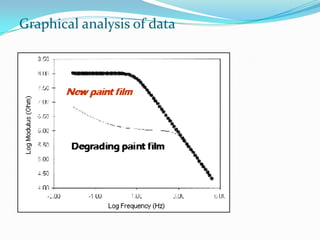
changes. In EIS, an AC voltage of varying frequency is applied to the
sample and a plot of frequency vs. impedance change is traced for analysis.
 EIS generates quantitative data that relates to the quality of a coating on a
metal substrate by studying the nature of change of impedance of the
surface coating.
 EIS also provides a technique to optimize coatings while reducing the time
of coating evaluation and gives insight into the chemical properties of the
coatings.
The Technique
 Dielectric spectroscopy (sometimes called impedance spectroscopy), and
also known as electrochemical impedance spectroscopy (EIS), measures
the dielectric properties of a medium as a function of frequency.
 The pathway to coatings failure is monitored by making periodic EIS
measurements on the sample as it is stressed. Changes in the Coatings
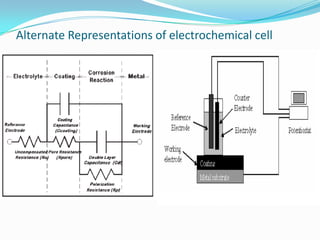
Capacitance, Pore Resistance, Polarization Resistance, and Double Layer
Capacitance can be measured and related to the rate of failure of the
coating.
 Polarization resistance of paints is experimentally observed to be inversely
proportional to probability of corrosion to set in on the metal substrate
 Active corrosion at the metal surface is often accompanied by delamination
of the coating and formation of blisters. This is signalled by a decrease in
the Double Layer Capacitance and a slight increase in the Coating
Capacitance
WHAT CAN EIS TELL US ABOUT PAINTS?
It is useful because using EIS to characterize a painted
metal substrate simultaneously measures three
phenomena:
The deterioration of the organic coating caused by
exposure to an electrolyte
 The increase in corrosion rate of the underlying
substrate due to the deterioration of the coating and
subsequent attack by the electrolyte
 The loss of adhesion between the coating and the
substrate, i.e. Delamination problems
ELECTROCHEMICAL INSTRUMENTATION FOR
EIS EVALUATION OF COATINGS
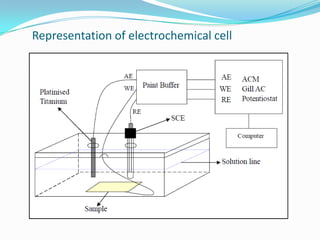
An electrochemical impedance instrument consists of a
potentiostat to apply the AC voltage and measure the
current(key component to measure current in the system)
Associated electronics to measure the impedance
An electrochemical cell to contain the sample.
Electrolyte(resembling service conditions in which the
coating will be used)
Electrodes
Frequency response analyzer (Computer system)
Representation of electrochemical cell
Alternate Representations of electrochemical cell
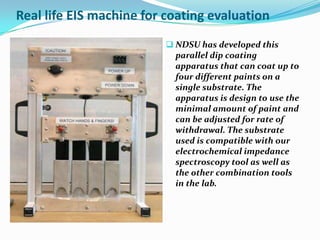
Real life EIS machine for coating evaluation
 NDSU has developed this
parallel dip coating
apparatus that can coat up to
four different paints on a
single substrate. The
apparatus is design to use the
minimal amount of paint and
can be adjusted for rate of
withdrawal. The substrate
used is compatible with our
electrochemical impedance
spectroscopy tool as well as
the other combination tools
in the lab.
A Case Study
Substitution of zinc chromate or zinc yellow, traditionally used as anticorrosive pigment,
for other phosphate-based pigments that are not hazardous to health and have the
same anticorrosive behavior or even better, is studied in this paper. Four alkyd paints
were specially prepared; two of them contained calcium acid phosphate or micronized
zinc phosphate as anticorrosive pigments respectively. A paint containing zinc chromate
was used as reference and a paint without anticorrosive pigments was used as a blank,
in which the other ingredients were increased proportionally to attain the desired PVC
relationship. It was observed after EIS testing, Results of all tests showed that the paint
with calcium acid phosphate and especially that with micronized zinc phosphate
exhibited better behavior than paint with zinc chromate. Analysis of impedance
parameters (ionic resistance and capacitance of the paint film) against immersion time
allowed the paints to be ranked in the same order as that obtained with salt spray and
humidity chamber tests.
Citation: L.S. Hernandez, B. del Amo, R. Romagnoli, (2008) "Accelerated and EIS tests
for anticorrosive paints pigmented with ecological pigments"
Graphical analysis of data
Electrochemical impedance spectroscopy (EIS) vs
salt spray testing
EIS methods can detect deterioration at metal/coating interfaces well before defects
become visible, and with greater accuracy than artificial testing methods such as salt
spray. More importantly, changes in electrical properties determined by EIS experiments
have been found to closely resemble long-term performance of coatings.
For the improved test, outdoor specimens are placed in a typical EIS test cell and
immersed in a 3.55% NaCl solution. Impedance measurements are taken ranging in
frequency from 0.01 Hz to 100 kHz. The results are processed, establishing parameters
for galvanic and barrier mechanisms in an equivalent-circuit model Early changes in
electrical properties of coatings will predict deterioration of the coating system.
The EIS method is also preferable to salt spray and salt fog testing, both techniques that
artificially increase exposure to corrosion. This is because the results of artificial
experiments tend to be uncorrelated with those performed under natural
conditions. Results are often distorted, as well.
Advantages of EIS technique over other
traditional techniques for coating evaluation
 EIS is a very sensitive detector of the condition of a coated metal, so
the EIS response can indicate changes in the coating long before any
visible damage occurs.
 Non- destructive technique, hence less loss of material while testing.
 Quantitative data available to back up the claims made by the
spectroscopy.
 Takes lesser time to evaluate coatings in comparison to other tests like
salt spray evaluation or PAC test.
 Time dependent data is available
Shortcomings of EIS technique for
coating evaluation
Expensive
Requirement of complex data analysis for
quantification
Heavy Requirement of complex lab computers
and peripherels,compilers etc for the process
Requires skilled operator
It can be easily concluded that EIS is a superior modern
technique to study and test surface coatings .What used to
take between 1-1/2 and 5 years of exposure to marine
conditions to gain definitive information on coatings can
now be accomplished in about 8 weeks or less with EIS.
It has been proposed that better quantitative approach to
surface coating testing is the need of the hour and bodies
like the American standards for testing of
materials(ASTM) have held discussions on the possibility
of including EIS techniques as a “pass-fail” test for
evaluation of common paints
Conclusion
References
Brasher, D.M. and Kingsbury, A.H., J. Appl. Chem., 4, 62 (1954).
Chico, B., Galvan, J.C., Dela Fuente, D. and Morcillo, M. (2007), Prog. Org. Coat. 60, pp.:53-
54.
David L., Peterson, P. and Rodgers, B. (2004), – Gamry Instruments,. “Evaluation of Organic
Coating with Electrochemical Impedance Spectroscopy”; part 2. Application of EIS to
Coatings, JCT, pp.: 88-93.
Gonza´lez, S., M.A. Gil, M.A., J.O. Herna´ndez, J.O., V. Fox, V. and Souto, R.M. (2001) Prog.
Org. Coat. 41, pp.: 167–170.
Gonza´lez, S., Fox, V., Souto, R.M. and Adhesion J. (2004), Science Technology. 18, pp.: 455–
464.
Gonza´lez, S., I.C. Mirza Rosca, I.C. and R.M. Souto, R.M. (2001) Prog. Org. Coat., 43, pp.:
282–285
Hare, C.H. (1986), “Adhesive and Cohesive Failure in Applied Coating System Composites”,
Journal of Protective Coatings and Linings, Sep 1986, pp.: 38-48.
Jhon M. N. and Pham Ha Q. (1996),. “Electrochemical Impedance Spectroscopy; a tool for
organic coatings optimizations”, Prog. Org. Coat., 27 , pp.: 201-207.
Mansfeld F., Jeanjaquet S.L. and M. W. Kendig, M.W. “An Electrochemical
Impedance Spectroscopy Study of Reactions at the Metal/Coating Interface, in
Corrosion Protection by Organic Coatings".
Naderi, R., Attar, M.M. and Moayed, M.H. (2004), “EIS examination of mill scale
on mild steel with polyester-epoxy powder coating”, Prog. Org. Coat., 50, pp.:
162-165.
Ramirez, D., Vera,R., H. Gomez, H., and Conajahua, C. (2005), “Evaluation of
protecting properties of epoxy coatings on Navy steel by Electrochemical
Impedance Spectroscopy”, J. Chil. Chem. Soc., 50, N 2, pp.: 489-494.
Scully, J. R. (1989), “Electrochemical Impedance of Organic-Coated Steel:
Correlation of Impedance Parameters with Long-Term Coating Deterioration”,
J. Electrochem. Soc. 136 (4), pp.: 979-990.
Souto, R.M., Fox, V., Laz, M.M., Gonza´lez, S. and Adhesion J. (2000), Science
Technology. 14, pp.: 1321–1330.
THANK YOU………
QUERIES ….?

electrochemical impedence spectroscopy

  • 1.
    Submitted by Amol Srivastava 3rdB.Tech Paint Technology HBTI, Kanpur
  • 2.
    INTRODUCTION  Electrochemical impedancespectroscopy (EIS) (sometimes also called AC impedance or dielectric spectroscopy) is an electrochemical technique that surfaced in the late 1960's but did not become extensively studied until the late 1970's and early 1980's when computer controlled laboratory equipment became the norm.  Electrochemical Impedance Spectroscopy (EIS) is a non-destructive technique used to track the condition of a coated metal sample as it changes. In EIS, an AC voltage of varying frequency is applied to the sample and a plot of frequency vs. impedance change is traced for analysis.  EIS generates quantitative data that relates to the quality of a coating on a metal substrate by studying the nature of change of impedance of the surface coating.  EIS also provides a technique to optimize coatings while reducing the time of coating evaluation and gives insight into the chemical properties of the coatings.
  • 3.
    The Technique  Dielectricspectroscopy (sometimes called impedance spectroscopy), and also known as electrochemical impedance spectroscopy (EIS), measures the dielectric properties of a medium as a function of frequency.  The pathway to coatings failure is monitored by making periodic EIS measurements on the sample as it is stressed. Changes in the Coatings Capacitance, Pore Resistance, Polarization Resistance, and Double Layer Capacitance can be measured and related to the rate of failure of the coating.  Polarization resistance of paints is experimentally observed to be inversely proportional to probability of corrosion to set in on the metal substrate  Active corrosion at the metal surface is often accompanied by delamination of the coating and formation of blisters. This is signalled by a decrease in the Double Layer Capacitance and a slight increase in the Coating Capacitance
  • 4.
    WHAT CAN EISTELL US ABOUT PAINTS? It is useful because using EIS to characterize a painted metal substrate simultaneously measures three phenomena: The deterioration of the organic coating caused by exposure to an electrolyte  The increase in corrosion rate of the underlying substrate due to the deterioration of the coating and subsequent attack by the electrolyte  The loss of adhesion between the coating and the substrate, i.e. Delamination problems
  • 5.
    ELECTROCHEMICAL INSTRUMENTATION FOR EISEVALUATION OF COATINGS An electrochemical impedance instrument consists of a potentiostat to apply the AC voltage and measure the current(key component to measure current in the system) Associated electronics to measure the impedance An electrochemical cell to contain the sample. Electrolyte(resembling service conditions in which the coating will be used) Electrodes Frequency response analyzer (Computer system)
  • 6.
  • 7.
    Alternate Representations ofelectrochemical cell
  • 8.
    Real life EISmachine for coating evaluation  NDSU has developed this parallel dip coating apparatus that can coat up to four different paints on a single substrate. The apparatus is design to use the minimal amount of paint and can be adjusted for rate of withdrawal. The substrate used is compatible with our electrochemical impedance spectroscopy tool as well as the other combination tools in the lab.
  • 9.
    A Case Study Substitutionof zinc chromate or zinc yellow, traditionally used as anticorrosive pigment, for other phosphate-based pigments that are not hazardous to health and have the same anticorrosive behavior or even better, is studied in this paper. Four alkyd paints were specially prepared; two of them contained calcium acid phosphate or micronized zinc phosphate as anticorrosive pigments respectively. A paint containing zinc chromate was used as reference and a paint without anticorrosive pigments was used as a blank, in which the other ingredients were increased proportionally to attain the desired PVC relationship. It was observed after EIS testing, Results of all tests showed that the paint with calcium acid phosphate and especially that with micronized zinc phosphate exhibited better behavior than paint with zinc chromate. Analysis of impedance parameters (ionic resistance and capacitance of the paint film) against immersion time allowed the paints to be ranked in the same order as that obtained with salt spray and humidity chamber tests. Citation: L.S. Hernandez, B. del Amo, R. Romagnoli, (2008) "Accelerated and EIS tests for anticorrosive paints pigmented with ecological pigments"
  • 10.
  • 11.
    Electrochemical impedance spectroscopy(EIS) vs salt spray testing EIS methods can detect deterioration at metal/coating interfaces well before defects become visible, and with greater accuracy than artificial testing methods such as salt spray. More importantly, changes in electrical properties determined by EIS experiments have been found to closely resemble long-term performance of coatings. For the improved test, outdoor specimens are placed in a typical EIS test cell and immersed in a 3.55% NaCl solution. Impedance measurements are taken ranging in frequency from 0.01 Hz to 100 kHz. The results are processed, establishing parameters for galvanic and barrier mechanisms in an equivalent-circuit model Early changes in electrical properties of coatings will predict deterioration of the coating system. The EIS method is also preferable to salt spray and salt fog testing, both techniques that artificially increase exposure to corrosion. This is because the results of artificial experiments tend to be uncorrelated with those performed under natural conditions. Results are often distorted, as well.
  • 12.
    Advantages of EIStechnique over other traditional techniques for coating evaluation  EIS is a very sensitive detector of the condition of a coated metal, so the EIS response can indicate changes in the coating long before any visible damage occurs.  Non- destructive technique, hence less loss of material while testing.  Quantitative data available to back up the claims made by the spectroscopy.  Takes lesser time to evaluate coatings in comparison to other tests like salt spray evaluation or PAC test.  Time dependent data is available
  • 13.
    Shortcomings of EIStechnique for coating evaluation Expensive Requirement of complex data analysis for quantification Heavy Requirement of complex lab computers and peripherels,compilers etc for the process Requires skilled operator
  • 14.
    It can beeasily concluded that EIS is a superior modern technique to study and test surface coatings .What used to take between 1-1/2 and 5 years of exposure to marine conditions to gain definitive information on coatings can now be accomplished in about 8 weeks or less with EIS. It has been proposed that better quantitative approach to surface coating testing is the need of the hour and bodies like the American standards for testing of materials(ASTM) have held discussions on the possibility of including EIS techniques as a “pass-fail” test for evaluation of common paints Conclusion
  • 15.
    References Brasher, D.M. andKingsbury, A.H., J. Appl. Chem., 4, 62 (1954). Chico, B., Galvan, J.C., Dela Fuente, D. and Morcillo, M. (2007), Prog. Org. Coat. 60, pp.:53- 54. David L., Peterson, P. and Rodgers, B. (2004), – Gamry Instruments,. “Evaluation of Organic Coating with Electrochemical Impedance Spectroscopy”; part 2. Application of EIS to Coatings, JCT, pp.: 88-93. Gonza´lez, S., M.A. Gil, M.A., J.O. Herna´ndez, J.O., V. Fox, V. and Souto, R.M. (2001) Prog. Org. Coat. 41, pp.: 167–170. Gonza´lez, S., Fox, V., Souto, R.M. and Adhesion J. (2004), Science Technology. 18, pp.: 455– 464. Gonza´lez, S., I.C. Mirza Rosca, I.C. and R.M. Souto, R.M. (2001) Prog. Org. Coat., 43, pp.: 282–285 Hare, C.H. (1986), “Adhesive and Cohesive Failure in Applied Coating System Composites”, Journal of Protective Coatings and Linings, Sep 1986, pp.: 38-48. Jhon M. N. and Pham Ha Q. (1996),. “Electrochemical Impedance Spectroscopy; a tool for organic coatings optimizations”, Prog. Org. Coat., 27 , pp.: 201-207.
  • 16.
    Mansfeld F., JeanjaquetS.L. and M. W. Kendig, M.W. “An Electrochemical Impedance Spectroscopy Study of Reactions at the Metal/Coating Interface, in Corrosion Protection by Organic Coatings". Naderi, R., Attar, M.M. and Moayed, M.H. (2004), “EIS examination of mill scale on mild steel with polyester-epoxy powder coating”, Prog. Org. Coat., 50, pp.: 162-165. Ramirez, D., Vera,R., H. Gomez, H., and Conajahua, C. (2005), “Evaluation of protecting properties of epoxy coatings on Navy steel by Electrochemical Impedance Spectroscopy”, J. Chil. Chem. Soc., 50, N 2, pp.: 489-494. Scully, J. R. (1989), “Electrochemical Impedance of Organic-Coated Steel: Correlation of Impedance Parameters with Long-Term Coating Deterioration”, J. Electrochem. Soc. 136 (4), pp.: 979-990. Souto, R.M., Fox, V., Laz, M.M., Gonza´lez, S. and Adhesion J. (2000), Science Technology. 14, pp.: 1321–1330.
  • 17.