Intelligence
Submitted to: Sir Irfan
Group members:
Maryam Noor, Rimsha Samuel & Yasmina Gul
2nd year Generic BSN
Objectives
After this presentation learners will be able to:
• Define intelligence.
• Demonstrate an understanding of the concept of the
measurement of intelligence.
• Describe the characteristics of test.
• Identify various management of scales.
9/23/2019 2
Intelligence:
Intelligence came from Latin word intelligere "to understand”.
Definitions:
“Intelligence is the aggregate or global capacity of the
individual to think rationally, to act purposefully and to deal
effectively with the environment” (Wechsler-1994)
“Intelligence is the ability to master the knowledge and skills
needed to succeed with in a particular culture”
(Lolurto-1991)
9/23/2019 3
Nature of Intelligence:
• It is an innate mental ability which grows and is influenced by
the environment.
• It shows the capacity to adapt to new or changed situations
quickly and correctly.
• It is the ability to carry on higher mental processes such as
reasoning, criticism, rational and judgment.
• It shows the capacity to observe the relationship and
absurdities.
• It implies the capacity to learn and solve difficult tasks and
problems.
9/23/2019 4
Types of intelligence:
Intelligence is divided into three kinds.
1. Concrete intelligence
2. Social or emotional intelligence
3. Abstract or general intelligence
9/23/2019 5
Types cont..
1. Concrete intelligence:
• This type of intelligence is applicable for using machines, tools and
instruments.
Ex. Mechanics, engineers are concrete intelligent.
2. Social intelligence:
• It is the ability to understand social situations and act wisely in
human relationship.
• Socially intelligent people know the art of winning friends and
influence them.
Ex. Leaders, ministers, salesmen, and diplomats are socially intelligent.
9/23/2019 6
Cont..
3. Abstract and general intelligence
• It is the ability to respond to words, numbers and letters etc.
• This type of intelligence is required from study of books
literature.
Ex. Teachers, lawyers, doctors and philosophers.
9/23/2019 7
Emotional intelligence
• First called social intelligence.
• The ability to perceive, express, understand, and regulate
emotions.
• Some studies show EQ to be a greater predictor for future success
than IQ.
• It is basis of the empathy for others, self awareness , and social
skills. e.g. eye contact, flexibility and cooperation
• It helps in building the therapeutic relationship with
patient.
9/23/2019
8
Intelligence quotient (IQ)
• The abbreviation "IQ" was coined by the psychologist William
Stern.
• The idea of intelligence quotient was utilized first in 1916 by Binnet
and Simon test.
• Binnet and Simon used mental age to distinguish “bright” from
“dull” children.
• IQ is the ratio between the metal age and chronological age.
IQ = MA/CA x 100
Ex. A 6 years old boy with the mental age of 4.
IQ = 4/6 x 100 = 66.6
9/23/2019 9
Classification of individual according to IQ
Genius 140above
Very superior 130-140
Superior 120-130
Above average 110-120
Average 90-110
Dull average 80-90
Borderline 70-80
Mild mental retardation 50-70
Moderate mental retardation 35-50
Severe mental retardation 20-35
Profound mental retardation 0-209/23/2019 10
• The children those
perform more than
average of their age have
IQ more than 100.
• And those perform less
than average of their age
have IQ less than 100.
Multiple intelligence
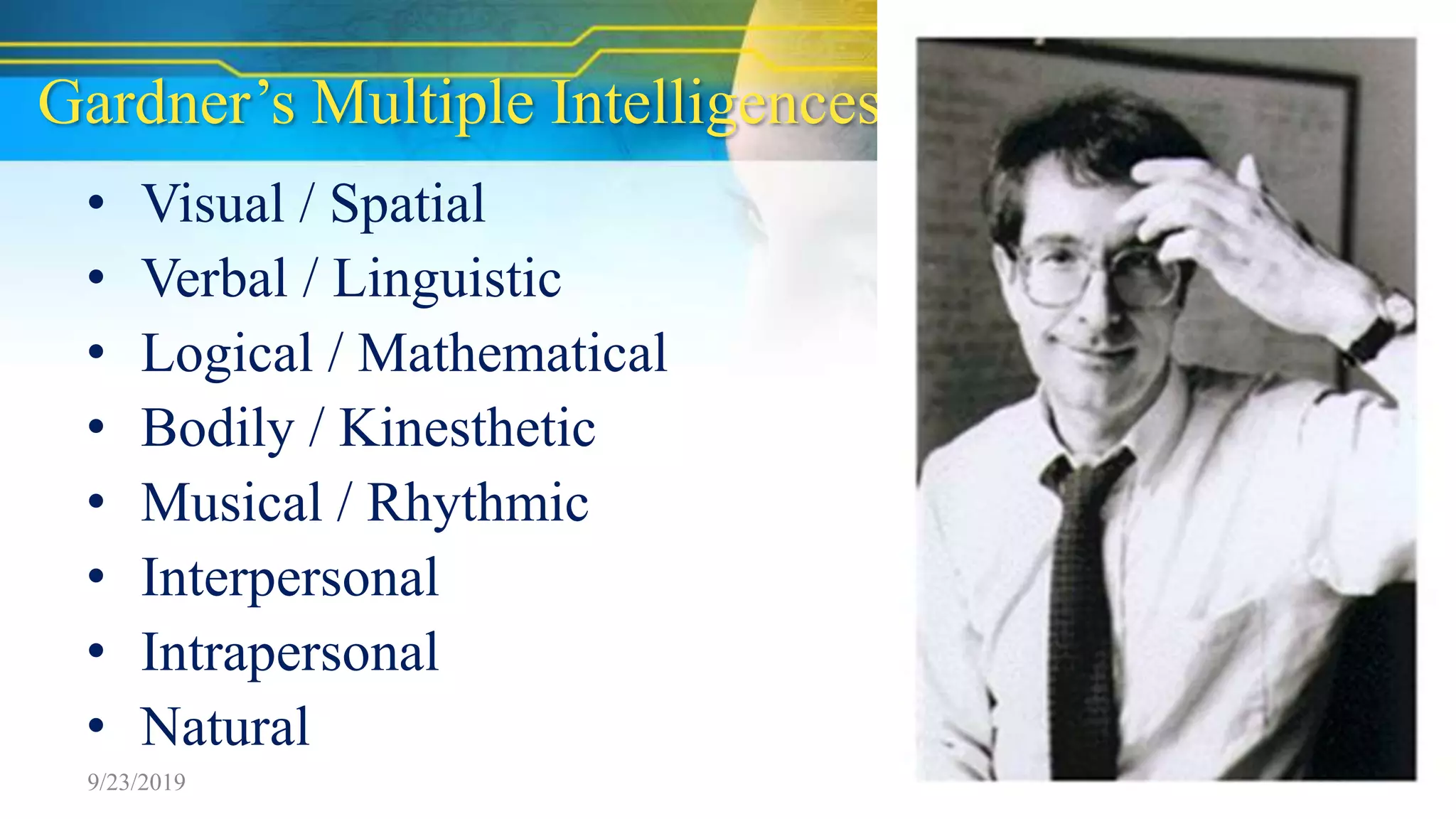
• According to Howard Gardner there are eight types of
intelligence.
• The theory of multiple intelligences differentiates
human intelligence into specific 'modalities', rather than
seeing intelligence as dominated by a single general ability.
• Howard Gardner proposed this model in his 1983 book Frames
of Mind: The Theory of Multiple Intelligences.
9/23/2019 11
Gardner’s Multiple Intelligences:
• Visual / Spatial
• Verbal / Linguistic
• Logical / Mathematical
• Bodily / Kinesthetic
• Musical / Rhythmic
• Interpersonal
• Intrapersonal
• Natural
9/23/2019 12
9/23/2019 13
9/23/2019 14
Theories
There are two main theories regarding intelligence. Every
approach comes up with his own perception and assumptions.
1. Factor theories of intelligence
1. Two factor theory or G-factor theory
2. Group factor or multifactor theory
2. Process oriented theories of intelligence
3. Sternberg’s Triacharic theory
9/23/2019 15
Two factor or G-factor theory
• Two factor theory was developed by Charles Spearman
(father of factor analysis) in 1927.
• Intellectual abilities were comprised of two factors: one
general ability or common ability known as ‘G’ factor and the
other a group of specific abilities known as ‘S’ factor.
• ‘G’ factor is universal inborn ability. Greater ‘G’ in an
individual leads to greater success in life.
• ‘‘S’ factor is acquired from the environment. It varies from
activity to activity in the same individual.
9/23/2019 16
G- factor theory :
• ‘‘S” factor is acquired from the environment. It varies from
activity to activity in the same individual.
• These specific abilities may be represented as :
S1, S2, S3 etc.
According to this theory:
An individual’s total intelligence (A) is the sum of the general
factor (G) and all his specific abilities (S). This can be expressed
as:
A = G+S1+S2+S3 +…….
9/23/2019 17
G factor vs. S factor
G factor S factor
It is Universal inborn ability Learned and acquired from
environment.
It is General mental ability These are specific abilities.
It is constant in one individual. It varies from activity to activity in
same individual.
G factor differs from individual to
individual.
Individuals differs in the amount of S
ability
Used in every activity of life.
9/23/2019 18
Group factor or Multifactor theory
• This theory was advocated by LL Thurstone in 1938.
• This theory rejected General Intelligence.
• This theory considers intelligence a combination of numerous
separate factors.
• Instead of viewing intelligence as a single , general ability ,
Thurstone's theory focused on seven primary mental abilities.
9/23/2019` `
19
Thurstone 7 factors
1. The Verbal Factor (V)—Found in tests involving Verbal
Comprehension.
2. The Spatial Factor (S)—ability to imagine an object in
space.
3. The Number Factor (N)—Ability to do Numerical
Calculations rapidly and accurately.
4. Memory Factor (M)—Involving ability to memorize
quickly.
9/23/2019 20
Thurstone 7 factors
5. The Reasoning Factor (R)—Found in tasks that require a
subject to discover a rule or principle involved in a series or
groups of letters.
6. The Perceptual Factor (P)- ability to perceive objects
accurately.
7. The Problem solving Factor (PS)- ability to solve problems
independently.
Based on these factors Thurstone constructed a new test of
intelligence known as:
‘‘Test of Primary Mental Abilities (PMA).
9/23/2019 21
2. Process Oriented Theories
• The process-oriented theorists tend to focus on the
development of intellectual processes that how the processes
change as individual matures.
• Focused on cognitive development rather than intelligence.
• Process oriented theories given by Jean Piaget and Brunner.
9/23/2019 22
I. Piaget’s theory of cognitive development:
• According to Piaget, intelligence is an adaptive process.
• Piaget viewed intellectual development as an evolution of
cognitive processes such as understanding the laws of nature ,
the principles of grammar & mathematical rules.
• He focused on schemas, assimilation and accommodation.
9/23/2019 23
II. Brunner’s theory:
• This growing abilities are influenced by the environment especially the
rewards and punishments people receives for particular intellectual skill.
• In contrast to Piaget;
Bruner argued that any subject can be taught effectively to any child at any
stage of development.
• For example, it would not be appropriate to teach a three year old complex
physics,
however, Bruner contented that they could be taught some
principles of physics (e.g., force, mass, momentum, friction) in
enactive form and later repeated in iconic, then symbolic form
9/23/2019 24
Sternberg’s Triacharic theory
9/23/2019 25
Three aspects of intelligence:
Componential:
• Analytical thinking “book smart”
Experiential thinking:
• Creative thinking and characterizes the person who can
separate elements of experience and combine them
insightfully.
Contextual:
• “Street smart” one who know how to play the game and
can successfully manipulate the environment.
9/23/2019 26
Characteristics of Stanford Binet test:
• The Stanford - Binet Intelligence Scales are designed to
measure five factors of cognitive ability.
• These five factors include;
1. Fluid reasoning
2. Knowledge
3. Quantitative reasoning
4. Visual-spatial processing
5. Working memory
• Both verbal and nonverbal responses are measured.
9/23/2019 27
Some other features:
 This test measures things that are
necessary for school success.
 Binet’s test is a set of age-graded
items
 Binet assumed that children’s
abilities increase with age.
1. Fluid reasoning
• Fluid reasoning is the ability to solve abstract problems in which
no prior knowledge is required.
• Nonverbal fluid reasoning is tested with object series matrices.
• Verbal absurdities are simply statements that are silly or
impossible.
For example;
– “an apple is to fruit as celery is to __________.” (vegetable).
– what is wrong with a sentence like: “I put ink on my hairbrush
and cleaned my teeth.”
9/23/2019 28
2. Knowledge
• Knowledge is defined as someone’s accumulated stock of
general information that has been committed to long-term
memory.
• For example, a young test subject might be asked to explain
basic human needs, like eating, using gestures. The verbal sub-
test includes vocabulary questions, which may be administered
using toys or flash cards.
• For example;
– Explain differences (between a fish and a horse);
9/23/2019 29
3. Quantitative Reasoning
• Quantitative reasoning measures a person’s numeracy.
• Questions in this section can include basic counting, addition
and subtraction.
• At higher levels, measurement, geometry and word problems
are included.
• Math concepts are presented in both verbal and nonverbal
formats.
9/23/2019 30
IQ Question
• Answer: D. 33
• Explanation: (7 x 6) + 3 = 45 | (8 x 8) + 1 = 65 | (9 x 8) + 3 = 75
(4 x 6) + 9 = 33
9/23/2019 31
4. Visual-spatial Processing
• Visual-spatial processing involves the recognition of both
patterns and spatial relationships.
• The nonverbal portion of this sub-test usually includes
assembling puzzles and patterns.
• The verbal portion includes questions about direction and tests
a subject’s ability to identify spatial relationships in pictures.
9/23/2019 32
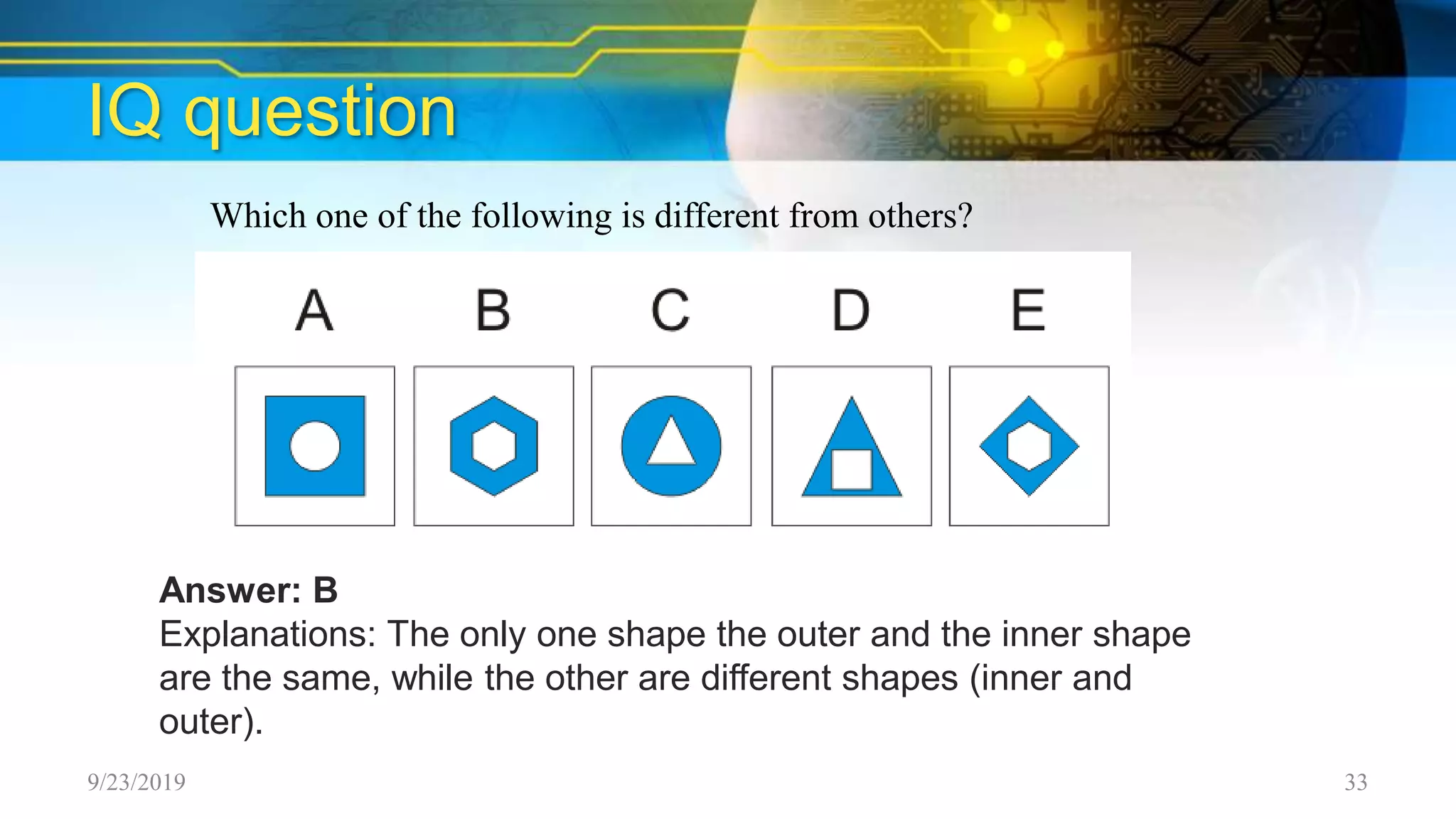
IQ question
9/23/2019 33
Answer: B
Explanations: The only one shape the outer and the inner shape
are the same, while the other are different shapes (inner and
outer).
Which one of the following is different from others?
5. Working Memory
• Working memory is defined as the multiple processes that
capture, sort and transform information in a person’s short-
term memory.
• For example, like the game Concentration, a test subject might
be asked to recall a previously presented picture.
• Block span simply involves tapping out a sequence on a series
of blocks and asking the test subject to repeat the sequence.
9/23/2019 34
Factors Influencing Intelligence:
1. Nature:
how genetics and heredity affects our intelligence.
 Genetics
 Gender
2. Nurture:
From immediate environment to through out the life.
 Pre and postnatal diet
 Family Environment
 School Environment
 Socioeconomic status of family
 Race/Ethnicity
9/23/2019 35
36
Intelligence
Factors
Heredity and environment:
• Land and seed used to grow the crop.
• While the seed is heredity and the land is environment.
• If the land is infertile, even with the good seed, one can not have
a good crop.
• Similar with the fertile land if the poor quality seeds are used the
crop will not achieve the good results.
• As fertile land and good quality seeds are required for good
crops, similarly the heredity and stimulating environment are
necessary for higher intelligence.
9/23/2019 37
Gender:
Boys and girls tend to be equivalent in most aspects of intelligence
• The average IQ scores of boys and girls is virtually identical
• The extremes (both low and high ends) are over- represented
by boys
1. Girls as a group:
• Tend to be stronger in verbal fluency, in writing, in
perceptual speed (starting as early as the toddler years)
2. Boys as a group
• Tend to be stronger in visual-spatial processing, in science, and
in mathematical problem solving (starting as early as age 3)
9/23/2019 38
Schooling:
• Attending school makes children smarter
– Children from families of low socioeconomic societies
and those from families of high socio economic
societies make comparable gains in school
achievement during the school year
9/23/2019 39
Poverty:
• The more years children spend in poverty, the lower their IQs
tend to be.
• Children from lower- and working-class homes average 10-15
points below their middle-class age mates on IQ tests
• In many countries, children from wealthier homes score better
on IQ test than children from poorer homes
9/23/2019 40
Intelligence in Nursing
• Knowledge about intelligence and its measurement is useful in
understanding the nurse herself, her colleagues as well as
patients.
• Nurse’s guidance to the patient would be according to the
patient’s intellectual level.
• Knowledge about intelligence helps the nurse in diagnosing the
mental subnormal or very superior intelligent patient.
• It helps in maintaining empathy but avoid emotional attachment.
9/23/2019 41
Intelligence in Nursing
• With a higher level of emotional intelligence, nurses are better
able to adapt and understand the needs of their patients.
• They can also better cope with the stress emotionally and
improve their social skills.
• Knowledge about abnormalities in new born and development
of their intelligence helps the nurse in providing suitable care.
• In disease related to psychiatric disorders, epilepsy, assessment
of intelligence is of great importance in their management.
9/23/2019 42
References :
• R Sreeveni. (2009). Psychology for nurses. 1st edition. Kundli:
Jaypee brothers medical publishers.
• N.J. Mackintosh. (2011). IQ and human intelligence. 2nd
edition. New York. Oxford university press.
• 2019 StanfordBinetTest.com.
9/23/2019 43
9/23/2019 44
9/23/2019 45
2. IQ Question
9/23/2019 46
Answer: D
Explanations: 15 is added each number, and D only added 10, while
the other numbers are added 15
4. IQ Question
9/23/2019 47
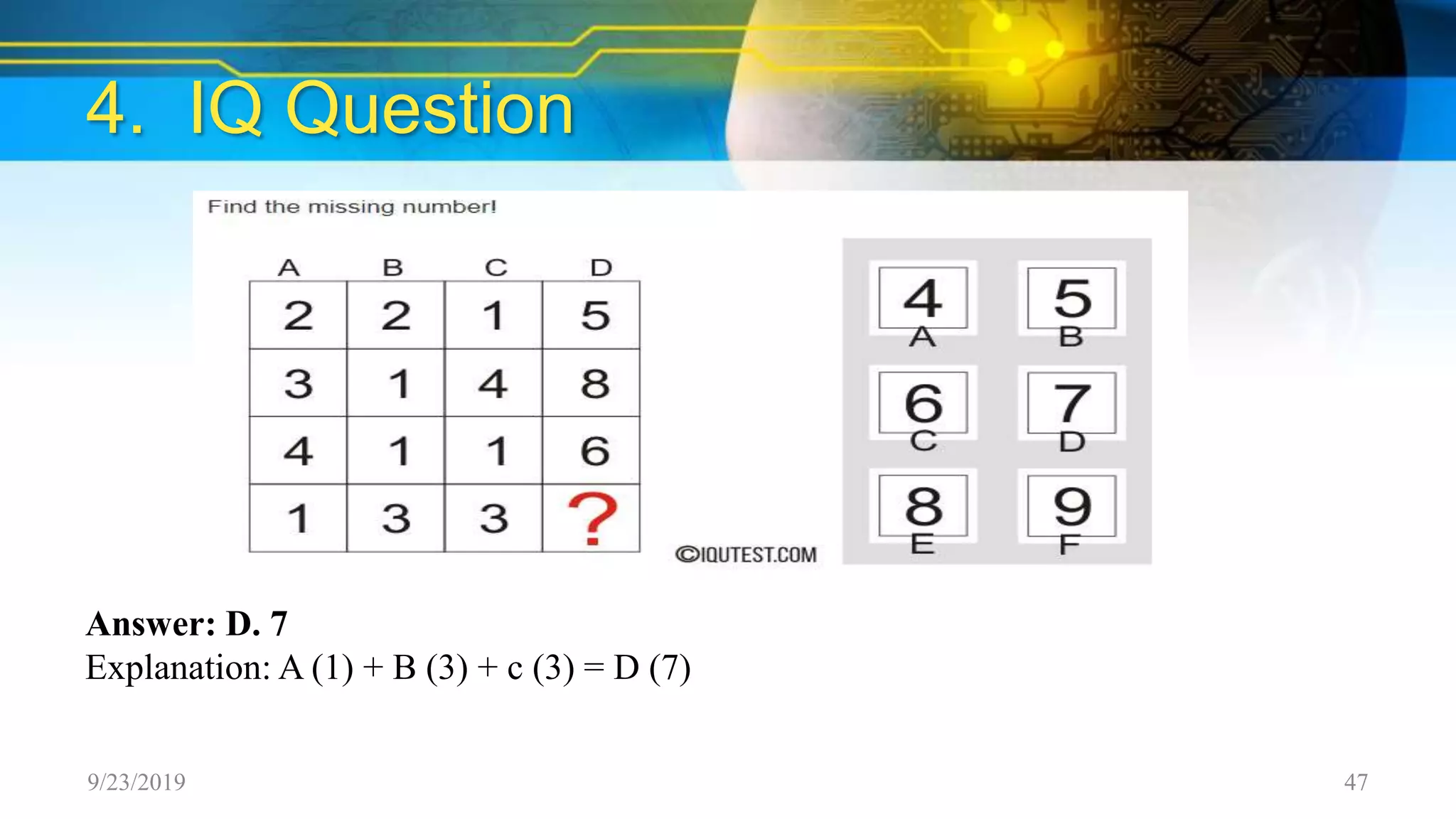
Answer: D. 7
Explanation: A (1) + B (3) + c (3) = D (7)
5. IQ Question
9/23/2019 48
The first letters are in alphabetical order with a letter skipped in
between each segment: C, E, G, I, K. The second and third letters are
repeated; they are also in order with a skipped letter: M, O, Q, S, U.
6. IQ Question
• All the tulips in Zoe's garden are white.
All the pansies in Zoe's garden are yellow.
All the flowers in Zoe's garden are either white or yellow.
If the first two statements are true, the third statement is:
a. True
b. False
c. Uncertain
The first two statements give information about Zoe's tulips and
pansies. Information about any other kinds of flowers cannot be
determined.
9/23/2019 49
IQ question
What is wrong in this sentence?
• In a old graveyard in Spain they have discovered a small skull
which they believe to be that of Cristopher Columbus when he
was about 10 years old.
9/23/2019 50

Intelligence

  • 1.
    Intelligence Submitted to: SirIrfan Group members: Maryam Noor, Rimsha Samuel & Yasmina Gul 2nd year Generic BSN
  • 2.
    Objectives After this presentationlearners will be able to: • Define intelligence. • Demonstrate an understanding of the concept of the measurement of intelligence. • Describe the characteristics of test. • Identify various management of scales. 9/23/2019 2
  • 3.
    Intelligence: Intelligence came fromLatin word intelligere "to understand”. Definitions: “Intelligence is the aggregate or global capacity of the individual to think rationally, to act purposefully and to deal effectively with the environment” (Wechsler-1994) “Intelligence is the ability to master the knowledge and skills needed to succeed with in a particular culture” (Lolurto-1991) 9/23/2019 3
  • 4.
    Nature of Intelligence: •It is an innate mental ability which grows and is influenced by the environment. • It shows the capacity to adapt to new or changed situations quickly and correctly. • It is the ability to carry on higher mental processes such as reasoning, criticism, rational and judgment. • It shows the capacity to observe the relationship and absurdities. • It implies the capacity to learn and solve difficult tasks and problems. 9/23/2019 4
  • 5.
    Types of intelligence: Intelligenceis divided into three kinds. 1. Concrete intelligence 2. Social or emotional intelligence 3. Abstract or general intelligence 9/23/2019 5
  • 6.
    Types cont.. 1. Concreteintelligence: • This type of intelligence is applicable for using machines, tools and instruments. Ex. Mechanics, engineers are concrete intelligent. 2. Social intelligence: • It is the ability to understand social situations and act wisely in human relationship. • Socially intelligent people know the art of winning friends and influence them. Ex. Leaders, ministers, salesmen, and diplomats are socially intelligent. 9/23/2019 6
  • 7.
    Cont.. 3. Abstract andgeneral intelligence • It is the ability to respond to words, numbers and letters etc. • This type of intelligence is required from study of books literature. Ex. Teachers, lawyers, doctors and philosophers. 9/23/2019 7
  • 8.
    Emotional intelligence • Firstcalled social intelligence. • The ability to perceive, express, understand, and regulate emotions. • Some studies show EQ to be a greater predictor for future success than IQ. • It is basis of the empathy for others, self awareness , and social skills. e.g. eye contact, flexibility and cooperation • It helps in building the therapeutic relationship with patient. 9/23/2019 8
  • 9.
    Intelligence quotient (IQ) •The abbreviation "IQ" was coined by the psychologist William Stern. • The idea of intelligence quotient was utilized first in 1916 by Binnet and Simon test. • Binnet and Simon used mental age to distinguish “bright” from “dull” children. • IQ is the ratio between the metal age and chronological age. IQ = MA/CA x 100 Ex. A 6 years old boy with the mental age of 4. IQ = 4/6 x 100 = 66.6 9/23/2019 9
  • 10.
    Classification of individualaccording to IQ Genius 140above Very superior 130-140 Superior 120-130 Above average 110-120 Average 90-110 Dull average 80-90 Borderline 70-80 Mild mental retardation 50-70 Moderate mental retardation 35-50 Severe mental retardation 20-35 Profound mental retardation 0-209/23/2019 10 • The children those perform more than average of their age have IQ more than 100. • And those perform less than average of their age have IQ less than 100.
  • 11.
    Multiple intelligence • Accordingto Howard Gardner there are eight types of intelligence. • The theory of multiple intelligences differentiates human intelligence into specific 'modalities', rather than seeing intelligence as dominated by a single general ability. • Howard Gardner proposed this model in his 1983 book Frames of Mind: The Theory of Multiple Intelligences. 9/23/2019 11
  • 12.
    Gardner’s Multiple Intelligences: •Visual / Spatial • Verbal / Linguistic • Logical / Mathematical • Bodily / Kinesthetic • Musical / Rhythmic • Interpersonal • Intrapersonal • Natural 9/23/2019 12
  • 13.
  • 14.
  • 15.
    Theories There are twomain theories regarding intelligence. Every approach comes up with his own perception and assumptions. 1. Factor theories of intelligence 1. Two factor theory or G-factor theory 2. Group factor or multifactor theory 2. Process oriented theories of intelligence 3. Sternberg’s Triacharic theory 9/23/2019 15
  • 16.
    Two factor orG-factor theory • Two factor theory was developed by Charles Spearman (father of factor analysis) in 1927. • Intellectual abilities were comprised of two factors: one general ability or common ability known as ‘G’ factor and the other a group of specific abilities known as ‘S’ factor. • ‘G’ factor is universal inborn ability. Greater ‘G’ in an individual leads to greater success in life. • ‘‘S’ factor is acquired from the environment. It varies from activity to activity in the same individual. 9/23/2019 16
  • 17.
    G- factor theory: • ‘‘S” factor is acquired from the environment. It varies from activity to activity in the same individual. • These specific abilities may be represented as : S1, S2, S3 etc. According to this theory: An individual’s total intelligence (A) is the sum of the general factor (G) and all his specific abilities (S). This can be expressed as: A = G+S1+S2+S3 +……. 9/23/2019 17
  • 18.
    G factor vs.S factor G factor S factor It is Universal inborn ability Learned and acquired from environment. It is General mental ability These are specific abilities. It is constant in one individual. It varies from activity to activity in same individual. G factor differs from individual to individual. Individuals differs in the amount of S ability Used in every activity of life. 9/23/2019 18
  • 19.
    Group factor orMultifactor theory • This theory was advocated by LL Thurstone in 1938. • This theory rejected General Intelligence. • This theory considers intelligence a combination of numerous separate factors. • Instead of viewing intelligence as a single , general ability , Thurstone's theory focused on seven primary mental abilities. 9/23/2019` ` 19
  • 20.
    Thurstone 7 factors 1.The Verbal Factor (V)—Found in tests involving Verbal Comprehension. 2. The Spatial Factor (S)—ability to imagine an object in space. 3. The Number Factor (N)—Ability to do Numerical Calculations rapidly and accurately. 4. Memory Factor (M)—Involving ability to memorize quickly. 9/23/2019 20
  • 21.
    Thurstone 7 factors 5.The Reasoning Factor (R)—Found in tasks that require a subject to discover a rule or principle involved in a series or groups of letters. 6. The Perceptual Factor (P)- ability to perceive objects accurately. 7. The Problem solving Factor (PS)- ability to solve problems independently. Based on these factors Thurstone constructed a new test of intelligence known as: ‘‘Test of Primary Mental Abilities (PMA). 9/23/2019 21
  • 22.
    2. Process OrientedTheories • The process-oriented theorists tend to focus on the development of intellectual processes that how the processes change as individual matures. • Focused on cognitive development rather than intelligence. • Process oriented theories given by Jean Piaget and Brunner. 9/23/2019 22
  • 23.
    I. Piaget’s theoryof cognitive development: • According to Piaget, intelligence is an adaptive process. • Piaget viewed intellectual development as an evolution of cognitive processes such as understanding the laws of nature , the principles of grammar & mathematical rules. • He focused on schemas, assimilation and accommodation. 9/23/2019 23
  • 24.
    II. Brunner’s theory: •This growing abilities are influenced by the environment especially the rewards and punishments people receives for particular intellectual skill. • In contrast to Piaget; Bruner argued that any subject can be taught effectively to any child at any stage of development. • For example, it would not be appropriate to teach a three year old complex physics, however, Bruner contented that they could be taught some principles of physics (e.g., force, mass, momentum, friction) in enactive form and later repeated in iconic, then symbolic form 9/23/2019 24
  • 25.
    Sternberg’s Triacharic theory 9/23/201925 Three aspects of intelligence: Componential: • Analytical thinking “book smart” Experiential thinking: • Creative thinking and characterizes the person who can separate elements of experience and combine them insightfully. Contextual: • “Street smart” one who know how to play the game and can successfully manipulate the environment.
  • 26.
  • 27.
    Characteristics of StanfordBinet test: • The Stanford - Binet Intelligence Scales are designed to measure five factors of cognitive ability. • These five factors include; 1. Fluid reasoning 2. Knowledge 3. Quantitative reasoning 4. Visual-spatial processing 5. Working memory • Both verbal and nonverbal responses are measured. 9/23/2019 27 Some other features:  This test measures things that are necessary for school success.  Binet’s test is a set of age-graded items  Binet assumed that children’s abilities increase with age.
  • 28.
    1. Fluid reasoning •Fluid reasoning is the ability to solve abstract problems in which no prior knowledge is required. • Nonverbal fluid reasoning is tested with object series matrices. • Verbal absurdities are simply statements that are silly or impossible. For example; – “an apple is to fruit as celery is to __________.” (vegetable). – what is wrong with a sentence like: “I put ink on my hairbrush and cleaned my teeth.” 9/23/2019 28
  • 29.
    2. Knowledge • Knowledgeis defined as someone’s accumulated stock of general information that has been committed to long-term memory. • For example, a young test subject might be asked to explain basic human needs, like eating, using gestures. The verbal sub- test includes vocabulary questions, which may be administered using toys or flash cards. • For example; – Explain differences (between a fish and a horse); 9/23/2019 29
  • 30.
    3. Quantitative Reasoning •Quantitative reasoning measures a person’s numeracy. • Questions in this section can include basic counting, addition and subtraction. • At higher levels, measurement, geometry and word problems are included. • Math concepts are presented in both verbal and nonverbal formats. 9/23/2019 30
  • 31.
    IQ Question • Answer:D. 33 • Explanation: (7 x 6) + 3 = 45 | (8 x 8) + 1 = 65 | (9 x 8) + 3 = 75 (4 x 6) + 9 = 33 9/23/2019 31
  • 32.
    4. Visual-spatial Processing •Visual-spatial processing involves the recognition of both patterns and spatial relationships. • The nonverbal portion of this sub-test usually includes assembling puzzles and patterns. • The verbal portion includes questions about direction and tests a subject’s ability to identify spatial relationships in pictures. 9/23/2019 32
  • 33.
    IQ question 9/23/2019 33 Answer:B Explanations: The only one shape the outer and the inner shape are the same, while the other are different shapes (inner and outer). Which one of the following is different from others?
  • 34.
    5. Working Memory •Working memory is defined as the multiple processes that capture, sort and transform information in a person’s short- term memory. • For example, like the game Concentration, a test subject might be asked to recall a previously presented picture. • Block span simply involves tapping out a sequence on a series of blocks and asking the test subject to repeat the sequence. 9/23/2019 34
  • 35.
    Factors Influencing Intelligence: 1.Nature: how genetics and heredity affects our intelligence.  Genetics  Gender 2. Nurture: From immediate environment to through out the life.  Pre and postnatal diet  Family Environment  School Environment  Socioeconomic status of family  Race/Ethnicity 9/23/2019 35
  • 36.
  • 37.
    Heredity and environment: •Land and seed used to grow the crop. • While the seed is heredity and the land is environment. • If the land is infertile, even with the good seed, one can not have a good crop. • Similar with the fertile land if the poor quality seeds are used the crop will not achieve the good results. • As fertile land and good quality seeds are required for good crops, similarly the heredity and stimulating environment are necessary for higher intelligence. 9/23/2019 37
  • 38.
    Gender: Boys and girlstend to be equivalent in most aspects of intelligence • The average IQ scores of boys and girls is virtually identical • The extremes (both low and high ends) are over- represented by boys 1. Girls as a group: • Tend to be stronger in verbal fluency, in writing, in perceptual speed (starting as early as the toddler years) 2. Boys as a group • Tend to be stronger in visual-spatial processing, in science, and in mathematical problem solving (starting as early as age 3) 9/23/2019 38
  • 39.
    Schooling: • Attending schoolmakes children smarter – Children from families of low socioeconomic societies and those from families of high socio economic societies make comparable gains in school achievement during the school year 9/23/2019 39
  • 40.
    Poverty: • The moreyears children spend in poverty, the lower their IQs tend to be. • Children from lower- and working-class homes average 10-15 points below their middle-class age mates on IQ tests • In many countries, children from wealthier homes score better on IQ test than children from poorer homes 9/23/2019 40
  • 41.
    Intelligence in Nursing •Knowledge about intelligence and its measurement is useful in understanding the nurse herself, her colleagues as well as patients. • Nurse’s guidance to the patient would be according to the patient’s intellectual level. • Knowledge about intelligence helps the nurse in diagnosing the mental subnormal or very superior intelligent patient. • It helps in maintaining empathy but avoid emotional attachment. 9/23/2019 41
  • 42.
    Intelligence in Nursing •With a higher level of emotional intelligence, nurses are better able to adapt and understand the needs of their patients. • They can also better cope with the stress emotionally and improve their social skills. • Knowledge about abnormalities in new born and development of their intelligence helps the nurse in providing suitable care. • In disease related to psychiatric disorders, epilepsy, assessment of intelligence is of great importance in their management. 9/23/2019 42
  • 43.
    References : • RSreeveni. (2009). Psychology for nurses. 1st edition. Kundli: Jaypee brothers medical publishers. • N.J. Mackintosh. (2011). IQ and human intelligence. 2nd edition. New York. Oxford university press. • 2019 StanfordBinetTest.com. 9/23/2019 43
  • 44.
  • 45.
  • 46.
    2. IQ Question 9/23/201946 Answer: D Explanations: 15 is added each number, and D only added 10, while the other numbers are added 15
  • 47.
    4. IQ Question 9/23/201947 Answer: D. 7 Explanation: A (1) + B (3) + c (3) = D (7)
  • 48.
    5. IQ Question 9/23/201948 The first letters are in alphabetical order with a letter skipped in between each segment: C, E, G, I, K. The second and third letters are repeated; they are also in order with a skipped letter: M, O, Q, S, U.
  • 49.
    6. IQ Question •All the tulips in Zoe's garden are white. All the pansies in Zoe's garden are yellow. All the flowers in Zoe's garden are either white or yellow. If the first two statements are true, the third statement is: a. True b. False c. Uncertain The first two statements give information about Zoe's tulips and pansies. Information about any other kinds of flowers cannot be determined. 9/23/2019 49
  • 50.
    IQ question What iswrong in this sentence? • In a old graveyard in Spain they have discovered a small skull which they believe to be that of Cristopher Columbus when he was about 10 years old. 9/23/2019 50