HOLISTIC NURSING
and
problem oriented
nursing
MANISHA PRAHARAJ
SUM NURSING COLLEGE
DEFINITION
Holistic nursing is generally defined as
“all nursing practice that has healing the whole person
as its goal”.
(American Holistic Nurses’ Association, 1998)
TRADITIONAL MEDICINE
• The goal of health care and nursing is to decrease the physical
disturbances caused by person’s illness.
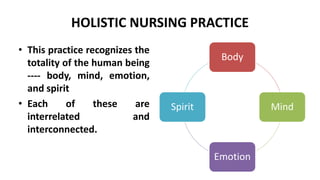
HOLISTIC NURSING PRACTICE
• This practice recognizes the
totality of the human being
---- body, mind, emotion,
and spirit
• Each of these are
interrelated and
interconnected.
Body
Mind
Emotion
Spirit
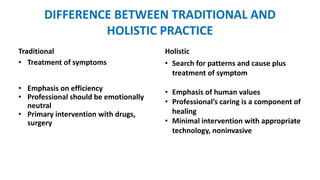
DIFFERENCE BETWEEN TRADITIONAL AND
HOLISTIC PRACTICE
Traditional Holistic
• Treatment of symptoms
• Emphasis on efficiency
• Professional should be emotionally
neutral
• Primary intervention with drugs,
surgery
• Search for patterns and cause plus
treatment of symptom
• Emphasis of human values
• Professional’s caring is a component of
healing
• Minimal intervention with appropriate
technology, noninvasive
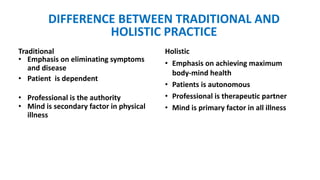
Traditional Holistic
• Emphasis on eliminating symptoms
and disease
• Patient is dependent
• Professional is the authority
• Mind is secondary factor in physical
illness
• Emphasis on achieving maximum
body-mind health
• Patients is autonomous
• Professional is therapeutic partner
• Mind is primary factor in all illness
DIFFERENCE BETWEEN TRADITIONAL AND
HOLISTIC PRACTICE
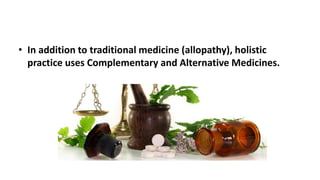
• In addition to traditional medicine (allopathy), holistic
practice uses Complementary and Alternative Medicines.
• Alternative therapy refers to one that is utilized instead of
conventional treatment. E.g. Ayurveda, Homeopathy, Unani
• Complementary implies a therapy used along with a
conventional one. E.g. Yoga, Meditation, Music therapy,
Mind-body intervention, energy therapy, aromatherapy,
acupressure, reflexology, diet and nutrition.
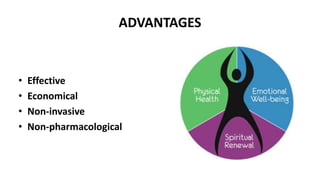
ADVANTAGES
• Effective
• Economical
• Non-invasive
• Non-pharmacological
PROBLEM ORIENTED NURSING
PROBLEM ORIENTED APPROACH
• First proposed by Lawrence Weed as Problem Oriented
Medical Record.
• A system of managing patients based on the recognition of
the patient’s problems done for planning the treatment
program.
• A patient’s total medical situation is summarized by a
complete list of problems.
• A problem-oriented structure requires that all nurses should
record each plan of care according to each problem of the
patient.
PURPOSES
• Documenting evidence of nursing process.
• Speed up retrieval of information about patient at a later
time.
• Give more importance to patient’s progress in documentation
• Facilitating patient care.
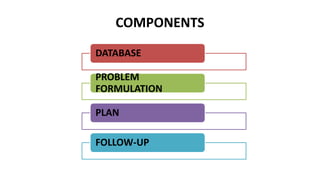
COMPONENTS
DATABASE
PROBLEM
FORMULATION
PLAN
FOLLOW-UP
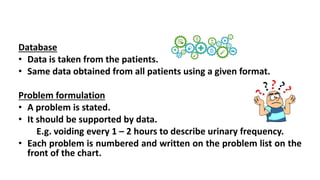
Database
• Data is taken from the patients.
• Same data obtained from all patients using a given format.
Problem formulation
• A problem is stated.
• It should be supported by data.
E.g. voiding every 1 – 2 hours to describe urinary frequency.
• Each problem is numbered and written on the problem list on the
front of the chart.
Plans
• Development of plan of management for
each problem.
• The plan consists of: diagnostic plan,
therapeutic plan and patient education plan.
Follow-up
• The responses of the patient to his care
are recorded.
THANK
YOU

Holistic nursing

  • 1.
  • 2.
    DEFINITION Holistic nursing isgenerally defined as “all nursing practice that has healing the whole person as its goal”. (American Holistic Nurses’ Association, 1998)
  • 3.
    TRADITIONAL MEDICINE • Thegoal of health care and nursing is to decrease the physical disturbances caused by person’s illness.
  • 4.
    HOLISTIC NURSING PRACTICE •This practice recognizes the totality of the human being ---- body, mind, emotion, and spirit • Each of these are interrelated and interconnected. Body Mind Emotion Spirit
  • 5.
    DIFFERENCE BETWEEN TRADITIONALAND HOLISTIC PRACTICE Traditional Holistic • Treatment of symptoms • Emphasis on efficiency • Professional should be emotionally neutral • Primary intervention with drugs, surgery • Search for patterns and cause plus treatment of symptom • Emphasis of human values • Professional’s caring is a component of healing • Minimal intervention with appropriate technology, noninvasive
  • 6.
    Traditional Holistic • Emphasison eliminating symptoms and disease • Patient is dependent • Professional is the authority • Mind is secondary factor in physical illness • Emphasis on achieving maximum body-mind health • Patients is autonomous • Professional is therapeutic partner • Mind is primary factor in all illness DIFFERENCE BETWEEN TRADITIONAL AND HOLISTIC PRACTICE
  • 7.
    • In additionto traditional medicine (allopathy), holistic practice uses Complementary and Alternative Medicines.
  • 8.
    • Alternative therapyrefers to one that is utilized instead of conventional treatment. E.g. Ayurveda, Homeopathy, Unani • Complementary implies a therapy used along with a conventional one. E.g. Yoga, Meditation, Music therapy, Mind-body intervention, energy therapy, aromatherapy, acupressure, reflexology, diet and nutrition.
  • 9.
    ADVANTAGES • Effective • Economical •Non-invasive • Non-pharmacological
  • 10.
  • 11.
    PROBLEM ORIENTED APPROACH •First proposed by Lawrence Weed as Problem Oriented Medical Record. • A system of managing patients based on the recognition of the patient’s problems done for planning the treatment program.
  • 12.
    • A patient’stotal medical situation is summarized by a complete list of problems. • A problem-oriented structure requires that all nurses should record each plan of care according to each problem of the patient.
  • 13.
    PURPOSES • Documenting evidenceof nursing process. • Speed up retrieval of information about patient at a later time. • Give more importance to patient’s progress in documentation • Facilitating patient care.
  • 14.
  • 15.
    Database • Data istaken from the patients. • Same data obtained from all patients using a given format. Problem formulation • A problem is stated. • It should be supported by data. E.g. voiding every 1 – 2 hours to describe urinary frequency. • Each problem is numbered and written on the problem list on the front of the chart.
  • 16.
    Plans • Development ofplan of management for each problem. • The plan consists of: diagnostic plan, therapeutic plan and patient education plan. Follow-up • The responses of the patient to his care are recorded.
  • 17.