PROFESSIONAL ASSOCIATION
AND REGULATORY BODY
MANISHA PRAHARAJ
SUM NURSING COLLEGE
REGULATORY BODY
• A regulatory body is a public authority or
government agency responsible for exercising
autonomous authority over some area of
human activity in a regulatory or supervisory
capacity.
MAJOR NURSING PROFESSIONAL
ASSOCIATION & REGULATORY BODIES
• International Council of Nurses (ICN)
• American Nurses Association(ANA)
• Indian Nursing Council (INC)
• State Registration Council
• Trained Nurses association of India (TNAI)
• Student Nurses Association
International Council of Nurses (ICN)
• Founded in 1899, headquartered in Geneva,
Switzerland.
• World’s first largest international
organization for health.
• Represents 16 million international nurses
130 national nurses organization.
The Three goals are:
• To bring nursing together worldwide
• To advance nurses and nursing worldwide
• To influence health policy.
OBJECTIVES are four fold:
1. To promote & development of strong nurse’s
association.
2. To assist nurse’s association to improve
standard of nursing.
3. To assist nurse’s association status of nurses
within their countries.
4. To serve as authoritative voice for nurses.
ACTIVITIES
PROFESSIONAL NURSING PRACTICE
• Advance nursing practice
• Primary health care
• Family health, women’s health
• Safe water
NURSING REGULATIONS
• Code of ethics, standards & competencies.
• Continuing education.
SOCIO-ECONOMIC WELFARE FOR NURSES
• Occupational health & safety.
• Career development.
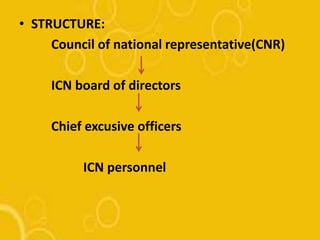
• STRUCTURE:
Council of national representative(CNR)
ICN board of directors
Chief excusive officers
ICN personnel
• CNR is the governing body of ICN & sets
policies, admits members, selects board of
directors.
• ICN is governed by 15 member board of
directors & they once in a year.
• ICN has 4 officers. One president & three vice
– president.
INDIAN NURSING COUNCIL (INC)
• AIM – To establish a uniform standard of
training for nurses midwives and health
visitors.
• INC was constituted in 1949.
• INC is a regulatory body for nurses and
nursing education in India.
• It is an autonomous body under the
Government of India, Ministry of Health and
Family Affairs
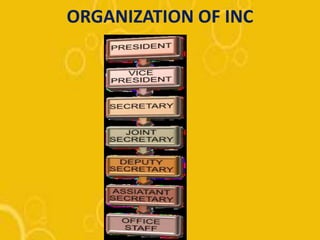
ORGANIZATION OF INC
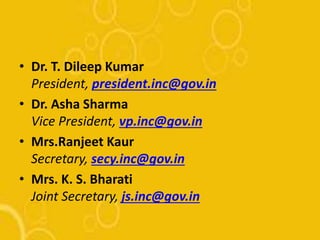
• Dr. T. Dileep Kumar
President, president.inc@gov.in
• Dr. Asha Sharma
Vice President, vp.inc@gov.in
• Mrs.Ranjeet Kaur
Secretary, secy.inc@gov.in
• Mrs. K. S. Bharati
Joint Secretary, js.inc@gov.in
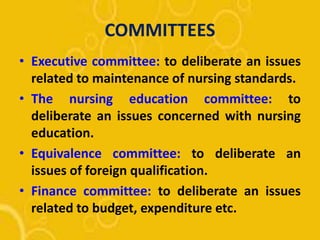
COMMITTEES
• Executive committee: to deliberate an issues
related to maintenance of nursing standards.
• The nursing education committee: to
deliberate an issues concerned with nursing
education.
• Equivalence committee: to deliberate an
issues of foreign qualification.
• Finance committee: to deliberate an issues
related to budget, expenditure etc.
FUNCTIONS
• To establish and monitor a uniform standard
of nursing education.
• To recognize the qualifications for the
purpose of registration and employment
everywhere.
• To give approval for registration of Indian and
foreign nurses possessing foreign
qualification.
• To prescribe the syllabus and regulations for
nursing programme.
• Power to withdraw the recognition in case
the institution fails to maintain its standard.
• To advise the state nursing councils,
examining board, state and central
government in various important items in
nursing education.
GUIDELINES FOR THE ESTABLISHMENT OF
NEW NURSING SCHOOLS / COLLEGES
• Any organization under the central, state
government, local body or a private trust should
obtain the no objection certificate from the state
government.
• The INC on the receipt of the proposal from the
institution to start nursing programme, will undertake
the first inspection to assess the suitability.
• After the approval from INC, the institution shall
obtain the approval from state nursing council and
examination board.
• The INC conducts the inspection every year till the
first batch completes the programme.
TYPE OF INSPECTION
• FIRST INSPECTION : The first inspection is
conducted on the receipt of proposal.
• RE – INSPECTIONS : Re-inspections are
conducted for those institutions, which are
found unsuitable by INC.
• PERIODIC INSPECTION : INC conducts the
periodical inspections once the institution is
found suitable by INC.
PROGRAME INDER INC
• ANM: 1 and a half year
• GNM: Three and a half years
• P.B. Bsc(N): 2 years
• Bsc.(N): 4 years
• Msc.(N): 2 years
• M.Phil: 1 year
• Doctorate in Nursing:3 to 5 years
RESOLUTION
• Maximum period for the students to complete
revised ANM/GNM programme is 3 and 6 years
respectively.
• Maximum age for teaching faculty is 70 years.
• Admission to married candidates for all the
nursing programme is allowed.
• Relaxation of norms to establish M.Sc.(N)
Programme.
• Relaxation of student patient ratio for clinical
practice: 1:3 student patient ration instead of
1:5.
• Relaxation of teaching faculty qualification to
start a B.Sc. (N) programme.
• To maintain the quality of post-graduate, INC
resolved not to have a M.Sc. (N) Programme
through distance education.
• Institutions should have their own building
within two years of establishment.
• Maximum no. of 60 seats can be sanctioned
to the institutions having less than 500
bedded hospital and 100 to those having 500
bedded hospital.
STATE NURSING COUNCIL
• Registration in state Nursing council is very
necessary for every nurse. It is necessary to
be registered in order to function officially as
a professional nurse. Registration councils are
functioning in all the states of India and they
are affiliated to I.N.C.
• A register of names of professional nurses is
maintained by each state nurses Registration
Council. These names are also put into the
Indian Nurses Register maintained by the
Indian Nursing Council. Nurses, midwives,
auxiliary nurse midwives and health visitors
are registered. All degree holding nurses also
have to get the registration in state council.
The present functions of the State Nurses
Registration Council:
• Recognize Officially and inspect schools of
nursing in their states.
• Conduct examinations.
• Prescribe rules of conduct, take disciplinary
actions, etc.
• Maintain registers of Graduate nurses, nurses
holding degrees in nursing, midwives revised
auxiliary nurse midwives or multi-purpose
workers and health visitors.
Composition of SNRC
• The State Nursing Councils are
administratively headed by the Registrar who
usually is a nurse.
• There is deputy registrar who also is a nurse.
• There is a staff consisting of Accountant and
other staff as clerks and peons to help him in
his day to day work and functions.
• The President and Vice-President is elected
by members from amongst themselves.
Functions of Registrar of SNC
• To draw a programme for examinations of
various types of educational programmes at
all centres at the same time.
• To prepare a time schedule for written and
practical examinations, to prepare Roll
number sheets of students and send them to
various examination centres.
• After examiners have drawn the question
papers, to get them printed under strict
confidential atmosphere and keep up the
secrecy regarding them.
• To prepare examination results and
communicate the results to concerned
institutions.
• To prepare the diploma certificates and
registration certificates of nurses who have been
qualified for both.
• To arrange for inspections to ascertain that
the institutions are carrying out the
educational programmes as per syllabus,
conditions and rules and regulations laid
down by State Council.
TRAINED NURSES
ASSOCIATION OF INDIA
• The TNAI is the national professional association.
• 1905 : The association had its beginning in the
association of nursing superintendent at lucknow.
OBJECTIVES :
• Uphold the dignity and honour of nursing profession
• Promote a sense of espirit-de-corps among all the
nurses.
• Enabling members to take counsel together on
matters relating to their profession.
• 1909 : Inaugurated Trained Nurses Association.
• 1910 : TNA elected its own officer.
• 1922 : Two organizations were brought together as
the “TRAINED NURSES ASSOCIATION OF INDIA”
AIMS :
• To standardize, upgrade, develop nursing education
and to elevate nursing education.
• To improve the living and working conditions of the
nurses and develop the educational conditions
available for nursing.
• To provide registration for qualified nurses and to
provide reciprocity of registration within different
states in the country and within different countries.
ORGANISATION OF TNAI
• It consists of :
1.President
2. Vice President
3.Honorary Treasurer
4. Secretary General
5. Assistant Secretaries
6. Branch/joint Secretaries
MEMBERSHIP
• FULL MEMBERS: Fully qualified Registered
nurses.
• ASSOCIATE MEMBERS: Health Visitors,
midwives and ANMs.
• AFFILIATE MEMBERS: Student nurses and
members of affiliated organizations.
BENEFITS OF TNAI MEMBERSHIP
• Holding national level conferences
• Low cost publications for members and students
Continuing education programmes for updating
knowledge
• Socio-economic welfare programmes
• Research studies are conducted regularly for
benefit of members
• Scholarship for TNAI members and student
nurses.
• Scholarships: TNAI has been granting scholarship iof
INR 24000/- years since 1943 to student nurse
members and life members for pursuing
ANM/Diploma/Degree/Post Graduate Degree. (for
details. write to us on sna@tnaionline.org
• Welfare Grant: Welfare grant is being provided since
1939 for the members who are critically/terminally ill.
(for details write to us on prim@tnaionline.org.
• Elderly Care Home and Day Care Centre: TNAI had
started Day Care Centre at Greater Noida for Nurses,
senior citizens and general public.
• Annual grant to state branches to hold
activities.
• One fourth railway concession for TNAI
members.
• The guest room facilities at the headquarters
and also in some states.
• Nurses day celebration at Rashtrapati Bhavan
every year.
PUBLICATION
• Handbook of TNAI…..published in 1913.
• Nursing Journal of India……published
monthly. It is the official organ of the TNAI.
• A copy of this journal shall be sent free to all
the full members and Associate members.
STUDENT NURSES ASSOCIATION
• It is an incorporate organization of TNAI.
• It was established in 1929.
• In 1954 : SNA celebrated its silver jubilee and
no. of units were 117
• At present, it has more than 506 units.
OBJECTIVES OF SNA
• To help students to uphold the dignity of the profession.
• To promote a corporate spirit among students for the
common good.
• To encourage leadership ability and help students to gain a
wide knowledge of nursing profession.
• To help students to increase their social contacts & general
knowledge.
• To encourage professional, social & recreational
development.
• To provide a special section in “ THE NURSING JOURNAL OF
INDIA.” for student’s benefit.
• To encourage students to compete for prizes in the students
nurses exhibition & to attend national & state conferences.
MANAGEMENT OF SNA
• GENERAL COMMITTEE OF SNA:
• President of TNAI or vice president
• Vice president of SNA state branches,
honorary treasurer of TNAI, National SNA
advisor, secretaries of SNA state branches,
secretary general of TNAI.
SNA GENERAL BODY
AT NATIONAL LEVEL:
Members are:
• Members of SNA general committee.
• 3 representatives from each unit i.e., SNA VP,
SNA Secretary & SNA advisor.
• All SNA delegates attending the conference.
AT STATE LEVEL:
Members are:
• State SNA Executive members
• SNA Unit representatives ( VP, Secretary, SNA
Advisor )
SNA UNIT
• Members elected by its own in GBM.
Members are:
– SNA Unit advisor ( should be a TNAI member)
– Vice president
– Secretary
– Treasurer
– Programme chair person
• GBM held at regular intervals
• Agenda for GBM will be acc. To needs of the unit
members & aims & objectives of SNA.
ACTIVITIES OF SNA
• Organization of meetings and conferences.
• Maintenance of diary.
• Exhibition.
• Public speaking and writing.
• Project undertaking.
• Propagation of nursing profession.
• Fund raising.
• Socio-cultural and recreational activities.
• Other activities.
AMERICAN NURSES ASSOCIATION(1911)
PURPOSE:
• To improve the quality of nursing care.
ACTIVITIES:
• Establish standards for nursing care.
• Develop educational standards.
• Promote nursing research.
• Establish a professional code of ethics.
• Oversee a credentialing system.
• Influences legislation affecting health care.
• Protect the economic and general welfare of
RN.
• Assist with professional development of
nurse.
MEMBERSHIP
• Federation of state nurses associations
• Individual RN can participate in ANA joining
their respective state nurses association.
PUBLICATIONS
• American journal of nursing.
• American nurses.
THANK
YOU

Professional association

  • 1.
    PROFESSIONAL ASSOCIATION AND REGULATORYBODY MANISHA PRAHARAJ SUM NURSING COLLEGE
  • 2.
    REGULATORY BODY • Aregulatory body is a public authority or government agency responsible for exercising autonomous authority over some area of human activity in a regulatory or supervisory capacity.
  • 3.
    MAJOR NURSING PROFESSIONAL ASSOCIATION& REGULATORY BODIES • International Council of Nurses (ICN) • American Nurses Association(ANA) • Indian Nursing Council (INC) • State Registration Council • Trained Nurses association of India (TNAI) • Student Nurses Association
  • 4.
    International Council ofNurses (ICN) • Founded in 1899, headquartered in Geneva, Switzerland. • World’s first largest international organization for health. • Represents 16 million international nurses 130 national nurses organization.
  • 5.
    The Three goalsare: • To bring nursing together worldwide • To advance nurses and nursing worldwide • To influence health policy.
  • 6.
    OBJECTIVES are fourfold: 1. To promote & development of strong nurse’s association. 2. To assist nurse’s association to improve standard of nursing. 3. To assist nurse’s association status of nurses within their countries. 4. To serve as authoritative voice for nurses.
  • 7.
    ACTIVITIES PROFESSIONAL NURSING PRACTICE •Advance nursing practice • Primary health care • Family health, women’s health • Safe water NURSING REGULATIONS • Code of ethics, standards & competencies. • Continuing education. SOCIO-ECONOMIC WELFARE FOR NURSES • Occupational health & safety. • Career development.
  • 8.
    • STRUCTURE: Council ofnational representative(CNR) ICN board of directors Chief excusive officers ICN personnel
  • 9.
    • CNR isthe governing body of ICN & sets policies, admits members, selects board of directors. • ICN is governed by 15 member board of directors & they once in a year. • ICN has 4 officers. One president & three vice – president.
  • 10.
    INDIAN NURSING COUNCIL(INC) • AIM – To establish a uniform standard of training for nurses midwives and health visitors. • INC was constituted in 1949. • INC is a regulatory body for nurses and nursing education in India. • It is an autonomous body under the Government of India, Ministry of Health and Family Affairs
  • 11.
  • 12.
    • Dr. T.Dileep Kumar President, president.inc@gov.in • Dr. Asha Sharma Vice President, vp.inc@gov.in • Mrs.Ranjeet Kaur Secretary, secy.inc@gov.in • Mrs. K. S. Bharati Joint Secretary, js.inc@gov.in
  • 13.
    COMMITTEES • Executive committee:to deliberate an issues related to maintenance of nursing standards. • The nursing education committee: to deliberate an issues concerned with nursing education. • Equivalence committee: to deliberate an issues of foreign qualification. • Finance committee: to deliberate an issues related to budget, expenditure etc.
  • 14.
    FUNCTIONS • To establishand monitor a uniform standard of nursing education. • To recognize the qualifications for the purpose of registration and employment everywhere. • To give approval for registration of Indian and foreign nurses possessing foreign qualification. • To prescribe the syllabus and regulations for nursing programme.
  • 15.
    • Power towithdraw the recognition in case the institution fails to maintain its standard. • To advise the state nursing councils, examining board, state and central government in various important items in nursing education.
  • 16.
    GUIDELINES FOR THEESTABLISHMENT OF NEW NURSING SCHOOLS / COLLEGES • Any organization under the central, state government, local body or a private trust should obtain the no objection certificate from the state government. • The INC on the receipt of the proposal from the institution to start nursing programme, will undertake the first inspection to assess the suitability. • After the approval from INC, the institution shall obtain the approval from state nursing council and examination board. • The INC conducts the inspection every year till the first batch completes the programme.
  • 17.
    TYPE OF INSPECTION •FIRST INSPECTION : The first inspection is conducted on the receipt of proposal. • RE – INSPECTIONS : Re-inspections are conducted for those institutions, which are found unsuitable by INC. • PERIODIC INSPECTION : INC conducts the periodical inspections once the institution is found suitable by INC.
  • 18.
    PROGRAME INDER INC •ANM: 1 and a half year • GNM: Three and a half years • P.B. Bsc(N): 2 years • Bsc.(N): 4 years • Msc.(N): 2 years • M.Phil: 1 year • Doctorate in Nursing:3 to 5 years
  • 19.
    RESOLUTION • Maximum periodfor the students to complete revised ANM/GNM programme is 3 and 6 years respectively. • Maximum age for teaching faculty is 70 years. • Admission to married candidates for all the nursing programme is allowed. • Relaxation of norms to establish M.Sc.(N) Programme. • Relaxation of student patient ratio for clinical practice: 1:3 student patient ration instead of 1:5.
  • 20.
    • Relaxation ofteaching faculty qualification to start a B.Sc. (N) programme. • To maintain the quality of post-graduate, INC resolved not to have a M.Sc. (N) Programme through distance education. • Institutions should have their own building within two years of establishment. • Maximum no. of 60 seats can be sanctioned to the institutions having less than 500 bedded hospital and 100 to those having 500 bedded hospital.
  • 21.
    STATE NURSING COUNCIL •Registration in state Nursing council is very necessary for every nurse. It is necessary to be registered in order to function officially as a professional nurse. Registration councils are functioning in all the states of India and they are affiliated to I.N.C.
  • 22.
    • A registerof names of professional nurses is maintained by each state nurses Registration Council. These names are also put into the Indian Nurses Register maintained by the Indian Nursing Council. Nurses, midwives, auxiliary nurse midwives and health visitors are registered. All degree holding nurses also have to get the registration in state council.
  • 23.
    The present functionsof the State Nurses Registration Council: • Recognize Officially and inspect schools of nursing in their states. • Conduct examinations. • Prescribe rules of conduct, take disciplinary actions, etc. • Maintain registers of Graduate nurses, nurses holding degrees in nursing, midwives revised auxiliary nurse midwives or multi-purpose workers and health visitors.
  • 24.
    Composition of SNRC •The State Nursing Councils are administratively headed by the Registrar who usually is a nurse. • There is deputy registrar who also is a nurse. • There is a staff consisting of Accountant and other staff as clerks and peons to help him in his day to day work and functions. • The President and Vice-President is elected by members from amongst themselves.
  • 25.
    Functions of Registrarof SNC • To draw a programme for examinations of various types of educational programmes at all centres at the same time. • To prepare a time schedule for written and practical examinations, to prepare Roll number sheets of students and send them to various examination centres.
  • 26.
    • After examinershave drawn the question papers, to get them printed under strict confidential atmosphere and keep up the secrecy regarding them. • To prepare examination results and communicate the results to concerned institutions. • To prepare the diploma certificates and registration certificates of nurses who have been qualified for both.
  • 27.
    • To arrangefor inspections to ascertain that the institutions are carrying out the educational programmes as per syllabus, conditions and rules and regulations laid down by State Council.
  • 28.
    TRAINED NURSES ASSOCIATION OFINDIA • The TNAI is the national professional association. • 1905 : The association had its beginning in the association of nursing superintendent at lucknow. OBJECTIVES : • Uphold the dignity and honour of nursing profession • Promote a sense of espirit-de-corps among all the nurses. • Enabling members to take counsel together on matters relating to their profession.
  • 29.
    • 1909 :Inaugurated Trained Nurses Association. • 1910 : TNA elected its own officer. • 1922 : Two organizations were brought together as the “TRAINED NURSES ASSOCIATION OF INDIA” AIMS : • To standardize, upgrade, develop nursing education and to elevate nursing education. • To improve the living and working conditions of the nurses and develop the educational conditions available for nursing. • To provide registration for qualified nurses and to provide reciprocity of registration within different states in the country and within different countries.
  • 30.
    ORGANISATION OF TNAI •It consists of : 1.President 2. Vice President 3.Honorary Treasurer 4. Secretary General 5. Assistant Secretaries 6. Branch/joint Secretaries
  • 31.
    MEMBERSHIP • FULL MEMBERS:Fully qualified Registered nurses. • ASSOCIATE MEMBERS: Health Visitors, midwives and ANMs. • AFFILIATE MEMBERS: Student nurses and members of affiliated organizations.
  • 32.
    BENEFITS OF TNAIMEMBERSHIP • Holding national level conferences • Low cost publications for members and students Continuing education programmes for updating knowledge • Socio-economic welfare programmes • Research studies are conducted regularly for benefit of members • Scholarship for TNAI members and student nurses.
  • 33.
    • Scholarships: TNAIhas been granting scholarship iof INR 24000/- years since 1943 to student nurse members and life members for pursuing ANM/Diploma/Degree/Post Graduate Degree. (for details. write to us on sna@tnaionline.org • Welfare Grant: Welfare grant is being provided since 1939 for the members who are critically/terminally ill. (for details write to us on prim@tnaionline.org. • Elderly Care Home and Day Care Centre: TNAI had started Day Care Centre at Greater Noida for Nurses, senior citizens and general public.
  • 34.
    • Annual grantto state branches to hold activities. • One fourth railway concession for TNAI members. • The guest room facilities at the headquarters and also in some states. • Nurses day celebration at Rashtrapati Bhavan every year.
  • 35.
    PUBLICATION • Handbook ofTNAI…..published in 1913. • Nursing Journal of India……published monthly. It is the official organ of the TNAI. • A copy of this journal shall be sent free to all the full members and Associate members.
  • 36.
    STUDENT NURSES ASSOCIATION •It is an incorporate organization of TNAI. • It was established in 1929. • In 1954 : SNA celebrated its silver jubilee and no. of units were 117 • At present, it has more than 506 units.
  • 37.
    OBJECTIVES OF SNA •To help students to uphold the dignity of the profession. • To promote a corporate spirit among students for the common good. • To encourage leadership ability and help students to gain a wide knowledge of nursing profession. • To help students to increase their social contacts & general knowledge. • To encourage professional, social & recreational development. • To provide a special section in “ THE NURSING JOURNAL OF INDIA.” for student’s benefit. • To encourage students to compete for prizes in the students nurses exhibition & to attend national & state conferences.
  • 38.
    MANAGEMENT OF SNA •GENERAL COMMITTEE OF SNA: • President of TNAI or vice president • Vice president of SNA state branches, honorary treasurer of TNAI, National SNA advisor, secretaries of SNA state branches, secretary general of TNAI.
  • 39.
    SNA GENERAL BODY ATNATIONAL LEVEL: Members are: • Members of SNA general committee. • 3 representatives from each unit i.e., SNA VP, SNA Secretary & SNA advisor. • All SNA delegates attending the conference. AT STATE LEVEL: Members are: • State SNA Executive members • SNA Unit representatives ( VP, Secretary, SNA Advisor )
  • 40.
    SNA UNIT • Memberselected by its own in GBM. Members are: – SNA Unit advisor ( should be a TNAI member) – Vice president – Secretary – Treasurer – Programme chair person • GBM held at regular intervals • Agenda for GBM will be acc. To needs of the unit members & aims & objectives of SNA.
  • 41.
    ACTIVITIES OF SNA •Organization of meetings and conferences. • Maintenance of diary. • Exhibition. • Public speaking and writing. • Project undertaking. • Propagation of nursing profession. • Fund raising. • Socio-cultural and recreational activities. • Other activities.
  • 42.
    AMERICAN NURSES ASSOCIATION(1911) PURPOSE: •To improve the quality of nursing care. ACTIVITIES: • Establish standards for nursing care. • Develop educational standards. • Promote nursing research. • Establish a professional code of ethics. • Oversee a credentialing system. • Influences legislation affecting health care.
  • 43.
    • Protect theeconomic and general welfare of RN. • Assist with professional development of nurse. MEMBERSHIP • Federation of state nurses associations • Individual RN can participate in ANA joining their respective state nurses association. PUBLICATIONS • American journal of nursing. • American nurses.
  • 44.