

HOME VISITING
Mr. Veeresh Demashetti
MSc (N) 2nd Year
GCON,KIMS, Hubballi
Introduction
A home visit is one of the essential parts
of the community health services because most of
the people are found in a home. Home visit fulfils
the needs of individual, family and community in
general for nursing service and health counselling.
A home visit is considered as the backbone of
community health service. A home visit is a
family –nurse contact which allows the health
worker to assess the home and family situation in
order to provide the necessary nursing care and
health-related activities.
Meaning:
Home visit refers to meeting the health needs
of people at their doorsteps. Health services given
at home for patient, families and the community
in general for nursing service and health
counseling.
Definition
 A home visit is defined as the process of
providing the nursing care to patients at their
doorsteps. It requires technical skills,
resourcefulness, judgment, relationships.
 It is defined as providing the services to
family at their doorstep to maintain the health
and to reduce the mortality and morbidity in
family
CONCEPTSOFHOMEVISITING
1. Home visiting provides opportunity to make
direct observation on home environment family
structure, familial roles and relationships.
2. In home visiting the members are relaxed, have
more time and privacy and feel free to raise
questions, seek clarifications and sort out their
problems.
3. It provides opportunities to make direct
observation of care given by family members.
CONCEPTSOFHOMEVISITING
4. It provides opportunities to contact and interact
with most of the family members.
5. It also makes possible to have active participation
of family members in planning and implementing
family health care.
6. It makes feasible to plan and provide
comprehensive family health care with major
emphasis on promotive and preventive care.
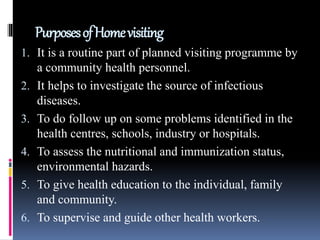
PurposesofHomevisiting
1. It is a routine part of planned visiting programme by
a community health personnel.
2. It helps to investigate the source of infectious
diseases.
3. To do follow up on some problems identified in the
health centres, schools, industry or hospitals.
4. To assess the nutritional and immunization status,
environmental hazards.
5. To give health education to the individual, family
and community.
6. To supervise and guide other health workers.
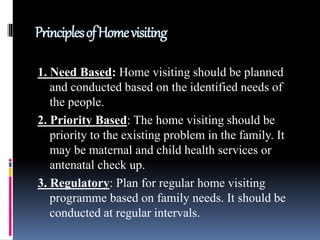
PrinciplesofHomevisiting
1. Need Based: Home visiting should be planned
and conducted based on the identified needs of
the people.
2. Priority Based: The home visiting should be
priority to the existing problem in the family. It
may be maternal and child health services or
antenatal check up.
3. Regulatory: Plan for regular home visiting
programme based on family needs. It should be
conducted at regular intervals.
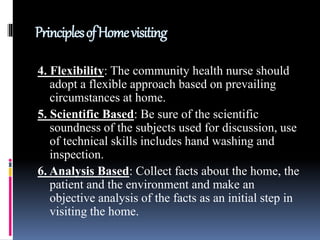
PrinciplesofHomevisiting
4. Flexibility: The community health nurse should
adopt a flexible approach based on prevailing
circumstances at home.
5. Scientific Based: Be sure of the scientific
soundness of the subjects used for discussion, use
of technical skills includes hand washing and
inspection.
6. Analysis Based: Collect facts about the home, the
patient and the environment and make an
objective analysis of the facts as an initial step in
visiting the home.
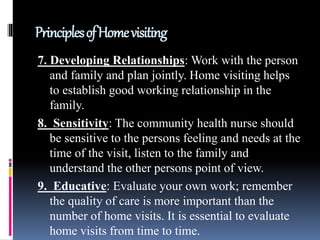
PrinciplesofHomevisiting
7. Developing Relationships: Work with the person
and family and plan jointly. Home visiting helps
to establish good working relationship in the
family.
8. Sensitivity: The community health nurse should
be sensitive to the persons feeling and needs at the
time of the visit, listen to the family and
understand the other persons point of view.
9. Educative: Evaluate your own work; remember
the quality of care is more important than the
number of home visits. It is essential to evaluate
home visits from time to time.
STEPSINHOMEVISITING:
1. Initial phase:
2. Action phase:
3. Termination phase:
STEPSINHOMEVISITING:
1. Initial phase:
The community health nurse should
collect information from clinical and other
records before planning for a visit. During the
home visit, she has to assess or observe and
make a note in initial visit. The community
health nurse should introduce and establish a
friendly relationship by using simple language,
assess physical and environmental status,
family’s cultural background, occupation and
income of the family, member age, educational
factors and psychological factors.
STEPSINHOMEVISITING:
2. Action phase:
The interpersonal relationship starts when
nurse enters into the house. The nurse should use
their effective communication skills to implement
the nursing process. During action phase the
community health nurse provides nursing care ex:
taking temperature, physical examination and
dressing etc. Demonstrating and teaching ex:
teaching insulin self administration. She makes
diagnosis and tentative nursing care plan based on
establishing priorities.
STEPSINHOMEVISITING:
3. Termination phase:
Nurse-patient goals are reached,
health is restored and the patient can function
without actions. The nurse records the
important events in the family and reports the
problems of the family. Evaluation of home
visit is a continuous process, though at the end
of every visit, community health nurse
evaluate the self.
AdvantagesofHomeVisit:
1. The nurse can directly observe home and family
atmosphere.
2. The nurse can directly observe the care given to
patient by the family members.
3. It is possible to discover new health problems.
4. The family members will be more relaxed in their
own surroundings.
5. The family gains confidence and feels to clear their
doubts.
6. This helps to apply the gained knowledge and skills
in the homes assisting and solving individuals and
families health problems.
QualitiesofCommunityHealthNurse:
1. A qualified community health nurse is one
who has undergone basic general nursing,
midwifery training and post basic education in
community health nursing.
2. A community health nurse must have interest
in people and in understanding human
behavior.
3. Sincerity and ability to empathize are basic
qualities required for a nurse.
QualitiesofCommunityHealthNurse:
4. A well poised nurse has a friendly disposition,
honest, charitable, resourceful and cooperative
and takes responsibilities with initiative.
5. Minimum essential skills of a nurse are
observation, communication, interviewing and
bedsides supportive and technical skills.
6. She must have abilities to make
interpretations, make judgements and take
decisions.
Thankyou

Home Visiting.ppt

  • 1.
    HOME VISITING Mr. VeereshDemashetti MSc (N) 2nd Year GCON,KIMS, Hubballi
  • 2.
    Introduction A home visitis one of the essential parts of the community health services because most of the people are found in a home. Home visit fulfils the needs of individual, family and community in general for nursing service and health counselling. A home visit is considered as the backbone of community health service. A home visit is a family –nurse contact which allows the health worker to assess the home and family situation in order to provide the necessary nursing care and health-related activities.
  • 3.
    Meaning: Home visit refersto meeting the health needs of people at their doorsteps. Health services given at home for patient, families and the community in general for nursing service and health counseling.
  • 4.
    Definition  A homevisit is defined as the process of providing the nursing care to patients at their doorsteps. It requires technical skills, resourcefulness, judgment, relationships.  It is defined as providing the services to family at their doorstep to maintain the health and to reduce the mortality and morbidity in family
  • 5.
    CONCEPTSOFHOMEVISITING 1. Home visitingprovides opportunity to make direct observation on home environment family structure, familial roles and relationships. 2. In home visiting the members are relaxed, have more time and privacy and feel free to raise questions, seek clarifications and sort out their problems. 3. It provides opportunities to make direct observation of care given by family members.
  • 6.
    CONCEPTSOFHOMEVISITING 4. It providesopportunities to contact and interact with most of the family members. 5. It also makes possible to have active participation of family members in planning and implementing family health care. 6. It makes feasible to plan and provide comprehensive family health care with major emphasis on promotive and preventive care.
  • 7.
    PurposesofHomevisiting 1. It isa routine part of planned visiting programme by a community health personnel. 2. It helps to investigate the source of infectious diseases. 3. To do follow up on some problems identified in the health centres, schools, industry or hospitals. 4. To assess the nutritional and immunization status, environmental hazards. 5. To give health education to the individual, family and community. 6. To supervise and guide other health workers.
  • 8.
    PrinciplesofHomevisiting 1. Need Based:Home visiting should be planned and conducted based on the identified needs of the people. 2. Priority Based: The home visiting should be priority to the existing problem in the family. It may be maternal and child health services or antenatal check up. 3. Regulatory: Plan for regular home visiting programme based on family needs. It should be conducted at regular intervals.
  • 9.
    PrinciplesofHomevisiting 4. Flexibility: Thecommunity health nurse should adopt a flexible approach based on prevailing circumstances at home. 5. Scientific Based: Be sure of the scientific soundness of the subjects used for discussion, use of technical skills includes hand washing and inspection. 6. Analysis Based: Collect facts about the home, the patient and the environment and make an objective analysis of the facts as an initial step in visiting the home.
  • 10.
    PrinciplesofHomevisiting 7. Developing Relationships:Work with the person and family and plan jointly. Home visiting helps to establish good working relationship in the family. 8. Sensitivity: The community health nurse should be sensitive to the persons feeling and needs at the time of the visit, listen to the family and understand the other persons point of view. 9. Educative: Evaluate your own work; remember the quality of care is more important than the number of home visits. It is essential to evaluate home visits from time to time.
  • 11.
    STEPSINHOMEVISITING: 1. Initial phase: 2.Action phase: 3. Termination phase:
  • 12.
    STEPSINHOMEVISITING: 1. Initial phase: Thecommunity health nurse should collect information from clinical and other records before planning for a visit. During the home visit, she has to assess or observe and make a note in initial visit. The community health nurse should introduce and establish a friendly relationship by using simple language, assess physical and environmental status, family’s cultural background, occupation and income of the family, member age, educational factors and psychological factors.
  • 13.
    STEPSINHOMEVISITING: 2. Action phase: Theinterpersonal relationship starts when nurse enters into the house. The nurse should use their effective communication skills to implement the nursing process. During action phase the community health nurse provides nursing care ex: taking temperature, physical examination and dressing etc. Demonstrating and teaching ex: teaching insulin self administration. She makes diagnosis and tentative nursing care plan based on establishing priorities.
  • 14.
    STEPSINHOMEVISITING: 3. Termination phase: Nurse-patientgoals are reached, health is restored and the patient can function without actions. The nurse records the important events in the family and reports the problems of the family. Evaluation of home visit is a continuous process, though at the end of every visit, community health nurse evaluate the self.
  • 15.
    AdvantagesofHomeVisit: 1. The nursecan directly observe home and family atmosphere. 2. The nurse can directly observe the care given to patient by the family members. 3. It is possible to discover new health problems. 4. The family members will be more relaxed in their own surroundings. 5. The family gains confidence and feels to clear their doubts. 6. This helps to apply the gained knowledge and skills in the homes assisting and solving individuals and families health problems.
  • 16.
    QualitiesofCommunityHealthNurse: 1. A qualifiedcommunity health nurse is one who has undergone basic general nursing, midwifery training and post basic education in community health nursing. 2. A community health nurse must have interest in people and in understanding human behavior. 3. Sincerity and ability to empathize are basic qualities required for a nurse.
  • 17.
    QualitiesofCommunityHealthNurse: 4. A wellpoised nurse has a friendly disposition, honest, charitable, resourceful and cooperative and takes responsibilities with initiative. 5. Minimum essential skills of a nurse are observation, communication, interviewing and bedsides supportive and technical skills. 6. She must have abilities to make interpretations, make judgements and take decisions.
  • 18.