FORMULATION OF
RESEARCH PROBLEM
DR. MAHESWARI JAIKUMAR
maheswarijaikumar2103@gmail.com
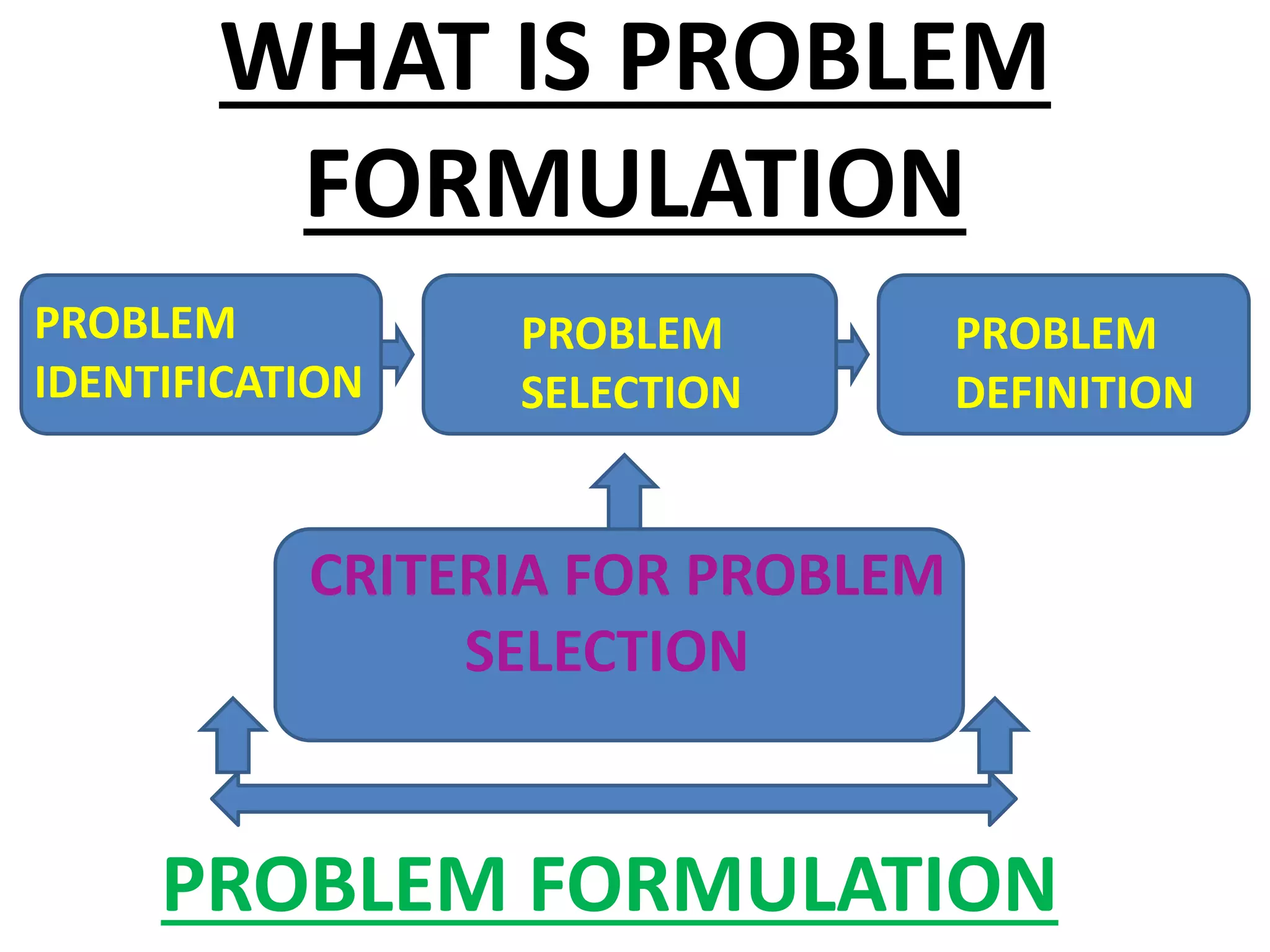
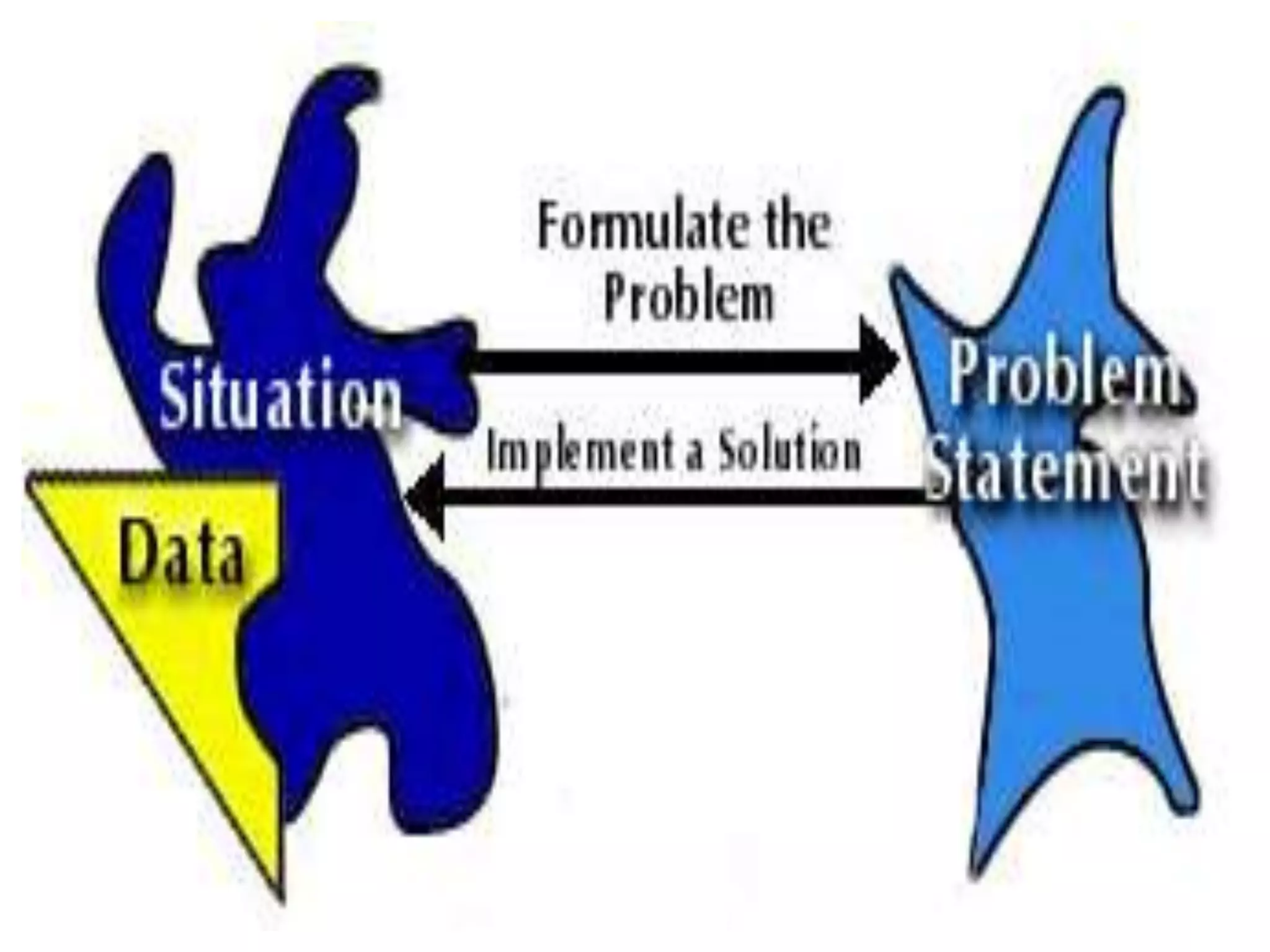
WHAT IS PROBLEM
FORMULATION
PROBLEM
IDENTIFICATION
PROBLEM
SELECTION
PROBLEM
DEFINITION
CRITERIA FOR PROBLEM
SELECTION
PROBLEM FORMULATION
• Formulation of a research
problem is a complex process.
• It includes the following steps.
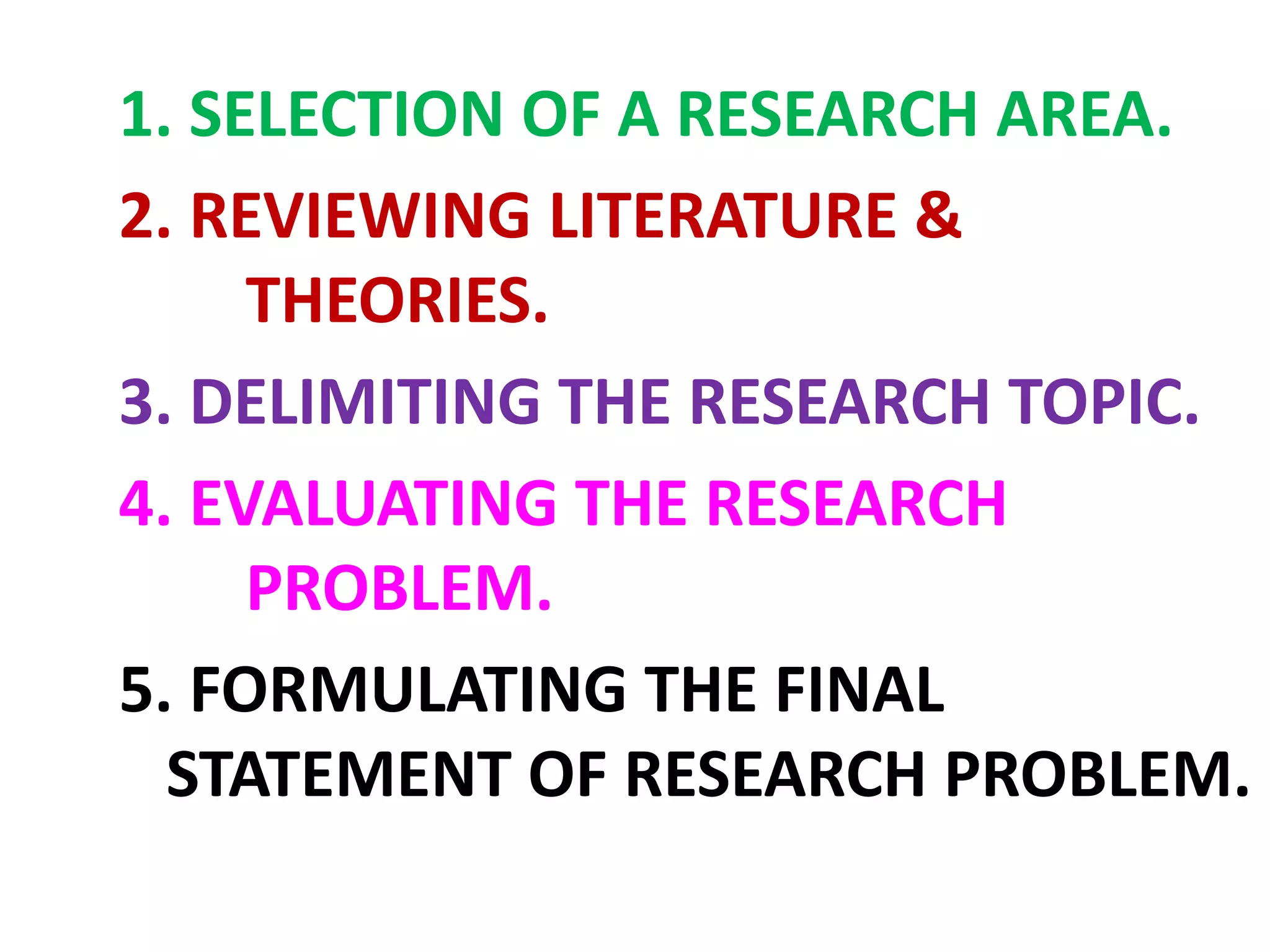
1. SELECTION OF A RESEARCH AREA.
2. REVIEWING LITERATURE &
THEORIES.
3. DELIMITING THE RESEARCH TOPIC.
4. EVALUATING THE RESEARCH
PROBLEM.
5. FORMULATING THE FINAL
STATEMENT OF RESEARCH PROBLEM.
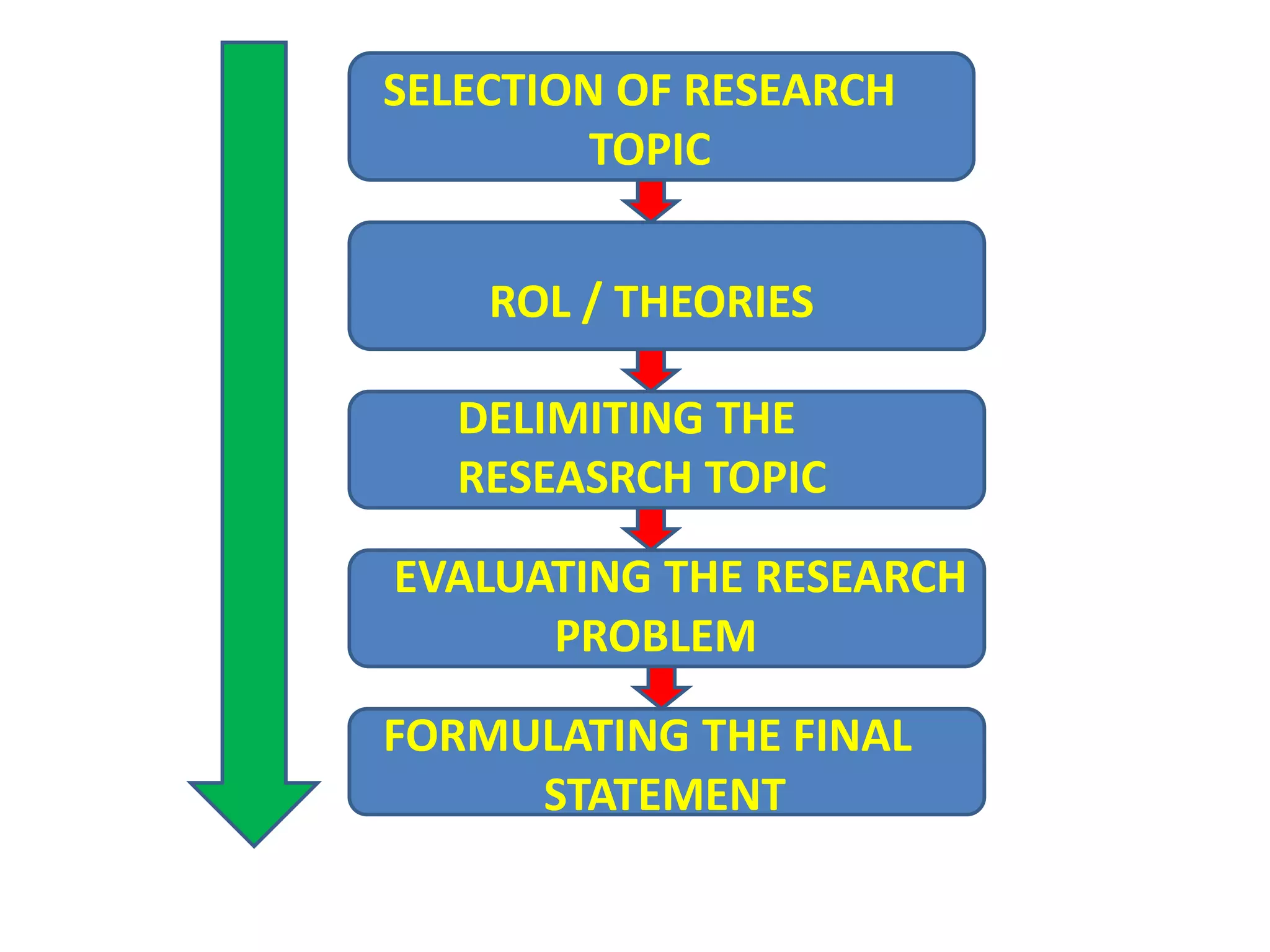
SELECTION OF RESEARCH
TOPIC
ROL / THEORIES
DELIMITING THE
RESEASRCH TOPIC
EVALUATING THE RESEARCH
PROBLEM
FORMULATING THE FINAL
STATEMENT
SELECTING A RESEARCH
AREA
• Formulation of a research
problem begins with selection of
a broad research topic from
personal experience, literature,
previous research & theories.
REVIEWING / THEORIES
• After obtaining a broad idea for
research, the researcher needs
to review the nursing literature
and theories.
• Literature is reviewed to know
what has already been done in
this selected area of research.
• Therefore, a researcher can plan
a research topic to further
expand the existing body of
knowledge.
• Reviewing the theories provides
an opportunity for the
researcher to plan a research
problem to contribute towards
either testing or development of
a theory conceptual model.
DELIMITING THE RESEARCH
TOPIC
• Here the researcher proceeds
from a general research area of
interest to more specific topic of
research while conducting the
study.
EVALUATING THE RESEARCH
PROBLEM
• Once the researcher is clear
about the research problem, the
research problem must be
carefully evaluated for its
significance, researchability and
feasibility.
• Feasibility refers to feasibility in
terms of time, cost availability of
subjects, resources,
administrative & peer support,
ethical consideration,
researcher’s competence of the
researcher and interest.
• The research problem may be
evaluated using guidelines for
evaluation.
GUIDELINES FOR
EVALUATING
RESEARCH PROBLEM
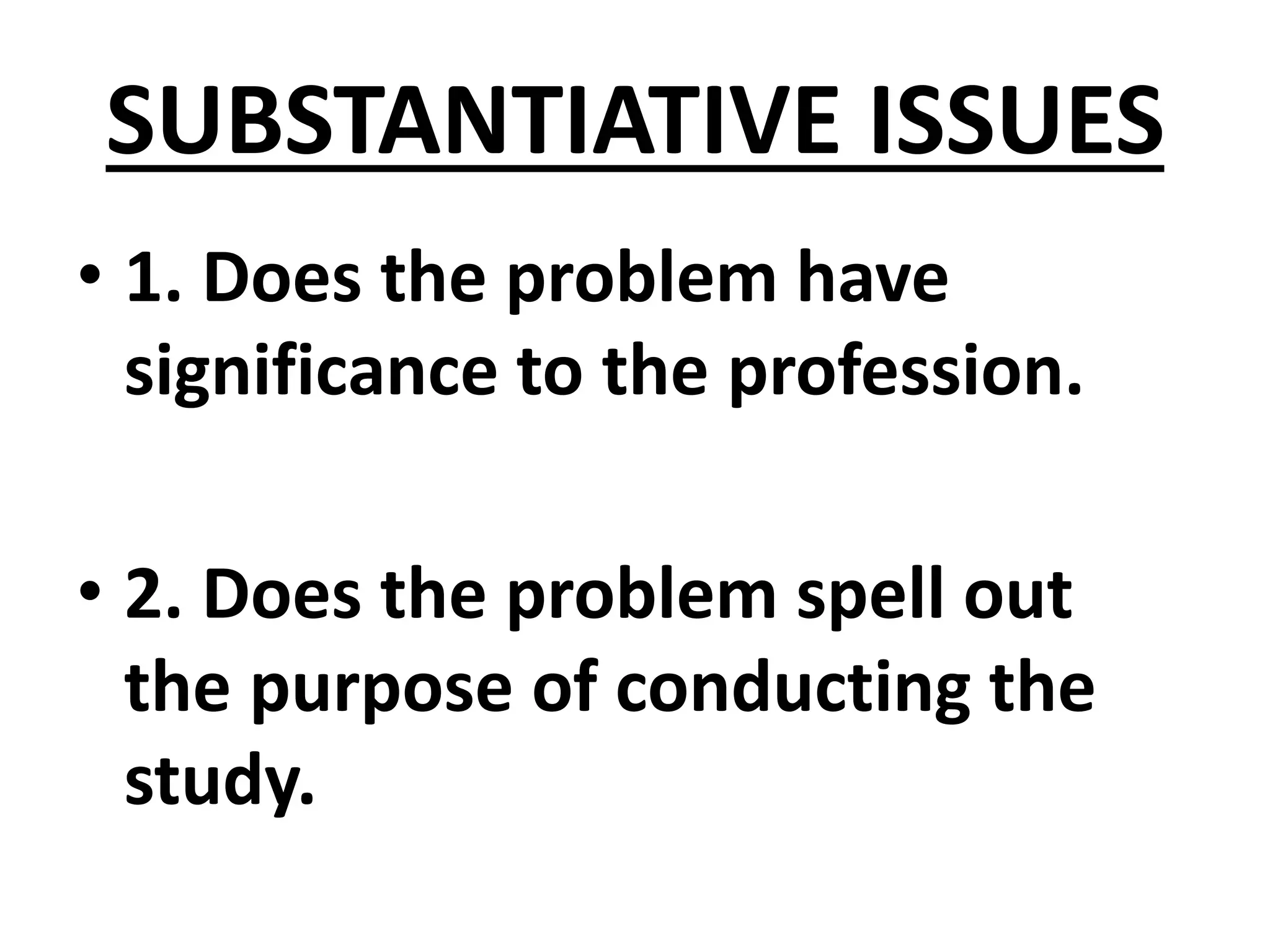
SUBSTANTIATIVE ISSUES
• 1. Does the problem have
significance to the profession.
• 2. Does the problem spell out
the purpose of conducting the
study.
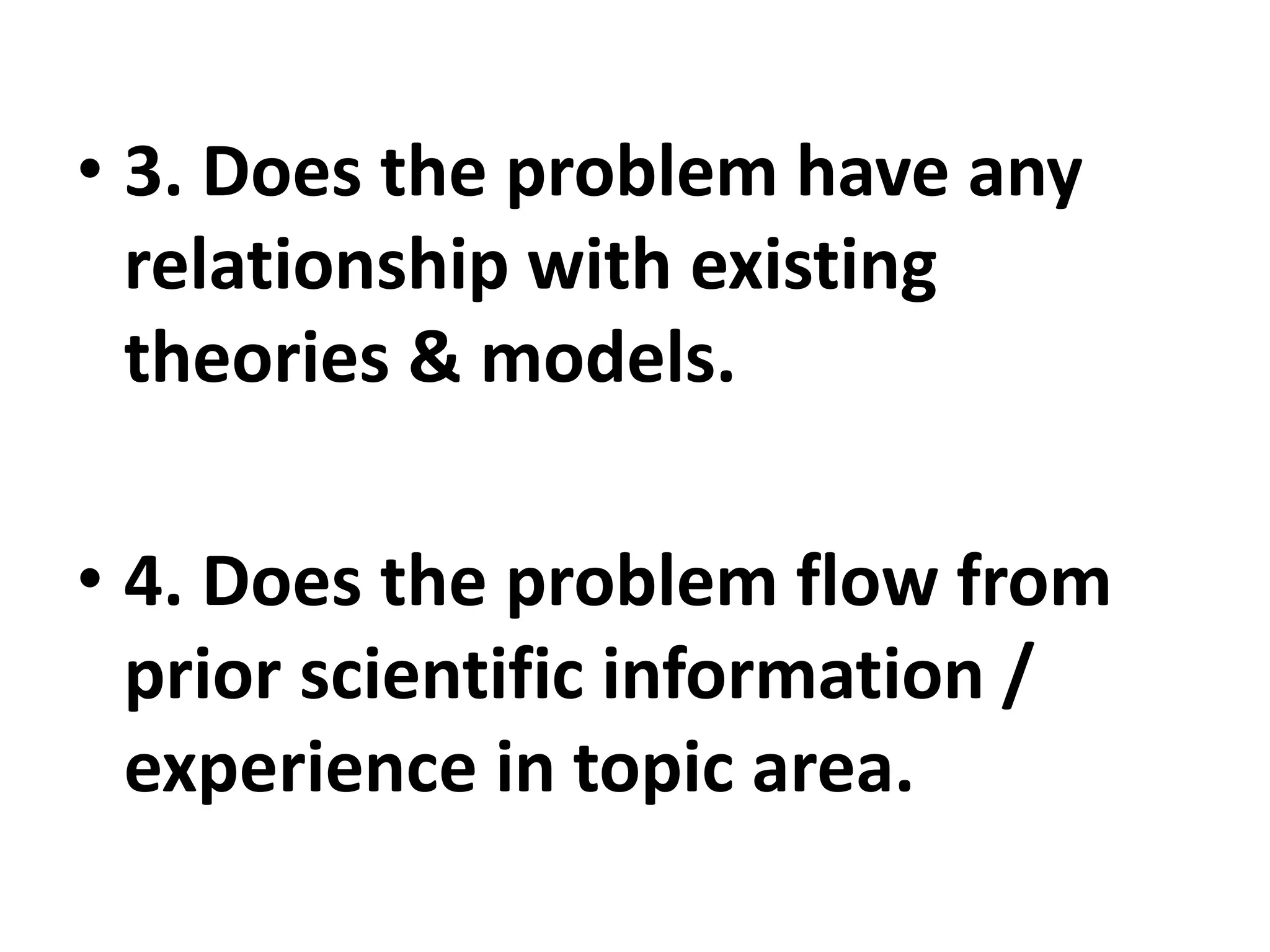
• 3. Does the problem have any
relationship with existing
theories & models.
• 4. Does the problem flow from
prior scientific information /
experience in topic area.
METHODOLOGICAL
ISSUES
• Does the problem statement
clearly identify the research
variables in measurable terms.
• 2. Does the problem identify the
nature of population which is to be
studied.
• 3. Does the problem clearly
define about type or design of
study.
• 4. Does the problem describe the
research setting, place and time.
• 5. Does the problem comprise
appropriate phrases.
STYLISTIC ISSUES
• 1.Is the problem statement
complete, concise, clear in
declarative form clearly suggesting
answers to be questioned.
• 2. Was the problem statement
introduced promptly.
ETHICAL ISSUES
• 1. Does the research problem
require the use of human
subject.
• 2. Does the problem imply
potential risks for those subjects.
PRACTICAL ISSUES
• Has the researcher appropriately
delimited the scope of the
problem, or is the problem too
big or complex foe a single
investigation.
• 2. Is the researcher able to
manage man, money, material,
& appropriate permissions from
authorities.
FORMULATING FINAL
STATEMENT OF RESEARCH
PROBLEM
• Following the establishment of
of the significance,
researchability and feasibility
the researcher finally formulates
the final problem statement.
• A statement of problem could be
in declarative or interrogative
format.
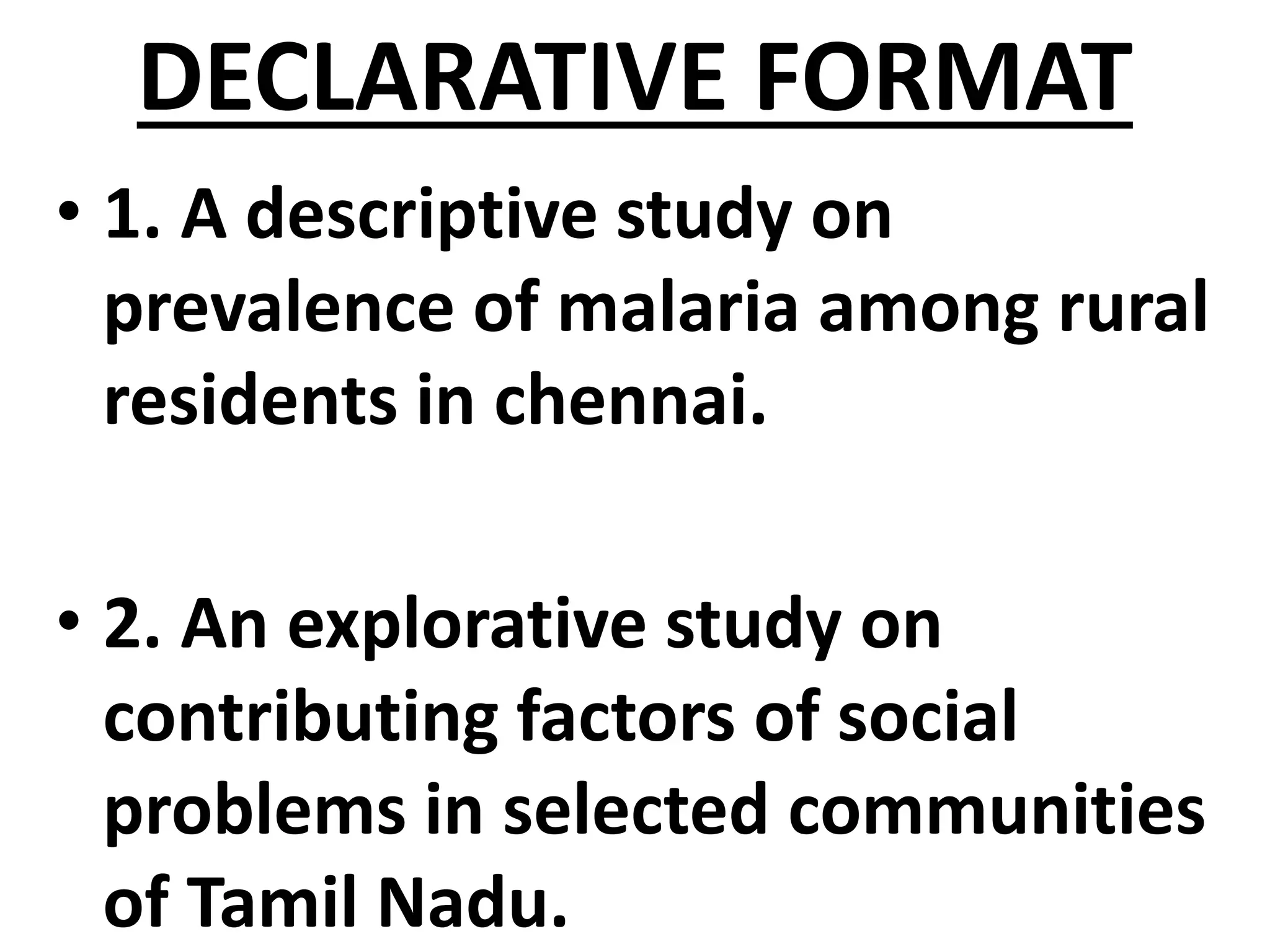
DECLARATIVE FORMAT
• 1. A descriptive study on
prevalence of malaria among rural
residents in chennai.
• 2. An explorative study on
contributing factors of social
problems in selected communities
of Tamil Nadu.
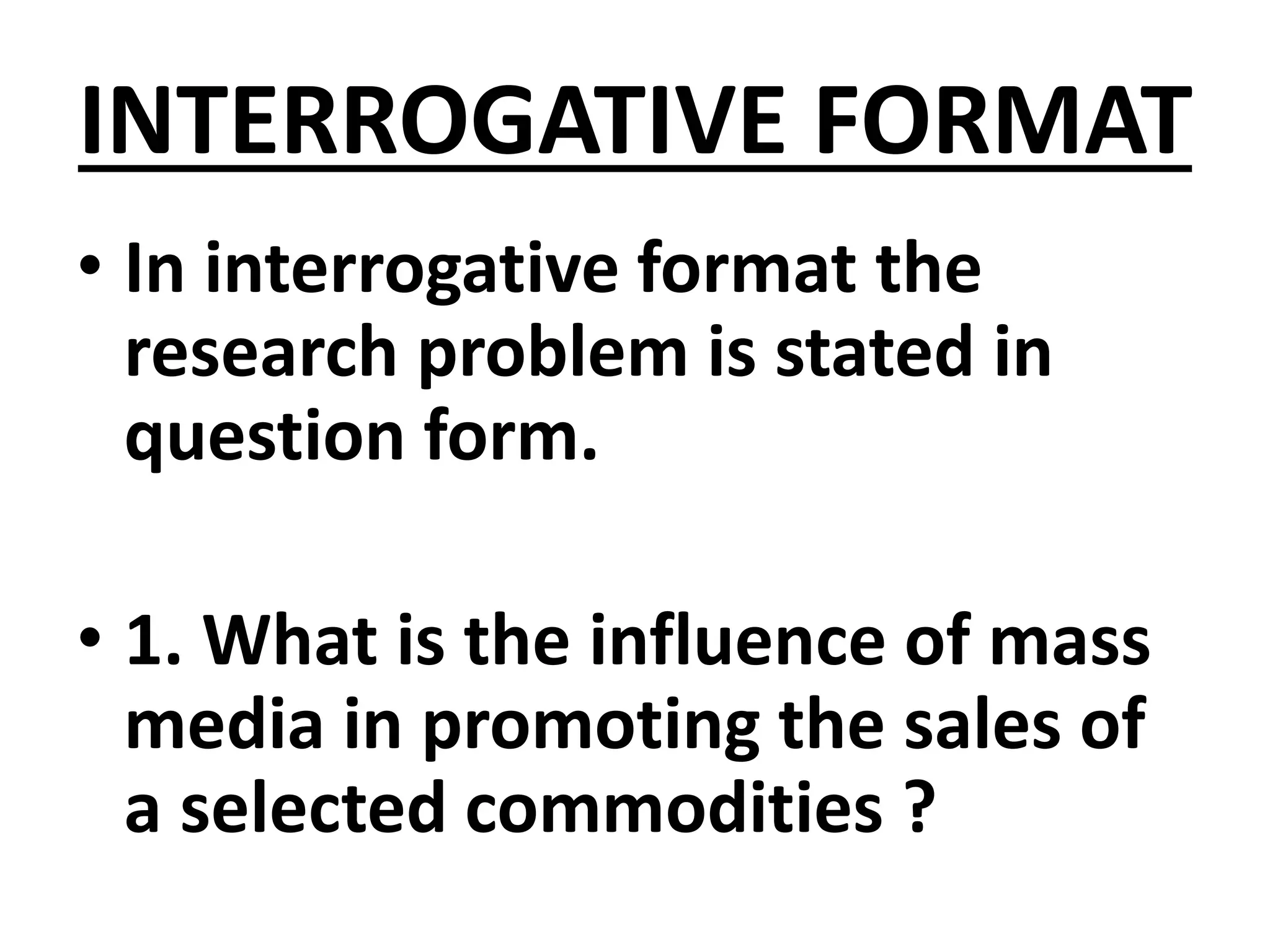
INTERROGATIVE FORMAT
• In interrogative format the
research problem is stated in
question form.
• 1. What is the influence of mass
media in promoting the sales of
a selected commodities ?
• The choice of either of the
format depends on the
researcher’s preference and
institutional policies.
• However declarative format is
much popular.
PREFERED CRITERIA ….
• 1. Clear, Precise, Concise.
• 2. States variables, population &
research setting.
• 3. Variables are expressed in
measurable terms.
• 4. The statement expresses the
type of study.
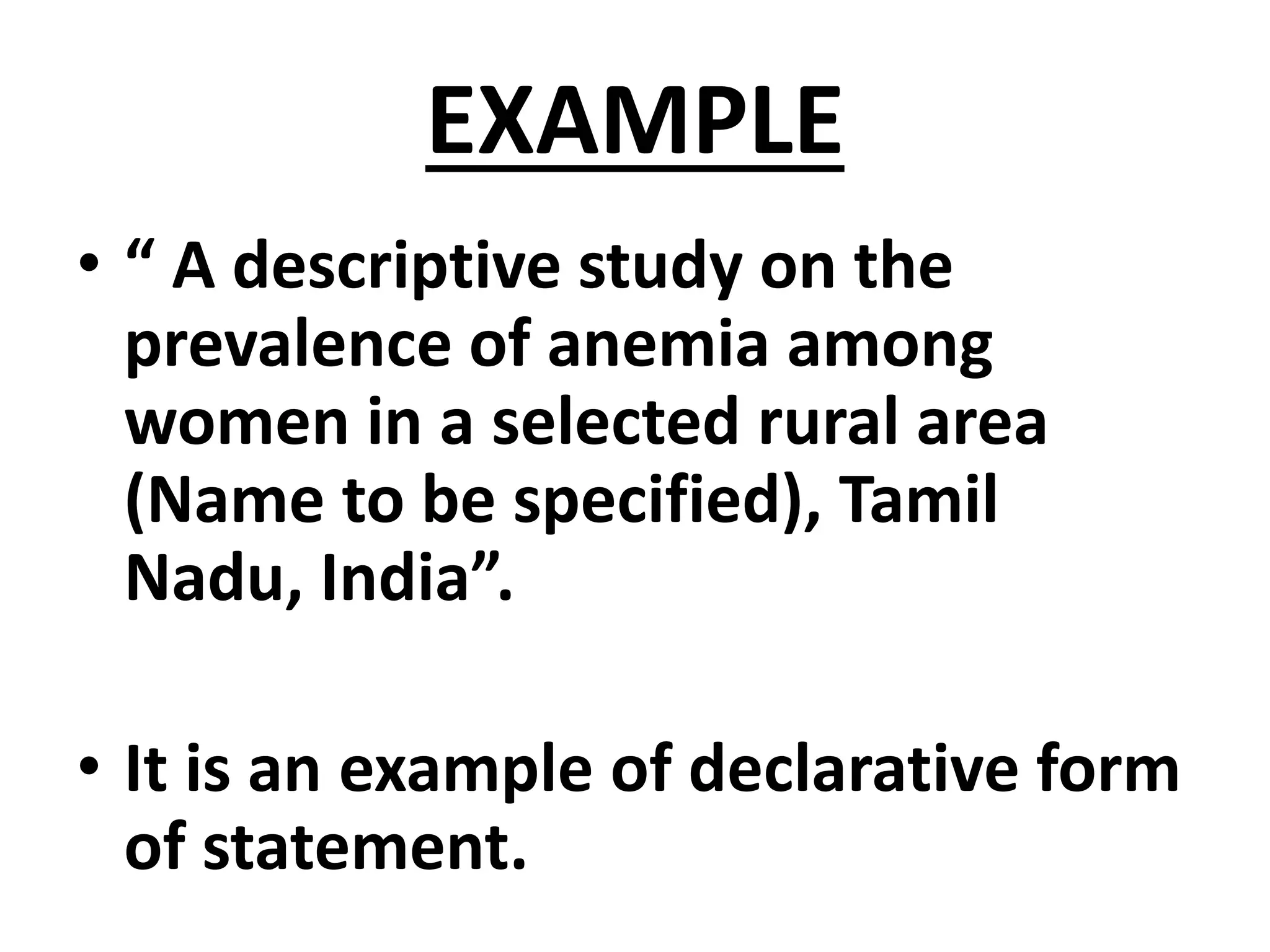
EXAMPLE
• “ A descriptive study on the
prevalence of anemia among
women in a selected rural area
(Name to be specified), Tamil
Nadu, India”.
• It is an example of declarative form
of statement.
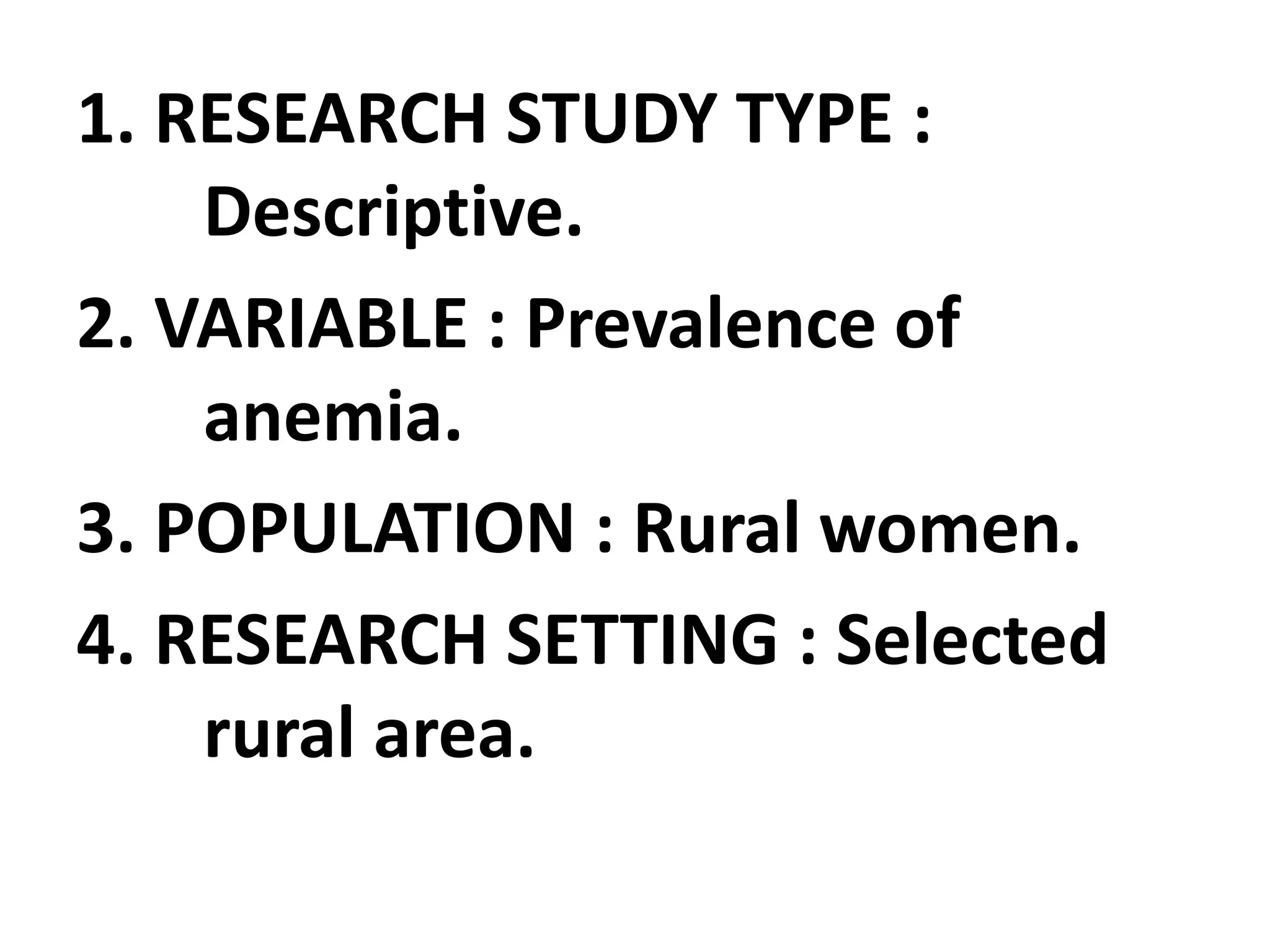
1. RESEARCH STUDY TYPE :
Descriptive.
2. VARIABLE : Prevalence of
anemia.
3. POPULATION : Rural women.
4. RESEARCH SETTING : Selected
rural area.
THANK YOU

FORMULATION OF RESEARCH PROBLEM

  • 1.
    FORMULATION OF RESEARCH PROBLEM DR.MAHESWARI JAIKUMAR maheswarijaikumar2103@gmail.com
  • 2.
  • 4.
    • Formulation ofa research problem is a complex process. • It includes the following steps.
  • 5.
    1. SELECTION OFA RESEARCH AREA. 2. REVIEWING LITERATURE & THEORIES. 3. DELIMITING THE RESEARCH TOPIC. 4. EVALUATING THE RESEARCH PROBLEM. 5. FORMULATING THE FINAL STATEMENT OF RESEARCH PROBLEM.
  • 6.
    SELECTION OF RESEARCH TOPIC ROL/ THEORIES DELIMITING THE RESEASRCH TOPIC EVALUATING THE RESEARCH PROBLEM FORMULATING THE FINAL STATEMENT
  • 7.
    SELECTING A RESEARCH AREA •Formulation of a research problem begins with selection of a broad research topic from personal experience, literature, previous research & theories.
  • 8.
    REVIEWING / THEORIES •After obtaining a broad idea for research, the researcher needs to review the nursing literature and theories.
  • 9.
    • Literature isreviewed to know what has already been done in this selected area of research. • Therefore, a researcher can plan a research topic to further expand the existing body of knowledge.
  • 10.
    • Reviewing thetheories provides an opportunity for the researcher to plan a research problem to contribute towards either testing or development of a theory conceptual model.
  • 11.
    DELIMITING THE RESEARCH TOPIC •Here the researcher proceeds from a general research area of interest to more specific topic of research while conducting the study.
  • 12.
    EVALUATING THE RESEARCH PROBLEM •Once the researcher is clear about the research problem, the research problem must be carefully evaluated for its significance, researchability and feasibility.
  • 13.
    • Feasibility refersto feasibility in terms of time, cost availability of subjects, resources, administrative & peer support, ethical consideration, researcher’s competence of the researcher and interest.
  • 14.
    • The researchproblem may be evaluated using guidelines for evaluation.
  • 15.
  • 16.
    SUBSTANTIATIVE ISSUES • 1.Does the problem have significance to the profession. • 2. Does the problem spell out the purpose of conducting the study.
  • 17.
    • 3. Doesthe problem have any relationship with existing theories & models. • 4. Does the problem flow from prior scientific information / experience in topic area.
  • 18.
    METHODOLOGICAL ISSUES • Does theproblem statement clearly identify the research variables in measurable terms. • 2. Does the problem identify the nature of population which is to be studied.
  • 19.
    • 3. Doesthe problem clearly define about type or design of study. • 4. Does the problem describe the research setting, place and time.
  • 20.
    • 5. Doesthe problem comprise appropriate phrases.
  • 21.
    STYLISTIC ISSUES • 1.Isthe problem statement complete, concise, clear in declarative form clearly suggesting answers to be questioned. • 2. Was the problem statement introduced promptly.
  • 22.
    ETHICAL ISSUES • 1.Does the research problem require the use of human subject. • 2. Does the problem imply potential risks for those subjects.
  • 23.
    PRACTICAL ISSUES • Hasthe researcher appropriately delimited the scope of the problem, or is the problem too big or complex foe a single investigation.
  • 24.
    • 2. Isthe researcher able to manage man, money, material, & appropriate permissions from authorities.
  • 25.
    FORMULATING FINAL STATEMENT OFRESEARCH PROBLEM • Following the establishment of of the significance, researchability and feasibility the researcher finally formulates the final problem statement.
  • 26.
    • A statementof problem could be in declarative or interrogative format.
  • 27.
    DECLARATIVE FORMAT • 1.A descriptive study on prevalence of malaria among rural residents in chennai. • 2. An explorative study on contributing factors of social problems in selected communities of Tamil Nadu.
  • 28.
    INTERROGATIVE FORMAT • Ininterrogative format the research problem is stated in question form. • 1. What is the influence of mass media in promoting the sales of a selected commodities ?
  • 29.
    • The choiceof either of the format depends on the researcher’s preference and institutional policies. • However declarative format is much popular.
  • 30.
    PREFERED CRITERIA …. •1. Clear, Precise, Concise. • 2. States variables, population & research setting.
  • 31.
    • 3. Variablesare expressed in measurable terms. • 4. The statement expresses the type of study.
  • 32.
    EXAMPLE • “ Adescriptive study on the prevalence of anemia among women in a selected rural area (Name to be specified), Tamil Nadu, India”. • It is an example of declarative form of statement.
  • 33.
    1. RESEARCH STUDYTYPE : Descriptive. 2. VARIABLE : Prevalence of anemia. 3. POPULATION : Rural women. 4. RESEARCH SETTING : Selected rural area.
  • 34.