Research Process
• Research process is about a series of linked stages/steps and it gives
the appearance of being organized in a linear manner.
• Most research textbooks represent research as a multi-stage process
that you must follow in order to undertake and complete your
research project.
• The precise number of stages varies, but they usually include
formulating and clarifying a topic/problem, reviewing the
literature, designing the research, collecting data, analyzing data
and writing up.
Chapter Two
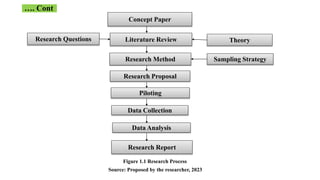
Figure 1.1 Research Process
Source: Proposed by the researcher, 2023
…. Cont
Concept Paper
Literature Review
Research Method
Research Proposal
Piloting
Data Collection
Data Analysis
Research Report
Theory
Sampling Strategy
Research Questions
Formulation of Research Problems & Research Hypotheses
• Carrying out a research or research project is a complex and lengthy
activity.
• Research process consists of a series of actions or steps necessary to
effectively carry out a research and the desired sequencing of these steps.
• One should remember that the various steps involved in a research
process are not mutually exclusive; nor they are separated and distinct.
• The following order concerning various steps provides a useful
procedural guideline regarding the research process.
….cont’d
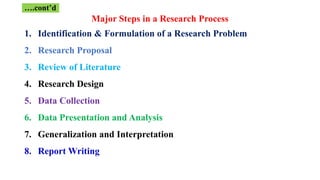
Major Steps in a Research Process
1. Identification & Formulation of a Research Problem
2. Research Proposal
3. Review of Literature
4. Research Design
5. Data Collection
6. Data Presentation and Analysis
7. Generalization and Interpretation
8. Report Writing
….cont’d
 A research problem refers to some kind of difficulty a researcher
might encounter or experience in the context of either a theoretical
or practical situation, which he/she would like to solve (resolve) and
find a solution to.
 Identification and formulation of a research problem constitutes
the starting phase of a research.
 Its appropriate selection and formulation has great influence in the
success of a research because an ill-defined and deficiently
formulated research problem always makes a researcher
subsequently to loose his/her ‘interest’ in the problem.
Problem/Topic Identification
 If a researcher is not clear with a problem he/she is researching,
this results in a number of unanticipated difficulties at the latter
stages of a research.
 Thus, it becomes necessary to have a well-defined and precise
research problem/topic for a meaningful research.
 In this regard, there is an old and wise saying that a problem well
put is half solved.
 Identification and formulation of research problem is not an easy
task and in most scientific works, the difficulty lies in framing
problems rather than in finding their solutions.
….cont’d
• The first step in designing a social science or business research is to
perceive a problem or identification of a topic which can be either
theoretical or applied.
• In other words, identification and formulation of a research
problem is the first and foremost step in any research undertaking.
• It is a way of identifying and stating well the problem of a study.
• It can be a researcher’s perception or recognition of a problem that
motivates research.
….cont’d
• Problem identification is establishing/finding what one wants to
know and why.
• If you are working in an organization, the problem to be
researched may be assigned by the top management of that
organization.
• If you are doing some research project by yourself, then you have to
identify the problem and state it by your own.
• Sometimes research problem is known as the research topic or the
research situation or the information need.
….cont’d
• Research topics are generally derived from two sources:
1. The need to test and refine a theory which is referred to as basic or
pure research, and
2. The need to solve a practical problem, referred to as applied
research.
• Research topics can come from a review of professional literature,
discussions with colleagues, day-to-day observations of real life
situations, textbooks, and research publications to name a few.
….cont’d
Criteria of a Problem
• Every problem selected for a research must satisfy the following
criteria.
1. It should be Original
• The purpose of a research is to fill gaps in existing knowledge and to
discover new facts.
• Therefore, a preliminary survey of the existing literature in the
proposed area of research should be carried out to find out the
possibility of making an original contribution.
2. It should be neither very general nor very specific
• If the problem is very general, it is usually too vague to be tested or
may become unmanageable.
….cont’d
• On the other hand, if a problem is very specific, it is usually too
narrow to be important or consequential or beneficial.
3. It should be Solvable
• No problem, however, is significant and is a good choice if it is
unsolvable.
• Generally, a problem may not be solvable due to two reasons:
i. It may concern with some supernatural issue or it can be unsolvable
if it is concerned with amorphous phenomenon. For example, how
does human mind work? Who created this world? What will happen
if an oxygen or a sun disappears?
ii. It cannot be operationally defined.
….cont’d
4. It should be feasible
• The feasibility of carrying out research on a selected problem/topic
should be checked against the following considerations;
i. Study design
ii. Access to organization and respondents
iii. Sample or universe to be studied
iv. Source of data
v. Method of collecting data
vi. Type of variables (nominal/ordinal) involved
vii. Selection of scale of measurement and statistics
viii.Treatment of data – manual calculation or computer calculation
ix. Time required for study and its availability
x. Funds required and their availability
….cont’d
Techniques in Defining a Research Problem
• Whenever defining a research problem, it would be better to follow
these techniques (stages):
1. Stating problem in a general way (e.g. HRA/M).
2. Understating/reducing the nature of a problem (e.g. Recruitment &
Selection or Training & Development)
3. Surveying available literatures
4. Developing ideas (special interest)
5. Rephrasing the problem
….cont’d
• A proposal/design is a kind of blueprint that researchers prepare
before carrying out research.
• It is also known as a work plan, prospectus outline, statement of
intent, or draft plan.
• The proposal tells us what, why, how, where, and to whom will it be
done.
• It is a systematically/scientifically prepared outline starting with the
manner in which you plan to carry out your research.
• The purpose of a research proposal is to help a researcher to focus
and define his/her research plans.
Research Proposal
Specially, a research proposal has a purpose to:
 Show that the researcher is engaging in genuine enquiry
 Link your proposal work with the work of others
 Establish a particular theoretical orientation
 Establish the researcher’s methodological approach
 Present the problem to be researched and its importance, clearly
 Provide a basis for the sponsor to evaluate the study
 Generally speaking, research proposal is essentially a road map,
showing clearly the location from which a journey begins, the
destination to be reached, and the method of getting there.
….cont’d
Bonus: Checklist to guide & evaluate your research proposal
1. Have I explained what am I going to do?
2. Have I explained why I am doing this?
3. Have I said why it is worth doing?
4. Have I explained how it relates to what has been done before in my
subject area?
5. Have I stated which theory or theories will inform what I am doing
and how I will use it or them?
6. Have I stated my research question(s), research aim and my research
objectives and hypothesis?
7. Have I outlined how I will conduct my research?
8. Have I outlined my research design?
9. Have I outlined what data I need?
….cont’d
10. Have I stated who and where my intended participants are?
11. Have I explained how I will select my participants?
12. Have I explained how I will gain access?
13. Have I outlined how I will collect my data?
14. Have I outlined how I will analyze my data and use this to develop
theoretical explanations?
15. Have I outlined what data quality issues I might encounter?
16. Have I outlined how I will seek to overcome these data quality
issues?
17. Have I considered the ethical issues I might encounter at each stage
of my research?
18. Have I outlined how I will address these?
….cont’d
• A research proposal, occasionally referred to as a protocol or outline,
is a structured plan of your proposed research project.
 Sponsor uses the proposal to evaluate research ideas
 Ensures the sponsor and investigator agree to the research question
 For a newcomer, a research proposal helps to learn from others
 Completed proposal provides a logical guidance
Significances of a Research Proposal
• A research proposal is a series of advanced decisions that, taken
together, comprise a master plan or model for the conduct of an
investigation.
• A sound research proposal has writing style which enables a
researcher to attract reader’s (sponsors) attention because it has easily
distinguishable subdivided sections which facilitate easy retrieving
and clear understanding.
Basic Components of a Research Proposal
The basic components of a sound research proposal include:
1. Cover Page, Abstract, Table of Contents, and Introduction
2. Background of the Study
3. Statement of the Problem
4. Research Questions
5. Research Objectives
6. Research Hypothesis (Optional)
7. Literature Review
8. Significance of the Study
9. Scope of the Study
….cont’d
10. Limitation of the Study
11. Methodology
12. Organization of Paper
13. Timetable
14. Budget for the Study
15. Bibliography/ References
• Cover page:- identifies title, writer, institution (university), specific
department of the institution, degree, year of conduction, advisor.
….cont’d
1. Cover Page, Abstract, Table of Contents, Introduction
• Abstract:- is a brief summary of the research proposal. The
abstract, here, mostly focuses on planned issues to be undertaken.
• It should include- research questions, the rational for the study,
the hypothesis (if any), the method, design, sample, instruments
(tools), main findings that will be expected, among other things.
• Table of contents:- This part lists of sections or chapters of a proposal
and page references. It uses a hierarchy for titles and sub-titles.
• Introductory section:- It is a section at the beginning of a research
proposal and its main purpose is to provide the necessary
background or context for a research problem.
….cont’d
1. Background of the Study
….cont’d
• Background of the study includes either theoretical background
about the problem or practical organization background.
• In other words, it provides historical, cultural, political, social or
organizational information about the context of a research
• It flows from general to specific issues (from the world level to a
specific case study area or from Africa or Ethiopia to a case study
area).
• A research problem refers to some inquiry which a researcher
undertakes in the context of either a theoretical or practical
situation and wants to obtain an explanation of the same.
• This section includes a clear statement of the problem in language
understandable to a generally informed reader. (i.e. should not be
sophisticated or complicated).
• This section needs to convince the sponsor to continue reading the
proposal.
• A researcher has to clearly define the problem to be researched.
….cont’d
2. Statement of the Problem
• The problem should not be vague or unclear.
• Effective problem statements answer the question “why does this
research need to be conducted?”
• Statement of the problem may incorporate management dilemma in
a given organization and the resulting management question.
• It should include any restrictions or areas of the management question
that will not be addressed.
• In general, formulating and defining a research problem is an
important step in the research process and a clearly stated problem is
research that is half done.
….cont’d
• A researcher needs to clearly state the research questions in the light
of the problems, topic, and the theoretical foundations on which it rests.
• The research questions should be clear as much as possible that gives a
clear guide to data collection and analysis processes.
• Hence, to find out what is not known about the topic through
systematic questions is an important job of a researcher.
• The problem for research should ordinarily be expressed in an
interrogative form. For example: What are the effects on workers’
performance of different types of incentives?
….cont’d
3. Research Questions
• Research objectives lay out exactly what is being planned by a
proposed research.
• Objectives flow naturally from the problem statement, giving
specific, concrete, and achievable goals.
• It is best to list the objectives either in order of importance or in
general terms first, moving to specific terms.
• Research objectives form the basis for judging the remainder of the
proposal and, ultimately, the final report.
….cont’d
4. Research Objectives
• Verify the consistency of the proposal by checking to see that each
objective is discussed in the research design, data analysis, and results.
sections.
• It is a tentative assumption made in order to test its logical or empirical
consequences.
• It could also be defined as a proposition or set of propositions set forth
as an explanation for the occurrence of a specified phenomenon.
• When prediction or hypothesized relationship is to be tested by scientific
methods, it is termed as a research hypothesis.
….cont’d
5. Research Hypothesis
• The research hypothesis is a predictive statement that relates an
independent variable to a dependent variable.
• Usually, a research hypothesis must contain, at least, one independent
and dependent variable.
• The hypotheses must meet two requirements.
• First of all, the concepts and variables related by the hypotheses must
be measurable.
• Secondly, hypothesis must state in clear-cut language the relationship
between the independent and dependent variables.
….cont’d
• H1: There is significant relationship between industrial park
construction and employment creation.
• H2: There is significant relationship between industrial park
construction and skill upgrading/formation.
• H3: There is significant relationship between industrial park
construction and female workers.
• H4: There is significant relationship between industrial park
construction and migration of workers.
• H5: There is significant relationship between industrial park
construction and the challenges faced by its stakeholders.
….cont’d
• This section indicates those sources of literature that are proposed for
review and briefly summarized important and closely related works.
• The literature review section examines recent (or historically significant)
research studies, company data, or industry reports that act as a basis for the
proposed study.
• Begin your discussion of the related literature and relevant secondary
data from a comprehensive perspective, moving to more specific studies
that are associated with your problem.
• If the problem has a historical background, begin with the earliest
references.
….cont’d
6. Literature Review
• Avoid the extraneous details of the literature; do a brief review of the
information, not a comprehensive report.
• Always refer to the original source.
• Emphasize the important results and conclusions of other studies, the
relevant data and trends from previous research, and particular
methods or designs that could be duplicated or should be avoided.
• Discuss how the literature applies to the study you are proposing;
show the weaknesses or faults in the design, discussing how you
would avoid similar problems.
….cont’d
• If your proposal deals solely with secondary data, discuss the relevance of
the data and the bias or lack of bias inherent in it.
• The literature review may also explain the need for the proposed
work to appraise the shortcomings and informational gaps in
secondary data sources.
• This analysis may go beyond examining the availability or
conclusions of past studies and their data, to examine the accuracy of
secondary sources, the credibility of these sources, and the
appropriateness of earlier studies.
….cont’d
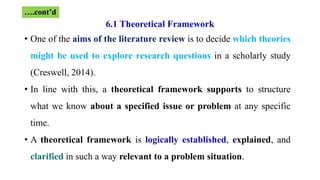
6.1 Theoretical Framework
• One of the aims of the literature review is to decide which theories
might be used to explore research questions in a scholarly study
(Creswell, 2014).
• In line with this, a theoretical framework supports to structure
what we know about a specified issue or problem at any specific
time.
• A theoretical framework is logically established, explained, and
clarified in such a way relevant to a problem situation.
….cont’d
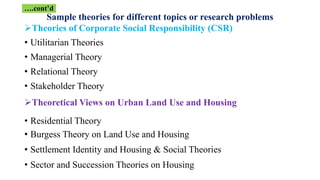
Sample theories for different topics or research problems
Theories of Corporate Social Responsibility (CSR)
• Utilitarian Theories
• Managerial Theory
• Relational Theory
• Stakeholder Theory
Theoretical Views on Urban Land Use and Housing
• Residential Theory
• Burgess Theory on Land Use and Housing
• Settlement Identity and Housing & Social Theories
• Sector and Succession Theories on Housing
….cont’d
The following are some of the theories regarding the impacts of
industrial parks.
• The Neo-Classical Approach (Orthodox View)
• The New Growth Approach
• The Heterodox Approach
• Agglomeration Economies Approach
• The Global Value Chain Approach
• The Political Economy Approach
….cont’d
6.2 Conceptual Framework
• Conceptual framework is developed to guide an inquiry process of a
study or a subsequent works of a research.
• Considering the study objectives and research questions, a study can
develop a conceptual framework based on a literature review so as to
show the relationship among the variables identified.
• It is the researcher’s “map” in following the investigation he/she is
undertaking (McGaghie et al., 2001).
• This framework may be developed before, during or after your data
collection and then refined as your research progresses (Saunders et al.,
2016).
….cont’d
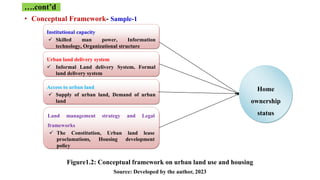
• Conceptual Framework- Sample-1
Figure1.2: Conceptual framework on urban land use and housing
Source: Developed by the author, 2023
….cont’d
Land management strategy and Legal
frameworks
 The Constitution, Urban land lease
proclamations, Housing development
policy
Institutional capacity
 Skilled man power, Information
technology, Organizational structure
Access to urban land
 Supply of urban land, Demand of urban
land
Home
ownership
status
Urban land delivery system
 Informal Land delivery System, Formal
land delivery system
….cont’d
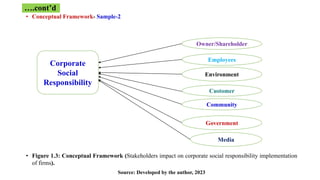
• Conceptual Framework- Sample-2
• Figure 1.3: Conceptual Framework (Stakeholders impact on corporate social responsibility implementation
of firms).
Source: Developed by the author, 2023
Corporate
Social
Responsibility
Owner/Shareholder
Employees
Environment
Customer
Community
Government
Media
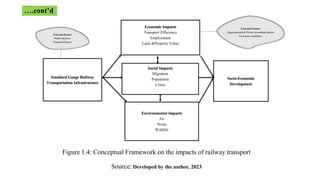
Figure 1.4: Conceptual Framework on the impacts of railway transport
Source: Developed by the author, 2023
….cont’d
Socio-Economic
Development
Environmental Impacts
Air
Noise
Wildlife
External Factors
Organisational & Private investment factors
Economic conditions
External factors
Public Opinion
Financial Factors
Economic Impacts
Transport Efficiency
Employment
Land &Property Value
Social Impacts
Migration
Population
Crime
Standard Gauge Railway
Transportation Infrastructure
• Research studies are largely undertaken to add useful knowledge to the
existing ones or solve practical societal problems.
- So, this section allows you to describe explicit benefits that will accrue
from your study and it states to whom the importance is.
• The importance of “doing the study now” should be emphasized.
• If you find it difficult to write, then you have probably not understood the
problem adequately.
• Therefore, return to the analysis of the problem and ensure by a
reexamination of the literature, that you have captured the essence of the
problem.
7. Significance of the Study
….cont’d
• Creswell (2014) firmly argues that delineating a study project
employing a precise location, time frame, or problem to be researched
supports the investigator to target the focus of effort and entertain the
research question in a budget efficient and effective manner.
• In other words, it is about the time limit, area coverage/area focus of
your research, issues to be addressed.
….cont’d
8. Scope of the Study
• This section incorporates any of the following or all of the them which
constraints your study:
 Time constraints
 Financial constraints
 Researchers' know-how
 Unavailability of data
….cont’d
9. Limitation of the Study
10. Organization of Paper
• This refers to the chapters of the paper and their main contents.
11. Timetable
• Indicates time schedule for performing each chapter of your paper.
12. Budget for Study
• The budget should be presented in the form of the sponsor requests.
13. Bibliography/ References
• The material used for the preparation of the proposal and the materials
intended to be used in the future should be listed.
….cont’d
Thank You For Your Attention

Chapter-2.pptxyear upon out upon hhhhhhhh

  • 1.
    Research Process • Researchprocess is about a series of linked stages/steps and it gives the appearance of being organized in a linear manner. • Most research textbooks represent research as a multi-stage process that you must follow in order to undertake and complete your research project. • The precise number of stages varies, but they usually include formulating and clarifying a topic/problem, reviewing the literature, designing the research, collecting data, analyzing data and writing up. Chapter Two
  • 2.
    Figure 1.1 ResearchProcess Source: Proposed by the researcher, 2023 …. Cont Concept Paper Literature Review Research Method Research Proposal Piloting Data Collection Data Analysis Research Report Theory Sampling Strategy Research Questions
  • 3.
    Formulation of ResearchProblems & Research Hypotheses • Carrying out a research or research project is a complex and lengthy activity. • Research process consists of a series of actions or steps necessary to effectively carry out a research and the desired sequencing of these steps. • One should remember that the various steps involved in a research process are not mutually exclusive; nor they are separated and distinct. • The following order concerning various steps provides a useful procedural guideline regarding the research process. ….cont’d
  • 4.
    Major Steps ina Research Process 1. Identification & Formulation of a Research Problem 2. Research Proposal 3. Review of Literature 4. Research Design 5. Data Collection 6. Data Presentation and Analysis 7. Generalization and Interpretation 8. Report Writing ….cont’d
  • 5.
     A researchproblem refers to some kind of difficulty a researcher might encounter or experience in the context of either a theoretical or practical situation, which he/she would like to solve (resolve) and find a solution to.  Identification and formulation of a research problem constitutes the starting phase of a research.  Its appropriate selection and formulation has great influence in the success of a research because an ill-defined and deficiently formulated research problem always makes a researcher subsequently to loose his/her ‘interest’ in the problem. Problem/Topic Identification
  • 6.
     If aresearcher is not clear with a problem he/she is researching, this results in a number of unanticipated difficulties at the latter stages of a research.  Thus, it becomes necessary to have a well-defined and precise research problem/topic for a meaningful research.  In this regard, there is an old and wise saying that a problem well put is half solved.  Identification and formulation of research problem is not an easy task and in most scientific works, the difficulty lies in framing problems rather than in finding their solutions. ….cont’d
  • 7.
    • The firststep in designing a social science or business research is to perceive a problem or identification of a topic which can be either theoretical or applied. • In other words, identification and formulation of a research problem is the first and foremost step in any research undertaking. • It is a way of identifying and stating well the problem of a study. • It can be a researcher’s perception or recognition of a problem that motivates research. ….cont’d
  • 8.
    • Problem identificationis establishing/finding what one wants to know and why. • If you are working in an organization, the problem to be researched may be assigned by the top management of that organization. • If you are doing some research project by yourself, then you have to identify the problem and state it by your own. • Sometimes research problem is known as the research topic or the research situation or the information need. ….cont’d
  • 9.
    • Research topicsare generally derived from two sources: 1. The need to test and refine a theory which is referred to as basic or pure research, and 2. The need to solve a practical problem, referred to as applied research. • Research topics can come from a review of professional literature, discussions with colleagues, day-to-day observations of real life situations, textbooks, and research publications to name a few. ….cont’d
  • 10.
    Criteria of aProblem • Every problem selected for a research must satisfy the following criteria. 1. It should be Original • The purpose of a research is to fill gaps in existing knowledge and to discover new facts. • Therefore, a preliminary survey of the existing literature in the proposed area of research should be carried out to find out the possibility of making an original contribution. 2. It should be neither very general nor very specific • If the problem is very general, it is usually too vague to be tested or may become unmanageable. ….cont’d
  • 11.
    • On theother hand, if a problem is very specific, it is usually too narrow to be important or consequential or beneficial. 3. It should be Solvable • No problem, however, is significant and is a good choice if it is unsolvable. • Generally, a problem may not be solvable due to two reasons: i. It may concern with some supernatural issue or it can be unsolvable if it is concerned with amorphous phenomenon. For example, how does human mind work? Who created this world? What will happen if an oxygen or a sun disappears? ii. It cannot be operationally defined. ….cont’d
  • 12.
    4. It shouldbe feasible • The feasibility of carrying out research on a selected problem/topic should be checked against the following considerations; i. Study design ii. Access to organization and respondents iii. Sample or universe to be studied iv. Source of data v. Method of collecting data vi. Type of variables (nominal/ordinal) involved vii. Selection of scale of measurement and statistics viii.Treatment of data – manual calculation or computer calculation ix. Time required for study and its availability x. Funds required and their availability ….cont’d
  • 13.
    Techniques in Defininga Research Problem • Whenever defining a research problem, it would be better to follow these techniques (stages): 1. Stating problem in a general way (e.g. HRA/M). 2. Understating/reducing the nature of a problem (e.g. Recruitment & Selection or Training & Development) 3. Surveying available literatures 4. Developing ideas (special interest) 5. Rephrasing the problem ….cont’d
  • 14.
    • A proposal/designis a kind of blueprint that researchers prepare before carrying out research. • It is also known as a work plan, prospectus outline, statement of intent, or draft plan. • The proposal tells us what, why, how, where, and to whom will it be done. • It is a systematically/scientifically prepared outline starting with the manner in which you plan to carry out your research. • The purpose of a research proposal is to help a researcher to focus and define his/her research plans. Research Proposal
  • 15.
    Specially, a researchproposal has a purpose to:  Show that the researcher is engaging in genuine enquiry  Link your proposal work with the work of others  Establish a particular theoretical orientation  Establish the researcher’s methodological approach  Present the problem to be researched and its importance, clearly  Provide a basis for the sponsor to evaluate the study  Generally speaking, research proposal is essentially a road map, showing clearly the location from which a journey begins, the destination to be reached, and the method of getting there. ….cont’d
  • 16.
    Bonus: Checklist toguide & evaluate your research proposal 1. Have I explained what am I going to do? 2. Have I explained why I am doing this? 3. Have I said why it is worth doing? 4. Have I explained how it relates to what has been done before in my subject area? 5. Have I stated which theory or theories will inform what I am doing and how I will use it or them? 6. Have I stated my research question(s), research aim and my research objectives and hypothesis? 7. Have I outlined how I will conduct my research? 8. Have I outlined my research design? 9. Have I outlined what data I need? ….cont’d
  • 17.
    10. Have Istated who and where my intended participants are? 11. Have I explained how I will select my participants? 12. Have I explained how I will gain access? 13. Have I outlined how I will collect my data? 14. Have I outlined how I will analyze my data and use this to develop theoretical explanations? 15. Have I outlined what data quality issues I might encounter? 16. Have I outlined how I will seek to overcome these data quality issues? 17. Have I considered the ethical issues I might encounter at each stage of my research? 18. Have I outlined how I will address these? ….cont’d
  • 18.
    • A researchproposal, occasionally referred to as a protocol or outline, is a structured plan of your proposed research project.  Sponsor uses the proposal to evaluate research ideas  Ensures the sponsor and investigator agree to the research question  For a newcomer, a research proposal helps to learn from others  Completed proposal provides a logical guidance Significances of a Research Proposal
  • 19.
    • A researchproposal is a series of advanced decisions that, taken together, comprise a master plan or model for the conduct of an investigation. • A sound research proposal has writing style which enables a researcher to attract reader’s (sponsors) attention because it has easily distinguishable subdivided sections which facilitate easy retrieving and clear understanding. Basic Components of a Research Proposal
  • 20.
    The basic componentsof a sound research proposal include: 1. Cover Page, Abstract, Table of Contents, and Introduction 2. Background of the Study 3. Statement of the Problem 4. Research Questions 5. Research Objectives 6. Research Hypothesis (Optional) 7. Literature Review 8. Significance of the Study 9. Scope of the Study ….cont’d
  • 21.
    10. Limitation ofthe Study 11. Methodology 12. Organization of Paper 13. Timetable 14. Budget for the Study 15. Bibliography/ References • Cover page:- identifies title, writer, institution (university), specific department of the institution, degree, year of conduction, advisor. ….cont’d 1. Cover Page, Abstract, Table of Contents, Introduction
  • 22.
    • Abstract:- isa brief summary of the research proposal. The abstract, here, mostly focuses on planned issues to be undertaken. • It should include- research questions, the rational for the study, the hypothesis (if any), the method, design, sample, instruments (tools), main findings that will be expected, among other things. • Table of contents:- This part lists of sections or chapters of a proposal and page references. It uses a hierarchy for titles and sub-titles. • Introductory section:- It is a section at the beginning of a research proposal and its main purpose is to provide the necessary background or context for a research problem. ….cont’d
  • 23.
    1. Background ofthe Study ….cont’d • Background of the study includes either theoretical background about the problem or practical organization background. • In other words, it provides historical, cultural, political, social or organizational information about the context of a research • It flows from general to specific issues (from the world level to a specific case study area or from Africa or Ethiopia to a case study area).
  • 24.
    • A researchproblem refers to some inquiry which a researcher undertakes in the context of either a theoretical or practical situation and wants to obtain an explanation of the same. • This section includes a clear statement of the problem in language understandable to a generally informed reader. (i.e. should not be sophisticated or complicated). • This section needs to convince the sponsor to continue reading the proposal. • A researcher has to clearly define the problem to be researched. ….cont’d 2. Statement of the Problem
  • 25.
    • The problemshould not be vague or unclear. • Effective problem statements answer the question “why does this research need to be conducted?” • Statement of the problem may incorporate management dilemma in a given organization and the resulting management question. • It should include any restrictions or areas of the management question that will not be addressed. • In general, formulating and defining a research problem is an important step in the research process and a clearly stated problem is research that is half done. ….cont’d
  • 26.
    • A researcherneeds to clearly state the research questions in the light of the problems, topic, and the theoretical foundations on which it rests. • The research questions should be clear as much as possible that gives a clear guide to data collection and analysis processes. • Hence, to find out what is not known about the topic through systematic questions is an important job of a researcher. • The problem for research should ordinarily be expressed in an interrogative form. For example: What are the effects on workers’ performance of different types of incentives? ….cont’d 3. Research Questions
  • 27.
    • Research objectiveslay out exactly what is being planned by a proposed research. • Objectives flow naturally from the problem statement, giving specific, concrete, and achievable goals. • It is best to list the objectives either in order of importance or in general terms first, moving to specific terms. • Research objectives form the basis for judging the remainder of the proposal and, ultimately, the final report. ….cont’d 4. Research Objectives
  • 28.
    • Verify theconsistency of the proposal by checking to see that each objective is discussed in the research design, data analysis, and results. sections. • It is a tentative assumption made in order to test its logical or empirical consequences. • It could also be defined as a proposition or set of propositions set forth as an explanation for the occurrence of a specified phenomenon. • When prediction or hypothesized relationship is to be tested by scientific methods, it is termed as a research hypothesis. ….cont’d 5. Research Hypothesis
  • 29.
    • The researchhypothesis is a predictive statement that relates an independent variable to a dependent variable. • Usually, a research hypothesis must contain, at least, one independent and dependent variable. • The hypotheses must meet two requirements. • First of all, the concepts and variables related by the hypotheses must be measurable. • Secondly, hypothesis must state in clear-cut language the relationship between the independent and dependent variables. ….cont’d
  • 30.
    • H1: Thereis significant relationship between industrial park construction and employment creation. • H2: There is significant relationship between industrial park construction and skill upgrading/formation. • H3: There is significant relationship between industrial park construction and female workers. • H4: There is significant relationship between industrial park construction and migration of workers. • H5: There is significant relationship between industrial park construction and the challenges faced by its stakeholders. ….cont’d
  • 31.
    • This sectionindicates those sources of literature that are proposed for review and briefly summarized important and closely related works. • The literature review section examines recent (or historically significant) research studies, company data, or industry reports that act as a basis for the proposed study. • Begin your discussion of the related literature and relevant secondary data from a comprehensive perspective, moving to more specific studies that are associated with your problem. • If the problem has a historical background, begin with the earliest references. ….cont’d 6. Literature Review
  • 32.
    • Avoid theextraneous details of the literature; do a brief review of the information, not a comprehensive report. • Always refer to the original source. • Emphasize the important results and conclusions of other studies, the relevant data and trends from previous research, and particular methods or designs that could be duplicated or should be avoided. • Discuss how the literature applies to the study you are proposing; show the weaknesses or faults in the design, discussing how you would avoid similar problems. ….cont’d
  • 33.
    • If yourproposal deals solely with secondary data, discuss the relevance of the data and the bias or lack of bias inherent in it. • The literature review may also explain the need for the proposed work to appraise the shortcomings and informational gaps in secondary data sources. • This analysis may go beyond examining the availability or conclusions of past studies and their data, to examine the accuracy of secondary sources, the credibility of these sources, and the appropriateness of earlier studies. ….cont’d
  • 34.
    6.1 Theoretical Framework •One of the aims of the literature review is to decide which theories might be used to explore research questions in a scholarly study (Creswell, 2014). • In line with this, a theoretical framework supports to structure what we know about a specified issue or problem at any specific time. • A theoretical framework is logically established, explained, and clarified in such a way relevant to a problem situation. ….cont’d
  • 35.
    Sample theories fordifferent topics or research problems Theories of Corporate Social Responsibility (CSR) • Utilitarian Theories • Managerial Theory • Relational Theory • Stakeholder Theory Theoretical Views on Urban Land Use and Housing • Residential Theory • Burgess Theory on Land Use and Housing • Settlement Identity and Housing & Social Theories • Sector and Succession Theories on Housing ….cont’d
  • 36.
    The following aresome of the theories regarding the impacts of industrial parks. • The Neo-Classical Approach (Orthodox View) • The New Growth Approach • The Heterodox Approach • Agglomeration Economies Approach • The Global Value Chain Approach • The Political Economy Approach ….cont’d
  • 37.
    6.2 Conceptual Framework •Conceptual framework is developed to guide an inquiry process of a study or a subsequent works of a research. • Considering the study objectives and research questions, a study can develop a conceptual framework based on a literature review so as to show the relationship among the variables identified. • It is the researcher’s “map” in following the investigation he/she is undertaking (McGaghie et al., 2001). • This framework may be developed before, during or after your data collection and then refined as your research progresses (Saunders et al., 2016). ….cont’d
  • 38.
    • Conceptual Framework-Sample-1 Figure1.2: Conceptual framework on urban land use and housing Source: Developed by the author, 2023 ….cont’d Land management strategy and Legal frameworks  The Constitution, Urban land lease proclamations, Housing development policy Institutional capacity  Skilled man power, Information technology, Organizational structure Access to urban land  Supply of urban land, Demand of urban land Home ownership status Urban land delivery system  Informal Land delivery System, Formal land delivery system
  • 39.
    ….cont’d • Conceptual Framework-Sample-2 • Figure 1.3: Conceptual Framework (Stakeholders impact on corporate social responsibility implementation of firms). Source: Developed by the author, 2023 Corporate Social Responsibility Owner/Shareholder Employees Environment Customer Community Government Media
  • 40.
    Figure 1.4: ConceptualFramework on the impacts of railway transport Source: Developed by the author, 2023 ….cont’d Socio-Economic Development Environmental Impacts Air Noise Wildlife External Factors Organisational & Private investment factors Economic conditions External factors Public Opinion Financial Factors Economic Impacts Transport Efficiency Employment Land &Property Value Social Impacts Migration Population Crime Standard Gauge Railway Transportation Infrastructure
  • 41.
    • Research studiesare largely undertaken to add useful knowledge to the existing ones or solve practical societal problems. - So, this section allows you to describe explicit benefits that will accrue from your study and it states to whom the importance is. • The importance of “doing the study now” should be emphasized. • If you find it difficult to write, then you have probably not understood the problem adequately. • Therefore, return to the analysis of the problem and ensure by a reexamination of the literature, that you have captured the essence of the problem. 7. Significance of the Study ….cont’d
  • 42.
    • Creswell (2014)firmly argues that delineating a study project employing a precise location, time frame, or problem to be researched supports the investigator to target the focus of effort and entertain the research question in a budget efficient and effective manner. • In other words, it is about the time limit, area coverage/area focus of your research, issues to be addressed. ….cont’d 8. Scope of the Study
  • 43.
    • This sectionincorporates any of the following or all of the them which constraints your study:  Time constraints  Financial constraints  Researchers' know-how  Unavailability of data ….cont’d 9. Limitation of the Study
  • 44.
    10. Organization ofPaper • This refers to the chapters of the paper and their main contents. 11. Timetable • Indicates time schedule for performing each chapter of your paper. 12. Budget for Study • The budget should be presented in the form of the sponsor requests. 13. Bibliography/ References • The material used for the preparation of the proposal and the materials intended to be used in the future should be listed. ….cont’d
  • 45.
    Thank You ForYour Attention