IDENTIFICATION, SELECTION,
ANALYSIS, AND FORMULATION
OF THE RESEARCH PROBLEM
DR. AMAN ULLAH
B.SC. MEDICAL LAB. TECHNOLOGY
P.HD. MICROBIOLOGY
LECTURER OF MLT, KHYBER MEDICAL UNIVERSITY, PAKISTAN
INTRODUCTION
• Formulation of the research proposal is the major task in the
process of developing a research project
• The proposal draws on all the preparatory steps of the research
process and pulls them together in a document describing the
rationale and the methodology proposed for research
• The proposal is a basis for approval and funding
• After approval, the proposal is used as a blueprint during
implementation of the project
QUESTION TO BE CONSIDERED
• Is there evidence to indicate that the research proposal focuses on a
problem of priority importance?
• Was the given health problem identified by relevant groups?
• Was the problem adequately analysed to include all possible contributory
factors from different sectors?
• Was it clearly stated?
These questions should be clearly answered before trying to develop
the research proposal
PROBLEM IDENTIFICATION
• If the answer to the research question is obvious, that may be solved
without further research, then we do not need research
Whether a problem requires research depends on three conditions
• There should be a perceived difference or discrepancy between what it is
and what it should be
• The reason(s) for this difference should be unclear so that it makes sense
to develop a research question
• There should be more than one possible and plausible answer to the
question or solution to the problem
CRITERIA FOR PRIORITIZING PROBLEMS FOR
RESEARCH
• Each problem that is proposed for research has to be
judged according to certain guidelines or criteria
• There may be several ideas to choose from
• Therefore, before deciding on a research topic, each
proposed topic must be compared with all other options
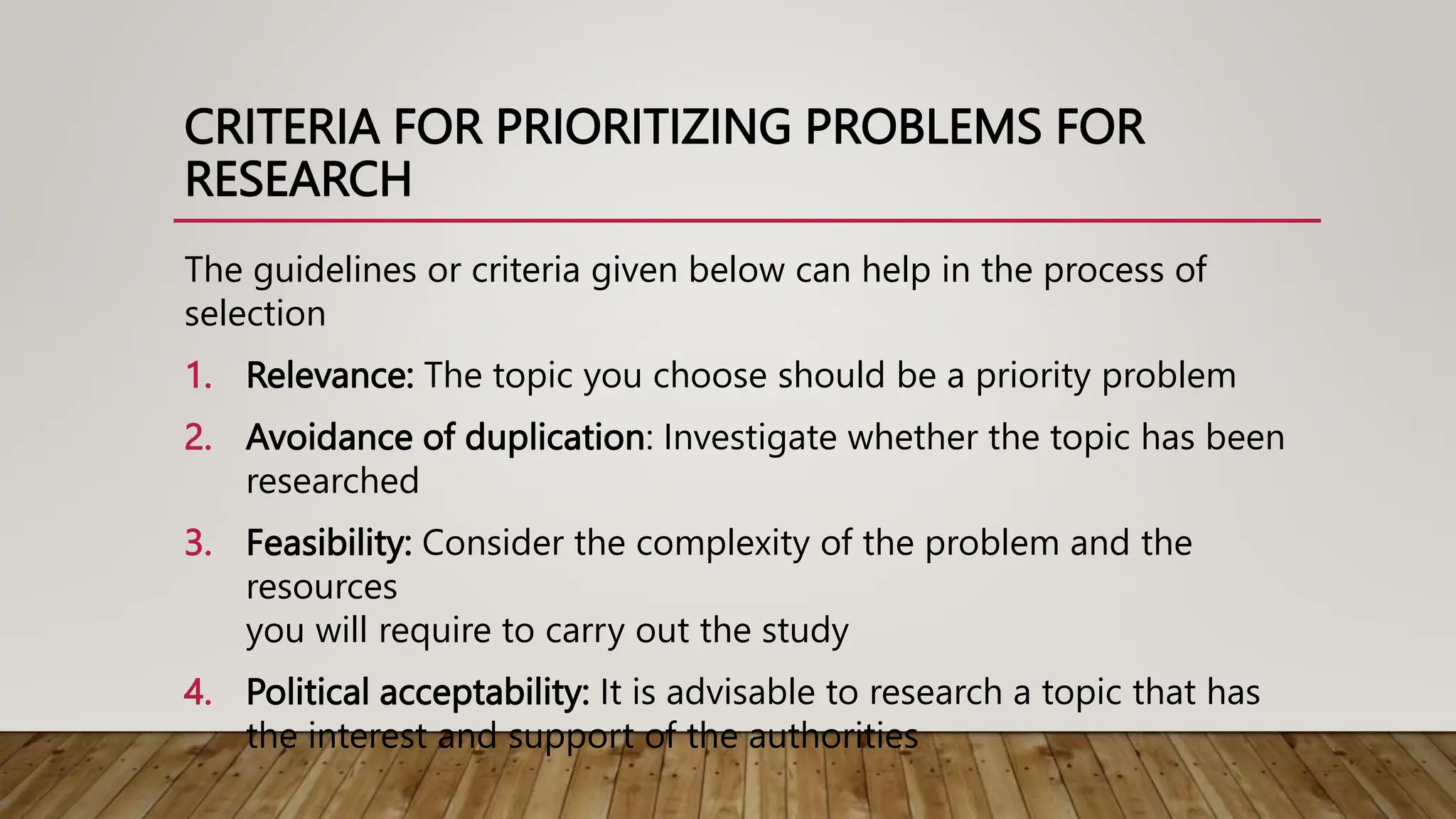
CRITERIA FOR PRIORITIZING PROBLEMS FOR
RESEARCH
The guidelines or criteria given below can help in the process of
selection
1. Relevance: The topic you choose should be a priority problem
2. Avoidance of duplication: Investigate whether the topic has been
researched
3. Feasibility: Consider the complexity of the problem and the
resources
you will require to carry out the study
4. Political acceptability: It is advisable to research a topic that has
the interest and support of the authorities
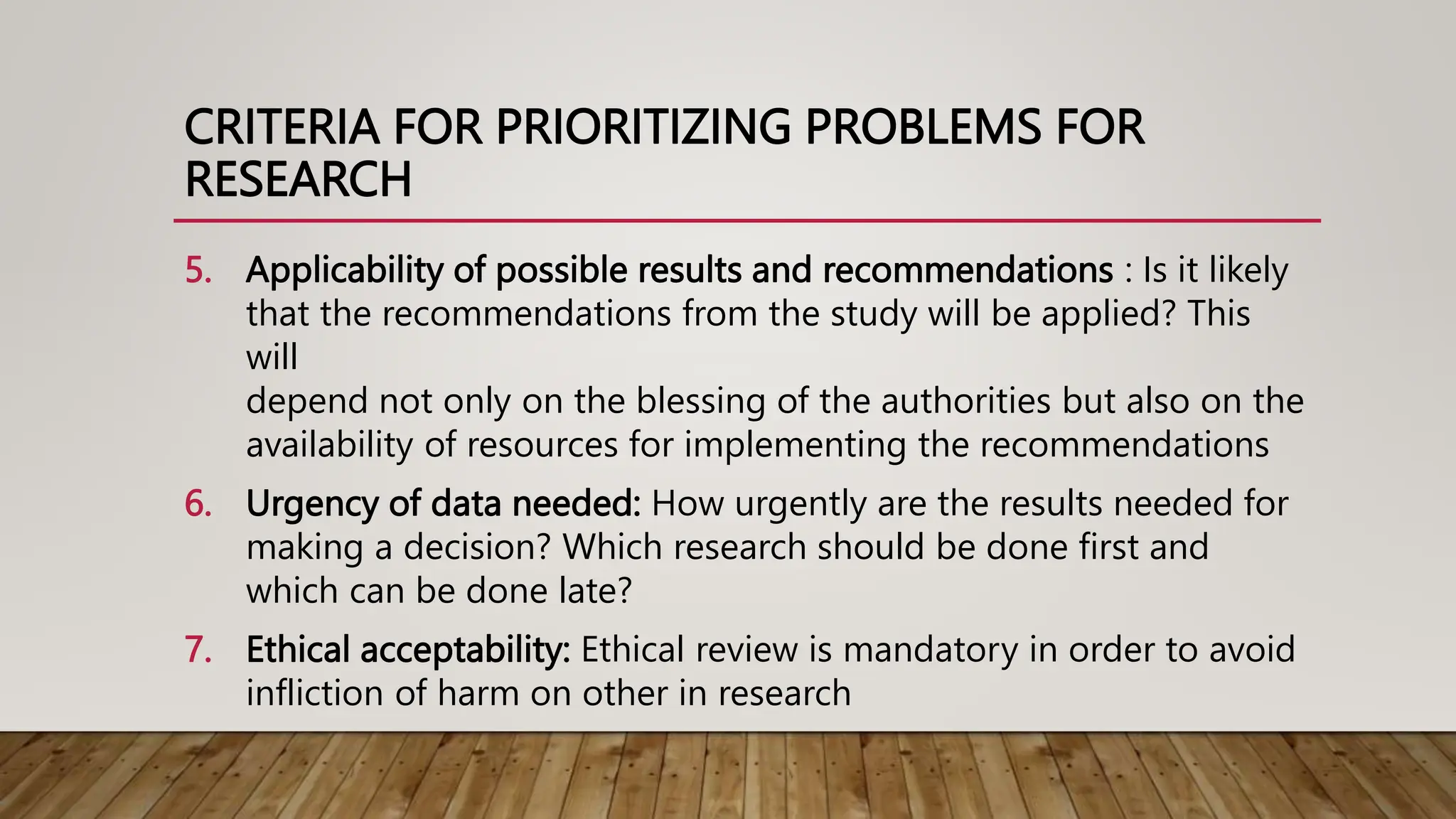
CRITERIA FOR PRIORITIZING PROBLEMS FOR
RESEARCH
5. Applicability of possible results and recommendations : Is it likely
that the recommendations from the study will be applied? This
will
depend not only on the blessing of the authorities but also on the
availability of resources for implementing the recommendations
6. Urgency of data needed: How urgently are the results needed for
making a decision? Which research should be done first and
which can be done late?
7. Ethical acceptability: Ethical review is mandatory in order to avoid
infliction of harm on other in research
ANALYSIS AND STATEMENT OF THE PROBLEM
• Was the problem adequately analysed to include all possible
contributory factors from different sectors?
• Was it clearly stated?
These questions should be clearly answered before trying to
develop the research proposal
ANALYZING THE PROBLEM
A systematic analysis of the problem,
completed jointly by the researchers, health
workers, managers, and community
representatives is a very crucial step in
designing the research
FORMULATING THE PROBLEM STATEMENT
• The process of research often begins with an attempt to arrive at a
clear statement of the research question (or questions)
• The research question is a statement of what you hope to
have learned by the time you complete the program of research
• It is good practice to revise and refine the research question several
times to ensure that you are very clear about what it is you really
want to know
• For example: what is the effect of chloroquine on terminal ill patient
of COVID-19

Topic selection-1.pptx how to select the topic

  • 1.
    IDENTIFICATION, SELECTION, ANALYSIS, ANDFORMULATION OF THE RESEARCH PROBLEM DR. AMAN ULLAH B.SC. MEDICAL LAB. TECHNOLOGY P.HD. MICROBIOLOGY LECTURER OF MLT, KHYBER MEDICAL UNIVERSITY, PAKISTAN
  • 2.
    INTRODUCTION • Formulation ofthe research proposal is the major task in the process of developing a research project • The proposal draws on all the preparatory steps of the research process and pulls them together in a document describing the rationale and the methodology proposed for research • The proposal is a basis for approval and funding • After approval, the proposal is used as a blueprint during implementation of the project
  • 3.
    QUESTION TO BECONSIDERED • Is there evidence to indicate that the research proposal focuses on a problem of priority importance? • Was the given health problem identified by relevant groups? • Was the problem adequately analysed to include all possible contributory factors from different sectors? • Was it clearly stated? These questions should be clearly answered before trying to develop the research proposal
  • 4.
    PROBLEM IDENTIFICATION • Ifthe answer to the research question is obvious, that may be solved without further research, then we do not need research Whether a problem requires research depends on three conditions • There should be a perceived difference or discrepancy between what it is and what it should be • The reason(s) for this difference should be unclear so that it makes sense to develop a research question • There should be more than one possible and plausible answer to the question or solution to the problem
  • 5.
    CRITERIA FOR PRIORITIZINGPROBLEMS FOR RESEARCH • Each problem that is proposed for research has to be judged according to certain guidelines or criteria • There may be several ideas to choose from • Therefore, before deciding on a research topic, each proposed topic must be compared with all other options
  • 6.
    CRITERIA FOR PRIORITIZINGPROBLEMS FOR RESEARCH The guidelines or criteria given below can help in the process of selection 1. Relevance: The topic you choose should be a priority problem 2. Avoidance of duplication: Investigate whether the topic has been researched 3. Feasibility: Consider the complexity of the problem and the resources you will require to carry out the study 4. Political acceptability: It is advisable to research a topic that has the interest and support of the authorities
  • 7.
    CRITERIA FOR PRIORITIZINGPROBLEMS FOR RESEARCH 5. Applicability of possible results and recommendations : Is it likely that the recommendations from the study will be applied? This will depend not only on the blessing of the authorities but also on the availability of resources for implementing the recommendations 6. Urgency of data needed: How urgently are the results needed for making a decision? Which research should be done first and which can be done late? 7. Ethical acceptability: Ethical review is mandatory in order to avoid infliction of harm on other in research
  • 8.
    ANALYSIS AND STATEMENTOF THE PROBLEM • Was the problem adequately analysed to include all possible contributory factors from different sectors? • Was it clearly stated? These questions should be clearly answered before trying to develop the research proposal
  • 9.
    ANALYZING THE PROBLEM Asystematic analysis of the problem, completed jointly by the researchers, health workers, managers, and community representatives is a very crucial step in designing the research
  • 10.
    FORMULATING THE PROBLEMSTATEMENT • The process of research often begins with an attempt to arrive at a clear statement of the research question (or questions) • The research question is a statement of what you hope to have learned by the time you complete the program of research • It is good practice to revise and refine the research question several times to ensure that you are very clear about what it is you really want to know • For example: what is the effect of chloroquine on terminal ill patient of COVID-19