RESEARCH
FORMULATION
V.Harini
2nd MSC Zoology
content
Introduction
Importance of formulating a Research problem
Sources of research problem
Identification of research problem
Consideration in selecting research problem
Steps in formulation of research problem
Formulation of objectives and functions
INTRODUCTION
The central aim of research formulation is the RESEARCH PROBLEM
FORMULATION OF RESEARCH refers to state the problem to a
researchable manner. It means to portray the topic in a way that it becomes
ready for scientific investigation.
WHAT IS RESEARCH PROBLEM?
A problem is a question proposed for a solution generally speaking a
problem exists when there is no available answer to same question.
“ PROBLEM IS THE OBSTACLE IN THE PATH OF SATISFYING OUR
NEEDS”
It refers to some difficulty which a researcher experiences in the context of
either in a THEORETICAL OR PRACTICAL SITUATION and wants to
obtain a solution for the same.
IF THERE IS NO
PROBLEM …..
THERE IS NO RESEARCH
IMPORTANCE OF FORMULATING A
RESEARCH PROBLEM
 Formulation of research problem is the first and most important step of
the research process.
 Identification of a destination before undertaking a journey.
 In the absence of a clear research problem, a clear and economic plan is
impossible.
 Foundation of building
 According to KERLINGER
IF ONE WANTS TO SOLVE A PROBLEM,ONE MUST GENERALLY
KNOW WHAT THE PROBLEM IS.IT CAN BE SAID THAT A LARGER
PART OF THE PROBLEM LIES IN KNOWING WHAT ONE IS TRYING
TO DO.
SOURCES OF RESEARCH PROBLEM
RESEARCH
Study population
Subject areas
P people
p
p
p
problem
programme
phenomena
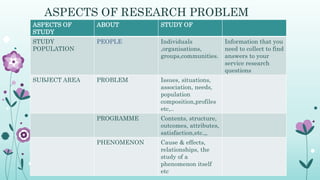
ASPECTS OF RESEARCH PROBLEM
ASPECTS OF
STUDY
ABOUT STUDY OF
STUDY
POPULATION
PEOPLE Individuals
,organisations,
groups,communities.
Information that you
need to collect to find
answers to your
service research
questions
SUBJECT AREA PROBLEM Issues, situations,
association, needs,
population
composition,profiles
etc,..
PROGRAMME Contents, structure,
outcomes, attributes,
satisfaction,etc.,,
PHENOMENON Cause & effects,
relationships, the
study of a
phenomenon itself
etc
•
 Determine the field of research in which a researcher is keen to do the
reseach work
Researcher should develop the mastery on the area or the should be the field
of his specializations.
He should review the research conducted in area to know the recent trend &
studies are being conducted in the area.
On the basis of review , he should consider the priority field of the study.
Should draw an analog & insight in identifying the problem or employ
his personal experience of the field in locating the problem. He may take
help of supervisor or expert of the field.
CONSIDERATIONS IN SELECTING THE
RESEARCH PROBLEM
Consideration in selecting the research
problem
interest
magnitu
de
ethics
Data
availabilit
y
Concept
measure
s
relevance expertise
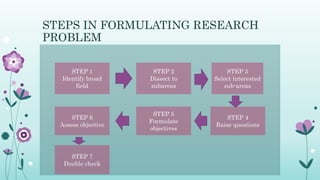
STEPS IN FORMULATING RESEARCH
PROBLEM
STEP 1
Identify broad
field
STEP 2
Dissect to
subareas
STEP 3
Select interested
sub-areas
STEP 6
Assess objective
STEP 5
Formulate
objectives
STEP 4
Raise questions
STEP 7
Double check
Formulation of research objectives
• OBJECTIVE
a clear and specific goals you set out to attain in your study.
objectives
Main objectives subobjectives
•
Main objectives sub objectives
Overall statement of the trust of
your study
Specific aspects of the topic that
you want to investigate within
the framework of your study
• Clear
• Complete
• Specific
• Main variables
• Direction
FUNCTIONS
• Focus the study
• Organize the study in clearly defined parts or phases
Characteristics and function of objectives
REFERENCE
• RESEARCH METHODOLOGY (methods and techniques) – KOTHARI
CK
• RESEARCH METHODOLOGY- TOOLS AND TECHNIQUES BY
DR.PRABHAT PANDEY, DR. MEEW MISHRA RANDEY
• https://www.studyandexam.com> - formulation of research
• RESEARCH METHODS THE BASICS – NICHOLAS WALLIMAN
THANK YOU

research formulation

  • 1.
  • 2.
    content Introduction Importance of formulatinga Research problem Sources of research problem Identification of research problem Consideration in selecting research problem Steps in formulation of research problem Formulation of objectives and functions
  • 4.
    INTRODUCTION The central aimof research formulation is the RESEARCH PROBLEM FORMULATION OF RESEARCH refers to state the problem to a researchable manner. It means to portray the topic in a way that it becomes ready for scientific investigation. WHAT IS RESEARCH PROBLEM? A problem is a question proposed for a solution generally speaking a problem exists when there is no available answer to same question. “ PROBLEM IS THE OBSTACLE IN THE PATH OF SATISFYING OUR NEEDS” It refers to some difficulty which a researcher experiences in the context of either in a THEORETICAL OR PRACTICAL SITUATION and wants to obtain a solution for the same.
  • 5.
    IF THERE ISNO PROBLEM ….. THERE IS NO RESEARCH
  • 6.
    IMPORTANCE OF FORMULATINGA RESEARCH PROBLEM  Formulation of research problem is the first and most important step of the research process.  Identification of a destination before undertaking a journey.  In the absence of a clear research problem, a clear and economic plan is impossible.  Foundation of building  According to KERLINGER IF ONE WANTS TO SOLVE A PROBLEM,ONE MUST GENERALLY KNOW WHAT THE PROBLEM IS.IT CAN BE SAID THAT A LARGER PART OF THE PROBLEM LIES IN KNOWING WHAT ONE IS TRYING TO DO.
  • 7.
    SOURCES OF RESEARCHPROBLEM RESEARCH Study population Subject areas P people p p p problem programme phenomena
  • 8.
    ASPECTS OF RESEARCHPROBLEM ASPECTS OF STUDY ABOUT STUDY OF STUDY POPULATION PEOPLE Individuals ,organisations, groups,communities. Information that you need to collect to find answers to your service research questions SUBJECT AREA PROBLEM Issues, situations, association, needs, population composition,profiles etc,.. PROGRAMME Contents, structure, outcomes, attributes, satisfaction,etc.,, PHENOMENON Cause & effects, relationships, the study of a phenomenon itself etc
  • 9.
    •  Determine thefield of research in which a researcher is keen to do the reseach work Researcher should develop the mastery on the area or the should be the field of his specializations. He should review the research conducted in area to know the recent trend & studies are being conducted in the area. On the basis of review , he should consider the priority field of the study.
  • 10.
    Should draw ananalog & insight in identifying the problem or employ his personal experience of the field in locating the problem. He may take help of supervisor or expert of the field.
  • 11.
    CONSIDERATIONS IN SELECTINGTHE RESEARCH PROBLEM
  • 12.
    Consideration in selectingthe research problem interest magnitu de ethics Data availabilit y Concept measure s relevance expertise
  • 13.
    STEPS IN FORMULATINGRESEARCH PROBLEM STEP 1 Identify broad field STEP 2 Dissect to subareas STEP 3 Select interested sub-areas STEP 6 Assess objective STEP 5 Formulate objectives STEP 4 Raise questions STEP 7 Double check
  • 15.
    Formulation of researchobjectives • OBJECTIVE a clear and specific goals you set out to attain in your study. objectives Main objectives subobjectives
  • 16.
    • Main objectives subobjectives Overall statement of the trust of your study Specific aspects of the topic that you want to investigate within the framework of your study
  • 17.
    • Clear • Complete •Specific • Main variables • Direction FUNCTIONS • Focus the study • Organize the study in clearly defined parts or phases Characteristics and function of objectives
  • 18.
    REFERENCE • RESEARCH METHODOLOGY(methods and techniques) – KOTHARI CK • RESEARCH METHODOLOGY- TOOLS AND TECHNIQUES BY DR.PRABHAT PANDEY, DR. MEEW MISHRA RANDEY • https://www.studyandexam.com> - formulation of research • RESEARCH METHODS THE BASICS – NICHOLAS WALLIMAN
  • 19.