BRONCHIECTASIS
Presented by ,
Mr. Maheboob
1st year M.sc Nursing
Govt college of nursing
Holenarsipur
DEFINITION:
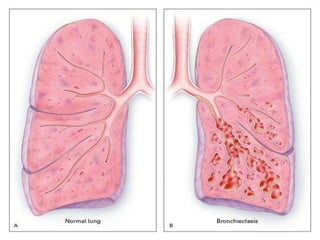
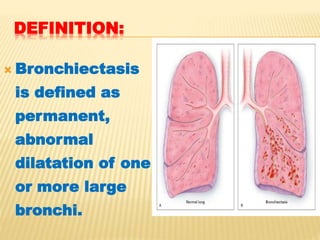
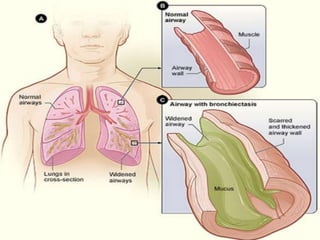
 Bronchiectasis
is defined as
permanent,
abnormal
dilatation of one
or more large
bronchi.
DEFINITION:
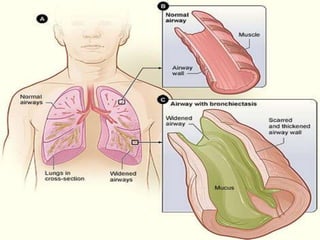
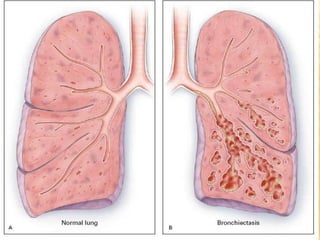
Bronchiectasis is defined as
abnormal and irreversible dilatation of
the bronchi and bronchioles (greater
than 2mm in diameter) developing
secondary to inflammatory weakening
of bronchial walls.
ETIOLOGY:
Bronchiectasis has both

congenital and acquired
causes.
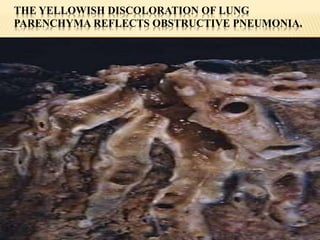
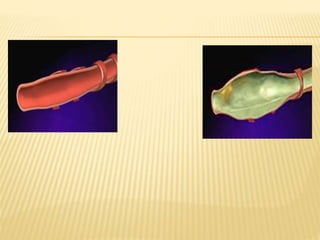
THE YELLOWISH DISCOLORATION OF LUNG
PARENCHYMA REFLECTS OBSTRUCTIVE PNEUMONIA.
ACQUIRED CAUSES
 Tuberculosis,
 pneumonia,
 inhaled foreign bodies,
 allergic bronchopulmonary aspergillosis and
bronchiol tumours are the major acquired
causes of Bronchiectasis.
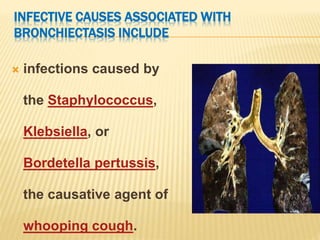
INFECTIVE CAUSES ASSOCIATED WITH
BRONCHIECTASIS INCLUDE
 infections caused by
the Staphylococcus,
Klebsiella, or
Bordetella pertussis,
the causative agent of
whooping cough.
ASPIRATION OF AMMONIA AND OTHER TOXIC
GASES,
 pulmonary aspiration,
 alcoholism, heroin (drug use),
 various allergies all appear to be linked
to the development of Bronchiectasis
 Childhood Acquired Immune Deficiency
Syndrome (AIDS), which predisposes patients
to a variety of pulmonary ailments, such as
pneumonia and other opportunistic infections.
 Inflammatory bowel disease, especially
ulcerative colitis.
 A Hiatal hernia can cause Bronchiectasis when
the stomach acid that is aspirated into the
lungs causes tissue damage.
CONGENITAL CAUSES
 Kartagener syndrome
 primary immunodeficiencies
 Williams-Campbell syndrome and Marfan’s
syndrome.
 Patients with alpha 1-antitrypsin deficiency
have been found to be particularly
susceptible to bronchiectasis,
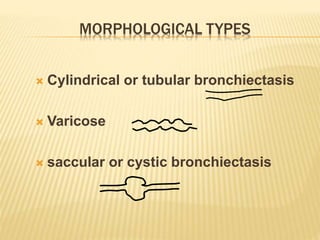
MORPHOLOGICAL TYPES
 Cylindrical or tubular bronchiectasis
 Varicose
 saccular or cystic bronchiectasis
Three different patterns of bronchiectasis have been
described
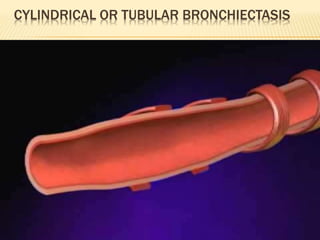
cylindrical bronchiectasis: the involved bronchi
appear uniformly dilated
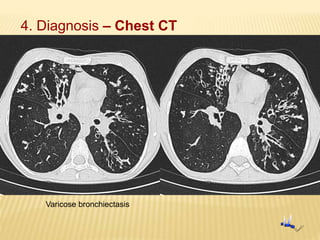
varicose bronchiectasis: the affected bronchi have an
irregular or beaded pattern of dilatation resembling
varicose veins
PATTERNS OF BRONCHIECTASIS
CYLINDRICAL OR TUBULAR BRONCHIECTASIS
Varicose bronchiectasis
4. Diagnosis – Chest CT
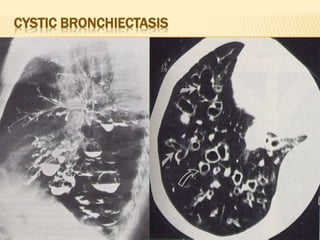
 Saccular (cystic) bronchiectasis:
The bronchi have a ballooned appearance at the
periphery, ending in blind sacs without
recognizable bronchial structures distal to the
sacs
CYSTIC BRONCHIECTASIS
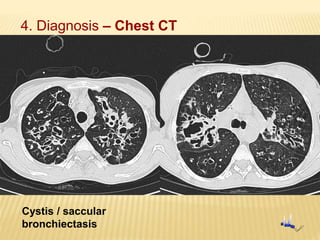
Cystis / saccular
bronchiectasis
4. Diagnosis – Chest CT
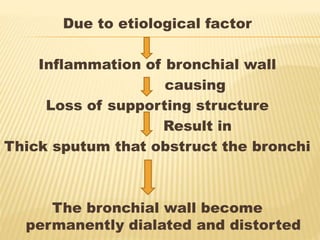
Due to etiological factor
Inflammation of bronchial wall
causing
Loss of supporting structure
Result in
Thick sputum that obstruct the bronchi
The bronchial wall become
permanently dialated and distorted
PATHOPHYSIOLOGY
Dilation and distortion of the
bronchi
Damage of airway epithelium
Dilation and hyperplasia of
blood capillary
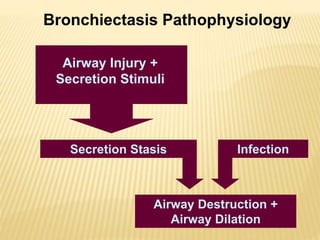
Bronchiectasis Pathophysiology
Airway Injury +
Secretion Stimuli
Secretion Stasis Infection
Airway Destruction +
Airway Dilation
CLINICAL MANIFESTATION
1. The production of large quantities of purulent
and often foul-smelling sputum.
The volume of sputum can be used for
estimating the severity of the disease
 Mild < 10 mL
 Moderate 10~150 mL
 Severe >150 mL
2. Chronic cough
3. Hemoptysis:
Frequent
More commonly in dry variety
Usually mild (blood streaking of purulent
sputum)
Massive hemoptysis is usually from
dilated bronchial arteries or bronchial-
pulmonary anastomoses under systemic
pressure
4. Recurrent pneumonia:
same segment
5. Systemic manifestations:
fever, weight loss
SIGNS AND SYMPTOMS
 Chronic cough with foul smelling sputum
production,
 Some people with bronchiectasis may
produce frequent green/yellow sputum (up to
240ml (8 oz) daily).
 Bronchiectasis may also present with
hemoptysis
 Pneumonia
 Bad breath indicative of active infection.
 Frequent bronchial infections and
breathlessness are two possible indicators of
DIAGNOSTIC EVALUATION:
 History and physical examination
 Chest x-ray
 CT (computerised tomography) scan
 Blood tests
 Testing of the mucus to identify any bacteria
present
 Checking oxygen levels in the blood
 Lung function tests (spirometry).
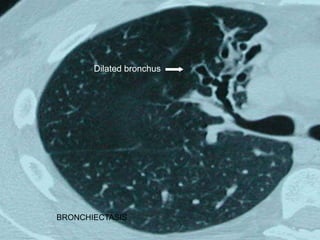
Dilated bronchus
BRONCHIECTASIS
COMPLICATIONS
 Progressive suppuration.
 Haemoptysis, major pulmonary
haemorrhage.
 COPD,
 emphysema,
 chronic respiratory insufficiency
COMPLICATION
Local complication
 Recurrent pneumonia
 Lung abcess
 Empyema
 Hemoptysis
 Pulmonary hypertension
Systemic complication
 Hypoproteinemia &amyloidosis
 Generalized edema (100gm sputum/4_5 g
protein)protein loosing pneumopathy
TREATMENT
 Treatment of bronchiectasis includes
 controlling infections and bronchial
secretions,
 relieving airway obstructions,
 removal of affected portions of lung by
surgical removal or artery embolization
 preventing complications.
TREATMENT
Therapy has several major goals:
(1)Treatment of infection, particularly during acute
exacerbations
(2) Improved clearance of tracheobronchial secretions
(3) Reduction of inflammation
(4) Treatment of an identifiable underlying problem
TREATMENT
 Medical management
1. Improving the drainage of airway
1) expectorant
2) bronchodilators
3) postural drainage
2. Antibiotic
 The choice of antibiotics should be
accurately by the results of sputum
culture and drug sensitivity test.
 Empirical therapy ---
antipseudomonal antibiotics.
ANTIBIOTICS ARE THE CORNERSTONE OF BRONCHIECTASIS
MANAGEMENT
 Antibiotics are used only during acute
episodes
 Choice of an antibiotic should be guided by
gram's stain and culture of sputum
 Empiric coverage (amoxicillin, co-
trimoxazole,levofloxacin) is often given
initially
BRONCHODILATER
 Bronchodilators to improve
obstruction and aid clearance
of secretions are useful in
patients with airway
hyperreactivity and reversible
airflow obstruction
 Surgical management is indicated
1. Recurrent and refractory clinical
symptoms are due to a focal area
of disease involvement.
2. Massive hemoptysis
 Management of hemoptysis
Surgical resection
Bronchial arterial embolization
Although resection may be successful if disease
is localized, embolization is preferable with
widespread disease
NURSING MANAGEMENT:
 History and physical examination
 Obtain history regarding amount
and characteristics of sputum
produced, including haemoptysis.
 Auscultate lungs for diffuse rhonchi
and crackles.
NURSING DIAGNOSIS
 Ineffective Airway Clearance related to
tenacious and copious secretions

Bronchiectasis

  • 1.
    BRONCHIECTASIS Presented by , Mr.Maheboob 1st year M.sc Nursing Govt college of nursing Holenarsipur
  • 3.
    DEFINITION:  Bronchiectasis is definedas permanent, abnormal dilatation of one or more large bronchi.
  • 4.
    DEFINITION: Bronchiectasis is definedas abnormal and irreversible dilatation of the bronchi and bronchioles (greater than 2mm in diameter) developing secondary to inflammatory weakening of bronchial walls.
  • 6.
  • 7.
    THE YELLOWISH DISCOLORATIONOF LUNG PARENCHYMA REFLECTS OBSTRUCTIVE PNEUMONIA.
  • 8.
    ACQUIRED CAUSES  Tuberculosis, pneumonia,  inhaled foreign bodies,  allergic bronchopulmonary aspergillosis and bronchiol tumours are the major acquired causes of Bronchiectasis.
  • 9.
    INFECTIVE CAUSES ASSOCIATEDWITH BRONCHIECTASIS INCLUDE  infections caused by the Staphylococcus, Klebsiella, or Bordetella pertussis, the causative agent of whooping cough.
  • 10.
    ASPIRATION OF AMMONIAAND OTHER TOXIC GASES,  pulmonary aspiration,  alcoholism, heroin (drug use),  various allergies all appear to be linked to the development of Bronchiectasis
  • 11.
     Childhood AcquiredImmune Deficiency Syndrome (AIDS), which predisposes patients to a variety of pulmonary ailments, such as pneumonia and other opportunistic infections.  Inflammatory bowel disease, especially ulcerative colitis.  A Hiatal hernia can cause Bronchiectasis when the stomach acid that is aspirated into the lungs causes tissue damage.
  • 12.
    CONGENITAL CAUSES  Kartagenersyndrome  primary immunodeficiencies  Williams-Campbell syndrome and Marfan’s syndrome.  Patients with alpha 1-antitrypsin deficiency have been found to be particularly susceptible to bronchiectasis,
  • 13.
    MORPHOLOGICAL TYPES  Cylindricalor tubular bronchiectasis  Varicose  saccular or cystic bronchiectasis
  • 14.
    Three different patternsof bronchiectasis have been described cylindrical bronchiectasis: the involved bronchi appear uniformly dilated varicose bronchiectasis: the affected bronchi have an irregular or beaded pattern of dilatation resembling varicose veins PATTERNS OF BRONCHIECTASIS
  • 15.
    CYLINDRICAL OR TUBULARBRONCHIECTASIS
  • 16.
  • 17.
     Saccular (cystic)bronchiectasis: The bronchi have a ballooned appearance at the periphery, ending in blind sacs without recognizable bronchial structures distal to the sacs
  • 18.
  • 19.
  • 21.
    Due to etiologicalfactor Inflammation of bronchial wall causing Loss of supporting structure Result in Thick sputum that obstruct the bronchi The bronchial wall become permanently dialated and distorted
  • 22.
    PATHOPHYSIOLOGY Dilation and distortionof the bronchi Damage of airway epithelium Dilation and hyperplasia of blood capillary
  • 23.
    Bronchiectasis Pathophysiology Airway Injury+ Secretion Stimuli Secretion Stasis Infection Airway Destruction + Airway Dilation
  • 26.
    CLINICAL MANIFESTATION 1. Theproduction of large quantities of purulent and often foul-smelling sputum. The volume of sputum can be used for estimating the severity of the disease  Mild < 10 mL  Moderate 10~150 mL  Severe >150 mL
  • 27.
    2. Chronic cough 3.Hemoptysis: Frequent More commonly in dry variety Usually mild (blood streaking of purulent sputum) Massive hemoptysis is usually from dilated bronchial arteries or bronchial- pulmonary anastomoses under systemic pressure
  • 28.
    4. Recurrent pneumonia: samesegment 5. Systemic manifestations: fever, weight loss
  • 29.
    SIGNS AND SYMPTOMS Chronic cough with foul smelling sputum production,  Some people with bronchiectasis may produce frequent green/yellow sputum (up to 240ml (8 oz) daily).  Bronchiectasis may also present with hemoptysis  Pneumonia  Bad breath indicative of active infection.  Frequent bronchial infections and breathlessness are two possible indicators of
  • 30.
    DIAGNOSTIC EVALUATION:  Historyand physical examination  Chest x-ray  CT (computerised tomography) scan  Blood tests  Testing of the mucus to identify any bacteria present  Checking oxygen levels in the blood  Lung function tests (spirometry).
  • 31.
  • 32.
    COMPLICATIONS  Progressive suppuration. Haemoptysis, major pulmonary haemorrhage.  COPD,  emphysema,  chronic respiratory insufficiency
  • 33.
    COMPLICATION Local complication  Recurrentpneumonia  Lung abcess  Empyema  Hemoptysis  Pulmonary hypertension
  • 34.
    Systemic complication  Hypoproteinemia&amyloidosis  Generalized edema (100gm sputum/4_5 g protein)protein loosing pneumopathy
  • 35.
    TREATMENT  Treatment ofbronchiectasis includes  controlling infections and bronchial secretions,  relieving airway obstructions,  removal of affected portions of lung by surgical removal or artery embolization  preventing complications.
  • 36.
    TREATMENT Therapy has severalmajor goals: (1)Treatment of infection, particularly during acute exacerbations (2) Improved clearance of tracheobronchial secretions (3) Reduction of inflammation (4) Treatment of an identifiable underlying problem
  • 37.
    TREATMENT  Medical management 1.Improving the drainage of airway 1) expectorant 2) bronchodilators 3) postural drainage
  • 38.
    2. Antibiotic  Thechoice of antibiotics should be accurately by the results of sputum culture and drug sensitivity test.  Empirical therapy --- antipseudomonal antibiotics.
  • 39.
    ANTIBIOTICS ARE THECORNERSTONE OF BRONCHIECTASIS MANAGEMENT  Antibiotics are used only during acute episodes  Choice of an antibiotic should be guided by gram's stain and culture of sputum  Empiric coverage (amoxicillin, co- trimoxazole,levofloxacin) is often given initially
  • 40.
    BRONCHODILATER  Bronchodilators toimprove obstruction and aid clearance of secretions are useful in patients with airway hyperreactivity and reversible airflow obstruction
  • 41.
     Surgical managementis indicated 1. Recurrent and refractory clinical symptoms are due to a focal area of disease involvement. 2. Massive hemoptysis  Management of hemoptysis
  • 42.
    Surgical resection Bronchial arterialembolization Although resection may be successful if disease is localized, embolization is preferable with widespread disease
  • 43.
    NURSING MANAGEMENT:  Historyand physical examination  Obtain history regarding amount and characteristics of sputum produced, including haemoptysis.  Auscultate lungs for diffuse rhonchi and crackles.
  • 44.
    NURSING DIAGNOSIS  IneffectiveAirway Clearance related to tenacious and copious secretions