HEAD INJURY
PRESENTERS: DANNY
FARAHANA
SUPERVISED BY: DR. NITHYA RAMANATHAN
Layout
Aims
Outline
â—¦Definition
â—¦Pathophysiology
â—¦Characterization of TBI
â—¦Management
Take home messages
Aim
To understand
â—¦ Definition of head injury
â—¦ Simple pathophysiology related to head injury
â—¦ Classification of pathology related to head injury
â—¦ Basic approaches toward head injury
Definition
Head injury / Traumatic brain injury
◦ “any alteration in mental or physical functioning related
to a blow to the head”
◦ “Loss of consciousness does not need to occur”
source: David A Olson. Head injury [internet] 2013 [updated Apr 1 2013] available from
http://emedicine.medscape.com/article/1163653
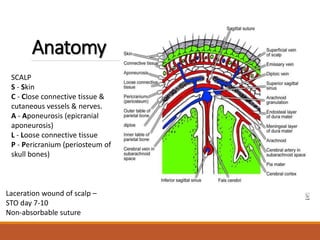
Anatomy
SCALP
S - Skin
C - Close connective tissue &
cutaneous vessels & nerves.
A - Aponeurosis (epicranial
aponeurosis)
L - Loose connective tissue
P - Pericranium (periosteum of
skull bones)
Laceration wound of scalp –
STO day 7-10
Non-absorbable suture
Pathophysiology
Primary head injury
â—¦ Direct result of the trauma
â—¦ The initial structural injury due to impact
Secondary head injury
o Any subsequent injury to brain after initial insult
o Eg: hypotension, hypoxia, increase ICP, neurochemical changes
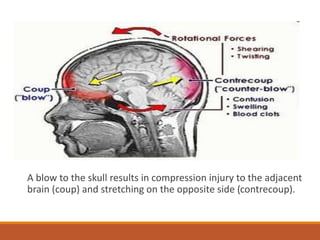
A blow to the skull results in compression injury to the adjacent
brain (coup) and stretching on the opposite side (contrecoup).
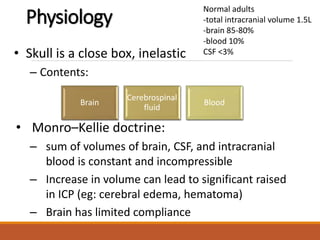
Physiology
Brain
Cerebrospinal
fluid
Blood
• Skull is a close box, inelastic
– Contents:
• Monro–Kellie doctrine:
– sum of volumes of brain, CSF, and intracranial
blood is constant and incompressible
– Increase in volume can lead to significant raised
in ICP (eg: cerebral edema, hematoma)
– Brain has limited compliance
Normal adults
-total intracranial volume 1.5L
-brain 85-80%
-blood 10%
CSF <3%
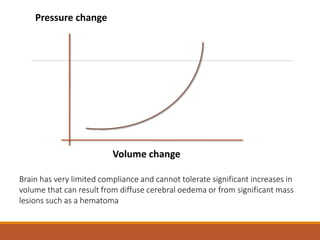
Pressure change
Brain has very limited compliance and cannot tolerate significant increases in
volume that can result from diffuse cerebral oedema or from significant mass
lesions such as a hematoma
Volume change
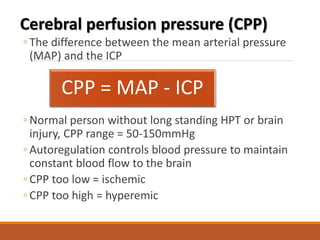
Cerebral perfusion pressure (CPP)
â—¦ The difference between the mean arterial pressure
(MAP) and the ICP
â—¦ Normal person without long standing HPT or brain
injury, CPP range = 50-150mmHg
â—¦ Autoregulation controls blood pressure to maintain
constant blood flow to the brain
â—¦ CPP too low = ischemic
â—¦ CPP too high = hyperemic
CPP = MAP - ICP
Characterization of TBI
Pathology
â—¦Cerebral concussion
â—¦Skull fracture
â—¦Surgical lesions
â—¦Diffuse injuries
Cerebral Concussion
Definition
â—¦ Physiological dysfunction without anatomical or
radiological abnormality
Symptoms
â—¦ Transient loss of consciousness (usually regain full
conscioness by < 6hours
â—¦ + post traumatic amnesia (anterograde / retrograde)
Most patient are without sequelae
Skull fracture
Linear
Depressed
â—¦ Simple (closed)/compound(open)
Basal Skull fracture
Craniofacial fracture
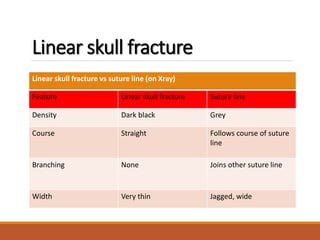
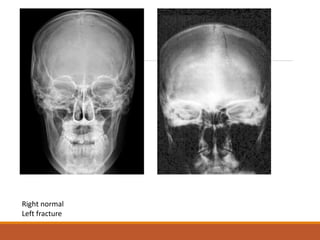
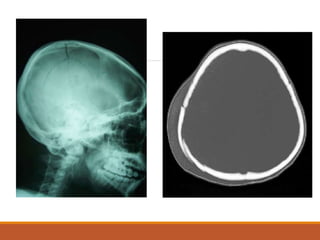
Linear skull fracture
Linear skull fracture vs suture line (on Xray)
Feature Linear skull fracture Suture line
Density Dark black Grey
Course Straight Follows course of suture
line
Branching None Joins other suture line
Width Very thin Jagged, wide
Right normal
Left fracture
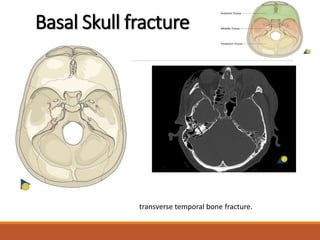
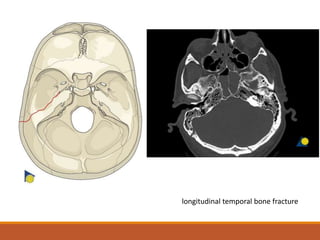
Basal Skull fracture
transverse temporal bone fracture.
longitudinal temporal bone fracture
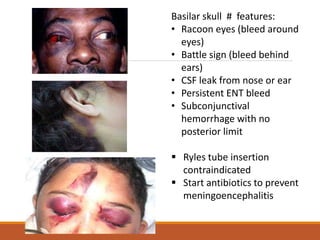
Basilar skull # features:
• Racoon eyes (bleed around
eyes)
• Battle sign (bleed behind
ears)
• CSF leak from nose or ear
• Persistent ENT bleed
• Subconjunctival
hemorrhage with no
posterior limit
ď‚§ Ryles tube insertion
contraindicated
ď‚§ Start antibiotics to prevent
meningoencephalitis
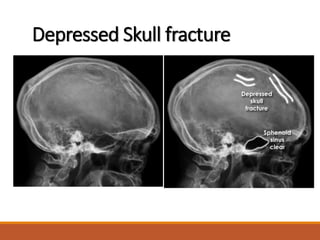
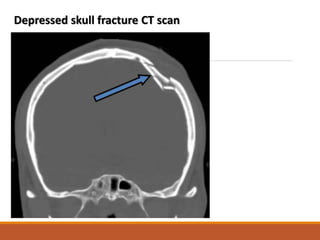
Depressed Skull fracture
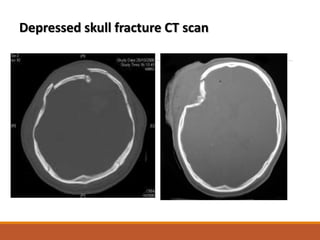
Depressed skull fracture CT scan
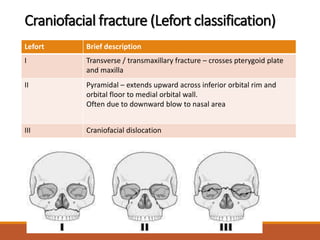
Craniofacial fracture (Lefort classification)
Lefort Brief description
I Transverse / transmaxillary fracture – crosses pterygoid plate
and maxilla
II Pyramidal – extends upward across inferior orbital rim and
orbital floor to medial orbital wall.
Often due to downward blow to nasal area
III Craniofacial dislocation
Intracranial Hematoma
Extradural Bleed
Subdural Bleed
Subarachnoid Bleed
Contusional bleed
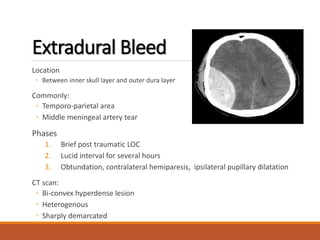
Extradural Bleed
Location
â—¦ Between inner skull layer and outer dura layer
Commonly:
â—¦ Temporo-parietal area
â—¦ Middle meningeal artery tear
Phases
1. Brief post traumatic LOC
2. Lucid interval for several hours
3. Obtundation, contralateral hemiparesis, ipsilateral pupillary dilatation
CT scan:
â—¦ Bi-convex hyperdense lesion
â—¦ Heterogenous
â—¦ Sharply demarcated
Extradural bleed
40% of lesion will not be seen on Skull Xray
Mortality
â—¦ 20-50% without treatment
â—¦ 5% with surgical treatment
Indication for conservative treatment
â—¦ <1.5 cm bleed
â—¦ No midline shift
â—¦ No neurological deficit
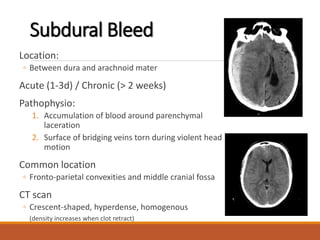
Subdural Bleed
Location:
â—¦ Between dura and arachnoid mater
Acute (1-3d) / Chronic (> 2 weeks)
Pathophysio:
1. Accumulation of blood around parenchymal
laceration
2. Surface of bridging veins torn during violent head
motion
Common location
â—¦ Fronto-parietal convexities and middle cranial fossa
CT scan
â—¦ Crescent-shaped, hyperdense, homogenous
(density increases when clot retract)
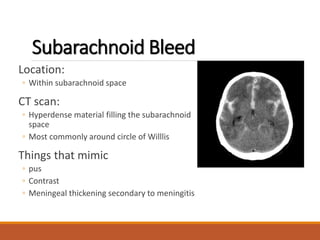
Subarachnoid Bleed
Location:
â—¦ Within subarachnoid space
CT scan:
â—¦ Hyperdense material filling the subarachnoid
space
â—¦ Most commonly around circle of Willlis
Things that mimic
â—¦ pus
â—¦ Contrast
â—¦ Meningeal thickening secondary to meningitis
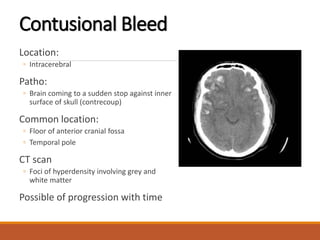
Contusional Bleed
Location:
â—¦ Intracerebral
Patho:
â—¦ Brain coming to a sudden stop against inner
surface of skull (contrecoup)
Common location:
â—¦ Floor of anterior cranial fossa
â—¦ Temporal pole
CT scan
â—¦ Foci of hyperdensity involving grey and
white matter
Possible of progression with time
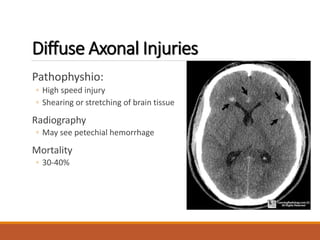
Diffuse Axonal Injuries
Pathophyshio:
â—¦ High speed injury
â—¦ Shearing or stretching of brain tissue
Radiography
â—¦ May see petechial hemorrhage
Mortality
â—¦ 30-40%
Management
Aims of Management
General aims:
1. Stabilization
2. Prevention of secondary brain injury
Specific aims:
1. Protect airway & oxygenate
2. Ventilate to normocapnia
3. Correct hypovolemia/hypotension
4. CT scan when appropriate
5. Neurosurgery if indicated
6. Intensive care for further monitoring & management
o To detect & treat immediately life threatening
conditions
o Idea – to keep patient alive
A - Airway with C-spine control
B - Breathing
C - Circulation with hemorrhage control
D- Disability
E- Exposure
A. AIRWAY AND CERVICAL SPINE
• Inadequate delivery of oxygenated blood to the brain can cause fatal
• Maintain an open airway with cervical spine control since every head injury
patient must be presumed to have a spinal injury.
• The cervical spine should be immobilised initially by in-line stabilisation
• An increasing intracranial pressure produces vomiting. Protect the airway, to
prevent vomiting, by gentle endotracheal intubation because an
inappropriate management may precipitate dangerous increases in
intracranial pressure
• Intubate
- airway protection
- to give controlled ventilation
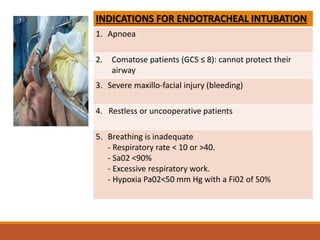
INDICATIONS FOR ENDOTRACHEAL INTUBATION
1. Apnoea
2. Comatose patients (GCS ≤ 8): cannot protect their
airway
3. Severe maxillo-facial injury (bleeding)
4. Restless or uncooperative patients
5. Breathing is inadequate
- Respiratory rate < 10 or >40.
- Sa02 <90%
- Excessive respiratory work.
- Hypoxia Pa02<50 mm Hg with a Fi02 of 50%
B. BREATHING
• Asses patient’s breathing.
- to prevent hypoxia and hypercapnia
• Identify immediately life-threatening thoracic injuries and
treat them when found. (eg: tension pneumothorax)
• If the respirations are depressed, assist breathing with a bag-
valve-mask or bag-valve-endotracheal tube and 100% oxygen.
C. CIRCULATION
• Normal cardiac output must be maintained
- 2 large bore iv cannula
• Maintenance fluid: Dextrose solution should be avoided
- Dextrose lowers plasma osmolality and increases cerebral oedema
• Intracranial bleeding will never cause hypovolemic shock
• Control bleeding by applying direct pressure.
- Be sure there isn’t a depressed skull fracture beneath the wound.
- In that case, apply pressure to the scalp close to the wound but beyond the
fracture.
• Bradycardia , high blood pressure and slow breathing may be a sign of rising
ICP (“Cushing reflex”).
D. DISABILITY
• Assess the level of consciousness using the AVPU scale
A Alert
V Responds to voice
P Responds to pain
Purposefully
Non-purposefully
Withdrawal/flexor response
Extensor response
U Unresponsive
Assess pupil size, equality and reactivity
E. EXPOSURE
• Undress patient but prevent hypothermia.
• Do not miss other associated injuries.
o To detect injuries that can kill patient in
few hours
o Idea – to keep patient alive longer
SECONDARY SURVEY
History
• Time and mechanism of injury
• Circumstances of injury, e.g. accident, unexplained fall
(consider seizure or arrhythmia)
• Loss or impairment of consciousness and duration
• Nausea and vomiting
• Clinical course prior to consultation - stable, deteriorating,
improving
• Other injuries sustained
• Past history of bleeding tendency
Systemic examination (Head-to-toe)
Neck and cervical spine
â—¦ Deformity
â—¦ Tenderness
â—¦ Muscle spasm
Head
â—¦ Scalp bruising
â—¦ Lacerations
â—¦ Swelling
â—¦ Tenderness
â—¦ Raccoon eyes*
â—¦ Bruising behind the ear (Battles sign)*
Eyes
â—¦ Pupil size
â—¦ Equality
â—¦ Reactivity
â—¦ Fundoscopy for retinal haemorrhage (may
indicate non-accidental injury)
Ears
• Blood behind the ear drum
• CSF leak
Nose
• Deformity
• Swelling
• Bleeding
• CSF leak
Mouth
• Dental trauma
• Soft tissue injuries
Face
• Focal tenderness
• Crepitus
Motor function
• Reflexes present
• Lateralizing sign
Precise Neurological Examination
• Level of consciousness
• Pupillary response & other cranial nerve examination
• Scalp, ears, eyes, face, jaw, mouth
• Extremity : motor & reflexes
• Signs of skull base fracture
- Racoon eyes
- Battle sign (8-12hours)
- CSF rhinorrhoea or otorrhoea
- Hemotympanum
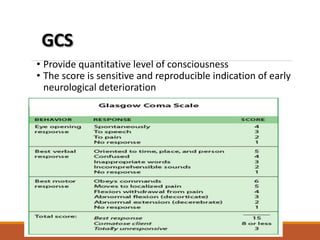
GCS
• Provide quantitative level of consciousness
• The score is sensitive and reproducible indication of early
neurological deterioration
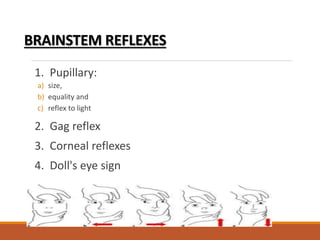
BRAINSTEM REFLEXES
1. Pupillary:
a) size,
b) equality and
c) reflex to light
2. Gag reflex
3. Corneal reflexes
4. Doll's eye sign
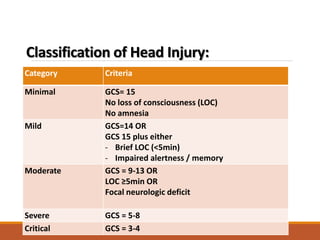
Classification of Head Injury:
Category Criteria
Minimal GCS= 15
No loss of consciousness (LOC)
No amnesia
Mild GCS=14 OR
GCS 15 plus either
- Brief LOC (<5min)
- Impaired alertness / memory
Moderate GCS = 9-13 OR
LOC ≥5min OR
Focal neurologic deficit
Severe GCS = 5-8
Critical GCS = 3-4
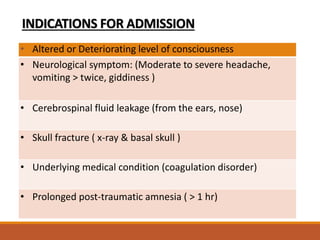
INDICATIONS FOR ADMISSION
• Altered or Deteriorating level of consciousness
• Neurological symptom: (Moderate to severe headache,
vomiting > twice, giddiness )
• Cerebrospinal fluid leakage (from the ears, nose)
• Skull fracture ( x-ray & basal skull )
• Underlying medical condition (coagulation disorder)
• Prolonged post-traumatic amnesia ( > 1 hr)
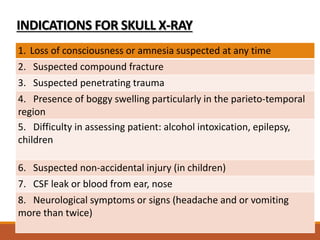
INDICATIONS FOR SKULL X-RAY
1. Loss of consciousness or amnesia suspected at any time
2. Suspected compound fracture
3. Suspected penetrating trauma
4. Presence of boggy swelling particularly in the parieto-temporal
region
5. Difficulty in assessing patient: alcohol intoxication, epilepsy,
children
6. Suspected non-accidental injury (in children)
7. CSF leak or blood from ear, nose
8. Neurological symptoms or signs (headache and or vomiting
more than twice)
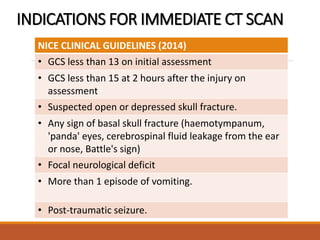
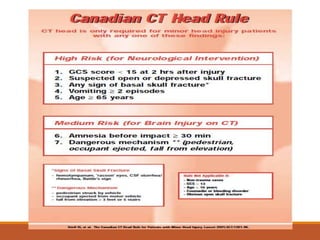
INDICATIONS FOR IMMEDIATE CT SCAN
NICE CLINICAL GUIDELINES (2014)
• GCS less than 13 on initial assessment
• GCS less than 15 at 2 hours after the injury on
assessment
• Suspected open or depressed skull fracture.
• Any sign of basal skull fracture (haemotympanum,
'panda' eyes, cerebrospinal fluid leakage from the ear
or nose, Battle's sign)
• Focal neurological deficit
• More than 1 episode of vomiting.
• Post-traumatic seizure.
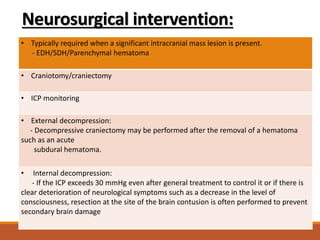
Neurosurgical intervention:
• Typically required when a significant intracranial mass lesion is present.
- EDH/SDH/Parenchymal hematoma
• Craniotomy/craniectomy
• ICP monitoring
• External decompression:
- Decompressive craniectomy may be performed after the removal of a hematoma
such as an acute
subdural hematoma.
• Internal decompression:
- If the ICP exceeds 30 mmHg even after general treatment to control it or if there is
clear deterioration of neurological symptoms such as a decrease in the level of
consciousness, resection at the site of the brain contusion is often performed to prevent
secondary brain damage
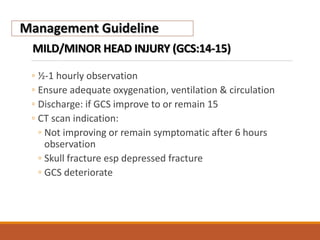
MILD/MINOR HEAD INJURY (GCS:14-15)
◦ ½-1 hourly observation
â—¦ Ensure adequate oxygenation, ventilation & circulation
â—¦ Discharge: if GCS improve to or remain 15
â—¦ CT scan indication:
â—¦ Not improving or remain symptomatic after 6 hours
observation
â—¦ Skull fracture esp depressed fracture
â—¦ GCS deteriorate
MODERATE HEAD INJURY (GCS: 9-13)
â—¦ Ensure adequate oxygenation, ventilation & circulation
( PaO2=100mmHg, PCO2=30-35mmHg)
â—¦ Urgent CT scan of brain
â—¦ Cervical spine X-ray
â—¦ Medical / Neuro-surgical intervention
â—¦ Admit Neuro-HDU
SEVERE HEAD INJURY (GCS : 3-8)
o Elective intubation for airway protection and ventilation
o Adequate circulation: ATLS protocols
o Blood pressure control to avoid brain oedema or hypotension
CT scan of brain & cervical
o Neuro-Surgical intervention for mass lesion associated with
neurological deficits or worsening
o ICU: Cerebral Perfusion Pressure directed therapy
o GCS=3, pupils fixed & dilated: conservative management
Take Home messages
1. Loss of consciousness does not need to occur in traumatic
brain injury
2. Cerebral concussion is when there is physiological
dysfunction without anatomical or radiological abnormality
3. Secondary brain injury (hypoxia / hypotension eg.) can
cause more damage than primary brain injury
4. Minor change in intracranial volume can raise ICP
significantly
5. CPP = MAP – ICP
6. Battle sign, raccoon eyes, CSF leak are features of basal skull
fracture
7. Lucid interval is an important feature of presence of
extradural hemorrhage
8. Intracranial bleeding will never cause hypovolemic shock
9. Never use dextrose saline as maintenance fluid
10. Primary & secondary survey are the crucial part in managing
head injury
11. Every head injury patient must be presumed to have a spinal
injury.
12. CT is generally the imaging study of choice in the acute
assessment of head injury
13. Mass effects eg. Midline shift is an indication for
neurosurgical intervention
References
• David A Olson. Head injury [internet] 2013 [updated Apr 1 2013] available from
http://emedicine.medscape.com/article/1163653
• Principle and practice of Surgery 5th Edition, O. James Garden
• Anderson P. Hemodynamic Complications Common in Traumatic Brain Injury.
Available at http://www.medscape.com/viewarticle/778999. Accessed March 25,
2013.
• Eisenberg HM, Gary HE Jr, Aldrich EF, et al. Initial CT findings in 753 patients with
severe head injury. A report from the NIH Traumatic Coma Data Bank. J Neurosurg.
Nov 1990;73(5):688-98.
• Mark S. Greenberg MD, Handbook of Neurosurgery 7th edition
• NICE clinical guideline 176 guidance.nice.org.uk/cg176. Triage, assessment,
investigation and early management of head injury in children, young people and
adults (Issued: January 2014)
Thank You!

Head injury finalized

  • 1.
  • 2.
  • 3.
    Aim To understand â—¦ Definitionof head injury â—¦ Simple pathophysiology related to head injury â—¦ Classification of pathology related to head injury â—¦ Basic approaches toward head injury
  • 4.
    Definition Head injury /Traumatic brain injury ◦ “any alteration in mental or physical functioning related to a blow to the head” ◦ “Loss of consciousness does not need to occur” source: David A Olson. Head injury [internet] 2013 [updated Apr 1 2013] available from http://emedicine.medscape.com/article/1163653
  • 5.
    Anatomy SCALP S - Skin C- Close connective tissue & cutaneous vessels & nerves. A - Aponeurosis (epicranial aponeurosis) L - Loose connective tissue P - Pericranium (periosteum of skull bones) Laceration wound of scalp – STO day 7-10 Non-absorbable suture
  • 6.
    Pathophysiology Primary head injury â—¦Direct result of the trauma â—¦ The initial structural injury due to impact Secondary head injury o Any subsequent injury to brain after initial insult o Eg: hypotension, hypoxia, increase ICP, neurochemical changes
  • 7.
    A blow tothe skull results in compression injury to the adjacent brain (coup) and stretching on the opposite side (contrecoup).
  • 8.
    Physiology Brain Cerebrospinal fluid Blood • Skull isa close box, inelastic – Contents: • Monro–Kellie doctrine: – sum of volumes of brain, CSF, and intracranial blood is constant and incompressible – Increase in volume can lead to significant raised in ICP (eg: cerebral edema, hematoma) – Brain has limited compliance Normal adults -total intracranial volume 1.5L -brain 85-80% -blood 10% CSF <3%
  • 9.
    Pressure change Brain hasvery limited compliance and cannot tolerate significant increases in volume that can result from diffuse cerebral oedema or from significant mass lesions such as a hematoma Volume change
  • 10.
    Cerebral perfusion pressure(CPP) â—¦ The difference between the mean arterial pressure (MAP) and the ICP â—¦ Normal person without long standing HPT or brain injury, CPP range = 50-150mmHg â—¦ Autoregulation controls blood pressure to maintain constant blood flow to the brain â—¦ CPP too low = ischemic â—¦ CPP too high = hyperemic CPP = MAP - ICP
  • 11.
    Characterization of TBI Pathology â—¦Cerebralconcussion â—¦Skull fracture â—¦Surgical lesions â—¦Diffuse injuries
  • 12.
    Cerebral Concussion Definition â—¦ Physiologicaldysfunction without anatomical or radiological abnormality Symptoms â—¦ Transient loss of consciousness (usually regain full conscioness by < 6hours â—¦ + post traumatic amnesia (anterograde / retrograde) Most patient are without sequelae
  • 13.
    Skull fracture Linear Depressed â—¦ Simple(closed)/compound(open) Basal Skull fracture Craniofacial fracture
  • 14.
    Linear skull fracture Linearskull fracture vs suture line (on Xray) Feature Linear skull fracture Suture line Density Dark black Grey Course Straight Follows course of suture line Branching None Joins other suture line Width Very thin Jagged, wide
  • 15.
  • 17.
    Basal Skull fracture transversetemporal bone fracture.
  • 18.
  • 19.
    Basilar skull #features: • Racoon eyes (bleed around eyes) • Battle sign (bleed behind ears) • CSF leak from nose or ear • Persistent ENT bleed • Subconjunctival hemorrhage with no posterior limit  Ryles tube insertion contraindicated  Start antibiotics to prevent meningoencephalitis
  • 20.
  • 21.
  • 22.
  • 23.
    Craniofacial fracture (Lefortclassification) Lefort Brief description I Transverse / transmaxillary fracture – crosses pterygoid plate and maxilla II Pyramidal – extends upward across inferior orbital rim and orbital floor to medial orbital wall. Often due to downward blow to nasal area III Craniofacial dislocation
  • 24.
    Intracranial Hematoma Extradural Bleed SubduralBleed Subarachnoid Bleed Contusional bleed
  • 25.
    Extradural Bleed Location â—¦ Betweeninner skull layer and outer dura layer Commonly: â—¦ Temporo-parietal area â—¦ Middle meningeal artery tear Phases 1. Brief post traumatic LOC 2. Lucid interval for several hours 3. Obtundation, contralateral hemiparesis, ipsilateral pupillary dilatation CT scan: â—¦ Bi-convex hyperdense lesion â—¦ Heterogenous â—¦ Sharply demarcated
  • 26.
    Extradural bleed 40% oflesion will not be seen on Skull Xray Mortality â—¦ 20-50% without treatment â—¦ 5% with surgical treatment Indication for conservative treatment â—¦ <1.5 cm bleed â—¦ No midline shift â—¦ No neurological deficit
  • 27.
    Subdural Bleed Location: â—¦ Betweendura and arachnoid mater Acute (1-3d) / Chronic (> 2 weeks) Pathophysio: 1. Accumulation of blood around parenchymal laceration 2. Surface of bridging veins torn during violent head motion Common location â—¦ Fronto-parietal convexities and middle cranial fossa CT scan â—¦ Crescent-shaped, hyperdense, homogenous (density increases when clot retract)
  • 28.
    Subarachnoid Bleed Location: â—¦ Withinsubarachnoid space CT scan: â—¦ Hyperdense material filling the subarachnoid space â—¦ Most commonly around circle of Willlis Things that mimic â—¦ pus â—¦ Contrast â—¦ Meningeal thickening secondary to meningitis
  • 29.
    Contusional Bleed Location: â—¦ Intracerebral Patho: â—¦Brain coming to a sudden stop against inner surface of skull (contrecoup) Common location: â—¦ Floor of anterior cranial fossa â—¦ Temporal pole CT scan â—¦ Foci of hyperdensity involving grey and white matter Possible of progression with time
  • 30.
    Diffuse Axonal Injuries Pathophyshio: â—¦High speed injury â—¦ Shearing or stretching of brain tissue Radiography â—¦ May see petechial hemorrhage Mortality â—¦ 30-40%
  • 31.
  • 32.
    Aims of Management Generalaims: 1. Stabilization 2. Prevention of secondary brain injury Specific aims: 1. Protect airway & oxygenate 2. Ventilate to normocapnia 3. Correct hypovolemia/hypotension 4. CT scan when appropriate 5. Neurosurgery if indicated 6. Intensive care for further monitoring & management
  • 33.
    o To detect& treat immediately life threatening conditions o Idea – to keep patient alive A - Airway with C-spine control B - Breathing C - Circulation with hemorrhage control D- Disability E- Exposure
  • 34.
    A. AIRWAY ANDCERVICAL SPINE • Inadequate delivery of oxygenated blood to the brain can cause fatal • Maintain an open airway with cervical spine control since every head injury patient must be presumed to have a spinal injury. • The cervical spine should be immobilised initially by in-line stabilisation • An increasing intracranial pressure produces vomiting. Protect the airway, to prevent vomiting, by gentle endotracheal intubation because an inappropriate management may precipitate dangerous increases in intracranial pressure • Intubate - airway protection - to give controlled ventilation
  • 35.
    INDICATIONS FOR ENDOTRACHEALINTUBATION 1. Apnoea 2. Comatose patients (GCS ≤ 8): cannot protect their airway 3. Severe maxillo-facial injury (bleeding) 4. Restless or uncooperative patients 5. Breathing is inadequate - Respiratory rate < 10 or >40. - Sa02 <90% - Excessive respiratory work. - Hypoxia Pa02<50 mm Hg with a Fi02 of 50%
  • 36.
    B. BREATHING • Assespatient’s breathing. - to prevent hypoxia and hypercapnia • Identify immediately life-threatening thoracic injuries and treat them when found. (eg: tension pneumothorax) • If the respirations are depressed, assist breathing with a bag- valve-mask or bag-valve-endotracheal tube and 100% oxygen.
  • 37.
    C. CIRCULATION • Normalcardiac output must be maintained - 2 large bore iv cannula • Maintenance fluid: Dextrose solution should be avoided - Dextrose lowers plasma osmolality and increases cerebral oedema • Intracranial bleeding will never cause hypovolemic shock • Control bleeding by applying direct pressure. - Be sure there isn’t a depressed skull fracture beneath the wound. - In that case, apply pressure to the scalp close to the wound but beyond the fracture. • Bradycardia , high blood pressure and slow breathing may be a sign of rising ICP (“Cushing reflex”).
  • 38.
    D. DISABILITY • Assessthe level of consciousness using the AVPU scale A Alert V Responds to voice P Responds to pain Purposefully Non-purposefully Withdrawal/flexor response Extensor response U Unresponsive Assess pupil size, equality and reactivity
  • 39.
    E. EXPOSURE • Undresspatient but prevent hypothermia. • Do not miss other associated injuries.
  • 40.
    o To detectinjuries that can kill patient in few hours o Idea – to keep patient alive longer SECONDARY SURVEY
  • 41.
    History • Time andmechanism of injury • Circumstances of injury, e.g. accident, unexplained fall (consider seizure or arrhythmia) • Loss or impairment of consciousness and duration • Nausea and vomiting • Clinical course prior to consultation - stable, deteriorating, improving • Other injuries sustained • Past history of bleeding tendency
  • 42.
    Systemic examination (Head-to-toe) Neckand cervical spine ◦ Deformity ◦ Tenderness ◦ Muscle spasm Head ◦ Scalp bruising ◦ Lacerations ◦ Swelling ◦ Tenderness ◦ Raccoon eyes* ◦ Bruising behind the ear (Battles sign)* Eyes ◦ Pupil size ◦ Equality ◦ Reactivity ◦ Fundoscopy for retinal haemorrhage (may indicate non-accidental injury) Ears • Blood behind the ear drum • CSF leak Nose • Deformity • Swelling • Bleeding • CSF leak Mouth • Dental trauma • Soft tissue injuries Face • Focal tenderness • Crepitus Motor function • Reflexes present • Lateralizing sign
  • 43.
    Precise Neurological Examination •Level of consciousness • Pupillary response & other cranial nerve examination • Scalp, ears, eyes, face, jaw, mouth • Extremity : motor & reflexes • Signs of skull base fracture - Racoon eyes - Battle sign (8-12hours) - CSF rhinorrhoea or otorrhoea - Hemotympanum
  • 44.
    GCS • Provide quantitativelevel of consciousness • The score is sensitive and reproducible indication of early neurological deterioration
  • 45.
    BRAINSTEM REFLEXES 1. Pupillary: a)size, b) equality and c) reflex to light 2. Gag reflex 3. Corneal reflexes 4. Doll's eye sign
  • 46.
    Classification of HeadInjury: Category Criteria Minimal GCS= 15 No loss of consciousness (LOC) No amnesia Mild GCS=14 OR GCS 15 plus either - Brief LOC (<5min) - Impaired alertness / memory Moderate GCS = 9-13 OR LOC ≥5min OR Focal neurologic deficit Severe GCS = 5-8 Critical GCS = 3-4
  • 47.
    INDICATIONS FOR ADMISSION •Altered or Deteriorating level of consciousness • Neurological symptom: (Moderate to severe headache, vomiting > twice, giddiness ) • Cerebrospinal fluid leakage (from the ears, nose) • Skull fracture ( x-ray & basal skull ) • Underlying medical condition (coagulation disorder) • Prolonged post-traumatic amnesia ( > 1 hr)
  • 48.
    INDICATIONS FOR SKULLX-RAY 1. Loss of consciousness or amnesia suspected at any time 2. Suspected compound fracture 3. Suspected penetrating trauma 4. Presence of boggy swelling particularly in the parieto-temporal region 5. Difficulty in assessing patient: alcohol intoxication, epilepsy, children 6. Suspected non-accidental injury (in children) 7. CSF leak or blood from ear, nose 8. Neurological symptoms or signs (headache and or vomiting more than twice)
  • 49.
    INDICATIONS FOR IMMEDIATECT SCAN NICE CLINICAL GUIDELINES (2014) • GCS less than 13 on initial assessment • GCS less than 15 at 2 hours after the injury on assessment • Suspected open or depressed skull fracture. • Any sign of basal skull fracture (haemotympanum, 'panda' eyes, cerebrospinal fluid leakage from the ear or nose, Battle's sign) • Focal neurological deficit • More than 1 episode of vomiting. • Post-traumatic seizure.
  • 51.
    Neurosurgical intervention: • Typicallyrequired when a significant intracranial mass lesion is present. - EDH/SDH/Parenchymal hematoma • Craniotomy/craniectomy • ICP monitoring • External decompression: - Decompressive craniectomy may be performed after the removal of a hematoma such as an acute subdural hematoma. • Internal decompression: - If the ICP exceeds 30 mmHg even after general treatment to control it or if there is clear deterioration of neurological symptoms such as a decrease in the level of consciousness, resection at the site of the brain contusion is often performed to prevent secondary brain damage
  • 52.
    MILD/MINOR HEAD INJURY(GCS:14-15) ◦ ½-1 hourly observation ◦ Ensure adequate oxygenation, ventilation & circulation ◦ Discharge: if GCS improve to or remain 15 ◦ CT scan indication: ◦ Not improving or remain symptomatic after 6 hours observation ◦ Skull fracture esp depressed fracture ◦ GCS deteriorate
  • 53.
    MODERATE HEAD INJURY(GCS: 9-13) â—¦ Ensure adequate oxygenation, ventilation & circulation ( PaO2=100mmHg, PCO2=30-35mmHg) â—¦ Urgent CT scan of brain â—¦ Cervical spine X-ray â—¦ Medical / Neuro-surgical intervention â—¦ Admit Neuro-HDU
  • 54.
    SEVERE HEAD INJURY(GCS : 3-8) o Elective intubation for airway protection and ventilation o Adequate circulation: ATLS protocols o Blood pressure control to avoid brain oedema or hypotension CT scan of brain & cervical o Neuro-Surgical intervention for mass lesion associated with neurological deficits or worsening o ICU: Cerebral Perfusion Pressure directed therapy o GCS=3, pupils fixed & dilated: conservative management
  • 55.
    Take Home messages 1.Loss of consciousness does not need to occur in traumatic brain injury 2. Cerebral concussion is when there is physiological dysfunction without anatomical or radiological abnormality 3. Secondary brain injury (hypoxia / hypotension eg.) can cause more damage than primary brain injury 4. Minor change in intracranial volume can raise ICP significantly 5. CPP = MAP – ICP 6. Battle sign, raccoon eyes, CSF leak are features of basal skull fracture
  • 56.
    7. Lucid intervalis an important feature of presence of extradural hemorrhage 8. Intracranial bleeding will never cause hypovolemic shock 9. Never use dextrose saline as maintenance fluid 10. Primary & secondary survey are the crucial part in managing head injury 11. Every head injury patient must be presumed to have a spinal injury. 12. CT is generally the imaging study of choice in the acute assessment of head injury 13. Mass effects eg. Midline shift is an indication for neurosurgical intervention
  • 57.
    References • David AOlson. Head injury [internet] 2013 [updated Apr 1 2013] available from http://emedicine.medscape.com/article/1163653 • Principle and practice of Surgery 5th Edition, O. James Garden • Anderson P. Hemodynamic Complications Common in Traumatic Brain Injury. Available at http://www.medscape.com/viewarticle/778999. Accessed March 25, 2013. • Eisenberg HM, Gary HE Jr, Aldrich EF, et al. Initial CT findings in 753 patients with severe head injury. A report from the NIH Traumatic Coma Data Bank. J Neurosurg. Nov 1990;73(5):688-98. • Mark S. Greenberg MD, Handbook of Neurosurgery 7th edition • NICE clinical guideline 176 guidance.nice.org.uk/cg176. Triage, assessment, investigation and early management of head injury in children, young people and adults (Issued: January 2014)
  • 58.

Editor's Notes

  • #38 Cushing’s response (reflex)—When ICP increases, systemic blood pressure increases to try to preserve blood flow to brain. The rise in systemic blood pressure triggers a drop in pulse rate as body tries to lower blood pressure. This hypertension is usually associated with a widening of pulse pressure (systolic minus diastolic pressure). Other causes of hypertension include fear and pain.
  • #43 Lateralizing signs-
  • #46 Doll's eye sign -a positive doll's eye sign is when the eyes deviate away from the direction of rotation (if the head is rotated to the right, the eyes will deviate to the left). - indicate a positive oculocephalic reflex (brainstem intact).  - It is where rotation/flexion of the of the head cause transient eye movement in the opposite directionÂ