HEAD INJURIES
Dr Phillipo L. Chalya M.D. ;M.Med [Surg]
Surgeon specialist
Dept of Surgery
BMC
OUTLINE
 Definition
 Surgical Anatomy
 Epidemiology
 Etiology
 Mechanism of injury
 Classifications
 Pathophysiology
 Clinical presentation
 Workup
 Management
 Complications
DEFINITION
 Head injury is defined as traumatic injuries involving the cranium
and intracranial structures (i.e., brain; cranial nerves; meninges;
and other structures
 Head injury can also be defined as any alteration in mental or
physical functioning related to a blow to the head
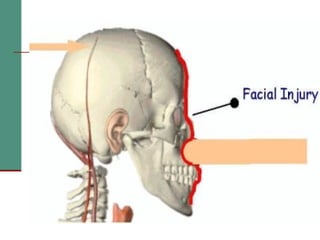
 Maxillofacial injuries is not part of head injury
SURGICAL ANATOMY
 Structures to be considered in head injuries
 Scalp
 Skull
 Meninges
 Brain
 CSF
Scalp
 Skin
 Thick, hair bearing with many
sebaceous glands
 Connective tissue
 Fibro-fatty
 Many blood vessels
 Aponeurosis [epicranial]
 Tough structure joining occipitalis
muscle posteriorly and frontalis
anteriorly
 Loose areola tissue
 Occupies the subaponeurotic space
 Pericranium
 Periosteum covering the outer
surface of the skull
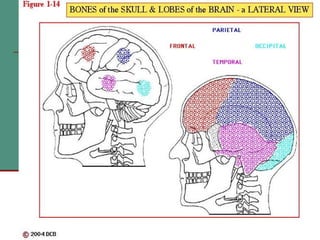
Skull
 22 bones in total
 Consists of:-
 8 cranial bones [cranium]
 14 facial bones
 Cranium is that part of the skull that encloses the brain
 The cranium is made up of the vault [the upper part] and the base
of the skull [lower part]
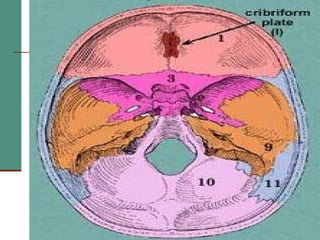
 The inner aspect of the base of the skull consists of 3 cranial
fossae:-
 Anterior cranial fossa
 Middle cranial fossa
 Posterior cranial fossa
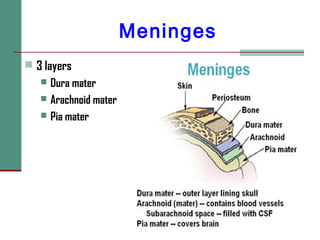
Meninges
 3 layers
 Dura mater
 Arachnoid mater
 Pia mater
Dura mater
 Conventionally 2 layers:
 Endosteal layer (periosteum)
 Meningeal layer (true dura)
 Septa: made up of dural folds
 Divides the cranial cavity into 3 compartments
 2 upper compartments [supratentorial compartments]
 1 lower compartment [infratentorial compartment]
 Major dural folds include:-
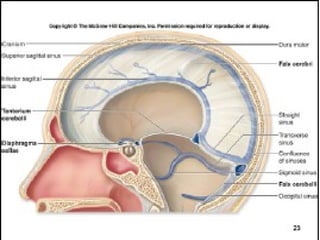
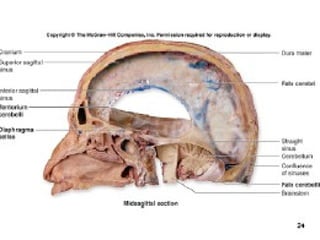
 Falx cerebri
 Tentorium cerebelli
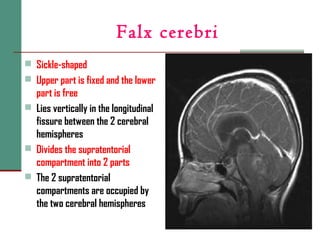
Falx cerebri
 Sickle-shaped
 Upper part is fixed and the lower
part is free
 Lies vertically in the longitudinal
fissure between the 2 cerebral
hemispheres
 Divides the supratentorial
compartment into 2 parts
 The 2 supratentorial
compartments are occupied by
the two cerebral hemispheres
Tentorium cerebelli
 Crescent shaped
 Lies horizontally between the occipital lobe of the cerebrum and
the cerebellum
 Posteriorly is fixed
 Anteriorly is free with an opening [tentorial notch] for passage of
the midbrain
 Has a protective function
 it prevents shuddering movements of the brain within the cranial
cavity and the folds prevent damage to nervous tissue during
sudden rotational movements
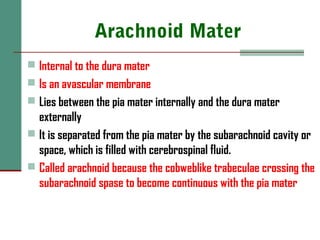
Arachnoid Mater
 Internal to the dura mater
 Is an avascular membrane
 Lies between the pia mater internally and the dura mater
externally
 It is separated from the pia mater by the subarachnoid cavity or
space, which is filled with cerebrospinal fluid.
 Called arachnoid because the cobweblike trabeculae crossing the
subarachnoid spase to become continuous with the pia mater
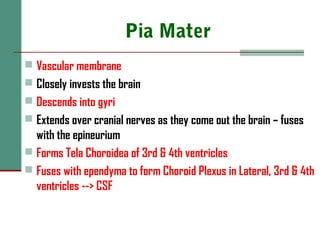
Pia Mater
 Vascular membrane
 Closely invests the brain
 Descends into gyri
 Extends over cranial nerves as they come out the brain – fuses
with the epineurium
 Forms Tela Choroidea of 3rd & 4th ventricles
 Fuses with ependyma to form Choroid Plexus in Lateral, 3rd & 4th
ventricles --> CSF
Brain
 Divided into three major areas
 Cerebrum
 Brain stem
 Cerebellum
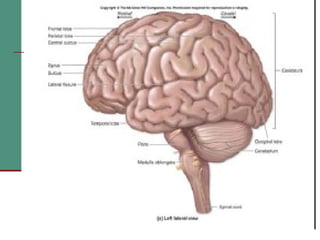
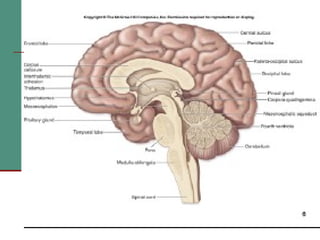
Cerebrum
 The cerebrum is composed of 2 cerebral hemispheres
 The hemispheres are connected by the corpus callosum
 Consists of 4 lobes
 Parietal lobe
 Frontal lobe
 Occipital lobe
 Temporal lobe
Brain stem
 Three major divisions
 Midbrain
 Pons
 Medulla
 10 of the 12 pairs of cranial nerves arise from the brainstem
(ipsilateral signs)
 Cortical pathways pass through the brainstem and decussate
(cross) in the medulla (contralateral signs)
Cerebellum
 This is the largest part of the hind brain
EPIDEMIOLOGY
 Incidence
 Morbidity/mortality
 Age
 Sex
 Race
 Head injury continues to be an enormous public health
problem, even with modern medicine in the 21st century
 It is one of the most common cause of admissions to the A&E
department worldwide
Incidence
Morbidity /mortality
 Head injury are the major cause of morbidity and mortality
among trauma admissions
Age
 Head injuries occur in all age groups, with a peak incidence
between the ages of 16 and 25 years and a second peak in the
elderly who have a high incidence of chronic subdural
haematomas
 Head injuries are a leading cause of trauma related deaths in
patients young than 45 years
sex
 Males are more affected than females
 The male to female ratio is 2:1 [M:F= 2:1] worldwide
AETIOLOGY
 Road traffic accidents
 Fall injuries
 Assault injuries
 Sport injuries
 Penetrating injuries e.g. bullets, knives, screwdrivers, arrows,
nails etc
MECHANISM OF INJURY
 Blunt head injury
 Penetrating head injury
Blunt head injury
 Direct trauma to the head
 Occurs in 2 ways: a moving head strikes a fixed object or a
moving object strikes an immobile head scalp injury,→
fractures of the skull, contused brain etc
 Deceleration head injuries
 These are injuries resulting from rapid deceleration of the
head causing the brain to move within the cranial cavity and to
come into contact with bony protuberances within the skull→
brain contusions, lacerations etc
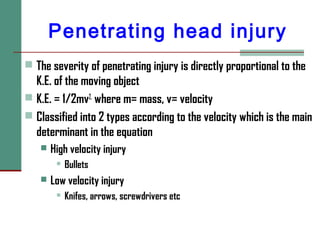
Penetrating head injury
 The severity of penetrating injury is directly proportional to the
K.E. of the moving object
 K.E. = 1/2mv2,
where m= mass, v= velocity
 Classified into 2 types according to the velocity which is the main
determinant in the equation
 High velocity injury
 Bullets
 Low velocity injury
 Knifes, arrows, screwdrivers etc
CLASSIFICATION
 According to mechanism of injury
 According to the integrity of the dura mater
 According to the site of injury
 According to the pathology
 According to severity
According to mechanism
of injury
 Blunt head injury [Non-missile injuries]
 Penetrating head injury [Missile injuries]
Blunt head injury
 Occurs as a result of blunt force trauma or non-missile injury
to the head →injury to the scalp, skull and other intracranial
structures
 Can also occur as a result of rapid deceleration and
acceleration causing the brain to move within the cranial cavity
and come into contact with bony prominences within the skull→
contusion, laceration and shearing strains within the brain
substances
Penetrating head injury
 A penetrating head injury occurs when a sharp object pierces
the skull and breaches the dura mater
According to the integrity of
the dura mater
 Open head injury
 Closed head injury
Open head injury
 Is one in which there is a wound which extends through the
scalp, the skull and the dura mater, that is to say the brain is
exposed
 In open head injury the dura mater is not intact
 There is grave danger of infection
Closed head injury
 In the closed type of head injury the brain is not exposed to
outside world, that is any or all , of the scalp, skull bone and
dura mater are intact
 In closed head injury the dura mater is intact and the risk of
infection is low
 Today we are talking of “ BRAIN INJURIES INSIDE THE CLOSED
BOX”
According to the site of
injury
 Scalp injury
 Skull injury
 Meningeal injury
 Brain injury
 Intracranial vascular injury
 Cranial nerves injury
Scalp injury
 Scalp lacerations
 Scalp cut wounds
 Scalp hematoma
 Subcutaneous
 Subaponerotic
 Subpericranial
Skull injury
 Fracture of the vault [vault skull fracture]
 Fracture of the base of the skull [basilar fracture]
Fracture of the vault
 According to whether the fracture is exposed to the outside world
 Simple [closed] fracture: The fracture is not exposed the outside
 Compound [open] fracture : The fracture is exposed to the outside
 According to the type of fracture
 Liner fracture
 Depressed fracture
 Comminuted fracture
Fracture of the base of the
skull
 Fracture of the anterior cranial fossa
 Fracture of the middle cranial fossa
 Fracture of the posterior cranial fossa
Fracture of the anterior cranial fossa
 The patient will present with:-
 Nasal bleeding (epistaxis), traumatic CSF rhinorrhoea or escape
of brain mater through the nose
 Periorbital ecchymosis (racoon eyes), subconjuctival h’ge
extending beyond the conjuctival reflections intraorbital h’ge
 Anosmia if both olfactory nerves are damaged
 Injuries to 3rd
, 4th
, 1st
division of 5th
and 6th
at the sphenoidal fissure
 3rd
palsy produces dilated a pupil in a conscious patient
Fracture of the middle cranial fossa
 This presents with:-
 Bleeding from the ears [hemotympanum] or mouth
 CSF otorrhoea
 CSF Rhinorrhoea via the eustachian tube
 Oscular disruption
 7th
and 8th
cranial nerve palsies →facial palsy and deafness
respectively
Fracture of the posterior cranial fossa
 Extravasation of blood may be seen in the suboccipal region
producing a swelling at the back
 Post auricular [posterior to the mastoid process] ecchymosis
[Battle’s sign]
 Injury to the 9th
, 10th
and 11st at the jugular foramen
Meningeal injury
 This occurs commonly as a result of fracture of the skull
 The type of fracture of the skull which causes laceration of
the dura mater is the depressed compound fracture
Brain injury
 Primary brain injury
 That is damage which occurs at the time of injury
 Secondary brain injury
 That is damage which occurs as a consequence of primary
brain damage
Primary brain injury
 Cerebral concussion
 Cerebral contusion
 Cerebral laceration
 Diffuse axonal injury
Cerebral concussion
 Temporary physiological loss of function without any organic
structural damage
 The patient becomes unconscious for a short period ,
followed by complete and perfect recovery
 Develops immediately after injury
 It may be accompanied by autonomic abnormalities e.g.
bradycardia, hypotension & sweating
 Prolonged LOC means something easy than pure concussion
Cerebral contusion
 Bruising of the brain
 Characterized by rupture of white fibres of the brain causing
peticheal h,ge in the cerebral parenchyma
 Usually produces neurological deficits that persist for > 24
hrs
 Contusions may resolve together with the accompanying
deficits or the may persist
 Blood-brain barrier defects and cerebral edema are common
and these lesions enlarge or coalesce with time
Cerebral laceration
 In this condition the brain surface is torn with effusion of blood
into CSF→SAH [subarachnoid h’ge]
 This occurs when there is a significant force to the skull
→laceration of the brain as a result of rapid movement and
shearing of brain tissue
 The pia mater and arachnoid may be torn →ICH [intra-cerebral
h’ge]
 Focal neurological deficits are common
 Clinically presents as cerebral contusion
Diffuse axonal injury
 This type of brain damage occurs as a result of mechanical
shearing following deceleration, causing disruption and tearing of
axons, especially at the grey/white matter interfaces
Secondary brain injury
 Intracranial hematoma
 Cerebral edema
 Brain herniation
 Cerebral ischaemia
 Infection
 Epilepsy
Intracranial vascular injuries
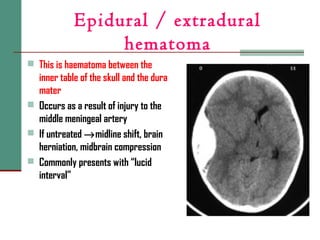
 Epidural / extradural hematoma
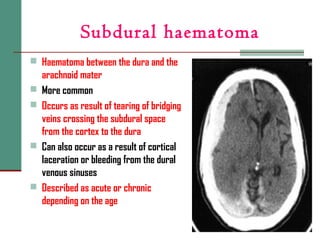
 Subdural haematoma
 Subarachnoid haematoma
 Intracerebral hematoma
Epidural / extradural
hematoma
 This is haematoma between the
inner table of the skull and the dura
mater
 Occurs as a result of injury to the
middle meningeal artery
 If untreated →midline shift, brain
herniation, midbrain compression
 Commonly presents with “lucid
interval”
Subdural haematoma
 Haematoma between the dura and the
arachnoid mater
 More common
 Occurs as result of tearing of bridging
veins crossing the subdural space
from the cortex to the dura
 Can also occur as a result of cortical
laceration or bleeding from the dural
venous sinuses
 Described as acute or chronic
depending on the age
Subarachnoid haematoma
 Haematoma in the space between the arachnoid space and the pia
mater [subarachnoid space]
 Occurs when a vessel ruptures into the subarachnoid layer or in
case of cerebral lacerations
 There is extravasations of blood under pressure into the CSF
space, ventricles or into the brain itself
 The patient presents with severe headache of sudden onset,
nausea and vomiting
Intracerebral hematoma
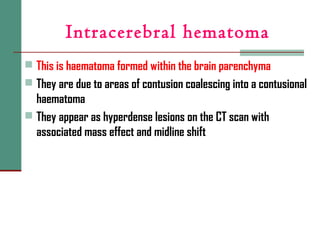
 This is haematoma formed within the brain parenchyma
 They are due to areas of contusion coalescing into a contusional
haematoma
 They appear as hyperdense lesions on the CT scan with
associated mass effect and midline shift
Cranial nerve injuries
 Head injury may be associated with the injuries to deferent
cranial nerves
 The 3rd
cranial nerve is the most important as it is involved
even by cerebral compression besides direct injury
 The different cranial nerves are injured in fracture of
different parts of the base of the skull
According to the
pathology
 Focal head injury
 Diffuse head injury
Focal head injury
 In this type, the injury is localized to only part of the head
 Focal injuries include scalp injury, skull fracture, and surface
contusions and are generally be caused by direct impact
Diffuse head injury
 Diffuse injuries include diffuse axonal injury, hypoxic-
ischemic damage, meningitis, and vascular injury
 They are usually caused by acceleration-deceleration forces
According to severity
 Classified according to Glasgow Coma Score [GCS]
 Classified into:-
 Mild head injury [GCS of 13-15]
 Moderate head injury [GCS of 9-12]
 Severe head injury [ GCS of 3-8 ]
PATHOPHYSIOLOGY
 Requires understanding of the following crucial concepts:-
 The concept of Monro-Kellie doctrine
 The concept of Cerebral Perfusion Pressure [CPP]
 The concept of increased ICP
Monro-Kellie doctrine
 The skull is a rigid structure (once the sutures have fused)
 3 components within that have a balance
 80% brain
 10% blood
 10% CSF
 If any one of these components increases [or if there is a SOL]
another component must decrease to maintain the balance (ICP)
 If this does not happen then there will be an increase in ICP
 This observations were first reported by Monro [1783] and
confirmed by Kellie 40 years later→ becoming known as the
Monro-Kellie docrine
Cerebral Perfusion
Pressure [CPP]
 CPP is defined as the difference between the mean arterial
pressure (MAP) and the ICP [ i.e. CPP = MAP – ICP]
 CPP is the net pressure required to deliver blood to the brain
 Cerebral blood flow (CBF) is constant in the range of MAPs of 50-
150 mm Hg
 This is due to autoregulation by the arterioles
 As ICP increases, in order to maintain a constant CPP there has to
be a compensatory rise in the MAP
 A hypertensive response is therefore elicited which classically is
associated with bradycardia
 This is termed as the Cushing reflex after the eminent American
neurosurgeon
Increased ICP
 May result from primary or secondary brain injury
 Normal ICP in adult is 0-15 mmHg, in children is 0-10 mmHg
 This causes:-
 Cerebral herniation
 Cerebral edema
 Cerebral ischaemia
Brain herniation
 Several types of herniation exist, as follows:
 Transtentorial herniation
 Subfalcine herniation
 Central herniation
 Cerebellar herniation
 Upward cerebellar herniation
 Tonsillar herniation
Transtentorial herniation
 Occurs when the medial aspect of the temporal lobe
(uncus) migrates across the free edge of the tentorium
 This causes pressure on the third cranial nerve,
interrupting parasympathetic input to the eye and
resulting in a dilated pupil
 This unilateral dilated pupil is the classic sign of
transtentorial herniation and usually (80%) occurs
ipsilateral to the side of the transtentorial herniation
 In addition to pressure on the third cranial nerve,
transtentorial herniation compresses the brainstem
Subfalcine herniation
 Occurs when the cingulate gyrus on the medial aspect of
the frontal lobe is displaced across the midline under the
free edge of the falx
 This may compromise the blood flow through the anterior
cerebral artery complexes, which are located on the
medial side of each frontal lobe
 Subfalcine herniation does not cause the same brainstem
effects as those caused by transtentorial herniation
Central herniation
 Central herniation occurs when a diffuse increase in ICP occurs
 Each of the cerebral hemispheres is displaced through the
tentorium, resulting in significant pressure on the upper
brainstem
Cerebellar herniation
 2 types:-
 Upward cerebellar herniation
 Downward cerebellar herniation [tonsillar]
Upward cerebellar herniation
 Occurs when either a large mass or increased pressure in
the posterior fossa is present and the cerebellum is
displaced in an upward direction through the tentorial
opening
 This also causes significant upper brainstem compression
Tonsillar herniation
 Occurs when increased pressure develops in the posterior
fossa
 In this form of herniation, the cerebellar tonsils are displaced
in a downward direction through the foramen magnum,
causing compression on the lower brainstem and upper
cervical spinal cord as they pass through the foramen
magnum
Cerebral edema
 Vasogenic cerebral edema
 Cytotoxic cerebral edema
 Interstitial cerebral edema
Vasogenic cerebral edema
 Refers to the influx of fluid and solutes into the brain tissue
through an incompetent or damaged blood-brain-barrier (BBB)
 This is the most common type of brain edema and results from
increased permeability of the capillary endothelial cells
 Breakdown of the BBB allows movement of proteins from the
intravascular space through the capillary wall into the
extracellular space→ influx of fluid and solutes
Cytotoxic cerebral edema
 In this type of edema the BBB remains intact
 This edema is due to the derangement in cellular metabolism
resulting in inadequate functioning of the sodium and potassium
pump in the glial cell membrane
 As a result there is cellular retention of sodium and water
→swelling of the glia, neurons and endothelial cells
 Cytotoxic edema affects predominantly the grey mater
Interstitial cerebral edema
 This is seen in hydrocephalus when the outflow of CSF is
obstructed and intraventricular pressure increases
 The result is movement of sodium and water across the
ventricular wall into the paraventricular space
Cerebral ischaemia
 ICP results in CPP and therefore CBF [CPP= MAP-ICP]→
cerebral ischaemia
 This is common after severe head injury and is caused by a
combination of either hypoxia and impaired cerebral
perfusion
 The brain is unable to autoregulate its blood supply with a
decrease in blood pressure
CLINICAL
PRESANTATION
 History
 Physical Examination
History [cont’d]
 Taken from an eye witness if the patient is unconscious or
from the patient
 Include;-
 Mechanism and full details of injury
 For example:
 Fall: Height, surface, posture of fall, point of contact
 Motor vehicle collision: Speed, place in car, restraint, point of
impact
 etc
History [cont’d]
 Time of accident
 Level of consciousness / unconscious?
 Time of onset of unconsciousness
 Duration of unconsciousness
 Lucid interval
 Amnesia [loss of memory]–
 Retrograde Traumatic Amnesia
 Post-traumatic amnesia
History [cont’d]
 Current symptoms
 Headache, vomiting, bleeding from ENT, LOC, fits, other associated
injuries
 Pre-morbid illness
 Diabetes mellitus
 Renal diseases
 Hypertension
 Previous history of fits
 History of medications and Allergies
 Habit of taking alcohol or opium
Physical Examination
 Head
 Scalp lacerations or haematoma
 Fractures: depressed, base of skull (“raccoon eyes”, “Battles
sign”
 CSF leak, blood in the ear canal or behind the tympanic
membrane, bleeding from nose or mouth etc
 Face
 Fractures
 intra-oral injuries
Physical Examination
[cont’d]
 Neck
 Neck rigidity
 Immobilization is required until stability is assured
 Trunk
 Evidence of chest injuries
 Evidence of abdominal injuries
 MSS [limbs, pelvis and spines]
 Closed or open wounds, fractures
 Neurological
 Level of consciousness (GCS), pupilary size and reaction to light
Focal signs, brainstem reflexes, motor function
WORKUP
 Laboratory investigations
 Imaging investigations
 Other investigations
Laboratory investigations
 Haemogram
 Serum sugar
 Serum electrolytes
 RFT
 Grouping & cross-matching
 Coagulation profile
Imaging investigations
 Skull x-rays
 CT Scan brain/skull
 MRI [Magnetic Resonance Imaging]
 Cervical x-rays
Skull x-rays
 2 views
 AP-views
 Lateral views
 Can revealed
 Fracture of the skull
 Other bony abnormalities
 If CT scan is easily available Skull x-ray can be avoided
as with CT scan all the relevant information obtained in
skull x-ray can be obtained with bone windows of CT scan
CT Scan brain/skull
 Investigation of choice
 Can reveal
 Bony injury
 Haematomas
 Evidence of cerebral edema
 Mass effect [midline shift]
 It is necessary for operative planning
CT Scan brain/skull [cont’d]
 Indications
 Moderate to severe head injury
 Deteriorating levels of consciousness
 Depressed fractures
 Focal neurological deficits
 Evidence of basilar fracture
 Penetrating head trauma
 Persistent severe headache and vomiting
 Seizures
Magnetic Resonance Imaging
[MRI]
 Has no role in acute management of patients with head injury
 Can be used in case of diffuse axonal injury and in follow-up
prognostication
 Able to detect small lesions in vital areas of brain not seen by
CT scan
 Preserved for later detail evaluation after acute problem has
been addressed
Cervical spine x-ray
 2 views
 AP view
 Lateral view
 Done to exclude associated cervical spine injuries
 CERVICAL SPINAL COLLAR should be kept on until a fracture
or dislocation of the cervical spine has been ruled out
Other investigations
 Carotid angiography
 Electro-encephalography
 Echo-encephalography
Carotid angiography
 Plays an important role to demonstrate the site of the lesion
 Not performed in acute conditions
 Can indicate:-
 Subdural haematoma
 Displacement of the cortical vessels away from the inner table of the
skull
 Epidural haematoma
 Displacement of middle cerebral artery inward
 Displacement of anterior cerebral artery across the midline
 Intracerebral haematoma
 Displacement of the middle cerebral artery upwards
Electro-encephalography
 This investigation will show areas of suppressed
activity of the cortex due to injury or pressure by h’ge
Echo-encephalography
 This will indicate the presence of haematoma by indicating
a shift of the midline structure
 It is not of much help in subdural haematoma as half of
the cases are bilateral with no midline shift
MANAGEMENT
 Criteria for admission
 The management of head injury follow Advanced Trauma
Life Support [ATLS] guideline
 6 phases
 Primary survey phase
 Resuscitation phase
 Secondary survey phase
 Tertiary survey phase
 Supportive care phase
 Definitive care phase
Criteria for admission
 Moderate to severe head injury
 No CT scan available or abnormal CT Head
 All penetrating head injuries
 History of loss of consciousness
 Deteriorating Level of Consciousness
 Moderate to severe Headache
 Significant Alcohol or drug intoxication
 Skull Fracture
 Cerebrospinal Fluid leakage (Otorrhea or Rhinorrhea)
 Significant associated injuries
 No reliable companion at home or displaced home
 Amnesia
Primary survey phase
 Aimed at identifying the immediately life threatening
conditions
 Elements of primary survey phase:-
 Airway with cervical spine control
 Breathing and ventilation
 Circulation with control of hemorrhage
 Dysfunction of the CNS
 Exposure in a controlled environment
Resuscitation phase
 Done simultaneously with primary survey phase
 Needs multidisciplinary approach
 Aimed at treating the immediately life threatening
conditions
 Establish a patent airway and immobilization of cervical
spine
 Ensure breathing and adequate ventilatory support
 Restore circulatory volume and h’ge control
 Brief neurological evaluation
 Fully expose [undress] the patient
Airway with cervical spine
control
 A clear patent and functional airway should be
established
 This can be achieved by:-
 Use of airways
 Proper position of the patient
 Endotracheal intubation
 Ambubags
 Tracheostomy
Breathing and ventilation
 Make sure the patient is breathing properly
 Achieved by:-
 use of oxygen masks
 Mechanical ventilators
Circulation with control of
hemorrhage
 Patients with head trauma may be associated with massive
blood loss leading to hemorrhagic shock
 A functional i.v. fluid should be established to restore blood
volume and prevent irreversible shock
 During the shock state use crystalloid fluid
 Glucose containing solutions should be avoided; euvolaemia
should be maintained
 BT should be given in case of hemorrhagic shock
Dysfunction of the CNS
 Brief neurological evaluation should be done
 This involves brief assessment of the following:-
 Level of consciousness using GCS
 Pupilary size and reaction to light
 Motor function
 Sensory function
 Reflexes
Exposure in a controlled
environment
 The patient should be fully exposed to be able to exclude
missed injuries
Secondary survey phase
 This include:-
 History
 Physical examination
 Investigations as above
Tertiary survey phase
 A routine head-to-toe examination of a patient should
take place within 24 hours of the injury to document any
missed injuries and re-evaluate existing injuries and
their treatment
Supportive care phase
 Position:
 In a recovery position
 Elevate the head by 15-30
o
[take care of cervical fracture]
 2 hourly turning to avoid pressure sores
 Urethral catheterization to empty the bladder in order to:-
 Avoid renal complications
 Enable good record of his output to be kept
 To ensure the bed is dry
 NGT should be inserted in all patients with severe head injury
except patient with nasal bleeding and rhinorrhoea
 To empty the stomach and for feeding
Supportive care phase
[cont’d]
 Monitor:
 Levels of consciousness
 Pupillary size and reaction to light
 Vital signs
 Input-output chart
 Motor and sensory functions
 Nutrition support
 Patients who started on nutrition earlier have better out
come than when it is started later
Supportive care phase
[cont’d
 Hyperthermia
 Temperature of 32-34
o
C is maintained for at least 48 hours
and is to be started within 8 hours of traumatic brain injury
 Has been shown to decrease the rate of cerebral
metabolism, decreasing cerebral blood flow and
intracranial pressure
 Use of this technique is limited, as it increases risk of
infection, cardiac arrhythmia, and coagulopathy
Supportive care phase
[cont’d
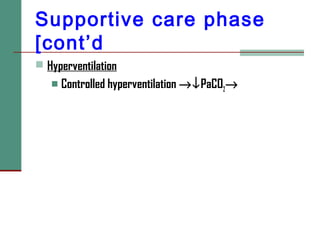
 Hyperventilation
 Controlled hyperventilation →↓PaCO2
→
Supportive care phase
[cont’d
 Correction of contributory factors - Correction of factors
increasing ICP e.g.
 Hypercarbia
 Hypoxia
 Hyperthermia
 Acidosis
 Hypotension
 Hypovolaemia
Definitive care phase
 Medical treatment
 Surgical management
Medical treatment
 Osmotherapy
 Corticosteroids
 Anticonvulsants
 Barbiturates
 Antibiotics
 Analgesics
Osmotherapy
 Intended to draw water out of the brain by an osmotic
gradient and to decrease blood viscosity
 These changes decrease ICP and increase CBF
 Include
 Mannitol
 Diuretics [loop] –e.g. Frusemide
Mannitol
 Potent osmotic agent
 ↓ICP by 2 mechanisms:-
 Drawing water from the brain by osmotic gradient→ ↓cerebral
edema
 ↓viscosity of blood →↑CPP and CBF
 Used when the BBB is intact otherwise if the BBB is disrupted as
in cerebral contusion, Mannitol can leach out into the brain and
potentiate the mass effect
 It becomes ineffective when brain osmolarity becomes iso-
osmolar with that of the serum→so it is of short-term use
 Dose: 1 g/kg 4-6 hourly
Diuretics [loop]
 E.g. Frusemide
 Potent osmotic agent
 Reduces ICP by reducing cerebral edema and CSF production
 It may act synergistically with mannitol
Corticosteroids
 Commonly used corticosteroids e.g. Dexamethasone
 ↓ICP primarily in vasogenic edema
 Less effective in cytotoxic edema
Anticonvulsants
 Includes:-
 Diazepam
 Phenobarbitone
 Phenytoin
 E.g.
 These agents may help treat or prevent early seizures in
head injury
Barbiturates
 E.g. thiopentone
 ↓ICP by reducing cerebral metabolism
 Has been shown to decrease the rate of cerebral metabolism,
decreasing cerebral blood flow and intracranial pressure
 Help to ↓ICP that is refractory to other conventional
measures
Antibiotics
 Prophylactic antibiotics is important in preventing meningitis
and other intracranial infections
Analgesics
 Avoid stronger sedatives especially morphine because they
interfere with the assessment of consciousness and depress
respiration
 Moderate restless is useful, because it is good physiotherapy
for his lung and prevent pressure sores
Surgical management
 Aim
 Indications
 Type of surgery performed
 Site for burr holes
 Types of scalp incisions for craniotomies
Aim of surgical treatment
 To relieve cerebral compression
 To reduce ICP
 To elevate depressed skull pressure
 Treatment of open or penetrating head injuries
Indications
 Deterioration in patient’s levels of consciousness
 Development of focal neurological deficits e.g. hemiplegia
 Pupilary unilateral dilation
 A rise BP associated with bradycardia
 Depressed skull fracture
 Open head injuries
Types of surgery performed
 Decompressive craniotomy
 Elevation of depressed fracture
 Surgical toilet
Site for burr holes
 Parietal burr hole
 Temporal burr hole
 Frontal burr hole
Types of scalp incisions
 Question mark flap
 Bicoronal flap
 Linear incision
 Square-sided flap
CoMpliCATioNs
 Focal neurological deficits
 CSF fistula
 Pneumocephalus
 Intracranial infections
 Posttraumatic Hydrocephalus
 Posttraumatic seizures
 Intracranial vascular injuries
 Posttraumatic epilepsy
 Carotico-cavernous sinus fistula
 Brain death

01. head injuries dr phillip bmc

  • 1.
    HEAD INJURIES Dr PhillipoL. Chalya M.D. ;M.Med [Surg] Surgeon specialist Dept of Surgery BMC
  • 2.
    OUTLINE  Definition  SurgicalAnatomy  Epidemiology  Etiology  Mechanism of injury  Classifications  Pathophysiology  Clinical presentation  Workup  Management  Complications
  • 3.
    DEFINITION  Head injuryis defined as traumatic injuries involving the cranium and intracranial structures (i.e., brain; cranial nerves; meninges; and other structures  Head injury can also be defined as any alteration in mental or physical functioning related to a blow to the head  Maxillofacial injuries is not part of head injury
  • 5.
    SURGICAL ANATOMY  Structuresto be considered in head injuries  Scalp  Skull  Meninges  Brain  CSF
  • 6.
    Scalp  Skin  Thick,hair bearing with many sebaceous glands  Connective tissue  Fibro-fatty  Many blood vessels  Aponeurosis [epicranial]  Tough structure joining occipitalis muscle posteriorly and frontalis anteriorly  Loose areola tissue  Occupies the subaponeurotic space  Pericranium  Periosteum covering the outer surface of the skull
  • 7.
    Skull  22 bonesin total  Consists of:-  8 cranial bones [cranium]  14 facial bones  Cranium is that part of the skull that encloses the brain  The cranium is made up of the vault [the upper part] and the base of the skull [lower part]  The inner aspect of the base of the skull consists of 3 cranial fossae:-  Anterior cranial fossa  Middle cranial fossa  Posterior cranial fossa
  • 10.
    Meninges  3 layers Dura mater  Arachnoid mater  Pia mater
  • 11.
    Dura mater  Conventionally2 layers:  Endosteal layer (periosteum)  Meningeal layer (true dura)  Septa: made up of dural folds  Divides the cranial cavity into 3 compartments  2 upper compartments [supratentorial compartments]  1 lower compartment [infratentorial compartment]  Major dural folds include:-  Falx cerebri  Tentorium cerebelli
  • 12.
    Falx cerebri  Sickle-shaped Upper part is fixed and the lower part is free  Lies vertically in the longitudinal fissure between the 2 cerebral hemispheres  Divides the supratentorial compartment into 2 parts  The 2 supratentorial compartments are occupied by the two cerebral hemispheres
  • 14.
    Tentorium cerebelli  Crescentshaped  Lies horizontally between the occipital lobe of the cerebrum and the cerebellum  Posteriorly is fixed  Anteriorly is free with an opening [tentorial notch] for passage of the midbrain  Has a protective function  it prevents shuddering movements of the brain within the cranial cavity and the folds prevent damage to nervous tissue during sudden rotational movements
  • 16.
    Arachnoid Mater  Internalto the dura mater  Is an avascular membrane  Lies between the pia mater internally and the dura mater externally  It is separated from the pia mater by the subarachnoid cavity or space, which is filled with cerebrospinal fluid.  Called arachnoid because the cobweblike trabeculae crossing the subarachnoid spase to become continuous with the pia mater
  • 17.
    Pia Mater  Vascularmembrane  Closely invests the brain  Descends into gyri  Extends over cranial nerves as they come out the brain – fuses with the epineurium  Forms Tela Choroidea of 3rd & 4th ventricles  Fuses with ependyma to form Choroid Plexus in Lateral, 3rd & 4th ventricles --> CSF
  • 18.
    Brain  Divided intothree major areas  Cerebrum  Brain stem  Cerebellum
  • 19.
    Cerebrum  The cerebrumis composed of 2 cerebral hemispheres  The hemispheres are connected by the corpus callosum  Consists of 4 lobes  Parietal lobe  Frontal lobe  Occipital lobe  Temporal lobe
  • 22.
    Brain stem  Threemajor divisions  Midbrain  Pons  Medulla  10 of the 12 pairs of cranial nerves arise from the brainstem (ipsilateral signs)  Cortical pathways pass through the brainstem and decussate (cross) in the medulla (contralateral signs)
  • 23.
    Cerebellum  This isthe largest part of the hind brain
  • 24.
  • 25.
     Head injurycontinues to be an enormous public health problem, even with modern medicine in the 21st century  It is one of the most common cause of admissions to the A&E department worldwide Incidence
  • 26.
    Morbidity /mortality  Headinjury are the major cause of morbidity and mortality among trauma admissions
  • 27.
    Age  Head injuriesoccur in all age groups, with a peak incidence between the ages of 16 and 25 years and a second peak in the elderly who have a high incidence of chronic subdural haematomas  Head injuries are a leading cause of trauma related deaths in patients young than 45 years
  • 28.
    sex  Males aremore affected than females  The male to female ratio is 2:1 [M:F= 2:1] worldwide
  • 29.
    AETIOLOGY  Road trafficaccidents  Fall injuries  Assault injuries  Sport injuries  Penetrating injuries e.g. bullets, knives, screwdrivers, arrows, nails etc
  • 30.
    MECHANISM OF INJURY Blunt head injury  Penetrating head injury
  • 31.
    Blunt head injury Direct trauma to the head  Occurs in 2 ways: a moving head strikes a fixed object or a moving object strikes an immobile head scalp injury,→ fractures of the skull, contused brain etc  Deceleration head injuries  These are injuries resulting from rapid deceleration of the head causing the brain to move within the cranial cavity and to come into contact with bony protuberances within the skull→ brain contusions, lacerations etc
  • 32.
    Penetrating head injury The severity of penetrating injury is directly proportional to the K.E. of the moving object  K.E. = 1/2mv2, where m= mass, v= velocity  Classified into 2 types according to the velocity which is the main determinant in the equation  High velocity injury  Bullets  Low velocity injury  Knifes, arrows, screwdrivers etc
  • 33.
    CLASSIFICATION  According tomechanism of injury  According to the integrity of the dura mater  According to the site of injury  According to the pathology  According to severity
  • 34.
    According to mechanism ofinjury  Blunt head injury [Non-missile injuries]  Penetrating head injury [Missile injuries]
  • 35.
    Blunt head injury Occurs as a result of blunt force trauma or non-missile injury to the head →injury to the scalp, skull and other intracranial structures  Can also occur as a result of rapid deceleration and acceleration causing the brain to move within the cranial cavity and come into contact with bony prominences within the skull→ contusion, laceration and shearing strains within the brain substances
  • 36.
    Penetrating head injury A penetrating head injury occurs when a sharp object pierces the skull and breaches the dura mater
  • 37.
    According to theintegrity of the dura mater  Open head injury  Closed head injury
  • 38.
    Open head injury Is one in which there is a wound which extends through the scalp, the skull and the dura mater, that is to say the brain is exposed  In open head injury the dura mater is not intact  There is grave danger of infection
  • 39.
    Closed head injury In the closed type of head injury the brain is not exposed to outside world, that is any or all , of the scalp, skull bone and dura mater are intact  In closed head injury the dura mater is intact and the risk of infection is low  Today we are talking of “ BRAIN INJURIES INSIDE THE CLOSED BOX”
  • 40.
    According to thesite of injury  Scalp injury  Skull injury  Meningeal injury  Brain injury  Intracranial vascular injury  Cranial nerves injury
  • 41.
    Scalp injury  Scalplacerations  Scalp cut wounds  Scalp hematoma  Subcutaneous  Subaponerotic  Subpericranial
  • 42.
    Skull injury  Fractureof the vault [vault skull fracture]  Fracture of the base of the skull [basilar fracture]
  • 43.
    Fracture of thevault  According to whether the fracture is exposed to the outside world  Simple [closed] fracture: The fracture is not exposed the outside  Compound [open] fracture : The fracture is exposed to the outside  According to the type of fracture  Liner fracture  Depressed fracture  Comminuted fracture
  • 44.
    Fracture of thebase of the skull  Fracture of the anterior cranial fossa  Fracture of the middle cranial fossa  Fracture of the posterior cranial fossa
  • 45.
    Fracture of theanterior cranial fossa  The patient will present with:-  Nasal bleeding (epistaxis), traumatic CSF rhinorrhoea or escape of brain mater through the nose  Periorbital ecchymosis (racoon eyes), subconjuctival h’ge extending beyond the conjuctival reflections intraorbital h’ge  Anosmia if both olfactory nerves are damaged  Injuries to 3rd , 4th , 1st division of 5th and 6th at the sphenoidal fissure  3rd palsy produces dilated a pupil in a conscious patient
  • 46.
    Fracture of themiddle cranial fossa  This presents with:-  Bleeding from the ears [hemotympanum] or mouth  CSF otorrhoea  CSF Rhinorrhoea via the eustachian tube  Oscular disruption  7th and 8th cranial nerve palsies →facial palsy and deafness respectively
  • 47.
    Fracture of theposterior cranial fossa  Extravasation of blood may be seen in the suboccipal region producing a swelling at the back  Post auricular [posterior to the mastoid process] ecchymosis [Battle’s sign]  Injury to the 9th , 10th and 11st at the jugular foramen
  • 48.
    Meningeal injury  Thisoccurs commonly as a result of fracture of the skull  The type of fracture of the skull which causes laceration of the dura mater is the depressed compound fracture
  • 49.
    Brain injury  Primarybrain injury  That is damage which occurs at the time of injury  Secondary brain injury  That is damage which occurs as a consequence of primary brain damage
  • 50.
    Primary brain injury Cerebral concussion  Cerebral contusion  Cerebral laceration  Diffuse axonal injury
  • 51.
    Cerebral concussion  Temporaryphysiological loss of function without any organic structural damage  The patient becomes unconscious for a short period , followed by complete and perfect recovery  Develops immediately after injury  It may be accompanied by autonomic abnormalities e.g. bradycardia, hypotension & sweating  Prolonged LOC means something easy than pure concussion
  • 52.
    Cerebral contusion  Bruisingof the brain  Characterized by rupture of white fibres of the brain causing peticheal h,ge in the cerebral parenchyma  Usually produces neurological deficits that persist for > 24 hrs  Contusions may resolve together with the accompanying deficits or the may persist  Blood-brain barrier defects and cerebral edema are common and these lesions enlarge or coalesce with time
  • 53.
    Cerebral laceration  Inthis condition the brain surface is torn with effusion of blood into CSF→SAH [subarachnoid h’ge]  This occurs when there is a significant force to the skull →laceration of the brain as a result of rapid movement and shearing of brain tissue  The pia mater and arachnoid may be torn →ICH [intra-cerebral h’ge]  Focal neurological deficits are common  Clinically presents as cerebral contusion
  • 54.
    Diffuse axonal injury This type of brain damage occurs as a result of mechanical shearing following deceleration, causing disruption and tearing of axons, especially at the grey/white matter interfaces
  • 55.
    Secondary brain injury Intracranial hematoma  Cerebral edema  Brain herniation  Cerebral ischaemia  Infection  Epilepsy
  • 56.
    Intracranial vascular injuries Epidural / extradural hematoma  Subdural haematoma  Subarachnoid haematoma  Intracerebral hematoma
  • 57.
    Epidural / extradural hematoma This is haematoma between the inner table of the skull and the dura mater  Occurs as a result of injury to the middle meningeal artery  If untreated →midline shift, brain herniation, midbrain compression  Commonly presents with “lucid interval”
  • 58.
    Subdural haematoma  Haematomabetween the dura and the arachnoid mater  More common  Occurs as result of tearing of bridging veins crossing the subdural space from the cortex to the dura  Can also occur as a result of cortical laceration or bleeding from the dural venous sinuses  Described as acute or chronic depending on the age
  • 59.
    Subarachnoid haematoma  Haematomain the space between the arachnoid space and the pia mater [subarachnoid space]  Occurs when a vessel ruptures into the subarachnoid layer or in case of cerebral lacerations  There is extravasations of blood under pressure into the CSF space, ventricles or into the brain itself  The patient presents with severe headache of sudden onset, nausea and vomiting
  • 60.
    Intracerebral hematoma  Thisis haematoma formed within the brain parenchyma  They are due to areas of contusion coalescing into a contusional haematoma  They appear as hyperdense lesions on the CT scan with associated mass effect and midline shift
  • 61.
    Cranial nerve injuries Head injury may be associated with the injuries to deferent cranial nerves  The 3rd cranial nerve is the most important as it is involved even by cerebral compression besides direct injury  The different cranial nerves are injured in fracture of different parts of the base of the skull
  • 62.
    According to the pathology Focal head injury  Diffuse head injury
  • 63.
    Focal head injury In this type, the injury is localized to only part of the head  Focal injuries include scalp injury, skull fracture, and surface contusions and are generally be caused by direct impact
  • 64.
    Diffuse head injury Diffuse injuries include diffuse axonal injury, hypoxic- ischemic damage, meningitis, and vascular injury  They are usually caused by acceleration-deceleration forces
  • 65.
    According to severity Classified according to Glasgow Coma Score [GCS]  Classified into:-  Mild head injury [GCS of 13-15]  Moderate head injury [GCS of 9-12]  Severe head injury [ GCS of 3-8 ]
  • 66.
    PATHOPHYSIOLOGY  Requires understandingof the following crucial concepts:-  The concept of Monro-Kellie doctrine  The concept of Cerebral Perfusion Pressure [CPP]  The concept of increased ICP
  • 67.
    Monro-Kellie doctrine  Theskull is a rigid structure (once the sutures have fused)  3 components within that have a balance  80% brain  10% blood  10% CSF  If any one of these components increases [or if there is a SOL] another component must decrease to maintain the balance (ICP)  If this does not happen then there will be an increase in ICP  This observations were first reported by Monro [1783] and confirmed by Kellie 40 years later→ becoming known as the Monro-Kellie docrine
  • 68.
    Cerebral Perfusion Pressure [CPP] CPP is defined as the difference between the mean arterial pressure (MAP) and the ICP [ i.e. CPP = MAP – ICP]  CPP is the net pressure required to deliver blood to the brain  Cerebral blood flow (CBF) is constant in the range of MAPs of 50- 150 mm Hg  This is due to autoregulation by the arterioles  As ICP increases, in order to maintain a constant CPP there has to be a compensatory rise in the MAP  A hypertensive response is therefore elicited which classically is associated with bradycardia  This is termed as the Cushing reflex after the eminent American neurosurgeon
  • 69.
    Increased ICP  Mayresult from primary or secondary brain injury  Normal ICP in adult is 0-15 mmHg, in children is 0-10 mmHg  This causes:-  Cerebral herniation  Cerebral edema  Cerebral ischaemia
  • 70.
    Brain herniation  Severaltypes of herniation exist, as follows:  Transtentorial herniation  Subfalcine herniation  Central herniation  Cerebellar herniation  Upward cerebellar herniation  Tonsillar herniation
  • 71.
    Transtentorial herniation  Occurswhen the medial aspect of the temporal lobe (uncus) migrates across the free edge of the tentorium  This causes pressure on the third cranial nerve, interrupting parasympathetic input to the eye and resulting in a dilated pupil  This unilateral dilated pupil is the classic sign of transtentorial herniation and usually (80%) occurs ipsilateral to the side of the transtentorial herniation  In addition to pressure on the third cranial nerve, transtentorial herniation compresses the brainstem
  • 72.
    Subfalcine herniation  Occurswhen the cingulate gyrus on the medial aspect of the frontal lobe is displaced across the midline under the free edge of the falx  This may compromise the blood flow through the anterior cerebral artery complexes, which are located on the medial side of each frontal lobe  Subfalcine herniation does not cause the same brainstem effects as those caused by transtentorial herniation
  • 73.
    Central herniation  Centralherniation occurs when a diffuse increase in ICP occurs  Each of the cerebral hemispheres is displaced through the tentorium, resulting in significant pressure on the upper brainstem
  • 74.
    Cerebellar herniation  2types:-  Upward cerebellar herniation  Downward cerebellar herniation [tonsillar]
  • 75.
    Upward cerebellar herniation Occurs when either a large mass or increased pressure in the posterior fossa is present and the cerebellum is displaced in an upward direction through the tentorial opening  This also causes significant upper brainstem compression
  • 76.
    Tonsillar herniation  Occurswhen increased pressure develops in the posterior fossa  In this form of herniation, the cerebellar tonsils are displaced in a downward direction through the foramen magnum, causing compression on the lower brainstem and upper cervical spinal cord as they pass through the foramen magnum
  • 77.
    Cerebral edema  Vasogeniccerebral edema  Cytotoxic cerebral edema  Interstitial cerebral edema
  • 78.
    Vasogenic cerebral edema Refers to the influx of fluid and solutes into the brain tissue through an incompetent or damaged blood-brain-barrier (BBB)  This is the most common type of brain edema and results from increased permeability of the capillary endothelial cells  Breakdown of the BBB allows movement of proteins from the intravascular space through the capillary wall into the extracellular space→ influx of fluid and solutes
  • 79.
    Cytotoxic cerebral edema In this type of edema the BBB remains intact  This edema is due to the derangement in cellular metabolism resulting in inadequate functioning of the sodium and potassium pump in the glial cell membrane  As a result there is cellular retention of sodium and water →swelling of the glia, neurons and endothelial cells  Cytotoxic edema affects predominantly the grey mater
  • 80.
    Interstitial cerebral edema This is seen in hydrocephalus when the outflow of CSF is obstructed and intraventricular pressure increases  The result is movement of sodium and water across the ventricular wall into the paraventricular space
  • 81.
    Cerebral ischaemia  ICPresults in CPP and therefore CBF [CPP= MAP-ICP]→ cerebral ischaemia  This is common after severe head injury and is caused by a combination of either hypoxia and impaired cerebral perfusion  The brain is unable to autoregulate its blood supply with a decrease in blood pressure
  • 82.
  • 83.
    History [cont’d]  Takenfrom an eye witness if the patient is unconscious or from the patient  Include;-  Mechanism and full details of injury  For example:  Fall: Height, surface, posture of fall, point of contact  Motor vehicle collision: Speed, place in car, restraint, point of impact  etc
  • 84.
    History [cont’d]  Timeof accident  Level of consciousness / unconscious?  Time of onset of unconsciousness  Duration of unconsciousness  Lucid interval  Amnesia [loss of memory]–  Retrograde Traumatic Amnesia  Post-traumatic amnesia
  • 85.
    History [cont’d]  Currentsymptoms  Headache, vomiting, bleeding from ENT, LOC, fits, other associated injuries  Pre-morbid illness  Diabetes mellitus  Renal diseases  Hypertension  Previous history of fits  History of medications and Allergies  Habit of taking alcohol or opium
  • 86.
    Physical Examination  Head Scalp lacerations or haematoma  Fractures: depressed, base of skull (“raccoon eyes”, “Battles sign”  CSF leak, blood in the ear canal or behind the tympanic membrane, bleeding from nose or mouth etc  Face  Fractures  intra-oral injuries
  • 87.
    Physical Examination [cont’d]  Neck Neck rigidity  Immobilization is required until stability is assured  Trunk  Evidence of chest injuries  Evidence of abdominal injuries  MSS [limbs, pelvis and spines]  Closed or open wounds, fractures  Neurological  Level of consciousness (GCS), pupilary size and reaction to light Focal signs, brainstem reflexes, motor function
  • 88.
    WORKUP  Laboratory investigations Imaging investigations  Other investigations
  • 89.
    Laboratory investigations  Haemogram Serum sugar  Serum electrolytes  RFT  Grouping & cross-matching  Coagulation profile
  • 90.
    Imaging investigations  Skullx-rays  CT Scan brain/skull  MRI [Magnetic Resonance Imaging]  Cervical x-rays
  • 91.
    Skull x-rays  2views  AP-views  Lateral views  Can revealed  Fracture of the skull  Other bony abnormalities  If CT scan is easily available Skull x-ray can be avoided as with CT scan all the relevant information obtained in skull x-ray can be obtained with bone windows of CT scan
  • 92.
    CT Scan brain/skull Investigation of choice  Can reveal  Bony injury  Haematomas  Evidence of cerebral edema  Mass effect [midline shift]  It is necessary for operative planning
  • 93.
    CT Scan brain/skull[cont’d]  Indications  Moderate to severe head injury  Deteriorating levels of consciousness  Depressed fractures  Focal neurological deficits  Evidence of basilar fracture  Penetrating head trauma  Persistent severe headache and vomiting  Seizures
  • 94.
    Magnetic Resonance Imaging [MRI] Has no role in acute management of patients with head injury  Can be used in case of diffuse axonal injury and in follow-up prognostication  Able to detect small lesions in vital areas of brain not seen by CT scan  Preserved for later detail evaluation after acute problem has been addressed
  • 95.
    Cervical spine x-ray 2 views  AP view  Lateral view  Done to exclude associated cervical spine injuries  CERVICAL SPINAL COLLAR should be kept on until a fracture or dislocation of the cervical spine has been ruled out
  • 96.
    Other investigations  Carotidangiography  Electro-encephalography  Echo-encephalography
  • 97.
    Carotid angiography  Playsan important role to demonstrate the site of the lesion  Not performed in acute conditions  Can indicate:-  Subdural haematoma  Displacement of the cortical vessels away from the inner table of the skull  Epidural haematoma  Displacement of middle cerebral artery inward  Displacement of anterior cerebral artery across the midline  Intracerebral haematoma  Displacement of the middle cerebral artery upwards
  • 98.
    Electro-encephalography  This investigationwill show areas of suppressed activity of the cortex due to injury or pressure by h’ge
  • 99.
    Echo-encephalography  This willindicate the presence of haematoma by indicating a shift of the midline structure  It is not of much help in subdural haematoma as half of the cases are bilateral with no midline shift
  • 100.
    MANAGEMENT  Criteria foradmission  The management of head injury follow Advanced Trauma Life Support [ATLS] guideline  6 phases  Primary survey phase  Resuscitation phase  Secondary survey phase  Tertiary survey phase  Supportive care phase  Definitive care phase
  • 101.
    Criteria for admission Moderate to severe head injury  No CT scan available or abnormal CT Head  All penetrating head injuries  History of loss of consciousness  Deteriorating Level of Consciousness  Moderate to severe Headache  Significant Alcohol or drug intoxication  Skull Fracture  Cerebrospinal Fluid leakage (Otorrhea or Rhinorrhea)  Significant associated injuries  No reliable companion at home or displaced home  Amnesia
  • 102.
    Primary survey phase Aimed at identifying the immediately life threatening conditions  Elements of primary survey phase:-  Airway with cervical spine control  Breathing and ventilation  Circulation with control of hemorrhage  Dysfunction of the CNS  Exposure in a controlled environment
  • 103.
    Resuscitation phase  Donesimultaneously with primary survey phase  Needs multidisciplinary approach  Aimed at treating the immediately life threatening conditions  Establish a patent airway and immobilization of cervical spine  Ensure breathing and adequate ventilatory support  Restore circulatory volume and h’ge control  Brief neurological evaluation  Fully expose [undress] the patient
  • 104.
    Airway with cervicalspine control  A clear patent and functional airway should be established  This can be achieved by:-  Use of airways  Proper position of the patient  Endotracheal intubation  Ambubags  Tracheostomy
  • 105.
    Breathing and ventilation Make sure the patient is breathing properly  Achieved by:-  use of oxygen masks  Mechanical ventilators
  • 106.
    Circulation with controlof hemorrhage  Patients with head trauma may be associated with massive blood loss leading to hemorrhagic shock  A functional i.v. fluid should be established to restore blood volume and prevent irreversible shock  During the shock state use crystalloid fluid  Glucose containing solutions should be avoided; euvolaemia should be maintained  BT should be given in case of hemorrhagic shock
  • 107.
    Dysfunction of theCNS  Brief neurological evaluation should be done  This involves brief assessment of the following:-  Level of consciousness using GCS  Pupilary size and reaction to light  Motor function  Sensory function  Reflexes
  • 108.
    Exposure in acontrolled environment  The patient should be fully exposed to be able to exclude missed injuries
  • 109.
    Secondary survey phase This include:-  History  Physical examination  Investigations as above
  • 110.
    Tertiary survey phase A routine head-to-toe examination of a patient should take place within 24 hours of the injury to document any missed injuries and re-evaluate existing injuries and their treatment
  • 111.
    Supportive care phase Position:  In a recovery position  Elevate the head by 15-30 o [take care of cervical fracture]  2 hourly turning to avoid pressure sores  Urethral catheterization to empty the bladder in order to:-  Avoid renal complications  Enable good record of his output to be kept  To ensure the bed is dry  NGT should be inserted in all patients with severe head injury except patient with nasal bleeding and rhinorrhoea  To empty the stomach and for feeding
  • 112.
    Supportive care phase [cont’d] Monitor:  Levels of consciousness  Pupillary size and reaction to light  Vital signs  Input-output chart  Motor and sensory functions  Nutrition support  Patients who started on nutrition earlier have better out come than when it is started later
  • 113.
    Supportive care phase [cont’d Hyperthermia  Temperature of 32-34 o C is maintained for at least 48 hours and is to be started within 8 hours of traumatic brain injury  Has been shown to decrease the rate of cerebral metabolism, decreasing cerebral blood flow and intracranial pressure  Use of this technique is limited, as it increases risk of infection, cardiac arrhythmia, and coagulopathy
  • 114.
    Supportive care phase [cont’d Hyperventilation  Controlled hyperventilation →↓PaCO2 →
  • 115.
    Supportive care phase [cont’d Correction of contributory factors - Correction of factors increasing ICP e.g.  Hypercarbia  Hypoxia  Hyperthermia  Acidosis  Hypotension  Hypovolaemia
  • 116.
    Definitive care phase Medical treatment  Surgical management
  • 117.
    Medical treatment  Osmotherapy Corticosteroids  Anticonvulsants  Barbiturates  Antibiotics  Analgesics
  • 118.
    Osmotherapy  Intended todraw water out of the brain by an osmotic gradient and to decrease blood viscosity  These changes decrease ICP and increase CBF  Include  Mannitol  Diuretics [loop] –e.g. Frusemide
  • 119.
    Mannitol  Potent osmoticagent  ↓ICP by 2 mechanisms:-  Drawing water from the brain by osmotic gradient→ ↓cerebral edema  ↓viscosity of blood →↑CPP and CBF  Used when the BBB is intact otherwise if the BBB is disrupted as in cerebral contusion, Mannitol can leach out into the brain and potentiate the mass effect  It becomes ineffective when brain osmolarity becomes iso- osmolar with that of the serum→so it is of short-term use  Dose: 1 g/kg 4-6 hourly
  • 120.
    Diuretics [loop]  E.g.Frusemide  Potent osmotic agent  Reduces ICP by reducing cerebral edema and CSF production  It may act synergistically with mannitol
  • 121.
    Corticosteroids  Commonly usedcorticosteroids e.g. Dexamethasone  ↓ICP primarily in vasogenic edema  Less effective in cytotoxic edema
  • 122.
    Anticonvulsants  Includes:-  Diazepam Phenobarbitone  Phenytoin  E.g.  These agents may help treat or prevent early seizures in head injury
  • 123.
    Barbiturates  E.g. thiopentone ↓ICP by reducing cerebral metabolism  Has been shown to decrease the rate of cerebral metabolism, decreasing cerebral blood flow and intracranial pressure  Help to ↓ICP that is refractory to other conventional measures
  • 124.
    Antibiotics  Prophylactic antibioticsis important in preventing meningitis and other intracranial infections
  • 125.
    Analgesics  Avoid strongersedatives especially morphine because they interfere with the assessment of consciousness and depress respiration  Moderate restless is useful, because it is good physiotherapy for his lung and prevent pressure sores
  • 126.
    Surgical management  Aim Indications  Type of surgery performed  Site for burr holes  Types of scalp incisions for craniotomies
  • 127.
    Aim of surgicaltreatment  To relieve cerebral compression  To reduce ICP  To elevate depressed skull pressure  Treatment of open or penetrating head injuries
  • 128.
    Indications  Deterioration inpatient’s levels of consciousness  Development of focal neurological deficits e.g. hemiplegia  Pupilary unilateral dilation  A rise BP associated with bradycardia  Depressed skull fracture  Open head injuries
  • 129.
    Types of surgeryperformed  Decompressive craniotomy  Elevation of depressed fracture  Surgical toilet
  • 130.
    Site for burrholes  Parietal burr hole  Temporal burr hole  Frontal burr hole
  • 131.
    Types of scalpincisions  Question mark flap  Bicoronal flap  Linear incision  Square-sided flap
  • 132.
    CoMpliCATioNs  Focal neurologicaldeficits  CSF fistula  Pneumocephalus  Intracranial infections  Posttraumatic Hydrocephalus  Posttraumatic seizures  Intracranial vascular injuries  Posttraumatic epilepsy  Carotico-cavernous sinus fistula  Brain death