PRESENTATION ON
‘HEAD INJURY MANAGEMENT’
DR. EMRAN MURSHED
MEDICAL OFFICER , SINGRA UPAZILA HEALTH COMPLEX
� Determination of grading of head injury
� When to do CT Scan
� When to refer in specialized neurosurgical centre
� Pre referral management
� When to discharge
� When to do surgical intervention
� Post head injury effects
Outline
Approach to a head injured patient
Resuscitation is performed according to Advanced
Trauma and Life Support (ATLS) guidelines, beginning
with management of the airway and cervical spine
control, and proceeding to assess and manage
breathing and circulation. History obtained in parallel is
key to shaping ongoing management
History
Bystanders and paramedics may give vital information
on the:
●● preinjury state (fits, alcohol, chest pain)
●● mechanism and energy involved in the injury
(speed of vehicles, height fallen]
●● conscious state and haemodynamic stability
of the patient after the accident
●● length of time taken for extrication
●● Check the medication history especially
anticoagulants and antiplatelet agents
Primary survey
●● Ensure adequate oxygenation and
circulation
●● Exclude hypoglycaemia
●● Check pupil size and response and Glasgow
Coma Scale score as soon as possible
●● Check for focal neurological deficits before
intubation, if possible
Pupils
Uncal herniation can compress the third nerve,
compromising the parasympathetic supply to the pupil.
Unopposed sympathetic activity produces a sluggish
enlarged pupil, progressing to fixed and dilated under
continued compression.
Glasgow Coma Scale score
Head injury classification using the
Glasgow Coma Scale (GCS) score.
●● Minor head injury GCS 15 with
no loss of consciousness (LOC)
●● Mild head injury GCS 14 or 15
with LOC
●● Moderate head injury GCS 9–
13
●● Severe head injury GCS 3–8
Neurological deficit
Gross focal neurological deficits, such as paraplegia,
may be evident at the primary survey.
Secondary survey
●● Battle’s sign, periorbital bruising and blood in
ears/nose/ mouth may point to base of skull fracture .
Skll base # may be complicated by CSF leak, pituitary
dysfunction, arterial dissection, cranial nerve deficit with
anosmia, facial palsy or hearing loss.
●● Cervical spine fractures are common and must be
actively excluded
●● Log-roll to check whole spine for steps and
tenderness, and for per rectum exam
Secondary survey
BATTLE SIGN
RACOON EYES
INVESTIGATION
Baseline investigations :
●●blood grouping and Rh Typing
●●full blood count
●● RBS
●● s.creatinine
●● urinalysis
●● s.electrolyte
●● ABG
INVESTIGATION
Specific investigation :
●●Skull and cervical spine x ray
●●cranial CT scan
●● Brain MRI
●● Transcranial doppler
cranial CT scan
Considered as best diagnostic tool to evaluate cranio-
cerebral trauma as it allows rapid diagnosis and helps in
decision making wheather intervention is needed or
not.
National Institute for Health and Care Excellence
guidelines for computed tomography (CT) in head
injury.
cranial CT scan
Indications for CT imaging within 1 hour
●● GCS <13 at any point
●● GCS <15 at 2 hours
●● Focal neurological deficit
●● Suspected open, depressed or basal skull fracture
●● More than one episode of vomiting
●● Post-traumatic seizure
cranial CT scan
Indications for CT imaging within 8 hours
●● Age >65 years
●● Coagulopathy (e.g. aspirin, warfarin or rivaroxaban use)
●● Dangerous mechanism of injury (e.g. fall from a height,
road traffic accident)
●● Retrograde amnesia >30 minutes
Management of head injury
●● PREVENTION OF SECONDARY BRAIN INJURY
●● CONTROL OF INTRACRANIAL PRESSURE
●● ENDOCRINE AND METABOLIC MANAGEMENT
●● CONTROL OF SEIZURE
●● NUTRITION
●● PEPTIC ULCER PROPHYLAXIS
●● ANTIBIOTIC PROPHYLAXIS
●● TETANUS prophylaxis
PREVENTION OF SECONDARY BRAIN INJURY
� avoidance of hypoxia and hypotension
� control of ICP.
CPP (75–105 mmHg) = MAP (90–110 mmHg) – ICP (5–15
mmHg)
A sustained rise of ICP over 20–25 mmHg above normal is
associated with a poor outcome, and maintenance of a
cerebral perfusion pressure of at least 60 mmHg is
important in preventing secondary injury.
PREVENTION OF SECONDARY BRAIN INJURY
Brain swelling and mass lesions contribute to a raised intracranial pressure,
which compromises perfusion, leading to secondary brain injury and
further swelling.
CONTROL OF INTRACRANIAL PRESSURE
Initial measure
●● Head up 20-30 degree
●● Loosen collar which doesnot restrict venous drainage
●● Optimse ventilation
●● Optimise electrolyte balance
(hypertonic fluid if necessary , isotonic fluid is choosen , hypotonic
fluid is always avoided )
●● Treat hyperglycema
●● Sedation using combination of opiates and barbiturates
●● Seizure control
CONTROL OF INTRACRANIAL PRESSURE
Intermediate measure
●● Manitol 20 percent 100 ml as a bolus dose.
Repeated use is controversial as it may cause hypovolumia
and hypotension .
CONTROL OF INTRACRANIAL PRESSURE
Final measure
●● Early evacuation of focal haematoma [ EDH,SDH ]
by burr hole or craniotomy
●● decompressive craniectomy
●● CSF drainage by insertion of EVD
.
CONTROL OF INTRACRANIAL PRESSURE
An external ventricular drain (EVD), also
known as ventriculostomy or extraventricular
drain, is a device used in neurosurgery to
treat hydrocephalus and relieve
elevated intracranial pressure when the
normal flow of CSF inside the brain is
obstructed.
craniotomy: surgical opening of a portion of the
skull to gain access to the intracranial
structures and replacement of the bone flap.
Decompressive craniectomy: is a neurosurgical
procedure in which part of the skull is removed to
allow a swelling brain room to expand without
being squeezed.
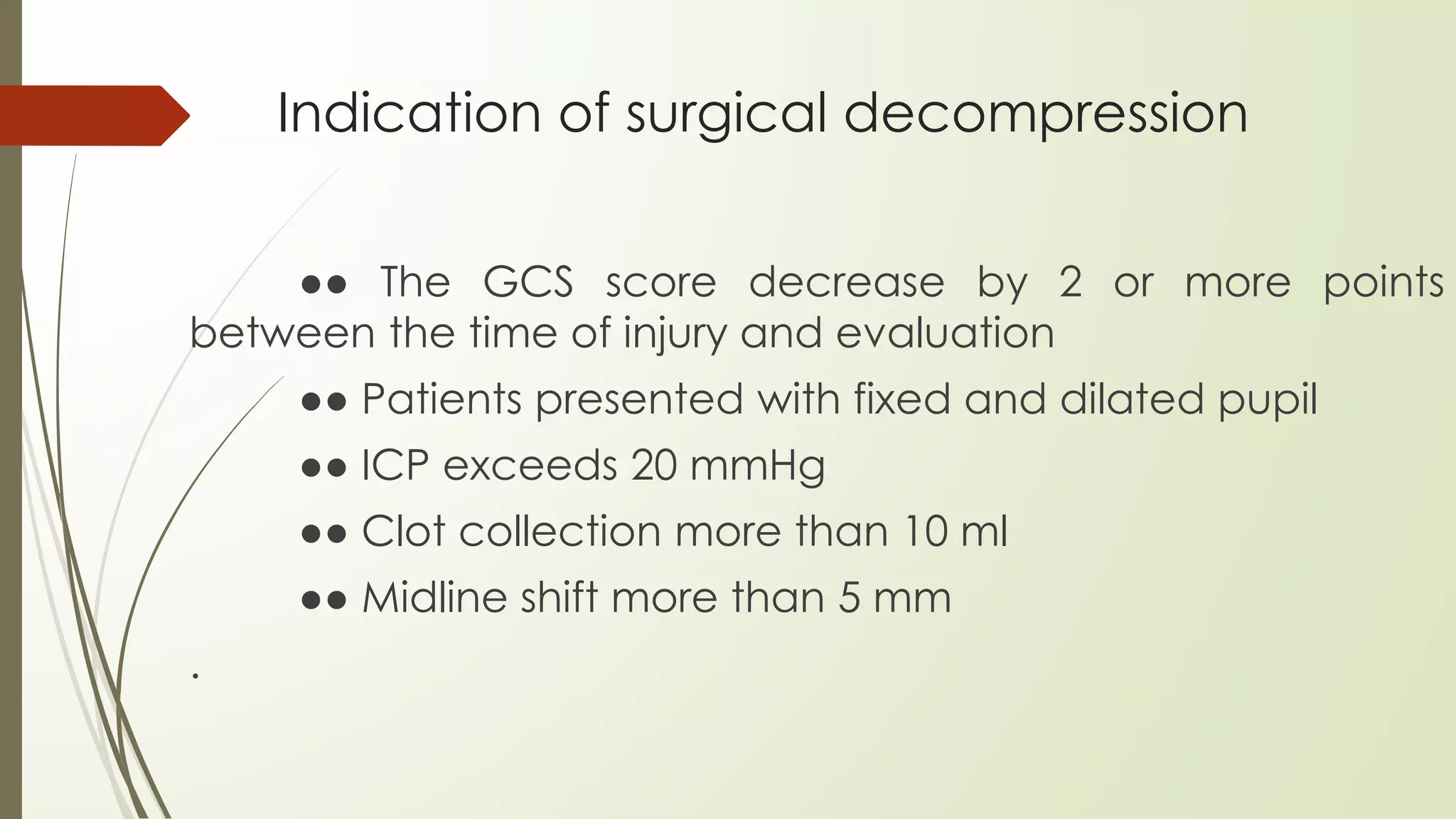
Indication of surgical decompression
●● The GCS score decrease by 2 or more points
between the time of injury and evaluation
●● Patients presented with fixed and dilated pupil
●● ICP exceeds 20 mmHg
●● Clot collection more than 10 ml
●● Midline shift more than 5 mm
.
EXTRADURAL AND SUBDURAL HAEMATOMA
A large extradural haematoma (note the biconvex
shape) exerts mass effect .
EXTRADURAL AND SUBDURAL HAEMATOMA
A surgical temporal bone exposure showing a linear
skull fracture with underlying extradural haematoma
visible through a burr hole.
Subarachnoid Haemorrhage
Blood in circle of willis, cisterns and fissure
Subarachnoid Haemorrhage
Trauma is the commonest cause of subarachnoid haemorrhage , and this is managed
conservatively. It is not usually associated with significant vasospasm, which
characterises aneurysmal subarachnoid haemorrhage .
Subarachnoid Haemorrhage
Right frontal intracerebral haematoma extending into the lateral
ventricle is evident.
Endovascular treatment is generally preferred over craniotomy .
Intracranial Haemorrhage
❑10-15 percent of all strokes with 40 percent
mortality
❑May be spontaneous or traumatic .
❑Occurs at a context of HTN or amyloid
angiopathy or as a complication of ischemic
stroke
❑Presented as focal neurological deficit with or
without decreased conciousness level
❑High blood should be reduced with care
❑Anticoagulents should be reversed at once
❑Craniotomy and evacuation is especially
helpful in young patients
ENDOCRINE AND METABOLIC MANAGEMENT
Electrolyte imbalance is common in TBI and contribute to
brain swelling and to causing seizure . Morever cerebral salt
wasting [poorly understood mechanism ] causing volume
depletion and hyponatremia .
low osmotic pressure can contribute to brain swelling , so
hypotonic fluids are avoided in this setting .
Administration of steroid in severe head injury is associated
with increased mortality and it is not recommended .
CONTROL OF SEIZURE
Antiepeleptics, typically phenytoin are administered
prophylactically to patients with high risk [3-5 mg/kg/day]
High risk patrients are:
●● depressed skull
●● presence of ICH
●● tears of dura
.
NUTRITION
Enteral feeding should be started within 72 hours .
PEPTIC ULCER PROPHYLAXIS by PPI
ANTIBIOTIC PROPHYLAXIS to combat infection .
TETANUS prophylaxis
key parameters to maintain in patients in
neurointensive care.
●● pCO2 = 4.5–5.0 kPa
●● pO2>11 kPa
●● MAP = 80–90 mmHg
●● ICP <20 mmHg
●● CPP >60 mmHg
●● [Na+] >140 mmol/L
●● [K+] >4 mmol/L
Scalp injury
❑Scalp wound are highly vascular
❑Avoid direct pressure if there is
underlying unstable #
❑After hemostasis is achieved and the
wound is irrigated, scalp lacerations
are typically closed with surgical
staples under local anesthesia. Sutures
may be preferred over staples for
large, gaping wounds and to provide
hemostasis for wounds with brisk
bleeding.
OUTCOME AND SEQUELAE
Mild injury
Concussion is defined as alteration of conciousness as a result of
closed head injury. LOC at the time of injury is not prerequisite
.key features includes confusion and amnesia .
Postconcussive syndrome Patients may report somatic features
such as headache, dizziness and disorders of hearing and vision.
They may also suffer a variety of neurocognitive and
neuropsychological disturbances, including difficulty with
concentration and recall, insomnia, emotional lability, fatigue,
depression and personality change.
The long-term sequelae of moderate and severe traumatic
� Brain injury include headache, memory and cognitive
impairments.
� Good recovery implies independence return to work
rather than a full return to previous capacity.
� Rehabilitation represents a complex and prolonged
multidisciplinary challenge.
REFERENCE
SHORT
PRACTICE of
SURGERY
Bailey &
Love’s : 27th
EDITION
Clinical
surgery in
general : RCS
course
manual: 4TH
EDITION
Google
[photo)
Thanks to all

HEAD-injury-MX.-Copy 5.pptx

  • 1.
    PRESENTATION ON ‘HEAD INJURYMANAGEMENT’ DR. EMRAN MURSHED MEDICAL OFFICER , SINGRA UPAZILA HEALTH COMPLEX
  • 2.
    � Determination ofgrading of head injury � When to do CT Scan � When to refer in specialized neurosurgical centre � Pre referral management � When to discharge � When to do surgical intervention � Post head injury effects Outline
  • 3.
    Approach to ahead injured patient Resuscitation is performed according to Advanced Trauma and Life Support (ATLS) guidelines, beginning with management of the airway and cervical spine control, and proceeding to assess and manage breathing and circulation. History obtained in parallel is key to shaping ongoing management
  • 4.
    History Bystanders and paramedicsmay give vital information on the: ●● preinjury state (fits, alcohol, chest pain) ●● mechanism and energy involved in the injury (speed of vehicles, height fallen] ●● conscious state and haemodynamic stability of the patient after the accident ●● length of time taken for extrication ●● Check the medication history especially anticoagulants and antiplatelet agents
  • 5.
    Primary survey ●● Ensureadequate oxygenation and circulation ●● Exclude hypoglycaemia ●● Check pupil size and response and Glasgow Coma Scale score as soon as possible ●● Check for focal neurological deficits before intubation, if possible
  • 6.
    Pupils Uncal herniation cancompress the third nerve, compromising the parasympathetic supply to the pupil. Unopposed sympathetic activity produces a sluggish enlarged pupil, progressing to fixed and dilated under continued compression.
  • 7.
    Glasgow Coma Scalescore Head injury classification using the Glasgow Coma Scale (GCS) score. ●● Minor head injury GCS 15 with no loss of consciousness (LOC) ●● Mild head injury GCS 14 or 15 with LOC ●● Moderate head injury GCS 9– 13 ●● Severe head injury GCS 3–8
  • 8.
    Neurological deficit Gross focalneurological deficits, such as paraplegia, may be evident at the primary survey.
  • 9.
    Secondary survey ●● Battle’ssign, periorbital bruising and blood in ears/nose/ mouth may point to base of skull fracture . Skll base # may be complicated by CSF leak, pituitary dysfunction, arterial dissection, cranial nerve deficit with anosmia, facial palsy or hearing loss. ●● Cervical spine fractures are common and must be actively excluded ●● Log-roll to check whole spine for steps and tenderness, and for per rectum exam
  • 10.
  • 11.
    INVESTIGATION Baseline investigations : ●●bloodgrouping and Rh Typing ●●full blood count ●● RBS ●● s.creatinine ●● urinalysis ●● s.electrolyte ●● ABG
  • 12.
    INVESTIGATION Specific investigation : ●●Skulland cervical spine x ray ●●cranial CT scan ●● Brain MRI ●● Transcranial doppler
  • 13.
    cranial CT scan Consideredas best diagnostic tool to evaluate cranio- cerebral trauma as it allows rapid diagnosis and helps in decision making wheather intervention is needed or not. National Institute for Health and Care Excellence guidelines for computed tomography (CT) in head injury.
  • 14.
    cranial CT scan Indicationsfor CT imaging within 1 hour ●● GCS <13 at any point ●● GCS <15 at 2 hours ●● Focal neurological deficit ●● Suspected open, depressed or basal skull fracture ●● More than one episode of vomiting ●● Post-traumatic seizure
  • 15.
    cranial CT scan Indicationsfor CT imaging within 8 hours ●● Age >65 years ●● Coagulopathy (e.g. aspirin, warfarin or rivaroxaban use) ●● Dangerous mechanism of injury (e.g. fall from a height, road traffic accident) ●● Retrograde amnesia >30 minutes
  • 16.
    Management of headinjury ●● PREVENTION OF SECONDARY BRAIN INJURY ●● CONTROL OF INTRACRANIAL PRESSURE ●● ENDOCRINE AND METABOLIC MANAGEMENT ●● CONTROL OF SEIZURE ●● NUTRITION ●● PEPTIC ULCER PROPHYLAXIS ●● ANTIBIOTIC PROPHYLAXIS ●● TETANUS prophylaxis
  • 17.
    PREVENTION OF SECONDARYBRAIN INJURY � avoidance of hypoxia and hypotension � control of ICP. CPP (75–105 mmHg) = MAP (90–110 mmHg) – ICP (5–15 mmHg) A sustained rise of ICP over 20–25 mmHg above normal is associated with a poor outcome, and maintenance of a cerebral perfusion pressure of at least 60 mmHg is important in preventing secondary injury.
  • 18.
    PREVENTION OF SECONDARYBRAIN INJURY Brain swelling and mass lesions contribute to a raised intracranial pressure, which compromises perfusion, leading to secondary brain injury and further swelling.
  • 19.
    CONTROL OF INTRACRANIALPRESSURE Initial measure ●● Head up 20-30 degree ●● Loosen collar which doesnot restrict venous drainage ●● Optimse ventilation ●● Optimise electrolyte balance (hypertonic fluid if necessary , isotonic fluid is choosen , hypotonic fluid is always avoided ) ●● Treat hyperglycema ●● Sedation using combination of opiates and barbiturates ●● Seizure control
  • 20.
    CONTROL OF INTRACRANIALPRESSURE Intermediate measure ●● Manitol 20 percent 100 ml as a bolus dose. Repeated use is controversial as it may cause hypovolumia and hypotension .
  • 21.
    CONTROL OF INTRACRANIALPRESSURE Final measure ●● Early evacuation of focal haematoma [ EDH,SDH ] by burr hole or craniotomy ●● decompressive craniectomy ●● CSF drainage by insertion of EVD .
  • 22.
    CONTROL OF INTRACRANIALPRESSURE An external ventricular drain (EVD), also known as ventriculostomy or extraventricular drain, is a device used in neurosurgery to treat hydrocephalus and relieve elevated intracranial pressure when the normal flow of CSF inside the brain is obstructed. craniotomy: surgical opening of a portion of the skull to gain access to the intracranial structures and replacement of the bone flap. Decompressive craniectomy: is a neurosurgical procedure in which part of the skull is removed to allow a swelling brain room to expand without being squeezed.
  • 23.
    Indication of surgicaldecompression ●● The GCS score decrease by 2 or more points between the time of injury and evaluation ●● Patients presented with fixed and dilated pupil ●● ICP exceeds 20 mmHg ●● Clot collection more than 10 ml ●● Midline shift more than 5 mm .
  • 24.
  • 25.
    EXTRADURAL AND SUBDURALHAEMATOMA A large extradural haematoma (note the biconvex shape) exerts mass effect .
  • 26.
    EXTRADURAL AND SUBDURALHAEMATOMA A surgical temporal bone exposure showing a linear skull fracture with underlying extradural haematoma visible through a burr hole.
  • 27.
    Subarachnoid Haemorrhage Blood incircle of willis, cisterns and fissure
  • 28.
  • 29.
    Subarachnoid Haemorrhage Trauma isthe commonest cause of subarachnoid haemorrhage , and this is managed conservatively. It is not usually associated with significant vasospasm, which characterises aneurysmal subarachnoid haemorrhage .
  • 30.
    Subarachnoid Haemorrhage Right frontalintracerebral haematoma extending into the lateral ventricle is evident. Endovascular treatment is generally preferred over craniotomy .
  • 31.
    Intracranial Haemorrhage ❑10-15 percentof all strokes with 40 percent mortality ❑May be spontaneous or traumatic . ❑Occurs at a context of HTN or amyloid angiopathy or as a complication of ischemic stroke ❑Presented as focal neurological deficit with or without decreased conciousness level ❑High blood should be reduced with care ❑Anticoagulents should be reversed at once ❑Craniotomy and evacuation is especially helpful in young patients
  • 32.
    ENDOCRINE AND METABOLICMANAGEMENT Electrolyte imbalance is common in TBI and contribute to brain swelling and to causing seizure . Morever cerebral salt wasting [poorly understood mechanism ] causing volume depletion and hyponatremia . low osmotic pressure can contribute to brain swelling , so hypotonic fluids are avoided in this setting . Administration of steroid in severe head injury is associated with increased mortality and it is not recommended .
  • 33.
    CONTROL OF SEIZURE Antiepeleptics,typically phenytoin are administered prophylactically to patients with high risk [3-5 mg/kg/day] High risk patrients are: ●● depressed skull ●● presence of ICH ●● tears of dura .
  • 34.
    NUTRITION Enteral feeding shouldbe started within 72 hours . PEPTIC ULCER PROPHYLAXIS by PPI ANTIBIOTIC PROPHYLAXIS to combat infection . TETANUS prophylaxis
  • 35.
    key parameters tomaintain in patients in neurointensive care. ●● pCO2 = 4.5–5.0 kPa ●● pO2>11 kPa ●● MAP = 80–90 mmHg ●● ICP <20 mmHg ●● CPP >60 mmHg ●● [Na+] >140 mmol/L ●● [K+] >4 mmol/L
  • 36.
    Scalp injury ❑Scalp woundare highly vascular ❑Avoid direct pressure if there is underlying unstable # ❑After hemostasis is achieved and the wound is irrigated, scalp lacerations are typically closed with surgical staples under local anesthesia. Sutures may be preferred over staples for large, gaping wounds and to provide hemostasis for wounds with brisk bleeding.
  • 37.
    OUTCOME AND SEQUELAE Mildinjury Concussion is defined as alteration of conciousness as a result of closed head injury. LOC at the time of injury is not prerequisite .key features includes confusion and amnesia . Postconcussive syndrome Patients may report somatic features such as headache, dizziness and disorders of hearing and vision. They may also suffer a variety of neurocognitive and neuropsychological disturbances, including difficulty with concentration and recall, insomnia, emotional lability, fatigue, depression and personality change.
  • 38.
    The long-term sequelaeof moderate and severe traumatic � Brain injury include headache, memory and cognitive impairments. � Good recovery implies independence return to work rather than a full return to previous capacity. � Rehabilitation represents a complex and prolonged multidisciplinary challenge.
  • 39.
    REFERENCE SHORT PRACTICE of SURGERY Bailey & Love’s: 27th EDITION Clinical surgery in general : RCS course manual: 4TH EDITION Google [photo)
  • 40.