Simple Present vs. Present Progressive
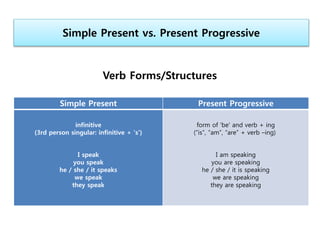
Simple Present Present Progressive
infinitive
(3rd person singular: infinitive + 's')
I speak
you speak
he / she / it speaks
we speak
they speak
form of 'be' and verb + ing
(“is”, “am”, “are” + verb –ing)
I am speaking
you are speaking
he / she / it is speaking
we are speaking
they are speaking
Verb Forms/Structures
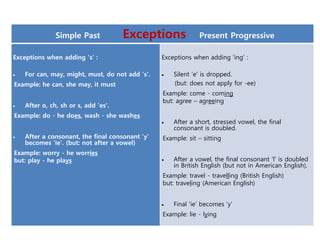
Simple Past Exceptions Present Progressive
Exceptions when adding 's' :
 For can, may, might, must, do not add 's'.
Example: he can, she may, it must
 After o, ch, sh or s, add 'es'.
Example: do - he does, wash - she washes
 After a consonant, the final consonant 'y'
becomes 'ie'. (but: not after a vowel)
Example: worry - he worries
but: play - he plays
Exceptions when adding 'ing' :
 Silent ‘e' is dropped.
(but: does not apply for -ee)
Example: come - coming
but: agree – agreeing
 After a short, stressed vowel, the final
consonant is doubled.
Example: sit – sitting
 After a vowel, the final consonant 'l' is doubled
in British English (but not in American English).
Example: travel - travelling (British English)
but: traveling (American English)
 Final 'ie' becomes 'y'
Example: lie - lying
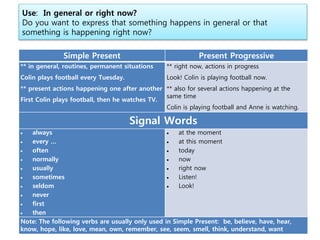
Use: In general or right now?
Do you want to express that something happens in general or that
something is happening right now?
Simple Present Present Progressive
** in general, routines, permanent situations
Colin plays football every Tuesday.
** present actions happening one after another
First Colin plays football, then he watches TV.
** right now, actions in progress
Look! Colin is playing football now.
** also for several actions happening at the
same time
Colin is playing football and Anne is watching.
Signal Words
 always
 every …
 often
 normally
 usually
 sometimes
 seldom
 never
 first
 then
 at the moment
 at this moment
 today
 now
 right now
 Listen!
 Look!
Note: The following verbs are usually only used in Simple Present: be, believe, have, hear,
know, hope, like, love, mean, own, remember, see, seem, smell, think, understand, want
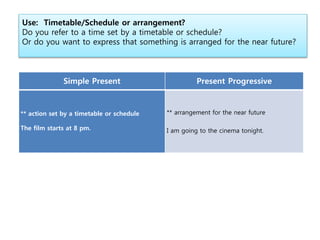
Use: Timetable/Schedule or arrangement?
Do you refer to a time set by a timetable or schedule?
Or do you want to express that something is arranged for the near future?
Simple Present Present Progressive
** action set by a timetable or schedule
The film starts at 8 pm.
** arrangement for the near future
I am going to the cinema tonight.
Use: Daily routine or just for a limited period of time?
Do you want to talk about a daily routine? Or do you want to emphasize that
something is only going on for a limited (rather short) period of time?
Simple Present Present Progressive
** daily routine
Bob works in a restaurant.
** only for a limited period of time, temporary
situations (does not have to happen directly at the
moment of speaking)
Jenny is working in a restaurant this week.
Certain Verbs
The following verbs are usually only used in Simple Present
(not in the progressive form).
state: be, cost, fit, mean, suit
Example: We are on holiday.
possession: belong, have
Example: Sam has a cat.
senses: feel, hear, see, smell, taste, touch
Example: He feels the cold.
feelings: hate, hope, like, love, prefer, regret, want, wish
Example: Jane loves pizza.
brain work: believe, know, think, understand
Example: I believe you.
Introductory clauses for direct speech: answer, ask, reply, say
Example: “I am watching TV,“ he says.

Ppt simple present vs present progressive

  • 1.
    Simple Present vs.Present Progressive Simple Present Present Progressive infinitive (3rd person singular: infinitive + 's') I speak you speak he / she / it speaks we speak they speak form of 'be' and verb + ing (“is”, “am”, “are” + verb –ing) I am speaking you are speaking he / she / it is speaking we are speaking they are speaking Verb Forms/Structures
  • 2.
    Simple Past ExceptionsPresent Progressive Exceptions when adding 's' :  For can, may, might, must, do not add 's'. Example: he can, she may, it must  After o, ch, sh or s, add 'es'. Example: do - he does, wash - she washes  After a consonant, the final consonant 'y' becomes 'ie'. (but: not after a vowel) Example: worry - he worries but: play - he plays Exceptions when adding 'ing' :  Silent ‘e' is dropped. (but: does not apply for -ee) Example: come - coming but: agree – agreeing  After a short, stressed vowel, the final consonant is doubled. Example: sit – sitting  After a vowel, the final consonant 'l' is doubled in British English (but not in American English). Example: travel - travelling (British English) but: traveling (American English)  Final 'ie' becomes 'y' Example: lie - lying
  • 3.
    Use: In generalor right now? Do you want to express that something happens in general or that something is happening right now? Simple Present Present Progressive ** in general, routines, permanent situations Colin plays football every Tuesday. ** present actions happening one after another First Colin plays football, then he watches TV. ** right now, actions in progress Look! Colin is playing football now. ** also for several actions happening at the same time Colin is playing football and Anne is watching. Signal Words  always  every …  often  normally  usually  sometimes  seldom  never  first  then  at the moment  at this moment  today  now  right now  Listen!  Look! Note: The following verbs are usually only used in Simple Present: be, believe, have, hear, know, hope, like, love, mean, own, remember, see, seem, smell, think, understand, want
  • 4.
    Use: Timetable/Schedule orarrangement? Do you refer to a time set by a timetable or schedule? Or do you want to express that something is arranged for the near future? Simple Present Present Progressive ** action set by a timetable or schedule The film starts at 8 pm. ** arrangement for the near future I am going to the cinema tonight.
  • 5.
    Use: Daily routineor just for a limited period of time? Do you want to talk about a daily routine? Or do you want to emphasize that something is only going on for a limited (rather short) period of time? Simple Present Present Progressive ** daily routine Bob works in a restaurant. ** only for a limited period of time, temporary situations (does not have to happen directly at the moment of speaking) Jenny is working in a restaurant this week.
  • 6.
    Certain Verbs The followingverbs are usually only used in Simple Present (not in the progressive form). state: be, cost, fit, mean, suit Example: We are on holiday. possession: belong, have Example: Sam has a cat. senses: feel, hear, see, smell, taste, touch Example: He feels the cold. feelings: hate, hope, like, love, prefer, regret, want, wish Example: Jane loves pizza. brain work: believe, know, think, understand Example: I believe you. Introductory clauses for direct speech: answer, ask, reply, say Example: “I am watching TV,“ he says.