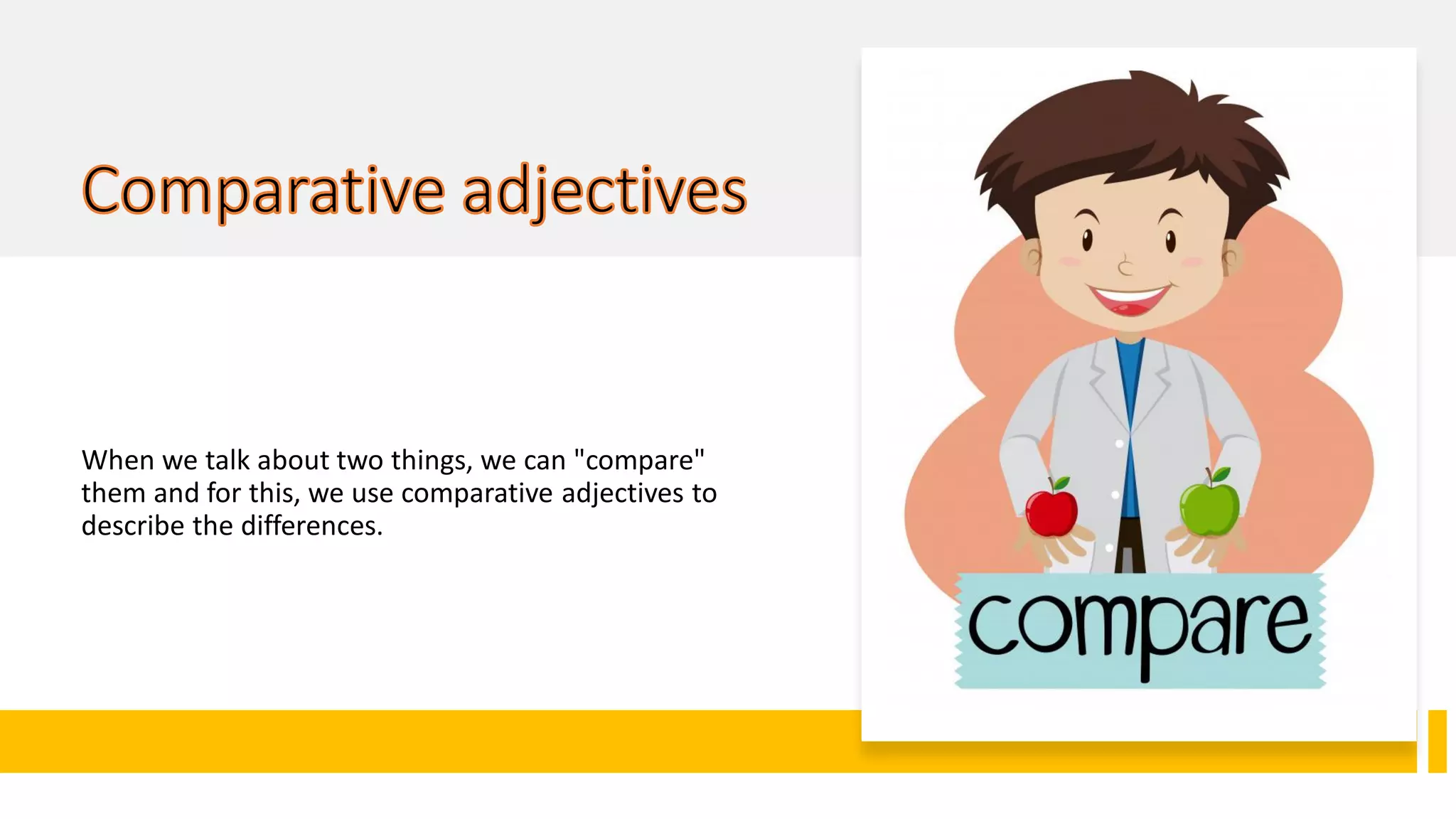
When we talk about two things, we can "compare"
them and for this, we use comparative adjectives to
describe the differences.
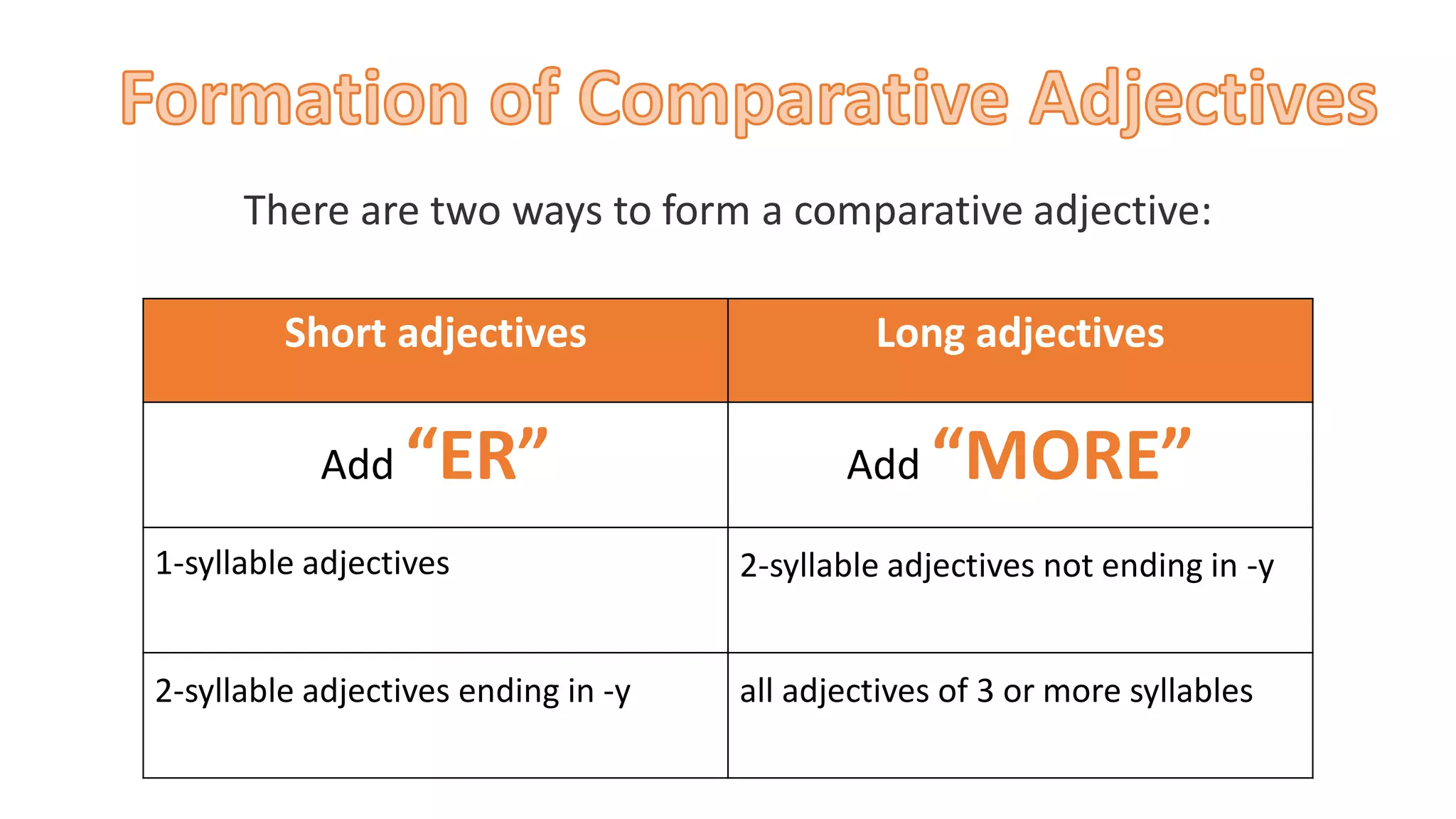
Short adjectives Long adjectives
Add “ER” Add “MORE”
1-syllable adjectives 2-syllable adjectives not ending in -y
2-syllable adjectives ending in -y all adjectives of 3 or more syllables
There are two ways to form a comparative adjective:
1-syllable adjectives
• Old → Older
• Fast → Faster
2-syllable adjectives
ending in -y
• Happy → Happier
• Easy → Easier
Variation:
• if the adjective ends
in -e, just add –r
• Late → Later
• If the adjective ends
in consonant, vowel,
consonant, double
the last consonant.
• big → bigger
Jhon is 42 years old Josh is 67 years old
Josh is older than Jhon.
Jhon is younger than Josh.
Remember:
For adjectives that are just one
syllable, add -er to the end.
Toby is a fat cat. Many is a fat cat too.
Many is fatter than Toby.
Remember:
If the adjective has a consonant +
single vowel + consonant spelling,
the final consonant must be
doubled before adding the ending.
Hanz is happy. Thomas is happy too.
Thomas is happier than hanz.
Remember:
For adjectives ending in y,
change the y to an i before
adding the ending.
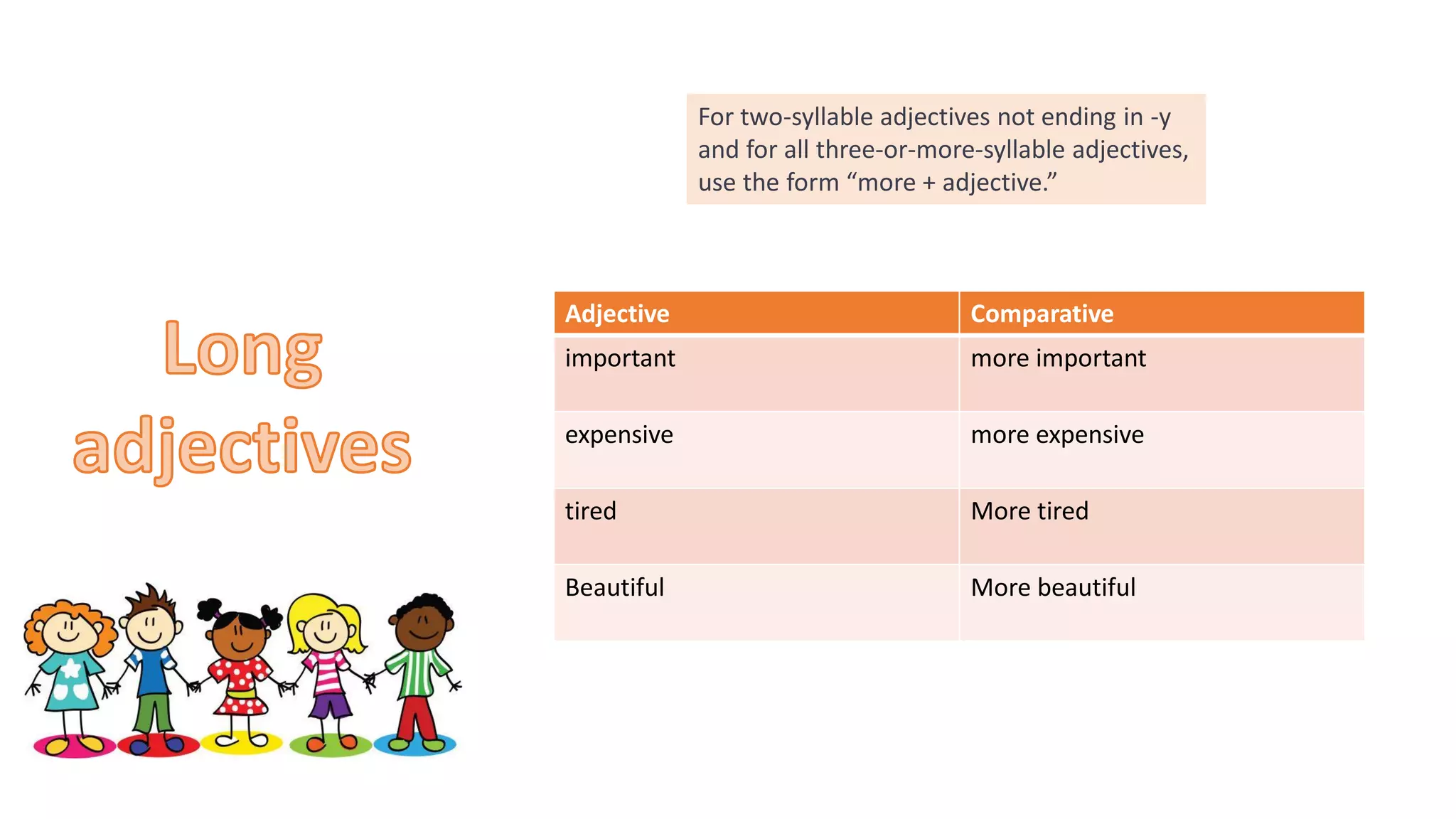
For two-syllable adjectives not ending in -y
and for all three-or-more-syllable adjectives,
use the form “more + adjective.”
Adjective Comparative
important more important
expensive more expensive
tired More tired
Beautiful More beautiful
Jen is intelligent Tom is intelligent too.
Tom is more intelligent than Jen.
Remember:
Adjectives with three or more
syllables form the comparative by
putting more in front of the
adjective
These very common adjectives have
completely irregular comparative forms.
Adjective Comparative
good better
bad worse
little less
much more
far further / farther
Lucy´s painting Michael’s painting.
Lucy´s painting is better than
Michael’s painting. .
Remember:
It’s important to note that
there are irregular
adjectives that don’t
follow the rules above.
Subject
France
Germany
Verb TO BE
Is
Is
Comparative
adjective
Bigger
More
interesting
Than
Than
Than
Subject
Scotland
Indonesia

Comparative adjectives

  • 1.
    When we talkabout two things, we can "compare" them and for this, we use comparative adjectives to describe the differences.
  • 2.
    Short adjectives Longadjectives Add “ER” Add “MORE” 1-syllable adjectives 2-syllable adjectives not ending in -y 2-syllable adjectives ending in -y all adjectives of 3 or more syllables There are two ways to form a comparative adjective:
  • 3.
    1-syllable adjectives • Old→ Older • Fast → Faster 2-syllable adjectives ending in -y • Happy → Happier • Easy → Easier Variation: • if the adjective ends in -e, just add –r • Late → Later • If the adjective ends in consonant, vowel, consonant, double the last consonant. • big → bigger
  • 4.
    Jhon is 42years old Josh is 67 years old Josh is older than Jhon. Jhon is younger than Josh. Remember: For adjectives that are just one syllable, add -er to the end.
  • 5.
    Toby is afat cat. Many is a fat cat too. Many is fatter than Toby. Remember: If the adjective has a consonant + single vowel + consonant spelling, the final consonant must be doubled before adding the ending.
  • 6.
    Hanz is happy.Thomas is happy too. Thomas is happier than hanz. Remember: For adjectives ending in y, change the y to an i before adding the ending.
  • 7.
    For two-syllable adjectivesnot ending in -y and for all three-or-more-syllable adjectives, use the form “more + adjective.” Adjective Comparative important more important expensive more expensive tired More tired Beautiful More beautiful
  • 8.
    Jen is intelligentTom is intelligent too. Tom is more intelligent than Jen. Remember: Adjectives with three or more syllables form the comparative by putting more in front of the adjective
  • 9.
    These very commonadjectives have completely irregular comparative forms. Adjective Comparative good better bad worse little less much more far further / farther
  • 10.
    Lucy´s painting Michael’spainting. Lucy´s painting is better than Michael’s painting. . Remember: It’s important to note that there are irregular adjectives that don’t follow the rules above.
  • 11.