LM-SSR
Grammar
Simple Present & Present Continuous
Prof Sanhaji
Grammar:
Why Tenses:
• Learning English tenses is crucial for speaking good English.
• Think of tenses as the backbone of your sentences.
• They tell you when something happens – in the past, present, or future.
• Without them, your sentences would be confusing and hard to
understand!
Grammar:
Why are English Tenses Important?
• Clarity: Tenses make your meaning clear.
• Accuracy: Using the right tense makes your English sound more accurate
and natural.
• Effective Communication: Knowing tenses allows you to express yourself
more precisely and effectively.
• Avoid Confusion: Using the wrong tense can lead to miscommunication or
confusion.
Grammar: Simple Present
• The Simple Present tense is one of the first tenses you learn in
English, and for good reason! It's used a lot in everyday
conversations and forms the foundation for understanding
other tenses.
Grammar: Simple Present
The Simple Present tense:
1. Form:
In the present simple 3rd person singular (he, she, it), add s, es, or ies to
the base form of the verb.
For regular verbs just add an ‘s’
For example: travel >travels, give > gives, play > plays…
Grammar: Simple Present
To verbs that end in s, ss, sh, ch, x, and o, add an ‘es’:
For example:
Focus > focuses
Discuss > discusses
Wash > washes,
Teach > teaches
Fix> fixes,
Go >goes…
Grammar: Simple Present
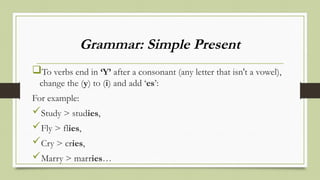
To verbs end in ‘Y’ after a consonant (any letter that isn't a vowel),
change the (y) to (i) and add ‘es’:
For example:
Study > studies,
Fly > flies,
Cry > cries,
Marry > marries…
Grammar: Simple Present
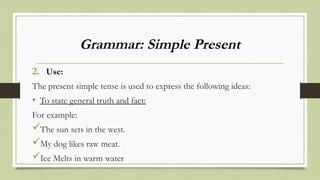
2. Use:
The present simple tense is used to express the following ideas:
• To state general truth and fact:
For example:
The sun sets in the west.
My dog likes raw meat.
Ice Melts in warm water
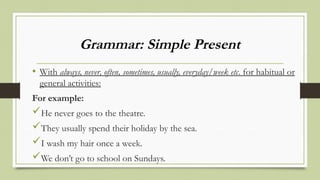
Grammar: Simple Present
• With always, never, often, sometimes, usually, everyday/week etc. for habitual or
general activities:
For example:
He never goes to the theatre.
They usually spend their holiday by the sea.
I wash my hair once a week.
We don’t go to school on Sundays.
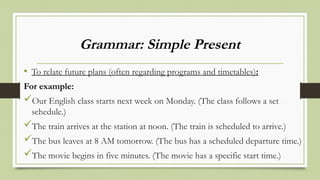
Grammar: Simple Present
• To relate future plans (often regarding programs and timetables):
For example:
Our English class starts next week on Monday. (The class follows a set
schedule.)
The train arrives at the station at noon. (The train is scheduled to arrive.)
The bus leaves at 8 AM tomorrow. (The bus has a scheduled departure time.)
The movie begins in five minutes. (The movie has a specific start time.)
Grammar: Simple Present
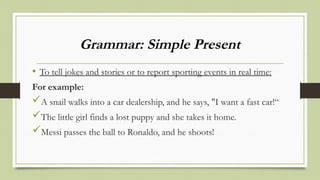
• To tell jokes and stories or to report sporting events in real time:
For example:
A snail walks into a car dealership, and he says, "I want a fast car!“
The little girl finds a lost puppy and she takes it home.
Messi passes the ball to Ronaldo, and he shoots!
Grammar: Simple Present
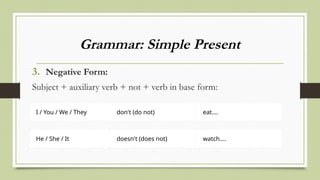
3. Negative Form:
Subject + auxiliary verb + not + verb in base form:
I / You / We / They don't (do not) eat….
He / She / It doesn't (does not) watch….
Grammar: Simple Present
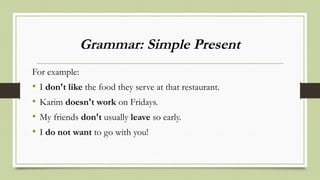
For example:
• I don't like the food they serve at that restaurant.
• Karim doesn't work on Fridays.
• My friends don't usually leave so early.
• I do not want to go with you!
Grammar: Simple Present
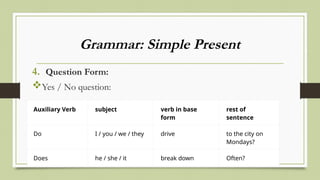
4. Question Form:
Yes / No question:
Auxiliary Verb subject verb in base
form
rest of
sentence
Do I / you / we / they drive to the city on
Mondays?
Does he / she / it break down Often?
Grammar: Simple Present
For example:
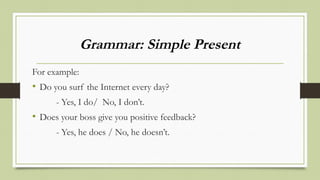
• Do you surf the Internet every day?
- Yes, I do/ No, I don’t.
• Does your boss give you positive feedback?
- Yes, he does / No, he doesn’t.
Grammar: Simple Present
W/h question:
Wh-Word Auxiliary
Verb
Subject Verb in Base
Form
Rest of
Sentence
What do I / you / we /
they
want
Why does he / she / it shout at you
Grammar: Simple Present
For example:
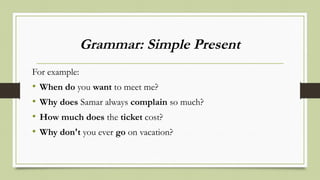
• When do you want to meet me?
• Why does Samar always complain so much?
• How much does the ticket cost?
• Why don't you ever go on vacation?
Grammar: Simple Present
Tag Questions:
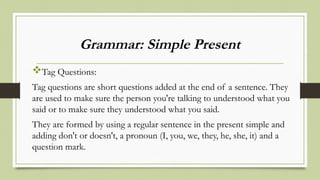
Tag questions are short questions added at the end of a sentence. They
are used to make sure the person you're talking to understood what you
said or to make sure they understood what you said.
They are formed by using a regular sentence in the present simple and
adding don't or doesn't, a pronoun (I, you, we, they, he, she, it) and a
question mark.
Grammar: Simple Present
For example:
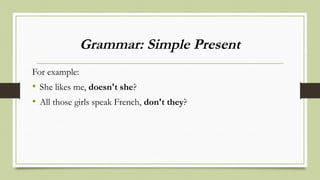
• She likes me, doesn't she?
• All those girls speak French, don't they?
Grammar: Simple Present
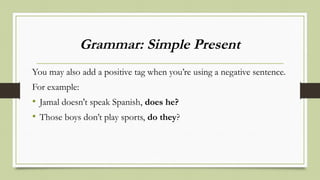
You may also add a positive tag when you’re using a negative sentence.
For example:
• Jamal doesn't speak Spanish, does he?
• Those boys don’t play sports, do they?
Grammar: Simple Present
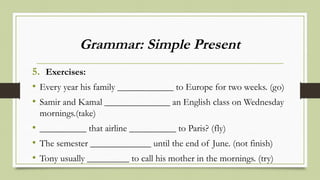
5. Exercises:
• Every year his family ____________ to Europe for two weeks. (go)
• Samir and Kamal ______________ an English class on Wednesday
mornings.(take)
• __________ that airline __________ to Paris? (fly)
• The semester _____________ until the end of June. (not finish)
• Tony usually _________ to call his mother in the mornings. (try)
Grammar: Simple Present
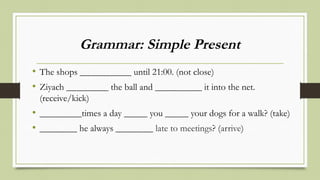
• The shops ___________ until 21:00. (not close)
• Ziyach _________ the ball and __________ it into the net.
(receive/kick)
• _________times a day _____ you _____ your dogs for a walk? (take)
• ________ he always ________ late to meetings? (arrive)
Grammar: Simple Present
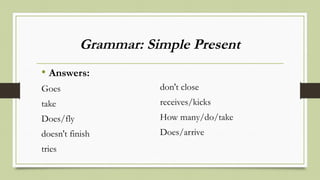
• Answers:
Goes
take
Does/fly
doesn't finish
tries
don't close
receives/kicks
How many/do/take
Does/arrive
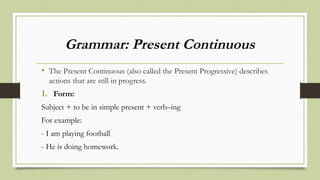
Grammar: Present Continuous
• The Present Continuous (also called the Present Progressive) describes
actions that are still in progress.
1. Form:
Subject + to be in simple present + verb–ing
For example:
- I am playing football
- He is doing homework.
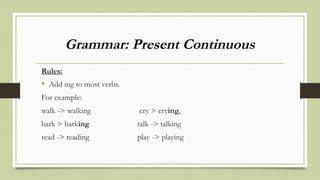
Grammar: Present Continuous
Rules:
• Add ing to most verbs.
For example:
walk -> walking cry > crying,
bark > barking talk -> talking
read -> reading play -> playing
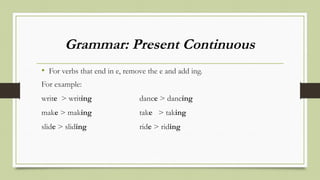
Grammar: Present Continuous
• For verbs that end in e, remove the e and add ing.
For example:
write > writing dance > dancing
make > making take > taking
slide > sliding ride > riding
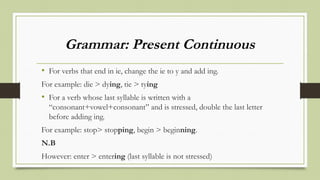
Grammar: Present Continuous
• For verbs that end in ie, change the ie to y and add ing.
For example: die > dying, tie > tying
• For a verb whose last syllable is written with a
“consonant+vowel+consonant” and is stressed, double the last letter
before adding ing.
For example: stop> stopping, begin > beginning.
N.B
However: enter > entering (last syllable is not stressed)
Grammar: Present Continuous
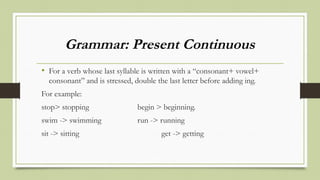
• For a verb whose last syllable is written with a “consonant+ vowel+
consonant” and is stressed, double the last letter before adding ing.
For example:
stop> stopping begin > beginning.
swim -> swimming run -> running
sit -> sitting get -> getting
Grammar: Present Continuous
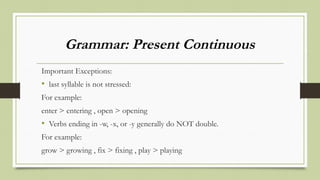
Important Exceptions:
• last syllable is not stressed:
For example:
enter > entering , open > opening
• Verbs ending in -w, -x, or -y generally do NOT double.
For example:
grow > growing , fix > fixing , play > playing
Grammar: Present Continuous
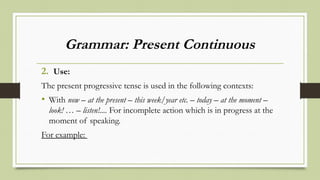
2. Use:
The present progressive tense is used in the following contexts:
• With now – at the present – this week/year etc. – today – at the moment –
look! … – listen!.... For incomplete action which is in progress at the
moment of speaking.
For example:
Grammar: Present Continuous
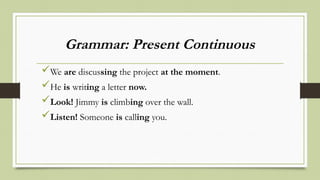
We are discussing the project at the moment.
He is writing a letter now.
Look! Jimmy is climbing over the wall.
Listen! Someone is calling you.
Grammar: Present Continuous
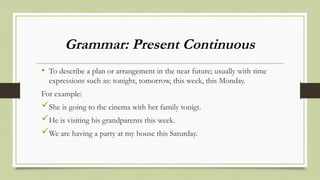
• To describe a plan or arrangement in the near future; usually with time
expressions such as: tonight, tomorrow, this week, this Monday.
For example:
She is going to the cinema with her family tonigt.
He is visiting his grandparents this week.
We are having a party at my house this Saturday.
Future in Simple Present & Present
Continuous
N.B
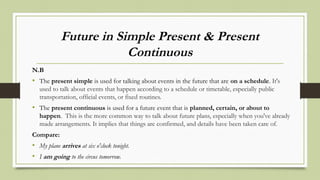
• The present simple is used for talking about events in the future that are on a schedule. It's
used to talk about events that happen according to a schedule or timetable, especially public
transportation, official events, or fixed routines.
• The present continuous is used for a future event that is planned, certain, or about to
happen. This is the more common way to talk about future plans, especially when you've already
made arrangements. It implies that things are confirmed, and details have been taken care of.
Compare:
• My plane arrives at six o'clock tonight.
• I am going to the circus tomorrow.
Grammar: Present Continuous
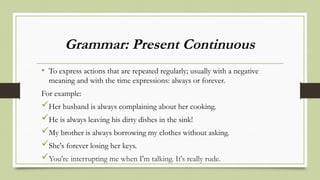
• To express actions that are repeated regularly; usually with a negative
meaning and with the time expressions: always or forever.
For example:
Her husband is always complaining about her cooking.
He is always leaving his dirty dishes in the sink!
My brother is always borrowing my clothes without asking.
She's forever losing her keys.
You're interrupting me when I'm talking. It's really rude.
Grammar: Present Continuous
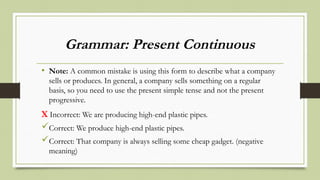
• Note: A common mistake is using this form to describe what a company
sells or produces. In general, a company sells something on a regular
basis, so you need to use the present simple tense and not the present
progressive.
X Incorrect: We are producing high-end plastic pipes.
Correct: We produce high-end plastic pipes.
Correct: That company is always selling some cheap gadget. (negative
meaning)
Grammar: Present Continuous
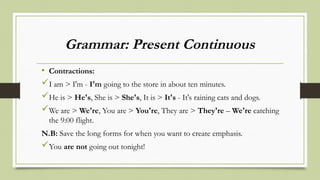
• Contractions:
I am > I'm - I'm going to the store in about ten minutes.
He is > He's, She is > She's, It is > It's - It's raining cats and dogs.
We are > We're, You are > You're, They are > They're – We're catching
the 9:00 flight.
N.B: Save the long forms for when you want to create emphasis.
You are not going out tonight!
Grammar: Present Continuous
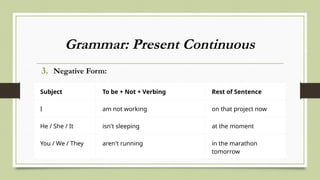
3. Negative Form:
Subject To be + Not + Verbing Rest of Sentence
I am not working on that project now
He / She / It isn't sleeping at the moment
You / We / They aren't running in the marathon
tomorrow
Grammar: Present Continuous
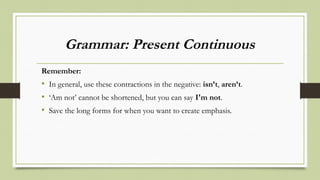
Remember:
• In general, use these contractions in the negative: isn’t, aren’t.
• ‘Am not’ cannot be shortened, but you can say I'm not.
• Save the long forms for when you want to create emphasis.
Grammar: Present Continuous
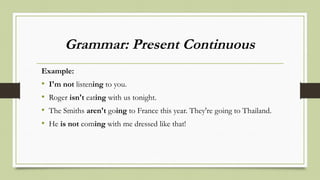
Example:
• I'm not listening to you.
• Roger isn't eating with us tonight.
• The Smiths aren't going to France this year. They're going to Thailand.
• He is not coming with me dressed like that!
Grammar: Present Continuous
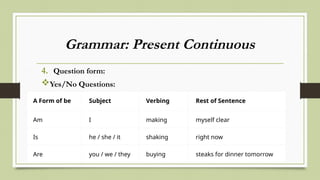
4. Question form:
Yes/No Questions:
A Form of be Subject Verbing Rest of Sentence
Am I making myself clear
Is he / she / it shaking right now
Are you / we / they buying steaks for dinner tomorrow
Grammar: Present Continuous
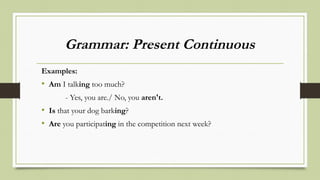
Examples:
• Am I talking too much?
- Yes, you are./ No, you aren't.
• Is that your dog barking?
• Are you participating in the competition next week?
Grammar: Present Continuous
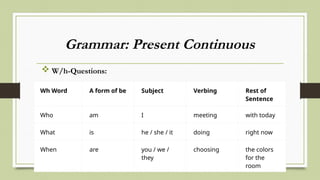
 W/h-Questions:
Wh Word A form of be Subject Verbing Rest of
Sentence
Who am I meeting with today
What is he / she / it doing right now
When are you / we /
they
choosing the colors
for the
room
Grammar: Present Continuous
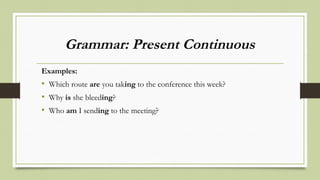
Examples:
• Which route are you taking to the conference this week?
• Why is she bleeding?
• Who am I sending to the meeting?
Grammar: Present Continuous
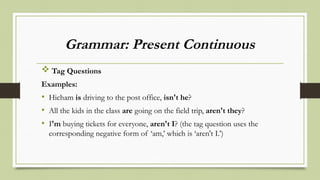
 Tag Questions
Examples:
• Hicham is driving to the post office, isn't he?
• All the kids in the class are going on the field trip, aren't they?
• I'm buying tickets for everyone, aren't I? (the tag question uses the
corresponding negative form of ‘am,’ which is ‘aren't I.’)
Grammar: Present Continuous
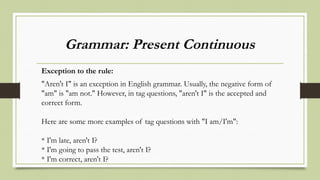
Exception to the rule:
"Aren't I" is an exception in English grammar. Usually, the negative form of
"am" is "am not." However, in tag questions, "aren't I" is the accepted and
correct form.
Here are some more examples of tag questions with "I am/I'm":
* I'm late, aren't I?
* I'm going to pass the test, aren't I?
* I'm correct, aren't I?
Grammar: Present Continuous
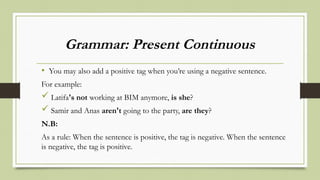
• You may also add a positive tag when you’re using a negative sentence.
For example:
 Latifa's not working at BIM anymore, is she?
 Samir and Anas aren't going to the party, are they?
N.B:
As a rule: When the sentence is positive, the tag is negative. When the sentence
is negative, the tag is positive.
Grammar: Present Continuous
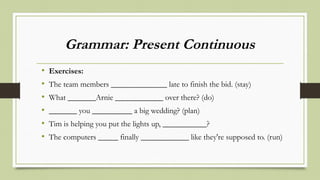
• Exercises:
• The team members ______________ late to finish the bid. (stay)
• What _______Arnie ____________ over there? (do)
• _______ you __________ a big wedding? (plan)
• Tim is helping you put the lights up, ___________?
• The computers _____ finally ____________ like they're supposed to. (run)
Grammar: Present Continuous
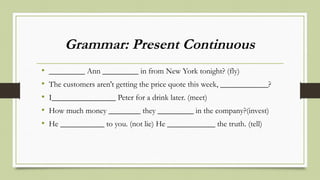
• _________ Ann _________ in from New York tonight? (fly)
• The customers aren't getting the price quote this week, ____________?
• I________________ Peter for a drink later. (meet)
• How much money ________ they _________ in the company?(invest)
• He ___________ to you. (not lie) He ____________ the truth. (tell)
Grammar: Present Continuous
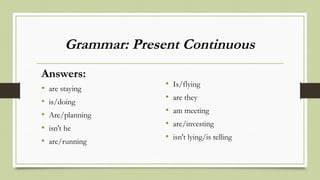
Answers:
• are staying
• is/doing
• Are/planning
• isn't he
• are/running
• Is/flying
• are they
• am meeting
• are/investing
• isn't lying/is telling
Grammar Simple Present. Present tense grammar

  • 1.
    LM-SSR Grammar Simple Present &Present Continuous Prof Sanhaji
  • 2.
    Grammar: Why Tenses: • LearningEnglish tenses is crucial for speaking good English. • Think of tenses as the backbone of your sentences. • They tell you when something happens – in the past, present, or future. • Without them, your sentences would be confusing and hard to understand!
  • 3.
    Grammar: Why are EnglishTenses Important? • Clarity: Tenses make your meaning clear. • Accuracy: Using the right tense makes your English sound more accurate and natural. • Effective Communication: Knowing tenses allows you to express yourself more precisely and effectively. • Avoid Confusion: Using the wrong tense can lead to miscommunication or confusion.
  • 4.
    Grammar: Simple Present •The Simple Present tense is one of the first tenses you learn in English, and for good reason! It's used a lot in everyday conversations and forms the foundation for understanding other tenses.
  • 5.
    Grammar: Simple Present TheSimple Present tense: 1. Form: In the present simple 3rd person singular (he, she, it), add s, es, or ies to the base form of the verb. For regular verbs just add an ‘s’ For example: travel >travels, give > gives, play > plays…
  • 6.
    Grammar: Simple Present Toverbs that end in s, ss, sh, ch, x, and o, add an ‘es’: For example: Focus > focuses Discuss > discusses Wash > washes, Teach > teaches Fix> fixes, Go >goes…
  • 7.
    Grammar: Simple Present Toverbs end in ‘Y’ after a consonant (any letter that isn't a vowel), change the (y) to (i) and add ‘es’: For example: Study > studies, Fly > flies, Cry > cries, Marry > marries…
  • 8.
    Grammar: Simple Present 2.Use: The present simple tense is used to express the following ideas: • To state general truth and fact: For example: The sun sets in the west. My dog likes raw meat. Ice Melts in warm water
  • 9.
    Grammar: Simple Present •With always, never, often, sometimes, usually, everyday/week etc. for habitual or general activities: For example: He never goes to the theatre. They usually spend their holiday by the sea. I wash my hair once a week. We don’t go to school on Sundays.
  • 10.
    Grammar: Simple Present •To relate future plans (often regarding programs and timetables): For example: Our English class starts next week on Monday. (The class follows a set schedule.) The train arrives at the station at noon. (The train is scheduled to arrive.) The bus leaves at 8 AM tomorrow. (The bus has a scheduled departure time.) The movie begins in five minutes. (The movie has a specific start time.)
  • 11.
    Grammar: Simple Present •To tell jokes and stories or to report sporting events in real time: For example: A snail walks into a car dealership, and he says, "I want a fast car!“ The little girl finds a lost puppy and she takes it home. Messi passes the ball to Ronaldo, and he shoots!
  • 12.
    Grammar: Simple Present 3.Negative Form: Subject + auxiliary verb + not + verb in base form: I / You / We / They don't (do not) eat…. He / She / It doesn't (does not) watch….
  • 13.
    Grammar: Simple Present Forexample: • I don't like the food they serve at that restaurant. • Karim doesn't work on Fridays. • My friends don't usually leave so early. • I do not want to go with you!
  • 14.
    Grammar: Simple Present 4.Question Form: Yes / No question: Auxiliary Verb subject verb in base form rest of sentence Do I / you / we / they drive to the city on Mondays? Does he / she / it break down Often?
  • 15.
    Grammar: Simple Present Forexample: • Do you surf the Internet every day? - Yes, I do/ No, I don’t. • Does your boss give you positive feedback? - Yes, he does / No, he doesn’t.
  • 16.
    Grammar: Simple Present W/hquestion: Wh-Word Auxiliary Verb Subject Verb in Base Form Rest of Sentence What do I / you / we / they want Why does he / she / it shout at you
  • 17.
    Grammar: Simple Present Forexample: • When do you want to meet me? • Why does Samar always complain so much? • How much does the ticket cost? • Why don't you ever go on vacation?
  • 18.
    Grammar: Simple Present TagQuestions: Tag questions are short questions added at the end of a sentence. They are used to make sure the person you're talking to understood what you said or to make sure they understood what you said. They are formed by using a regular sentence in the present simple and adding don't or doesn't, a pronoun (I, you, we, they, he, she, it) and a question mark.
  • 19.
    Grammar: Simple Present Forexample: • She likes me, doesn't she? • All those girls speak French, don't they?
  • 20.
    Grammar: Simple Present Youmay also add a positive tag when you’re using a negative sentence. For example: • Jamal doesn't speak Spanish, does he? • Those boys don’t play sports, do they?
  • 21.
    Grammar: Simple Present 5.Exercises: • Every year his family ____________ to Europe for two weeks. (go) • Samir and Kamal ______________ an English class on Wednesday mornings.(take) • __________ that airline __________ to Paris? (fly) • The semester _____________ until the end of June. (not finish) • Tony usually _________ to call his mother in the mornings. (try)
  • 22.
    Grammar: Simple Present •The shops ___________ until 21:00. (not close) • Ziyach _________ the ball and __________ it into the net. (receive/kick) • _________times a day _____ you _____ your dogs for a walk? (take) • ________ he always ________ late to meetings? (arrive)
  • 23.
    Grammar: Simple Present •Answers: Goes take Does/fly doesn't finish tries don't close receives/kicks How many/do/take Does/arrive
  • 24.
    Grammar: Present Continuous •The Present Continuous (also called the Present Progressive) describes actions that are still in progress. 1. Form: Subject + to be in simple present + verb–ing For example: - I am playing football - He is doing homework.
  • 25.
    Grammar: Present Continuous Rules: •Add ing to most verbs. For example: walk -> walking cry > crying, bark > barking talk -> talking read -> reading play -> playing
  • 26.
    Grammar: Present Continuous •For verbs that end in e, remove the e and add ing. For example: write > writing dance > dancing make > making take > taking slide > sliding ride > riding
  • 27.
    Grammar: Present Continuous •For verbs that end in ie, change the ie to y and add ing. For example: die > dying, tie > tying • For a verb whose last syllable is written with a “consonant+vowel+consonant” and is stressed, double the last letter before adding ing. For example: stop> stopping, begin > beginning. N.B However: enter > entering (last syllable is not stressed)
  • 28.
    Grammar: Present Continuous •For a verb whose last syllable is written with a “consonant+ vowel+ consonant” and is stressed, double the last letter before adding ing. For example: stop> stopping begin > beginning. swim -> swimming run -> running sit -> sitting get -> getting
  • 29.
    Grammar: Present Continuous ImportantExceptions: • last syllable is not stressed: For example: enter > entering , open > opening • Verbs ending in -w, -x, or -y generally do NOT double. For example: grow > growing , fix > fixing , play > playing
  • 30.
    Grammar: Present Continuous 2.Use: The present progressive tense is used in the following contexts: • With now – at the present – this week/year etc. – today – at the moment – look! … – listen!.... For incomplete action which is in progress at the moment of speaking. For example:
  • 31.
    Grammar: Present Continuous Weare discussing the project at the moment. He is writing a letter now. Look! Jimmy is climbing over the wall. Listen! Someone is calling you.
  • 32.
    Grammar: Present Continuous •To describe a plan or arrangement in the near future; usually with time expressions such as: tonight, tomorrow, this week, this Monday. For example: She is going to the cinema with her family tonigt. He is visiting his grandparents this week. We are having a party at my house this Saturday.
  • 33.
    Future in SimplePresent & Present Continuous N.B • The present simple is used for talking about events in the future that are on a schedule. It's used to talk about events that happen according to a schedule or timetable, especially public transportation, official events, or fixed routines. • The present continuous is used for a future event that is planned, certain, or about to happen. This is the more common way to talk about future plans, especially when you've already made arrangements. It implies that things are confirmed, and details have been taken care of. Compare: • My plane arrives at six o'clock tonight. • I am going to the circus tomorrow.
  • 34.
    Grammar: Present Continuous •To express actions that are repeated regularly; usually with a negative meaning and with the time expressions: always or forever. For example: Her husband is always complaining about her cooking. He is always leaving his dirty dishes in the sink! My brother is always borrowing my clothes without asking. She's forever losing her keys. You're interrupting me when I'm talking. It's really rude.
  • 35.
    Grammar: Present Continuous •Note: A common mistake is using this form to describe what a company sells or produces. In general, a company sells something on a regular basis, so you need to use the present simple tense and not the present progressive. X Incorrect: We are producing high-end plastic pipes. Correct: We produce high-end plastic pipes. Correct: That company is always selling some cheap gadget. (negative meaning)
  • 36.
    Grammar: Present Continuous •Contractions: I am > I'm - I'm going to the store in about ten minutes. He is > He's, She is > She's, It is > It's - It's raining cats and dogs. We are > We're, You are > You're, They are > They're – We're catching the 9:00 flight. N.B: Save the long forms for when you want to create emphasis. You are not going out tonight!
  • 37.
    Grammar: Present Continuous 3.Negative Form: Subject To be + Not + Verbing Rest of Sentence I am not working on that project now He / She / It isn't sleeping at the moment You / We / They aren't running in the marathon tomorrow
  • 38.
    Grammar: Present Continuous Remember: •In general, use these contractions in the negative: isn’t, aren’t. • ‘Am not’ cannot be shortened, but you can say I'm not. • Save the long forms for when you want to create emphasis.
  • 39.
    Grammar: Present Continuous Example: •I'm not listening to you. • Roger isn't eating with us tonight. • The Smiths aren't going to France this year. They're going to Thailand. • He is not coming with me dressed like that!
  • 40.
    Grammar: Present Continuous 4.Question form: Yes/No Questions: A Form of be Subject Verbing Rest of Sentence Am I making myself clear Is he / she / it shaking right now Are you / we / they buying steaks for dinner tomorrow
  • 41.
    Grammar: Present Continuous Examples: •Am I talking too much? - Yes, you are./ No, you aren't. • Is that your dog barking? • Are you participating in the competition next week?
  • 42.
    Grammar: Present Continuous W/h-Questions: Wh Word A form of be Subject Verbing Rest of Sentence Who am I meeting with today What is he / she / it doing right now When are you / we / they choosing the colors for the room
  • 43.
    Grammar: Present Continuous Examples: •Which route are you taking to the conference this week? • Why is she bleeding? • Who am I sending to the meeting?
  • 44.
    Grammar: Present Continuous Tag Questions Examples: • Hicham is driving to the post office, isn't he? • All the kids in the class are going on the field trip, aren't they? • I'm buying tickets for everyone, aren't I? (the tag question uses the corresponding negative form of ‘am,’ which is ‘aren't I.’)
  • 45.
    Grammar: Present Continuous Exceptionto the rule: "Aren't I" is an exception in English grammar. Usually, the negative form of "am" is "am not." However, in tag questions, "aren't I" is the accepted and correct form. Here are some more examples of tag questions with "I am/I'm": * I'm late, aren't I? * I'm going to pass the test, aren't I? * I'm correct, aren't I?
  • 46.
    Grammar: Present Continuous •You may also add a positive tag when you’re using a negative sentence. For example:  Latifa's not working at BIM anymore, is she?  Samir and Anas aren't going to the party, are they? N.B: As a rule: When the sentence is positive, the tag is negative. When the sentence is negative, the tag is positive.
  • 47.
    Grammar: Present Continuous •Exercises: • The team members ______________ late to finish the bid. (stay) • What _______Arnie ____________ over there? (do) • _______ you __________ a big wedding? (plan) • Tim is helping you put the lights up, ___________? • The computers _____ finally ____________ like they're supposed to. (run)
  • 48.
    Grammar: Present Continuous •_________ Ann _________ in from New York tonight? (fly) • The customers aren't getting the price quote this week, ____________? • I________________ Peter for a drink later. (meet) • How much money ________ they _________ in the company?(invest) • He ___________ to you. (not lie) He ____________ the truth. (tell)
  • 49.
    Grammar: Present Continuous Answers: •are staying • is/doing • Are/planning • isn't he • are/running • Is/flying • are they • am meeting • are/investing • isn't lying/is telling