Unit 10: Living Your Life
Interactions, p.96
I’ll give it some thought.
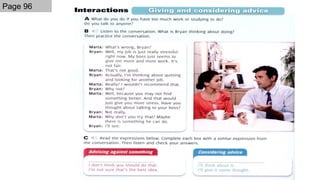
Page 96
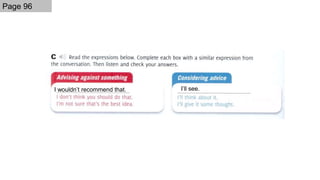
I wouldn’t recommend that. I’ll see.
Page 96
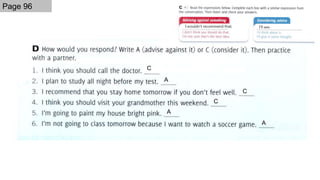
C
A
C
C
A
A
Page 96
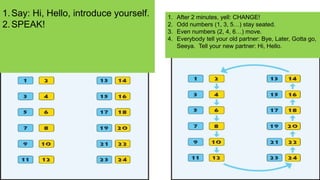
1.Say: Hi, Hello, introduce yourself.
2.SPEAK!
1. After 2 minutes, yell: CHANGE!
2. Odd numbers (1, 3, 5…) stay seated.
3. Even numbers (2, 4, 6…) move.
4. Everybody tell your old partner: Bye, Later, Gotta go,
Seeya. Tell your new partner: Hi, Hello.
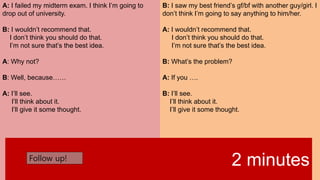
A: I failed my midterm exam. I think I’m going to
drop out of university.
B: I wouldn’t recommend that.
I don’t think you should do that.
I’m not sure that’s the best idea.
A: Why not?
B: Well, because……
A: I’ll see.
I’ll think about it.
I’ll give it some thought.
B: I saw my best friend’s gf/bf with another guy/girl. I
don’t think I’m going to say anything to him/her.
A: I wouldn’t recommend that.
I don’t think you should do that.
I’m not sure that’s the best idea.
B: What’s the problem?
A: If you ….
B: I’ll see.
I’ll think about it.
I’ll give it some thought.
2 minutesFollow up!
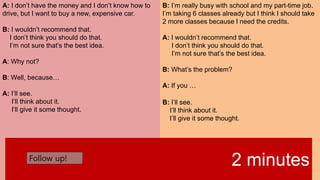
A: I don’t have the money and I don’t know how to
drive, but I want to buy a new, expensive car.
B: I wouldn’t recommend that.
I don’t think you should do that.
I’m not sure that’s the best idea.
A: Why not?
B: Well, because…
A: I’ll see.
I’ll think about it.
I’ll give it some thought.
B: I’m really busy with school and my part-time job.
I’m taking 6 classes already but I think I should take
2 more classes because I need the credits.
A: I wouldn’t recommend that.
I don’t think you should do that.
I’m not sure that’s the best idea.
B: What’s the problem?
A: If you …
B: I’ll see.
I’ll think about it.
I’ll give it some thought.
2 minutesFollow up!
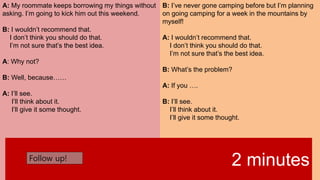
A: My roommate keeps borrowing my things without
asking. I’m going to kick him out this weekend.
B: I wouldn’t recommend that.
I don’t think you should do that.
I’m not sure that’s the best idea.
A: Why not?
B: Well, because……
A: I’ll see.
I’ll think about it.
I’ll give it some thought.
B: I’ve never gone camping before but I’m planning
on going camping for a week in the mountains by
myself!
A: I wouldn’t recommend that.
I don’t think you should do that.
I’m not sure that’s the best idea.
B: What’s the problem?
A: If you ….
B: I’ll see.
I’ll think about it.
I’ll give it some thought.
2 minutesFollow up!
Listening , p.96
Maybe I’ll do that.
(Answers on next page.)
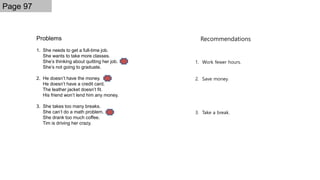
Problems
1. She needs to get a full-time job.
She wants to take more classes.
She’s thinking about quitting her job.
She’s not going to graduate.
2. He doesn’t have the money.
He doesn’t have a credit card.
The leather jacket doesn’t fit.
His friend won’t lend him any money.
3. She takes too many breaks.
She can’t do a math problem.
She drank too much coffee.
Tim is driving her crazy.
Page 97
Recommendations
1. Work fewer hours.
2. Save money.
3. Take a break.
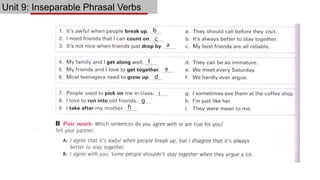
Unit 9: Inseparable Phrasal Verbs
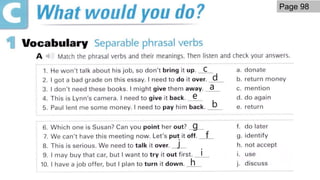
h
g
i
d
e
f
a
c
b
Page 98
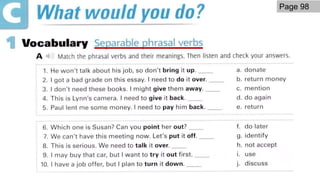
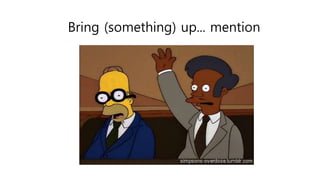
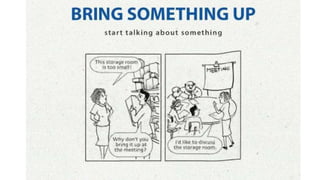
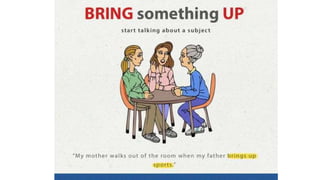
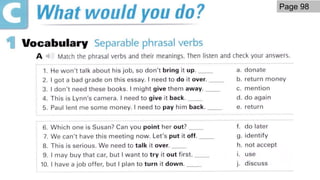
Bring (something) up... mention
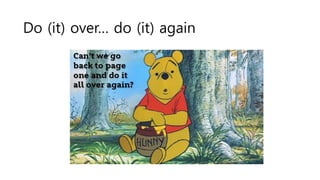
Do (it) over… do (it) again
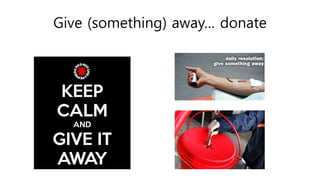
Give (something) away… donate
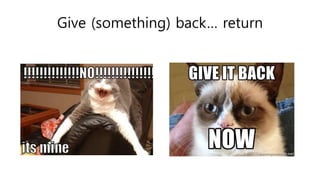
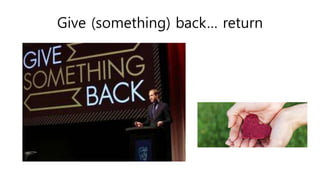
Give (something) back… return
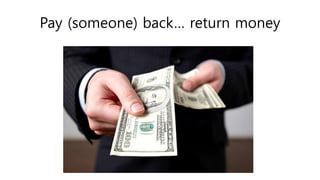
Pay (someone) back… return money
Page 98
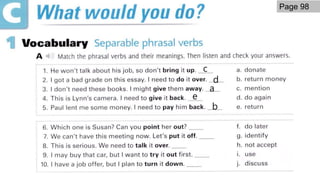
c
d
a
e
b
Page 98
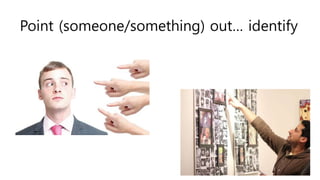
Point (someone/something) out… identify
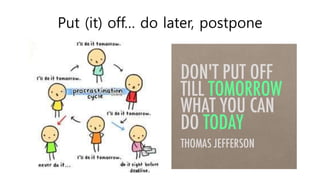
Put (it) off… do later, postpone
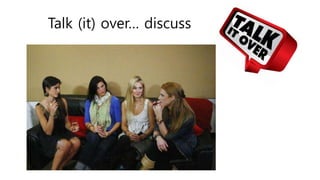
Talk (it) over… discuss
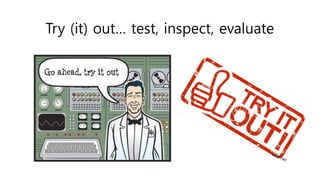
Try (it) out… test, inspect, evaluate
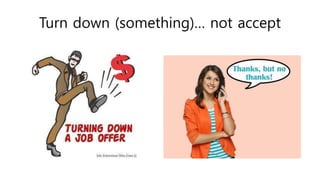
Turn down (something)… not accept
c
d
a
e
b
g
f
j
i
h
Page 98
Conversation, p. 98
“I’m kind of broke.”
SECOND CONDITIONAL
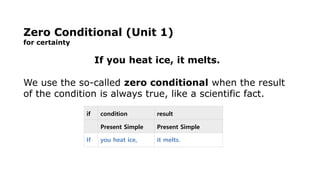
if condition result
Present Simple Present Simple
If you heat ice, it melts.
Zero Conditional (Unit 1)
for certainty
If you heat ice, it melts.
We use the so-called zero conditional when the result
of the condition is always true, like a scientific fact.
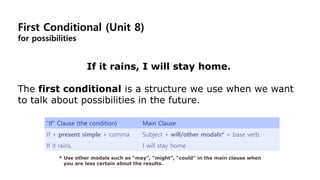
First Conditional (Unit 8)
for possibilities
If it rains, I will stay home.
The first conditional is a structure we use when we want
to talk about possibilities in the future.
"If" Clause (the condition) Main Clause
If + present simple + comma Subject + will/other modals* + base verb.
If it rains, I will stay home
* Use other modals such as “may”, “might”, “could” in the main clause when
you are less certain about the results.
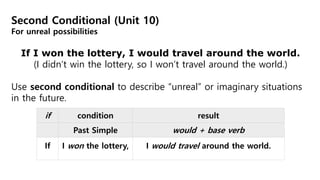
Second Conditional (Unit 10)
For unreal possibilities
If I won the lottery, I would travel around the world.
(I didn’t win the lottery, so I won’t travel around the world.)
Use second conditional to describe “unreal” or imaginary situations
in the future.
if condition result
Past Simple would + base verb
If I won the lottery, I would travel around the world.
Grammar – Second Conditional p. 99
Second conditional sentences talk about
“unreal”
Second conditional sentences talk about
“unreal”
or
imaginary situations
Second conditional sentences talk about
“unreal”
or
imaginary situations
in the future.
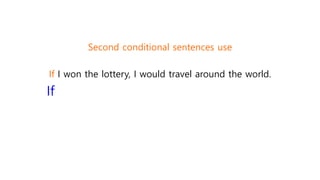
Second conditional sentences use
two clauses.
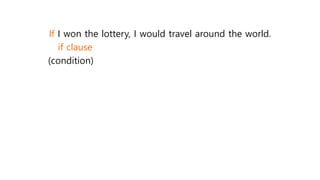
If I won the lottery, I would travel around the world.
if clause
(condition)
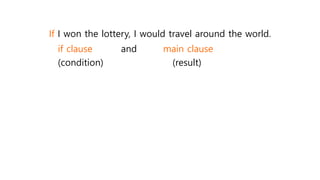
If I won the lottery, I would travel around the world.
if clause and main clause
(condition) (result)
Second conditional sentences use
If I won the lottery, I would travel around the world.
If
Second conditional sentences use
If I won the lottery, I would travel around the world.
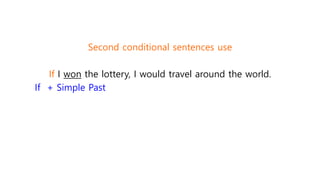
If + Simple Past
Second conditional sentences use
If I won the lottery, I would travel around the world.
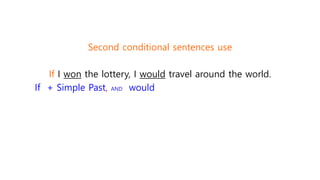
If + Simple Past, AND would
Second conditional sentences use
If I won the lottery, I would travel around the world.
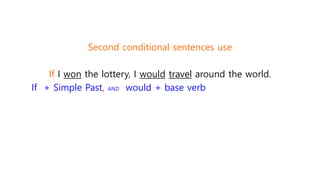
If + Simple Past, AND would + base verb
Second conditional sentences use
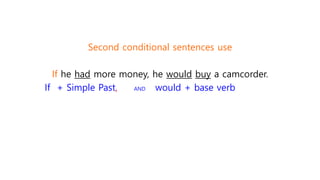
If he had more money, he would buy a camcorder.
If + Simple Past, AND would + base verb
Second conditional sentences use
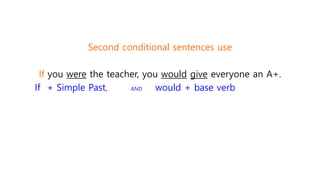
If you were the teacher, you would give everyone an A+.
If + Simple Past, AND would + base verb
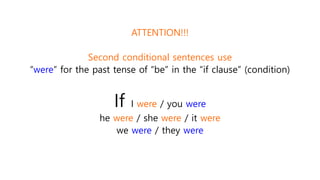
ATTENTION!!!
Second conditional sentences use
“were” for the past tense of “be” in the “if clause” (condition)
If I were / you were
he were / she were / it were
we were / they were
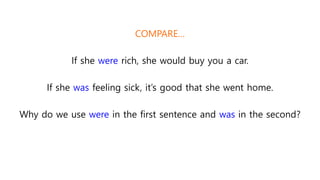
COMPARE…
If she were rich, she would buy you a car.
If she was feeling sick, it’s good that she went home.
Why do we use were in the first sentence and was in the second?
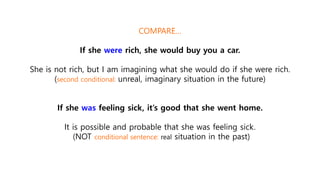
COMPARE…
If she were rich, she would buy you a car.
She is not rich, but I am imagining what she would do if she were rich.
(second conditional: unreal, imaginary situation in the future)
If she was feeling sick, it’s good that she went home.
It is possible and probable that she was feeling sick.
(NOT conditional sentence: real situation in the past)
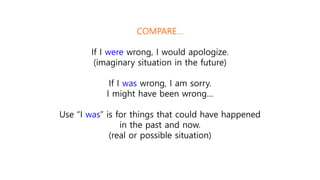
COMPARE…
If I were wrong, I would apologize.
(imaginary situation in the future)
If I was wrong, I am sorry.
I might have been wrong…
Use “I was” is for things that could have happened
in the past and now.
(real or possible situation)
The clauses can also be reversed
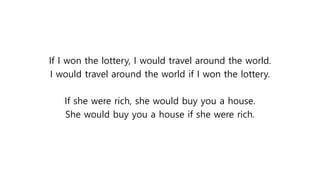
If I won the lottery, I would travel around the world.
I would travel around the world if I won the lottery.
If she were rich, she would buy you a house.
She would buy you a house if she were rich.
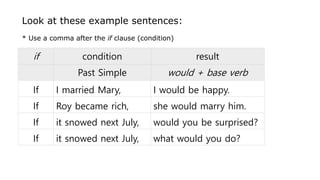
Look at these example sentences:
* Use a comma after the if clause (condition)
if condition result
Past Simple would + base verb
If I married Mary, I would be happy.
If Roy became rich, she would marry him.
If it snowed next July, would you be surprised?
If it snowed next July, what would you do?
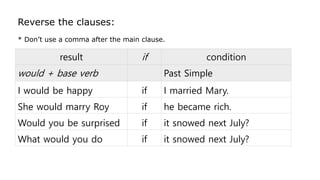
result if condition
would + base verb Past Simple
I would be happy if I married Mary.
She would marry Roy if he became rich.
Would you be surprised if it snowed next July?
What would you do if it snowed next July?
Reverse the clauses:
* Don’t use a comma after the main clause.
Answer grammar on p.99
(answers on next slide)
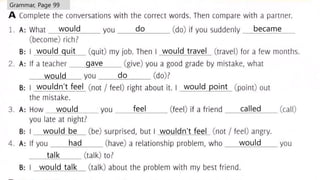
Grammar, Page 99
would do became
would quit would travel
gave
wouldn’t feel
would do
would point
feel called
would be wouldn’t feel
had
talk
would talk
would
would
What
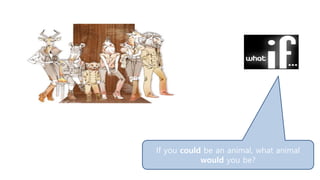
If you could be an animal, what animal
would you be?
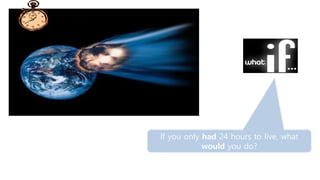
If you only had 24 hours to live, what
would you do?
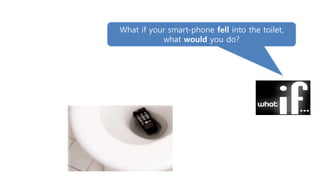
What if your smart-phone fell into the toilet,
what would you do?
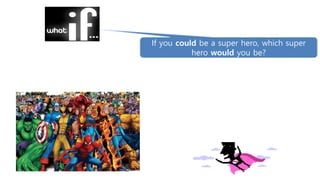
If you could be a super hero, which super
hero would you be?
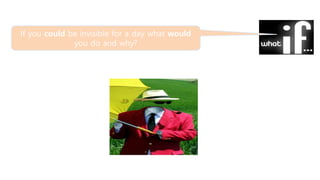
If you could be invisible for a day what would
you do and why?
If you had to commit any crime, what would
you do?
If there were a time machine and you could travel back in
time, where and when would you go and why?
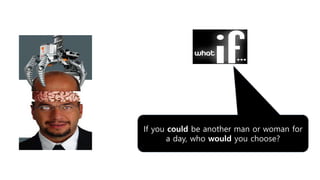
If you could be another man or woman for
a day, who would you choose?
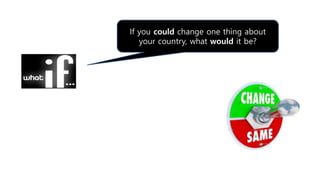
If you could change one thing about
your country, what would it be?
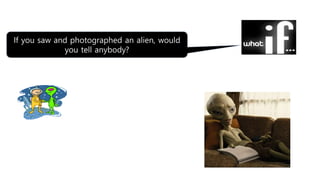
If you saw and photographed an alien, would
you tell anybody?
If you could erase any moment in your life,
which moment would it be and why?
If you were experiencing a harsh moment in life,
to whom would you go to for help and why?
If you could sail around the
world, who would you invite to
go with you and why?
Good Job !
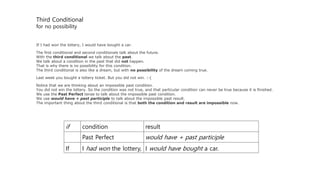
Third Conditional
for no possibility
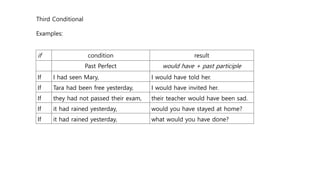
if condition result
Past Perfect would have + past participle
If I had won the lottery, I would have bought a car.
The first conditional and second conditionals talk about the future.
With the third conditional we talk about the past.
We talk about a condition in the past that did not happen.
That is why there is no possibility for this condition.
The third conditional is also like a dream, but with no possibility of the dream coming true.
Last week you bought a lottery ticket. But you did not win. :-(
Notice that we are thinking about an impossible past condition.
You did not win the lottery. So the condition was not true, and that particular condition can never be true because it is finished.
We use the Past Perfect tense to talk about the impossible past condition.
We use would have + past participle to talk about the impossible past result.
The important thing about the third conditional is that both the condition and result are impossible now.
if condition result
Past Perfect would have + past participle
If I had seen Mary, I would have told her.
If Tara had been free yesterday, I would have invited her.
If they had not passed their exam, their teacher would have been sad.
If it had rained yesterday, would you have stayed at home?
If it had rained yesterday, what would you have done?
Third Conditional
Examples:
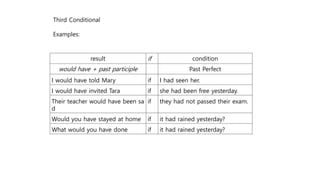
result if condition
would have + past participle Past Perfect
I would have told Mary if I had seen her.
I would have invited Tara if she had been free yesterday.
Their teacher would have been sa
d
if they had not passed their exam.
Would you have stayed at home if it had rained yesterday?
What would you have done if it had rained yesterday?
Third Conditional
Examples:
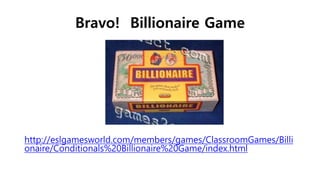
Bravo! Billionaire Game
http://eslgamesworld.com/members/games/ClassroomGames/Billi
onaire/Conditionals%20Billionaire%20Game/index.html

Unit 10 lesson b, c

  • 1.
    Unit 10: LivingYour Life
  • 2.
  • 3.
  • 4.
    I wouldn’t recommendthat. I’ll see. Page 96
  • 5.
  • 7.
    1.Say: Hi, Hello,introduce yourself. 2.SPEAK! 1. After 2 minutes, yell: CHANGE! 2. Odd numbers (1, 3, 5…) stay seated. 3. Even numbers (2, 4, 6…) move. 4. Everybody tell your old partner: Bye, Later, Gotta go, Seeya. Tell your new partner: Hi, Hello.
  • 9.
    A: I failedmy midterm exam. I think I’m going to drop out of university. B: I wouldn’t recommend that. I don’t think you should do that. I’m not sure that’s the best idea. A: Why not? B: Well, because…… A: I’ll see. I’ll think about it. I’ll give it some thought. B: I saw my best friend’s gf/bf with another guy/girl. I don’t think I’m going to say anything to him/her. A: I wouldn’t recommend that. I don’t think you should do that. I’m not sure that’s the best idea. B: What’s the problem? A: If you …. B: I’ll see. I’ll think about it. I’ll give it some thought. 2 minutesFollow up!
  • 10.
    A: I don’thave the money and I don’t know how to drive, but I want to buy a new, expensive car. B: I wouldn’t recommend that. I don’t think you should do that. I’m not sure that’s the best idea. A: Why not? B: Well, because… A: I’ll see. I’ll think about it. I’ll give it some thought. B: I’m really busy with school and my part-time job. I’m taking 6 classes already but I think I should take 2 more classes because I need the credits. A: I wouldn’t recommend that. I don’t think you should do that. I’m not sure that’s the best idea. B: What’s the problem? A: If you … B: I’ll see. I’ll think about it. I’ll give it some thought. 2 minutesFollow up!
  • 11.
    A: My roommatekeeps borrowing my things without asking. I’m going to kick him out this weekend. B: I wouldn’t recommend that. I don’t think you should do that. I’m not sure that’s the best idea. A: Why not? B: Well, because…… A: I’ll see. I’ll think about it. I’ll give it some thought. B: I’ve never gone camping before but I’m planning on going camping for a week in the mountains by myself! A: I wouldn’t recommend that. I don’t think you should do that. I’m not sure that’s the best idea. B: What’s the problem? A: If you …. B: I’ll see. I’ll think about it. I’ll give it some thought. 2 minutesFollow up!
  • 12.
    Listening , p.96 MaybeI’ll do that. (Answers on next page.)
  • 13.
    Problems 1. She needsto get a full-time job. She wants to take more classes. She’s thinking about quitting her job. She’s not going to graduate. 2. He doesn’t have the money. He doesn’t have a credit card. The leather jacket doesn’t fit. His friend won’t lend him any money. 3. She takes too many breaks. She can’t do a math problem. She drank too much coffee. Tim is driving her crazy. Page 97 Recommendations 1. Work fewer hours. 2. Save money. 3. Take a break.
  • 14.
    Unit 9: InseparablePhrasal Verbs h g i d e f a c b
  • 15.
  • 16.
  • 19.
    Do (it) over…do (it) again
  • 20.
  • 21.
  • 22.
  • 23.
  • 24.
  • 25.
  • 26.
  • 27.
    Put (it) off…do later, postpone
  • 28.
  • 29.
    Try (it) out…test, inspect, evaluate
  • 30.
  • 31.
  • 32.
  • 33.
  • 34.
    if condition result PresentSimple Present Simple If you heat ice, it melts. Zero Conditional (Unit 1) for certainty If you heat ice, it melts. We use the so-called zero conditional when the result of the condition is always true, like a scientific fact.
  • 35.
    First Conditional (Unit8) for possibilities If it rains, I will stay home. The first conditional is a structure we use when we want to talk about possibilities in the future. "If" Clause (the condition) Main Clause If + present simple + comma Subject + will/other modals* + base verb. If it rains, I will stay home * Use other modals such as “may”, “might”, “could” in the main clause when you are less certain about the results.
  • 36.
    Second Conditional (Unit10) For unreal possibilities If I won the lottery, I would travel around the world. (I didn’t win the lottery, so I won’t travel around the world.) Use second conditional to describe “unreal” or imaginary situations in the future. if condition result Past Simple would + base verb If I won the lottery, I would travel around the world.
  • 37.
    Grammar – SecondConditional p. 99
  • 38.
  • 39.
    Second conditional sentencestalk about “unreal”
  • 40.
    Second conditional sentencestalk about “unreal” or imaginary situations
  • 41.
    Second conditional sentencestalk about “unreal” or imaginary situations in the future.
  • 42.
  • 43.
    If I wonthe lottery, I would travel around the world. if clause (condition)
  • 44.
    If I wonthe lottery, I would travel around the world. if clause and main clause (condition) (result)
  • 45.
    Second conditional sentencesuse If I won the lottery, I would travel around the world. If
  • 46.
    Second conditional sentencesuse If I won the lottery, I would travel around the world. If + Simple Past
  • 47.
    Second conditional sentencesuse If I won the lottery, I would travel around the world. If + Simple Past, AND would
  • 48.
    Second conditional sentencesuse If I won the lottery, I would travel around the world. If + Simple Past, AND would + base verb
  • 49.
    Second conditional sentencesuse If he had more money, he would buy a camcorder. If + Simple Past, AND would + base verb
  • 50.
    Second conditional sentencesuse If you were the teacher, you would give everyone an A+. If + Simple Past, AND would + base verb
  • 51.
    ATTENTION!!! Second conditional sentencesuse “were” for the past tense of “be” in the “if clause” (condition) If I were / you were he were / she were / it were we were / they were
  • 52.
    COMPARE… If she wererich, she would buy you a car. If she was feeling sick, it’s good that she went home. Why do we use were in the first sentence and was in the second?
  • 53.
    COMPARE… If she wererich, she would buy you a car. She is not rich, but I am imagining what she would do if she were rich. (second conditional: unreal, imaginary situation in the future) If she was feeling sick, it’s good that she went home. It is possible and probable that she was feeling sick. (NOT conditional sentence: real situation in the past)
  • 54.
    COMPARE… If I werewrong, I would apologize. (imaginary situation in the future) If I was wrong, I am sorry. I might have been wrong… Use “I was” is for things that could have happened in the past and now. (real or possible situation)
  • 55.
    The clauses canalso be reversed
  • 56.
    If I wonthe lottery, I would travel around the world. I would travel around the world if I won the lottery. If she were rich, she would buy you a house. She would buy you a house if she were rich.
  • 57.
    Look at theseexample sentences: * Use a comma after the if clause (condition) if condition result Past Simple would + base verb If I married Mary, I would be happy. If Roy became rich, she would marry him. If it snowed next July, would you be surprised? If it snowed next July, what would you do?
  • 58.
    result if condition would+ base verb Past Simple I would be happy if I married Mary. She would marry Roy if he became rich. Would you be surprised if it snowed next July? What would you do if it snowed next July? Reverse the clauses: * Don’t use a comma after the main clause.
  • 59.
    Answer grammar onp.99 (answers on next slide)
  • 60.
    Grammar, Page 99 woulddo became would quit would travel gave wouldn’t feel would do would point feel called would be wouldn’t feel had talk would talk would would
  • 62.
  • 63.
    If you couldbe an animal, what animal would you be?
  • 64.
    If you onlyhad 24 hours to live, what would you do?
  • 65.
    What if yoursmart-phone fell into the toilet, what would you do?
  • 66.
    If you couldbe a super hero, which super hero would you be?
  • 67.
    If you couldbe invisible for a day what would you do and why?
  • 68.
    If you hadto commit any crime, what would you do?
  • 69.
    If there werea time machine and you could travel back in time, where and when would you go and why?
  • 70.
    If you couldbe another man or woman for a day, who would you choose?
  • 71.
    If you couldchange one thing about your country, what would it be?
  • 72.
    If you sawand photographed an alien, would you tell anybody?
  • 73.
    If you coulderase any moment in your life, which moment would it be and why?
  • 74.
    If you wereexperiencing a harsh moment in life, to whom would you go to for help and why?
  • 75.
    If you couldsail around the world, who would you invite to go with you and why?
  • 76.
  • 77.
    Third Conditional for nopossibility if condition result Past Perfect would have + past participle If I had won the lottery, I would have bought a car. If I had won the lottery, I would have bought a car. The first conditional and second conditionals talk about the future. With the third conditional we talk about the past. We talk about a condition in the past that did not happen. That is why there is no possibility for this condition. The third conditional is also like a dream, but with no possibility of the dream coming true. Last week you bought a lottery ticket. But you did not win. :-( Notice that we are thinking about an impossible past condition. You did not win the lottery. So the condition was not true, and that particular condition can never be true because it is finished. We use the Past Perfect tense to talk about the impossible past condition. We use would have + past participle to talk about the impossible past result. The important thing about the third conditional is that both the condition and result are impossible now.
  • 78.
    if condition result PastPerfect would have + past participle If I had seen Mary, I would have told her. If Tara had been free yesterday, I would have invited her. If they had not passed their exam, their teacher would have been sad. If it had rained yesterday, would you have stayed at home? If it had rained yesterday, what would you have done? Third Conditional Examples:
  • 79.
    result if condition wouldhave + past participle Past Perfect I would have told Mary if I had seen her. I would have invited Tara if she had been free yesterday. Their teacher would have been sa d if they had not passed their exam. Would you have stayed at home if it had rained yesterday? What would you have done if it had rained yesterday? Third Conditional Examples:
  • 80.