The Difference Between Tenses
By :
Fauziah Khoirun Nisa
X MIA 5 / 14
Simple Present vs Present Continuous
FORM
Simple Present Present Continuous
infinitive
(3rd person singular: infinitive + 's')
I speak
you speak
he / she / it speaks
we speak
they speak
form of 'be' and verb + ing
I am speaking
you are speaking
he / she / it is speaking
we are speaking
they are speaking
Exceptions
Exceptions when adding 's' :
• For can, may, might, must, do not add s. Example:
he can, she may, it must
• After o, ch, sh or s, add es.
Example: do - he does, wash - she washes
• After a consonant, the final consonant y becomes
ie. (but: not after a vowel)
Example: worry - he worries
but: play - he plays
Exceptions when adding 'ing' :
• Silent e is dropped. (but: does not apply for -ee)
Example: come - coming
but: agree - agreeing
• After a short, stressed vowel, the final consonant
is doubled.
Example: sit - sitting
• After a vowel, the final consonant l is doubled in
British English (but not in American English).
Example: travel - travelling (British English)
but: traveling (American English)
• Final ie becomes y.
Example: lie - lying
USE
In general or right now?
Simple Present Present Continuous
in general (regularly, often, never)
Colin plays football every Tuesday.
present actions happening one after another
First Colin plays football, then he watches TV.
right now
Look! Colin is playing football now.
also for several actions happening at the same
time
Colin is playing football and Anne is watching.
Signal words
• always
• every ...
• often
• normally
• usually
• sometimes
• seldom
• never
• first
• then
• at the moment
• at this moment
• today
• now
• right now
• Listen!
• Look!
Note: The following verbs are usually only used in Simple Present:
be, have, hear, know, like, love, see, smell, think, want
Timetable / Schedule or arrangement?
Daily routine or just for a limited period of time?
Simple Present Present Continuous
action set by a timetable or schedule
The film starts at 8 pm.
arrangement for the near future
I am going to the cinema tonight.
Simple Present Present Continuous
daily routine
Bob works in a restaurant.
only for a limited period of time (does
not have to happen directly at the
moment of speaking)
Jenny is working in a restaurant this
week.
Certain Verbs
The following verbs are usually only used in Simple Present (not in the
continuous form).
• state: be, cost, fit, mean, suit
Example: We are on holiday.
• possession: belong, have
Example: Sam has a cat.
• senses: feel, hear, see, smell, taste, touch
Example: He feels the cold.
• feelings: hate, hope, like, love, prefer, regret, want, wish
Example: Jane loves pizza.
• brain work: believe, know, think, understand
Example: I believe you.
• Introductory clauses for direct speech: answer, ask, reply, say
Example: “I am watching TV,“ he says.
Exercise
Simple Present – Present Continuous
Question :
1. This (be) ____ Caroline.
2. Caroline (have) ____ long blond hair.
3. She usually (wear) ____ glasses, but now she (wear) ____ contact lenses.
4. Caroline (like) ____ sports.
5. She (play) ____ handball every Monday and Thursday.
Answer :
1. This is Caroline.
2. Caroline has long blond hair.
3. She usually wears glasses, but now she is wearing contact lenses.
4. Caroline likes sports.
5. She plays handball every Monday and Thursday.
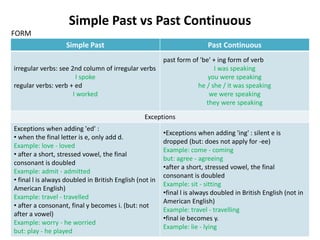
Simple Past vs Past Continuous
FORM
Simple Past Past Continuous
irregular verbs: see 2nd column of irregular verbs
I spoke
regular verbs: verb + ed
I worked
past form of 'be' + ing form of verb
I was speaking
you were speaking
he / she / it was speaking
we were speaking
they were speaking
Exceptions
Exceptions when adding 'ed' :
• when the final letter is e, only add d.
Example: love - loved
• after a short, stressed vowel, the final
consonant is doubled
Example: admit - admitted
• final l is always doubled in British English (not in
American English)
Example: travel - travelled
• after a consonant, final y becomes i. (but: not
after a vowel)
Example: worry - he worried
but: play - he played
•Exceptions when adding 'ing' : silent e is
dropped (but: does not apply for -ee)
Example: come - coming
but: agree - agreeing
•after a short, stressed vowel, the final
consonant is doubled
Example: sit - sitting
•final l is always doubled in British English (not in
American English)
Example: travel - travelling
•final ie becomes y.
Example: lie - lying
USE
After another or at the same time?
New action or already in progress?
Only mentioning or emphasising progress?
Simple Past Past Continuous
after another
She came home, switched on the
computer and checked her e-mails.
at the same time
Simon was playing on the computer while
his brother was watching TV.
Simple Past Past Continuous
new action
My mobile rang (when I was sitting in a
meeting.)
action already in progress
While I was sitting in a meeting, (my mobile
suddenly rang.)
Simple Past Past Continuous
just mentioning
Colin played football yesterday.
emphasising progress
Yesterday at six o'clock, Colin was playing
football.
Certain Verbs
The following verbs are usually only used in Simple Past (not
in the continuous form).
• state: be, cost, fit, mean, suit
Example: We were on holiday.
• possession: belong, have
Example: Sam had a cat.
• senses: feel, hear, see, smell, taste, touch
Example: He felt the cold.
• feelings: hate, hope, like, love, prefer, regret, want, wish
Example: Jane loved pizza.
• brain work: believe, know, think, understand
Example: I did not understand him.
• introductory clauses for direct speech: answer, ask, reply, say
Example: “I am watching TV,“ he said.
Signal Words
Simple Past Past Continuous
• first
• then
• If-Satz Typ II (If I talked, …)
• when
• while
• as long as
Exercise
Simple Past or Past Continuous
Question :
1. When I (get) ____ up yesterday, the sun (shine) .
2. It (is) ____ a beautiful morning.
3. So I (decide) ____ to cycle around a little.
4. I (go) ____ to the shed and (take) ____ out my bike.
5. While I (cycle) ____ past some villages, I (see) ____ some people in their
gardens.
Answer :
1. When I got up yesterday, the sun was shining.
2. It was a beautiful morning.
3. So I decided to cycle around a little.
4. I went to the shed and took out my bike.
5. While I was cycling past some villages, I saw some people in their
gardens.
Simple Past vs Present Perfect Simple
FORM
Simple Past Present Perfect Simple
irregular verbs: see 2nd column of irregular
verbs
Example: I spoke
irregular verbs: form of 'have' + 3rd column of
irregular verbs
Example: I / you / we / they have spoken he /
she / it has spoken
regular verbs: infinitive + ed
Example: I worked
regular verbs: form of 'have' + infinitive + ed
Example: I / you / we / they have worked he /
she / it has worked
Exceptions
Exceptions when adding 'ed':
• when the final letter is e, only add d
Example: love - loved
• after a short, stressed vowel, the final consonant is doubled
Example: admit - admitted
• final l is always doubled in British English (not in American English)
Example: travel - travelled
• after a consonant, final y becomes i (but: not after a vowel)
Example: worry - worried but: play - played
Use
In British English, the use of Simple Past and Present Perfect is
quite strict. As soon as a time expression in the past is given, you
have to use Simple Past. If there are no signal words, you must
decide if we just talk about an action in the past or if its
consequence in the present is important.
Note that the following explanations and exercises refer to
British English only. In American English, you can normally use
Simple Past instead of Present Perfect. We cannot accept this in our
exercises, however, as this would lead to confusions amongst those
who have to learn the differences.
Certain time in the past or just / already / yet?
Certain event in the past or how often so far?
Emphasis on action or result?
Simple Past Present Perfect Simple
certain time in the past
Example: I phoned Mary 2 minutes ago.
just / already / not yet
Example: I have just phoned Mary.
Simple Past Present Perfect Simple
certain event in the past
Example: He went to Canada last summer.
whether / how often till now
Example: Have you ever been to Canada? /
I have been to Canada twice.
Simple Past Present Perfect Simple
Emphasis on action
Example: I bought a new bike. (just telling
what I did in the past.)
Emphasis on result
Example: I have bought a new bike. (With
this sentence I actually want to express that
I have a new bike now.)
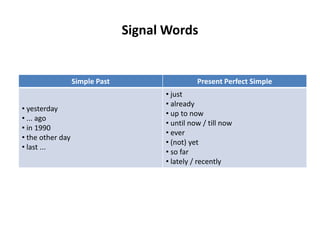
Signal Words
Simple Past Present Perfect Simple
• yesterday
• ... ago
• in 1990
• the other day
• last ...
• just
• already
• up to now
• until now / till now
• ever
• (not) yet
• so far
• lately / recently
Exercise
Simple Past or Present Perfect Simple
Question :
1. Mary (already / write) ____ five letters.
2. Tom (move) ____ to this town in 1994.
3. My friend (be) ____ in Canada two years ago.
4. I (not / be) ____ to Canada so far.
5. But I (already / travel) ____ to London a couple of times.
Answer :
1. Mary has already written five letters.
2. Tom moved to this town in 1994.
3. My friend was in Canada two years ago.
4. I have not been to Canada so far.
5. But I have already travelled to London a couple of times.
PPT Bahasa Inggris: The Difference Between Tenses

PPT Bahasa Inggris: The Difference Between Tenses

  • 1.
    The Difference BetweenTenses By : Fauziah Khoirun Nisa X MIA 5 / 14
  • 2.
    Simple Present vsPresent Continuous FORM Simple Present Present Continuous infinitive (3rd person singular: infinitive + 's') I speak you speak he / she / it speaks we speak they speak form of 'be' and verb + ing I am speaking you are speaking he / she / it is speaking we are speaking they are speaking Exceptions Exceptions when adding 's' : • For can, may, might, must, do not add s. Example: he can, she may, it must • After o, ch, sh or s, add es. Example: do - he does, wash - she washes • After a consonant, the final consonant y becomes ie. (but: not after a vowel) Example: worry - he worries but: play - he plays Exceptions when adding 'ing' : • Silent e is dropped. (but: does not apply for -ee) Example: come - coming but: agree - agreeing • After a short, stressed vowel, the final consonant is doubled. Example: sit - sitting • After a vowel, the final consonant l is doubled in British English (but not in American English). Example: travel - travelling (British English) but: traveling (American English) • Final ie becomes y. Example: lie - lying
  • 3.
    USE In general orright now? Simple Present Present Continuous in general (regularly, often, never) Colin plays football every Tuesday. present actions happening one after another First Colin plays football, then he watches TV. right now Look! Colin is playing football now. also for several actions happening at the same time Colin is playing football and Anne is watching. Signal words • always • every ... • often • normally • usually • sometimes • seldom • never • first • then • at the moment • at this moment • today • now • right now • Listen! • Look! Note: The following verbs are usually only used in Simple Present: be, have, hear, know, like, love, see, smell, think, want
  • 4.
    Timetable / Scheduleor arrangement? Daily routine or just for a limited period of time? Simple Present Present Continuous action set by a timetable or schedule The film starts at 8 pm. arrangement for the near future I am going to the cinema tonight. Simple Present Present Continuous daily routine Bob works in a restaurant. only for a limited period of time (does not have to happen directly at the moment of speaking) Jenny is working in a restaurant this week.
  • 5.
    Certain Verbs The followingverbs are usually only used in Simple Present (not in the continuous form). • state: be, cost, fit, mean, suit Example: We are on holiday. • possession: belong, have Example: Sam has a cat. • senses: feel, hear, see, smell, taste, touch Example: He feels the cold. • feelings: hate, hope, like, love, prefer, regret, want, wish Example: Jane loves pizza. • brain work: believe, know, think, understand Example: I believe you. • Introductory clauses for direct speech: answer, ask, reply, say Example: “I am watching TV,“ he says.
  • 6.
    Exercise Simple Present –Present Continuous Question : 1. This (be) ____ Caroline. 2. Caroline (have) ____ long blond hair. 3. She usually (wear) ____ glasses, but now she (wear) ____ contact lenses. 4. Caroline (like) ____ sports. 5. She (play) ____ handball every Monday and Thursday. Answer : 1. This is Caroline. 2. Caroline has long blond hair. 3. She usually wears glasses, but now she is wearing contact lenses. 4. Caroline likes sports. 5. She plays handball every Monday and Thursday.
  • 7.
    Simple Past vsPast Continuous FORM Simple Past Past Continuous irregular verbs: see 2nd column of irregular verbs I spoke regular verbs: verb + ed I worked past form of 'be' + ing form of verb I was speaking you were speaking he / she / it was speaking we were speaking they were speaking Exceptions Exceptions when adding 'ed' : • when the final letter is e, only add d. Example: love - loved • after a short, stressed vowel, the final consonant is doubled Example: admit - admitted • final l is always doubled in British English (not in American English) Example: travel - travelled • after a consonant, final y becomes i. (but: not after a vowel) Example: worry - he worried but: play - he played •Exceptions when adding 'ing' : silent e is dropped (but: does not apply for -ee) Example: come - coming but: agree - agreeing •after a short, stressed vowel, the final consonant is doubled Example: sit - sitting •final l is always doubled in British English (not in American English) Example: travel - travelling •final ie becomes y. Example: lie - lying
  • 8.
    USE After another orat the same time? New action or already in progress? Only mentioning or emphasising progress? Simple Past Past Continuous after another She came home, switched on the computer and checked her e-mails. at the same time Simon was playing on the computer while his brother was watching TV. Simple Past Past Continuous new action My mobile rang (when I was sitting in a meeting.) action already in progress While I was sitting in a meeting, (my mobile suddenly rang.) Simple Past Past Continuous just mentioning Colin played football yesterday. emphasising progress Yesterday at six o'clock, Colin was playing football.
  • 9.
    Certain Verbs The followingverbs are usually only used in Simple Past (not in the continuous form). • state: be, cost, fit, mean, suit Example: We were on holiday. • possession: belong, have Example: Sam had a cat. • senses: feel, hear, see, smell, taste, touch Example: He felt the cold. • feelings: hate, hope, like, love, prefer, regret, want, wish Example: Jane loved pizza. • brain work: believe, know, think, understand Example: I did not understand him. • introductory clauses for direct speech: answer, ask, reply, say Example: “I am watching TV,“ he said.
  • 10.
    Signal Words Simple PastPast Continuous • first • then • If-Satz Typ II (If I talked, …) • when • while • as long as
  • 11.
    Exercise Simple Past orPast Continuous Question : 1. When I (get) ____ up yesterday, the sun (shine) . 2. It (is) ____ a beautiful morning. 3. So I (decide) ____ to cycle around a little. 4. I (go) ____ to the shed and (take) ____ out my bike. 5. While I (cycle) ____ past some villages, I (see) ____ some people in their gardens. Answer : 1. When I got up yesterday, the sun was shining. 2. It was a beautiful morning. 3. So I decided to cycle around a little. 4. I went to the shed and took out my bike. 5. While I was cycling past some villages, I saw some people in their gardens.
  • 12.
    Simple Past vsPresent Perfect Simple FORM Simple Past Present Perfect Simple irregular verbs: see 2nd column of irregular verbs Example: I spoke irregular verbs: form of 'have' + 3rd column of irregular verbs Example: I / you / we / they have spoken he / she / it has spoken regular verbs: infinitive + ed Example: I worked regular verbs: form of 'have' + infinitive + ed Example: I / you / we / they have worked he / she / it has worked Exceptions Exceptions when adding 'ed': • when the final letter is e, only add d Example: love - loved • after a short, stressed vowel, the final consonant is doubled Example: admit - admitted • final l is always doubled in British English (not in American English) Example: travel - travelled • after a consonant, final y becomes i (but: not after a vowel) Example: worry - worried but: play - played
  • 13.
    Use In British English,the use of Simple Past and Present Perfect is quite strict. As soon as a time expression in the past is given, you have to use Simple Past. If there are no signal words, you must decide if we just talk about an action in the past or if its consequence in the present is important. Note that the following explanations and exercises refer to British English only. In American English, you can normally use Simple Past instead of Present Perfect. We cannot accept this in our exercises, however, as this would lead to confusions amongst those who have to learn the differences.
  • 14.
    Certain time inthe past or just / already / yet? Certain event in the past or how often so far? Emphasis on action or result? Simple Past Present Perfect Simple certain time in the past Example: I phoned Mary 2 minutes ago. just / already / not yet Example: I have just phoned Mary. Simple Past Present Perfect Simple certain event in the past Example: He went to Canada last summer. whether / how often till now Example: Have you ever been to Canada? / I have been to Canada twice. Simple Past Present Perfect Simple Emphasis on action Example: I bought a new bike. (just telling what I did in the past.) Emphasis on result Example: I have bought a new bike. (With this sentence I actually want to express that I have a new bike now.)
  • 15.
    Signal Words Simple PastPresent Perfect Simple • yesterday • ... ago • in 1990 • the other day • last ... • just • already • up to now • until now / till now • ever • (not) yet • so far • lately / recently
  • 16.
    Exercise Simple Past orPresent Perfect Simple Question : 1. Mary (already / write) ____ five letters. 2. Tom (move) ____ to this town in 1994. 3. My friend (be) ____ in Canada two years ago. 4. I (not / be) ____ to Canada so far. 5. But I (already / travel) ____ to London a couple of times. Answer : 1. Mary has already written five letters. 2. Tom moved to this town in 1994. 3. My friend was in Canada two years ago. 4. I have not been to Canada so far. 5. But I have already travelled to London a couple of times.