Z-PLASTY: GENERAL SURGICAL
       PROSPECTIVE


    By- Dr.Kundan Kharde


            DPU
Conventional technique
1. Post Burn Scars- are managed by release /
   excision of scar followed by SSG, and post
   operatively patient requires splinting in
   corrected position for almost 6-12 months
   to prevent recurrence of deformity. But
   compliance of patients for prolonged
   splinting is very poor, hence come back
   with recurrence.

                     DPU
Conventional technique
Pilonidal sinus : Several surgical techniques
are available for repair of the defect created
after excision of pilonidal sinus including
excision and direct closure, marsupalisation,
skin grafting or local flaps but each
technique has some advantages/ limitations.
Recurrence is almost 40% percent after
excision and direct closure.

                    DPU
Z- PLASTY-is it the answer?
1. Scars- Z-plasty serves to reorient and lengthen
   a scar
2. In Pilonidal disease- Z-plasty eliminates the
   deep natal cleft by bringing healthy, lateral skin
   and subcutaneous tissue into the midline
3. This report is based on our experience in
   managing 10 cases of Post burn contractures and
   05 cases of Pilonidal sinus utilising Z-plasty
   technique.

                         DPU
What is Z-plasty?
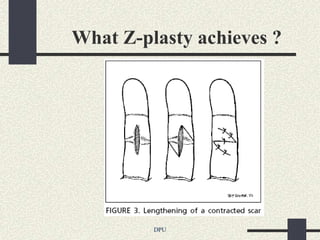
Z-Plasty is a surgical technique that is
extensively used in plastic surgery to
lengthen the linear scars and thus correct the
deformity and improve the function.
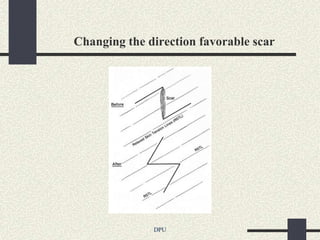
This technique redirects the forces acting
on the scar to improve the appearance.


                    DPU
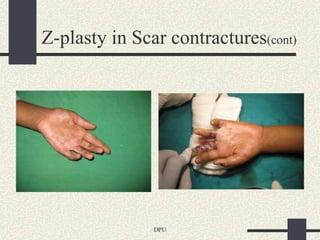
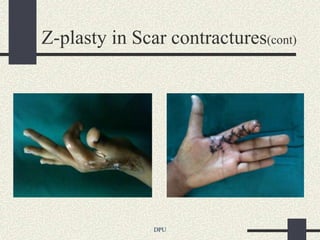
Z- plasty in Scar contracture
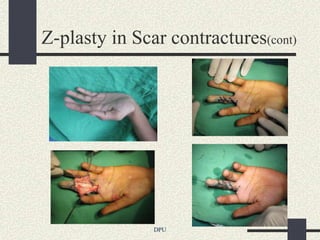
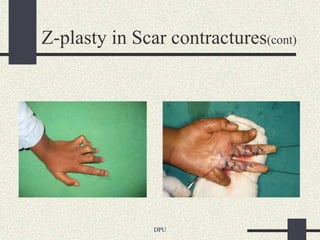
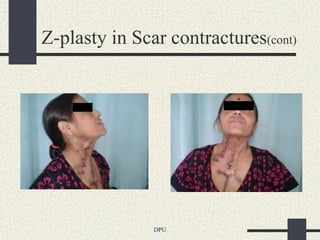
A total of 10 patients of scar contractures
were operated.(linear scars)

 There were 5 males and 5 females, in the
age group of 3 – 30 years.


                    DPU
Z-plasty in Scar contractures(cont)


               DPU
Z-plasty in Scar contractures(cont)


               DPU
Z-plasty in Scar contractures(cont)


               DPU
Z-plasty in Scar contractures(cont)


               DPU
Z-plasty in Scar contractures(cont)


               DPU
Z-plasty in Scar contractures(cont)
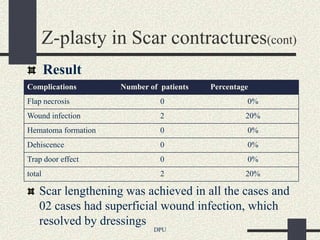
        Result
Complications        Number of patients   Percentage
Flap necrosis                  0                   0%
Wound infection                2                   20%
Hematoma formation             0                   0%
Dehiscence                     0                   0%
Trap door effect               0                   0%
total                          2                   20%

    Scar lengthening was achieved in all the cases and
    02 cases had superficial wound infection, which
    resolved by dressings
                             DPU
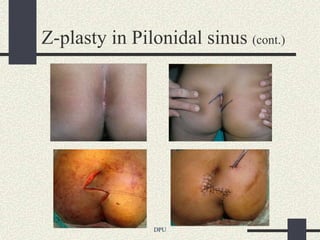
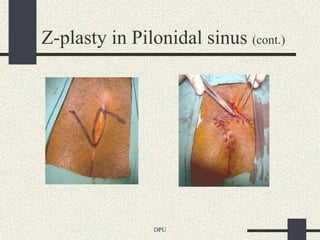
Z- plasty in Pilonidal sinus
A total of five patients of Pilonidal sinus
were operated

All were males, majority in the age group of
15 – 30

The operating time ranged between 30-45
minutes (mean 35 + 2).
                     DPU
Z-plasty in Pilonidal sinus (cont.)


                DPU
Z-plasty in Pilonidal sinus (cont.)


                DPU
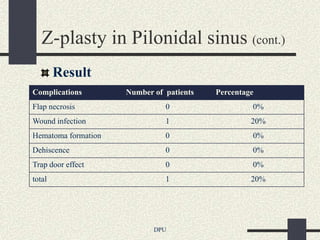
Z-plasty in Pilonidal sinus (cont.)
        Result
Complications        Number of patients   Percentage
Flap necrosis                  0                   0%
Wound infection                1                   20%
Hematoma formation             0                   0%
Dehiscence                     0                   0%
Trap door effect               0                   0%
total                          1                   20%


                            DPU
Z-plasty in Pilonidal sinus (cont.)
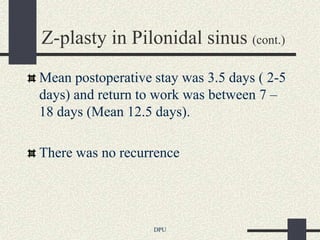
Mean postoperative stay was 3.5 days ( 2-5
days) and return to work was between 7 –
18 days (Mean 12.5 days).

There was no recurrence


                   DPU
What Z-plasty achieves ?


         DPU
Changing the direction favorable scar


              DPU
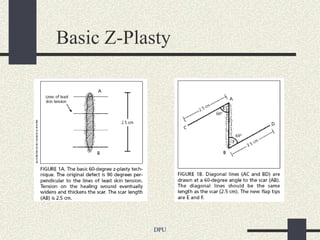
Basic Z-Plasty


           DPU
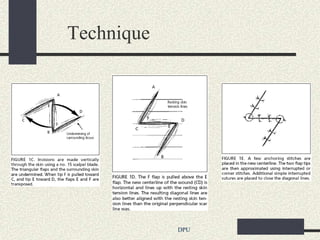
Technique


            DPU
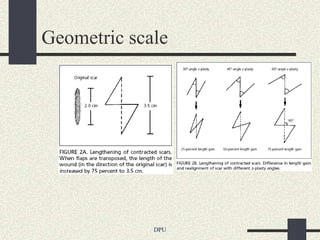
Geometric scale


             DPU
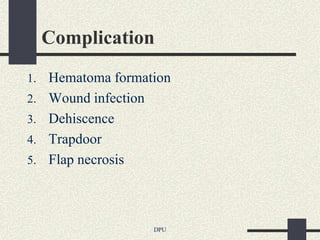
Complication
1.   Hematoma formation
2.   Wound infection
3.   Dehiscence
4.   Trapdoor
5.   Flap necrosis


                    DPU
Discussion
Multiple reconstructive methods have been used
for the treatment of postburn scar contractures
including skin grafting, local flaps and free flaps.

Similarly, multiple Techniques such as drainage,
excision, and marsupilization yield mixed results
in the treatment of pilonidal sinuses. Patients are
often dissatisfied, because of long post op period
and recurrence.

                        DPU
Discussion (cont.)
Severe contracture lines crossing flexion folds can
be released effectively by using Z- plasty
technique.
In pilonidal disease, the Z- plasty eliminates the
deep natal cleft by bringing healthy, lateral skin
and subcutaneous tissue into the midline.
 Excision and Z- plasty together can lead to a low
recurrence rate with rapid healing


                       DPU
Conclusion
In linear scar contracture Z plasty technique
helped to increase the length of scars with
release of contractures

In pilonidal sinus management with Z
plasty showed zero recurrence and less
hospital stay

                    DPU
Conclusion
Z- plasty is a versatile technique, easy to perform
and can be an armamentarium of general surgeon
to manage linear scar contractures where scar
lengthening is necessary.

 Once the concept of dual transposition of the
triangular flaps is understood, any general surgeon
should be able to use to achieve optimal results


                       DPU
References
1.   Wiliams NS, Christopher JK. Bulstrode P,Ronan O Connell. Pilonidal
     sinus. In: Bailey and Love’s Short practice of
     Surgery.25thed.London: Hodder Arnold 2008:1247-8.
2.    I. Iesalnieks, A. Furst, M. Rentsch and K.W. Jauch. Primary midline
     closure after excision of a pilonidal sinus is associated with a high
     recurrence rate.Chirurg, 74 (2003), pp. 461–468
3.   The basic Z-plasty. Am Fam Physician. 2003 Jun 1 ;67(11):2329-32
4.   Bernstein L. Z-plasty in head and neck surgery. Arch Otolaryn
     89:574-84, 1969 Apr
5.   Rohrich RJ, Zbar RI. A simplified algorithm for the use of Z-plasty.
     Plast Reconstr Surg 1999;103:1513-7.


                                   DPU

Z plasty

  • 1.
    Z-PLASTY: GENERAL SURGICAL PROSPECTIVE By- Dr.Kundan Kharde DPU
  • 2.
    Conventional technique 1. PostBurn Scars- are managed by release / excision of scar followed by SSG, and post operatively patient requires splinting in corrected position for almost 6-12 months to prevent recurrence of deformity. But compliance of patients for prolonged splinting is very poor, hence come back with recurrence. DPU
  • 3.
    Conventional technique Pilonidal sinus: Several surgical techniques are available for repair of the defect created after excision of pilonidal sinus including excision and direct closure, marsupalisation, skin grafting or local flaps but each technique has some advantages/ limitations. Recurrence is almost 40% percent after excision and direct closure. DPU
  • 4.
    Z- PLASTY-is itthe answer? 1. Scars- Z-plasty serves to reorient and lengthen a scar 2. In Pilonidal disease- Z-plasty eliminates the deep natal cleft by bringing healthy, lateral skin and subcutaneous tissue into the midline 3. This report is based on our experience in managing 10 cases of Post burn contractures and 05 cases of Pilonidal sinus utilising Z-plasty technique. DPU
  • 5.
    What is Z-plasty? Z-Plastyis a surgical technique that is extensively used in plastic surgery to lengthen the linear scars and thus correct the deformity and improve the function. This technique redirects the forces acting on the scar to improve the appearance. DPU
  • 6.
    Z- plasty inScar contracture A total of 10 patients of scar contractures were operated.(linear scars) There were 5 males and 5 females, in the age group of 3 – 30 years. DPU
  • 7.
    Z-plasty in Scarcontractures(cont) DPU
  • 8.
    Z-plasty in Scarcontractures(cont) DPU
  • 9.
    Z-plasty in Scarcontractures(cont) DPU
  • 10.
    Z-plasty in Scarcontractures(cont) DPU
  • 11.
    Z-plasty in Scarcontractures(cont) DPU
  • 12.
    Z-plasty in Scarcontractures(cont) Result Complications Number of patients Percentage Flap necrosis 0 0% Wound infection 2 20% Hematoma formation 0 0% Dehiscence 0 0% Trap door effect 0 0% total 2 20% Scar lengthening was achieved in all the cases and 02 cases had superficial wound infection, which resolved by dressings DPU
  • 13.
    Z- plasty inPilonidal sinus A total of five patients of Pilonidal sinus were operated All were males, majority in the age group of 15 – 30 The operating time ranged between 30-45 minutes (mean 35 + 2). DPU
  • 14.
    Z-plasty in Pilonidalsinus (cont.) DPU
  • 15.
    Z-plasty in Pilonidalsinus (cont.) DPU
  • 16.
    Z-plasty in Pilonidalsinus (cont.) Result Complications Number of patients Percentage Flap necrosis 0 0% Wound infection 1 20% Hematoma formation 0 0% Dehiscence 0 0% Trap door effect 0 0% total 1 20% DPU
  • 17.
    Z-plasty in Pilonidalsinus (cont.) Mean postoperative stay was 3.5 days ( 2-5 days) and return to work was between 7 – 18 days (Mean 12.5 days). There was no recurrence DPU
  • 18.
  • 19.
    Changing the directionfavorable scar DPU
  • 20.
  • 21.
  • 22.
  • 23.
    Complication 1. Hematoma formation 2. Wound infection 3. Dehiscence 4. Trapdoor 5. Flap necrosis DPU
  • 24.
    Discussion Multiple reconstructive methodshave been used for the treatment of postburn scar contractures including skin grafting, local flaps and free flaps. Similarly, multiple Techniques such as drainage, excision, and marsupilization yield mixed results in the treatment of pilonidal sinuses. Patients are often dissatisfied, because of long post op period and recurrence. DPU
  • 25.
    Discussion (cont.) Severe contracturelines crossing flexion folds can be released effectively by using Z- plasty technique. In pilonidal disease, the Z- plasty eliminates the deep natal cleft by bringing healthy, lateral skin and subcutaneous tissue into the midline. Excision and Z- plasty together can lead to a low recurrence rate with rapid healing DPU
  • 26.
    Conclusion In linear scarcontracture Z plasty technique helped to increase the length of scars with release of contractures In pilonidal sinus management with Z plasty showed zero recurrence and less hospital stay DPU
  • 27.
    Conclusion Z- plasty isa versatile technique, easy to perform and can be an armamentarium of general surgeon to manage linear scar contractures where scar lengthening is necessary. Once the concept of dual transposition of the triangular flaps is understood, any general surgeon should be able to use to achieve optimal results DPU
  • 28.
    References 1. Wiliams NS, Christopher JK. Bulstrode P,Ronan O Connell. Pilonidal sinus. In: Bailey and Love’s Short practice of Surgery.25thed.London: Hodder Arnold 2008:1247-8. 2. I. Iesalnieks, A. Furst, M. Rentsch and K.W. Jauch. Primary midline closure after excision of a pilonidal sinus is associated with a high recurrence rate.Chirurg, 74 (2003), pp. 461–468 3. The basic Z-plasty. Am Fam Physician. 2003 Jun 1 ;67(11):2329-32 4. Bernstein L. Z-plasty in head and neck surgery. Arch Otolaryn 89:574-84, 1969 Apr 5. Rohrich RJ, Zbar RI. A simplified algorithm for the use of Z-plasty. Plast Reconstr Surg 1999;103:1513-7. DPU

Editor's Notes

  • #3 Conventionally pbc were managed by release or excision of scars wit ssg