FLORES, SONZA, SAMSON
 Amniotic fluid is present in the amnion, a
membranous sac that surrounds the fetus
 The primary functions of the fluid are to
provide a protective cushion for the fetus,
allow fetal movement, stablize the temperature
to protect the fetus from extreme temperature
changes, and to permit proper lung
development
Volume
 Amniotic fluid volume is regulated by a
balance between the production of fetal urine
and lung fluid and the absorption from fetal
swallowing and intramembranous flow
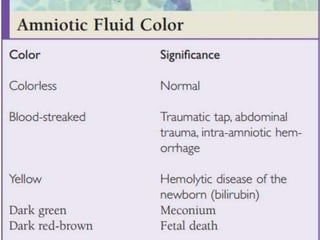
 Meconium - which is usually defined as a
newborn’s first bowel movement, may be
present in the amniotic fluid as the result of
fetal intestinal secretions.
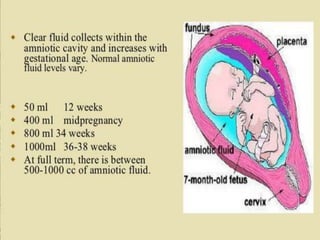
 About 500 mls enter and leave the
amniotic sac each hour.
 gradual ↑ up to 36 weeks to around 600 to
1000 ml then↓ after that.
 The normal range is wide but the
approximate volumes are:
- 500 ml at 18 weeks
- 800 ml at 34 weeks.
- 600 ml at term.
Polyhydramnios
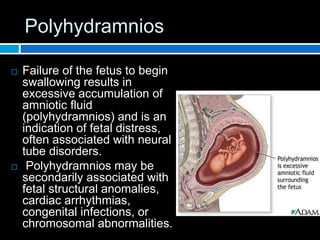
 Failure of the fetus to begin
swallowing results in
excessive accumulation of
amniotic fluid
(polyhydramnios) and is an
indication of fetal distress,
often associated with neural
tube disorders.
 Polyhydramnios may be
secondarily associated with
fetal structural anomalies,
cardiac arrhythmias,
congenital infections, or
chromosomal abnormalities.
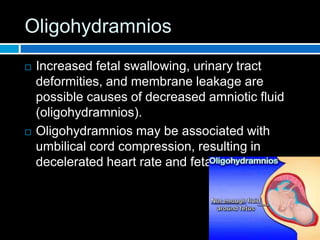
Oligohydramnios
 Increased fetal swallowing, urinary tract
deformities, and membrane leakage are
possible causes of decreased amniotic fluid
(oligohydramnios).
 Oligohydramnios may be associated with
umbilical cord compression, resulting in
decelerated heart rate and fetal death.
Chemical Composition
 The placenta is the ultimate source of amniotic
fluid water and solutes.
 Amniotic fluid has a composition similar to that of
the maternal plasma and contains a small amount
of sloughed fetal cells from the skin, digestive
system, and urinary tract.
 These cells provide the basis for cytogenetic
analysis. The fluid also contains biochemical
substances that are produced by the fetus, such
as bilirubin, lipids, enzymes, electrolytes,
nitrogenous compounds, and proteins that can be
tested to determine the health or maturity of the
fetus.
Amniocentesis
 Amniotic fluid is obtained by needle
aspiration into the amniotic sac, a
procedure called amniocentesis.
 The procedure most frequently performed is a
transabdominal amniocentesis
 A thin, hollow needle is inserted through the
mother’s abdomen into the mother’s uterus
and into the amniotic sac to aspirate the
amniotic fluid.
 Vaginal amniocentesis may also be performed;
however, this method carries a greater risk of
infection
Indications for Performing
Amniocentesis
 Amniocentesis may be indicated
at 15 to 18 weeks of gestation for
the following conditions to
determine early treatment or
intervention:
 Mother’s age of 35 or more at
delivery
 Family history of chromosome
abnormalities, such as trisomy 21
(Down syndrome)
 Parents carry an abnormal
chromosome rearrangement
 Earlier pregnancy or child with
birth defect
 Parent is a carrier of a metabolic
disorder
 History of genetic diseases such
a sickle cell disease, Tay-Sachs
disease, hemophilia, muscular
dystrophy, sickle cell anemia,
Huntington chorea, and cystic
 Elevated maternal serum
alpha fetoprotein
 Abnormal triple marker
screening test
 Previous child with a neural
tube disorder such as spina
bifida, or ventral wall defects
(gastroschisis) •
 Three or more miscarriages
Evaluation of amniocentesis
is indicated later in the
pregnancy (20 to 42 weeks)
to evaluate:
 Fetal lung maturity
 Fetal distress
 Hemolytic disease of the
newborn caused by Rh blood
type incompatibility
 Infection
NEURAL TUBE DEFECTS
 -increased levels of alpha-fetoprotein (AFP) in
both the maternal circulation and the amniotic fluid
can be indicative of fetal neural tube defects such
as anencephaly and spina bifida.
 AFP- major protein produced by the fetal liver
during early gestation (prior to 18 weeks).
 -found in the maternal serum due to the combined
fetal-maternal circulations and in the amniotic fluid
from diffusion and excretion of fetal urine.
 -increased levels are found in the maternal serum
and amniotic fluid when the skin fails to close over
the neural tissue, as occurs in anencephaly and
spina bifida.
 Measurement of amniotic fluid AFP levels is indicated
when maternal serum levels are elevated.
 -Multiple Pregnancy-investigates when serum levels
are elevated
 -Normal values are based on the week of gestational
age
 -Fetus produces maximal AFP between 12-15 weeks
of gestation
 -Serum and amniotic fluid AFP levels are reported in
terms of multiples of the median (MoM)
 -Testing for AFP has been automated by the Access
Immunoassay System.
 -Elevated amniotic fluid AFP levels are followed by
measurement of amniotic acetyl cholinesterase
(AChE).
TEST FOR FETAL MATURITY
FETAL LUNG MATURITY
 Respiratory Distress Syndrome (RDS)- most frequent
complication of early delivery and is a cause of morbidity
and mortality in the premature infant.
 -caused by a lack of lung surfactant

 Lung surfactant- substance that normally appears in
mature lungs and allows the alveoli (air sacs of the lung)
to remain open throughout the normal cycle of inhalation
and exhalation.
 -keeps the alveoli from collapsing by
decreasing the surface tension and allows them to inflate
with air more easily.
LECITHIN-SPHINGOMYELIN RATIO
 Lecithin
 primary component of the surfactants (phospholipids, neutral lipids and
proteins) that make up the alveolar lining and account for alveolar stability.
 produced at a relatively low and constant rate until the 35th week of gestation
 Sphingomyelin- lipid that is produced at a constant rate after about 26
weeks’ gestation
 Lecithin and Sphingomyelin appear in the amniotic fluid in amounts
proportional to their concentration to their concentrations in the fetus.
 Prior to 35 weeks’ gestation the L/S ratio is usually less than 1.6 because
large amount of lecithin are not being produces at this time. It will rise to 2.0
or higher when lecithin production increases to prevent alveolar collapse.
 Reaches 2.0- pre term delivery is considered to be a relatively safe
procedure.
 Falsely elevated- contaminated with blood or meconium
 Quantitative measurement- using thin-layer chromatography.
 *phosphatidyl glycerol immunoassays, fluorescence polarization, lamellar
body density procedures.
AMNIOSTAT-FLM
 Phosphatidyl glycerol- essential for adequate
lung maturity.
 Aminostat-FLM uses antisera specific for
phosphatidyl
glycerol and is not affected
by specimen contamination
with blood and meconium.
FOAM STABILITY
 “Foam” or “Shake” test- mechanical screening
test, used to determine their presence.
 Amniotic is mixed with 95% ethanol, shaken for 15
seconds, and allowed to sit undisturbed for 15
mins.
 The presence of the bubbles indicates that a
sufficient amount of phospholipid is available to
reduce the surface tension of the fluid even in the
presence of alcohol, an antifoaming agent.
MICROVISCOSITY: FLUORESCENCE
POLARIZATION ASSAY
 The presence of phospholipids decreases the
microviscosity of the amniotic fluid
 This change can be measured using the principle
of fluorescence polarization employed by the
Abbott TDx analyzer with the TDx/TDxFLxFLM II
Assay System
 TDx/TDxFLxFetal Lung Maturity II- reagentsystem
for the quantitative measurement of the ratio of
surfactant to albumin in amniotic fluid for
assessment of lung maturity of the fetus.
LAMELLAR BODIES AND OPTICAL DENSITY
 Lamellar Bodies- lamelled phospholipids that
represent storage form of surfactant
 the presence of lamellar bodies increases the OD
of the amniotic fluid
 lamellar body diameter is similar to that of small
platelets
 can be counted using resistance-pulse counting
such as that employed by Coulter cell-counting
instruments.
Amniotic Fluid

Amniotic Fluid

  • 1.
  • 2.
     Amniotic fluidis present in the amnion, a membranous sac that surrounds the fetus  The primary functions of the fluid are to provide a protective cushion for the fetus, allow fetal movement, stablize the temperature to protect the fetus from extreme temperature changes, and to permit proper lung development
  • 3.
    Volume  Amniotic fluidvolume is regulated by a balance between the production of fetal urine and lung fluid and the absorption from fetal swallowing and intramembranous flow  Meconium - which is usually defined as a newborn’s first bowel movement, may be present in the amniotic fluid as the result of fetal intestinal secretions.
  • 5.
     About 500mls enter and leave the amniotic sac each hour.  gradual ↑ up to 36 weeks to around 600 to 1000 ml then↓ after that.  The normal range is wide but the approximate volumes are: - 500 ml at 18 weeks - 800 ml at 34 weeks. - 600 ml at term.
  • 6.
    Polyhydramnios  Failure ofthe fetus to begin swallowing results in excessive accumulation of amniotic fluid (polyhydramnios) and is an indication of fetal distress, often associated with neural tube disorders.  Polyhydramnios may be secondarily associated with fetal structural anomalies, cardiac arrhythmias, congenital infections, or chromosomal abnormalities.
  • 7.
    Oligohydramnios  Increased fetalswallowing, urinary tract deformities, and membrane leakage are possible causes of decreased amniotic fluid (oligohydramnios).  Oligohydramnios may be associated with umbilical cord compression, resulting in decelerated heart rate and fetal death.
  • 8.
    Chemical Composition  Theplacenta is the ultimate source of amniotic fluid water and solutes.  Amniotic fluid has a composition similar to that of the maternal plasma and contains a small amount of sloughed fetal cells from the skin, digestive system, and urinary tract.  These cells provide the basis for cytogenetic analysis. The fluid also contains biochemical substances that are produced by the fetus, such as bilirubin, lipids, enzymes, electrolytes, nitrogenous compounds, and proteins that can be tested to determine the health or maturity of the fetus.
  • 10.
    Amniocentesis  Amniotic fluidis obtained by needle aspiration into the amniotic sac, a procedure called amniocentesis.  The procedure most frequently performed is a transabdominal amniocentesis  A thin, hollow needle is inserted through the mother’s abdomen into the mother’s uterus and into the amniotic sac to aspirate the amniotic fluid.  Vaginal amniocentesis may also be performed; however, this method carries a greater risk of infection
  • 11.
    Indications for Performing Amniocentesis Amniocentesis may be indicated at 15 to 18 weeks of gestation for the following conditions to determine early treatment or intervention:  Mother’s age of 35 or more at delivery  Family history of chromosome abnormalities, such as trisomy 21 (Down syndrome)  Parents carry an abnormal chromosome rearrangement  Earlier pregnancy or child with birth defect  Parent is a carrier of a metabolic disorder  History of genetic diseases such a sickle cell disease, Tay-Sachs disease, hemophilia, muscular dystrophy, sickle cell anemia, Huntington chorea, and cystic  Elevated maternal serum alpha fetoprotein  Abnormal triple marker screening test  Previous child with a neural tube disorder such as spina bifida, or ventral wall defects (gastroschisis) •  Three or more miscarriages Evaluation of amniocentesis is indicated later in the pregnancy (20 to 42 weeks) to evaluate:  Fetal lung maturity  Fetal distress  Hemolytic disease of the newborn caused by Rh blood type incompatibility  Infection
  • 12.
    NEURAL TUBE DEFECTS -increased levels of alpha-fetoprotein (AFP) in both the maternal circulation and the amniotic fluid can be indicative of fetal neural tube defects such as anencephaly and spina bifida.  AFP- major protein produced by the fetal liver during early gestation (prior to 18 weeks).  -found in the maternal serum due to the combined fetal-maternal circulations and in the amniotic fluid from diffusion and excretion of fetal urine.  -increased levels are found in the maternal serum and amniotic fluid when the skin fails to close over the neural tissue, as occurs in anencephaly and spina bifida.
  • 14.
     Measurement ofamniotic fluid AFP levels is indicated when maternal serum levels are elevated.  -Multiple Pregnancy-investigates when serum levels are elevated  -Normal values are based on the week of gestational age  -Fetus produces maximal AFP between 12-15 weeks of gestation  -Serum and amniotic fluid AFP levels are reported in terms of multiples of the median (MoM)  -Testing for AFP has been automated by the Access Immunoassay System.  -Elevated amniotic fluid AFP levels are followed by measurement of amniotic acetyl cholinesterase (AChE).
  • 15.
    TEST FOR FETALMATURITY FETAL LUNG MATURITY  Respiratory Distress Syndrome (RDS)- most frequent complication of early delivery and is a cause of morbidity and mortality in the premature infant.  -caused by a lack of lung surfactant   Lung surfactant- substance that normally appears in mature lungs and allows the alveoli (air sacs of the lung) to remain open throughout the normal cycle of inhalation and exhalation.  -keeps the alveoli from collapsing by decreasing the surface tension and allows them to inflate with air more easily.
  • 16.
    LECITHIN-SPHINGOMYELIN RATIO  Lecithin primary component of the surfactants (phospholipids, neutral lipids and proteins) that make up the alveolar lining and account for alveolar stability.  produced at a relatively low and constant rate until the 35th week of gestation  Sphingomyelin- lipid that is produced at a constant rate after about 26 weeks’ gestation  Lecithin and Sphingomyelin appear in the amniotic fluid in amounts proportional to their concentration to their concentrations in the fetus.  Prior to 35 weeks’ gestation the L/S ratio is usually less than 1.6 because large amount of lecithin are not being produces at this time. It will rise to 2.0 or higher when lecithin production increases to prevent alveolar collapse.  Reaches 2.0- pre term delivery is considered to be a relatively safe procedure.  Falsely elevated- contaminated with blood or meconium  Quantitative measurement- using thin-layer chromatography.  *phosphatidyl glycerol immunoassays, fluorescence polarization, lamellar body density procedures.
  • 17.
    AMNIOSTAT-FLM  Phosphatidyl glycerol-essential for adequate lung maturity.  Aminostat-FLM uses antisera specific for phosphatidyl glycerol and is not affected by specimen contamination with blood and meconium.
  • 18.
    FOAM STABILITY  “Foam”or “Shake” test- mechanical screening test, used to determine their presence.  Amniotic is mixed with 95% ethanol, shaken for 15 seconds, and allowed to sit undisturbed for 15 mins.  The presence of the bubbles indicates that a sufficient amount of phospholipid is available to reduce the surface tension of the fluid even in the presence of alcohol, an antifoaming agent.
  • 19.
    MICROVISCOSITY: FLUORESCENCE POLARIZATION ASSAY The presence of phospholipids decreases the microviscosity of the amniotic fluid  This change can be measured using the principle of fluorescence polarization employed by the Abbott TDx analyzer with the TDx/TDxFLxFLM II Assay System  TDx/TDxFLxFetal Lung Maturity II- reagentsystem for the quantitative measurement of the ratio of surfactant to albumin in amniotic fluid for assessment of lung maturity of the fetus.
  • 20.
    LAMELLAR BODIES ANDOPTICAL DENSITY  Lamellar Bodies- lamelled phospholipids that represent storage form of surfactant  the presence of lamellar bodies increases the OD of the amniotic fluid  lamellar body diameter is similar to that of small platelets  can be counted using resistance-pulse counting such as that employed by Coulter cell-counting instruments.