
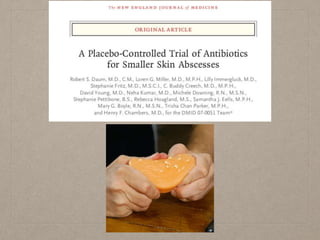

POP THAT PIMPLE
ROLE OF ANTIBIOTICS IN ABSCESS
MANAGEMENT
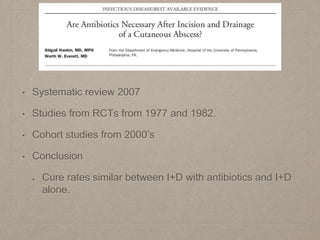
• Systematic review 2007
• Studies from RCTs from 1977 and 1982.
• Cohort studies from 2000’s
• Conclusion
Cure rates similar between I+D with antibiotics and I+D
alone.
GUIDELINES
Australian
• eTG
I+D alone.
Flucloxacillin if cellulitis
and systemic
symptoms.
USA
• Clinical Practice Guidelines by the
Infectious Diseases Society of
America
I+D is primary treatment.
Antibiotics
>5cm
Cellulitis
Systemic symptoms
Immunosuppression
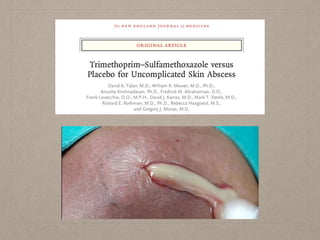
TALAN ET AL.
• 2016
• USA, Multicentre RCT, Double blind
• 1247 patients
• High dose Bactrim (320/1600mg) BD for 7 days versus
placebo.
• Abscesses > 2cm in size.
• Primary outcome was clinical cure at 7-14 days.
• 45% found to be MRSA.
TALAN ET AL.
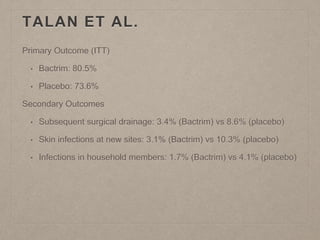
Primary Outcome (ITT)
• Bactrim: 80.5%
• Placebo: 73.6%
Secondary Outcomes
• Subsequent surgical drainage: 3.4% (Bactrim) vs 8.6% (placebo)
• Skin infections at new sites: 3.1% (Bactrim) vs 10.3% (placebo)
• Infections in household members: 1.7% (Bactrim) vs 4.1% (placebo)
TALAN ET AL.
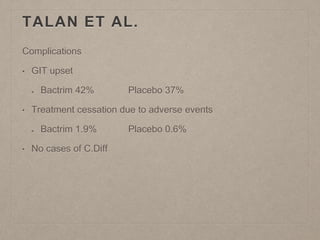
Complications
• GIT upset
Bactrim 42% Placebo 37%
• Treatment cessation due to adverse events
Bactrim 1.9% Placebo 0.6%
• No cases of C.Diff
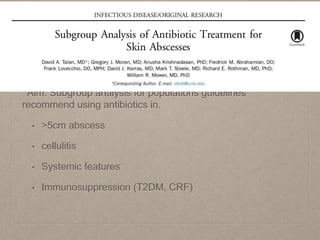
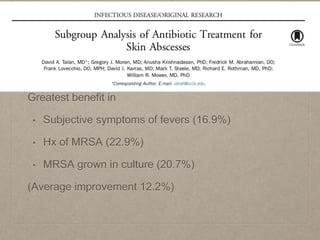
Aim: Subgroup analysis for populations guidelines
recommend using antibiotics in.
• >5cm abscess
• cellulitis
• Systemic features
• Immunosuppression (T2DM, CRF)
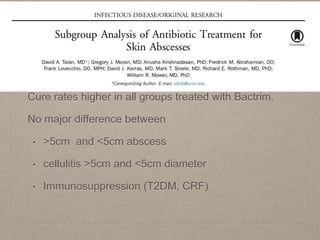
Cure rates higher in all groups treated with Bactrim.
No major difference between
• >5cm and <5cm abscess
• cellulitis >5cm and <5cm diameter
• Immunosuppression (T2DM, CRF)
Greatest benefit in
• Subjective symptoms of fevers (16.9%)
• Hx of MRSA (22.9%)
• MRSA grown in culture (20.7%)
(Average improvement 12.2%)
DAUM ET AL.
• 2017 USA, Multicentre RCT, Double blind
• 786 patients (Paediatric and Adult)
• 10 days of Bactrim (160/800mg) BD versus clindamycin
(300mg) TDS versus placebo.
• Abscesses <5cm in size.
• Exclusions: obese, multiple lesions, systemically unwell,
major comorbidities (T2DM)
• 49% found to have MRSA.
DAUM ET AL.
Primary outcome: clinical cure rates at 19-22 days
• Clindamycin 83.1%
• Bactrim 81.7%
• Placebo 68.9%
DAUM ET AL.
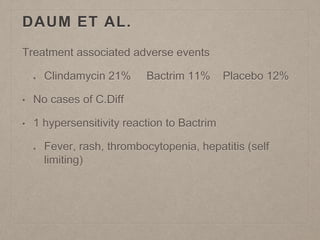
Treatment associated adverse events
Clindamycin 21% Bactrim 11% Placebo 12%
• No cases of C.Diff
• 1 hypersensitivity reaction to Bactrim
Fever, rash, thrombocytopenia, hepatitis (self
limiting)
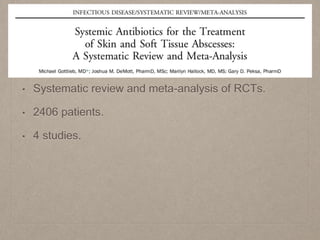
• Systematic review and meta-analysis of RCTs.
• 2406 patients.
• 4 studies.
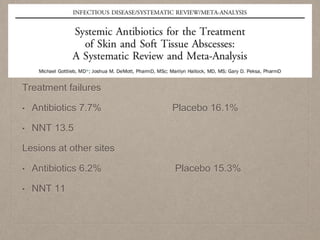
Treatment failures
• Antibiotics 7.7% Placebo 16.1%
• NNT 13.5
Lesions at other sites
• Antibiotics 6.2% Placebo 15.3%
• NNT 11
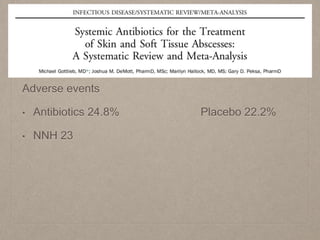
Adverse events
• Antibiotics 24.8% Placebo 22.2%
• NNH 23
ISSUES
• US studies only.
• Significant amounts of overlying cellulitis in study
populations.
• Rare but serious drug side effects associated with
Bactrim and clindamycin (C. Diff, SJS).
• Changes to resistance patterns of Staph Aureus with
widespread antibiotic use.
• Which drug and what dose?

Abscess management

  • 1.
    POP THAT PIMPLE ROLEOF ANTIBIOTICS IN ABSCESS MANAGEMENT
  • 2.
    • Systematic review2007 • Studies from RCTs from 1977 and 1982. • Cohort studies from 2000’s • Conclusion Cure rates similar between I+D with antibiotics and I+D alone.
  • 3.
    GUIDELINES Australian • eTG I+D alone. Flucloxacillinif cellulitis and systemic symptoms. USA • Clinical Practice Guidelines by the Infectious Diseases Society of America I+D is primary treatment. Antibiotics >5cm Cellulitis Systemic symptoms Immunosuppression
  • 5.
    TALAN ET AL. •2016 • USA, Multicentre RCT, Double blind • 1247 patients • High dose Bactrim (320/1600mg) BD for 7 days versus placebo. • Abscesses > 2cm in size. • Primary outcome was clinical cure at 7-14 days. • 45% found to be MRSA.
  • 6.
    TALAN ET AL. PrimaryOutcome (ITT) • Bactrim: 80.5% • Placebo: 73.6% Secondary Outcomes • Subsequent surgical drainage: 3.4% (Bactrim) vs 8.6% (placebo) • Skin infections at new sites: 3.1% (Bactrim) vs 10.3% (placebo) • Infections in household members: 1.7% (Bactrim) vs 4.1% (placebo)
  • 7.
    TALAN ET AL. Complications •GIT upset Bactrim 42% Placebo 37% • Treatment cessation due to adverse events Bactrim 1.9% Placebo 0.6% • No cases of C.Diff
  • 8.
    Aim: Subgroup analysisfor populations guidelines recommend using antibiotics in. • >5cm abscess • cellulitis • Systemic features • Immunosuppression (T2DM, CRF)
  • 9.
    Cure rates higherin all groups treated with Bactrim. No major difference between • >5cm and <5cm abscess • cellulitis >5cm and <5cm diameter • Immunosuppression (T2DM, CRF)
  • 10.
    Greatest benefit in •Subjective symptoms of fevers (16.9%) • Hx of MRSA (22.9%) • MRSA grown in culture (20.7%) (Average improvement 12.2%)
  • 12.
    DAUM ET AL. •2017 USA, Multicentre RCT, Double blind • 786 patients (Paediatric and Adult) • 10 days of Bactrim (160/800mg) BD versus clindamycin (300mg) TDS versus placebo. • Abscesses <5cm in size. • Exclusions: obese, multiple lesions, systemically unwell, major comorbidities (T2DM) • 49% found to have MRSA.
  • 13.
    DAUM ET AL. Primaryoutcome: clinical cure rates at 19-22 days • Clindamycin 83.1% • Bactrim 81.7% • Placebo 68.9%
  • 14.
    DAUM ET AL. Treatmentassociated adverse events Clindamycin 21% Bactrim 11% Placebo 12% • No cases of C.Diff • 1 hypersensitivity reaction to Bactrim Fever, rash, thrombocytopenia, hepatitis (self limiting)
  • 15.
    • Systematic reviewand meta-analysis of RCTs. • 2406 patients. • 4 studies.
  • 16.
    Treatment failures • Antibiotics7.7% Placebo 16.1% • NNT 13.5 Lesions at other sites • Antibiotics 6.2% Placebo 15.3% • NNT 11
  • 17.
    Adverse events • Antibiotics24.8% Placebo 22.2% • NNH 23
  • 19.
    ISSUES • US studiesonly. • Significant amounts of overlying cellulitis in study populations. • Rare but serious drug side effects associated with Bactrim and clindamycin (C. Diff, SJS). • Changes to resistance patterns of Staph Aureus with widespread antibiotic use. • Which drug and what dose?