Forensic Science
Forensic Science defined:Forensic Science is the use of science & technology to enforce civil & criminal laws.It is vague & hard to define b/c it includes so many other areas of science.
Philosophy of ForensicsThe key to criminalistics is the ability to think clearly when faced with the daunting confusion of the average crime scene.One must rely on experience, intuition, and  abductive reasoning (testing a likely scenario against the facts).
History & Development of Forensic Science
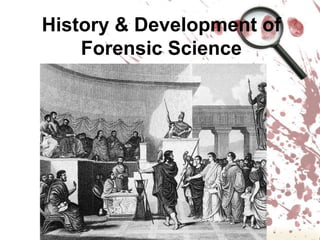
When in Rome…“Forensic” comes from the Latin word “forensis” meaning forum. During the time of the Romans, a criminal charge meant presenting the case before the public.Both the person accused of the crime & the accuser would give speeches based on their side of the story. The individual with the best argumentation would determine the outcome of the case.
HistorySt. Thomas, the Doubter The Patron Saint of Forensic Science
Sir Arthur Conan DoyleSci-fi author in late 1800’sPopularized scientific crime-detection methods through his fictional character ‘Sherlock Holmes’.
Mathieu Orfila(1787-1853)“Father of Toxicology”Wrote about the detection of poisons & their effects on animals.
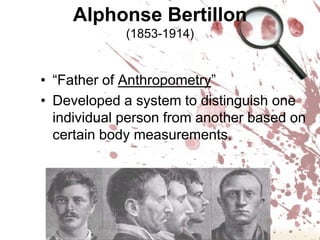
Alphonse Bertillon (1853-1914)“Father of Anthropometry”Developed a system to distinguish one individual person from another based on certain body measurements.
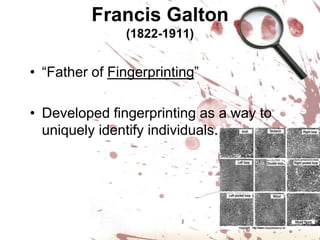
Francis Galton(1822-1911)“Father of Fingerprinting”Developed fingerprinting as a way to uniquely identify individuals.
Leone Lattes(1887-1954)“Father of Bloodstain Identification”He developed a procedure for determining the blood type (A, B, AB, or O) of a dried blood stain.
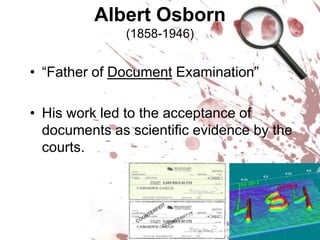
Albert Osborn(1858-1946)“Father of Document Examination”His work led to the acceptance of documents as scientific evidence by the courts.
J. Edgar Hoover“Father of the FBI” - Director of Federal Bureau of Investigation during the 1930’sHoover's leadership spanned 48 yrs & 8 presidential administrations. His reign covered Prohibition, the Great Depression, WWII, the Korean War, the Cold War, & the Vietnam War. He organized a national laboratory to offer forensic services to all law enforcement agencies in the U.S.
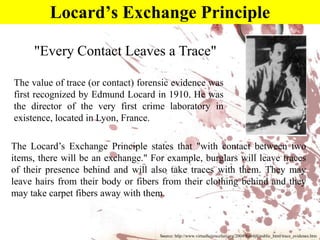
Edmond Locard(1877-1966)“Father of the Crime Lab”In 1910, he started the 1st crime lab in an attic of a police station.With few tools, he quickly became known world-wide to forensic scientists & criminal investigators & eventually founded the Institute of Criminalistics in France.His most important contribution was the “Locard’sExchangePrinciple”
Crime Scene BasicsForensic ScienceT. Trimpe 2006   http://sciencespot.net
Crime Scene VocabularyCRIME SCENE: Any physical location in which a crime has occurred or is suspected of having occurred.  PRIMARY CRIME SCENE: The original location of a crime or accident.SECONDARY CRIME SCENE: An alternate location where additional evidence may be found.SUSPECT: Person thought to be capable of committing a crime.ACCOMPLICE: Person associated with someone suspected of committing a crime.ALIBI: Statement of where a suspect was at the time of a crime.Source: http://www3.sc.maricopa.edu/ajs/crime_scene_technician.htm
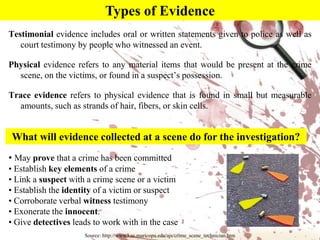
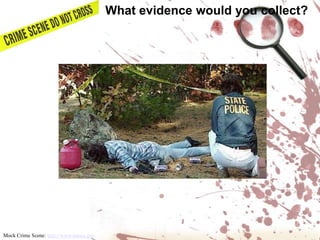
Types of EvidenceTestimonial evidence includes oral or written statements given to police as well as court testimony by people who witnessed an event. Physical evidence refers to any material items that would be present at the crime scene, on the victims, or found in a suspect’s possession. Trace evidence refers to physical evidence that is found in small but measurable amounts, such as strands of hair, fibers, or skin cells.What will evidence collected at a scene do for the investigation?May prove that a crime has been committed
 Establish key elements of a crime
 Link a suspect with a crime scene or a victim
 Establish the identity of a victim or suspect
 Corroborate verbal witness testimony
 Exonerate the innocent.
 Give detectives leads to work with in the caseSource: http://www3.sc.maricopa.edu/ajs/crime_scene_technician.htm
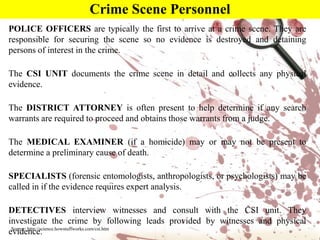
Crime Scene PersonnelPOLICE OFFICERS are typically the first to arrive at a crime scene. They are responsible for securing the scene so no evidence is destroyed and detaining persons of interest in the crime.The CSI UNIT documents the crime scene in detail and collects any physical evidence. The DISTRICT ATTORNEY is often present to help determine if any search warrants are required to proceed and obtains those warrants from a judge. The MEDICAL EXAMINER (if a homicide) may or may not be present to determine a preliminary cause of death. SPECIALISTS (forensic entomologists, anthropologists, or psychologists) may be called in if the evidence requires expert analysis. DETECTIVES interview witnesses and consult with the CSI unit. They investigate the crime by following leads provided by witnesses and physical evidence. Source: http://science.howstuffworks.com/csi.htm
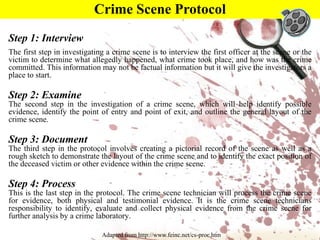
Crime Scene ProtocolStep 1: InterviewThe first step in investigating a crime scene is to interview the first officer at the scene or the victim to determine what allegedly happened, what crime took place, and how was the crime committed. This information may not be factual information but it will give the investigators a place to start. Step 2: ExamineThe second step in the investigation of a crime scene, which will help identify possible evidence, identify the point of entry and point of exit, and outline the general layout of the crime scene. Step 3: DocumentThe third step in the protocol involves creating a pictorial record of the scene as well as a rough sketch to demonstrate the layout of the crime scene and to identify the exact position of the deceased victim or other evidence within the crime scene. Step 4: ProcessThis is the last step in the protocol. The crime scene technician will process the crime scene for evidence, both physical and testimonial evidence. It is the crime scene technicians responsibility to identify, evaluate and collect physical evidence from the crime scene for further analysis by a crime laboratory. Adapted from http://www.feinc.net/cs-proc.htm
Securing the Crime SceneFirst officers to respond are responsible for securing the scene.Victims showing signs of life – emergency personnel are called in.Victims that are dead are left untouchedRigor mortis gives clue to time of deathLividity (discoloration of skin after death) changes with movement
Crime Scene (con’t)Preliminary observations and interviews will be doneVictims are quarantined and questioned, without any physical disturbanceArea must be searchedInitial officers must be interviewedScene must be described in a report All items must be measured and photographed
Collecting EvidenceCSI’s must analyze the evidence and give to a detective to put the pieces together…CSI’s are there to determine the TRUTH behind the crime!All items must be photographed, catalogued and signed in and outDon’t make a theory – this makes one try to make the evidence fit a story.  Instead, let the story fit the evidence!!
Determining Cause of DeathCoroner, or medical examiner, make prelimanary appraisal of cause of deathIf death is of unnatural or suspicious nature, an autopsy is ordered.Coroner pronounces death of a victim.
Retrieving VictimCSI will cover the head, hands and feet with plastic bags and secure with tape.Body is wrapped in a sheet and placed in a WHITE body bag.Rooms for autopsy must be kept at 3°C (38°F) to prevent decomposition and bacterial growth.Average autopsy takes 1-2 hours.
Determining Time of DeathAverage corpse cools down 1 degree every hour.  Not very accurate.Rigor mortis Stiffening of the joints between 30 min – 3 hoursBegins with eyelids and jawLasts 6-12 hoursLividityTakes 6 hours for full effect
Physical EvidenceLet the evidence speak for itself.Presentation developed by T. Trimpe 2006   http://sciencespot.net/
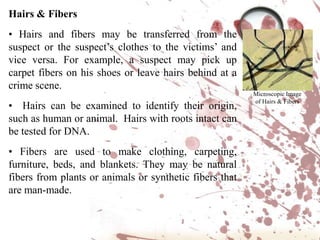
Locard’s Exchange PrincipleThe value of trace (or contact) forensic evidence was first recognized by Edmund Locard in 1910. He was the director of the very first crime laboratory in existence, located in Lyon, France. "Every Contact Leaves a Trace"The Locard’s Exchange Principle states that "with contact between two items, there will be an exchange." For example, burglars will leave traces of their presence behind and will also take traces with them. They may leave hairs from their body or fibers from their clothing behind and they may take carpet fibers away with them. Source: http://www.virtualsciencefair.org/2004/fren4j0/public_html/trace_evidence.htm
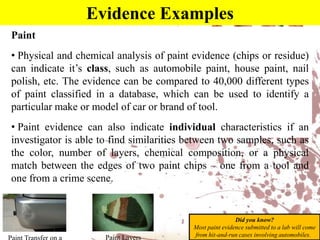
Evidence ExamplesPaint Physical and chemical analysis of paint evidence (chips or residue) can indicate it’s class, such as automobile paint, house paint, nail polish, etc. The evidence can be compared to 40,000 different types of paint classified in a database, which can be used to identify a particular make or model of car or brand of tool.
 Paint evidence can also indicate individual characteristics if an investigator is able to find similarities between two samples, such as the color, number of layers, chemical composition, or a physical match between the edges of two paint chips – one from a tool and one from a crime scene.   Paint LayersPaint Transfer on a CarDid you know? Most paint evidence submitted to a lab will come from hit-and-run cases involving automobiles.  Images: http://www.state.nj.us/njsp/divorg/invest/criminalistics.html
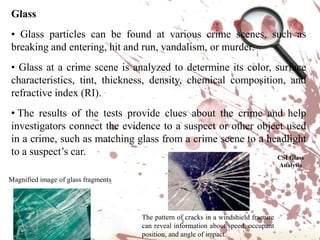
The pattern of cracks in a windshield fracture can reveal information about speed, occupant position, and angle of impact. Glass• Glass particles can be found at various crime scenes, such as breaking and entering, hit and run, vandalism, or murder. • Glass at a crime scene is analyzed to determine its color, surface characteristics, tint, thickness, density, chemical composition, and refractive index (RI). The results of the tests provide clues about the crime and help investigators connect the evidence to a suspect or other object used in a crime, such as matching glass from a crime scene to a headlight to a suspect’s car. CSI Glass AnalysisMagnified image of glass fragments
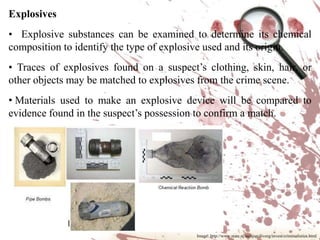
Explosives•  Explosive substances can be examined to determine its chemical composition to identify the type of explosive used and its origin. • Traces of explosives found on a suspect’s clothing, skin, hair, or other objects may be matched to explosives from the crime scene. Materials used to make an explosive device will be compared to evidence found in the suspect’s possession to confirm a match. Image: http://www.state.nj.us/njsp/divorg/invest/criminalistics.html
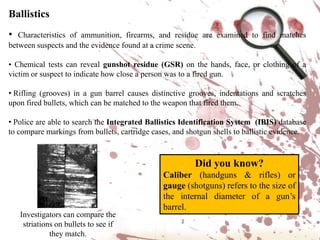
Ballistics• Characteristics of ammunition, firearms, and residue are examined to find matches between suspects and the evidence found at a crime scene.• Chemical tests can reveal gunshot residue (GSR) on the hands, face, or clothing of a victim or suspect to indicate how close a person was to a fired gun. Rifling (grooves) in a gun barrel causes distinctive grooves, indentations and scratches upon fired bullets, which can be matched to the weapon that fired them.
 Police are able to search the Integrated Ballistics Identification System  (IBIS) databaseto compare markings from bullets, cartridge cases, and shotgun shells to ballistic evidence.Investigators can compare the striations on bullets to see if they match.Did you know? Caliber(handguns & rifles) or gauge (shotguns) refers to the size of the internal diameter of a gun’s barrel.
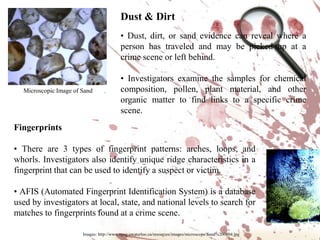
Fingerprints • There are 3 types of fingerprint patterns: arches, loops, and whorls. Investigators also identify unique ridge characteristics in a fingerprint that can be used to identify a suspect or victim.• AFIS (Automated Fingerprint Identification System) is a database used by investigators at local, state, and national levels to search for matches to fingerprints found at a crime scene. Dust & Dirt• Dust, dirt, or sand evidence can reveal where a person has traveled and may be picked up at a crime scene or left behind.• Investigators examine the samples for chemical composition, pollen, plant material, and other organic matter to find links to a specific crime scene.Microscopic Image of Sand Images: http://www.npsg.uwaterloo.ca/resources/images/microscope/Sand%200004.jpg
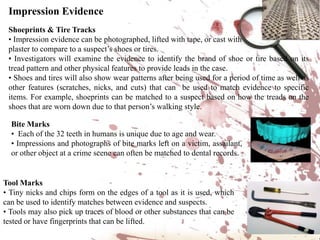
Bite Marks•  Each of the 32 teeth in humans is unique due to age and wear.• Impressions and photographs of bite marks left on a victim, assailant, or other object at a crime scene can often be matched to dental records. Impression EvidenceShoeprints & Tire Tracks• Impression evidence can be photographed, lifted with tape, or cast with plaster to compare to a suspect’s shoes or tires. • Investigators will examine the evidence to identify the brand of shoe or tire based on its tread pattern and other physical features to provide leads in the case.• Shoes and tires will also show wear patterns after being used for a period of time as well as other features (scratches, nicks, and cuts) that can  be used to match evidence to specific items. For example, shoeprints can be matched to a suspect based on how the treads on the shoes that are worn down due to that person’s walking style. Tool Marks• Tiny nicks and chips form on the edges of a tool as it is used, which can be used to identify matches between evidence and suspects. • Tools may also pick up traces of blood or other substances that can be tested or have fingerprints that can be lifted.

Forensic Science

  • 1.
  • 2.
    Forensic Science defined:ForensicScience is the use of science & technology to enforce civil & criminal laws.It is vague & hard to define b/c it includes so many other areas of science.
  • 3.
    Philosophy of ForensicsThekey to criminalistics is the ability to think clearly when faced with the daunting confusion of the average crime scene.One must rely on experience, intuition, and abductive reasoning (testing a likely scenario against the facts).
  • 4.
    History & Developmentof Forensic Science
  • 5.
    When in Rome…“Forensic”comes from the Latin word “forensis” meaning forum. During the time of the Romans, a criminal charge meant presenting the case before the public.Both the person accused of the crime & the accuser would give speeches based on their side of the story. The individual with the best argumentation would determine the outcome of the case.
  • 6.
    HistorySt. Thomas, theDoubter The Patron Saint of Forensic Science
  • 7.
    Sir Arthur ConanDoyleSci-fi author in late 1800’sPopularized scientific crime-detection methods through his fictional character ‘Sherlock Holmes’.
  • 8.
    Mathieu Orfila(1787-1853)“Father ofToxicology”Wrote about the detection of poisons & their effects on animals.
  • 9.
    Alphonse Bertillon (1853-1914)“Fatherof Anthropometry”Developed a system to distinguish one individual person from another based on certain body measurements.
  • 10.
    Francis Galton(1822-1911)“Father ofFingerprinting”Developed fingerprinting as a way to uniquely identify individuals.
  • 11.
    Leone Lattes(1887-1954)“Father ofBloodstain Identification”He developed a procedure for determining the blood type (A, B, AB, or O) of a dried blood stain.
  • 12.
    Albert Osborn(1858-1946)“Father ofDocument Examination”His work led to the acceptance of documents as scientific evidence by the courts.
  • 13.
    J. Edgar Hoover“Fatherof the FBI” - Director of Federal Bureau of Investigation during the 1930’sHoover's leadership spanned 48 yrs & 8 presidential administrations. His reign covered Prohibition, the Great Depression, WWII, the Korean War, the Cold War, & the Vietnam War. He organized a national laboratory to offer forensic services to all law enforcement agencies in the U.S.
  • 14.
    Edmond Locard(1877-1966)“Father ofthe Crime Lab”In 1910, he started the 1st crime lab in an attic of a police station.With few tools, he quickly became known world-wide to forensic scientists & criminal investigators & eventually founded the Institute of Criminalistics in France.His most important contribution was the “Locard’sExchangePrinciple”
  • 15.
    Crime Scene BasicsForensicScienceT. Trimpe 2006 http://sciencespot.net
  • 16.
    Crime Scene VocabularyCRIMESCENE: Any physical location in which a crime has occurred or is suspected of having occurred. PRIMARY CRIME SCENE: The original location of a crime or accident.SECONDARY CRIME SCENE: An alternate location where additional evidence may be found.SUSPECT: Person thought to be capable of committing a crime.ACCOMPLICE: Person associated with someone suspected of committing a crime.ALIBI: Statement of where a suspect was at the time of a crime.Source: http://www3.sc.maricopa.edu/ajs/crime_scene_technician.htm
  • 17.
    Types of EvidenceTestimonialevidence includes oral or written statements given to police as well as court testimony by people who witnessed an event. Physical evidence refers to any material items that would be present at the crime scene, on the victims, or found in a suspect’s possession. Trace evidence refers to physical evidence that is found in small but measurable amounts, such as strands of hair, fibers, or skin cells.What will evidence collected at a scene do for the investigation?May prove that a crime has been committed
  • 18.
    Establish keyelements of a crime
  • 19.
    Link asuspect with a crime scene or a victim
  • 20.
    Establish theidentity of a victim or suspect
  • 21.
    Corroborate verbalwitness testimony
  • 22.
    Exonerate theinnocent.
  • 23.
    Give detectivesleads to work with in the caseSource: http://www3.sc.maricopa.edu/ajs/crime_scene_technician.htm
  • 24.
    Crime Scene PersonnelPOLICEOFFICERS are typically the first to arrive at a crime scene. They are responsible for securing the scene so no evidence is destroyed and detaining persons of interest in the crime.The CSI UNIT documents the crime scene in detail and collects any physical evidence. The DISTRICT ATTORNEY is often present to help determine if any search warrants are required to proceed and obtains those warrants from a judge. The MEDICAL EXAMINER (if a homicide) may or may not be present to determine a preliminary cause of death. SPECIALISTS (forensic entomologists, anthropologists, or psychologists) may be called in if the evidence requires expert analysis. DETECTIVES interview witnesses and consult with the CSI unit. They investigate the crime by following leads provided by witnesses and physical evidence. Source: http://science.howstuffworks.com/csi.htm
  • 25.
    Crime Scene ProtocolStep1: InterviewThe first step in investigating a crime scene is to interview the first officer at the scene or the victim to determine what allegedly happened, what crime took place, and how was the crime committed. This information may not be factual information but it will give the investigators a place to start. Step 2: ExamineThe second step in the investigation of a crime scene, which will help identify possible evidence, identify the point of entry and point of exit, and outline the general layout of the crime scene. Step 3: DocumentThe third step in the protocol involves creating a pictorial record of the scene as well as a rough sketch to demonstrate the layout of the crime scene and to identify the exact position of the deceased victim or other evidence within the crime scene. Step 4: ProcessThis is the last step in the protocol. The crime scene technician will process the crime scene for evidence, both physical and testimonial evidence. It is the crime scene technicians responsibility to identify, evaluate and collect physical evidence from the crime scene for further analysis by a crime laboratory. Adapted from http://www.feinc.net/cs-proc.htm
  • 26.
    Securing the CrimeSceneFirst officers to respond are responsible for securing the scene.Victims showing signs of life – emergency personnel are called in.Victims that are dead are left untouchedRigor mortis gives clue to time of deathLividity (discoloration of skin after death) changes with movement
  • 27.
    Crime Scene (con’t)Preliminaryobservations and interviews will be doneVictims are quarantined and questioned, without any physical disturbanceArea must be searchedInitial officers must be interviewedScene must be described in a report All items must be measured and photographed
  • 28.
    Collecting EvidenceCSI’s mustanalyze the evidence and give to a detective to put the pieces together…CSI’s are there to determine the TRUTH behind the crime!All items must be photographed, catalogued and signed in and outDon’t make a theory – this makes one try to make the evidence fit a story. Instead, let the story fit the evidence!!
  • 29.
    Determining Cause ofDeathCoroner, or medical examiner, make prelimanary appraisal of cause of deathIf death is of unnatural or suspicious nature, an autopsy is ordered.Coroner pronounces death of a victim.
  • 30.
    Retrieving VictimCSI willcover the head, hands and feet with plastic bags and secure with tape.Body is wrapped in a sheet and placed in a WHITE body bag.Rooms for autopsy must be kept at 3°C (38°F) to prevent decomposition and bacterial growth.Average autopsy takes 1-2 hours.
  • 31.
    Determining Time ofDeathAverage corpse cools down 1 degree every hour. Not very accurate.Rigor mortis Stiffening of the joints between 30 min – 3 hoursBegins with eyelids and jawLasts 6-12 hoursLividityTakes 6 hours for full effect
  • 32.
    Physical EvidenceLet theevidence speak for itself.Presentation developed by T. Trimpe 2006 http://sciencespot.net/
  • 33.
    Locard’s Exchange PrincipleThevalue of trace (or contact) forensic evidence was first recognized by Edmund Locard in 1910. He was the director of the very first crime laboratory in existence, located in Lyon, France. "Every Contact Leaves a Trace"The Locard’s Exchange Principle states that "with contact between two items, there will be an exchange." For example, burglars will leave traces of their presence behind and will also take traces with them. They may leave hairs from their body or fibers from their clothing behind and they may take carpet fibers away with them. Source: http://www.virtualsciencefair.org/2004/fren4j0/public_html/trace_evidence.htm
  • 34.
    Evidence ExamplesPaint Physicaland chemical analysis of paint evidence (chips or residue) can indicate it’s class, such as automobile paint, house paint, nail polish, etc. The evidence can be compared to 40,000 different types of paint classified in a database, which can be used to identify a particular make or model of car or brand of tool.
  • 35.
    Paint evidencecan also indicate individual characteristics if an investigator is able to find similarities between two samples, such as the color, number of layers, chemical composition, or a physical match between the edges of two paint chips – one from a tool and one from a crime scene. Paint LayersPaint Transfer on a CarDid you know? Most paint evidence submitted to a lab will come from hit-and-run cases involving automobiles.  Images: http://www.state.nj.us/njsp/divorg/invest/criminalistics.html
  • 36.
    The pattern ofcracks in a windshield fracture can reveal information about speed, occupant position, and angle of impact. Glass• Glass particles can be found at various crime scenes, such as breaking and entering, hit and run, vandalism, or murder. • Glass at a crime scene is analyzed to determine its color, surface characteristics, tint, thickness, density, chemical composition, and refractive index (RI). The results of the tests provide clues about the crime and help investigators connect the evidence to a suspect or other object used in a crime, such as matching glass from a crime scene to a headlight to a suspect’s car. CSI Glass AnalysisMagnified image of glass fragments
  • 37.
    Explosives• Explosivesubstances can be examined to determine its chemical composition to identify the type of explosive used and its origin. • Traces of explosives found on a suspect’s clothing, skin, hair, or other objects may be matched to explosives from the crime scene. Materials used to make an explosive device will be compared to evidence found in the suspect’s possession to confirm a match. Image: http://www.state.nj.us/njsp/divorg/invest/criminalistics.html
  • 38.
    Ballistics• Characteristics of ammunition,firearms, and residue are examined to find matches between suspects and the evidence found at a crime scene.• Chemical tests can reveal gunshot residue (GSR) on the hands, face, or clothing of a victim or suspect to indicate how close a person was to a fired gun. Rifling (grooves) in a gun barrel causes distinctive grooves, indentations and scratches upon fired bullets, which can be matched to the weapon that fired them.
  • 39.
    Police areable to search the Integrated Ballistics Identification System (IBIS) databaseto compare markings from bullets, cartridge cases, and shotgun shells to ballistic evidence.Investigators can compare the striations on bullets to see if they match.Did you know? Caliber(handguns & rifles) or gauge (shotguns) refers to the size of the internal diameter of a gun’s barrel.
  • 40.
    Fingerprints • There are3 types of fingerprint patterns: arches, loops, and whorls. Investigators also identify unique ridge characteristics in a fingerprint that can be used to identify a suspect or victim.• AFIS (Automated Fingerprint Identification System) is a database used by investigators at local, state, and national levels to search for matches to fingerprints found at a crime scene. Dust & Dirt• Dust, dirt, or sand evidence can reveal where a person has traveled and may be picked up at a crime scene or left behind.• Investigators examine the samples for chemical composition, pollen, plant material, and other organic matter to find links to a specific crime scene.Microscopic Image of Sand Images: http://www.npsg.uwaterloo.ca/resources/images/microscope/Sand%200004.jpg
  • 41.
    Bite Marks• Each of the 32 teeth in humans is unique due to age and wear.• Impressions and photographs of bite marks left on a victim, assailant, or other object at a crime scene can often be matched to dental records. Impression EvidenceShoeprints & Tire Tracks• Impression evidence can be photographed, lifted with tape, or cast with plaster to compare to a suspect’s shoes or tires. • Investigators will examine the evidence to identify the brand of shoe or tire based on its tread pattern and other physical features to provide leads in the case.• Shoes and tires will also show wear patterns after being used for a period of time as well as other features (scratches, nicks, and cuts) that can be used to match evidence to specific items. For example, shoeprints can be matched to a suspect based on how the treads on the shoes that are worn down due to that person’s walking style. Tool Marks• Tiny nicks and chips form on the edges of a tool as it is used, which can be used to identify matches between evidence and suspects. • Tools may also pick up traces of blood or other substances that can be tested or have fingerprints that can be lifted.