By
Bhriguraj Mourya
Assistant Professor
College of Law and Legal Studies
 Forensic Science embraces all branches of
science and applies them to the purposes of law
 all the techniques were borrowed from various
scientific disciplines like chemistry, medicines,
surgery, biology, photography, physics and
mathematics etc.
 The forensic scientist has to depend upon for
proper functioning of forensic science, on the
investigating officer, on the one hand, and on
the presenting counsel and the judge on the
other, for its effective utilisation in the
dissemination of justice
 Social Changes
 Anonymity
 Technical Knowledge
 Wide Field
 Better Evidence
 Alternatives of
 Eye Witnesses
 Confessions
 Approvers
 Stock Witnesses
 Dictated confessions
 It is always available. Locard’s
Principle of Exchange holds.
 It can link the culprit with the crime,
the victim, the scene, the weapon and
other evidence inter se decisively.
Evidentiary clues are unique. The Law
of Individuality holds.
 It is free from human failings: ‘bias’,
‘emotions’, ‘rationalisation‘, ‘memory
lapses’, ‘perjury’, etc. But the
scientist has to be honest and well-
versed.
 It is verifiable. Other honest scientists
can confirm the findings.
 It is efficient: time and cost effective.
Automation and computers have
conferred wings to the evaluation
processes.
 Law of Individuality;-Every object, natural or
man-made, has an individuality, which is not
duplicated in any other object. It is unique.
Neither the nature has duplicated itself, nor
can man.
 Principle of Exchange;- Whenever two
entities come in contact, mutual exchange of
traces takes place.
 Law of Progressive Change ;- Everything
changes with the passage of time.
 Principle of Comparison ;- Only the likes
can be compared.
 Principle of Analysis ;- The analysis can be
no better than the sample analysed.
 Law of Probability;- All identifications,
definite or indefinite, are made, consciously
or unconsciously, on the basis of probability.
 Provides leads to the investigation.
 Establishes whether the scene is real or fake.
 Locates hidden clues, correct clues, and also
proper samples for comparison.
 Establishes sequence of events.
 Verifies the prosecution version, the defence
versions and finds the correct version.
 Saves the innocent accused by de-linking
him, via clues, with the victim or with the
scene of crime.
 Identifies the correct crime weapon.
 “Forensic” comes from the Latin word “forensis”
meaning forum.
 During the time of the Romans, a criminal
charge meant presenting the case before the
public.
 Both the person accused of the crime & the
accuser would give speeches based on their
side of the story.
 The individual with the best argumentation
would determine the outcome of the case.
 Sci-fi author in late 1800’s
 Popularized scientific crime-detection
methods through his fictional character
‘Sherlock Holmes’.
 “Father of Toxicology”
 Wrote about the detection of poisons & their
effects on animals.
 “Father of Anthropometry”
 Developed a system to distinguish one individual
person from another based on certain body
measurements.
 “Father of Fingerprinting”
 Developed fingerprinting as a way to uniquely
identify individuals.
 “Father of Bloodstain Identification”
 He developed a procedure for determining the
blood type (A, B, AB, or O) of a dried blood
stain.
 “Father of Document Examination”
 His work led to the acceptance of documents
as scientific evidence by the courts.
 “Father of the Crime Lab”
 In 1910, he started the 1st crime lab in an
attic of a police station.
 With few tools, he quickly became known
world-wide to forensic scientists & criminal
investigators & eventually founded the
Institute of Criminalistics in France.
 His most important contribution was the
“Locard’s Exchange Principle”
 “Every Contact Leaves a Trace.”
 He believed that every criminal can be connected to
a crime by particles carried from the crime scene.
 When a criminal comes in contact with an object or
person, a cross-transfer of evidence occurs.
 Application of DNA as evidence
 Prevention vs. Reaction
 Catastrophes & Wars
 ID remains of victims (either civilian or
soldiers)
 ex. Holocaust or Katrina
 Military & International Forensics
 Terrorism
 The search for WMD’s
 stockpiled or stored weapons from past wars
When the Army unearthed more than a
1,000 mortar rounds from a WW2
training site, they enlisted a Forensic
Science Lab to determine which were
live munitions & which were dummies.
Munitions
 O.J. Simpson was a NFL football legend.
 He is now famous for having been tried for
the murder of ex-wife Nicole Brown Simpson
& her friend Ronald Goldman in 1994.
 He was acquitted in criminal court after a
lengthy, highly publicized trial.
 1st on the scene, police found evidence of blood
& entered the Simpson home without a search
warrant, an action permissible b/c the situation
was an emergency.
 HOWEVER, the police collected a pair of blood-
stained gloves during their search.
 Collection of evidence without proper warrants
became the key argument used by Simpson’s
legal team & ultimately led to his acquital.
 If forensic evidence is to be admissible in
court, the highest professional standards
must be used at the crime scene!
 He was found liable for their deaths in civil
court, but has yet to pay the $33.5 million
judgment.
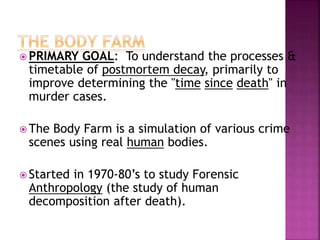
 PRIMARY GOAL: To understand the processes &
timetable of postmortem decay, primarily to
improve determining the "time since death" in
murder cases.
 The Body Farm is a simulation of various crime
scenes using real human bodies.
 Started in 1970-80’s to study Forensic
Anthropology (the study of human
decomposition after death).
Corpse 1-81 was an elderly white male; he became
part of a pioneering study of insect activity in
human corpses.
Close up of a recent research subject. After only a few weeks
in the Tennessee summer, the skull is completely bare &
many vertebrae are exposed. The rib cage & pelvis are
covered with dried, leathery skin, but the soft tissues
beneath are gone, consumed by insects & bacteria.
Close-up of a human femur & hip bone, containing
an artificial hip implant. Such orthopedic devices
can help identify an unknown crime victim.
 The nature of physical evidence to be
collected.
 Where it is found.
 How it is collected, preserved, packed and
dispatched.
 What standard samples for comparison
purposes are necessary.
 How much sample is required.
 How the sampling is done.
 How the laboratory results will link the crime
with the criminal and to what extent his
labours will be rewarded.
DFSS; Directorate of Forensic Science Services Govt. Of India
MHA (Ministry of Home Affairs) DFSS Forensic labs & GEQDs
CFSL, New Delhi (CBI) , Established in 2002-03
•M.S. Rao was the founder director of DFSS.
•Role of DFSS-
A. It helps in administration of justice system and provides
knowledge & facilities to various training programmes to
people involved with justice delivery.
B. It provides the scientific aid in criminal justice system.
C. It guides, regulates and controls the working of Forensic
Science Laboratories.
D. Also controls and regulates the working of GEQDs.
E. Provides financial and technical help to State Forensic Labs.
(SFSLs).
F. Promotes research & development in Forensic field.
G. To access and review the current procedures & practices in
labs.
 1. Central Forensic Labs (FSLs)
 2. State Forensic Labs (FSLs)
 3. Mini & Local Forensic Labs (RFSL &
MFSL)
• SHIMLA (1906)
• KOLKATA (1963)
• HYDRABAD (1968)
• Initially established to examine the various
documents related to or suspected with dealings of
Indian independence movement.
 DFSS CFSL Kolkata CFSL Chandigarh CFSL
Hyderabad
 CFSL Kolkata: (for biological sciences)
 Main R & D projects proposed are-
1. Development of genetic markers for forensic
wildlife investigation and GMOs etc.
2. Analysis of Y chromosome markers.
3. Development of technology for identification of
foetal genetic markers from maternal blood by
non-invasive methods.
4. Creation of complete crime analysis facility.
1. CFSL Guwahati
2. CFSL Bhopal
3. CFSL Pune
 Director Additional Director
 Deputy Director
 Assistant Director
 Senior Scientific Officer (SSO)
 Scientific Officer (SO)
 Senior Scientific Assistant (SSA)
 Scientific Assistant (SA)
 Lab Assistant (LA)
 Lab Attendant
 Receptionist/Sweeper/Peon/Helper Lab
 Blood,
 Semen & other Biological fluids,
 Viscera,
 Shoe impressions,
 Tool marks,
 Tyre marks,
 Bite Marks,
 Hair of Animal & Human,
 Fibers & Fabrics,
 Establishment of identity of Individuals: DNA,
 Fingerprints/Foot prints,
 Anthropology,
 Skeletal Remains &
 Odontology
 In the beginning, it was possible only to say
whether a given stain is of blood or not.
Later, it became possible to identify whether
the given stain is of human or animal-origin.
Further progress made it possible to classify
blood into four main groups, O, A, B, and AB.
Later, the division was extended further. A
group factors were found to exist in a
number of forms
 The liquid part in blood is called plasma.
 It forms 55% of the blood volume.
 It is mostly water (&90%).
 Red blood cells occupy 44% of the blood
volume by volume.
 Platelets are 0.7%.
 the reaming part is composed of white cells
 It establishes corpus delicti; the occurrence of
crime.
 It permits determination of the sequence of
occurrence of a crime, from the distribution of
blood.
 It is possible to guess the approximate time
when the crime was committed from the study
of the age of stains.
 It helps the investigation of poaching, maiming
and worrying.
 It helps to establish the paternity of a child in
disputed cases.
 It establishes an inter se link between the
criminal, the crime, the victim and the scene.
 Temperature
 Humidity
 Quantity of blood
 Surface bearing the stain
 Atmospheric conditions including rain
and wind.
 Does the given article bear bloodstain?
 Is it human or animal blood?
 What is the blood group of the human bloodstain or the given
body fluid?
 What is the species of animal to which the blood belong?
 How much blood has been shed?
 What is the age of the stain?
 Is the child biological issue of the alleged parent?
 Does the blood contain alcohol? If so, how much has the subject
has taken?
 Does the blood contain carbon monoxide, hydrogen cyanide or
other poison?
 Does the blood contain narcotic drug?
 Did the person suffer from any disease like syphilis or
leukaemia? If so, to what extent was the disease responsible for
the death of the person? This is possible when liquid blood is
available.
 Are there any artifacts to show the body part from which the
blood has come?
 At the Crime Scene;-
 In outdoor scenes, in the form of stains, smears, streaks,
splashes, spray, prints, clots, pools or liquid blood, on
avariet of places and articles.
 In indoor scenes, the floors, walls, doors, windows,
furniture (chairs, tables, beds) and fans are the likely
places
 The Suspect;- The suspect may carry blood on his
hands, nails, hair, earlobes, feet, male organ (in
sexual offences) and other exposed parts of his body.
 The Victim
 The Weapon of Offence
 The Vehicle
 The Route
 Disposal Site
 Establish the location of the evidence and the position of the article
with respect to other fixed objects at the scene through copious notes,
sketches and photographs.
 Note the direction, size and the number of stains.
 Note the condition of the stains, whether they are dry, sticky, wet,
contracting, puckering, crumbling or brittle.
 Note whether the stains are contaminated or exposed to natural
elements or heat. The facts should be mentioned in the forwarding
letter to the expert.
 Record the collection method: whether the stain was scraped, cut,
lifted, dislodged or collected in the form in which it is being sent.
 Pack the dry bloodstains from various sources separately in suitable
vials or cellophane envelopes of appropriate sizes.
 Preserve the purity of the stains. This is achieved by preventing mixing
of stains with one another or rubbing of the stain with the container or
with other parts of the article.
 Preserve the continuity of the chain of possession and distinct identity
of the evidence through proper packing, labelling, sealing and
observing other legal formalities. The possession of the evidence
should be accounted for from the time of recovery to the time of its
production in the court.
 Semen is the liquid ejaculated
by males in sexual processes.
It is the most important body
fluid in the investigation of
sexual offences, indecency,
rape, sodomy, bestiality and
the like
 The sperm has a definite
morphological structure. Its
identification in a stain
establishes its seminal nature
 Victim
 Culprit
 Scene of Occurrence
 Location Techniques
 Does the given article bear any
seminal stains?
 Are the seminal stains from human
source?
 Can the human source of the semen
be individualized?
 What is the age of the stains?
 How long can the spermatozoon
survive?
Footwear marks include the marks of shoes,
sandals, chappals, socks and the like. The
footwear may be factory-made or hand-
made. It may be made of leather, partly or
wholly, rubber (natural or synthetic) or
plastics. Cloth is used in canvas shoes…..
 The soles of a pair of shoes may be stitched,
nailed or pasted with the uppers (of leather,
rubber, plastics or canvass).
 Culprit’s presence
 Number
 Tracking
 Age of Culprit
 The footmarks are incomplete.
 The marks do not carry ridge details.
 The marks carry only a few
individualising features.
 The specimen marks are carelessly
lifted.
 Gait pattern has been studied
scientifically also. The individuality of the
gait pattern can be established from the
following considerations:
 Direction line (DL)
 Walk line (WL)
 Foot line (FL)
 Foot angle (FA)
 Step angle (SA)
 Step length (SL)
 Width of step (SW).
 66 A.D. Nero, the Roman Emperor.
 Nero's mother Agrippina had her soldiers
kill Lollia Paulina, with instructions to bring
back her head as proof that she was dead.
 Agrippina, unable to positively identify the
head, examined the front teeth and on
finding the discolored front tooth confirmed
the identity of the victim
 The first forensic dentist in the United States was
Paul Revere who was known for the identification
of fallen revolutionary soldiers
 1954, Texas burglary scene with bite mark in
cheese (Doyle v. State)
 1975, California sexual assault with bites to
victim’s nose (People v. Marx)
 Id unknown human remains through dental records.
 Assist at the scene of a mass disaster.
 Age estimations of both living and deceased persons.
 Analysis of bite marks found on victims of attack.
 ID of bite marks in other substances e.g. wood, duct
tape, pencils, leather and foodstuffs.
 Analysis of weapon marks using the principles of bite
mark analysis.
 Presentation of bite and weapon mark evidence in court.
 Building a picture of lifestyle and diet at an archaeological
site.
 Establish hierarchy of leadership
 Procure and implement computer data base
 Establish ante-mortem team
 Establish post-mortem team
 Determine protocol
 Post-Mortem resection of non-viewable remains
 Radiography of intact or fragmented jaws
 Charting of post-mortem examination
 Obtaining and charting of ante-mortem records
 Comparison of data
1. Fillings
2. Extractions
3. Surface structure/root configuration
4. Adjacent teeth
5. Twisted/tilted teeth
 Can be left in food,
gum and skin
 hemorrhage -- small bleeding spot
 abrasion -- undamaging mark on skin
 contusion -- ruptured blood vessel,
bruise (*most common)
 laceration -- punctured or torn skin
 incision -- neat puncture of skin
 avulsion -- removal of skin
 artifact -- bitten-off piece of body
 A sign of perp seeking to degrade the victim
while also achieving complete domination.
 Can be found on a suspect when a victim
attempts to defend him/herself.
 Scaled photography of bite mark evidence
 Scaled photography of dental casts
 Clinical comparisons
 Computer comparisons
 Connect suspect to
bite mark:
 We will focus on a specific element of
forensic dentistry – specifically, bitemark
analysis
 Here, a dentist is required to compare the
impressions and bruises left in the skin by one
person biting another to a suspect’s teeth.
 However, another important element of
forensic dentistry involves the
identification of human remains by
comparing dental charts to the teeth of
the victim
 This latter component of forensic dentistry has
only been around for about 50 or so years.
Why?
 Bitemark:
 A physical alteration in a medium
caused by the contact of teeth.
 A representative pattern left in an
object or tissue by the dental
structures of an animal or human.
 Cutaneous Human Bitemark:
 An injury in skin caused by contacting
teeth (with or without the lips or
tongue) which shows the
representational pattern of the oral
structures.
 What are evidential limitations to bitemarks
in the following substances:
 Wax
 Fruit
 Skin
 Paper
 Chewing gum
 We can use bitemarks to carry out bitemark
analysis. i.e. a comparison of a known
person’s dentition to a patterned injury
which appears consistent with a bitemark
 This type of comparison is used to confirm or
eliminate the identity of a suspect in relation
to the bitemark.
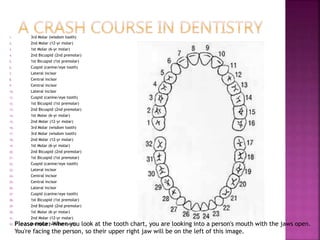
1. 3rd Molar (wisdom tooth)
2. 2nd Molar (12-yr molar)
3. 1st Molar (6-yr molar)
4. 2nd Bicuspid (2nd premolar)
5. 1st Bicuspid (1st premolar)
6. Cuspid (canine/eye tooth)
7. Lateral incisor
8. Central incisor
9. Central incisor
10. Lateral incisor
11. Cuspid (canine/eye tooth)
12. 1st Bicuspid (1st premolar)
13. 2nd Bicuspid (2nd premolar)
14. 1st Molar (6-yr molar)
15. 2nd Molar (12-yr molar)
16. 3rd Molar (wisdom tooth)
17. 3rd Molar (wisdom tooth)
18. 2nd Molar (12-yr molar)
19. 1st Molar (6-yr molar)
20. 2nd Bicuspid (2nd premolar)
21. 1st Bicuspid (1st premolar)
22. Cuspid (canine/eye tooth)
23. Lateral incisor
24. Central incisor
25. Central incisor
26. Lateral incisor
27. Cuspid (canine/eye tooth)
28. 1st Bicuspid (1st premolar)
29. 2nd Bicuspid (2nd premolar)
30. 1st Molar (6-yr molar)
31. 2nd Molar (12-yr molar)
32. 3rd Molar (wisdom tooth)
Please note: When you look at the tooth chart, you are looking into a person's mouth with the jaws open.
You're facing the person, so their upper right jaw will be on the left of this image.
 In a bitemark comparison, you are looking for
and matching unique features between the
bitemark and exemplar castings. These
features may include:
 Gaps
 Rotation (angle)
 Size of teeth (e.g. width at tip)
 Width from tooth to tooth (e.g. cuspid to cuspid)
 By establishing the uniqueness of the biter's
teeth and then applying those unique properties
to the bite pattern, a degree of confidence
relating the biter's teeth to the injury pattern is
described.
 This opinion can range for excluded ( the
suspect did not do the biting) to likely and
without a doubt (the bite was witnessed and
there is not question the suspected biter
inflicted the bite).
 Despite the unique nature of the position and
arrangement of the human teeth, it is usually
easier to rule out a suspect as a potential biter
than it is to include a suspect as a potential
biter.
There are over 20 different methods of bitemark analysis.
The most common used are:
1.Comparing an acetate overlay manually fabricated from
study models to a life size photograph of the wound.
2.Comparing study models to a life size photograph of the
wound
3.Comparing an acetate overlay manually fabricated from
bites in wax to a photograph of the wound
4.Comparing an acetate overlay manually fabricated from x-
rays of radiopaque material placed in a wax bite to a life
size photograph of the wound.
5. Comparing an acetate overlay manually fabricated from a
photocopy of study models to a life size photograph of the
wound.
http://forensic.to/webhome/bitemarks/
Bitemark : Upper Jaw Distance Suspect; Upper Jaw Distance
Cuspid to cuspid Cuspid to cuspid
38mm 42mm
Bitemark: Distance Suspect: : Distance
Tooth 6 to Tooth 10 Tooth 6 to Tooth 10
44.25mm 39.65mm
Angle: + 14.5 Degrees Angle: + 12.52 Degrees
 Most of these techniques involve the
fabrication of an acetate overlay
 An acetate overlay is an outline of the
biting edge of someone’s teeth as traced
onto and seen on a clear transparency
 They can be fabricated in a number of
ways
 A review of the literature has found over
15 methods
 These include tracing from dental models,
photographs, wax bites, photocopies.
 Have been developed to overcome some of
these problems
 Theoretically they can;
 Correct for distortion
 Generate the overlay objectively
 Carry out the comparison objectively
 Reproduce the overlay
Daubert Standards and Bitemarks
In recent years it has been questioned as a
reliable scientific tool. This is based on:
1. Numerous methods of fabrication
2. Relies on manual fabrication
3. Subjective element in fabrication
4. Subjective element in comparison
5. Distortion which occurs
As a result of this it has been suggested that
bitemark analysis using acetate overlays are
inaccurate, subjective and non-reproducible
 The threshold variable in bitemark analysis is the
fact that, in cases of physical assault having skin
injuries, the anatomy and physiology of the skin,
and the position the victim was in affects the
detail and shape of the bitemark.
 There is one article from the early 1970's that
showed how the positioning of the test bite on a
bicep varied whether the arm was flexed or
pronated.
 What is significant is that there is no way to
experimentally control or establish the amount
of positional variation in an actual bitemark
case.
 The bottom line is that skin is usually a poor
impression material. No significant tests have
been published on this subject since 1971 in the
odontology literature.
http://forensic.to/webhome/bitemarks/
 There is a considerable body of literature on
the subject
(http://www.forensicdentistryonline.org/Forensic_pages_1/bitemark_ref
.htm)
 There are rigid and strict standards
(http://www.forensic.to/webhome/bitemarks/#ABFO%20Bite%20Mark%20
Guidelines)
 Related to this, there is a known error rate
 Legal precedents on the admissibility of
bitemark analyses exist
(http://www.forensicdentistryonline.org/Forensic_pages_1/us_cases.htm
)
 The include the famous Ted Bundy case
Outlines of the same set of teeth. The different
perimeter shapes depend on how far the teeth are
pressed into the test substrate.
 The most basic
components of hair are
keratin, a very strong
protein that is resistant to
decomposition, and
melanin, a pigment.
 The keratins form groups
that interact and
interconnect to form very
stable fibrils. It is this
property of hair that
makes it such a prime
example of physical
evidence.
 Hairs are dead, cornified
cells. The portion
existing above the
epidermis is called the
shaft; below the
epidermis, the root is
embedded in the hair
follicle.
• The hair shaft is composed
of three layers:
− Outer cuticle
− Cortex
− Central medulla
 The cuticle of a hair is the
thin, translucent layer
surrounding the shaft. It
consists of scales of hardened,
keratinized tissue that vary
from species to species, and
includes such patterns as:
 Coronal, or “crown – like.” Rare in
humans; typical of rodents. Found
in hairs of very fine diameter.
 Spinous, or “petal – like.” Never
found in humans. Common in cats,
seals, and minks.
 Imbricate, or “flattened.”
Common in humans.
Coronal
Spinous
Imbricate
Photomicrograph of a
mink hair possessing a
Spinous cuticle.
Photomicrograph of a
bat hair possessing a
Coronal cuticle.
Photomicrograph of a human
hair possessing an Imbricate
cuticle.
 The cortex is the main body of
the hair, composed of spindle-
shaped cortical cells.
 Contains pigment bodies,
which contains the melanin
(hair color) and cortical fusi.
 Cortical fusi are air spaces of
varying sizes found near the root
of a mature human hair.
 Pigment granules are small, dark,
granulated structures that vary in
size, color, and distribution.
Typically distributed toward the
cuticle in humans.
 Bleached hair is devoid of pigment
granules, and dyed hair has dye in
the cuticle and the cortex.
Photomicrograph of cortical fusi
in human hair
Photomicrograph of pigment
distribution in human hair
 The medulla is a central core of
cells that runs through the center
of the cortex. The medulla may be:
 Continuous
 Fragmented
 Interrupted
 In human hairs, the medulla is
generally amorphous in appearance
or completely absent.
 In animal hairs, it’s structure is
frequently very regular and well
defined.
 Medullar ratio, of the formula
diameter of medulla/diameter of
the cortex, is less than ⅓ in humans
and more than ½ in animals.
Photomicrograph of a
human hair with no
medulla.
Photomicrograph of a
hair with trace medulla.
Photomicrograph of a hair
with a clear, continuous
medulla.
 Growth of mammal
hair goes through three
distinct phases:
 Anagenic phase can last
for up to 6 years. Follicle
is attached to the root by
the papilla. The hair
must be pulled to be
lost. If pulled, a follicular
tag is left, which can be
used later to test the
mitochondrial DNA.
 Catagenic phase lasts
only 2-3 weeks. Hair
keeps growing, but the
bulb shrinks.
 Telogenic phase lasts for
2-6 months. Hair
becomes naturally loose
and sheds.
Hair in Anagenic Phase
Hair in Catagenic Phase
Hair in Telogenic Phase
 The search for and collection
of hair evidence should begin
as soon as possible. Hair
evidence is easily transferred
to and from the crime scene.
 Collection should be done by
hand if the location of the hair
is important, which is usually
the case. Sticky tape and lint
rollers may be used to assist.
 A special filtered vacuum
cleaner may be used to collect
hairs and fibers en masse from
carpet, bedding, etc.
 If the evidence is stuck to
another object, the entire
object should be packaged and
labeled.
Evidence Collecting Vacuum
Evidence Collecting Kit
 Once collected, the hair
evidence should be
packaged into paper
packets.
 If sticky tape or a lint
roller are used, the entire
surface used should be
packed into a
polyethylene storage bag
– easy to see through, but
with no direct contact.
 Control samples need to
be collected from the
victim, suspect, and
other individuals who
could have left evidence
at the scene. Take from
all pertinent regions of
the body; 50 head hairs,
24 pubic hairs. Root still
in tact is preferable.
Evidence Collection Bags
Evidence Collecting Lint Roller
 Humans hairs can be
separated from animal hairs
in any number of ways,
including the medullary
ratio, characteristics of the
medulla, and the scale
patterns of the cuticle.
 Different species of animals
can be identified quite
easily using the same basic
principles.
 The next step tries to
classify the racial origin of
the hair as: negroid,
mongoloid, and caucasian,
typically using head hair.
Mixed individuals sometimes
exhibit properties of all of
their ancestral lineage, and
make classification difficult.
Deer Medullae
Human Medulla
Curly.
Dense pigment
distributed
unevenly.
Variations in the
diameter of the
shaft.
Fragmented or
absent medullae.
The cross-section is
flattened.
Cross Section of a Negroid Hair
Photomicrograph of a Negroid Head Hair
 Coarse and straight
shaft, with little
diameter variation.
 Dense pigment
distributed unevenly.
 Presence of a
continuous medulla.
 The cross-section is
round.
Cross Section of a Mongoloid Hair
Photomicrograph of a Mongoloid Head Hair
 Straight to
wavy.
 Fairly evenly
distributed, fine
pigment.
 Moderate shaft
diameter, with
little variation.
 The cross-
section is oval.
Cross Section of Caucasian Hair
Photomicrograph of a Caucasian Hair
 Somatic regions can be
determined based on the
hair’s morphology, such as:
 Head hairs have a soft texture,
cut or split tips, and moderate
shaft diameter.
 Pubic hairs have a course, wiry
texture, tapered, rounded, or
abraded tips, and a buckling
shaft.
 Facial hairs have a triangular
cross-section and a course in
texture.
 Eyelash/Eyebrow hairs are
saber-like in appearance, short,
and stubby.
 Limb hairs are soft, and arc-
like in appearance. Tips are
rounded and abraded; scales
rounded due to wear.
Head Hair
Beard Hair
Pubic Hair
 Using a microscope (SEM),
forensic scientists can
typically determine the
species, race, and somatic
origin of a hair. They may use
comparative microscopy to do
one of the following:
 Link the suspect to a crime
scene, meaning that a
control hair matches the
evidential hair.
 Exclude the suspect from a
crime scene, meaning that
a control hair does not
match the evidential hair.
 In addition to comparing hairs
in with a microscope, the
scientists may test for DNA on
the follicular tag, and run a
number of tests for drugs and
environmental toxins, which
will be described at length.
Scanning Electron Microscope, a
typical device used to study the
structures of hair.
 Hair analysis is used in forensic
toxicology to test and determine
whether a drug was used.
 When a drug is ingested, it
enters the blood stream and is
broken down to a specific
metabolite.
 Hair strands normally grow at an
average rate of 1.3 centimeters
every month; they absorb
metabolized drugs that are fed
to the hair follicle through the
blood stream.
 The drug will only disappear if
exposure to the drug is ceased,
and the hair containing the drug
is cut.
 Hair analysis can be used for the
detection of many therapeutic
drugs and recreational drugs,
including cocaine, heroin,
benzodiazepines (Valium-type
drugs) and amphetamines.
Depicting how
drugs enter the
hair.
General structure
for amphetamines.
Cocaine’s Structure
 The radioimmunoassay and
enzyme-linked
immunosorbent assay are
two common assays that
are used by forensic
toxicologists to detect
substances such as drugs in
the hair.
 Recall that the
immunoassays function on
the basis of an antigen-
antibody interaction. The
analyte, or drug, is added
and binds to the solid
phase, typically producing
a color change,
fluorescence, etc. that can
be measured to determine
the amount of drug
present.
 Forensic toxicologists also
look for toxic metals in the
hair to explain poor
mental and physical
health.
How an ELISA functions
 Individualization has been
impossible to obtain with
hairs in the past, but recent
techniques are making it
more realistic.
 Nuclear DNA (nDNA) and
mitochondrial DNA (mtDNA)
can be extracted from the
root or follicular tag of an
anagenic hair. Nuclear DNA
comes from both parents;
mitochondrial DNA is passed
only from mother to
offspring.
 Nuclear DNA can lead to
individualization. Odds
created by association of a
suspect with evidential hairs
are typically one to billions
or trillions. DNA Smear of
anagenic hair
 Toxicology is the study of drugs and
poisons, and their interactions with or
effects on the body
 Forensic Toxicology is the application of
toxicology to the law, including
 Workplace or Forensic Drug Testing
 Postmortem Toxicology
 Human Performance Testing
 Socrates was one of the earliest reported
victims of poisoning, by hemlock, in 399
BC.
 By the 17th century, it was not uncommon
for rich European families to use poisoning
as a means of settling disputes.
 Arsenic became known as “inheritance
powder.”
 Mathieu Orfila (1787-1853) is considered one
of the fathers of toxicology as he helped to
develop a method of chemical analysis to
identify arsenic and other toxins in human
tissue
 Today, less than 0.5% of all homicides result
from poisoning
 Studies body fluid, tissue, and organs for drugs
and/or poisons
 Must detect, identify, quantify, and assess
toxicity
 May have extremely minute quantities to test
 May conduct postmortem pathological
examinations, and examination of personal
effects and empty containers, etc.
 When possible, collect both blood and urine
 Collect two voids (samples) of urine in
separate specimen containers
 Collect a sample of blood if a physician
or registered nurse (RN) is available
 Approximately 40% of traffic deaths in the
U.S. are alcohol-related (2008)
 Toxicologists have had to develop specific
procedures for measuring the degree of
alcohol intoxication
 Methods for diagnosis must be defendable
within the framework of the legal system
 Alcoholic beverages contain ethanol, also
called ethyl alcohol, which is obtained by the
fermentation of sugars from grains, fruits,
and vegetables.
 Alcohol is a depressant, a chemical that
slows the heart rate and brain activity, and
causes drowsiness
 Alcohol is absorbed through the walls of the
stomach and small intestine, and distributed by
blood throughout the body.
 In the liver, the enzyme alcohol dehydrogenase
(ADH) breaks down ethanol into acetylaldehyde
(causes hangovers), then eventually into carbon
dioxide and water.
 The liver can normally metabolize 1-2 drinks (15-30
mL or up to 1 ounce) an hour. When a person drinks
more than the liver can metabolize, the excess is
distributed to the tissues of the body which can
damage them.
 Blood Alcohol Content (BAC) is usually
written as a decimal
 Example: 0.08
 This means there are 8 g of alcohol per 10,000
mL of blood; your blood is 0.08% alcohol.
0.03 – 0.12 0.25 – 0.40 0.35 – 0.50 0.40 and up
euphoria vomiting, loss
of bladder
control
circulatory and
respiratory
system
impairment
coma and
death
Effects of Alcohol at Different BACs
 A BAC greater than 0.08 is considered to be
“drunk driving”
 Implied consent says drivers who receive a
driver's license are automatically consenting to
be tested for blood alcohol content if a police
officer has probable cause
 While a driver can refuse to take this test, implied
consent laws often automatically revoke licenses on
the spot.
 If a police officer smells alcohol on a
driver, he/she may perform field sobriety
tests, including:
 Horizontal gaze nystagmus (HGN) test
 Nystagmus is involuntary jerking movements of
the eyes; more pronounced when intoxicated
 Walk and turn
 Heel to toe in a straight line, following directions
 One leg stand
 Count aloud by 1000’s for 30 seconds or
recite alphabet backwards
 90% of alcohol is processed by the liver. The
remaining 10% is excreted through breath,
perspiration, and urine
 A breath test, such as a Breathalyzer
measures the amount of alcohol in exhaled
air.
 The amount of alcohol in breath is 1/2100
the amount in blood.
 2100 mL of air has the same amount of alcohol
as 1 mL of blood.
 All alcohols are toxic to the body.
 Consumption of alcohol can lead to liver
damage, possibly cirrhosis. Chronic alcohol
abuse can lead to Korsakoff’s Syndrome.
 Driving while intoxicated can have deadly
results.
 Alcohol may change the effect of medications.
 Never consume alcohol while taking drugs with a
sedative effect.
 “Drug” can mean different things…
 Illicit or illegal drugs that have no accepted
medical use in the US
 Controlled substances: legal drugs whose sale,
possession, and use are restricted because of
their effects and the potential for abuse.
 Drugs can fall into one of several different
classes: narcotics, hallucinogens,
depressants, stimulants, club drugs, and
steroids
 Narcotics reduce pain by suppressing the
central nervous systems ability to relay pain
messages to the brain
 Pain relievers are called analgesics
 Narcotics induce sleep and depresses vital
body functions such as blood pressure, pulse,
and breathing
 Varieties of narcotics:
 Opiates: derived from the Asian Poppy
 Herione, morhpine, codeine
 Synthetic opiates: man-made
 Methadone: given to heroine addicts to try and break
their addiction
 Oxycodone (OxyContin or Percocet)
 Hydrocodone (Vicodin)
 Overdose on narcotics can result in
difficulty breathing, low blood pressure,
loss of consciousness, and possibly coma and
death.
 Hallucinogens alter the user’s perceptions,
thinking, self-awareness, and emotions.
 Some hallucinogens can cause panic
attacks, seizures, headaches, and
sometimes psychosis that can last for
weeks.
 Many hallucinogens, particularly PCP,
increase the user’s heart rate, which could
lead to heart failure.
 Varieties of Hallucinogens
 Marijuana (from cannabis plant)
 The most widely used illicit drug in the U.S.
 Contains tetrahydrocannabinol (THC)
 Has medical uses such as treating glaucoma and
relieving nausea due to chemotherapy
 MDMA (“Ecstacy”)
 Mescaline (from Peyote cactus)
 LSD (Lysergic Acid, or simply “Acid”)
 PCP (phencyclidine or “Angel Dust”)
 Mushrooms (contain psilocybin)
 Depressants are used to relieve anxiety and
produce sleep.
 Depressants reduce body functions such as
heart rate.
 Overdose can cause coma and death.
 Mixing depressants with other drugs or
alcohol can increase their effects and health
risks.
 Varieties of Depressants:
 Alcohol
 Barbiturates: “downers” such as Phenobarbital
and Methaqualone (also called Quaaludes,
illegal)
 Anti-psychotic and anti-anxiety drugs including
benzodiazepines such as Diazepam (Valium)
 Inhalants (“huffing”)
 Sedatives, muscle relaxers, etc.
 Marijuana and opiates (like morphine) are also
considered depressants.
 Stimulants increase feelings of energy and
alertness while suppressing fatigue and
appetite.
 Also called “uppers.”
 Depression often results as the drug wears
off.
 Stimulants are highly addictive.
 Overdose can result in irregular heart beat,
heart attack, stroke, seizures, coma, and
death.
 Varieties of Stimulants
 Amphetamines, also called “speed.”
 Cocaine, including crack cocaine
 Derived from the South American coca plant
 Addictions to cocaine are very difficult to overcome
 Methamphetamines, also called “meth.”
 Typically methamphetamines are more potent and
dangerous than amphetamines
 Club drugs are called such because they are
most often used at nightclubs, bars, and
raves (all night dance parties)
 Varieties of Club Drugs”
 Methylenedioxymethamphetamine (aka MDMA or
Ecstasy)
 Chronic use can cause body system breakdown,
severe brain damage, memory loss, and seizures
 Ketamine or “Special K” is an animal anesthetic
used by veterinarians
 Date Rape Drugs are called that because
they are often associated with drug-
facilitated sexual assault, rape, and
robbery.
 These drugs can produce increased libido
and depress the central nervous system,
resulting in loss of consciousness and
memory.
 Varieties include GHB and Rohypnol (also
called “Roofies”)
 Anabolic Steroids promote cell division and
tissue growth
 Athletes may take steroids to increase muscle
mass
 Anabolic steroids are chemically related to
testosterone
 Side effects include liver malfunction, cancer,
breast development in males, masculinizing
effects in females, diminished sex drive in
males, unpredictable moods (“roid rage”),
personality changes, depression, hypertension,
and high cholesterol
 All of these drugs, even the legal ones, can
have harmful side effects. Overdose can be
deadly.
 Assignment: Drug Brochures
 A poison is any substance that causes
disturbance to an organism
 More specifically, a toxin is poison produced
naturally by an organism
 Examples: snake venom, poison ivy
 Poisons enter and affect the body in
different ways:
 Ingestion (poisons are eaten)
 90% of all poisonings involve children swallowing
household products or medicine
 Inhaled
 Example: carbon monoxide, sarin nerve gas
 Injected
 Heroine
 Absorbed (through skin, eyes, or mucous
membranes)
 Poison sumac
 Pesticides are by definition poisons as they
are used to kill organisms that threaten
plants such as food crops
 Example: DDT (for mosquitoes)
 These chemicals lead to an excess of the
neurotransmitter acetylcholine
 Overdose can lead to muscle spasms, seizures,
anxiety, rapid heartbeat, sweating, diarrhea,
and at high concentrations coma and death
 Metal compounds can enter the body by
ingestion, inhalation, or absorption through
the skin or mucous membranes
 Metals are stored in soft body tissues and
damage organs
 Examples:
 Lead
 Mercury
 Arsenic
 Cyanide
 Strychnine
 Arsenic Poisoning
 Within 30 minutes: abdominal pain, severe
nausea, vomiting and diarrhea, muscle cramps,
convulsions, kidney failure, delirium, and
death.
 Cyanide Poisoning
 Can be fatal in 6-8 minutes.
 Signs of poisoning include weakness, confusion,
coma, pink skin, and an almond-like odor.
 A bioterrorism attack is the deliberate
release of viruses, bacteria, toxins or other
harmful agents used to cause illness or
death in people, animals, or plants.
Examples include:
 Ricin
 Anthrax
 Mustard Gas
 used in World War I
 A man-made gas
 Forms large blisters on exposed skin and the lungs
 Ricin comes from castor beans.
 Can be inhaled as a mist or powder, or ingested in
food
 Amount the size of a pin head can be deadly!
 Within a few hours of exposure the victim may die
 If inhaled effects include fever, cough, nausea,
sweating, low blood pressure, fluid in the lungs, and
death
 If ingested effects include vomiting diarrhea,
dehydration, low blood pressure, hallucinations,
seizures, and death
 Anthrax poisoning is caused by the spores of
the bacteria Bacillus anthracis
 Anthrax can enter the body through
inhalation, ingestion, or skin absorption
 Symptoms depend on exposure type:
 Inhalation: flu-like symptoms that become
progressively worse and usually result in death.
 Ingestion: vomiting, fever, abdominal pain, and
severe diarrhea. 25 - 60% fatal.
 Skin: itchy bumps that develop into sores with a
black center. Death is rare with appropriate
treatment.
 There are varying levels and penalties based
on:
 manufacture vs. distribution vs. possession
 type, amount, concentration
 The Controlled Substances Act – the
federal law that establishes five
classifications (“schedules”) of controlled
dangerous substances on the basis of a
drug’s potential abuse, potential for
physical and psychological dependence, and
medical value
 The U.S. Attorney General has the
authority to add, delete, or reschedule a
drug as needed
Schedule I
 High potential for abuse
 no currently accepted medical use in the
U.S.
 Examples: heroin, marijuana (some states),
methaqualone, LSD
Schedule II
 High potential for abuse
 some accepted medical use with severe
restrictions,
 potential for severe physiological and
psychological dependence
 Examples: morphine, cocaine, methadone,
PCP, most amphetamine preparations, most
barbiturate preparations, and medical
marijuana (some states)
Schedule III
 Less potential for abuse
 currently accepted medical use
 potential for low to moderate physiological
and high psychological dependence
 All barbiturates not included in Schedule II,
such as codeine preparations and anabolic
steroids
Schedule IV
 Low potential for abuse
 current medical use
 Examples: tranquilizers such Valium
Schedule V
 Low abuse
 medical use
 less potential for dependence than Schedule IV
 Examples: Robitussin cough syrup, non-
narcotic medicinal ingredients and some
opiate drug mixtures in low concentrations
 Schedule I and II have the most severe
penalties
 The Controlled Substance Act controls
substances that are chemically similar or
related to controlled substances such as
“designer drugs”
 It also regulates the manufacture and
distribution of chemical compounds used by
clandestine labs to make drugs
 Bodily fluids and tissues might be tested for
the presence of drugs, especially:
 Blood (drug remains for 24 hours)
 Urine (drug remains for 72 hours)
 Hair (drug is permenantly embedded in hair’s
protein structure)
 Location along hair shaft gives clues to time
of drug use. If drug is found closer to the
root, use was more recent.
 There are several types of tests to screen for
the presence of drugs
 Screening test: preliminary test that reduces
number of possibilities
 Confirmatory test: a single test that identifies a
specific substance
 Color test: changes color when a specific
substance is present
 Microcrystalline test: identifies drug based on
color and shape of crystals formed
 Immunoassay: uses drug specific antibodies to
detect low concentrations of drugs
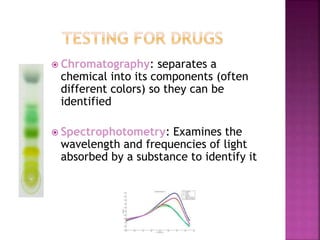
 Chromatography: separates a
chemical into its components (often
different colors) so they can be
identified
 Spectrophotometry: Examines the
wavelength and frequencies of light
absorbed by a substance to identify it
Related evidence includes
(a) firearms or guns
(b) bullets
(c) cartridge cases
Forensic ballistics is the scientific analysis
or interpretation of all ballistic related
evidence with the purpose of interpreting
and establishing the facts in a shooting
related crime
The most common types of crime scene
evidence includes
(a) bullet holes
(b) bullet damage on various mediums
(c) bullet trajectories
(d) gunshot wounds
Forensics Ballistics is divided into 3 sub-
categories
(a) internal
(b) external
(c) terminal ballistics
The study of the processes occurring inside a
firearm when a shot is fired. It includes the
study of various firearm mechanisms and
barrel manufacturing techniques; factors
influencing internal gas pressure; and firearm
recoil
The most common types of internal ballistics are:
(a) examining mechanism to determine the causes
of accidental discharge
(b) examining home-made devices (zip-guns) to
determine if they are capable of discharging
ammunition effectively
(c) microscopic examination and comparison of
fired bullets and cartridge cases to determine
whether a particular firearm was used
The study of the projectile’s flight from the
moment it leaves the muzzle of the barrel until it
strikes the target.
The 2 most common types of external ballistics
examinations are:
(a) the calculation and reconstruction of
bullet trajectories
(b) establishing the maximum range of a
given bullet
The study of the projectile’s effect on the
target or the counter-effect of the target on
the projectile
The ‘target’ can be any solid or liquid object,
but when the target is a human or animal it is
common to use the term “wound ballistics”
Common types of terminal ballistics
examinations are
(a) determination of the distance between
firing point and target
(b) establishing whether or not a particular
wound was caused by a fired bullet
(c) determining the caliber and type of
projectile that caused bullet damage or
gunshot wound
(d) examination of bullet exit/entrance by
examining the holes in targets, or the
wounds in biological tissue
(e) examination of ricochet possibilities and
fired projectiles
1. Cartridge: also called a “round”; made up of a
case, primer, powder and bullet
2. Bullet: the projectile which contains the
propellant or gunpowder
3. Flash Hole: when primer is ignited the
gases released go through this
small opening towards the
gunpowder
also known as ‘propellant’ or
‘gunpowder’. Found inside the
bullet casing itself; highly
reactive/flammable – but does not
explode – rather it forms gases
which push the bullet out of the
cartridge and gun barrel.
4. Powder:
5. Primer: a volatile chemical compound that
ignites when struck by firing pin of
gun; detonates the propellant in a
cartridge
is left behind and is NOT propelled
(only bullet is) when gun has been
fired
6. Casing:
7. Caliber: the diameter of the bore of the
bullet measured from end to end,
usually expressed in hundredths of
an inch (0.22 cal) or in millimeters
(9 mm)
8. Shot: may be a single metal projectile – this
is called a ‘slug’ (ideal for hunting
large game), or the shot may contain
many numerous round metal pellets
(ie. birdshot or buckshot).
Birdshot contains between 20 – 100
small metal pellets (ideal for hunting
birds), while buckshot contains
between 7 – 9 large round metal
pellets (used by law enforcement)
made up of a shot, wad,
powder and primer
9. Shell casing:
10. Wad: made of plastic or paper; separates
the powder from the shot; holds
shot together as it is projected
through the shotgun barrel
 It is easier to design features that aid
deceleration of a larger, slower moving bullet
in tissues than a small, high velocity bullet.
 Such measures include shape modifications
like round (round nose), flattened
(wadcutter), or cupped (hollowpoint) bullet
nose.
 Round nose bullets provide the least braking,
are usually jacketed, and are useful mostly
in low velocity handguns.
 The wadcutter design provides the most
braking from shape alone, is not jacketed,
and is used in low velocity handguns (often
for target practice).
 A semi-wadcutter design is intermediate
between the round nose and wadcutter and
is useful at medium velocity.
 Hollowpoint bullet design facilitates turning
the bullet "inside out" and flattening the
front, referred to as "expansion" or
“mushrooming”
 Expansion reliably occurs only at velocities
exceeding 1200 fps, so is suited only to the
highest velocity handguns.
Gunshot Injuries
The seriousness of gunshot wounds depends
on 5 factors
(a) kinetic energy of the bullet
(b) distance to the target
(c) type of tissue
(d) tumbling (flipping around or going straight
through)
(e) bullet design ex. hollowpoint, vs. round
nose etc.
Tissue
- the more dense the tissue the greater the
damage (will create permanent cavity)
ex. muscle is more dense than lung tissue
- the more elastic the tissue the less damage
because will NOT create a permanent cavity
ex. muscle tissue is more elastic than
organ tissue
Gunpowder residue is composed of 2
substances
(a) propellant
(b) primer
- 2 types of propellants are black powder or
smokeless powder
Black powder
 consists of 15% charcoal, 10% sulfur, and
75% potassium nitrate
 when ignited, it produces a lot of smoke
Smokeless powder
 contains either nitrocellulose alone or
nitrocellulose mixed with nitroglycerine
 these compounds are known as nitrates
The cartridge also contains some special
chemicals called the primer
These chemicals have the special property of
igniting when subjected to great pressure
Several types of primers may be used, but the
most commonly used are lead azide, lead
styphnate, mercury fulminate, barium nitrate,
potassium chlorate and antimony sulfide.
When the trigger of a gun is pressed, the firing
pin strikes the cartridge at a point where the
primer is kept.
This causes the primer to ignite.
The flames thus produced ignites the propellant
charge.
The burning of the propellant charge produces
large amounts of gases, which finally propels
the bullet
 James, Stuart. Forensic Science. 2. Boca Raton, FL: CRC Press,
2005.
 Bell, Suzanne. Forensic Chemistry. 1. Upper Saddle River, NJ:
Pearson Prentice Hall, 2006.
 Girard, James E.. Criminalistics: Forensic Science and Crime.
1. Sudbury, MA: Jones and Barlett Publishers Inc., 2008.
 Saferstein, Richard. Criminalistics: An Introduction to Forensic
Science. 9. Upper Saddle River, NJ: Pearson Prentice Hall,
2007.
 Deedrick, Douglas. "Hairs, Fibers, Crime and Evidence."
Forensic Science Communications 2.3July 2000 16 003 2008
<http://www.fbi.gov/hq/lab/fsc/backissu/july2000/deedric1.
htm>.
 Kathy, Steck-Flynn. "Trace Evidence: Hair." Crime and Clues:
The Art and Science of Criminal Investigation. 03 009 2006. 16
Mar 2008
<http://www.crimeandclues.com/hair_evidence.htm>.
 Bisbing, Richard E., (2001) Finding Trace Evidence. in Mute
Witnesses: Trace Evidence Analysis. Houck, Max., (ed.)
Academic Press, San Diego, California
 www.coolphysics.org/Hair,%20Fiber,%20and%20Paints%2005.ppt
 Hamrick, Barbara. "Uranium in Hair Analysis: Responding to Public
Concerns." 25 004 2004. Environmental Nuclear Council. 16 Mar 2008
<http://www.crcpd.org/AnnualMeeting-04/05-25-04_0810-
Hamrick.pdf>.
 https://www.slideshare.net/drbhargava5745/introduction-
to-forensic-science-labs-in-india/13.
 https://www.fortbendisd.com/cms/lib/TX01917858/Centr
icity/Domain/3901/CH_1_Forensic_Science_History.ppt.
 B R Sharma: Forensic Science in Criminal Investigation and
Trials, 5th ed.
 http://webcache.googleusercontent.com/search?q=cache:
k4O4AxHBFyMJ:meinster.pbworks.com/f/Bitemark.ppt+&c
d=15&hl=en&ct=clnk&gl=in.
 https://www.powershow.com/view/ade8f-
NGVkY/TYPES_OF_HAIRS_powerpoint_ppt_presentation.
 http://web.mst.edu/~dludlow/classes/che258/Toxicology.
ppt.
 http://www.troup.org/userfiles/685/Classes/8301/ballisti
cs.ppt?id=23669.
 http://www.hcs.stier.org/Downloads/IntroductiontoForens
ics.ppt.

FORENSIC SCIENCE.pptx

  • 1.
  • 2.
     Forensic Scienceembraces all branches of science and applies them to the purposes of law  all the techniques were borrowed from various scientific disciplines like chemistry, medicines, surgery, biology, photography, physics and mathematics etc.  The forensic scientist has to depend upon for proper functioning of forensic science, on the investigating officer, on the one hand, and on the presenting counsel and the judge on the other, for its effective utilisation in the dissemination of justice
  • 3.
     Social Changes Anonymity  Technical Knowledge  Wide Field  Better Evidence  Alternatives of  Eye Witnesses  Confessions  Approvers  Stock Witnesses  Dictated confessions
  • 4.
     It isalways available. Locard’s Principle of Exchange holds.  It can link the culprit with the crime, the victim, the scene, the weapon and other evidence inter se decisively. Evidentiary clues are unique. The Law of Individuality holds.  It is free from human failings: ‘bias’, ‘emotions’, ‘rationalisation‘, ‘memory lapses’, ‘perjury’, etc. But the scientist has to be honest and well- versed.  It is verifiable. Other honest scientists can confirm the findings.  It is efficient: time and cost effective. Automation and computers have conferred wings to the evaluation processes.
  • 5.
     Law ofIndividuality;-Every object, natural or man-made, has an individuality, which is not duplicated in any other object. It is unique. Neither the nature has duplicated itself, nor can man.  Principle of Exchange;- Whenever two entities come in contact, mutual exchange of traces takes place.
  • 6.
     Law ofProgressive Change ;- Everything changes with the passage of time.  Principle of Comparison ;- Only the likes can be compared.  Principle of Analysis ;- The analysis can be no better than the sample analysed.  Law of Probability;- All identifications, definite or indefinite, are made, consciously or unconsciously, on the basis of probability.
  • 7.
     Provides leadsto the investigation.  Establishes whether the scene is real or fake.  Locates hidden clues, correct clues, and also proper samples for comparison.  Establishes sequence of events.  Verifies the prosecution version, the defence versions and finds the correct version.  Saves the innocent accused by de-linking him, via clues, with the victim or with the scene of crime.  Identifies the correct crime weapon.
  • 9.
     “Forensic” comesfrom the Latin word “forensis” meaning forum.  During the time of the Romans, a criminal charge meant presenting the case before the public.  Both the person accused of the crime & the accuser would give speeches based on their side of the story.  The individual with the best argumentation would determine the outcome of the case.
  • 10.
     Sci-fi authorin late 1800’s  Popularized scientific crime-detection methods through his fictional character ‘Sherlock Holmes’.
  • 11.
     “Father ofToxicology”  Wrote about the detection of poisons & their effects on animals.
  • 12.
     “Father ofAnthropometry”  Developed a system to distinguish one individual person from another based on certain body measurements.
  • 13.
     “Father ofFingerprinting”  Developed fingerprinting as a way to uniquely identify individuals.
  • 14.
     “Father ofBloodstain Identification”  He developed a procedure for determining the blood type (A, B, AB, or O) of a dried blood stain.
  • 15.
     “Father ofDocument Examination”  His work led to the acceptance of documents as scientific evidence by the courts.
  • 16.
     “Father ofthe Crime Lab”  In 1910, he started the 1st crime lab in an attic of a police station.  With few tools, he quickly became known world-wide to forensic scientists & criminal investigators & eventually founded the Institute of Criminalistics in France.  His most important contribution was the “Locard’s Exchange Principle”
  • 17.
     “Every ContactLeaves a Trace.”  He believed that every criminal can be connected to a crime by particles carried from the crime scene.  When a criminal comes in contact with an object or person, a cross-transfer of evidence occurs.
  • 18.
     Application ofDNA as evidence  Prevention vs. Reaction  Catastrophes & Wars  ID remains of victims (either civilian or soldiers)  ex. Holocaust or Katrina  Military & International Forensics  Terrorism  The search for WMD’s  stockpiled or stored weapons from past wars
  • 19.
    When the Armyunearthed more than a 1,000 mortar rounds from a WW2 training site, they enlisted a Forensic Science Lab to determine which were live munitions & which were dummies. Munitions
  • 20.
     O.J. Simpsonwas a NFL football legend.  He is now famous for having been tried for the murder of ex-wife Nicole Brown Simpson & her friend Ronald Goldman in 1994.  He was acquitted in criminal court after a lengthy, highly publicized trial.
  • 21.
     1st onthe scene, police found evidence of blood & entered the Simpson home without a search warrant, an action permissible b/c the situation was an emergency.  HOWEVER, the police collected a pair of blood- stained gloves during their search.  Collection of evidence without proper warrants became the key argument used by Simpson’s legal team & ultimately led to his acquital.
  • 22.
     If forensicevidence is to be admissible in court, the highest professional standards must be used at the crime scene!  He was found liable for their deaths in civil court, but has yet to pay the $33.5 million judgment.
  • 23.
     PRIMARY GOAL:To understand the processes & timetable of postmortem decay, primarily to improve determining the "time since death" in murder cases.  The Body Farm is a simulation of various crime scenes using real human bodies.  Started in 1970-80’s to study Forensic Anthropology (the study of human decomposition after death).
  • 24.
    Corpse 1-81 wasan elderly white male; he became part of a pioneering study of insect activity in human corpses.
  • 25.
    Close up ofa recent research subject. After only a few weeks in the Tennessee summer, the skull is completely bare & many vertebrae are exposed. The rib cage & pelvis are covered with dried, leathery skin, but the soft tissues beneath are gone, consumed by insects & bacteria.
  • 26.
    Close-up of ahuman femur & hip bone, containing an artificial hip implant. Such orthopedic devices can help identify an unknown crime victim.
  • 27.
     The natureof physical evidence to be collected.  Where it is found.  How it is collected, preserved, packed and dispatched.  What standard samples for comparison purposes are necessary.  How much sample is required.  How the sampling is done.  How the laboratory results will link the crime with the criminal and to what extent his labours will be rewarded.
  • 29.
    DFSS; Directorate ofForensic Science Services Govt. Of India MHA (Ministry of Home Affairs) DFSS Forensic labs & GEQDs CFSL, New Delhi (CBI) , Established in 2002-03 •M.S. Rao was the founder director of DFSS. •Role of DFSS- A. It helps in administration of justice system and provides knowledge & facilities to various training programmes to people involved with justice delivery. B. It provides the scientific aid in criminal justice system. C. It guides, regulates and controls the working of Forensic Science Laboratories. D. Also controls and regulates the working of GEQDs. E. Provides financial and technical help to State Forensic Labs. (SFSLs). F. Promotes research & development in Forensic field. G. To access and review the current procedures & practices in labs.
  • 30.
     1. CentralForensic Labs (FSLs)  2. State Forensic Labs (FSLs)  3. Mini & Local Forensic Labs (RFSL & MFSL)
  • 31.
    • SHIMLA (1906) •KOLKATA (1963) • HYDRABAD (1968) • Initially established to examine the various documents related to or suspected with dealings of Indian independence movement.
  • 32.
     DFSS CFSLKolkata CFSL Chandigarh CFSL Hyderabad  CFSL Kolkata: (for biological sciences)  Main R & D projects proposed are- 1. Development of genetic markers for forensic wildlife investigation and GMOs etc. 2. Analysis of Y chromosome markers. 3. Development of technology for identification of foetal genetic markers from maternal blood by non-invasive methods. 4. Creation of complete crime analysis facility. 1. CFSL Guwahati 2. CFSL Bhopal 3. CFSL Pune
  • 33.
     Director AdditionalDirector  Deputy Director  Assistant Director  Senior Scientific Officer (SSO)  Scientific Officer (SO)  Senior Scientific Assistant (SSA)  Scientific Assistant (SA)  Lab Assistant (LA)  Lab Attendant  Receptionist/Sweeper/Peon/Helper Lab
  • 35.
     Blood,  Semen& other Biological fluids,  Viscera,  Shoe impressions,  Tool marks,  Tyre marks,  Bite Marks,  Hair of Animal & Human,  Fibers & Fabrics,  Establishment of identity of Individuals: DNA,  Fingerprints/Foot prints,  Anthropology,  Skeletal Remains &  Odontology
  • 37.
     In thebeginning, it was possible only to say whether a given stain is of blood or not. Later, it became possible to identify whether the given stain is of human or animal-origin. Further progress made it possible to classify blood into four main groups, O, A, B, and AB. Later, the division was extended further. A group factors were found to exist in a number of forms
  • 38.
     The liquidpart in blood is called plasma.  It forms 55% of the blood volume.  It is mostly water (&90%).  Red blood cells occupy 44% of the blood volume by volume.  Platelets are 0.7%.  the reaming part is composed of white cells
  • 39.
     It establishescorpus delicti; the occurrence of crime.  It permits determination of the sequence of occurrence of a crime, from the distribution of blood.  It is possible to guess the approximate time when the crime was committed from the study of the age of stains.  It helps the investigation of poaching, maiming and worrying.  It helps to establish the paternity of a child in disputed cases.  It establishes an inter se link between the criminal, the crime, the victim and the scene.
  • 41.
     Temperature  Humidity Quantity of blood  Surface bearing the stain  Atmospheric conditions including rain and wind.
  • 42.
     Does thegiven article bear bloodstain?  Is it human or animal blood?  What is the blood group of the human bloodstain or the given body fluid?  What is the species of animal to which the blood belong?  How much blood has been shed?  What is the age of the stain?  Is the child biological issue of the alleged parent?  Does the blood contain alcohol? If so, how much has the subject has taken?  Does the blood contain carbon monoxide, hydrogen cyanide or other poison?  Does the blood contain narcotic drug?  Did the person suffer from any disease like syphilis or leukaemia? If so, to what extent was the disease responsible for the death of the person? This is possible when liquid blood is available.  Are there any artifacts to show the body part from which the blood has come?
  • 43.
     At theCrime Scene;-  In outdoor scenes, in the form of stains, smears, streaks, splashes, spray, prints, clots, pools or liquid blood, on avariet of places and articles.  In indoor scenes, the floors, walls, doors, windows, furniture (chairs, tables, beds) and fans are the likely places  The Suspect;- The suspect may carry blood on his hands, nails, hair, earlobes, feet, male organ (in sexual offences) and other exposed parts of his body.  The Victim  The Weapon of Offence  The Vehicle  The Route  Disposal Site
  • 44.
     Establish thelocation of the evidence and the position of the article with respect to other fixed objects at the scene through copious notes, sketches and photographs.  Note the direction, size and the number of stains.  Note the condition of the stains, whether they are dry, sticky, wet, contracting, puckering, crumbling or brittle.  Note whether the stains are contaminated or exposed to natural elements or heat. The facts should be mentioned in the forwarding letter to the expert.  Record the collection method: whether the stain was scraped, cut, lifted, dislodged or collected in the form in which it is being sent.  Pack the dry bloodstains from various sources separately in suitable vials or cellophane envelopes of appropriate sizes.  Preserve the purity of the stains. This is achieved by preventing mixing of stains with one another or rubbing of the stain with the container or with other parts of the article.  Preserve the continuity of the chain of possession and distinct identity of the evidence through proper packing, labelling, sealing and observing other legal formalities. The possession of the evidence should be accounted for from the time of recovery to the time of its production in the court.
  • 46.
     Semen isthe liquid ejaculated by males in sexual processes. It is the most important body fluid in the investigation of sexual offences, indecency, rape, sodomy, bestiality and the like  The sperm has a definite morphological structure. Its identification in a stain establishes its seminal nature
  • 47.
     Victim  Culprit Scene of Occurrence  Location Techniques
  • 48.
     Does thegiven article bear any seminal stains?  Are the seminal stains from human source?  Can the human source of the semen be individualized?  What is the age of the stains?  How long can the spermatozoon survive?
  • 50.
    Footwear marks includethe marks of shoes, sandals, chappals, socks and the like. The footwear may be factory-made or hand- made. It may be made of leather, partly or wholly, rubber (natural or synthetic) or plastics. Cloth is used in canvas shoes…..  The soles of a pair of shoes may be stitched, nailed or pasted with the uppers (of leather, rubber, plastics or canvass).
  • 51.
     Culprit’s presence Number  Tracking  Age of Culprit
  • 52.
     The footmarksare incomplete.  The marks do not carry ridge details.  The marks carry only a few individualising features.  The specimen marks are carelessly lifted.
  • 53.
     Gait patternhas been studied scientifically also. The individuality of the gait pattern can be established from the following considerations:  Direction line (DL)  Walk line (WL)  Foot line (FL)  Foot angle (FA)  Step angle (SA)  Step length (SL)  Width of step (SW).
  • 55.
     66 A.D.Nero, the Roman Emperor.  Nero's mother Agrippina had her soldiers kill Lollia Paulina, with instructions to bring back her head as proof that she was dead.  Agrippina, unable to positively identify the head, examined the front teeth and on finding the discolored front tooth confirmed the identity of the victim
  • 56.
     The firstforensic dentist in the United States was Paul Revere who was known for the identification of fallen revolutionary soldiers  1954, Texas burglary scene with bite mark in cheese (Doyle v. State)  1975, California sexual assault with bites to victim’s nose (People v. Marx)
  • 57.
     Id unknownhuman remains through dental records.  Assist at the scene of a mass disaster.  Age estimations of both living and deceased persons.  Analysis of bite marks found on victims of attack.  ID of bite marks in other substances e.g. wood, duct tape, pencils, leather and foodstuffs.  Analysis of weapon marks using the principles of bite mark analysis.  Presentation of bite and weapon mark evidence in court.  Building a picture of lifestyle and diet at an archaeological site.
  • 58.
     Establish hierarchyof leadership  Procure and implement computer data base  Establish ante-mortem team  Establish post-mortem team  Determine protocol
  • 59.
     Post-Mortem resectionof non-viewable remains  Radiography of intact or fragmented jaws  Charting of post-mortem examination  Obtaining and charting of ante-mortem records  Comparison of data
  • 60.
    1. Fillings 2. Extractions 3.Surface structure/root configuration 4. Adjacent teeth 5. Twisted/tilted teeth
  • 61.
     Can beleft in food, gum and skin
  • 62.
     hemorrhage --small bleeding spot  abrasion -- undamaging mark on skin  contusion -- ruptured blood vessel, bruise (*most common)  laceration -- punctured or torn skin  incision -- neat puncture of skin  avulsion -- removal of skin  artifact -- bitten-off piece of body
  • 63.
     A signof perp seeking to degrade the victim while also achieving complete domination.  Can be found on a suspect when a victim attempts to defend him/herself.
  • 64.
     Scaled photographyof bite mark evidence  Scaled photography of dental casts  Clinical comparisons  Computer comparisons
  • 66.
     Connect suspectto bite mark:
  • 69.
     We willfocus on a specific element of forensic dentistry – specifically, bitemark analysis  Here, a dentist is required to compare the impressions and bruises left in the skin by one person biting another to a suspect’s teeth.  However, another important element of forensic dentistry involves the identification of human remains by comparing dental charts to the teeth of the victim  This latter component of forensic dentistry has only been around for about 50 or so years. Why?
  • 70.
     Bitemark:  Aphysical alteration in a medium caused by the contact of teeth.  A representative pattern left in an object or tissue by the dental structures of an animal or human.  Cutaneous Human Bitemark:  An injury in skin caused by contacting teeth (with or without the lips or tongue) which shows the representational pattern of the oral structures.
  • 71.
     What areevidential limitations to bitemarks in the following substances:  Wax  Fruit  Skin  Paper  Chewing gum
  • 72.
     We canuse bitemarks to carry out bitemark analysis. i.e. a comparison of a known person’s dentition to a patterned injury which appears consistent with a bitemark  This type of comparison is used to confirm or eliminate the identity of a suspect in relation to the bitemark.
  • 73.
    1. 3rd Molar(wisdom tooth) 2. 2nd Molar (12-yr molar) 3. 1st Molar (6-yr molar) 4. 2nd Bicuspid (2nd premolar) 5. 1st Bicuspid (1st premolar) 6. Cuspid (canine/eye tooth) 7. Lateral incisor 8. Central incisor 9. Central incisor 10. Lateral incisor 11. Cuspid (canine/eye tooth) 12. 1st Bicuspid (1st premolar) 13. 2nd Bicuspid (2nd premolar) 14. 1st Molar (6-yr molar) 15. 2nd Molar (12-yr molar) 16. 3rd Molar (wisdom tooth) 17. 3rd Molar (wisdom tooth) 18. 2nd Molar (12-yr molar) 19. 1st Molar (6-yr molar) 20. 2nd Bicuspid (2nd premolar) 21. 1st Bicuspid (1st premolar) 22. Cuspid (canine/eye tooth) 23. Lateral incisor 24. Central incisor 25. Central incisor 26. Lateral incisor 27. Cuspid (canine/eye tooth) 28. 1st Bicuspid (1st premolar) 29. 2nd Bicuspid (2nd premolar) 30. 1st Molar (6-yr molar) 31. 2nd Molar (12-yr molar) 32. 3rd Molar (wisdom tooth) Please note: When you look at the tooth chart, you are looking into a person's mouth with the jaws open. You're facing the person, so their upper right jaw will be on the left of this image.
  • 74.
     In abitemark comparison, you are looking for and matching unique features between the bitemark and exemplar castings. These features may include:  Gaps  Rotation (angle)  Size of teeth (e.g. width at tip)  Width from tooth to tooth (e.g. cuspid to cuspid)
  • 75.
     By establishingthe uniqueness of the biter's teeth and then applying those unique properties to the bite pattern, a degree of confidence relating the biter's teeth to the injury pattern is described.  This opinion can range for excluded ( the suspect did not do the biting) to likely and without a doubt (the bite was witnessed and there is not question the suspected biter inflicted the bite).  Despite the unique nature of the position and arrangement of the human teeth, it is usually easier to rule out a suspect as a potential biter than it is to include a suspect as a potential biter.
  • 76.
    There are over20 different methods of bitemark analysis. The most common used are: 1.Comparing an acetate overlay manually fabricated from study models to a life size photograph of the wound. 2.Comparing study models to a life size photograph of the wound 3.Comparing an acetate overlay manually fabricated from bites in wax to a photograph of the wound 4.Comparing an acetate overlay manually fabricated from x- rays of radiopaque material placed in a wax bite to a life size photograph of the wound. 5. Comparing an acetate overlay manually fabricated from a photocopy of study models to a life size photograph of the wound.
  • 77.
  • 78.
    Bitemark : UpperJaw Distance Suspect; Upper Jaw Distance Cuspid to cuspid Cuspid to cuspid 38mm 42mm Bitemark: Distance Suspect: : Distance Tooth 6 to Tooth 10 Tooth 6 to Tooth 10 44.25mm 39.65mm Angle: + 14.5 Degrees Angle: + 12.52 Degrees
  • 79.
     Most ofthese techniques involve the fabrication of an acetate overlay  An acetate overlay is an outline of the biting edge of someone’s teeth as traced onto and seen on a clear transparency  They can be fabricated in a number of ways  A review of the literature has found over 15 methods  These include tracing from dental models, photographs, wax bites, photocopies.
  • 80.
     Have beendeveloped to overcome some of these problems  Theoretically they can;  Correct for distortion  Generate the overlay objectively  Carry out the comparison objectively  Reproduce the overlay
  • 81.
  • 82.
    In recent yearsit has been questioned as a reliable scientific tool. This is based on: 1. Numerous methods of fabrication 2. Relies on manual fabrication 3. Subjective element in fabrication 4. Subjective element in comparison 5. Distortion which occurs As a result of this it has been suggested that bitemark analysis using acetate overlays are inaccurate, subjective and non-reproducible
  • 83.
     The thresholdvariable in bitemark analysis is the fact that, in cases of physical assault having skin injuries, the anatomy and physiology of the skin, and the position the victim was in affects the detail and shape of the bitemark.  There is one article from the early 1970's that showed how the positioning of the test bite on a bicep varied whether the arm was flexed or pronated.  What is significant is that there is no way to experimentally control or establish the amount of positional variation in an actual bitemark case.  The bottom line is that skin is usually a poor impression material. No significant tests have been published on this subject since 1971 in the odontology literature. http://forensic.to/webhome/bitemarks/
  • 84.
     There isa considerable body of literature on the subject (http://www.forensicdentistryonline.org/Forensic_pages_1/bitemark_ref .htm)  There are rigid and strict standards (http://www.forensic.to/webhome/bitemarks/#ABFO%20Bite%20Mark%20 Guidelines)  Related to this, there is a known error rate  Legal precedents on the admissibility of bitemark analyses exist (http://www.forensicdentistryonline.org/Forensic_pages_1/us_cases.htm )  The include the famous Ted Bundy case
  • 85.
    Outlines of thesame set of teeth. The different perimeter shapes depend on how far the teeth are pressed into the test substrate.
  • 87.
     The mostbasic components of hair are keratin, a very strong protein that is resistant to decomposition, and melanin, a pigment.  The keratins form groups that interact and interconnect to form very stable fibrils. It is this property of hair that makes it such a prime example of physical evidence.
  • 88.
     Hairs aredead, cornified cells. The portion existing above the epidermis is called the shaft; below the epidermis, the root is embedded in the hair follicle. • The hair shaft is composed of three layers: − Outer cuticle − Cortex − Central medulla
  • 89.
     The cuticleof a hair is the thin, translucent layer surrounding the shaft. It consists of scales of hardened, keratinized tissue that vary from species to species, and includes such patterns as:  Coronal, or “crown – like.” Rare in humans; typical of rodents. Found in hairs of very fine diameter.  Spinous, or “petal – like.” Never found in humans. Common in cats, seals, and minks.  Imbricate, or “flattened.” Common in humans. Coronal Spinous Imbricate
  • 90.
    Photomicrograph of a minkhair possessing a Spinous cuticle. Photomicrograph of a bat hair possessing a Coronal cuticle. Photomicrograph of a human hair possessing an Imbricate cuticle.
  • 91.
     The cortexis the main body of the hair, composed of spindle- shaped cortical cells.  Contains pigment bodies, which contains the melanin (hair color) and cortical fusi.  Cortical fusi are air spaces of varying sizes found near the root of a mature human hair.  Pigment granules are small, dark, granulated structures that vary in size, color, and distribution. Typically distributed toward the cuticle in humans.  Bleached hair is devoid of pigment granules, and dyed hair has dye in the cuticle and the cortex. Photomicrograph of cortical fusi in human hair Photomicrograph of pigment distribution in human hair
  • 92.
     The medullais a central core of cells that runs through the center of the cortex. The medulla may be:  Continuous  Fragmented  Interrupted  In human hairs, the medulla is generally amorphous in appearance or completely absent.  In animal hairs, it’s structure is frequently very regular and well defined.  Medullar ratio, of the formula diameter of medulla/diameter of the cortex, is less than ⅓ in humans and more than ½ in animals.
  • 93.
    Photomicrograph of a humanhair with no medulla. Photomicrograph of a hair with trace medulla. Photomicrograph of a hair with a clear, continuous medulla.
  • 94.
     Growth ofmammal hair goes through three distinct phases:  Anagenic phase can last for up to 6 years. Follicle is attached to the root by the papilla. The hair must be pulled to be lost. If pulled, a follicular tag is left, which can be used later to test the mitochondrial DNA.  Catagenic phase lasts only 2-3 weeks. Hair keeps growing, but the bulb shrinks.  Telogenic phase lasts for 2-6 months. Hair becomes naturally loose and sheds. Hair in Anagenic Phase Hair in Catagenic Phase Hair in Telogenic Phase
  • 95.
     The searchfor and collection of hair evidence should begin as soon as possible. Hair evidence is easily transferred to and from the crime scene.  Collection should be done by hand if the location of the hair is important, which is usually the case. Sticky tape and lint rollers may be used to assist.  A special filtered vacuum cleaner may be used to collect hairs and fibers en masse from carpet, bedding, etc.  If the evidence is stuck to another object, the entire object should be packaged and labeled. Evidence Collecting Vacuum Evidence Collecting Kit
  • 96.
     Once collected,the hair evidence should be packaged into paper packets.  If sticky tape or a lint roller are used, the entire surface used should be packed into a polyethylene storage bag – easy to see through, but with no direct contact.  Control samples need to be collected from the victim, suspect, and other individuals who could have left evidence at the scene. Take from all pertinent regions of the body; 50 head hairs, 24 pubic hairs. Root still in tact is preferable. Evidence Collection Bags Evidence Collecting Lint Roller
  • 97.
     Humans hairscan be separated from animal hairs in any number of ways, including the medullary ratio, characteristics of the medulla, and the scale patterns of the cuticle.  Different species of animals can be identified quite easily using the same basic principles.  The next step tries to classify the racial origin of the hair as: negroid, mongoloid, and caucasian, typically using head hair. Mixed individuals sometimes exhibit properties of all of their ancestral lineage, and make classification difficult. Deer Medullae Human Medulla
  • 98.
    Curly. Dense pigment distributed unevenly. Variations inthe diameter of the shaft. Fragmented or absent medullae. The cross-section is flattened. Cross Section of a Negroid Hair Photomicrograph of a Negroid Head Hair
  • 99.
     Coarse andstraight shaft, with little diameter variation.  Dense pigment distributed unevenly.  Presence of a continuous medulla.  The cross-section is round. Cross Section of a Mongoloid Hair Photomicrograph of a Mongoloid Head Hair
  • 100.
     Straight to wavy. Fairly evenly distributed, fine pigment.  Moderate shaft diameter, with little variation.  The cross- section is oval. Cross Section of Caucasian Hair Photomicrograph of a Caucasian Hair
  • 101.
     Somatic regionscan be determined based on the hair’s morphology, such as:  Head hairs have a soft texture, cut or split tips, and moderate shaft diameter.  Pubic hairs have a course, wiry texture, tapered, rounded, or abraded tips, and a buckling shaft.  Facial hairs have a triangular cross-section and a course in texture.  Eyelash/Eyebrow hairs are saber-like in appearance, short, and stubby.  Limb hairs are soft, and arc- like in appearance. Tips are rounded and abraded; scales rounded due to wear. Head Hair Beard Hair Pubic Hair
  • 102.
     Using amicroscope (SEM), forensic scientists can typically determine the species, race, and somatic origin of a hair. They may use comparative microscopy to do one of the following:  Link the suspect to a crime scene, meaning that a control hair matches the evidential hair.  Exclude the suspect from a crime scene, meaning that a control hair does not match the evidential hair.  In addition to comparing hairs in with a microscope, the scientists may test for DNA on the follicular tag, and run a number of tests for drugs and environmental toxins, which will be described at length. Scanning Electron Microscope, a typical device used to study the structures of hair.
  • 103.
     Hair analysisis used in forensic toxicology to test and determine whether a drug was used.  When a drug is ingested, it enters the blood stream and is broken down to a specific metabolite.  Hair strands normally grow at an average rate of 1.3 centimeters every month; they absorb metabolized drugs that are fed to the hair follicle through the blood stream.  The drug will only disappear if exposure to the drug is ceased, and the hair containing the drug is cut.  Hair analysis can be used for the detection of many therapeutic drugs and recreational drugs, including cocaine, heroin, benzodiazepines (Valium-type drugs) and amphetamines. Depicting how drugs enter the hair. General structure for amphetamines. Cocaine’s Structure
  • 104.
     The radioimmunoassayand enzyme-linked immunosorbent assay are two common assays that are used by forensic toxicologists to detect substances such as drugs in the hair.  Recall that the immunoassays function on the basis of an antigen- antibody interaction. The analyte, or drug, is added and binds to the solid phase, typically producing a color change, fluorescence, etc. that can be measured to determine the amount of drug present.  Forensic toxicologists also look for toxic metals in the hair to explain poor mental and physical health. How an ELISA functions
  • 105.
     Individualization hasbeen impossible to obtain with hairs in the past, but recent techniques are making it more realistic.  Nuclear DNA (nDNA) and mitochondrial DNA (mtDNA) can be extracted from the root or follicular tag of an anagenic hair. Nuclear DNA comes from both parents; mitochondrial DNA is passed only from mother to offspring.  Nuclear DNA can lead to individualization. Odds created by association of a suspect with evidential hairs are typically one to billions or trillions. DNA Smear of anagenic hair
  • 107.
     Toxicology isthe study of drugs and poisons, and their interactions with or effects on the body  Forensic Toxicology is the application of toxicology to the law, including  Workplace or Forensic Drug Testing  Postmortem Toxicology  Human Performance Testing
  • 108.
     Socrates wasone of the earliest reported victims of poisoning, by hemlock, in 399 BC.  By the 17th century, it was not uncommon for rich European families to use poisoning as a means of settling disputes.  Arsenic became known as “inheritance powder.”
  • 109.
     Mathieu Orfila(1787-1853) is considered one of the fathers of toxicology as he helped to develop a method of chemical analysis to identify arsenic and other toxins in human tissue  Today, less than 0.5% of all homicides result from poisoning
  • 110.
     Studies bodyfluid, tissue, and organs for drugs and/or poisons  Must detect, identify, quantify, and assess toxicity  May have extremely minute quantities to test  May conduct postmortem pathological examinations, and examination of personal effects and empty containers, etc.
  • 111.
     When possible,collect both blood and urine  Collect two voids (samples) of urine in separate specimen containers  Collect a sample of blood if a physician or registered nurse (RN) is available
  • 112.
     Approximately 40%of traffic deaths in the U.S. are alcohol-related (2008)  Toxicologists have had to develop specific procedures for measuring the degree of alcohol intoxication  Methods for diagnosis must be defendable within the framework of the legal system
  • 113.
     Alcoholic beveragescontain ethanol, also called ethyl alcohol, which is obtained by the fermentation of sugars from grains, fruits, and vegetables.  Alcohol is a depressant, a chemical that slows the heart rate and brain activity, and causes drowsiness
  • 114.
     Alcohol isabsorbed through the walls of the stomach and small intestine, and distributed by blood throughout the body.  In the liver, the enzyme alcohol dehydrogenase (ADH) breaks down ethanol into acetylaldehyde (causes hangovers), then eventually into carbon dioxide and water.  The liver can normally metabolize 1-2 drinks (15-30 mL or up to 1 ounce) an hour. When a person drinks more than the liver can metabolize, the excess is distributed to the tissues of the body which can damage them.
  • 115.
     Blood AlcoholContent (BAC) is usually written as a decimal  Example: 0.08  This means there are 8 g of alcohol per 10,000 mL of blood; your blood is 0.08% alcohol. 0.03 – 0.12 0.25 – 0.40 0.35 – 0.50 0.40 and up euphoria vomiting, loss of bladder control circulatory and respiratory system impairment coma and death Effects of Alcohol at Different BACs
  • 116.
     A BACgreater than 0.08 is considered to be “drunk driving”  Implied consent says drivers who receive a driver's license are automatically consenting to be tested for blood alcohol content if a police officer has probable cause  While a driver can refuse to take this test, implied consent laws often automatically revoke licenses on the spot.
  • 117.
     If apolice officer smells alcohol on a driver, he/she may perform field sobriety tests, including:  Horizontal gaze nystagmus (HGN) test  Nystagmus is involuntary jerking movements of the eyes; more pronounced when intoxicated  Walk and turn  Heel to toe in a straight line, following directions  One leg stand  Count aloud by 1000’s for 30 seconds or recite alphabet backwards
  • 118.
     90% ofalcohol is processed by the liver. The remaining 10% is excreted through breath, perspiration, and urine  A breath test, such as a Breathalyzer measures the amount of alcohol in exhaled air.  The amount of alcohol in breath is 1/2100 the amount in blood.  2100 mL of air has the same amount of alcohol as 1 mL of blood.
  • 119.
     All alcoholsare toxic to the body.  Consumption of alcohol can lead to liver damage, possibly cirrhosis. Chronic alcohol abuse can lead to Korsakoff’s Syndrome.  Driving while intoxicated can have deadly results.  Alcohol may change the effect of medications.  Never consume alcohol while taking drugs with a sedative effect.
  • 120.
     “Drug” canmean different things…  Illicit or illegal drugs that have no accepted medical use in the US  Controlled substances: legal drugs whose sale, possession, and use are restricted because of their effects and the potential for abuse.  Drugs can fall into one of several different classes: narcotics, hallucinogens, depressants, stimulants, club drugs, and steroids
  • 121.
     Narcotics reducepain by suppressing the central nervous systems ability to relay pain messages to the brain  Pain relievers are called analgesics  Narcotics induce sleep and depresses vital body functions such as blood pressure, pulse, and breathing
  • 122.
     Varieties ofnarcotics:  Opiates: derived from the Asian Poppy  Herione, morhpine, codeine  Synthetic opiates: man-made  Methadone: given to heroine addicts to try and break their addiction  Oxycodone (OxyContin or Percocet)  Hydrocodone (Vicodin)  Overdose on narcotics can result in difficulty breathing, low blood pressure, loss of consciousness, and possibly coma and death.
  • 123.
     Hallucinogens alterthe user’s perceptions, thinking, self-awareness, and emotions.  Some hallucinogens can cause panic attacks, seizures, headaches, and sometimes psychosis that can last for weeks.  Many hallucinogens, particularly PCP, increase the user’s heart rate, which could lead to heart failure.
  • 124.
     Varieties ofHallucinogens  Marijuana (from cannabis plant)  The most widely used illicit drug in the U.S.  Contains tetrahydrocannabinol (THC)  Has medical uses such as treating glaucoma and relieving nausea due to chemotherapy  MDMA (“Ecstacy”)  Mescaline (from Peyote cactus)  LSD (Lysergic Acid, or simply “Acid”)  PCP (phencyclidine or “Angel Dust”)  Mushrooms (contain psilocybin)
  • 125.
     Depressants areused to relieve anxiety and produce sleep.  Depressants reduce body functions such as heart rate.  Overdose can cause coma and death.  Mixing depressants with other drugs or alcohol can increase their effects and health risks.
  • 126.
     Varieties ofDepressants:  Alcohol  Barbiturates: “downers” such as Phenobarbital and Methaqualone (also called Quaaludes, illegal)  Anti-psychotic and anti-anxiety drugs including benzodiazepines such as Diazepam (Valium)  Inhalants (“huffing”)  Sedatives, muscle relaxers, etc.  Marijuana and opiates (like morphine) are also considered depressants.
  • 127.
     Stimulants increasefeelings of energy and alertness while suppressing fatigue and appetite.  Also called “uppers.”  Depression often results as the drug wears off.  Stimulants are highly addictive.  Overdose can result in irregular heart beat, heart attack, stroke, seizures, coma, and death.
  • 128.
     Varieties ofStimulants  Amphetamines, also called “speed.”  Cocaine, including crack cocaine  Derived from the South American coca plant  Addictions to cocaine are very difficult to overcome  Methamphetamines, also called “meth.”  Typically methamphetamines are more potent and dangerous than amphetamines
  • 130.
     Club drugsare called such because they are most often used at nightclubs, bars, and raves (all night dance parties)  Varieties of Club Drugs”  Methylenedioxymethamphetamine (aka MDMA or Ecstasy)  Chronic use can cause body system breakdown, severe brain damage, memory loss, and seizures  Ketamine or “Special K” is an animal anesthetic used by veterinarians
  • 131.
     Date RapeDrugs are called that because they are often associated with drug- facilitated sexual assault, rape, and robbery.  These drugs can produce increased libido and depress the central nervous system, resulting in loss of consciousness and memory.  Varieties include GHB and Rohypnol (also called “Roofies”)
  • 132.
     Anabolic Steroidspromote cell division and tissue growth  Athletes may take steroids to increase muscle mass  Anabolic steroids are chemically related to testosterone  Side effects include liver malfunction, cancer, breast development in males, masculinizing effects in females, diminished sex drive in males, unpredictable moods (“roid rage”), personality changes, depression, hypertension, and high cholesterol
  • 133.
     All ofthese drugs, even the legal ones, can have harmful side effects. Overdose can be deadly.  Assignment: Drug Brochures
  • 135.
     A poisonis any substance that causes disturbance to an organism  More specifically, a toxin is poison produced naturally by an organism  Examples: snake venom, poison ivy
  • 136.
     Poisons enterand affect the body in different ways:  Ingestion (poisons are eaten)  90% of all poisonings involve children swallowing household products or medicine  Inhaled  Example: carbon monoxide, sarin nerve gas  Injected  Heroine  Absorbed (through skin, eyes, or mucous membranes)  Poison sumac
  • 137.
     Pesticides areby definition poisons as they are used to kill organisms that threaten plants such as food crops  Example: DDT (for mosquitoes)  These chemicals lead to an excess of the neurotransmitter acetylcholine  Overdose can lead to muscle spasms, seizures, anxiety, rapid heartbeat, sweating, diarrhea, and at high concentrations coma and death
  • 138.
     Metal compoundscan enter the body by ingestion, inhalation, or absorption through the skin or mucous membranes  Metals are stored in soft body tissues and damage organs  Examples:  Lead  Mercury  Arsenic  Cyanide  Strychnine
  • 139.
     Arsenic Poisoning Within 30 minutes: abdominal pain, severe nausea, vomiting and diarrhea, muscle cramps, convulsions, kidney failure, delirium, and death.  Cyanide Poisoning  Can be fatal in 6-8 minutes.  Signs of poisoning include weakness, confusion, coma, pink skin, and an almond-like odor.
  • 140.
     A bioterrorismattack is the deliberate release of viruses, bacteria, toxins or other harmful agents used to cause illness or death in people, animals, or plants. Examples include:  Ricin  Anthrax  Mustard Gas  used in World War I  A man-made gas  Forms large blisters on exposed skin and the lungs
  • 141.
     Ricin comesfrom castor beans.  Can be inhaled as a mist or powder, or ingested in food  Amount the size of a pin head can be deadly!  Within a few hours of exposure the victim may die  If inhaled effects include fever, cough, nausea, sweating, low blood pressure, fluid in the lungs, and death  If ingested effects include vomiting diarrhea, dehydration, low blood pressure, hallucinations, seizures, and death
  • 142.
     Anthrax poisoningis caused by the spores of the bacteria Bacillus anthracis  Anthrax can enter the body through inhalation, ingestion, or skin absorption  Symptoms depend on exposure type:  Inhalation: flu-like symptoms that become progressively worse and usually result in death.  Ingestion: vomiting, fever, abdominal pain, and severe diarrhea. 25 - 60% fatal.  Skin: itchy bumps that develop into sores with a black center. Death is rare with appropriate treatment.
  • 143.
     There arevarying levels and penalties based on:  manufacture vs. distribution vs. possession  type, amount, concentration
  • 144.
     The ControlledSubstances Act – the federal law that establishes five classifications (“schedules”) of controlled dangerous substances on the basis of a drug’s potential abuse, potential for physical and psychological dependence, and medical value  The U.S. Attorney General has the authority to add, delete, or reschedule a drug as needed
  • 145.
    Schedule I  Highpotential for abuse  no currently accepted medical use in the U.S.  Examples: heroin, marijuana (some states), methaqualone, LSD
  • 146.
    Schedule II  Highpotential for abuse  some accepted medical use with severe restrictions,  potential for severe physiological and psychological dependence  Examples: morphine, cocaine, methadone, PCP, most amphetamine preparations, most barbiturate preparations, and medical marijuana (some states)
  • 147.
    Schedule III  Lesspotential for abuse  currently accepted medical use  potential for low to moderate physiological and high psychological dependence  All barbiturates not included in Schedule II, such as codeine preparations and anabolic steroids
  • 148.
    Schedule IV  Lowpotential for abuse  current medical use  Examples: tranquilizers such Valium Schedule V  Low abuse  medical use  less potential for dependence than Schedule IV  Examples: Robitussin cough syrup, non- narcotic medicinal ingredients and some opiate drug mixtures in low concentrations
  • 149.
     Schedule Iand II have the most severe penalties  The Controlled Substance Act controls substances that are chemically similar or related to controlled substances such as “designer drugs”  It also regulates the manufacture and distribution of chemical compounds used by clandestine labs to make drugs
  • 150.
     Bodily fluidsand tissues might be tested for the presence of drugs, especially:  Blood (drug remains for 24 hours)  Urine (drug remains for 72 hours)  Hair (drug is permenantly embedded in hair’s protein structure)  Location along hair shaft gives clues to time of drug use. If drug is found closer to the root, use was more recent.
  • 151.
     There areseveral types of tests to screen for the presence of drugs  Screening test: preliminary test that reduces number of possibilities  Confirmatory test: a single test that identifies a specific substance  Color test: changes color when a specific substance is present  Microcrystalline test: identifies drug based on color and shape of crystals formed  Immunoassay: uses drug specific antibodies to detect low concentrations of drugs
  • 152.
     Chromatography: separatesa chemical into its components (often different colors) so they can be identified  Spectrophotometry: Examines the wavelength and frequencies of light absorbed by a substance to identify it
  • 154.
    Related evidence includes (a)firearms or guns (b) bullets (c) cartridge cases Forensic ballistics is the scientific analysis or interpretation of all ballistic related evidence with the purpose of interpreting and establishing the facts in a shooting related crime
  • 155.
    The most commontypes of crime scene evidence includes (a) bullet holes (b) bullet damage on various mediums (c) bullet trajectories (d) gunshot wounds
  • 156.
    Forensics Ballistics isdivided into 3 sub- categories (a) internal (b) external (c) terminal ballistics
  • 157.
    The study ofthe processes occurring inside a firearm when a shot is fired. It includes the study of various firearm mechanisms and barrel manufacturing techniques; factors influencing internal gas pressure; and firearm recoil
  • 158.
    The most commontypes of internal ballistics are: (a) examining mechanism to determine the causes of accidental discharge (b) examining home-made devices (zip-guns) to determine if they are capable of discharging ammunition effectively (c) microscopic examination and comparison of fired bullets and cartridge cases to determine whether a particular firearm was used
  • 159.
    The study ofthe projectile’s flight from the moment it leaves the muzzle of the barrel until it strikes the target. The 2 most common types of external ballistics examinations are: (a) the calculation and reconstruction of bullet trajectories (b) establishing the maximum range of a given bullet
  • 160.
    The study ofthe projectile’s effect on the target or the counter-effect of the target on the projectile The ‘target’ can be any solid or liquid object, but when the target is a human or animal it is common to use the term “wound ballistics”
  • 161.
    Common types ofterminal ballistics examinations are (a) determination of the distance between firing point and target (b) establishing whether or not a particular wound was caused by a fired bullet (c) determining the caliber and type of projectile that caused bullet damage or gunshot wound
  • 162.
    (d) examination ofbullet exit/entrance by examining the holes in targets, or the wounds in biological tissue (e) examination of ricochet possibilities and fired projectiles
  • 163.
    1. Cartridge: alsocalled a “round”; made up of a case, primer, powder and bullet 2. Bullet: the projectile which contains the propellant or gunpowder 3. Flash Hole: when primer is ignited the gases released go through this small opening towards the gunpowder
  • 164.
    also known as‘propellant’ or ‘gunpowder’. Found inside the bullet casing itself; highly reactive/flammable – but does not explode – rather it forms gases which push the bullet out of the cartridge and gun barrel. 4. Powder: 5. Primer: a volatile chemical compound that ignites when struck by firing pin of gun; detonates the propellant in a cartridge
  • 165.
    is left behindand is NOT propelled (only bullet is) when gun has been fired 6. Casing: 7. Caliber: the diameter of the bore of the bullet measured from end to end, usually expressed in hundredths of an inch (0.22 cal) or in millimeters (9 mm)
  • 166.
    8. Shot: maybe a single metal projectile – this is called a ‘slug’ (ideal for hunting large game), or the shot may contain many numerous round metal pellets (ie. birdshot or buckshot). Birdshot contains between 20 – 100 small metal pellets (ideal for hunting birds), while buckshot contains between 7 – 9 large round metal pellets (used by law enforcement)
  • 167.
    made up ofa shot, wad, powder and primer 9. Shell casing: 10. Wad: made of plastic or paper; separates the powder from the shot; holds shot together as it is projected through the shotgun barrel
  • 169.
     It iseasier to design features that aid deceleration of a larger, slower moving bullet in tissues than a small, high velocity bullet.  Such measures include shape modifications like round (round nose), flattened (wadcutter), or cupped (hollowpoint) bullet nose.
  • 170.
     Round nosebullets provide the least braking, are usually jacketed, and are useful mostly in low velocity handguns.
  • 171.
     The wadcutterdesign provides the most braking from shape alone, is not jacketed, and is used in low velocity handguns (often for target practice).  A semi-wadcutter design is intermediate between the round nose and wadcutter and is useful at medium velocity.
  • 172.
     Hollowpoint bulletdesign facilitates turning the bullet "inside out" and flattening the front, referred to as "expansion" or “mushrooming”  Expansion reliably occurs only at velocities exceeding 1200 fps, so is suited only to the highest velocity handguns.
  • 173.
    Gunshot Injuries The seriousnessof gunshot wounds depends on 5 factors (a) kinetic energy of the bullet (b) distance to the target (c) type of tissue (d) tumbling (flipping around or going straight through) (e) bullet design ex. hollowpoint, vs. round nose etc.
  • 174.
    Tissue - the moredense the tissue the greater the damage (will create permanent cavity) ex. muscle is more dense than lung tissue - the more elastic the tissue the less damage because will NOT create a permanent cavity ex. muscle tissue is more elastic than organ tissue
  • 175.
    Gunpowder residue iscomposed of 2 substances (a) propellant (b) primer
  • 176.
    - 2 typesof propellants are black powder or smokeless powder Black powder  consists of 15% charcoal, 10% sulfur, and 75% potassium nitrate  when ignited, it produces a lot of smoke Smokeless powder  contains either nitrocellulose alone or nitrocellulose mixed with nitroglycerine  these compounds are known as nitrates
  • 177.
    The cartridge alsocontains some special chemicals called the primer These chemicals have the special property of igniting when subjected to great pressure Several types of primers may be used, but the most commonly used are lead azide, lead styphnate, mercury fulminate, barium nitrate, potassium chlorate and antimony sulfide.
  • 178.
    When the triggerof a gun is pressed, the firing pin strikes the cartridge at a point where the primer is kept. This causes the primer to ignite. The flames thus produced ignites the propellant charge. The burning of the propellant charge produces large amounts of gases, which finally propels the bullet
  • 179.
     James, Stuart.Forensic Science. 2. Boca Raton, FL: CRC Press, 2005.  Bell, Suzanne. Forensic Chemistry. 1. Upper Saddle River, NJ: Pearson Prentice Hall, 2006.  Girard, James E.. Criminalistics: Forensic Science and Crime. 1. Sudbury, MA: Jones and Barlett Publishers Inc., 2008.  Saferstein, Richard. Criminalistics: An Introduction to Forensic Science. 9. Upper Saddle River, NJ: Pearson Prentice Hall, 2007.  Deedrick, Douglas. "Hairs, Fibers, Crime and Evidence." Forensic Science Communications 2.3July 2000 16 003 2008 <http://www.fbi.gov/hq/lab/fsc/backissu/july2000/deedric1. htm>.  Kathy, Steck-Flynn. "Trace Evidence: Hair." Crime and Clues: The Art and Science of Criminal Investigation. 03 009 2006. 16 Mar 2008 <http://www.crimeandclues.com/hair_evidence.htm>.  Bisbing, Richard E., (2001) Finding Trace Evidence. in Mute Witnesses: Trace Evidence Analysis. Houck, Max., (ed.) Academic Press, San Diego, California  www.coolphysics.org/Hair,%20Fiber,%20and%20Paints%2005.ppt  Hamrick, Barbara. "Uranium in Hair Analysis: Responding to Public Concerns." 25 004 2004. Environmental Nuclear Council. 16 Mar 2008 <http://www.crcpd.org/AnnualMeeting-04/05-25-04_0810- Hamrick.pdf>.
  • 180.
     https://www.slideshare.net/drbhargava5745/introduction- to-forensic-science-labs-in-india/13.  https://www.fortbendisd.com/cms/lib/TX01917858/Centr icity/Domain/3901/CH_1_Forensic_Science_History.ppt. B R Sharma: Forensic Science in Criminal Investigation and Trials, 5th ed.  http://webcache.googleusercontent.com/search?q=cache: k4O4AxHBFyMJ:meinster.pbworks.com/f/Bitemark.ppt+&c d=15&hl=en&ct=clnk&gl=in.  https://www.powershow.com/view/ade8f- NGVkY/TYPES_OF_HAIRS_powerpoint_ppt_presentation.  http://web.mst.edu/~dludlow/classes/che258/Toxicology. ppt.  http://www.troup.org/userfiles/685/Classes/8301/ballisti cs.ppt?id=23669.  http://www.hcs.stier.org/Downloads/IntroductiontoForens ics.ppt.