Vascular tissues Xylem  Phloem Copyright © 2010 All Rights Reserved
Copyright © 2010 All Rights Reserved
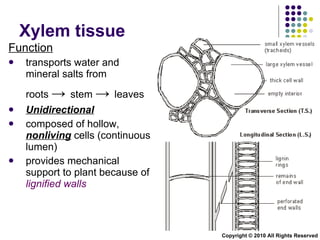
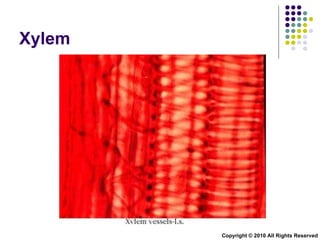
Xylem tissue Function transports water and mineral salts from  roots  ->   stem  ->   leaves Unidirectional composed of hollow,  nonliving  cells (continuous lumen) provides mechanical support to plant because of  lignified walls Copyright © 2010 All Rights Reserved
Xylem Copyright © 2010 All Rights Reserved
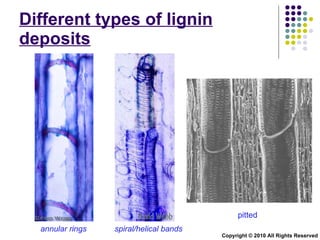
Different types of lignin deposits annular rings spiral/helical bands pitted Copyright © 2010 All Rights Reserved
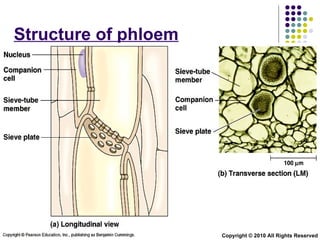
Phloem tissue Transports manufactured food (sucrose and amino acids),  usually  from   leaves  ->  other parts of the plant Bi-directional Consists mainly of  sieve tubes companion cells Copyright © 2010 All Rights Reserved
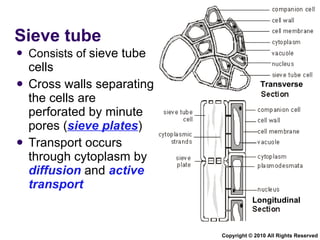
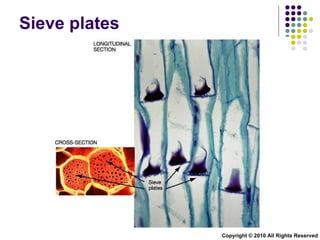
Sieve tube  Consists of  sieve tube cells Cross walls separating the cells are perforated by minute pores ( sieve plates ) Transport occurs through cytoplasm by  diffusion  and  active transport Copyright © 2010 All Rights Reserved Longitudinal Transverse
Sieve plates Copyright © 2010 All Rights Reserved
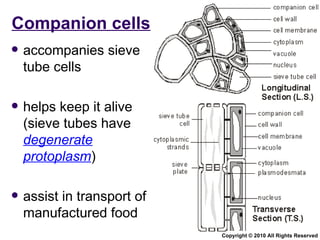
Companion cells accompanies sieve tube cells helps keep it alive (sieve tubes have  degenerate protoplasm ) assist in transport of manufactured food Copyright © 2010 All Rights Reserved
Structure of phloem Copyright © 2010 All Rights Reserved
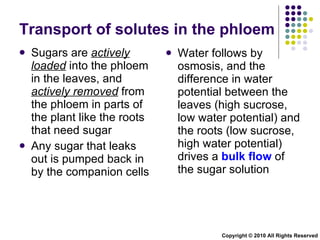
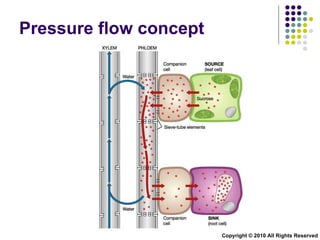
Transport of solutes in the phloem Sugars are  actively loaded  into the phloem in the leaves, and  actively removed  from the phloem in parts of the plant like the roots that need sugar Any sugar that leaks out is pumped back in by the companion cells Water follows by osmosis, and the difference in water potential between the leaves (high sucrose, low water potential) and the roots (low sucrose, high water potential) drives a  bulk flow  of the sugar solution Copyright © 2010 All Rights Reserved
Pressure flow concept Copyright © 2010 All Rights Reserved
Translocation studies Translocation : transport of a substance through a plant from the site of absorption to other parts of the plant  Copyright © 2010 All Rights Reserved
Lesson Objectives Translocation studies Structure of roots Transport of water and mineral salts into roots 3 mechanisms of xylem transport  Root pressure Capillary action Transpiration pull Copyright © 2010 All Rights Reserved
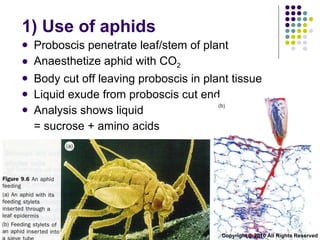
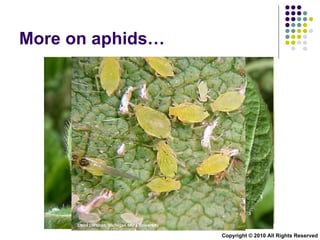
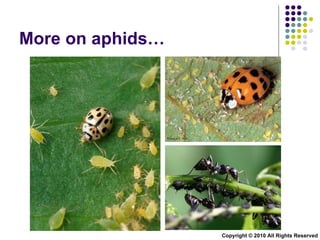
1) Use of aphids Proboscis penetrate leaf/stem of plant Anaesthetize aphid with CO 2 Body cut off leaving proboscis in plant tissue Liquid exude from proboscis cut end Analysis shows liquid  = sucrose + amino acids Copyright © 2010 All Rights Reserved
More on aphids…  Copyright © 2010 All Rights Reserved
More on aphids… Copyright © 2010 All Rights Reserved
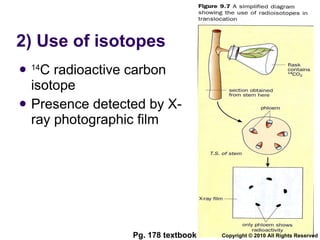
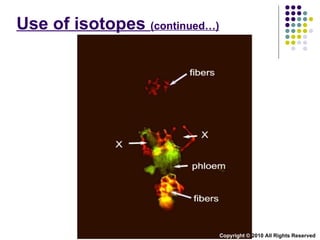
2) Use of isotopes 14 C radioactive carbon isotope  Presence detected by X-ray photographic film Pg. 178 textbook Copyright © 2010 All Rights Reserved
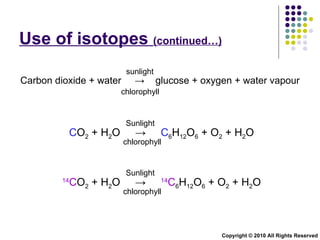
Use of isotopes  (continued…) Copyright © 2010 All Rights Reserved sunlight chlorophyll Carbon dioxide + water  ->  glucose + oxygen + water vapour C O 2  + H 2 O  ->  C 6 H 12 O 6  + O 2  +  H 2 O   Sunlight  chlorophyll  14 C O 2  + H 2 O  ->  14 C 6 H 12 O 6  + O 2  +  H 2 O   Sunlight  chlorophyll
Use of isotopes  (continued…) Copyright ©  2010 All Rights Reserved
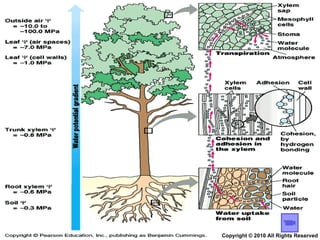
Transport of water Copyright © 2010 All Rights Reserved
Copyright © 2010 All Rights Reserved
Structure of root Copyright © 2010 All Rights Reserved
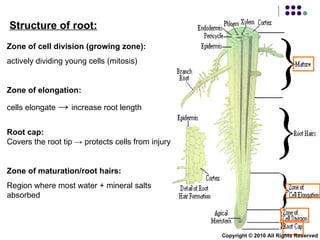
Structure of root: Zone of cell division (growing zone):   actively dividing young cells (mitosis) Zone of elongation:   cells elongate  ->  increase root length Root cap: Covers the root tip  -> protects cells from injury Zone of maturation/root hairs: Region where most water + mineral salts absorbed Copyright © 2010 All Rights Reserved
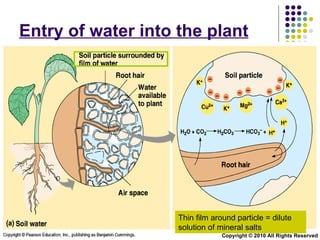
Entry of water into the plant Thin film around particle = dilute solution of mineral salts Copyright © 2010 All Rights Reserved
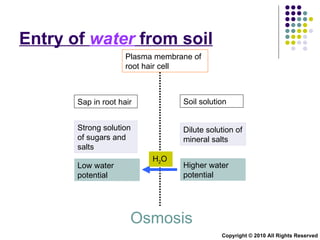
Entry of  water  from soil Plasma membrane of root hair cell Osmosis Copyright © 2010 All Rights Reserved Sap in root hair Soil solution Strong solution of sugars and salts Dilute solution of mineral salts Low water potential Higher water potential H 2 O
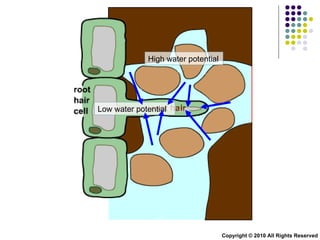
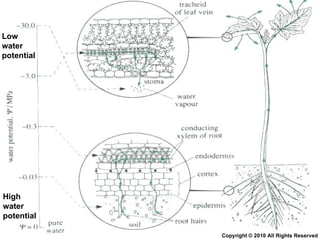
Low water potential High water potential Copyright © 2010 All Rights Reserved
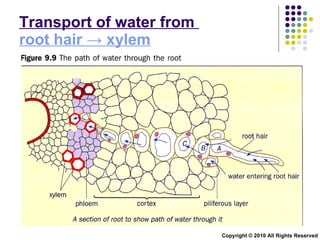
Transport of water from  root hair  ->  xylem Copyright © 2010 All Rights Reserved
Transport of mineral salts Copyright © 2010 All Rights Reserved
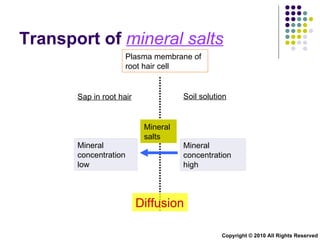
Transport of  mineral salts Plasma membrane of root hair cell Diffusion Copyright © 2010 All Rights Reserved Sap in root hair Soil solution Mineral concentration low Mineral concentration high Mineral salts
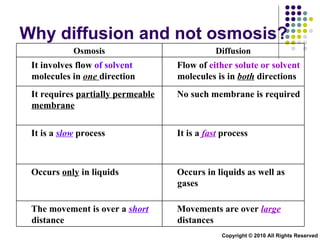
Why diffusion and not osmosis? Copyright © 2010 All Rights Reserved Movements are over  large   distances The movement is over a  short   distance Occurs in liquids as well as gases Occurs  only  in liquids It is a  fast   process It is a  slow  process No such membrane is required It requires  partially permeable membrane Flow of  either solute or solvent  molecules is in  both  directions It involves flow  of solvent  molecules in  one  direction Diffusion Osmosis
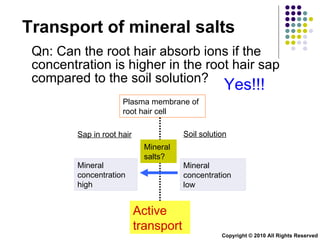
Qn: Can the root hair absorb ions if the concentration is higher in the root hair sap compared to the soil solution?  Transport of mineral salts Active transport Yes!!! Copyright © 2010 All Rights Reserved Sap in root hair Soil solution Plasma membrane of root hair cell Mineral concentration high Mineral concentration low Mineral salts?
High water potential Low water potential Copyright © 2010 All Rights Reserved

Chapter 9 Transport in Plants Lesson 2 - Xylem and Phloem structure and function

  • 1.
    Vascular tissues Xylem Phloem Copyright © 2010 All Rights Reserved
  • 2.
    Copyright © 2010All Rights Reserved
  • 3.
    Xylem tissue Functiontransports water and mineral salts from roots -> stem -> leaves Unidirectional composed of hollow, nonliving cells (continuous lumen) provides mechanical support to plant because of lignified walls Copyright © 2010 All Rights Reserved
  • 4.
    Xylem Copyright ©2010 All Rights Reserved
  • 5.
    Different types oflignin deposits annular rings spiral/helical bands pitted Copyright © 2010 All Rights Reserved
  • 6.
    Phloem tissue Transportsmanufactured food (sucrose and amino acids), usually from leaves -> other parts of the plant Bi-directional Consists mainly of sieve tubes companion cells Copyright © 2010 All Rights Reserved
  • 7.
    Sieve tube Consists of sieve tube cells Cross walls separating the cells are perforated by minute pores ( sieve plates ) Transport occurs through cytoplasm by diffusion and active transport Copyright © 2010 All Rights Reserved Longitudinal Transverse
  • 8.
    Sieve plates Copyright© 2010 All Rights Reserved
  • 9.
    Companion cells accompaniessieve tube cells helps keep it alive (sieve tubes have degenerate protoplasm ) assist in transport of manufactured food Copyright © 2010 All Rights Reserved
  • 10.
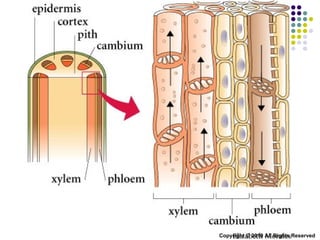
    Structure of phloemCopyright © 2010 All Rights Reserved
  • 11.
    Transport of solutesin the phloem Sugars are actively loaded into the phloem in the leaves, and actively removed from the phloem in parts of the plant like the roots that need sugar Any sugar that leaks out is pumped back in by the companion cells Water follows by osmosis, and the difference in water potential between the leaves (high sucrose, low water potential) and the roots (low sucrose, high water potential) drives a bulk flow of the sugar solution Copyright © 2010 All Rights Reserved
  • 12.
    Pressure flow conceptCopyright © 2010 All Rights Reserved
  • 13.
    Translocation studies Translocation: transport of a substance through a plant from the site of absorption to other parts of the plant Copyright © 2010 All Rights Reserved
  • 14.
    Lesson Objectives Translocationstudies Structure of roots Transport of water and mineral salts into roots 3 mechanisms of xylem transport Root pressure Capillary action Transpiration pull Copyright © 2010 All Rights Reserved
  • 15.
    1) Use ofaphids Proboscis penetrate leaf/stem of plant Anaesthetize aphid with CO 2 Body cut off leaving proboscis in plant tissue Liquid exude from proboscis cut end Analysis shows liquid = sucrose + amino acids Copyright © 2010 All Rights Reserved
  • 16.
    More on aphids… Copyright © 2010 All Rights Reserved
  • 17.
    More on aphids…Copyright © 2010 All Rights Reserved
  • 18.
    2) Use ofisotopes 14 C radioactive carbon isotope Presence detected by X-ray photographic film Pg. 178 textbook Copyright © 2010 All Rights Reserved
  • 19.
    Use of isotopes (continued…) Copyright © 2010 All Rights Reserved sunlight chlorophyll Carbon dioxide + water -> glucose + oxygen + water vapour C O 2 + H 2 O -> C 6 H 12 O 6 + O 2 + H 2 O Sunlight chlorophyll 14 C O 2 + H 2 O -> 14 C 6 H 12 O 6 + O 2 + H 2 O Sunlight chlorophyll
  • 20.
    Use of isotopes (continued…) Copyright © 2010 All Rights Reserved
  • 21.
    Transport of waterCopyright © 2010 All Rights Reserved
  • 22.
    Copyright © 2010All Rights Reserved
  • 23.
    Structure of rootCopyright © 2010 All Rights Reserved
  • 24.
    Structure of root:Zone of cell division (growing zone): actively dividing young cells (mitosis) Zone of elongation: cells elongate -> increase root length Root cap: Covers the root tip -> protects cells from injury Zone of maturation/root hairs: Region where most water + mineral salts absorbed Copyright © 2010 All Rights Reserved
  • 25.
    Entry of waterinto the plant Thin film around particle = dilute solution of mineral salts Copyright © 2010 All Rights Reserved
  • 26.
    Entry of water from soil Plasma membrane of root hair cell Osmosis Copyright © 2010 All Rights Reserved Sap in root hair Soil solution Strong solution of sugars and salts Dilute solution of mineral salts Low water potential Higher water potential H 2 O
  • 27.
    Low water potentialHigh water potential Copyright © 2010 All Rights Reserved
  • 28.
    Transport of waterfrom root hair -> xylem Copyright © 2010 All Rights Reserved
  • 29.
    Transport of mineralsalts Copyright © 2010 All Rights Reserved
  • 30.
    Transport of mineral salts Plasma membrane of root hair cell Diffusion Copyright © 2010 All Rights Reserved Sap in root hair Soil solution Mineral concentration low Mineral concentration high Mineral salts
  • 31.
    Why diffusion andnot osmosis? Copyright © 2010 All Rights Reserved Movements are over large distances The movement is over a short distance Occurs in liquids as well as gases Occurs only in liquids It is a fast process It is a slow process No such membrane is required It requires partially permeable membrane Flow of either solute or solvent molecules is in both directions It involves flow of solvent molecules in one direction Diffusion Osmosis
  • 32.
    Qn: Can theroot hair absorb ions if the concentration is higher in the root hair sap compared to the soil solution? Transport of mineral salts Active transport Yes!!! Copyright © 2010 All Rights Reserved Sap in root hair Soil solution Plasma membrane of root hair cell Mineral concentration high Mineral concentration low Mineral salts?
  • 33.
    High water potentialLow water potential Copyright © 2010 All Rights Reserved

Editor's Notes

  • #12 Transport of sugars and dissolved solutes in the phloem is kind of like water movement in the xylem in reverse. Sugars are actively pumped into the phloem sieve tube cells in the leaf. Thus the solute potential increases, making the water potential of the sieve tube cell more negative and water is drawn in from surrounding cells. In the root (and other tissues actively abstracting sugars), sugars are removed, lowering the water potential. This difference in water potential between the leaves which are actively uploading sugars, and the roots and other tissues actively removing them drives a bulk flow of water in the phloem with the sugars and other dissolved solutes. In the leaves, the concentration of sucrose in the sieve tube cells can reach as much a 1molar. This is equivalent to 10 atmospheres of pressure which can drive a bulk flow of water and sugars through the sieve tubes.