By iTutor.com
 T- 1-855-694-8886
Email- info@iTutor.com
What are bacteria?
   Bacteria are among the smallest
    living organisms.
   They usually band together in
    colonies.
   Bacteria can be autotrophic,                E. Coli O157:H7
                                                can make you
    make their own food
                                                very sick.
               or
    heterotrophic, feed off of other
    organisms.


                                       This E. coli helps you digest
                                                   food.
Characteristics of Bacteria
   Three basic shapes
       Rod shaped called bacilli (buh-sill-eye)
       Round shaped called cocci (cox-eye)
                                                   Bacilli
       Spiral shaped


                           Spiral


                                                    Cocci
Structure of Bacteria
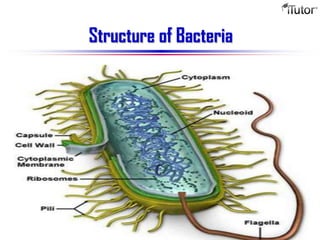
 Bacteria have these features:
     Cell wall
        resists osmotic pressure
     Flagella
        movement
     Pili
        Attachment
     Capsule
        protection and biofilms
Structure of Bacteria
   Cell Wall made of Peptidoglycan
   May have a sticky coating called the Capsule for attachment to host or
    other bacteria
   Have small rings of DNA called Plasmids Unicellular
   Small in size (0.5 to 2μm)
Structure of Bacteria
Capsule


 Some bacteria (often pathogens) are surrounded by a
  thick polysaccharide capsule.
 This is a loose jelly-like or mucus-like layer.
 It helps prevent immune system cells from reaching the
  bacteria, and it forms part of biofilms.
Structure of Bacteria


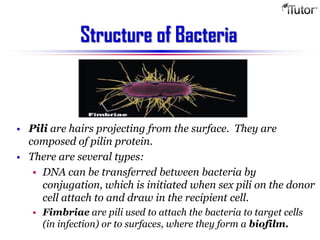
   Pili are hairs projecting from the surface. They are
    composed of pilin protein.
   There are several types:
      DNA can be transferred between bacteria by
       conjugation, which is initiated when sex pili on the donor
       cell attach to and draw in the recipient cell.
       Fimbriae are pili used to attach the bacteria to target cells
        (in infection) or to surfaces, where they form a biofilm.
Structure of Bacteria

                    Flagella


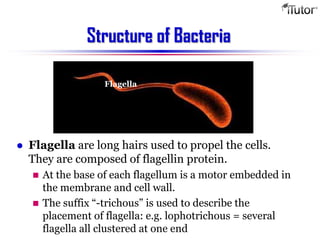
   Flagella are long hairs used to propel the cells.
    They are composed of flagellin protein.
       At the base of each flagellum is a motor embedded in
        the membrane and cell wall.
       The suffix “-trichous” is used to describe the
        placement of flagella: e.g. lophotrichous = several
        flagella all clustered at one end
Structure of Bacteria


   Chemotaxis: Bacteria move toward the source of
    nutrients by swimming up the chemical gradient.
      When moving up the gradient, bacteria rarely tumble,
       but when moving across it, or in the opposite direction,
       tumbling is frequent.
      This produces a net motion in the proper direction.
Structure of Bacteria

Spores


   Some bacteria can form very tough spores, which are
    metabolically inactive and can survive a long time under very
    harsh conditions.
      Allegedly, some bacterial spores that were embedded in
       amber.
      Panspermia: the idea that life got started on Earth due
       to bacterial spores that drifted in from another solar.
     Spores survive very high or low temperatures.
Movement and feeding
   Bacteria get around in
    many ways.
     Some bacteria move using
      flagella.
     Others have a slimy layer to
      grip surfaces.
     Some are carried by the
      movement of air or liquids.


                   .
Movement and feeding
   Photosynthetic bacteria can
    make their own food from
    sunlight and carbon dioxide, just
    like plants.
   Bacteria that break down dead
    organisms get their food by
    absorbing it.


                                           These blue green
                                        bacteria use sunlight to
                                              make food.
The importance of bacteria

   Bacteria are useful in many
    areas of industry.
       Yogurt and cheese are made
        with certain types of bacteria.
       Bacteria break down waste
        products in sewage.
       Bacteria can help clean up oil
        spills.
The importance of bacteria

   Bacteria are an
    important part of
    the nutrient cycles
    that all life depends
    upon.
The importance of bacteria
   Bacteria are “nature’s recyclers.”
Harmful effects of bacteria
   Certain bacteria act as pathogens and cause tetanus,
    typhoid fever, pneumonia, syphilis, cholera,
    food-borne illness and tuberculosis.
   Streptococcus bacteria may cause small infections
    like strep throat and some serious diseases like
    pneumonia.
   Some of the stomach bacteria enter the body through
    the mouth, and they can survive in the acidic conditions
    in the stomach.
Harmful effects of bacteria


                          Acidic condition
   Typhoid fever
Harmful effects of bacteria
   Campylobacter is a group of bacteria that can create
    illnesses in humans and is a common cause of food
    poisoning.
   Harmful bacteria in food cause botulism, which can
    cause paralysis or even death if even one-millionth of
    the bacterium is ingested.
   Yersinia pestis or bubonic plague, is a rod-shaped
    type of bacterium which is well-known for its harmful
    nature.
Harmful effects of bacteria
   Bacteria-carrying fleas
    found on animals such as
    rats and mice transmit the
    bacteria that are believed to
    have caused the deaths of
    millions of people in human
    history.
   Antibiotics are widely used
    to kill harmful bacteria.
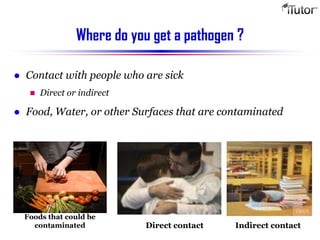
Where do you get a pathogen ?

   Contact with people who are sick
        Direct or indirect

   Food, Water, or other Surfaces that are contaminated


    Foods that could be
      contaminated            Direct contact   Indirect contact
Where do you get a pathogen?

                               Direct
                              Contact

Indirect
Contact


            Foods and water
                may be
             contaminated
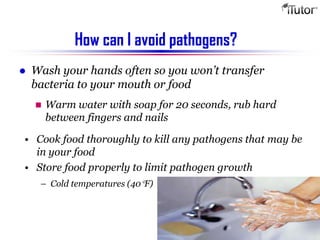
How can I avoid pathogens?
   Wash your hands often so you won’t transfer
    bacteria to your mouth or food
       Warm water with soap for 20 seconds, rub hard
        between fingers and nails

• Cook food thoroughly to kill any pathogens that may be
  in your food
• Store food properly to limit pathogen growth
     – Cold temperatures (40F)
www.iTutor.com


            The End

Bacteria

  • 1.
    By iTutor.com T-1-855-694-8886 Email- info@iTutor.com
  • 2.
    What are bacteria?  Bacteria are among the smallest living organisms.  They usually band together in colonies.  Bacteria can be autotrophic, E. Coli O157:H7 can make you make their own food very sick. or heterotrophic, feed off of other organisms. This E. coli helps you digest food.
  • 3.
    Characteristics of Bacteria  Three basic shapes  Rod shaped called bacilli (buh-sill-eye)  Round shaped called cocci (cox-eye) Bacilli  Spiral shaped Spiral Cocci
  • 4.
    Structure of Bacteria Bacteria have these features:  Cell wall  resists osmotic pressure  Flagella  movement  Pili  Attachment  Capsule  protection and biofilms
  • 5.
  • 6.
    Structure of Bacteria  Cell Wall made of Peptidoglycan  May have a sticky coating called the Capsule for attachment to host or other bacteria  Have small rings of DNA called Plasmids Unicellular  Small in size (0.5 to 2μm)
  • 7.
    Structure of Bacteria Capsule Some bacteria (often pathogens) are surrounded by a thick polysaccharide capsule.  This is a loose jelly-like or mucus-like layer.  It helps prevent immune system cells from reaching the bacteria, and it forms part of biofilms.
  • 8.
    Structure of Bacteria  Pili are hairs projecting from the surface. They are composed of pilin protein.  There are several types:  DNA can be transferred between bacteria by conjugation, which is initiated when sex pili on the donor cell attach to and draw in the recipient cell.  Fimbriae are pili used to attach the bacteria to target cells (in infection) or to surfaces, where they form a biofilm.
  • 9.
    Structure of Bacteria Flagella  Flagella are long hairs used to propel the cells. They are composed of flagellin protein.  At the base of each flagellum is a motor embedded in the membrane and cell wall.  The suffix “-trichous” is used to describe the placement of flagella: e.g. lophotrichous = several flagella all clustered at one end
  • 10.
    Structure of Bacteria  Chemotaxis: Bacteria move toward the source of nutrients by swimming up the chemical gradient.  When moving up the gradient, bacteria rarely tumble, but when moving across it, or in the opposite direction, tumbling is frequent.  This produces a net motion in the proper direction.
  • 11.
    Structure of Bacteria Spores  Some bacteria can form very tough spores, which are metabolically inactive and can survive a long time under very harsh conditions.  Allegedly, some bacterial spores that were embedded in amber.  Panspermia: the idea that life got started on Earth due to bacterial spores that drifted in from another solar.  Spores survive very high or low temperatures.
  • 12.
    Movement and feeding  Bacteria get around in many ways.  Some bacteria move using flagella.  Others have a slimy layer to grip surfaces.  Some are carried by the movement of air or liquids. .
  • 13.
    Movement and feeding  Photosynthetic bacteria can make their own food from sunlight and carbon dioxide, just like plants.  Bacteria that break down dead organisms get their food by absorbing it. These blue green bacteria use sunlight to make food.
  • 14.
    The importance ofbacteria  Bacteria are useful in many areas of industry.  Yogurt and cheese are made with certain types of bacteria.  Bacteria break down waste products in sewage.  Bacteria can help clean up oil spills.
  • 15.
    The importance ofbacteria  Bacteria are an important part of the nutrient cycles that all life depends upon.
  • 16.
    The importance ofbacteria  Bacteria are “nature’s recyclers.”
  • 17.
    Harmful effects ofbacteria  Certain bacteria act as pathogens and cause tetanus, typhoid fever, pneumonia, syphilis, cholera, food-borne illness and tuberculosis.  Streptococcus bacteria may cause small infections like strep throat and some serious diseases like pneumonia.  Some of the stomach bacteria enter the body through the mouth, and they can survive in the acidic conditions in the stomach.
  • 18.
    Harmful effects ofbacteria Acidic condition Typhoid fever
  • 19.
    Harmful effects ofbacteria  Campylobacter is a group of bacteria that can create illnesses in humans and is a common cause of food poisoning.  Harmful bacteria in food cause botulism, which can cause paralysis or even death if even one-millionth of the bacterium is ingested.  Yersinia pestis or bubonic plague, is a rod-shaped type of bacterium which is well-known for its harmful nature.
  • 20.
    Harmful effects ofbacteria  Bacteria-carrying fleas found on animals such as rats and mice transmit the bacteria that are believed to have caused the deaths of millions of people in human history.  Antibiotics are widely used to kill harmful bacteria.
  • 21.
    Where do youget a pathogen ?  Contact with people who are sick  Direct or indirect  Food, Water, or other Surfaces that are contaminated Foods that could be contaminated Direct contact Indirect contact
  • 22.
    Where do youget a pathogen? Direct Contact Indirect Contact Foods and water may be contaminated
  • 23.
    How can Iavoid pathogens?  Wash your hands often so you won’t transfer bacteria to your mouth or food  Warm water with soap for 20 seconds, rub hard between fingers and nails • Cook food thoroughly to kill any pathogens that may be in your food • Store food properly to limit pathogen growth – Cold temperatures (40F)
  • 24.