Interpreting Geophysical Well Logs
Hassan Harraz
hharraz2016@yahoo.com
Lecture items
Historical Aspect
Types of Logs
a) Gamma Ray
b) Sonic
c) Density/Neutron
d) Caliper
e) SP (spontaneous potential)
f) Resistivity (Induction)
Self Potential Log
* Theory of measurement.
-Shale-base line& Sand line
-SSP, PSP and SP log readings
* Factors affecting on log readings.
* Applications.
-Resistivity Logs
* Definition.
* Types
* Units& Presentation.
* Theories of measurement.
* Factors affecting on log readings.
* Applications.
2
Historical Aspect
 Schlumberger brothers, Conrad and Marcel, are credited
with inventing electrical well-logs.
 On September 5, 1927, the first “well-log” was created in a
small village named Pechelbroon in France.
 In 1931, the first SP (spontaneous potential) log was
recorded. Discovered when the galvanometer began
“wiggling” even though no current was being applied.
 The SP effect was produced naturally by the borehole mud
at the boundaries of permeable beds. By simultaneously
recording SP and resistivity, loggers could distinguish
between permeable oil-bearing beds and impermeable
nonproducing beds.
3
Types of Logs
a) Gamma Ray
b) Sonic
c) Density/Neutron
d) Caliper
e) SP (spontaneous potential)
f) Resistivity (Induction)
4
Well Logging
Is a technique used for formation evaluation
to determine the size of the reservoir and the
amount of oil and gas in place.
The following parameters can be estimated
from different types of logging tools:
1)Borehole Hole Diameter.
2)Reservoir Thickness.
3)Porosity.
4)Water Saturation.
5)Rock Type (Lithology).
5
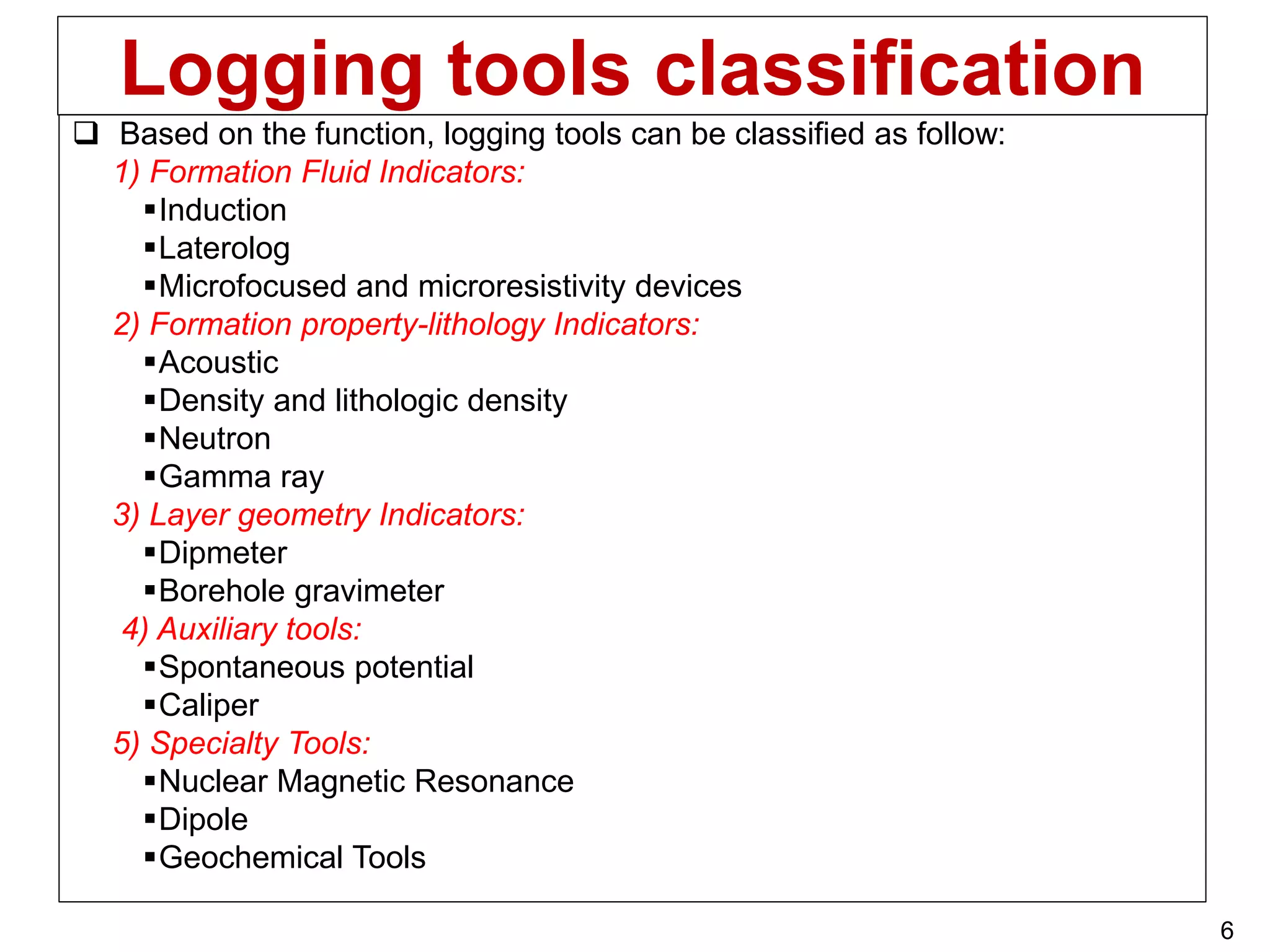
Logging tools classification
 Based on the function, logging tools can be classified as follow:
1) Formation Fluid Indicators:
▪Induction
▪Laterolog
▪Microfocused and microresistivity devices
2) Formation property-lithology Indicators:
▪Acoustic
▪Density and lithologic density
▪Neutron
▪Gamma ray
3) Layer geometry Indicators:
▪Dipmeter
▪Borehole gravimeter
4) Auxiliary tools:
▪Spontaneous potential
▪Caliper
5) Specialty Tools:
▪Nuclear Magnetic Resonance
▪Dipole
▪Geochemical Tools
6
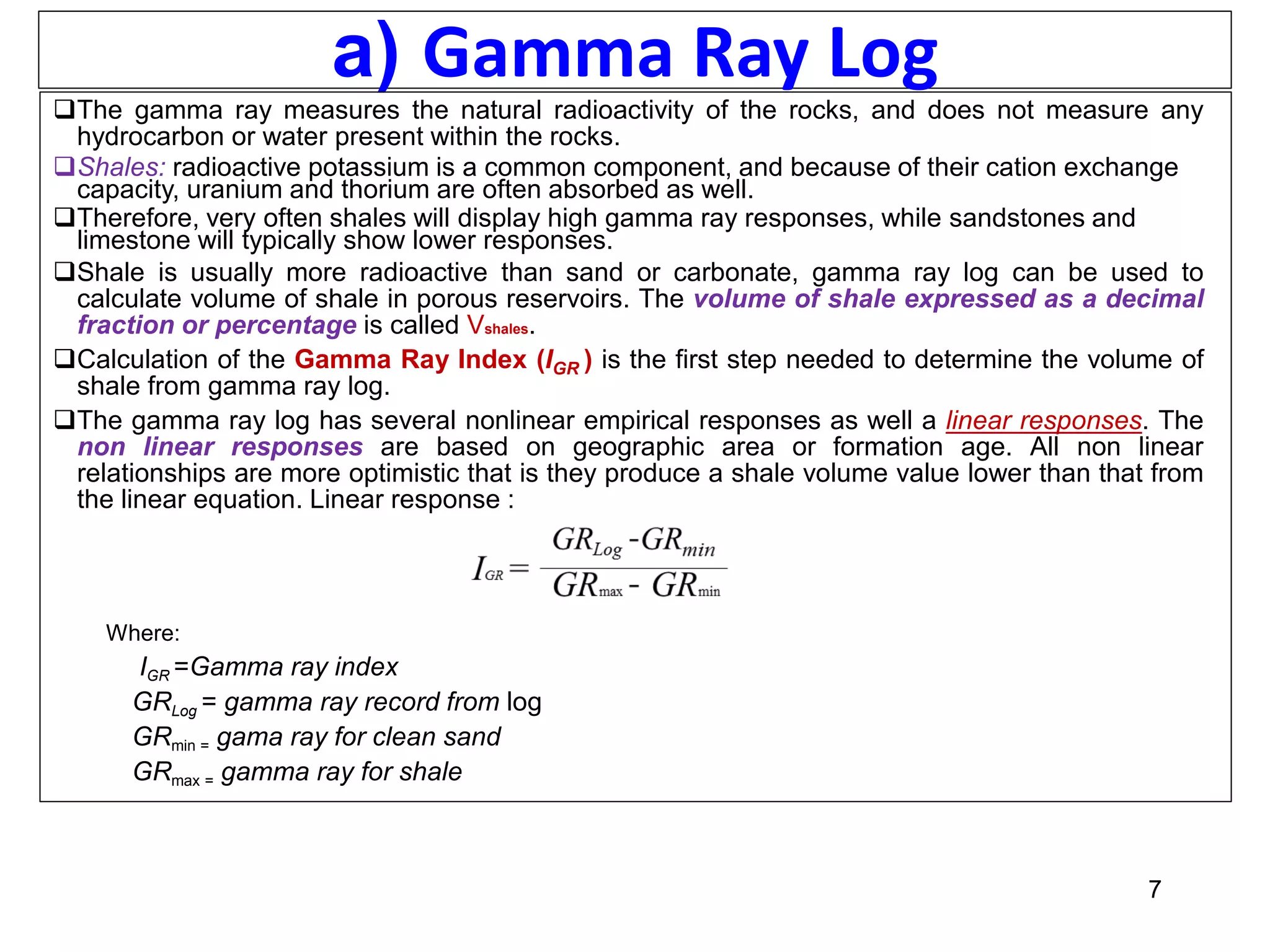
a) Gamma Ray Log
The gamma ray measures the natural radioactivity of the rocks, and does not measure any
hydrocarbon or water present within the rocks.
Shales: radioactive potassium is a common component, and because of their cation exchange
capacity, uranium and thorium are often absorbed as well.
Therefore, very often shales will display high gamma ray responses, while sandstones and
limestone will typically show lower responses.
Shale is usually more radioactive than sand or carbonate, gamma ray log can be used to
calculate volume of shale in porous reservoirs. The volume of shale expressed as a decimal
fraction or percentage is called Vshales.
Calculation of the Gamma Ray Index (IGR ) is the first step needed to determine the volume of
shale from gamma ray log.
The gamma ray log has several nonlinear empirical responses as well a linear responses. The
non linear responses are based on geographic area or formation age. All non linear
relationships are more optimistic that is they produce a shale volume value lower than that from
the linear equation. Linear response :
Where:
IGR =Gamma ray index
GRLog = gamma ray record from log
GRmin = gama ray for clean sand
GRmax = gamma ray for shale
7
a) Gamma Ray
8
The scale for GR is in
API (American
Petroleum Institute) and
runs from 0-125
units There are
often 10 divisions in a
GR log, so each
division represents 12.5
units.
Typical distinction
between a
sandstone/limestone
and shale occurs
between 50-60 units.
Often, very clean
sandstones or
carbonates will display
values within the 20
units range.
a) Gamma Ray
➢For very hard compacted formation at depth of 8,000 ft
or more, gamma ray index is considered equal to shale
volume:
Vsh = IGR
➢For tertiary sediment rocks at depth of less than 4,000
ft, the shale volume is:
Vsh = 0.083(23.7I
GR
-1)
➢For older rocks at depth of 4,000-8,000 ft, the shale
volume is:
Vsh = 0.33(22I
GR
-1)
9
d) Caliper Log Caliper Logs record the diameter of the hole. It is very useful in relaying information about the quality of the
hole and hence reliability of the other logs.
 An example includes a large hole where dissolution, caving or falling of the rock wall occurred, leading to
errors in other log responses.
 Most caliper logs are run with GR logs and typically will remain constant throughout.
 Borehole geometry is controlled by:
➢ Lithology
➢ Mud type
➢ Formation Properties
➢ In-situ stresses
 Borehole size can be determined from caliper log. Caliper log can be an indication to one of the following
cases:
1) Gauged hole: diameter of hole is about equal to the bit size Hard well consolidated and impermeable formation.
borehole diameter = drill bit size
2) Increased borehole diameter which means:
a) Washout: general drilling wear, especially in shaly zones and dipping beds, both caliper larger than bit
size, considerable vertical extent .
b) Keyseat: asymmetric oval holes, formed by wear against the drill string at points where the borehole
inclination changes (doglegs) .
c) Breakout: similar to keyseat but not due to doglegs, small brittle fractures due to existing stress regime of
the country rock.
Unconsolidated formation borehole diameter > drill bit size
3)Decreased borehole diameter means:
a) Generally due to formation of mud cake
Mud cake thickness = (bit size diameter – caliper diameter reading)/2
b) mud cake formation indicates permeability and involves loss of mud filtrate into a permeable
formation – invasion
Permeable formation borehole diameter < drill bit size
10
b) Sonic (or Acoustic) Log
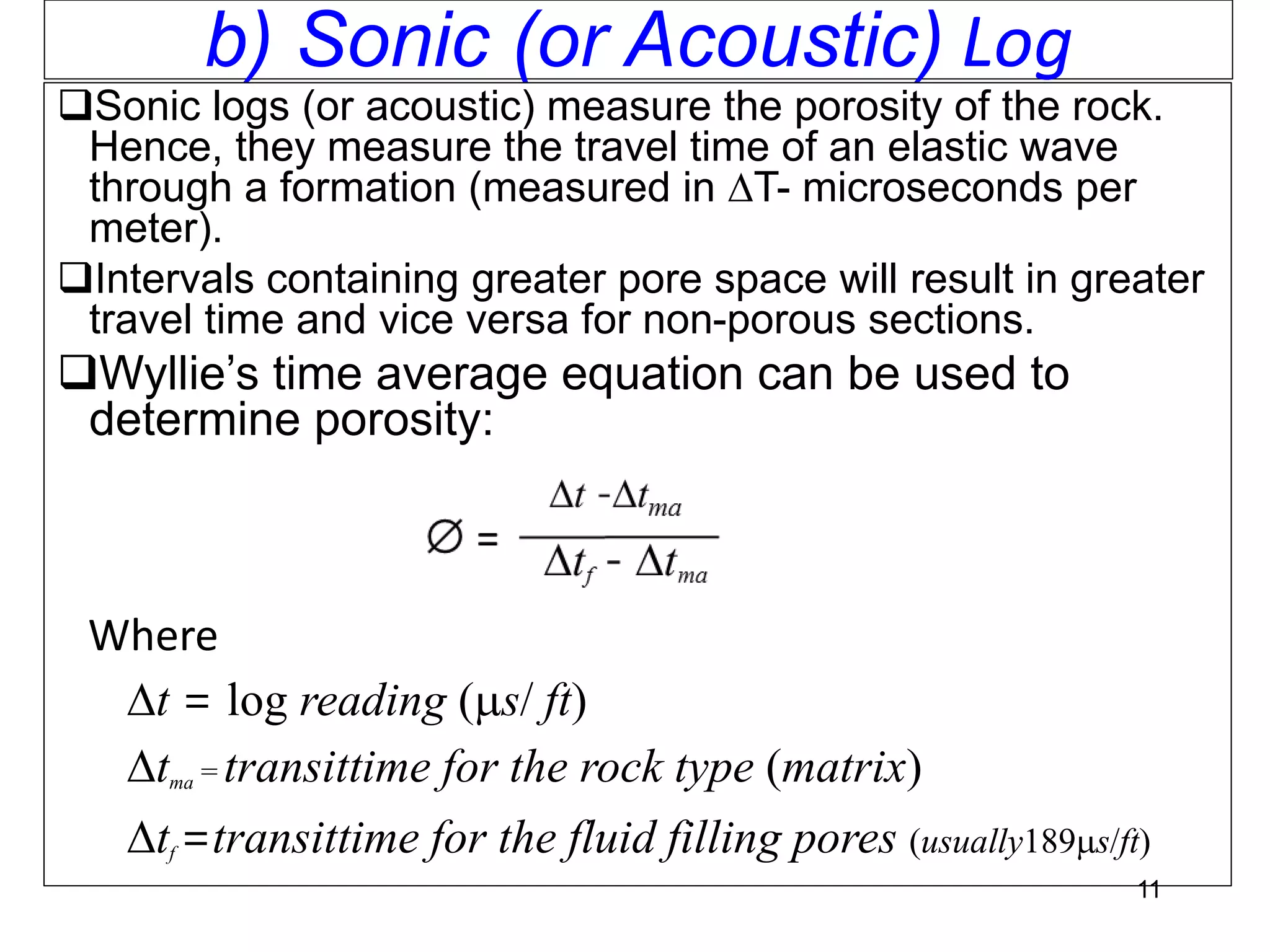
Sonic logs (or acoustic) measure the porosity of the rock.
Hence, they measure the travel time of an elastic wave
through a formation (measured in ∆T- microseconds per
meter).
Intervals containing greater pore space will result in greater
travel time and vice versa for non-porous sections.
Wyllie’s time average equation can be used to
determine porosity:
Where
t = log reading (s/ ft)
tma = transittime for the rock type (matrix)
tf =transittime for the fluid filling pores (usually189s/ft)
11
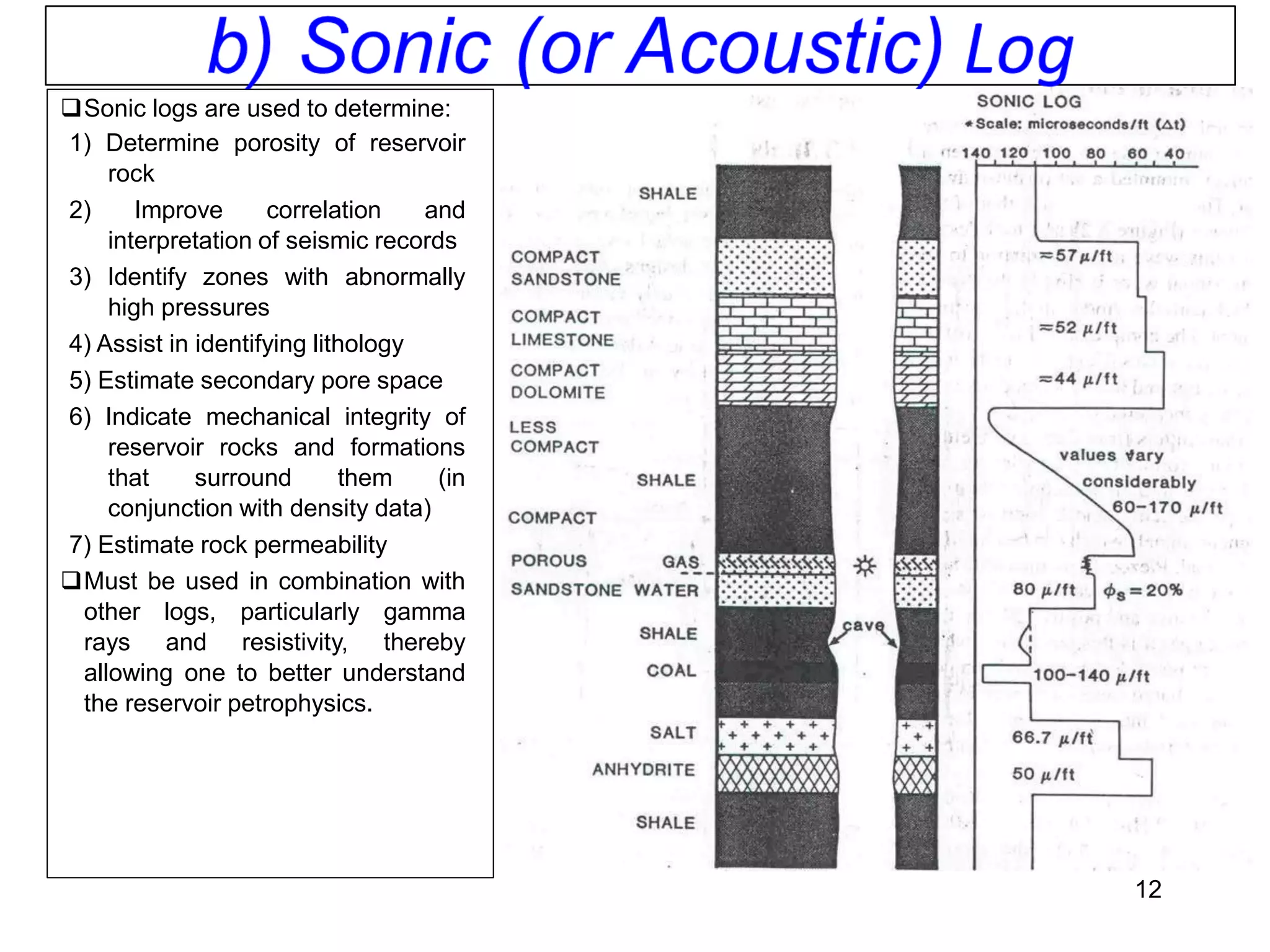
Sonic logs are used to determine:
1) Determine porosity of reservoir
rock
2) Improve correlation and
interpretation of seismic records
3) Identify zones with abnormally
high pressures
4) Assist in identifying lithology
5) Estimate secondary pore space
6) Indicate mechanical integrity of
reservoir rocks and formations
that surround them (in
conjunction with density data)
7) Estimate rock permeability
Must be used in combination with
other logs, particularly gamma
rays and resistivity, thereby
allowing one to better understand
the reservoir petrophysics.
12
HW
Q.8:
From the gamma ray log, the record is 200 API, gamma ray
for shale zone is 120 API and gamma ray for clean sand is 40
API. Calculate the gamma ray index and shale volume if the
rocks at depth 3,500 ft and 7,500 ft.
Q.9:
Sonic log reading t=100s/ft, tma = 80s/ft, tf
=190s/ft. Calculate porosity.
13
QuickTime™ and a
decompressor
are needed to see this picture.
QuickTime™ and a
decompressor
are needed to see this picture.
QuickTime™anda
decompressor
areneededtoseethis picture.
QuickTime™ and a
decompressor
are needed to see this picture.
c) Density Log
 The density log belongs to the group of active nuclear tools, which contains a
radioactive source and two detectors. The Gamma Ray tool, which is a passive
nuclear tool, contains no source and can only measure the natural radiation in
the formation. The radioactive source is applied to the wellbore wall in a
shielded sidewall skid and emits medium gamma rays into the formation. The
gamma ray waves may be thought of as energy particles. As these energy
particles (photons) collide with the electrons in the formation, the gamma ray
loses some of its energy to the electron. This is called Compton scattering. The
denser the formation, the more electrons are presented, and more energy is
lost due to collisions. If the matrix density is known, then the energy loss is
directly related to porosity.
 Density logs measure the bulk electron density of the formation, and is
measured in kilograms per cubic meter (gm/cm3 or kg/m3).
 Thus, the density tool emits gamma radiation which is scattered back to a
detector in amounts proportional to the electron density of the formation. The
higher the gamma ray reflected, the greater the porosity of the rock.
 Electron density is directly related to the density of the formation (except in
evaporates) and amount of density of interstitial fluids.
 Helpful in distinguishing lithologies, especially between dolomite (2.85 kg/m3)
and limestone (2.71 kg/m3).
17
c) Density Log
18
c) Density Log
19
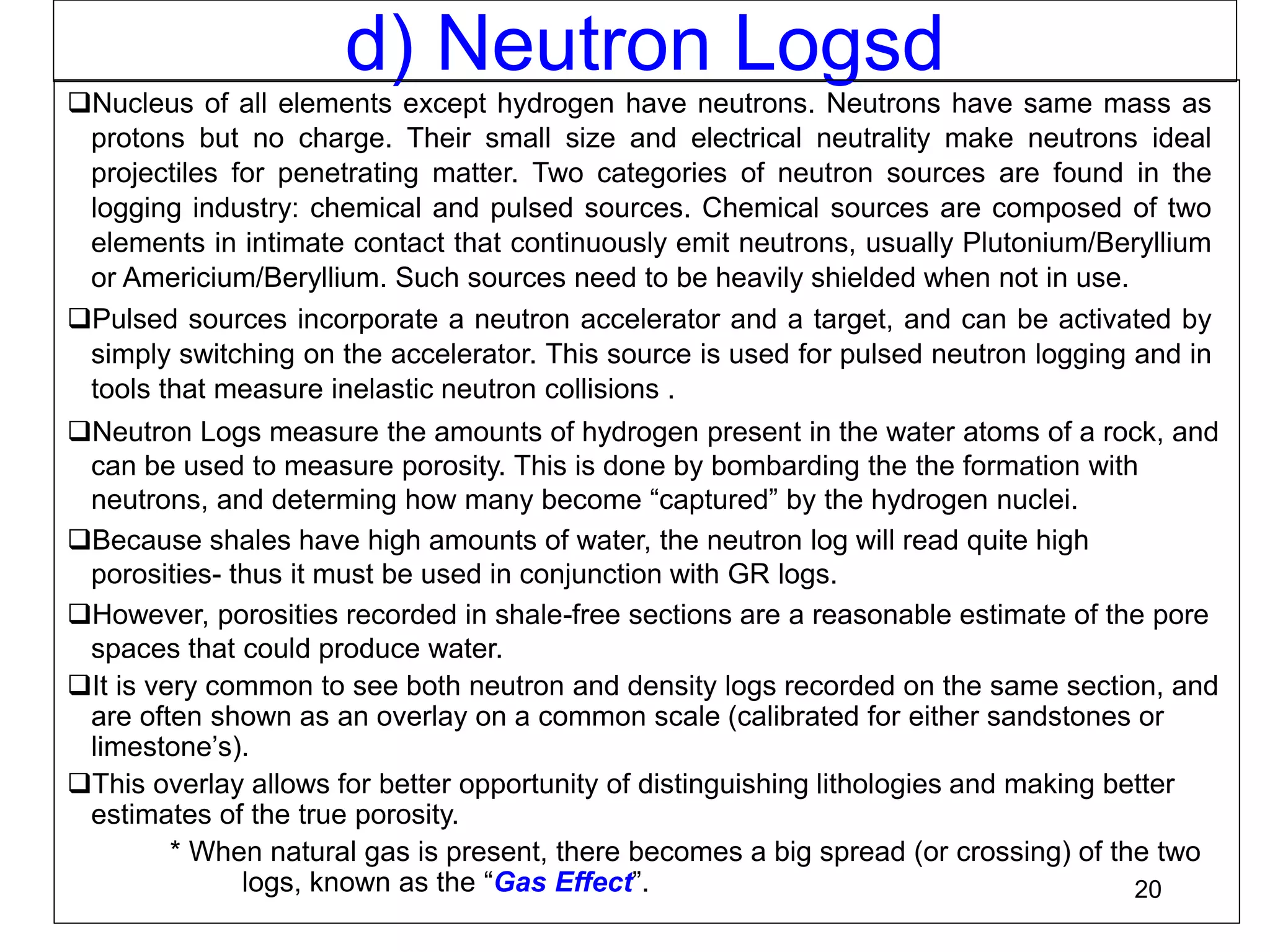
d) Neutron Logsd
Nucleus of all elements except hydrogen have neutrons. Neutrons have same mass as
protons but no charge. Their small size and electrical neutrality make neutrons ideal
projectiles for penetrating matter. Two categories of neutron sources are found in the
logging industry: chemical and pulsed sources. Chemical sources are composed of two
elements in intimate contact that continuously emit neutrons, usually Plutonium/Beryllium
or Americium/Beryllium. Such sources need to be heavily shielded when not in use.
Pulsed sources incorporate a neutron accelerator and a target, and can be activated by
simply switching on the accelerator. This source is used for pulsed neutron logging and in
tools that measure inelastic neutron collisions .
Neutron Logs measure the amounts of hydrogen present in the water atoms of a rock, and
can be used to measure porosity. This is done by bombarding the the formation with
neutrons, and determing how many become “captured” by the hydrogen nuclei.
Because shales have high amounts of water, the neutron log will read quite high
porosities- thus it must be used in conjunction with GR logs.
However, porosities recorded in shale-free sections are a reasonable estimate of the pore
spaces that could produce water.
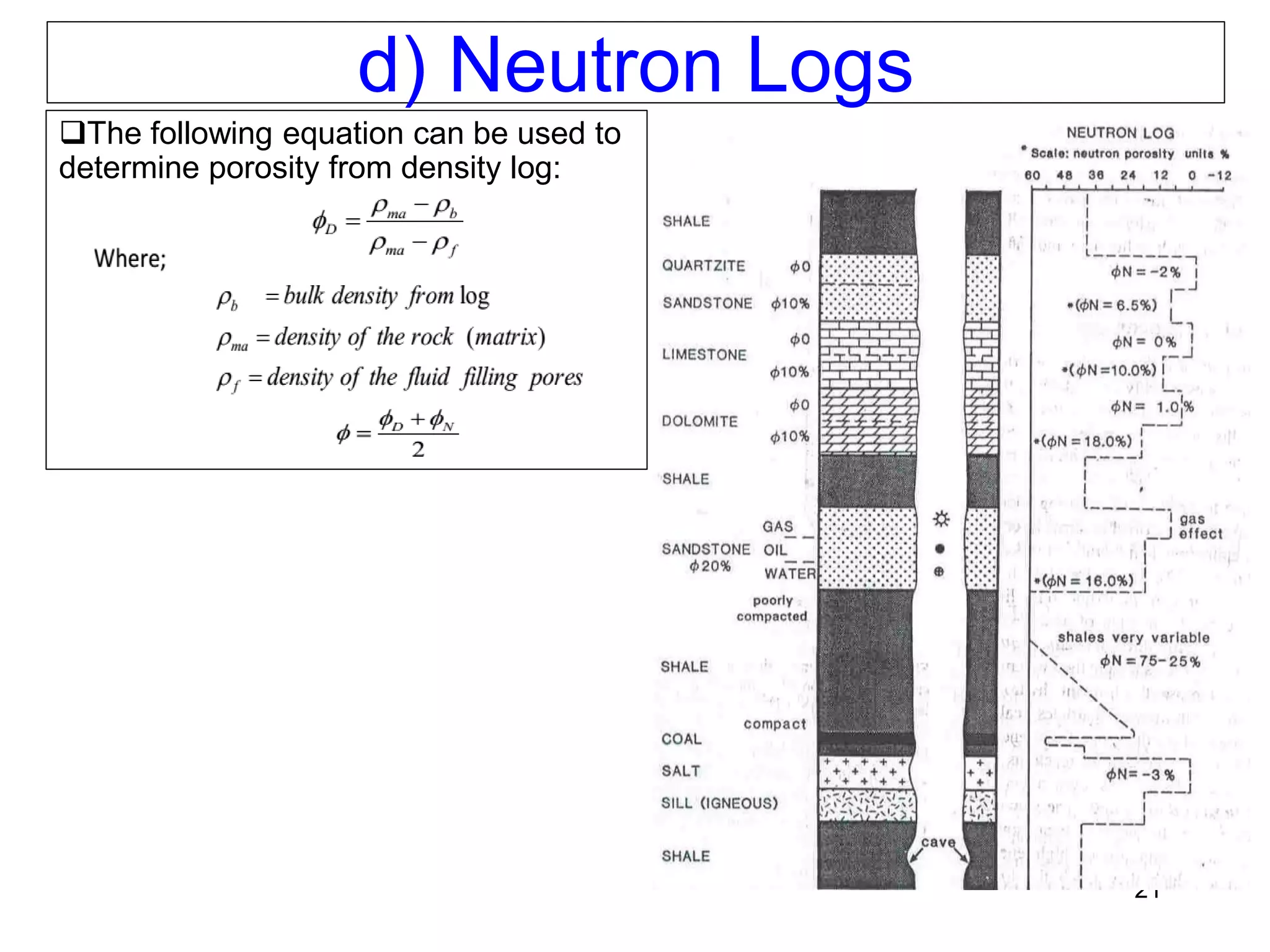
It is very common to see both neutron and density logs recorded on the same section, and
are often shown as an overlay on a common scale (calibrated for either sandstones or
limestone’s).
This overlay allows for better opportunity of distinguishing lithologies and making better
estimates of the true porosity.
* When natural gas is present, there becomes a big spread (or crossing) of the two
logs, known as the “Gas Effect”. 20
d) Neutron Logs
21
The following equation can be used to
determine porosity from density log:
HW
Q.10 :
The bulk density reading from density log is (2.2 gm/cc).
The density of matrix is (2.45 gm/cc) and fluid density is
(1.035 gm/cc). The density reading from neutron log is
(15%). Calculate formation density.
22
QuickTime™and a
decompressor
are needed to see this picture.
Example of dolomite overlying limestone, as
distinguished by the neutron/density.
QuickTime™ and a
decompressor
are needed to see this picture.
QuickTime™ and a
decompressor
are needed to see this picture.
QuickTime™ and a
decompressor
are needed to see this picture.
QuickTime™ and a
decompressor
are needed to see this picture.
QuickTime™ and a
decompressor
are needed to see this picture.
QuickTime™and a
decompressor
are needed to see this picture.
e) Resistivity Log
 Resistance is the opposition offered by a substance to the
passage of electric current. Resistivity is the resistance
measured between opposite faces of a unit cube of the
substance at specified temperature. Resistivity is measured in
ohm-meter2/meter, more commonly shortened to just ohm-
meter.
 Resistivity logs do not always measure resistivity directly.
➢ Some resistivity logs (actually induction logs) measures
conductivity instead which is the reciprocal of resistivity.
 Induction logs are used in wells drilled with a relatively fresh-
water mud (low salinity) to obtain more accurate value of true
resistivity.
30
e) Resistivity (Induction)
 Resistivity logs record the resistance of interstitial fluids to the flow of
an electric current, either transmitted directly to the rock through an
electrode, or magnetically induced deeper into the formation from the
hole.
 Therefore, the measure the ability of rocks to conduct electrical
currents and are scaled in units of ohm-meters.
 On most modern logs, there will be three curves, each measuring the
resistance of section to the flow of electricity.
 Porous formations filled with salt water (which is very common) have
very low resistivities (often only ranging from 1-10 ohms-meter).
 Formations that contain oil/gas generally have much higher
resisitivities (often ranging from 10-500 ohms-meter).
 With regards to the three lines, the one we are most interested in is
the one marked “deep”. This is because this curve looks into the
formation at a depth of six meters (or greater), thereby representing
the portion of the formation most unlikely undisturbed by the drilling
process.
 One must be careful of “extremely” high values, as they will often
represent zones of either anhydrite or other non-porous intervals.
31
The resistivity of a rock (R) is given by:
R = r (A / L)
Where:
r = resistance (ohms) = E / I
A = Cross sectional area (meters2)
L = Length (meters)
R = resistivity (ohm-meters)
E = Voltage (Volt)
I = current (Amp)
Factors that influence Resistivity of Natural
Porous Media:
1)Salinity of water
2)Porosity
3)Stress
4)Temperature
5)Pore geometry
6)Rock Composition
7)Wettability
32
Formation Water Resistivity (Rw):
 Formation water resistivity can vary widely from well to well. It can be estimated by the
following methods;
➢Chemical analysis of produced water
➢Direct measurement in resistivity cell
➢Using Empirical equations
 The best method is direct measurement of resistivity.
Chemical analysis:
 Resistivity of water is controlled by amount and type of ions present and temperature.
Salinity is a measure of concentration of dissolved salts in water and is generally expressed as
parts per million, grains/gallon or grams/liter.
1 grain/gallon = 17.118 ppm = 0.017118 grams/liter
 NaCl is the most common dissolved salt in formation water; the concentration of other
dissolved ions is generally converted to equivalent concentration of sodium chloride;
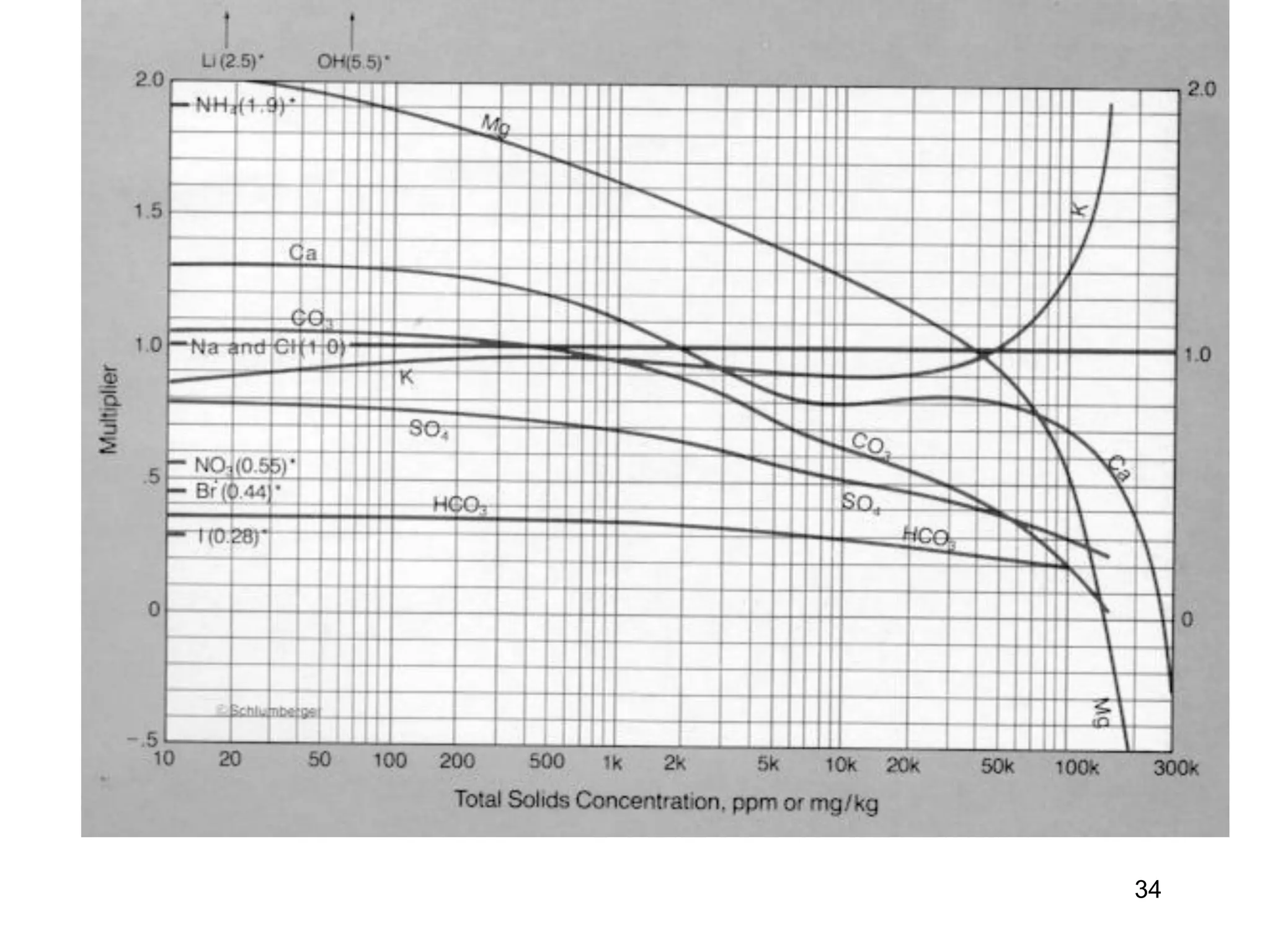
Where;
C = equivalent concentration of NaCl.
Mi=weight multiplier (can be estimated from graph)
Ci= concentration of each ion.
33
34
Based on equivalent
concentration of NaCl
and temperature,
formation water resistivity
can be determined using
graph.
The following equation
also can be used to
calculate (Rw).
35
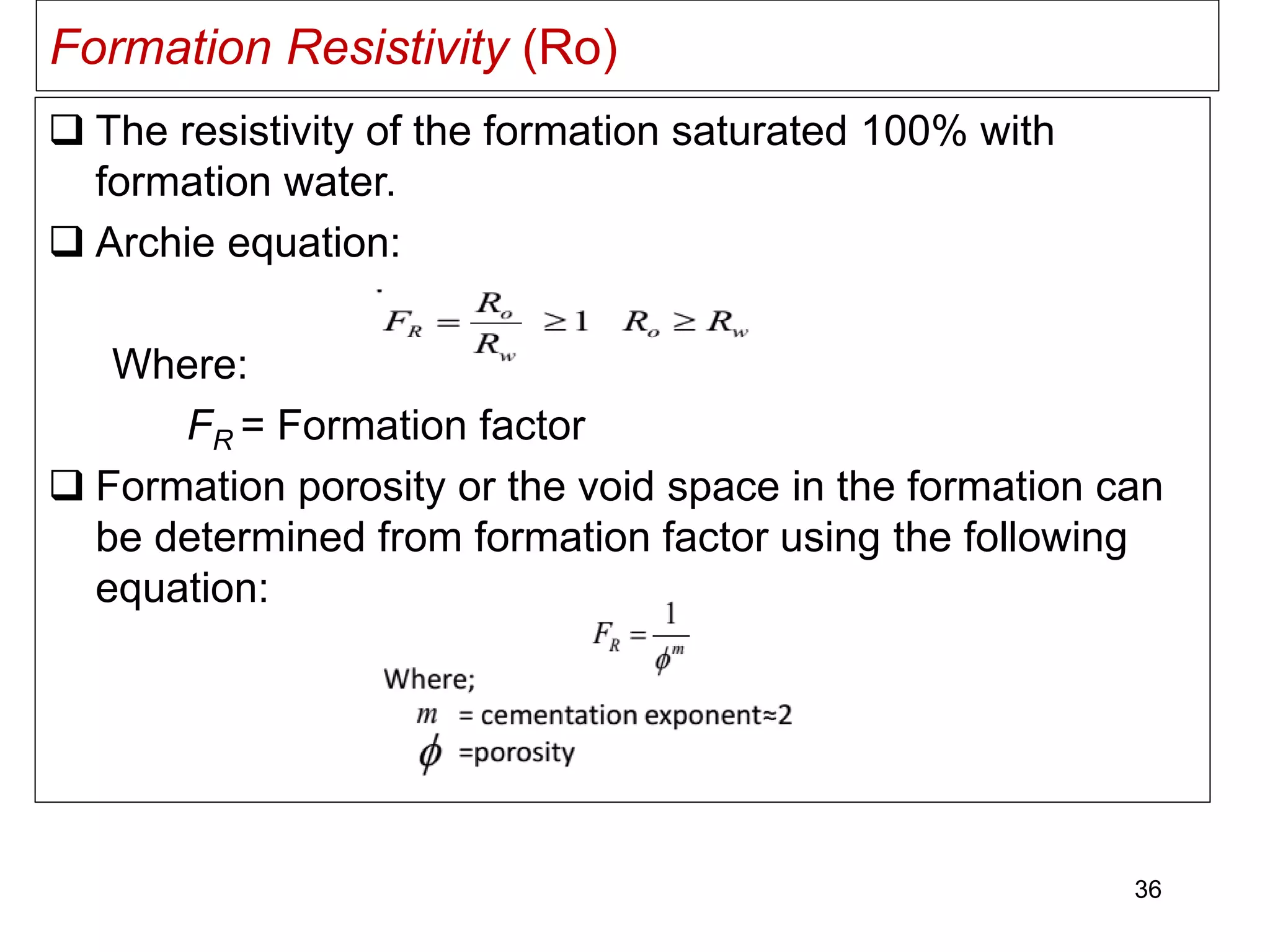
Formation Resistivity (Ro)
 The resistivity of the formation saturated 100% with
formation water.
 Archie equation:
Where:
FR = Formation factor
 Formation porosity or the void space in the formation can
be determined from formation factor using the following
equation:
36
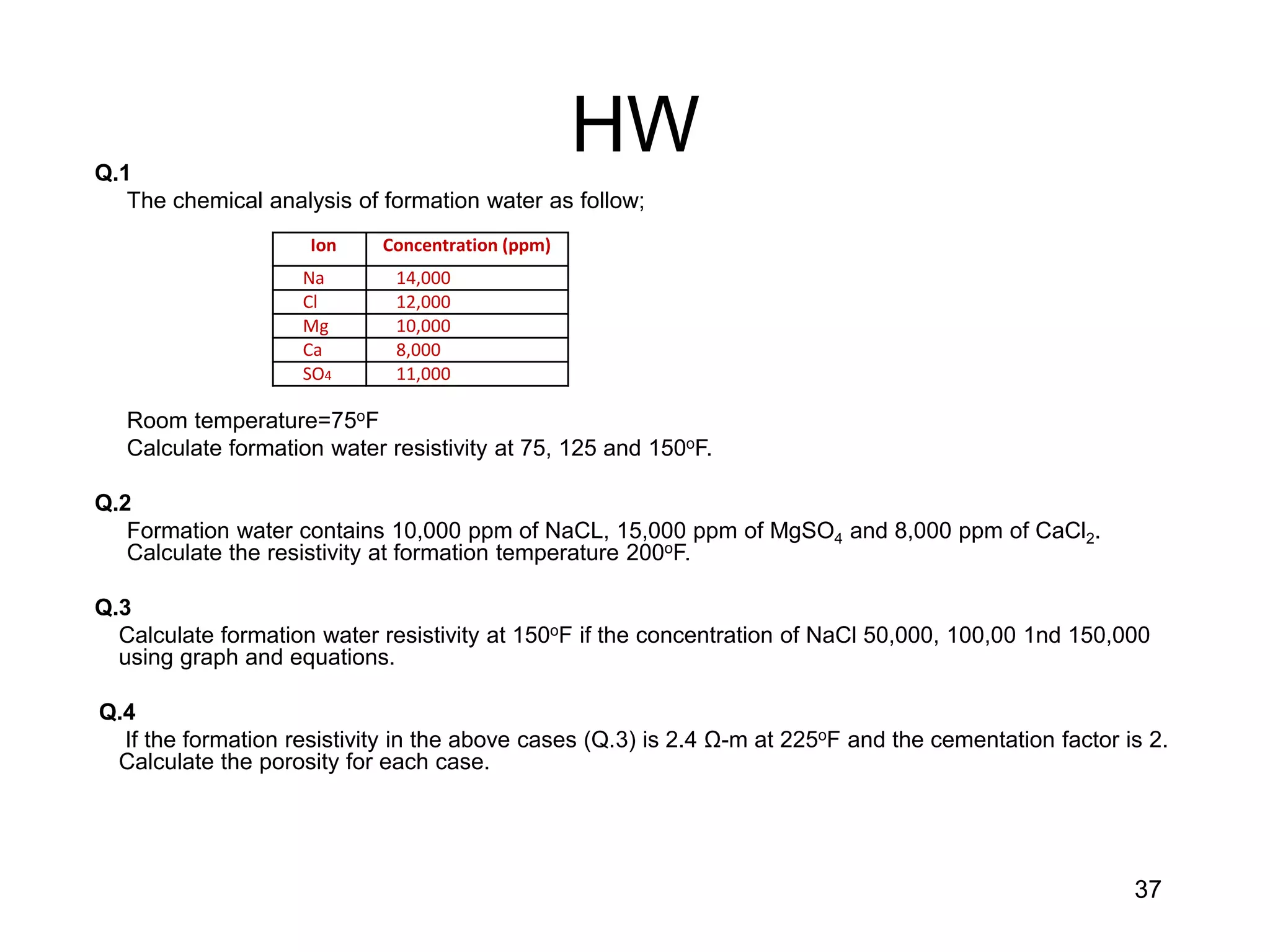
HWQ.1
The chemical analysis of formation water as follow;
Room temperature=75oF
Calculate formation water resistivity at 75, 125 and 150oF.
Q.2
Formation water contains 10,000 ppm of NaCL, 15,000 ppm of MgSO4 and 8,000 ppm of CaCl2.
Calculate the resistivity at formation temperature 200oF.
Q.3
Calculate formation water resistivity at 150oF if the concentration of NaCl 50,000, 100,00 1nd 150,000
using graph and equations.
Q.4
If the formation resistivity in the above cases (Q.3) is 2.4 Ω-m at 225oF and the cementation factor is 2.
Calculate the porosity for each case.
37
Ion Concentration (ppm)
Na 14,000
Cl 12,000
Mg 10,000
Ca 8,000
SO4 11,000
True Resistivity (Rt):
 The resistivity of the formation at any saturation of water less
than 100% when the hydrocarbon displaces some water
from pore space in the formation. The relationship between
formation resistivity (Ro) and true formation resistivity (Rt)
can be represented by resistivity index:
Where: IR = resistivity index
 Water saturation (Sw) which is defined as the percentage of
the pore volume filled with water can be determined from the
following equation :
Where: n = saturation exponent ≈2
38
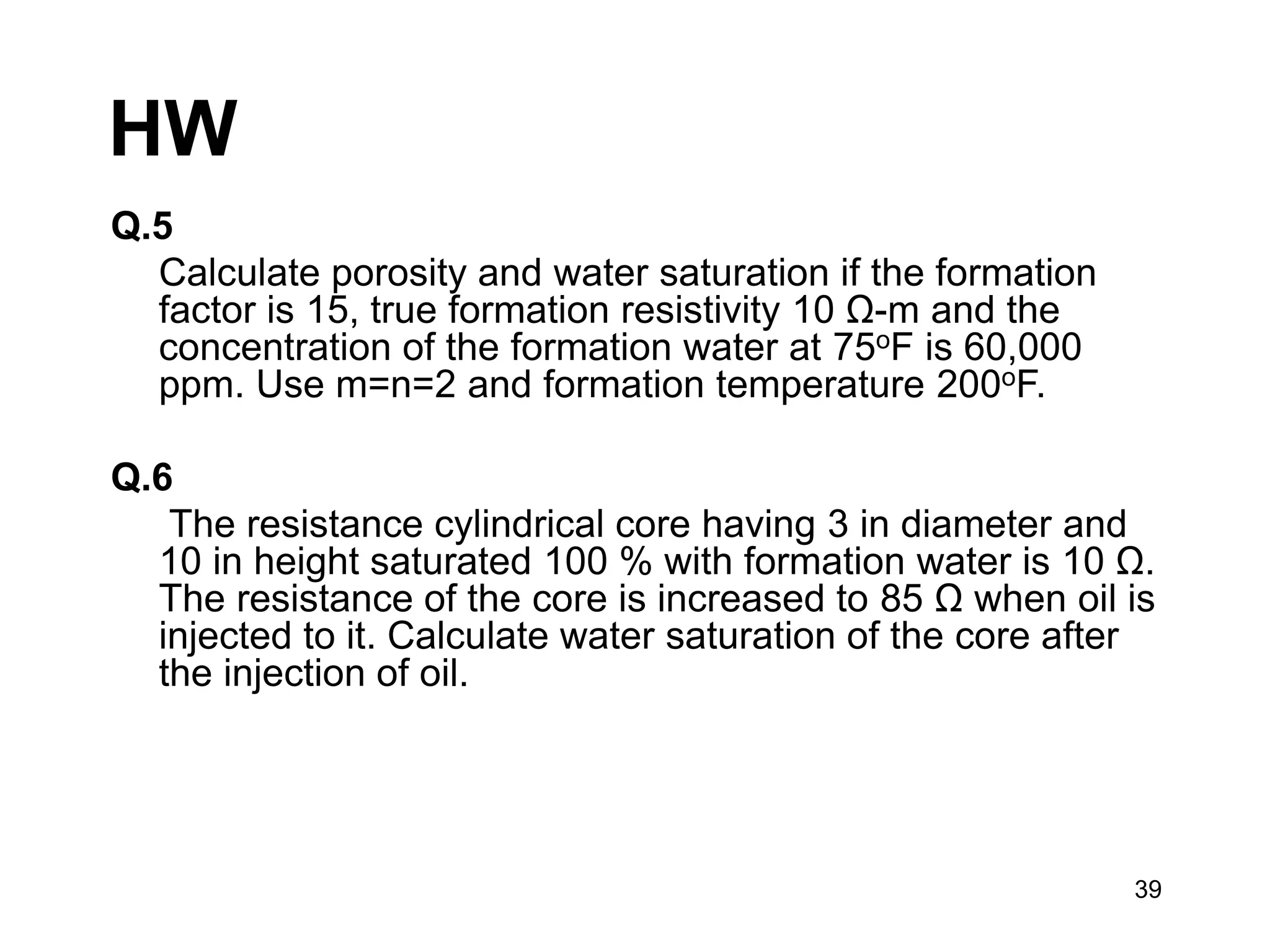
HW
Q.5
Calculate porosity and water saturation if the formation
factor is 15, true formation resistivity 10 Ω-m and the
concentration of the formation water at 75oF is 60,000
ppm. Use m=n=2 and formation temperature 200oF.
Q.6
The resistance cylindrical core having 3 in diameter and
10 in height saturated 100 % with formation water is 10 Ω.
The resistance of the core is increased to 85 Ω when oil is
injected to it. Calculate water saturation of the core after
the injection of oil.
39
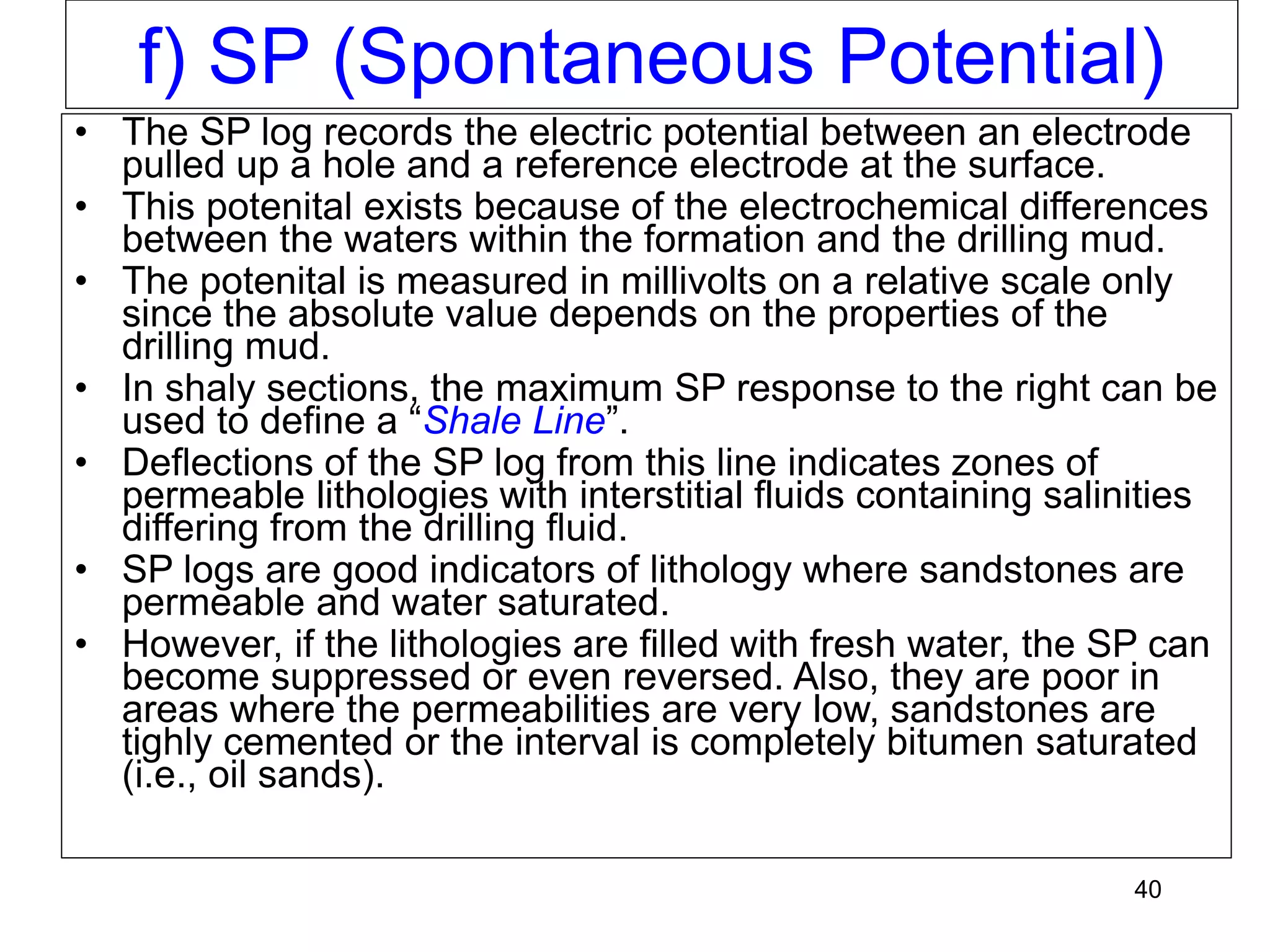
f) SP (Spontaneous Potential)
• The SP log records the electric potential between an electrode
pulled up a hole and a reference electrode at the surface.
• This potenital exists because of the electrochemical differences
between the waters within the formation and the drilling mud.
• The potenital is measured in millivolts on a relative scale only
since the absolute value depends on the properties of the
drilling mud.
• In shaly sections, the maximum SP response to the right can be
used to define a “Shale Line”.
• Deflections of the SP log from this line indicates zones of
permeable lithologies with interstitial fluids containing salinities
differing from the drilling fluid.
• SP logs are good indicators of lithology where sandstones are
permeable and water saturated.
• However, if the lithologies are filled with fresh water, the SP can
become suppressed or even reversed. Also, they are poor in
areas where the permeabilities are very low, sandstones are
tighly cemented or the interval is completely bitumen saturated
(i.e., oil sands).
40
f) SP (Spontaneous Potential)
 The spontaneous potential (SP) log is a measurement of the natural potential
difference or self-potential between an electrode in the borehole and a reference
electrode at the surface . It represents a recording of naturally occurring physical
phenomenon in in-situ rocks.
 The SP curve records the electrical potential (voltage) produced by the interaction of
formation water, drilling mud and shale. Though relatively simple in concept, the SP
curve is quite useful for a number of things:
1) Differentiates potentially porous and permeable reservoir rocks
2) from nonpermeable shales
3) Defines bed boundaries and correlation of beds
4) Aids in lithology identification
5) Detection of hydrocarbon from suppression of SP response
6) Permits determination of formation water resistivity, Rw
7) Gives semi-quantitative indication of bed shaliness
 Three factors are necessary to produce an SP current:
1) a conductive fluid in the borehole,
2) a porous and permeable bed surrounded by an impermeable formation, and
3) a difference in salinity (or pressure) between the borehole fluid and the
formation fluid.
41
Resistivity of drilling mud filtrate (Rmf):
➢The resistivity of drilling mud filtrate
which is normally observed in the
permeable layers.
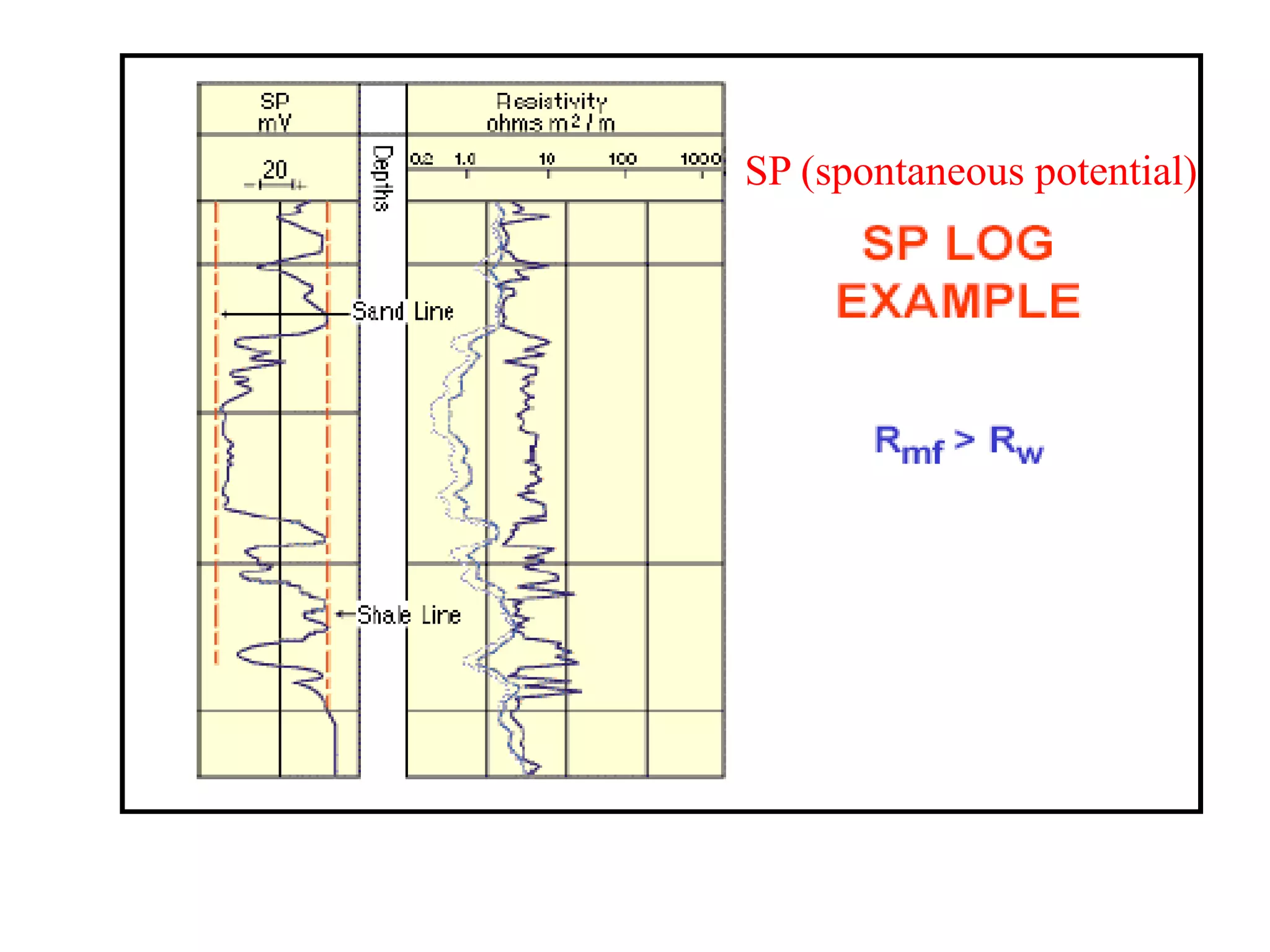
➢The SP deflection is a reflection of
contrast between the mud filtrate
and connate water resistivity.
➢The deflection is said to be normal
or -ve when the mud filtrate is more
resistive than the connate water
and is reverse or +ve when the mud
filtrate is less resistive that the
connate water. It is quite common
to find fresh water in shallow sands
and increasingly saline water as
depth increases. Such a progression
is shown in the figure, where SP
appears deflecting to left deep in
the well but is reversed near to the
surface.
42
43
SP (spontaneous potential)
44
1- Electrokinetic Potential (can be neglected)
45
46
47
48
2- Electrochemical Potential 1) Membrane Potential
2) Liquid Junction Potential
49
50
51
52
53
54
Shale Baseline and SSP:
SP has no absolute values and thus treated quantitatively and qualitatively in terms of
deflection, which is the amount the curve moves to the left or to the right of a defined zero. The
definition of the SP zero, called shale baseline, is made on thick shale intervals where the SP
curve does not move. All values are related to the shale baseline.
The theoretical maximum deflection of the SP opposite permeable beds is called the static SP
or SSP. It represents the SP value that would be measured in an ideal case with the permeable
bed isolated electrically. It is the maximum possible SP opposite a permeable, water-bearing
formation with no shale.
The SSP is used to calculate formation-water resistivity (Rw).
SP = -K log(Rmfe/Rwe)
SP= SP value: this should be the SSP
(Rmf)e = equivalent mud filtrate resistivity: closely related to Rmf
(Rw)e = equivalent formation water resistivity: closely related to Rw
K = temperature-dependent coefficient = 61+ 0.133 * T
T= formation temperature (°F)
 SP value measured is influenced by:
• Bed thickness
• Bed resistivity (Rmf, Rw, )
• Borehole and invasion
• Shale content
• Ratio of Rmf/Rw (amplitude and sign)
• Temperature
55
Factors affecting SP log measurements
 Rmf/Rw (Salinity effect) Fresh mud: negative SP, Saline
mud: positive SP.
 Shale or clay content Shale reduces SP.
 Permeability
 Presence of hydrocarbon
 Bed thickness: SP decreases when bed thickness
decreases.
 Invasion: Reduces SP.
 Mud filtrate: The magnitude and direction of SP
deflection from the shale baseline depends on relative
resistivities of the mud filtrate and the formation water.
 Resistive formations
56
57
PSP (Pseudo-static SP):
the SP value in the
water–bearing shaly
sand zone read from the
SP log.
SSP (Static SP): the
maximum SP value in a
clean sand zone.
58
59
60
61
62
Clean Laminated Structural Dispersed
63
Q.7
Calculate water formation resistivity
and shale volume if SSP=40 mv and
PSP=15 mv. Reservoir temperature is
250oF and Rmf=0.5 Ω-m.
64
65
66
67
Rw
calculation
from SP
68
Mathematical Calculation of Rw from SSP (modified after Bateman & Konen, 1977)
Rmf at 75o
F = Rmf temp
*
x (temp + 6.77)/81.77
Correction of Rmf to 75o
K = 60 + (0.133 x Tf)
Rmfe / Rwe = 10 – SSP / K**
Rmfe = (146 x Rmf – 5) / (337 x Rmf + 77)
Rmfe formula if Rmf at 75o
F < 0.1
Rmfe = 0.85 x Rmf
Rmfe formula if Rmf at 75o
> 0.1
Rwe = Rmfe / (Rmfe / Rwe)
Rw at 75o
F = (77 x Rwe + 5) / (146 – 377 x Rwe)
Rw at 75o
formula if Rwe < 0.12
Rw at 75o
F = - [0.58 – 10 (0.69 x Rwe –0.24)
]
Rw at 75o
F formula if Rwe > 0.12
Rw at formation temperature = Rw at 75o
x 81.77 / (Tf + 6.77)
*Rmftemp = Rmf at a temperature other than 75o
F
**The e subscript (i.e. Rmfe) stands for equivalent resistivity.
69
Applications
Differentiation between shaly, clean and
shale zones.
Differentiation between Permeable and
non-permeable zones.
Calculation of Rw.
Determination of the volume of shale.
For correlation purposes
For sedimentological analysis and facies
studies.
70
71
72
Notice how the shale baseline shows a
distinctive drift with depth. This
characteristics is commonly caused by an
increases in relative oxidation of the rocks
that are close to the land surface. The
highest sandstone in the well has a muted
deflection on the SP log as compared with
the lower sandstones. This contrast is an
immediate indication that water in the upper
sandstone may be significantly fresher than
waters of the lower sandstone. In other
wells it is not uncommon to see sandstone
units where the SP deflection goes to the
right of the shale baseline. In these
instances, the drilling mud filtrate is salter
than the formation water.
73
74
A good example of this
phenomenon is shown in
the figure attached. In the
upper sandstone, "U", the
SP log shows a deflection
to the right, indicating
formation water to be
fresher than the drilling
mud, while in the lower
sandstone, "L", the
deflection is to the left,
showing the formation
water to be more saline.
Flow chart from oil-industry log
analysis to estimate formation
water resistivity, Rw, in deep
formations from the SP log. RMF
is mud filtrate resistivity measured
at temperature Tmf and recorded
on the log header; Tf is the
temperature of the formation,
generally estimated by
interpolating between the bottom-
hole temperature (BHT) at total
depth (TD) and mean annual
temperature at the surface; SSP is
the static self-potential measured
on the log between the "clean
line" and "shale line" in millivolts
(mv) and with associated sign
(positive or negative).
75
QuickTime™ and a
decompressor
are needed to see this picture.
Qu ic k Tim e™ and a
d ec o m pres s or
are ne ede d to s e e th is p ic tu re.
QuickTime™ and a
decompressor
are needed to see this picture.
QuickTime™ and a
decompressor
are needed to see this picture.
QuickTime™ and a
decompressor
are needed to see this picture.
QuickTime™ and a
decompressor
are needed to see this picture.

Interpreting geophysical well logs

  • 1.
    Interpreting Geophysical WellLogs Hassan Harraz hharraz2016@yahoo.com
  • 2.
    Lecture items Historical Aspect Typesof Logs a) Gamma Ray b) Sonic c) Density/Neutron d) Caliper e) SP (spontaneous potential) f) Resistivity (Induction) Self Potential Log * Theory of measurement. -Shale-base line& Sand line -SSP, PSP and SP log readings * Factors affecting on log readings. * Applications. -Resistivity Logs * Definition. * Types * Units& Presentation. * Theories of measurement. * Factors affecting on log readings. * Applications. 2
  • 3.
    Historical Aspect  Schlumbergerbrothers, Conrad and Marcel, are credited with inventing electrical well-logs.  On September 5, 1927, the first “well-log” was created in a small village named Pechelbroon in France.  In 1931, the first SP (spontaneous potential) log was recorded. Discovered when the galvanometer began “wiggling” even though no current was being applied.  The SP effect was produced naturally by the borehole mud at the boundaries of permeable beds. By simultaneously recording SP and resistivity, loggers could distinguish between permeable oil-bearing beds and impermeable nonproducing beds. 3
  • 4.
    Types of Logs a)Gamma Ray b) Sonic c) Density/Neutron d) Caliper e) SP (spontaneous potential) f) Resistivity (Induction) 4
  • 5.
    Well Logging Is atechnique used for formation evaluation to determine the size of the reservoir and the amount of oil and gas in place. The following parameters can be estimated from different types of logging tools: 1)Borehole Hole Diameter. 2)Reservoir Thickness. 3)Porosity. 4)Water Saturation. 5)Rock Type (Lithology). 5
  • 6.
    Logging tools classification Based on the function, logging tools can be classified as follow: 1) Formation Fluid Indicators: ▪Induction ▪Laterolog ▪Microfocused and microresistivity devices 2) Formation property-lithology Indicators: ▪Acoustic ▪Density and lithologic density ▪Neutron ▪Gamma ray 3) Layer geometry Indicators: ▪Dipmeter ▪Borehole gravimeter 4) Auxiliary tools: ▪Spontaneous potential ▪Caliper 5) Specialty Tools: ▪Nuclear Magnetic Resonance ▪Dipole ▪Geochemical Tools 6
  • 7.
    a) Gamma RayLog The gamma ray measures the natural radioactivity of the rocks, and does not measure any hydrocarbon or water present within the rocks. Shales: radioactive potassium is a common component, and because of their cation exchange capacity, uranium and thorium are often absorbed as well. Therefore, very often shales will display high gamma ray responses, while sandstones and limestone will typically show lower responses. Shale is usually more radioactive than sand or carbonate, gamma ray log can be used to calculate volume of shale in porous reservoirs. The volume of shale expressed as a decimal fraction or percentage is called Vshales. Calculation of the Gamma Ray Index (IGR ) is the first step needed to determine the volume of shale from gamma ray log. The gamma ray log has several nonlinear empirical responses as well a linear responses. The non linear responses are based on geographic area or formation age. All non linear relationships are more optimistic that is they produce a shale volume value lower than that from the linear equation. Linear response : Where: IGR =Gamma ray index GRLog = gamma ray record from log GRmin = gama ray for clean sand GRmax = gamma ray for shale 7
  • 8.
    a) Gamma Ray 8 Thescale for GR is in API (American Petroleum Institute) and runs from 0-125 units There are often 10 divisions in a GR log, so each division represents 12.5 units. Typical distinction between a sandstone/limestone and shale occurs between 50-60 units. Often, very clean sandstones or carbonates will display values within the 20 units range.
  • 9.
    a) Gamma Ray ➢Forvery hard compacted formation at depth of 8,000 ft or more, gamma ray index is considered equal to shale volume: Vsh = IGR ➢For tertiary sediment rocks at depth of less than 4,000 ft, the shale volume is: Vsh = 0.083(23.7I GR -1) ➢For older rocks at depth of 4,000-8,000 ft, the shale volume is: Vsh = 0.33(22I GR -1) 9
  • 10.
    d) Caliper LogCaliper Logs record the diameter of the hole. It is very useful in relaying information about the quality of the hole and hence reliability of the other logs.  An example includes a large hole where dissolution, caving or falling of the rock wall occurred, leading to errors in other log responses.  Most caliper logs are run with GR logs and typically will remain constant throughout.  Borehole geometry is controlled by: ➢ Lithology ➢ Mud type ➢ Formation Properties ➢ In-situ stresses  Borehole size can be determined from caliper log. Caliper log can be an indication to one of the following cases: 1) Gauged hole: diameter of hole is about equal to the bit size Hard well consolidated and impermeable formation. borehole diameter = drill bit size 2) Increased borehole diameter which means: a) Washout: general drilling wear, especially in shaly zones and dipping beds, both caliper larger than bit size, considerable vertical extent . b) Keyseat: asymmetric oval holes, formed by wear against the drill string at points where the borehole inclination changes (doglegs) . c) Breakout: similar to keyseat but not due to doglegs, small brittle fractures due to existing stress regime of the country rock. Unconsolidated formation borehole diameter > drill bit size 3)Decreased borehole diameter means: a) Generally due to formation of mud cake Mud cake thickness = (bit size diameter – caliper diameter reading)/2 b) mud cake formation indicates permeability and involves loss of mud filtrate into a permeable formation – invasion Permeable formation borehole diameter < drill bit size 10
  • 11.
    b) Sonic (orAcoustic) Log Sonic logs (or acoustic) measure the porosity of the rock. Hence, they measure the travel time of an elastic wave through a formation (measured in ∆T- microseconds per meter). Intervals containing greater pore space will result in greater travel time and vice versa for non-porous sections. Wyllie’s time average equation can be used to determine porosity: Where t = log reading (s/ ft) tma = transittime for the rock type (matrix) tf =transittime for the fluid filling pores (usually189s/ft) 11
  • 12.
    Sonic logs areused to determine: 1) Determine porosity of reservoir rock 2) Improve correlation and interpretation of seismic records 3) Identify zones with abnormally high pressures 4) Assist in identifying lithology 5) Estimate secondary pore space 6) Indicate mechanical integrity of reservoir rocks and formations that surround them (in conjunction with density data) 7) Estimate rock permeability Must be used in combination with other logs, particularly gamma rays and resistivity, thereby allowing one to better understand the reservoir petrophysics. 12
  • 13.
    HW Q.8: From the gammaray log, the record is 200 API, gamma ray for shale zone is 120 API and gamma ray for clean sand is 40 API. Calculate the gamma ray index and shale volume if the rocks at depth 3,500 ft and 7,500 ft. Q.9: Sonic log reading t=100s/ft, tma = 80s/ft, tf =190s/ft. Calculate porosity. 13
  • 14.
    QuickTime™ and a decompressor areneeded to see this picture.
  • 15.
    QuickTime™ and a decompressor areneeded to see this picture.
  • 16.
  • 17.
    c) Density Log The density log belongs to the group of active nuclear tools, which contains a radioactive source and two detectors. The Gamma Ray tool, which is a passive nuclear tool, contains no source and can only measure the natural radiation in the formation. The radioactive source is applied to the wellbore wall in a shielded sidewall skid and emits medium gamma rays into the formation. The gamma ray waves may be thought of as energy particles. As these energy particles (photons) collide with the electrons in the formation, the gamma ray loses some of its energy to the electron. This is called Compton scattering. The denser the formation, the more electrons are presented, and more energy is lost due to collisions. If the matrix density is known, then the energy loss is directly related to porosity.  Density logs measure the bulk electron density of the formation, and is measured in kilograms per cubic meter (gm/cm3 or kg/m3).  Thus, the density tool emits gamma radiation which is scattered back to a detector in amounts proportional to the electron density of the formation. The higher the gamma ray reflected, the greater the porosity of the rock.  Electron density is directly related to the density of the formation (except in evaporates) and amount of density of interstitial fluids.  Helpful in distinguishing lithologies, especially between dolomite (2.85 kg/m3) and limestone (2.71 kg/m3). 17
  • 18.
  • 19.
  • 20.
    d) Neutron Logsd Nucleusof all elements except hydrogen have neutrons. Neutrons have same mass as protons but no charge. Their small size and electrical neutrality make neutrons ideal projectiles for penetrating matter. Two categories of neutron sources are found in the logging industry: chemical and pulsed sources. Chemical sources are composed of two elements in intimate contact that continuously emit neutrons, usually Plutonium/Beryllium or Americium/Beryllium. Such sources need to be heavily shielded when not in use. Pulsed sources incorporate a neutron accelerator and a target, and can be activated by simply switching on the accelerator. This source is used for pulsed neutron logging and in tools that measure inelastic neutron collisions . Neutron Logs measure the amounts of hydrogen present in the water atoms of a rock, and can be used to measure porosity. This is done by bombarding the the formation with neutrons, and determing how many become “captured” by the hydrogen nuclei. Because shales have high amounts of water, the neutron log will read quite high porosities- thus it must be used in conjunction with GR logs. However, porosities recorded in shale-free sections are a reasonable estimate of the pore spaces that could produce water. It is very common to see both neutron and density logs recorded on the same section, and are often shown as an overlay on a common scale (calibrated for either sandstones or limestone’s). This overlay allows for better opportunity of distinguishing lithologies and making better estimates of the true porosity. * When natural gas is present, there becomes a big spread (or crossing) of the two logs, known as the “Gas Effect”. 20
  • 21.
    d) Neutron Logs 21 Thefollowing equation can be used to determine porosity from density log:
  • 22.
    HW Q.10 : The bulkdensity reading from density log is (2.2 gm/cc). The density of matrix is (2.45 gm/cc) and fluid density is (1.035 gm/cc). The density reading from neutron log is (15%). Calculate formation density. 22
  • 23.
    QuickTime™and a decompressor are neededto see this picture. Example of dolomite overlying limestone, as distinguished by the neutron/density.
  • 24.
    QuickTime™ and a decompressor areneeded to see this picture.
  • 25.
    QuickTime™ and a decompressor areneeded to see this picture.
  • 26.
    QuickTime™ and a decompressor areneeded to see this picture.
  • 27.
    QuickTime™ and a decompressor areneeded to see this picture.
  • 28.
    QuickTime™ and a decompressor areneeded to see this picture.
  • 29.
  • 30.
    e) Resistivity Log Resistance is the opposition offered by a substance to the passage of electric current. Resistivity is the resistance measured between opposite faces of a unit cube of the substance at specified temperature. Resistivity is measured in ohm-meter2/meter, more commonly shortened to just ohm- meter.  Resistivity logs do not always measure resistivity directly. ➢ Some resistivity logs (actually induction logs) measures conductivity instead which is the reciprocal of resistivity.  Induction logs are used in wells drilled with a relatively fresh- water mud (low salinity) to obtain more accurate value of true resistivity. 30
  • 31.
    e) Resistivity (Induction) Resistivity logs record the resistance of interstitial fluids to the flow of an electric current, either transmitted directly to the rock through an electrode, or magnetically induced deeper into the formation from the hole.  Therefore, the measure the ability of rocks to conduct electrical currents and are scaled in units of ohm-meters.  On most modern logs, there will be three curves, each measuring the resistance of section to the flow of electricity.  Porous formations filled with salt water (which is very common) have very low resistivities (often only ranging from 1-10 ohms-meter).  Formations that contain oil/gas generally have much higher resisitivities (often ranging from 10-500 ohms-meter).  With regards to the three lines, the one we are most interested in is the one marked “deep”. This is because this curve looks into the formation at a depth of six meters (or greater), thereby representing the portion of the formation most unlikely undisturbed by the drilling process.  One must be careful of “extremely” high values, as they will often represent zones of either anhydrite or other non-porous intervals. 31
  • 32.
    The resistivity ofa rock (R) is given by: R = r (A / L) Where: r = resistance (ohms) = E / I A = Cross sectional area (meters2) L = Length (meters) R = resistivity (ohm-meters) E = Voltage (Volt) I = current (Amp) Factors that influence Resistivity of Natural Porous Media: 1)Salinity of water 2)Porosity 3)Stress 4)Temperature 5)Pore geometry 6)Rock Composition 7)Wettability 32
  • 33.
    Formation Water Resistivity(Rw):  Formation water resistivity can vary widely from well to well. It can be estimated by the following methods; ➢Chemical analysis of produced water ➢Direct measurement in resistivity cell ➢Using Empirical equations  The best method is direct measurement of resistivity. Chemical analysis:  Resistivity of water is controlled by amount and type of ions present and temperature. Salinity is a measure of concentration of dissolved salts in water and is generally expressed as parts per million, grains/gallon or grams/liter. 1 grain/gallon = 17.118 ppm = 0.017118 grams/liter  NaCl is the most common dissolved salt in formation water; the concentration of other dissolved ions is generally converted to equivalent concentration of sodium chloride; Where; C = equivalent concentration of NaCl. Mi=weight multiplier (can be estimated from graph) Ci= concentration of each ion. 33
  • 34.
  • 35.
    Based on equivalent concentrationof NaCl and temperature, formation water resistivity can be determined using graph. The following equation also can be used to calculate (Rw). 35
  • 36.
    Formation Resistivity (Ro) The resistivity of the formation saturated 100% with formation water.  Archie equation: Where: FR = Formation factor  Formation porosity or the void space in the formation can be determined from formation factor using the following equation: 36
  • 37.
    HWQ.1 The chemical analysisof formation water as follow; Room temperature=75oF Calculate formation water resistivity at 75, 125 and 150oF. Q.2 Formation water contains 10,000 ppm of NaCL, 15,000 ppm of MgSO4 and 8,000 ppm of CaCl2. Calculate the resistivity at formation temperature 200oF. Q.3 Calculate formation water resistivity at 150oF if the concentration of NaCl 50,000, 100,00 1nd 150,000 using graph and equations. Q.4 If the formation resistivity in the above cases (Q.3) is 2.4 Ω-m at 225oF and the cementation factor is 2. Calculate the porosity for each case. 37 Ion Concentration (ppm) Na 14,000 Cl 12,000 Mg 10,000 Ca 8,000 SO4 11,000
  • 38.
    True Resistivity (Rt): The resistivity of the formation at any saturation of water less than 100% when the hydrocarbon displaces some water from pore space in the formation. The relationship between formation resistivity (Ro) and true formation resistivity (Rt) can be represented by resistivity index: Where: IR = resistivity index  Water saturation (Sw) which is defined as the percentage of the pore volume filled with water can be determined from the following equation : Where: n = saturation exponent ≈2 38
  • 39.
    HW Q.5 Calculate porosity andwater saturation if the formation factor is 15, true formation resistivity 10 Ω-m and the concentration of the formation water at 75oF is 60,000 ppm. Use m=n=2 and formation temperature 200oF. Q.6 The resistance cylindrical core having 3 in diameter and 10 in height saturated 100 % with formation water is 10 Ω. The resistance of the core is increased to 85 Ω when oil is injected to it. Calculate water saturation of the core after the injection of oil. 39
  • 40.
    f) SP (SpontaneousPotential) • The SP log records the electric potential between an electrode pulled up a hole and a reference electrode at the surface. • This potenital exists because of the electrochemical differences between the waters within the formation and the drilling mud. • The potenital is measured in millivolts on a relative scale only since the absolute value depends on the properties of the drilling mud. • In shaly sections, the maximum SP response to the right can be used to define a “Shale Line”. • Deflections of the SP log from this line indicates zones of permeable lithologies with interstitial fluids containing salinities differing from the drilling fluid. • SP logs are good indicators of lithology where sandstones are permeable and water saturated. • However, if the lithologies are filled with fresh water, the SP can become suppressed or even reversed. Also, they are poor in areas where the permeabilities are very low, sandstones are tighly cemented or the interval is completely bitumen saturated (i.e., oil sands). 40
  • 41.
    f) SP (SpontaneousPotential)  The spontaneous potential (SP) log is a measurement of the natural potential difference or self-potential between an electrode in the borehole and a reference electrode at the surface . It represents a recording of naturally occurring physical phenomenon in in-situ rocks.  The SP curve records the electrical potential (voltage) produced by the interaction of formation water, drilling mud and shale. Though relatively simple in concept, the SP curve is quite useful for a number of things: 1) Differentiates potentially porous and permeable reservoir rocks 2) from nonpermeable shales 3) Defines bed boundaries and correlation of beds 4) Aids in lithology identification 5) Detection of hydrocarbon from suppression of SP response 6) Permits determination of formation water resistivity, Rw 7) Gives semi-quantitative indication of bed shaliness  Three factors are necessary to produce an SP current: 1) a conductive fluid in the borehole, 2) a porous and permeable bed surrounded by an impermeable formation, and 3) a difference in salinity (or pressure) between the borehole fluid and the formation fluid. 41
  • 42.
    Resistivity of drillingmud filtrate (Rmf): ➢The resistivity of drilling mud filtrate which is normally observed in the permeable layers. ➢The SP deflection is a reflection of contrast between the mud filtrate and connate water resistivity. ➢The deflection is said to be normal or -ve when the mud filtrate is more resistive than the connate water and is reverse or +ve when the mud filtrate is less resistive that the connate water. It is quite common to find fresh water in shallow sands and increasingly saline water as depth increases. Such a progression is shown in the figure, where SP appears deflecting to left deep in the well but is reversed near to the surface. 42
  • 43.
  • 44.
  • 45.
  • 46.
  • 47.
  • 48.
    48 2- Electrochemical Potential1) Membrane Potential 2) Liquid Junction Potential
  • 49.
  • 50.
  • 51.
  • 52.
  • 53.
  • 54.
  • 55.
    Shale Baseline andSSP: SP has no absolute values and thus treated quantitatively and qualitatively in terms of deflection, which is the amount the curve moves to the left or to the right of a defined zero. The definition of the SP zero, called shale baseline, is made on thick shale intervals where the SP curve does not move. All values are related to the shale baseline. The theoretical maximum deflection of the SP opposite permeable beds is called the static SP or SSP. It represents the SP value that would be measured in an ideal case with the permeable bed isolated electrically. It is the maximum possible SP opposite a permeable, water-bearing formation with no shale. The SSP is used to calculate formation-water resistivity (Rw). SP = -K log(Rmfe/Rwe) SP= SP value: this should be the SSP (Rmf)e = equivalent mud filtrate resistivity: closely related to Rmf (Rw)e = equivalent formation water resistivity: closely related to Rw K = temperature-dependent coefficient = 61+ 0.133 * T T= formation temperature (°F)  SP value measured is influenced by: • Bed thickness • Bed resistivity (Rmf, Rw, ) • Borehole and invasion • Shale content • Ratio of Rmf/Rw (amplitude and sign) • Temperature 55
  • 56.
    Factors affecting SPlog measurements  Rmf/Rw (Salinity effect) Fresh mud: negative SP, Saline mud: positive SP.  Shale or clay content Shale reduces SP.  Permeability  Presence of hydrocarbon  Bed thickness: SP decreases when bed thickness decreases.  Invasion: Reduces SP.  Mud filtrate: The magnitude and direction of SP deflection from the shale baseline depends on relative resistivities of the mud filtrate and the formation water.  Resistive formations 56
  • 57.
    57 PSP (Pseudo-static SP): theSP value in the water–bearing shaly sand zone read from the SP log. SSP (Static SP): the maximum SP value in a clean sand zone.
  • 58.
  • 59.
  • 60.
  • 61.
  • 62.
  • 63.
  • 64.
    Q.7 Calculate water formationresistivity and shale volume if SSP=40 mv and PSP=15 mv. Reservoir temperature is 250oF and Rmf=0.5 Ω-m. 64
  • 65.
  • 66.
  • 67.
  • 68.
  • 69.
    Mathematical Calculation ofRw from SSP (modified after Bateman & Konen, 1977) Rmf at 75o F = Rmf temp * x (temp + 6.77)/81.77 Correction of Rmf to 75o K = 60 + (0.133 x Tf) Rmfe / Rwe = 10 – SSP / K** Rmfe = (146 x Rmf – 5) / (337 x Rmf + 77) Rmfe formula if Rmf at 75o F < 0.1 Rmfe = 0.85 x Rmf Rmfe formula if Rmf at 75o > 0.1 Rwe = Rmfe / (Rmfe / Rwe) Rw at 75o F = (77 x Rwe + 5) / (146 – 377 x Rwe) Rw at 75o formula if Rwe < 0.12 Rw at 75o F = - [0.58 – 10 (0.69 x Rwe –0.24) ] Rw at 75o F formula if Rwe > 0.12 Rw at formation temperature = Rw at 75o x 81.77 / (Tf + 6.77) *Rmftemp = Rmf at a temperature other than 75o F **The e subscript (i.e. Rmfe) stands for equivalent resistivity. 69
  • 70.
    Applications Differentiation between shaly,clean and shale zones. Differentiation between Permeable and non-permeable zones. Calculation of Rw. Determination of the volume of shale. For correlation purposes For sedimentological analysis and facies studies. 70
  • 71.
  • 72.
  • 73.
    Notice how theshale baseline shows a distinctive drift with depth. This characteristics is commonly caused by an increases in relative oxidation of the rocks that are close to the land surface. The highest sandstone in the well has a muted deflection on the SP log as compared with the lower sandstones. This contrast is an immediate indication that water in the upper sandstone may be significantly fresher than waters of the lower sandstone. In other wells it is not uncommon to see sandstone units where the SP deflection goes to the right of the shale baseline. In these instances, the drilling mud filtrate is salter than the formation water. 73
  • 74.
    74 A good exampleof this phenomenon is shown in the figure attached. In the upper sandstone, "U", the SP log shows a deflection to the right, indicating formation water to be fresher than the drilling mud, while in the lower sandstone, "L", the deflection is to the left, showing the formation water to be more saline.
  • 75.
    Flow chart fromoil-industry log analysis to estimate formation water resistivity, Rw, in deep formations from the SP log. RMF is mud filtrate resistivity measured at temperature Tmf and recorded on the log header; Tf is the temperature of the formation, generally estimated by interpolating between the bottom- hole temperature (BHT) at total depth (TD) and mean annual temperature at the surface; SSP is the static self-potential measured on the log between the "clean line" and "shale line" in millivolts (mv) and with associated sign (positive or negative). 75
  • 76.
    QuickTime™ and a decompressor areneeded to see this picture.
  • 77.
    Qu ic kTim e™ and a d ec o m pres s or are ne ede d to s e e th is p ic tu re.
  • 78.
    QuickTime™ and a decompressor areneeded to see this picture.
  • 79.
    QuickTime™ and a decompressor areneeded to see this picture.
  • 80.
    QuickTime™ and a decompressor areneeded to see this picture.
  • 81.
    QuickTime™ and a decompressor areneeded to see this picture.