New England Eye Center Grand Rounds Debra M. Kroll, MD May 24, 2001
New England Eye Center Grand Rounds HPI: A 61 year old man with a 16 year history of rheumatoid arthritis taking prednisone and methotrexate was referred to the Lahey Clinic Cornea Service.  He had right eye discomfort, erythema, and blurring of vision for the 6 days prior to presentation. His general ophthalmologist had seen him the previous 2 consecutive days.  He was being treated for severe staphylococcal blepharitis with a stromal infiltrate and intact epithelium.
New England Eye Center Grand Rounds He was taking bacitracin ointment twice a day and ofloxacin drops every hour.  There was no epithelial defect at presentation.  Additionally, he was performing warm lid soaks twice a day. His discomfort and vision improved slightly from this treatment, but photophobia, tearing and blurring of his vision persisted.
New England Eye Center Grand Rounds He denied trauma, discharge from the eye, any sick contacts or upper respiratory infection. Additional medical, family, and social history was non-contributory.  Medications: methotrexate, prednisone 5 mg daily, and propxyphene/acetominophen (Darvocet).  No known drug allergies.
Figure 1: External Photos OD OS
Figure 2: Slit Lamp Photos OD OS
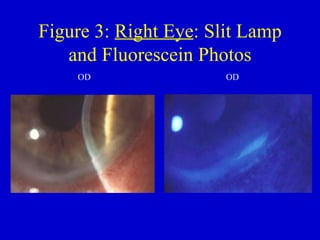
Figure 3:  Right Eye : Slit Lamp and Fluorescein Photos OD   OD
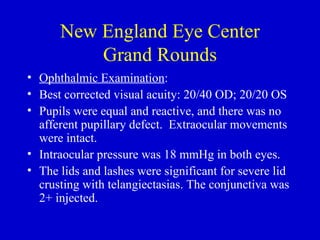
New England Eye Center Grand Rounds Ophthalmic Examination :  Best corrected visual acuity: 20/40 OD; 20/20 OS Pupils were equal and reactive, and there was no afferent pupillary defect.  Extraocular movements were intact.  Intraocular pressure was 18 mmHg in both eyes. The lids and lashes were significant for severe lid crusting with telangiectasias. The conjunctiva was 2+ injected.
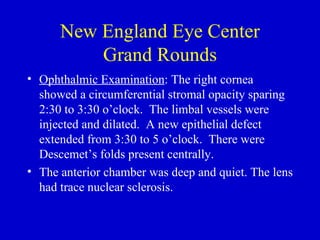
New England Eye Center Grand Rounds Ophthalmic Examination : The right cornea showed a circumferential stromal opacity sparing 2:30 to 3:30 o’clock.  The limbal vessels were injected and dilated.  A new epithelial defect extended from 3:30 to 5 o’clock.  There were Descemet’s folds present centrally.  The anterior chamber was deep and quiet. The lens had trace nuclear sclerosis.
New England Eye Center Grand Rounds  Ophthalmic Examination : The left eye exam was unremarkable.  His fundus exam showed no abnormalities in his disc, macula, vessels, and periphery.
New England Eye Center Grand Rounds What is the differential diagnosis?
New England Eye Center Grand Rounds Differential Diagnosis: Autoimmune Peripheral ulcerative keratopathy Rheumatoid arthritis, collagen vascular disease Mooren’s ulcer Infectious/ Inflammatory Staphylococcus marginal keratitis Catarrhal infiltrate Herpetic keratitis Acanthamoeba Phlyctenule
New England Eye Center Grand Rounds Clinical Course:  The patient was diagnosed with peripheral ulcerative keratopathy. On day #1, corneal cultures were performed and were sent to microbiology.  ESR and C-reactive proteins were drawn.  Oral prednisone (80 mg) was initiated.
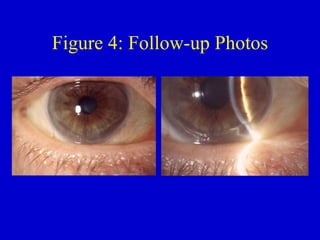
New England Eye Center Grand Rounds Clinical Course : Ofloxacin drops were decreased to four drops daily, prednisolone acetate 1% was initiated at one drop every three hours and bacitracin ointment was maintained at twice per day. On day #2 and #3, the patient felt significantly more comfortable.  The vision improved to 20/30. The epithelial defect had almost completely healed, except there was 5% corneal thinning at the involved limbal areas.
New England Eye Center Grand Rounds Clinical Course : One colony of gram positive, coagulase negative bacteria was isolated.  The C-reactive protein was 3.3 and ESR 40.  Oral prednisone was tapered every 3 days At day #8, the prednisolone acetate and ofloxacin were tapered to three drops per day.
Figure 4: Follow-up Photos
Figure 5: Follow up-Fluorescein
New England Eye Center Grand Rounds Clinical course : At day #15, the patient continued to improve and his vision was 20/20.  Tapering of the drops was continued. The cornea was mildly thinned, but there was no further progression.  The conjunctiva was quiet. At one month, the peripheral ulcerative keratitis was considered to be inactive.
New England Eye Center Grand Rounds Discussion : Peripheral ulcerative keratitis is a rare inflammatory disease most commonly associated with rheumatoid arthritis.  Also seen with Sjogren’s, polyarteritis nodosa, relapsing polychondritis, and Wegener’s granulomatosis.  RA is responsible for 34% of non-infectious PUK.  44% of cases are bilateral.
New England Eye Center Grand Rounds Discussion : The mechanism involves deposition of immune complexes in the limbal vessels or peripheral cornea.  Complement is activated.  Collagenolytic and proteolytic enzymes are liberated causing local ulceration and necrosis. PUK may lead to rapid corneal keratolysis, perforation and visual failure. Cataract surgery may be a trigger.
New England Eye Center Grand Rounds Discussion :  Symptoms : Foreign body sensation, pain, erythema, and decreased vision. Signs : Crescent-shaped inflammation of juxtalimbal corneal stroma associated with epithelial defects, inflammation and degradation.  There may be conjunctival, episcleral, and scleral inflammation.  Prognosis : Poor, if untreated.  May predict death in up to 30% of untreated patients.
New England Eye Center Grand Rounds Treatment :  Systemic : NSAIDs, corticosteroids, and cytotoxic agents such as methotrexate, cyclophosphamide, and azathioprine. Topical : Cyclosporin, lubrication, collagenase inhibitors (acetylcysteine 20%) and tissue adhesives with bandage contact lens.  Surgical : Conjunctival resection, tectonic grafts, penetrating keratoplasty (usually poor prognosis)
Conclusion This 62 year old man with a history of rheumatoid arthritis, taking immunosuppressants, presented with redness, irritation and blurred vision in the right eye.  He was diagnosed with peripheral ulcerative keratopathy.  He improved on oral steroids, topical steroids, ofloxacin, and bacitracin.
References Kenyon KR. Decision making in the therapy of external disease: non-infected corneal ulcers.  Ophthal. 1982; 89:44-51. Messmer EM, Foster CS.  Vasculitic Peripheral Ulcerative Keratitis.  Survey of Ophthal 1999;43(5)379-96. Mondino BJ.  Inflammatory diseases of the peripheral cornea. Ophthalmology 1988;95(4):463-72. Nobe JR, Moura BT, Robin JB et al.  Results of penetrating keratoplasty for the treatment of corneal perforation.  Arch Ophthal. 1990;108:939-941. Squirrell DM, Winfield J, Amos RS.  Peripheral ulcerative keratitis ‘corneal melt’ and rheumatoid arthritis: a case series.  Rheumatology 1999;38:1245-8.

peripheral ulcerative keratopathy

  • 1.
    New England EyeCenter Grand Rounds Debra M. Kroll, MD May 24, 2001
  • 2.
    New England EyeCenter Grand Rounds HPI: A 61 year old man with a 16 year history of rheumatoid arthritis taking prednisone and methotrexate was referred to the Lahey Clinic Cornea Service. He had right eye discomfort, erythema, and blurring of vision for the 6 days prior to presentation. His general ophthalmologist had seen him the previous 2 consecutive days. He was being treated for severe staphylococcal blepharitis with a stromal infiltrate and intact epithelium.
  • 3.
    New England EyeCenter Grand Rounds He was taking bacitracin ointment twice a day and ofloxacin drops every hour. There was no epithelial defect at presentation. Additionally, he was performing warm lid soaks twice a day. His discomfort and vision improved slightly from this treatment, but photophobia, tearing and blurring of his vision persisted.
  • 4.
    New England EyeCenter Grand Rounds He denied trauma, discharge from the eye, any sick contacts or upper respiratory infection. Additional medical, family, and social history was non-contributory. Medications: methotrexate, prednisone 5 mg daily, and propxyphene/acetominophen (Darvocet). No known drug allergies.
  • 5.
    Figure 1: ExternalPhotos OD OS
  • 6.
    Figure 2: SlitLamp Photos OD OS
  • 7.
    Figure 3: Right Eye : Slit Lamp and Fluorescein Photos OD OD
  • 8.
    New England EyeCenter Grand Rounds Ophthalmic Examination : Best corrected visual acuity: 20/40 OD; 20/20 OS Pupils were equal and reactive, and there was no afferent pupillary defect. Extraocular movements were intact. Intraocular pressure was 18 mmHg in both eyes. The lids and lashes were significant for severe lid crusting with telangiectasias. The conjunctiva was 2+ injected.
  • 9.
    New England EyeCenter Grand Rounds Ophthalmic Examination : The right cornea showed a circumferential stromal opacity sparing 2:30 to 3:30 o’clock. The limbal vessels were injected and dilated. A new epithelial defect extended from 3:30 to 5 o’clock. There were Descemet’s folds present centrally. The anterior chamber was deep and quiet. The lens had trace nuclear sclerosis.
  • 10.
    New England EyeCenter Grand Rounds Ophthalmic Examination : The left eye exam was unremarkable. His fundus exam showed no abnormalities in his disc, macula, vessels, and periphery.
  • 11.
    New England EyeCenter Grand Rounds What is the differential diagnosis?
  • 12.
    New England EyeCenter Grand Rounds Differential Diagnosis: Autoimmune Peripheral ulcerative keratopathy Rheumatoid arthritis, collagen vascular disease Mooren’s ulcer Infectious/ Inflammatory Staphylococcus marginal keratitis Catarrhal infiltrate Herpetic keratitis Acanthamoeba Phlyctenule
  • 13.
    New England EyeCenter Grand Rounds Clinical Course: The patient was diagnosed with peripheral ulcerative keratopathy. On day #1, corneal cultures were performed and were sent to microbiology. ESR and C-reactive proteins were drawn. Oral prednisone (80 mg) was initiated.
  • 14.
    New England EyeCenter Grand Rounds Clinical Course : Ofloxacin drops were decreased to four drops daily, prednisolone acetate 1% was initiated at one drop every three hours and bacitracin ointment was maintained at twice per day. On day #2 and #3, the patient felt significantly more comfortable. The vision improved to 20/30. The epithelial defect had almost completely healed, except there was 5% corneal thinning at the involved limbal areas.
  • 15.
    New England EyeCenter Grand Rounds Clinical Course : One colony of gram positive, coagulase negative bacteria was isolated. The C-reactive protein was 3.3 and ESR 40. Oral prednisone was tapered every 3 days At day #8, the prednisolone acetate and ofloxacin were tapered to three drops per day.
  • 16.
  • 17.
    Figure 5: Followup-Fluorescein
  • 18.
    New England EyeCenter Grand Rounds Clinical course : At day #15, the patient continued to improve and his vision was 20/20. Tapering of the drops was continued. The cornea was mildly thinned, but there was no further progression. The conjunctiva was quiet. At one month, the peripheral ulcerative keratitis was considered to be inactive.
  • 19.
    New England EyeCenter Grand Rounds Discussion : Peripheral ulcerative keratitis is a rare inflammatory disease most commonly associated with rheumatoid arthritis. Also seen with Sjogren’s, polyarteritis nodosa, relapsing polychondritis, and Wegener’s granulomatosis. RA is responsible for 34% of non-infectious PUK. 44% of cases are bilateral.
  • 20.
    New England EyeCenter Grand Rounds Discussion : The mechanism involves deposition of immune complexes in the limbal vessels or peripheral cornea. Complement is activated. Collagenolytic and proteolytic enzymes are liberated causing local ulceration and necrosis. PUK may lead to rapid corneal keratolysis, perforation and visual failure. Cataract surgery may be a trigger.
  • 21.
    New England EyeCenter Grand Rounds Discussion : Symptoms : Foreign body sensation, pain, erythema, and decreased vision. Signs : Crescent-shaped inflammation of juxtalimbal corneal stroma associated with epithelial defects, inflammation and degradation. There may be conjunctival, episcleral, and scleral inflammation. Prognosis : Poor, if untreated. May predict death in up to 30% of untreated patients.
  • 22.
    New England EyeCenter Grand Rounds Treatment : Systemic : NSAIDs, corticosteroids, and cytotoxic agents such as methotrexate, cyclophosphamide, and azathioprine. Topical : Cyclosporin, lubrication, collagenase inhibitors (acetylcysteine 20%) and tissue adhesives with bandage contact lens. Surgical : Conjunctival resection, tectonic grafts, penetrating keratoplasty (usually poor prognosis)
  • 23.
    Conclusion This 62year old man with a history of rheumatoid arthritis, taking immunosuppressants, presented with redness, irritation and blurred vision in the right eye. He was diagnosed with peripheral ulcerative keratopathy. He improved on oral steroids, topical steroids, ofloxacin, and bacitracin.
  • 24.
    References Kenyon KR.Decision making in the therapy of external disease: non-infected corneal ulcers. Ophthal. 1982; 89:44-51. Messmer EM, Foster CS. Vasculitic Peripheral Ulcerative Keratitis. Survey of Ophthal 1999;43(5)379-96. Mondino BJ. Inflammatory diseases of the peripheral cornea. Ophthalmology 1988;95(4):463-72. Nobe JR, Moura BT, Robin JB et al. Results of penetrating keratoplasty for the treatment of corneal perforation. Arch Ophthal. 1990;108:939-941. Squirrell DM, Winfield J, Amos RS. Peripheral ulcerative keratitis ‘corneal melt’ and rheumatoid arthritis: a case series. Rheumatology 1999;38:1245-8.