Approach to Pt.
With Something
Coming out of
Anus
DR. HASSAN MAHMUD
PGR TEACHING SURGERY UNIT
A.B.S.T.H
History
 Usama
 15 year
 Male
 Student
 Kotla Gujrat
 Opd
 15-03-16
Presenting Complaint
 Something coming out of anus- 4years
 Bleeding PR on & off- 4years
HOPI
 Pt. was alright 4 years back when he noticed
something coming out of anus. It was initially small but
gradually increased in size. It is including whole
circumference of anus. It always comes out during
defecation or straining. It is associated with bleeding
per rectum. It is of bright red color & comes after
defecation. There is no associated bruises on skin or
Hx of gum bleed. No Hx of constipation, diarrhea,
jaundice. He has Hx of sodomy.
Cont.
 No past medical or surgical Hx
 No family Hx
 No personal Hx
 No drug Hx
Impression
 Rectal Prolapse
 Large rectal polyp
 Hemorrhoids
Examination
 A young healthy boy, well oriented, lying comfortably
on bed
 Vitals:
Pulse: 82/min
Temp: 98 degree F
B.P: 110/70 mmHg
R.R: 24/min
Examination
 A pinkish mass coming out of anus during straining,
covering anus circumferentially, soft in consistency,
non tender, no bleeding spots, having concentric rings
and grooves around its wall, reduced manually.
Cont.
 GIT: Normal
 CVS: Normal
 CNS: Normal
 Resp: Normal
 Genitourinary: Normal
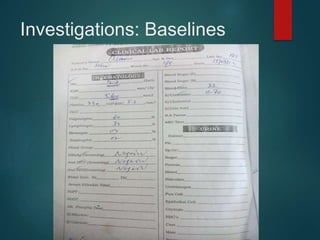
Investigations: Baselines
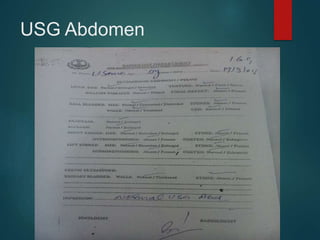
USG Abdomen
Rectal
Prolapse
DR. HASSAN MAHMUD
PGR TEACHING SURGERY UNIT
A.B.S.T.H
Outline
 Introduction
 Types
 Etiology
 Pathophysiology
 Clinical Features
 Evaluation
 Examination
 Investigations
 Non surgical Management
 Surgical Management
 Complication
Introduction
Rectal Prolapse is circumferential descent of rectum
(bowel) through the anal canal.
Common in infants, children & elderly
Common in females (6:1)
Types
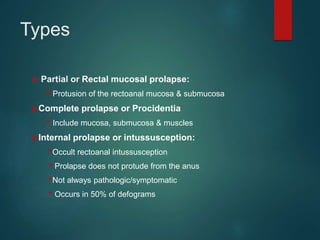
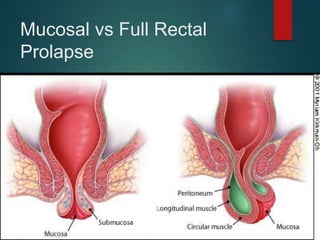
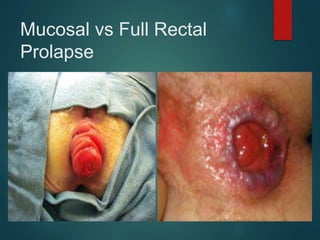
 Partial or Rectal mucosal prolapse:
• Protusion of the rectoanal mucosa & submucosa
Complete prolapse or Procidentia
• Include mucosa, submucosa & muscles
Internal prolapse or intussusception:
•Occult rectoanal intussusception
• Prolapse does not protude from the anus
•Not always pathologic/symptomatic
• Occurs in 50% of defograms
Mucosal vs Full Rectal
Prolapse
Mucosal vs Full Rectal
Prolapse
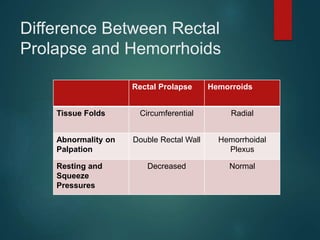
Difference Between Rectal
Prolapse and Hemorrhoids
Rectal Prolapse Hemorroids
Tissue Folds Circumferential Radial
Abnormality on
Palpation
Double Rectal Wall Hemorrhoidal
Plexus
Resting and
Squeeze
Pressures
Decreased Normal
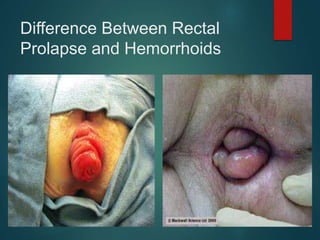
Difference Between Rectal
Prolapse and Hemorrhoids
Etiology
 Extreme of age
 Children: first three years (male=female)
● Cystic fibrosis, malnutrition, diarrhea, severe cough,
parasites
Constipation (component of colonic dysmotility)
Weakening/malfunctioning of pelvic floor/sphincters
Anismus – spastic pelvic floor
Pudendal neuropathy (obstetric injuries, aging)
Sphincter dysfunction (trauma, aging)
Decreased sacral curvature
Multipara female
Diarrhea, cough, malnutrition
Decreased ischiorectal fossa fat
Mental illness (depression, autism)
Pathophysiology
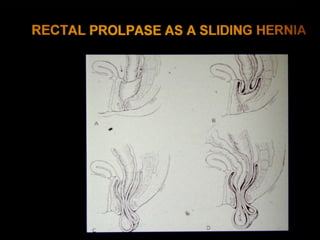
 Rectum passes through opening in pelvic floor
funnel
 Intussusception occurs much like
what happened with hiatal hernia
• Lateral & rectosigmoid attachments relax
• Mesorectum lengthens
•Anal sphincters stretch
• Rectal prolapse
Pathophysiology
 Associated pelvic anatomic abnormalities
● Deep anterior cul de sac
● Redundant sigmoid colon
● Patulous anal sphincter
● Loss of posterior rectal fixation
Clinical Features
 Mucus Discharge
 Rectal Bleeding
 Soilage
 Feeling of incomplete evacuation
 Diarrhea, constipation, Fecal Incontinence
 Itching
Clinical Features
 Constipation is associated with prolapse in 30%-70%
of pts
 Chronic straining, sensation of anorectal blockage,
need of digital evacation
 60% have coexisting incontinence
● Stretching of anal sphincters
● Impaired rectal compliance
 20-35% have associated urinary incontinence
Evaluation
 Ask patient to produce the prolapse
 If not obvious
● straining in sitting position (toilet)
● phosphate enema or glycerine suppositories
(children) to induce strain
 Look for associate vaginal prolapse (15-30%)
Examination
 Concentric rings and grooves
 Perianal skin excoriation and maceration
 Chronic prolapse
● Inflamed, edematous and irregular surface
● Biopsies to rule out neoplasia
 Digital examination
● Sphincter pressures
Investigations
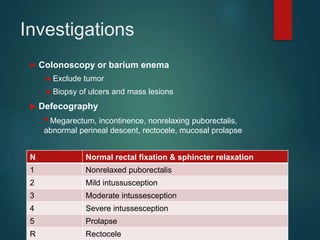
 Colonoscopy or barium enema
● Exclude tumor
● Biopsy of ulcers and mass lesions
 Defecography
• Megarectum, incontinence, nonrelaxing puborectalis,
abnormal perineal descent, rectocele, mucosal prolapse
N Normal rectal fixation & sphincter relaxation
1 Nonrelaxed puborectalis
2 Mild intussusception
3 Moderate intussesception
4 Severe intussesception
5 Prolapse
R Rectocele
Investigations
 Anal manometry can help assess sphincters
● Longstanding prolapse may damage internal sphincter
 EMG for patients with history of severe straining
 Pudendal nerve latency study
Pudendal nerve terminal motor latency (1.8-2.2msec)
Non operative management
 Treat constipation
● Fiber supplements
● Stool softeners
 Reduce incarcerated rectal prolapse
● Table sugar
Surgical Treatment
 Pertial Rectal prolapse
 Improve nutrition, correct constipation
 Submucosal injection of 10ml of 5% phenol in almond oil,
tetracycline, hypertonic saline
 Thiresch wiring
 Goodsall,s operation(excision of prolapsed mucosa at
three different places)
 Stapled transanal rectal resection surgery(STARR)
Surgical Treatment
Complete Rectal Prolapse
 Perineal procedures
● Resection, reefing, and encirclement
 Abdominal procedures
● Fixation, colon resection or combination of both
Choosing Type of Surgery/
Perineal
 High-risk or eldery patients
 Advantages
● Low morbidity and pain
● Low mortality
 Disadvantages
● Higher recurrence rate
● Risks coloanal leak
Choosing Type of Surgery/
Abdominal
 Overall better results than perineal
approaches
 Full mobilization of the rectum, sacral fixation
with or without resection
 Younger patients
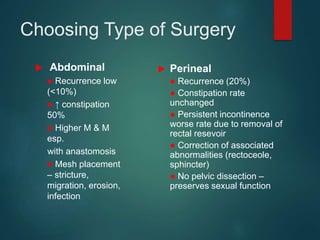
Choosing Type of Surgery
 Perineal
● Recurrence (20%)
● Constipation rate
unchanged
● Persistent incontinence
worse rate due to removal of
rectal resevoir
● Correction of associated
abnormalities (rectoceole,
sphincter)
● No pelvic dissection –
preserves sexual function
 Abdominal
● Recurrence low
(<10%)
● ↑ constipation
50%
● Higher M & M
esp.
with anastomosis
● Mesh placement
– stricture,
migration, erosion,
infection
Perineal Procedures
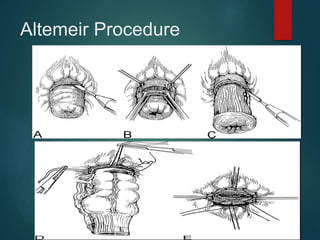
 Perineal Proctosigmoidectomy – Altemeir
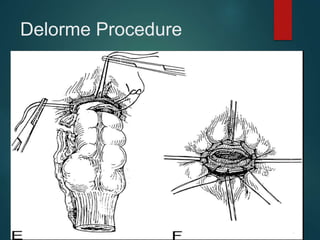
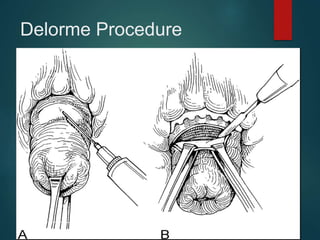
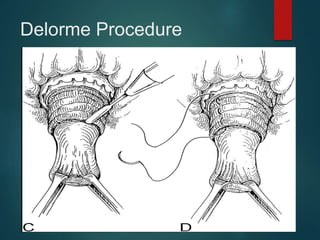
 Mucosal Sleeve Resection - Delorme
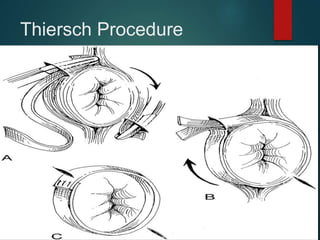
 Anal Encirclement - Thiersch Wire Technique
 Perineal suspension/fixation - Wyatt
Altemeir Procedure
Delorme Procedure
Delorme Procedure
Delorme Procedure
Thiersch Procedure
Perineal Procedures -
Advocates
 Pts suffer mainly from incontinence, constipation
and decreased quality of life
 Pts are not mainly threatened from recurrence
 Surgery should be verified in priority to its effect on
post op QOL rather than recurrence
Abdominal Procedures
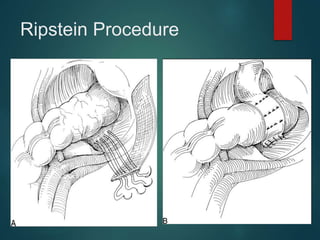
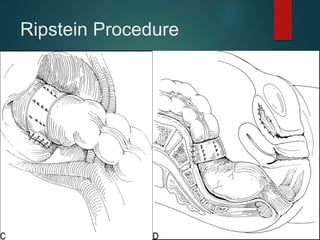
 Anterior rectopexy or Ripstein procedure
● Anterior wrapping of the rectum and fixation to sacrum
 Posterior rectopexy - Wells procedure
● Synthetic mesh
● Sutures alone
 Sigmoid colectomy with sutured rectopexy
● Low recurrence
● Low morbidity
● Improves constipation
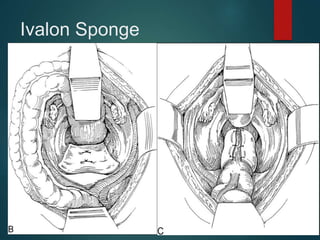
Materials used for Mesh
Rectopexy
 Natural
• Fascia Lata
 Non-absorbable Synthetic
• Nylon
• Polypropylene
• Marlex
• Polyvinyl Alcohol
• Polytef
 Absorbable Synthetic
• Polyglactin
• Polyglycolic Acid
Ripstein Procedure
Ripstein Procedure
Ivalon Sponge
Laparoscopic Rectopexy
 Largely replacing open abdominal procedures
 Ease of performing rectopexy and colon resection
simultaneously with shorter hospital stay
 Morbidity and mortality no different than open controls
 Recurrence rate lower but not statistically significant
Laparoscopic Rectopexy
 Ideal approach
 Laproscopic posterior mesh rectopexy
 Posterior as well as anterior mobilisation of rectum done,
mesh placed in presacral region and sutured to rectal
wall and presacral fascia
 Laproscopic sigmoid resection and
rectopexy
 Done in rectal prolapse with constipation, excess
redundant sigmoid colon with kinking
Complications
 Injury to hypogastric nerve causing impotence
 Bladder dysfunction
 Bleeding from sacral venous plexus
 Injury to rectum & colon causing fistula
 Constipation after rectopexy
 Recurrence
 Infection
Recurrence
 Can happen after either perineal or abdominal
procedure
● Overall 15% recurrence rate (range is 0-60%)
● Abdominal operations – up to 10%
● Perineal operations – up to 20%
Recurrence
 2 types of recurrence
● Mucosal
● Full thickness
 Early recurrence
● Occurs within first year
● Likely the result of a specific technical failure
 Non-early(late) recurrence
● Generally occurs 18-24 months postoperatively
Recurrence - Etiology
 Surgical factors
● Inadequate mobilization of rectum
● Inadequate fixation of the rectum to the sacrum
● Incomplete resection of a redundant rectosigmoid
 Nonsurgical factors:
● Vigorous physical activity or childbirth – disruption of pexy
● Continued constipation with persistent straining
 Pathophysiologic factors:
● Disordered defecation
● Intestinal dysmotility
Any Question???

Rectal prolapse

  • 1.
    Approach to Pt. WithSomething Coming out of Anus DR. HASSAN MAHMUD PGR TEACHING SURGERY UNIT A.B.S.T.H
  • 2.
    History  Usama  15year  Male  Student  Kotla Gujrat  Opd  15-03-16
  • 3.
    Presenting Complaint  Somethingcoming out of anus- 4years  Bleeding PR on & off- 4years
  • 4.
    HOPI  Pt. wasalright 4 years back when he noticed something coming out of anus. It was initially small but gradually increased in size. It is including whole circumference of anus. It always comes out during defecation or straining. It is associated with bleeding per rectum. It is of bright red color & comes after defecation. There is no associated bruises on skin or Hx of gum bleed. No Hx of constipation, diarrhea, jaundice. He has Hx of sodomy.
  • 5.
    Cont.  No pastmedical or surgical Hx  No family Hx  No personal Hx  No drug Hx
  • 6.
    Impression  Rectal Prolapse Large rectal polyp  Hemorrhoids
  • 7.
    Examination  A younghealthy boy, well oriented, lying comfortably on bed  Vitals: Pulse: 82/min Temp: 98 degree F B.P: 110/70 mmHg R.R: 24/min
  • 8.
    Examination  A pinkishmass coming out of anus during straining, covering anus circumferentially, soft in consistency, non tender, no bleeding spots, having concentric rings and grooves around its wall, reduced manually.
  • 9.
    Cont.  GIT: Normal CVS: Normal  CNS: Normal  Resp: Normal  Genitourinary: Normal
  • 10.
  • 11.
  • 12.
    Rectal Prolapse DR. HASSAN MAHMUD PGRTEACHING SURGERY UNIT A.B.S.T.H
  • 13.
    Outline  Introduction  Types Etiology  Pathophysiology  Clinical Features  Evaluation  Examination  Investigations  Non surgical Management  Surgical Management  Complication
  • 14.
    Introduction Rectal Prolapse iscircumferential descent of rectum (bowel) through the anal canal. Common in infants, children & elderly Common in females (6:1)
  • 15.
    Types  Partial orRectal mucosal prolapse: • Protusion of the rectoanal mucosa & submucosa Complete prolapse or Procidentia • Include mucosa, submucosa & muscles Internal prolapse or intussusception: •Occult rectoanal intussusception • Prolapse does not protude from the anus •Not always pathologic/symptomatic • Occurs in 50% of defograms
  • 16.
    Mucosal vs FullRectal Prolapse
  • 17.
    Mucosal vs FullRectal Prolapse
  • 18.
    Difference Between Rectal Prolapseand Hemorrhoids Rectal Prolapse Hemorroids Tissue Folds Circumferential Radial Abnormality on Palpation Double Rectal Wall Hemorrhoidal Plexus Resting and Squeeze Pressures Decreased Normal
  • 19.
  • 20.
    Etiology  Extreme ofage  Children: first three years (male=female) ● Cystic fibrosis, malnutrition, diarrhea, severe cough, parasites Constipation (component of colonic dysmotility) Weakening/malfunctioning of pelvic floor/sphincters Anismus – spastic pelvic floor Pudendal neuropathy (obstetric injuries, aging) Sphincter dysfunction (trauma, aging) Decreased sacral curvature Multipara female Diarrhea, cough, malnutrition Decreased ischiorectal fossa fat Mental illness (depression, autism)
  • 21.
    Pathophysiology  Rectum passesthrough opening in pelvic floor funnel  Intussusception occurs much like what happened with hiatal hernia • Lateral & rectosigmoid attachments relax • Mesorectum lengthens •Anal sphincters stretch • Rectal prolapse
  • 23.
    Pathophysiology  Associated pelvicanatomic abnormalities ● Deep anterior cul de sac ● Redundant sigmoid colon ● Patulous anal sphincter ● Loss of posterior rectal fixation
  • 24.
    Clinical Features  MucusDischarge  Rectal Bleeding  Soilage  Feeling of incomplete evacuation  Diarrhea, constipation, Fecal Incontinence  Itching
  • 25.
    Clinical Features  Constipationis associated with prolapse in 30%-70% of pts  Chronic straining, sensation of anorectal blockage, need of digital evacation  60% have coexisting incontinence ● Stretching of anal sphincters ● Impaired rectal compliance  20-35% have associated urinary incontinence
  • 26.
    Evaluation  Ask patientto produce the prolapse  If not obvious ● straining in sitting position (toilet) ● phosphate enema or glycerine suppositories (children) to induce strain  Look for associate vaginal prolapse (15-30%)
  • 27.
    Examination  Concentric ringsand grooves  Perianal skin excoriation and maceration  Chronic prolapse ● Inflamed, edematous and irregular surface ● Biopsies to rule out neoplasia  Digital examination ● Sphincter pressures
  • 28.
    Investigations  Colonoscopy orbarium enema ● Exclude tumor ● Biopsy of ulcers and mass lesions  Defecography • Megarectum, incontinence, nonrelaxing puborectalis, abnormal perineal descent, rectocele, mucosal prolapse N Normal rectal fixation & sphincter relaxation 1 Nonrelaxed puborectalis 2 Mild intussusception 3 Moderate intussesception 4 Severe intussesception 5 Prolapse R Rectocele
  • 29.
    Investigations  Anal manometrycan help assess sphincters ● Longstanding prolapse may damage internal sphincter  EMG for patients with history of severe straining  Pudendal nerve latency study Pudendal nerve terminal motor latency (1.8-2.2msec)
  • 30.
    Non operative management Treat constipation ● Fiber supplements ● Stool softeners  Reduce incarcerated rectal prolapse ● Table sugar
  • 31.
    Surgical Treatment  PertialRectal prolapse  Improve nutrition, correct constipation  Submucosal injection of 10ml of 5% phenol in almond oil, tetracycline, hypertonic saline  Thiresch wiring  Goodsall,s operation(excision of prolapsed mucosa at three different places)  Stapled transanal rectal resection surgery(STARR)
  • 32.
    Surgical Treatment Complete RectalProlapse  Perineal procedures ● Resection, reefing, and encirclement  Abdominal procedures ● Fixation, colon resection or combination of both
  • 33.
    Choosing Type ofSurgery/ Perineal  High-risk or eldery patients  Advantages ● Low morbidity and pain ● Low mortality  Disadvantages ● Higher recurrence rate ● Risks coloanal leak
  • 34.
    Choosing Type ofSurgery/ Abdominal  Overall better results than perineal approaches  Full mobilization of the rectum, sacral fixation with or without resection  Younger patients
  • 35.
    Choosing Type ofSurgery  Perineal ● Recurrence (20%) ● Constipation rate unchanged ● Persistent incontinence worse rate due to removal of rectal resevoir ● Correction of associated abnormalities (rectoceole, sphincter) ● No pelvic dissection – preserves sexual function  Abdominal ● Recurrence low (<10%) ● ↑ constipation 50% ● Higher M & M esp. with anastomosis ● Mesh placement – stricture, migration, erosion, infection
  • 36.
    Perineal Procedures  PerinealProctosigmoidectomy – Altemeir  Mucosal Sleeve Resection - Delorme  Anal Encirclement - Thiersch Wire Technique  Perineal suspension/fixation - Wyatt
  • 37.
  • 38.
  • 39.
  • 40.
  • 41.
  • 42.
    Perineal Procedures - Advocates Pts suffer mainly from incontinence, constipation and decreased quality of life  Pts are not mainly threatened from recurrence  Surgery should be verified in priority to its effect on post op QOL rather than recurrence
  • 43.
    Abdominal Procedures  Anteriorrectopexy or Ripstein procedure ● Anterior wrapping of the rectum and fixation to sacrum  Posterior rectopexy - Wells procedure ● Synthetic mesh ● Sutures alone  Sigmoid colectomy with sutured rectopexy ● Low recurrence ● Low morbidity ● Improves constipation
  • 44.
    Materials used forMesh Rectopexy  Natural • Fascia Lata  Non-absorbable Synthetic • Nylon • Polypropylene • Marlex • Polyvinyl Alcohol • Polytef  Absorbable Synthetic • Polyglactin • Polyglycolic Acid
  • 45.
  • 46.
  • 47.
  • 48.
    Laparoscopic Rectopexy  Largelyreplacing open abdominal procedures  Ease of performing rectopexy and colon resection simultaneously with shorter hospital stay  Morbidity and mortality no different than open controls  Recurrence rate lower but not statistically significant
  • 49.
    Laparoscopic Rectopexy  Idealapproach  Laproscopic posterior mesh rectopexy  Posterior as well as anterior mobilisation of rectum done, mesh placed in presacral region and sutured to rectal wall and presacral fascia  Laproscopic sigmoid resection and rectopexy  Done in rectal prolapse with constipation, excess redundant sigmoid colon with kinking
  • 50.
    Complications  Injury tohypogastric nerve causing impotence  Bladder dysfunction  Bleeding from sacral venous plexus  Injury to rectum & colon causing fistula  Constipation after rectopexy  Recurrence  Infection
  • 51.
    Recurrence  Can happenafter either perineal or abdominal procedure ● Overall 15% recurrence rate (range is 0-60%) ● Abdominal operations – up to 10% ● Perineal operations – up to 20%
  • 52.
    Recurrence  2 typesof recurrence ● Mucosal ● Full thickness  Early recurrence ● Occurs within first year ● Likely the result of a specific technical failure  Non-early(late) recurrence ● Generally occurs 18-24 months postoperatively
  • 53.
    Recurrence - Etiology Surgical factors ● Inadequate mobilization of rectum ● Inadequate fixation of the rectum to the sacrum ● Incomplete resection of a redundant rectosigmoid  Nonsurgical factors: ● Vigorous physical activity or childbirth – disruption of pexy ● Continued constipation with persistent straining  Pathophysiologic factors: ● Disordered defecation ● Intestinal dysmotility
  • 54.