RECTAL PROLAPSE
1
OUTLINE
Introduction
Epidemiology
Risk Factors
Types
Causes
Clinical Presentation
Diagnosis
Management
Complication
References
2
INTRODUCTION
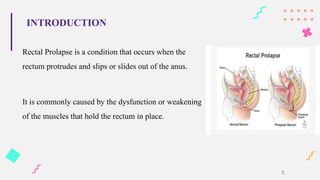
Rectal Prolapse is a condition that occurs when the
rectum protrudes and slips or slides out of the anus.
It is commonly caused by the dysfunction or weakening
of the muscles that hold the rectum in place.
3
Introduction
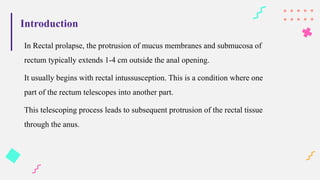
In Rectal prolapse, the protrusion of mucus membranes and submucosa of
rectum typically extends 1-4 cm outside the anal opening.
It usually begins with rectal intussusception. This is a condition where one
part of the rectum telescopes into another part.
This telescoping process leads to subsequent protrusion of the rectal tissue
through the anus.
The Rectum
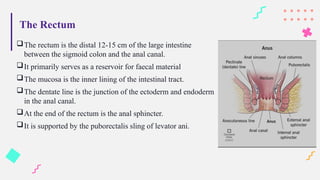
The rectum is the distal 12-15 cm of the large intestine
between the sigmoid colon and the anal canal.
It primarily serves as a reservoir for faecal material
The mucosa is the inner lining of the intestinal tract.
The dentate line is the junction of the ectoderm and endoderm
in the anal canal.
At the end of the rectum is the anal sphincter.
It is supported by the puborectalis sling of levator ani.
It is uncommon, with a prevalence of about 0.25% in adults.
It is estimated that the annual incidence of rectal prolapse was found to be 2.5 per
100,000 population
It is more common in women than men. The male-to-female ratio is 1:6
Pediatric patients usually are affected when younger than 3 years, with the peak
incidence in the first year of life.
EPIDEMIOLOGY
RISK FACTORS
Age ( > 40 years)
Gender ( Female > Male)

Multiparity
Vaginal Delivery
Previous pelvic surgery
Chronic constipation
Chronic diarrhea
7
TYPES OF RECTAL PROLAPSE
Rectal prolapse may be grouped into two;
Partial thickness or mucosal prolapse
Full thickness prolapse
8
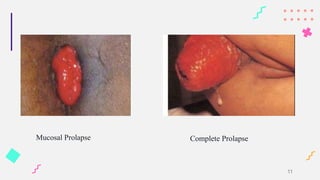
Mucosal Prolapse
This involves protrusion of only the rectal mucosa (not the entire wall) from the
anus.
It generally occurs when the connective tissue attachments of the rectal mucosa are
loosened and stretched, thus allowing the tissue to prolapse through the anus.
It mostly occurs in children and managed conservatively.
9
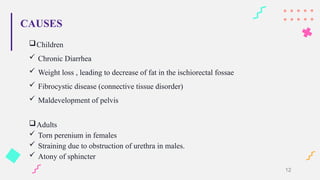
Complete Prolapse
This is also known as full thickness rectal prolapse
In this, the entire thickness of the the rectal wall is extruded.
It mainly occurs in adults.
It is frequently associated with symptoms of fecal incontinence.
Presence of full thickening can impact bowel control and may require surgical
intervention for optimal management.
10
Mucosal Prolapse
11
Complete Prolapse
CAUSES
Children
 Chronic Diarrhea
 Weight loss , leading to decrease of fat in the ischiorectal fossae
 Fibrocystic disease (connective tissue disorder)
 Maldevelopment of pelvis
Adults
 Torn perenium in females
 Straining due to obstruction of urethra in males.
 Atony of sphincter
12
CLINICAL PRESENTATION
 Abdominal pain and discomfort
 Bleeding from the anus
 Mucous discharge from the anus
 Faecal Incontinence or reduced ability to control the bowels.
 Protrusion of the rectum through the anus that may reduce spontaneously or require
manual reduction
 Leakage of liquefied faeces, particularly following a bowel motion
 The feeling of constipation or that the rectum is never completely emptied after passing a
motion
13
DIAGNOSIS
History Taking
Physical Examination
 Visual inspection of anus
 Digital rectal exam, using gloved finger
Colonsocopy : This test examines the inside of your large intestine with a flexible scope.
Defecography: This is an imaging study of your muscles when you poop, using an X-ray
or MRI.
14
Diagnosis
 Electromyography: This test determines if nerve damage is the reason why the anal
sphincters are not working properly. It also examines muscle coordination.
 Barium enema (Lower GI series): A chalky liquid containing barium is placed in your
rectum. A series of video X-rays of your lower gastrointestinal tract.
 Manometry : Involves measure of pressure within rectum and anal canal.
15
Differential Diagnosis
Hemorrhoids
There are some similarities, in that, there is bleeding and tissue protrusion in both rectal
prolapse and hemorrhoids.
Differences
 Rectal prolapse involves an entire segment of the bowel located higher up within the body
while hemorrhoids only involve the inner layer of the bowel near the anal opening.
16
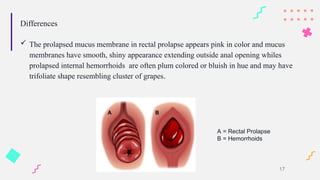
Differences
 The prolapsed mucus membrane in rectal prolapse appears pink in color and mucus
membranes have smooth, shiny appearance extending outside anal opening whiles
prolapsed internal hemorrhoids are often plum colored or bluish in hue and may have
trifoliate shape resembling cluster of grapes.
17
A = Rectal Prolapse
B = Hemorrhoids
MANAGEMENT
Goals of therapy
 To relieve pain and to stop bleeding
 Restore normal bowel function
 To prevent complications
 To improve patient’s quality of life
18
Management
Surgical Management
Non- surgical management
19
Non-Surgical Management
This is mostly done in children or when a patient refuses surgery.
 Management includes treating underlying causes.
 The buttocks can also be firmly strapped together with tape between bowel
movements to facilitate spontaneous resolution of prolapse.
 In small or mild prolapse recently occuring, the prolapsed rectum can be pushed back
by applying pressure with hand.
20
Non-Surgical Management
 Manual anal support during defecation
 Perineal exercises
 Electrical stimulation
 Submucosal injection of phenol in almond oil
21
Non- Surgical Management - Medications
Stool softeners
 Docusate Sodium ( 50-300mg PO OD or divided doses)
 Liquid paraffin, oral, Adults; 10-30 ml at night
 Mineral oil ( 15-45 mL/day PO, single or divided dose)
22
Medications
Osmotic Laxative
 Lactulose (15-30 mL (10-20 g) PO once daily, dose adjusted according to stools
passed)
 Polyethylene glycol ( ~1 heap spoon of oral powder in 120-240 mL of beverage
per day)
 Glycerine suppositories.
 Analgesics for pain management.
23
Surgical Management
This is the treatment of choice.
There are two main procedures;
Abdominal Procedures
Perineal Procedures
The choice of surgical procedure depends on the age, overall health and surgical
considerations.
24
Abdominal Procedures
This is the procedure of choice for the young and fit individuals due to their potential for
improving continence and having lower recurrence rates.
It is not suitable for the elderly or infirmed patients.
Procedure includes:
Abdominal Rectopexy
Laparascopic Rectopexy
Resection Rectopexy
25
Abdominal Rectopexy
Rectopexy refers to the fixation of the rectum in the pelvis with nonabsorbable suture or
mesh. Suturing the rectum to the sacral promontory aims to prevent the telescoping of the
redundant bowel.
 Suture Rectopexy:
Suture rectopexy is when the rectum is surgically fixed to sacrum using sutures. It reduces
the risk of foreign body reactions but has a slightly higher recurrence rate.
26
Abdominal Rectopexy
Anterior Mesh Rectopexy
With this procedure, a synthetic mesh is placed around the rectum and fixed to the sacrum. It
provides strong support but carries a risk of infection and constipation.
Posterior Mesh Rectopexy
The rectum is mobilized and attached to the sacrum while preserving autonomic nerves. The
mesh is positioned posteriorly between rectum and sacrum. This procedure lowers the risk of
constipation compared to anterior mesh rectopexy.
27
Laparoscopic Rectopexy
A minimally invasive approach (laparoscopic or robotic), where a mesh is placed
ventrally to reinforce the rectovaginal or rectovesical septum.
Advantages of this procedure are lower risk of constipation, less nerve damage, and
good long-term outcomes.
28
Resection Rectopexy
This procedure combines rectopexy with resection of a redundant segment of the
sigmoid colon to reduce constipation.
It involves removing the sigmoid colon and fixing the rectum to the sacrum.
It is recommended for patients with chronic constipation and redundant bowel loops.
29
Perineal Procedure
This procedure is well tolerated by the elderly, frail/unfit patients.
It is less likely to improve continence
It includes;
 Delorme's mucosectomy
 Thiersch & Encirclement
 Atemeier Rectosigmoidectomy
30
Delorme's Mucosectomy
This is a procedure where the prolapse mucosa is excised and rectal wall,
plicated or folded to reduce prolapse.
It is typically performed for short segment ( 1 to 3cm ) rectal prolapse
31
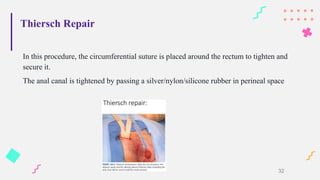
Thiersch Repair
In this procedure, the circumferential suture is placed around the rectum to tighten and
secure it.
The anal canal is tightened by passing a silver/nylon/silicone rubber in perineal space
32
Atemeier Rectosigmoidectomy
In this procedure, the prolapsed portion of the rectum is exorcised/resected and
remaining part of rectum is sutured/ stapled closed.
It is typically for rectal prolapse that are more extensive (> 3cm ).
33
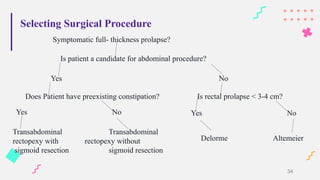
Selecting Surgical Procedure
Symptomatic full- thickness prolapse?
34
Is patient a candidate for abdominal procedure?
Yes No
Does Patient have preexisting constipation? Is rectal prolapse < 3-4 cm?
Yes No Yes No
Transabdominal Transabdominal
rectopexy with rectopexy without
sigmoid resection sigmoid resection
Delorme Altemeier
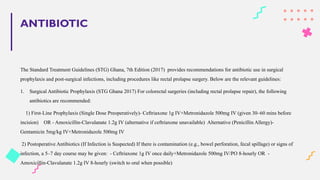
ANTIBIOTIC
The Standard Treatment Guidelines (STG) Ghana, 7th Edition (2017) provides recommendations for antibiotic use in surgical
prophylaxis and post-surgical infections, including procedures like rectal prolapse surgery. Below are the relevant guidelines:
1. Surgical Antibiotic Prophylaxis (STG Ghana 2017) For colorectal surgeries (including rectal prolapse repair), the following
antibiotics are recommended:
1) First-Line Prophylaxis (Single Dose Preoperatively)- Ceftriaxone 1g IV+Metronidazole 500mg IV (given 30–60 mins before
incision) OR - Amoxicillin-Clavulanate 1.2g IV (alternative if ceftriaxone unavailable) Alternative (Penicillin Allergy)-
Gentamicin 5mg/kg IV+Metronidazole 500mg IV
2) Postoperative Antibiotics (If Infection is Suspected) If there is contamination (e.g., bowel perforation, fecal spillage) or signs of
infection, a 5–7 day course may be given: - Ceftriaxone 1g IV once daily+Metronidazole 500mg IV/PO 8-hourly OR -
Amoxicillin-Clavulanate 1.2g IV 8-hourly (switch to oral when possible)
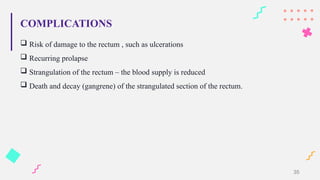
COMPLICATIONS
 Risk of damage to the rectum , such as ulcerations
 Recurring prolapse
 Strangulation of the rectum – the blood supply is reduced
 Death and decay (gangrene) of the strangulated section of the rectum.
35
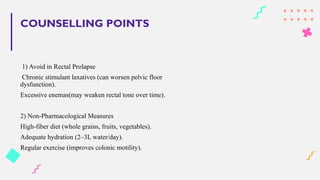
COUNSELLING POINTS
1) Avoid in Rectal Prolapse
Chronic stimulant laxatives (can worsen pelvic floor
dysfunction).
Excessive enemas(may weaken rectal tone over time).
2) Non-Pharmacological Measures
High-fiber diet (whole grains, fruits, vegetables).
Adequate hydration (2–3L water/day).
Regular exercise (improves colonic motility).
REFERENCES
1. Bordeianou L, Paquette I, Johnson E, et al. Clinical Practice Guidelines for the
Treatment of Rectal Prolapse. Dis Colon Rectum 2017; 60:1121.
2. Emile SH, Elbanna H, Youssef M, et al. Laparoscopic ventral mesh rectopexy vs
Delorme's operation in management of complete rectal prolapse: a prospective
randomized study. Colorectal Dis 2017; 19:50.
3. American society of Colon and Rectal Surgeons, Clinical Practice guidelines for the
treatment of rectal Prolapse (2017).
36
ThankYou!
Have a nice day 

RECTAL PROLAPSE !!!!!!!!!-1.pptx hdhdbdh

  • 1.
  • 2.
  • 3.
    INTRODUCTION Rectal Prolapse isa condition that occurs when the rectum protrudes and slips or slides out of the anus. It is commonly caused by the dysfunction or weakening of the muscles that hold the rectum in place. 3
  • 4.
    Introduction In Rectal prolapse,the protrusion of mucus membranes and submucosa of rectum typically extends 1-4 cm outside the anal opening. It usually begins with rectal intussusception. This is a condition where one part of the rectum telescopes into another part. This telescoping process leads to subsequent protrusion of the rectal tissue through the anus.
  • 5.
    The Rectum The rectumis the distal 12-15 cm of the large intestine between the sigmoid colon and the anal canal. It primarily serves as a reservoir for faecal material The mucosa is the inner lining of the intestinal tract. The dentate line is the junction of the ectoderm and endoderm in the anal canal. At the end of the rectum is the anal sphincter. It is supported by the puborectalis sling of levator ani.
  • 6.
    It is uncommon,with a prevalence of about 0.25% in adults. It is estimated that the annual incidence of rectal prolapse was found to be 2.5 per 100,000 population It is more common in women than men. The male-to-female ratio is 1:6 Pediatric patients usually are affected when younger than 3 years, with the peak incidence in the first year of life. EPIDEMIOLOGY
  • 7.
    RISK FACTORS Age (> 40 years) Gender ( Female > Male) Multiparity Vaginal Delivery Previous pelvic surgery Chronic constipation Chronic diarrhea 7
  • 8.
    TYPES OF RECTALPROLAPSE Rectal prolapse may be grouped into two; Partial thickness or mucosal prolapse Full thickness prolapse 8
  • 9.
    Mucosal Prolapse This involvesprotrusion of only the rectal mucosa (not the entire wall) from the anus. It generally occurs when the connective tissue attachments of the rectal mucosa are loosened and stretched, thus allowing the tissue to prolapse through the anus. It mostly occurs in children and managed conservatively. 9
  • 10.
    Complete Prolapse This isalso known as full thickness rectal prolapse In this, the entire thickness of the the rectal wall is extruded. It mainly occurs in adults. It is frequently associated with symptoms of fecal incontinence. Presence of full thickening can impact bowel control and may require surgical intervention for optimal management. 10
  • 11.
  • 12.
    CAUSES Children  Chronic Diarrhea Weight loss , leading to decrease of fat in the ischiorectal fossae  Fibrocystic disease (connective tissue disorder)  Maldevelopment of pelvis Adults  Torn perenium in females  Straining due to obstruction of urethra in males.  Atony of sphincter 12
  • 13.
    CLINICAL PRESENTATION  Abdominalpain and discomfort  Bleeding from the anus  Mucous discharge from the anus  Faecal Incontinence or reduced ability to control the bowels.  Protrusion of the rectum through the anus that may reduce spontaneously or require manual reduction  Leakage of liquefied faeces, particularly following a bowel motion  The feeling of constipation or that the rectum is never completely emptied after passing a motion 13
  • 14.
    DIAGNOSIS History Taking Physical Examination Visual inspection of anus  Digital rectal exam, using gloved finger Colonsocopy : This test examines the inside of your large intestine with a flexible scope. Defecography: This is an imaging study of your muscles when you poop, using an X-ray or MRI. 14
  • 15.
    Diagnosis  Electromyography: Thistest determines if nerve damage is the reason why the anal sphincters are not working properly. It also examines muscle coordination.  Barium enema (Lower GI series): A chalky liquid containing barium is placed in your rectum. A series of video X-rays of your lower gastrointestinal tract.  Manometry : Involves measure of pressure within rectum and anal canal. 15
  • 16.
    Differential Diagnosis Hemorrhoids There aresome similarities, in that, there is bleeding and tissue protrusion in both rectal prolapse and hemorrhoids. Differences  Rectal prolapse involves an entire segment of the bowel located higher up within the body while hemorrhoids only involve the inner layer of the bowel near the anal opening. 16
  • 17.
    Differences  The prolapsedmucus membrane in rectal prolapse appears pink in color and mucus membranes have smooth, shiny appearance extending outside anal opening whiles prolapsed internal hemorrhoids are often plum colored or bluish in hue and may have trifoliate shape resembling cluster of grapes. 17 A = Rectal Prolapse B = Hemorrhoids
  • 18.
    MANAGEMENT Goals of therapy To relieve pain and to stop bleeding  Restore normal bowel function  To prevent complications  To improve patient’s quality of life 18
  • 19.
  • 20.
    Non-Surgical Management This ismostly done in children or when a patient refuses surgery.  Management includes treating underlying causes.  The buttocks can also be firmly strapped together with tape between bowel movements to facilitate spontaneous resolution of prolapse.  In small or mild prolapse recently occuring, the prolapsed rectum can be pushed back by applying pressure with hand. 20
  • 21.
    Non-Surgical Management  Manualanal support during defecation  Perineal exercises  Electrical stimulation  Submucosal injection of phenol in almond oil 21
  • 22.
    Non- Surgical Management- Medications Stool softeners  Docusate Sodium ( 50-300mg PO OD or divided doses)  Liquid paraffin, oral, Adults; 10-30 ml at night  Mineral oil ( 15-45 mL/day PO, single or divided dose) 22
  • 23.
    Medications Osmotic Laxative  Lactulose(15-30 mL (10-20 g) PO once daily, dose adjusted according to stools passed)  Polyethylene glycol ( ~1 heap spoon of oral powder in 120-240 mL of beverage per day)  Glycerine suppositories.  Analgesics for pain management. 23
  • 24.
    Surgical Management This isthe treatment of choice. There are two main procedures; Abdominal Procedures Perineal Procedures The choice of surgical procedure depends on the age, overall health and surgical considerations. 24
  • 25.
    Abdominal Procedures This isthe procedure of choice for the young and fit individuals due to their potential for improving continence and having lower recurrence rates. It is not suitable for the elderly or infirmed patients. Procedure includes: Abdominal Rectopexy Laparascopic Rectopexy Resection Rectopexy 25
  • 26.
    Abdominal Rectopexy Rectopexy refersto the fixation of the rectum in the pelvis with nonabsorbable suture or mesh. Suturing the rectum to the sacral promontory aims to prevent the telescoping of the redundant bowel.  Suture Rectopexy: Suture rectopexy is when the rectum is surgically fixed to sacrum using sutures. It reduces the risk of foreign body reactions but has a slightly higher recurrence rate. 26
  • 27.
    Abdominal Rectopexy Anterior MeshRectopexy With this procedure, a synthetic mesh is placed around the rectum and fixed to the sacrum. It provides strong support but carries a risk of infection and constipation. Posterior Mesh Rectopexy The rectum is mobilized and attached to the sacrum while preserving autonomic nerves. The mesh is positioned posteriorly between rectum and sacrum. This procedure lowers the risk of constipation compared to anterior mesh rectopexy. 27
  • 28.
    Laparoscopic Rectopexy A minimallyinvasive approach (laparoscopic or robotic), where a mesh is placed ventrally to reinforce the rectovaginal or rectovesical septum. Advantages of this procedure are lower risk of constipation, less nerve damage, and good long-term outcomes. 28
  • 29.
    Resection Rectopexy This procedurecombines rectopexy with resection of a redundant segment of the sigmoid colon to reduce constipation. It involves removing the sigmoid colon and fixing the rectum to the sacrum. It is recommended for patients with chronic constipation and redundant bowel loops. 29
  • 30.
    Perineal Procedure This procedureis well tolerated by the elderly, frail/unfit patients. It is less likely to improve continence It includes;  Delorme's mucosectomy  Thiersch & Encirclement  Atemeier Rectosigmoidectomy 30
  • 31.
    Delorme's Mucosectomy This isa procedure where the prolapse mucosa is excised and rectal wall, plicated or folded to reduce prolapse. It is typically performed for short segment ( 1 to 3cm ) rectal prolapse 31
  • 32.
    Thiersch Repair In thisprocedure, the circumferential suture is placed around the rectum to tighten and secure it. The anal canal is tightened by passing a silver/nylon/silicone rubber in perineal space 32
  • 33.
    Atemeier Rectosigmoidectomy In thisprocedure, the prolapsed portion of the rectum is exorcised/resected and remaining part of rectum is sutured/ stapled closed. It is typically for rectal prolapse that are more extensive (> 3cm ). 33
  • 34.
    Selecting Surgical Procedure Symptomaticfull- thickness prolapse? 34 Is patient a candidate for abdominal procedure? Yes No Does Patient have preexisting constipation? Is rectal prolapse < 3-4 cm? Yes No Yes No Transabdominal Transabdominal rectopexy with rectopexy without sigmoid resection sigmoid resection Delorme Altemeier
  • 35.
    ANTIBIOTIC The Standard TreatmentGuidelines (STG) Ghana, 7th Edition (2017) provides recommendations for antibiotic use in surgical prophylaxis and post-surgical infections, including procedures like rectal prolapse surgery. Below are the relevant guidelines: 1. Surgical Antibiotic Prophylaxis (STG Ghana 2017) For colorectal surgeries (including rectal prolapse repair), the following antibiotics are recommended: 1) First-Line Prophylaxis (Single Dose Preoperatively)- Ceftriaxone 1g IV+Metronidazole 500mg IV (given 30–60 mins before incision) OR - Amoxicillin-Clavulanate 1.2g IV (alternative if ceftriaxone unavailable) Alternative (Penicillin Allergy)- Gentamicin 5mg/kg IV+Metronidazole 500mg IV 2) Postoperative Antibiotics (If Infection is Suspected) If there is contamination (e.g., bowel perforation, fecal spillage) or signs of infection, a 5–7 day course may be given: - Ceftriaxone 1g IV once daily+Metronidazole 500mg IV/PO 8-hourly OR - Amoxicillin-Clavulanate 1.2g IV 8-hourly (switch to oral when possible)
  • 36.
    COMPLICATIONS  Risk ofdamage to the rectum , such as ulcerations  Recurring prolapse  Strangulation of the rectum – the blood supply is reduced  Death and decay (gangrene) of the strangulated section of the rectum. 35
  • 37.
    COUNSELLING POINTS 1) Avoidin Rectal Prolapse Chronic stimulant laxatives (can worsen pelvic floor dysfunction). Excessive enemas(may weaken rectal tone over time). 2) Non-Pharmacological Measures High-fiber diet (whole grains, fruits, vegetables). Adequate hydration (2–3L water/day). Regular exercise (improves colonic motility).
  • 38.
    REFERENCES 1. Bordeianou L,Paquette I, Johnson E, et al. Clinical Practice Guidelines for the Treatment of Rectal Prolapse. Dis Colon Rectum 2017; 60:1121. 2. Emile SH, Elbanna H, Youssef M, et al. Laparoscopic ventral mesh rectopexy vs Delorme's operation in management of complete rectal prolapse: a prospective randomized study. Colorectal Dis 2017; 19:50. 3. American society of Colon and Rectal Surgeons, Clinical Practice guidelines for the treatment of rectal Prolapse (2017). 36
  • 39.

Editor's Notes

  • #5  The internal anal sphincter is a smooth muscle that is the most distal extension of the inner circular smooth muscle of the colon and the rectum. The external anal sphincter is striated muscle that forms a circular tube around the anal canal.
  • #12 Perenium is the area between the vagina and anus atony is the loss or weakness of muscle tone
  • #15 Manometry test measures the strength and tightness of your anal sphincters.
  • #34 Indications for surgery are; mass from prolapsed rectum, fecal incontinence, constipation