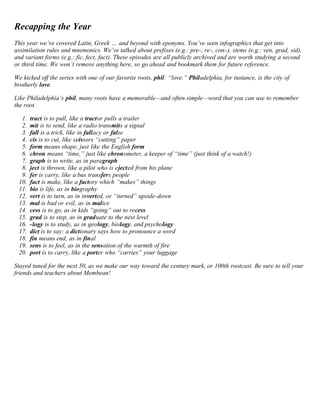
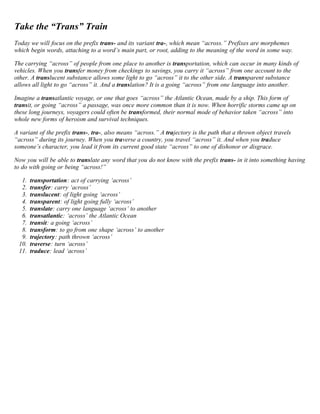
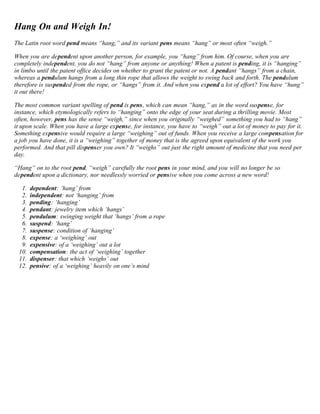
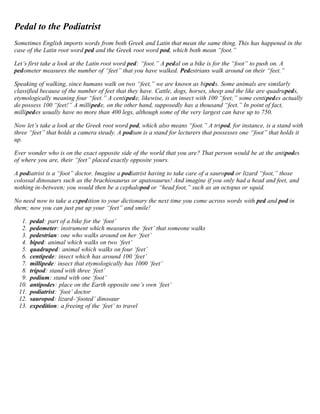
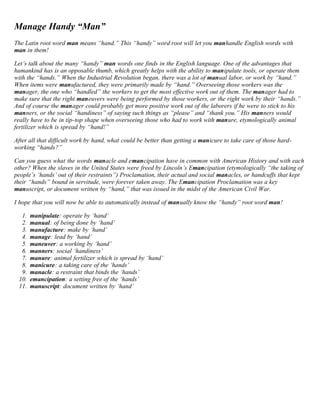
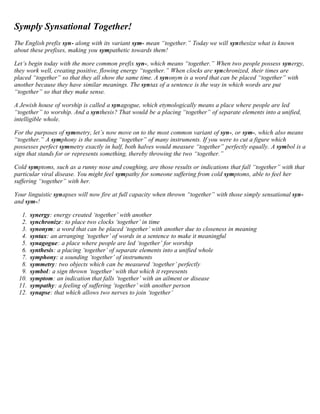
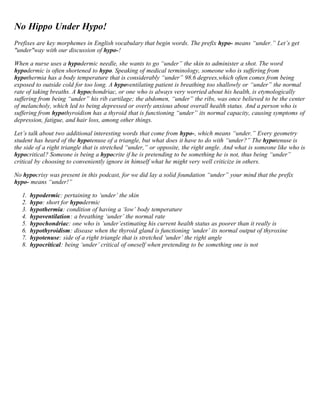
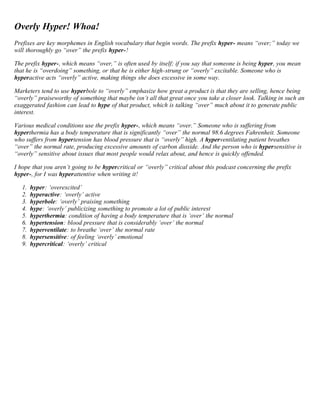
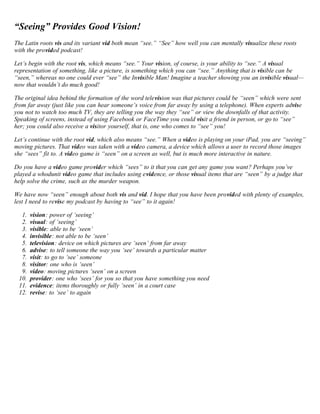
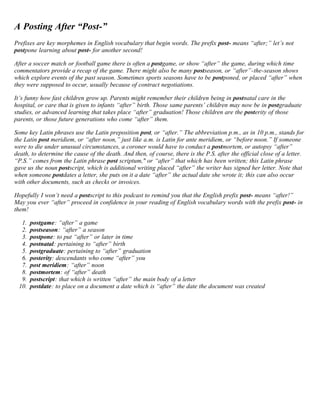
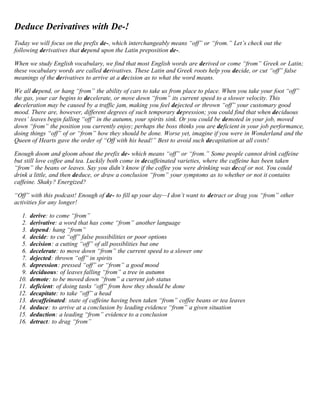
Fascinated by Love? 
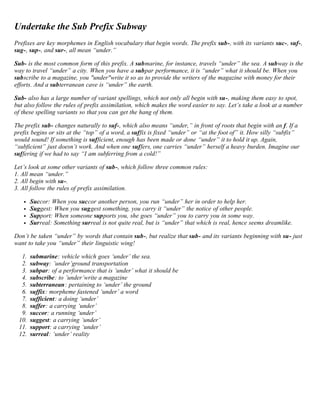
The root word phil comes from a Greek verb meaning to love. So, if your name is Philip, you are etymologically a 
‘lover of horses!’ The city of Philadelphia is the city of ‘brotherly love.’ A philosopher is a ‘lover of wisdom;’ you 
will probably recognize the soph in the word philosopher—it means ‘wise.’ A philodendron is a type of plant that 
‘loves trees’ because it curls up or twines around them as it climbs. 
Hemophiliacs are etymologically ‘lovers of blood.’ This does not mean that hemophiliacs are vampires, but 
rather that they ‘love blood’ because their platelets are ineffective at clotting wounds; they therefore lose a lot of 
blood when wounded, causing them to need more, hence ‘loving,’ and needing, extra. 
A philanthropist is etymologically a ‘lover of man(kind),’ that is, someone who is charitable to and does good 
deeds for the good of mankind as a whole. A lesser known word is philogynist, a ‘lover of women,’ that is, of all 
things related to the well-being of women in general (the gyn gives rise to gynecology as well). 
A philologist is a scholar of language who ‘loves words;’ your soft contact lenses are probably hydrophilic 
because they ‘love water,’ and a bibliophile ‘loves books’! 
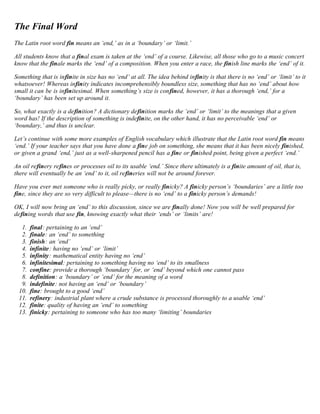
These constitute but a few of the “lovely” words that use the root word phil! 
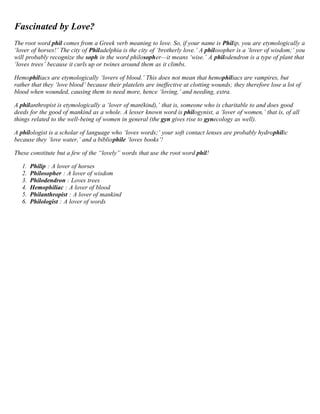
1. Philip : A lover of horses 
2. Philosopher : A lover of wisdom 
3. Philodendron : Loves trees 
4. Hemophiliac : A lover of blood 
5. Philanthropist : A lover of mankind 
6. Philologist : A lover of words 
Membean Word Root Of The Day Archive Numbers 1-99 
For MP3 files and more information visit: 
http://www.membean.com/wrotds/archive 
http://feeds.feedburner.com/membean/MembeanWROTD
Chop-chop, Cut-cut 
The root word cis and its variants cid and -cide come from a Latin root which means ‘cut’ or ‘kill.’ A decision, 
for instance, is a ‘cutting off’ of all possibilities except for one; if you are decisive you have ‘killed’ all other 
options. And scissors? They just ‘cut.’ 
Ever had an incision during surgery? That’s nothing but a ‘cutting into’ your body. On the other hand, if you 
excise text from a book, you are removing or ‘cutting out’ material from it. 
Many words in English also come from the root cid that is a variant of cis and disturbingly enough means ‘to kill.’ 
Cid typically appears in the form of the suffix -cide. Let’s take a look at just some of the English words that have 
this chilling suffix. 
Homicide means ‘killing a human,’ fratricide is ‘killing of a brother.’ 
Herbicides and pesticides are chemicals that are commonly used for ‘killing plants,’ and a hippopotomonstricide 
is the ‘killing of a giant hippopotamus.’ 
The legendary ‘Julius Caesar’ also shares this Latin root. The word part Caes in Caesar is believed to be a 
reference to Mr. Julius being cut from his mother’s womb, the first recorded cesarean section. 
We could go on and on, but in the spirit of conciseness we will ‘thoroughly cut’ any more words from this 
discussion and leave you with this incisive summary: When you see a cis or cid, tread carefully or sooner or later 
you just might just get ‘cut’ down to size! 
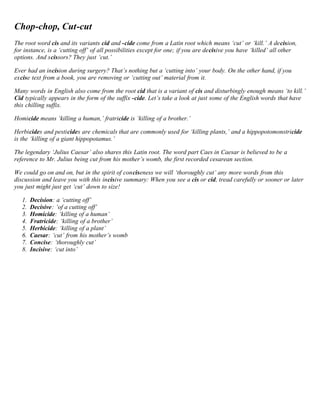
1. Decision: a ‘cutting off’ 
2. Decisive: ‘of a cutting off’ 
3. Homicide: ‘killing of a human’ 
4. Fratricide: ‘killing of a brother’ 
5. Herbicide: ‘killing of a plant’ 
6. Caesar: ‘cut’ from his mother’s womb 
7. Concise: ‘thoroughly cut’ 
8. Incisive: ‘cut into’
Of Popes and Tricky Pipes 
There are some truly interesting English vocabulary words that come from the roots fall and fals which mean to 
‘trick.’ 
For instance, consider the word false. If an answer is false, it has tried to ‘trick’ someone into thinking it is true. 
When you falsify information, you ‘trick’ others into thinking something is true, when it, in fact, is not. 
A fallacy is a ‘deceptive’ belief or notion. In the same vein, a fallacious statement is misleading or trying to 
‘trick’ its readers. 
If someone is infallible you mean that she cannot be ‘tricked,’ that is, she cannot make errors. The Pope is often 
considered infallible because he is believed to be unable to make errors when it comes to spiritual matters. 
The word fault comes from this root as well. If you are at fault in a matter, you were ‘tricked’ into doing the 
wrong thing, perhaps due to lack of good judgment. A fault in the earth is ‘tricking’ you because the ground there 
is not quite as solid as it appears to be. When someone defaults on a loan, she has ‘tricked’ the bank by not 
paying her loan installments on time. 
The most interesting etymology with this root is probably the word faucet (tap). Picture a closed faucet. It is 
ironically ‘tricking’ you into thinking there is no water available, although the pipe is actually full! 
1. false: a ‘deceptive’ truth 
2. falsify: to ‘make a trick’ 
3. fallacious: ‘deceptive’ 
4. fallacy: a ‘deceptive’ notion 
5. infallible: ‘not capable of being tricked’ 
6. fallible: ‘capable of being tricked’ 
7. faucet: a ‘deceptive’ plumbing apparatus
On a Mission 
The English root mit and its variant miss comes from a Latin word that means ‘to send.’ 
When a lightbulb emits light, what does it do? It simply ‘sends it out.’ If you are out on a mission, you’ve been 
‘sent’ to do a task. If, however, you’ve been dismissed from that endeavor, you’ve been ‘sent away.’ If someone 
permits you to do something, you are ‘sent through’ to carry on. 
If you are confused by why mit and miss mean the same thing, just notice what happens when you add suffixes to 
the following mit words. Permit becomes permission, likewise emit becomes emission. Don’t “miss” that mit 
becomes a miss! 
Have you ever omitted anything from a test? If so, you have ‘sent it away.’ When you submit your answers, you 
‘send them under’ for the inspection of the teacher. Hopefully all those tests that you have submitted as a student 
will allow you to be admitted, or ‘sent to’ a good college! 
Are you committed to anyone? If so, you have ‘sent together’ your life with another. And if you promise to love 
that person then you’ve sent forth your faithful love. 
Every comic book villain tries his best to contribute wholeheartedly to the demise of his chosen superhero, that is, 
to his permanent ‘sending away,’ or ‘death;’ the words superhero and demise don’t go together very well. Dr. 
Octopus could never ‘send away’ Spiderman, at least on a permanent basis! 
Has anyone ever been falsely submissive to you, seeming to ‘send’ himself ‘beneath’ your command? Have you 
ever tried to surmise, or ‘send over’ a guess about why someone is acting the way he does? Or have aliens 
attempted to transmit or ‘send across’ thoughts to you? Enough tranmission, or ‘sending across’ of questions! 
Submit the handy root mit to your memory, promise to remember it, and you will never have to admit to not 
knowing it again! 
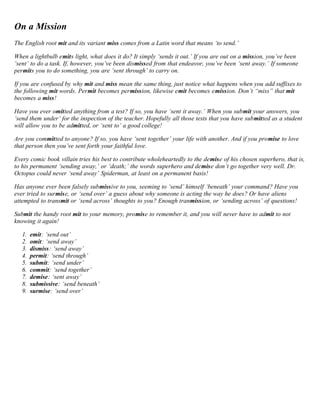
1. emit: ‘send out’ 
2. omit: ‘send away’ 
3. dismiss: ‘send away’ 
4. permit: ‘send through’ 
5. submit: ‘send under’ 
6. commit: ‘send together’ 
7. demise: ‘sent away’ 
8. submissive: ‘send beneath’ 
9. surmise: ‘send over’
Keep in Word Shape Using Good Verbal Form 
When we receive information, it is simply a description of something which gives a ‘shape’ to a given topic. An 
informant therefore gives a ‘shape’ to some fact, whereas if you are well informed you are in good ‘shape’ when 
it comes to facts. 
If something is deformed it is out of ‘shape’ in some way. Something malformed is ‘badly shaped.’ 
When we conform to another’s viewpoint, we give ourselves thoroughly to the ‘shape’ of someone else’s opinion 
or ideas. A nonconformist, on the other hand, does not give ‘shape’ to any widespread idea or opinion, but bucks 
current trends of thought. Of course, if you have to wear a uniform, everyone has but ‘one shape’! 
There are many different forms, or ‘shapes,’ in which this word is used, including the suffix ‘-form.’ For 
example, anything cruciform is ‘shaped’ like a cross, whereas writing that is cuneiform is ‘wedgelike in shape.’ 
Let’s talk science. When Isaac Newton gave the formula for gravitational force he was giving a scientific ‘shape’ 
to gravity. A formula in general is a mathematical equation which gives ‘shape’ to known rules or facts. But as 
we now know, Newton’s formula was misinformed or somewhat ‘badly shaped.’ It took the genius of Einstein to 
correctly transform or ‘shape’ Newton’s work ‘across’ into more precise scientific territory. 
There, that is plenty of information on form! I shall conform to preformed rules and formulate no more! 
1. information: descriptive ‘shape’ 
2. deformed: ‘out of shape’ 
3. malformed: ‘badly shaped’ 
4. conform: ‘thoroughly shape’ to others 
5. nonconformist: ‘not thoroughly shaped’ to others 
6. cruciform: ‘shaped like a cross’ 
7. cuneiform: ‘shaped like a wedge’ 
8. formula: mathematical ‘shape’ 
9. transform: ‘shape across’
Mental Cogs Cognition 
A Latin word meaning ‘to learn’ gives rise to the English word roots cogn and conn. 
We have much to ‘learn’ in this post, which may take some cognition on your part, or mental process of 
‘learning.’ 
When a person recognizes another, he gets to ‘learn’ about her ‘again,’ since he has presumably met her before. 
The more we are cognizant, or ‘learned’ about our acquaintances, the more we continue to ‘learn’ about them. 
If you possess precognition, or ‘foreknowledge,’ you have ‘learned’ something ‘before’ most people would be 
able to, for you can foretell the future. 
Are you a cognoscente of French cuisine, ‘having learned’ all the ins and outs of haute cuisine? Or might you be 
a connoisseur of sushi, ‘knowing’ much of its fishy art? 
A typical military maneuver is to reconnoiter an area, ‘learning’ a little about it ‘beforehand’ in order to be more 
prepared when going there. This act usually involves a spy sneaking in incognito, or ‘not learned’ about by 
anyone. The spy gathers information in this reconnaissance mission, where things are ‘learned about before’ the 
whole army goes in to attack. 
Your cognitive or ‘learning’ cogs are now well greased, having been much enhanced by your handy recognition 
of the word root cogn. 
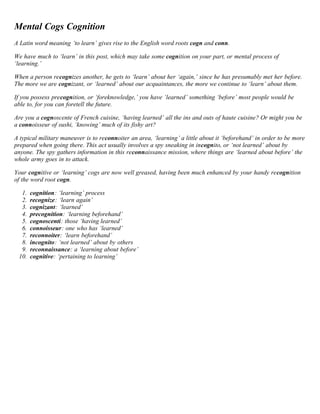
1. cognition: ‘learning’ process 
2. recognize: ‘learn again’ 
3. cognizant: ‘learned’ 
4. precognition: ‘learning beforehand’ 
5. cognoscenti: those ‘having learned’ 
6. connoisseur: one who has ‘learned’ 
7. reconnoiter: ‘learn beforehand’ 
8. incognito: ‘not learned’ about by others 
9. reconnaissance: a ‘learning about before’ 
10. cognitive: ‘pertaining to learning’
Mighty Morph 
A while back I talked to you about the Latin root word ‘form’ which meant ‘shape.’ Its Greek counterpart morph, 
which also means ‘shape’, has contributed important words to the English language as well. 
Perhaps you’ve read the short story “The Metamorphosis” by Kafka. In that story, Gregor Samsa wakes up one 
morning, having undergone a startling metamorphosis, or ‘shape’ change. I’m not just talking about having a 
bad hair day—Gregor has metamorphosed or changed his ‘shape’ into a giant disgusting … bug! You may be 
most familiar with the metamorphosis that a caterpillar undergoes when its ‘shape’ turns into that of a butterfly. 
An amorphous, or ’shape’less blob was featured in the 1958 classic film The Blob starring Steve McQueen. A 
blob is naturally amorphous, since it has no predefined ‘shape,’ but rather constantly changes it. 
The Greek god Morpheus was the god of dreams. Morpheus ‘shaped’ dream images during sleep. The painkiller 
morphine sends you off into dreamland. A great movie character is Morpheus from The Matrix, who helps 
‘shape’ the Matrix by dreaming it. 
In computer programming, you’ll learn in CS 101 the term polymorphism. It describes how objects can take on 
many ‘shapes’ by inheriting attributes from parent classes. Likewise, a wizard that casts a polymorph spell in 
Dungeons & Dragons can turn someone into many different ‘shapes,’ such as a toad or slug. 
You may recall from your biology classes that there are three primary classifications or ‘shapes’ into which 
human bodies can be categorized: endomorphs, mesomorphs, and ectomorphs. An endomorph has a little too 
much ‘shape’ to him, and could lose some weight. A mesomorph‘s body is in ’shape’ physically, being well- 
‘shaped’ with muscle. An ectomorph, on the other hand, has too little ‘shape,’ and needs to gain some muscular 
definition. 
Many Greek gods are anthropomorphic, or ‘human-shaped:’ their true essence is that of light, but they appear as 
humans to mere mortals. Another word that ends in -morphic is zoomorphic, or ‘shaped’ like an animal. 
In linguistics, which Membean loves, we talk about morphemes a lot, which are simply the different ‘shapes’ that 
make up words, such as prefixes, stems, and suffixes. Morphology would then be the study of the ‘shape’ words 
take. 
I hope that you too now feel the mighty power of morph! 
1. metamorphosis: ‘shape’ change 
2. amorphous: not having a fixed ‘shape’ 
3. Morpheus: god who ‘shaped’ dream images 
4. polymorph: change into many ‘shapes’ 
5. anthropomorphic: ‘human-shaped’ 
6. morpheme: word ‘shape’ 
7. morphology: study of the ‘shape’ words take
Chronos, the God of What? 
Let’s take a couple of minutes of your ‘time’ to talk about chron, the Greek root word for ‘time.’ 
Ever owned a Timex? Yes, you knew I was talking about watches, that is, keepers of ‘time.’ Watches are 
technically chronographs, or writers of ‘time’. The Chrono is one of Timex’s all-‘time’ bestsellers, meant to keep 
accurate ‘time’ to keep you on ‘time.’ In the same vein, some watches have stopwatches or chronometers, which 
measure how much ‘time’ has elapsed during an event. 
Ever watched synchronized swimmers in the Olympics? They all make their moves at the same ‘time.’ 
Synchronous events, therefore, happen at the same ‘time.’ 
You may have encountered the Greek god Chronos during your mythology studies, who was the god of ‘time.’ He 
is the origin of our depiction of Father ‘Time,’ and was often pictured with wings since ‘time’ tends to fly by. 
The Chronicles of Narnia by C.S. Lewis is a very popular series that you’ve probably read or watched. A 
chronicle is a record of historical events that happen over ‘time.’ Chronicles are kept in chronological order, 
that is, arranging events in the correct ‘time’ sequence in which they occurred. 
Ever watched a film in which there was something out of place, like a watch on the wrist of a Roman soldier, or a 
car speeding down a street during the Middle Ages? Those are both examples of anachronisms, or things that are 
placed in the wrong ‘time’ period. 
For you computer buffs, there’s a widely used Linux and Mac (UNIX) utility called cron; it manages how 
programs run, using a special syntax for specifying ‘time.’ 
People with acute symptoms of disease suffer for only a short time, but those with chronic ailments suffer over an 
extended period of ‘time.’ Hopefully neither you nor any of your cronies, or friends whom you have known for a 
long ‘time,’ are so afflicted! 
Well, to keep ‘in sync,’ or synchronized with the ‘time’ restraints for this podcast and blog, I’ll leave you in a 
’time’ly fashion, lest Chronos swing his sickle and cut off my ‘time’ for me! 
1. chronograph: writer of ‘time’ 
2. chronometer: instrument that measures ‘time’ 
3. synchronized: happens at the same ‘time’ 
4. chronicle: events in ‘time’ 
5. chronological: ‘time’ sequence 
6. anachronism: wrong ‘time’ 
7. chronic: pertaining to ‘time’ 
8. crony: friend over ‘time’
Graphic Writing 
There is much to say about the Greek root graph which means ‘to write,’ so let this ‘written’ discourse begin! 
One of the most common uses of this root is in the suffix -graphy. Geography is simply ‘writing’ about the 
physical characteristics of the Earth. A biography is ‘writing’ about someone’s life, whereas an autobiography is 
‘writing’ about your own life. And a bibliography is a ‘written’ lists of books you’ve used when writing a paper. 
Many people ‘write’ in different ways. For instance, a calligrapher is one who ‘writes’ with beautiful hand- 
‘writing.’ A choreographer, on the other hand, ‘writes’ dance steps. A cinematographer ‘writes’ scenes in a film 
by using a camera. ‘Writing’ with film is not unusual at all—consider the photographer, who expresses herself by 
‘writing’ with light on film! 
Life was made much easier by transmitting messages via the telegraph, which ‘wrote’ at a distance. What do you 
do with graph paper, on which lines have already been ‘written’? You, of course, draw a graph, or ‘written’ 
diagram! Paragraphs are, of course, ‘written;’ paragraphs are so called, however, because they are ‘written’ 
alongside each other. 
When you ask someone for her autograph, you want her signature ‘written’ by herself. Graphic artists might be 
particularly good at that, since they deal with ‘written,’ vivid images on a daily basis. Unfortunately, some people 
have a habit of ‘writing’ graffiti where they shouldn’t! 
Enough ‘writing’ for the day, lest I run out of graphite in my e-pencil! 
1. geography: Earth ‘writing’ 
2. biography: ‘writing’ of someone’s life 
3. bibliography: ‘writing’ about books used 
4. calligraphy: beautiful ‘writing’ 
5. choreography: the ‘writing’ of dance steps 
6. cinematography: the ‘writing’ of film scenes 
7. photography: the ‘writing’ of pictures using light 
8. telegraph: ‘writing’ from afar 
9. autograph: self ‘written’ 
10. graffiti: ‘writing’ on walls
‘Ject’ is Not a Word Reject! 
Unless anyone raises serious objections, today we are going to talk about the Latin root word ject which means 
‘throw.’ 
Do you remember when your classroom teacher used a projector, which ‘threw’ images up on a screen for a 
presentation? Sometimes students would object to this, or ‘throw’ their thoughts against it. Often students feel 
subjected to too many presentations, being too often ‘thrown’ under their boring burdens. 
Do you remember as a child getting an injection at the doctor’s office, where a nurse would ‘throw’ medicine into 
your arm with a shot? You might have tried to reject this attempt by ‘throwing’ it back at the shot giver. Often 
scared children interject or ‘throw’ between the shot and their bare arms many cries of terror and alarm, hoping 
to interrupt the progress of the painful syringe! 
Interestingly, our word jet comes from ject as well, for a jet plane is ‘thrown’ through the air by its engines. Jets 
often follow trajectories, or the paths across which they are ‘thrown.’ Sometimes a jet, or more often a ship at sea, 
is forced to jettison unwanted baggage, thereby ‘throwing’ it overboard. Another word for ‘throwing’ something 
out is ejecting it, such as ejecting a DVD or CD-ROM from a computer. 
Sometimes during a test we have to make a conjecture, or guess that is ‘thrown’ together based on the best 
available evidence. If we don’t guess correctly, we might become dejected, that is, ‘thrown’ or cast down, thus 
becoming depressed or blue. 
Now you’ll never have to reject or make a wild conjecture about an unknown word that contains the root word 
ject, for it has been permanently ‘thrown’ into your awareness of word roots! 
1. projector: that which ‘throws’ forth 
2. object: ‘throw’ in the way 
3. subject: ‘throw’ under 
4. injection: a ‘throwing’ in 
5. reject: ‘throw’ back 
6. interject: ‘throw’ between 
7. jet: ‘thrown’ across the sky 
8. trajectory: path ‘thrown’ across 
9. jettison: ‘throw’ out 
10. eject: ‘throw’ out 
11. conjecture: guess ‘thrown’ together 
12. dejected: ‘thrown’ down or off kilter
Carry Me Fer(ry)! 
Today we will refer often to the Latin root word fer, which means to ‘carry.’ 
Have you recently been to the reference section in the library? Reference books ‘carry’ back their knowledge to 
you, the reader, much like a reporter carries back the news. 
When you transfer funds from one bank account to another, you ‘carry’ them across from one to the next. As you 
do this, you might have to refer, or ‘carry’ back your eyes to your financial statements to make sure you have 
enough money. If you don’t do this, you might have to suffer the consequences, or be ‘carried’ under a heavy 
burden. 
We all like to root for different teams at a soccer match, since we are all ‘carried’ apart to separate likes and 
dislikes; or, to say it in a different way, when one thing is different from another, it is ‘carried’ apart from it. We 
also all love the referees in a match when they ‘carry’ back a good ruling for our own team! 
Some people find one thing to be preferable to another, that is, ‘carried’ before something else. When you don’t 
prefer one thing to another, you are said to be indifferent, that is, you do not ‘carry’ one thing apart from 
another, but remain completely neutral. When a preference is stated, however, some are quite vociferous in 
stating it, ‘carrying’ their voices quite loudly for all to hear. 
Many seemingly unrelated words are related etymologically by this root word. Consider, for instance, the words 
conifer, referendum, circumference, and fertile. A conifer is a cone ‘carrying’ tree, that is, one that is cone 
‘bearing.’ A referendum is a political or civic issue that is ‘carried’ back before the people for a vote. A 
circumference is the how far one must ‘carry’ a measurement around a circle. And a fertile apple tree? Its limbs 
‘carry’ a lot of apples! 
People often defer to experts, ‘carrying’ themselves away to hear their opinions. To hear these experts, people 
often attend conferences, or a ‘carrying’ together of many people with the same interests. 
I think that it is now safe for me to infer that you will no longer need to refer to the dictionary to know that the 
root word fer can make a difference as you ‘carry’ on in your study of vocabulary! 
1. transfer: ‘carry’ across 
2. suffer: ‘carry’ under 
3. different: ‘carried’ apart 
4. refer: ‘carry’ back 
5. prefer: ‘carry’ before 
6. fertile: ‘carries’ much fruit 
7. infer: ‘carry’ into 
8. referendum: vote ‘carried’ back 
9. circumference: a ‘carrying’ around 
10. vociferous: voice ‘carrying’ 
11. coniferous: cone ‘carrying’
Dukes of ‘Duc’ 
If you are going to be the Duke or Duchess of Word Roots, you are doing to have to know that the Latin root 
words duc and duct mean to ‘lead.’ Speaking of those words duke and duchess, they, of course, were and still are 
‘leaders’ in the British peerage system, ranking just below the Queen and right ahead of the Marquis and 
Marquess. 
Going from peers to repairs, today’s handyman can fix just about anything using duct tape. Duct tape was 
originally designed to be used with ducts, which simply refer to any tube or other enclosed passage which ‘leads’ 
air or fluid through it, such as the tear ducts in your eyes or the air conditioning ducts in your home. 
When you introduce two people, you ‘lead’ them into knowledge of one another. This, in turn, will hopefully 
produce, or ‘lead’ forth yet another friendship. And yes, a product is an item that has been ‘led’ forth by a 
company, usually to be sold. 
When you receive an education, you are ‘led’ forth into knowledge. For instance, you may recall when you 
learned what an aqueduct is, or bridgelike construction that ‘leads’ water over far distances. You may also have 
been taught how to use deductive reasoning, in which a conclusion is ‘led’ from a set of given facts. 
When you spend money, it is deducted from your checking account, or ‘led’ away from it. When the balance 
changes in this negative fashion, it is reduced, or ‘led’ backwards towards zero. 
When a criminal abducts someone, he ‘leads’ her away. This, of course, is bad conduct on his part, that is, not a 
way he should ‘lead’ or behave himself in public. On the other hand, when a conductor conducts, he skillfully 
‘leads’ an orchestra to play well together. 
Now that you have been sufficiently introduced to this productive word root, you won’t have to be given an 
education about any subsequent word that has this root, for you have become the Duchess or Duke of duc: to 
‘lead’! 
1. duke: ‘leader’ 
2. duchess: ‘leader’ 
3. duct: tube which ‘leads’ a substance 
4. aqueduct: structure which ‘leads’ water 
5. introduce: ‘lead’ within 
6. educate: ‘lead’ forth 
7. abduct: ‘lead’ away 
8. product: item ‘led’ forth 
9. reduce: ‘lead’ back 
10. conduct: thoroughly ‘lead’ 
11. conductor: one who thoroughly ‘leads’ 
12. deduct: ‘lead’ down from
Carry That Lat(te) over Here! 
Today I’ll be discussing the relative importance of the Latin word root lat, which means to ‘carry.’ 
The relationship that you develop with another person is how you ‘carry’ back and forth your interactions with 
him or her. Is it one of love? One of dislike? Or a mixture of both? 
Speaking of relationships, you have learned in biology class that your relatives are those who are genetically 
‘carried’ back to you. In turn, the relative importance of something is how strongly its influence is ‘carried’ back. 
When you hear your relatives relating stories to you, they are ‘carrying’ them back for your hopeful enjoyment. 
When you collate papers, you ‘carry’ them together for purposes of organization. For instance, you might have to 
organize a recent translation, or the ‘carrying’ across of words from one language into another, that you have 
recently completed. 
You might be elated, or ‘carried’ out of your normal emotional state to one of jubilation, by doing a great job on 
a project. Such a superlative job would have ‘carried’ that work over and above normal, everyday efforts. 
Just what do legislators do? Yep, you guessed it, they ‘carry’ laws into our society. 
A lesser known word that contains the root word lat is ablation, which refers to the ‘carrying’ away of something. 
Ablation can either be the slow erosion or ‘carrying’ away of parts of a glacier, or it can refer to a surgical 
procedure in which undesirable parts of the body are ‘carried’ away by cutting them out. 
So as not to make you late for your latte, I shall relate no more about lat, lest this turn out to be as long as the 
commentary on Einstein’s Theory of Special Relativity, ‘carrying’ you too far away from present concerns! 
1. relative: one ‘carried’ back to you 
2. relate: ‘carry’ back 
3. collate: ‘carry’ together 
4. legislate: ‘carry’ laws to creation 
5. translate: ‘carry’ across from one language to another 
6. elated: ‘carried’ out of a normal emotional state 
7. superlative: ‘carried’ over and above
Don’t make this more dif’fic’ult than it should be. 
The Latin word root fic, meaning to ‘make,’ is one of the most significant roots in the English language. The word 
significant means something that ‘makes’ a mark. 
If something undergoes purification, it is ‘made’ pure. When a teacher undergoes the process of certification, she 
is ‘making’ herself ready to teach. 
The Pacific Ocean was so named by Ferdinand Magellan because it was ‘making’ peace, that is, there was calm 
weather for an extended period of time. 
The root fic meaning ‘make’ is also the stem in magnificent and deficient. If someone constructs something that is 
magnificent, she has ‘made’ it great in some way. However, if it is deficient, it is ‘made’ in such a way that it is 
somewhat lacking. 
Here are more words that are ‘made’ in some way. Something artificial is ‘made’ by the skill or art of humans, 
not by nature alone. A sacrifice is a ritual that is used to ‘make’ something holy to please the gods. 
There are two simple words that will help you remember that the word fic is ‘make’: difficult and efficient. A 
difficult task is hard to get done, meaning it’s hard to ‘make’ it happen. If you are efficient, on the other hand, 
you ‘make’ things happen quickly and easily. 
The root word fic meaning ‘make’ is a very productive root in English and you should make yourself comfortable 
with it. 
1. purification: process of ‘making’ pure 
2. certification: act of ‘making’ sure 
3. pacification: act of ‘making’ peace 
4. Pacific: ‘making’ peace 
5. artificial: ‘made’ with human skill 
6. magnificent: ‘made’ great 
7. deficient: ‘made’ lacking or off of what it should be 
8. sacrifice: ‘make’ holy 
9. difficult: not ‘made’ easily 
10. efficient: ‘makes’ thoroughly 
11. beneficial: ‘making’ something good 
12. significant: ‘making’ a mark
Into the Fold 
The English stem plic comes from a Latin root word meaning ‘fold,’ as in to “bend over on itself” or “bend in 
two.” 
When you duplicate something, you ‘fold’ it twice, thus making two things. In the same way, if documents are in 
triplicate, they are ‘folded’ three times, or there are three copies of them. When you multiply two numbers, their 
product is a larger number, such as 9X7=63. If you think of each part of the product 63 as a ‘fold,’ multiplication 
makes many such ‘folds.’ 
If something is complicated, like a math problem, it is so thoroughly ‘folded’ that it is hard to unravel or un’fold’ 
it to make it clear. You might have quite a time trying to explicate a thorny problem, or ‘folding’ it out to reveal 
its solution. On the other hand, the origin of the word simplicity suggests being ‘folded’ only once, which is as 
clear as you can possibly get. 
When you replicate something, you ‘fold’ it again to make another one of it. For instance, a replica of a Roman 
coin is an identical ‘fold’ of it because it looks just like it. 
What are you doing if you are applying for a job? An applicant wishes to ‘fold’ herself into a particular 
institution, like a college or business. Thus she fills out an application in the hopes of ‘folding’ herself in where 
she wants to work! 
An accomplice to a crime is someone who has ‘folded’ himself towards the primary criminal, helping him either 
commit the crime or preparing the way for its completion. A person of this kind then would be complicit in the 
crime, choosing to be ‘folded’ in with it. 
Hopefully now you will no longer find complications but mere simplicity when you encounter an English word 
with the stem plic in it, since you have been ‘folded’ into the know! 
1. duplicate: ‘fold’ twice 
2. triplicate: ‘folded’ three times 
3. multiplication: act of ‘folding’ many times 
4. complicated: thoroughly ‘folded’ 
5. explicate: ‘fold’ out 
6. simplicity: ‘folded’ but once 
7. replicate: ‘fold’ again 
8. replica: that which is ‘folded’ again 
9. application: act of ‘folding’ towards 
10. accomplice: one ‘folded’ with another 
11. complicit: ‘folded’ with another
‘Fact’ the Word Factory 
It’s a fact that the Latin root word fact has ‘made’ many words in English; in point of fact, it even means ‘made’ 
or ‘done.’ 
What is a fact? It is simply something that has been ‘made’ already, so it is real. Another way of thinking about a 
fact is that it’s a ‘done’ deal. Facts used for science or in a court of law must have been ‘made’ already for them 
to be useful. Hence, something factual has a basis in reality, that is, it has been ‘made’ or ‘done.’ 
A chocolate factory is a place where chocolate is ‘made.’ A place where cars are manufactured is an industrial 
setting where they are ‘made.’ Originally, something that was manufactured was ‘made’ exclusively by hand, 
such as clothing or shoes on a mass scale. 
An artifact is something ‘made’ by human skill or artistic know-how. Anthropologists are particularly interested 
in artifacts because they tell them things about the ancient cultures who ‘made’ these objects. 
A masterpiece might cause a budding tailor great satisfaction because it shows that he has ‘done’ enough to earn 
the rank of a master tailor. As a matter of fact, a masterpiece was an excellent piece of work created by an 
apprentice that was the deciding factor in earning the rank of master, that is, it would either ‘make’ him a master, 
or ‘do’ him in. 
Do you remember the Gorgon Medusa from Greek mythology? She was into petrifaction, or having people ‘made’ 
into stone by gazing upon them. This, of course, is the work of a malefactor, or one who ‘does’ evil to or ‘makes’ 
evil for another. A benefactor, on the other hand, only ‘does’ good things for someone else. 
Have you ever undergone the process of stupefaction, or being ‘made’ so completely amazed by something that it 
renders you stupid, or speechless momentarily? Like now? 
I hope that your newly gained factual knowledge of fact has ‘made’ serious inroads into your vocabulary 
satisfaction! ‘Done’! 
1. fact: thing ‘made’ 
2. factual: pertaining to a thing ‘made’ 
3. factory: place where things are ‘made’ 
4. manufacture: ‘make’ by hand 
5. artifact: ‘made’ by human skill 
6. satisfaction: ‘done’ enough 
7. factor: ‘maker’ 
8. petrifaction: ‘making’ stone 
9. malefactor: evil-‘doer’ 
10. benefactor: good-‘doer’ 
11. stupefaction: ‘making’ amazed
Living with ‘Bio’ 
The Greek root word bio means ‘life,’ and gives rise mostly to words from the realm of the ‘life’ sciences. 
We’ve all taken biology (or bio) classes, in which you learn all about ‘life.’ Biological processes have to do with 
the way ‘living’ organisms function. Microbiologists study small ‘life’ forms, such as bacteria, viruses, and other 
one-celled organisms. 
Speaking of life forms, amphibians, such as frogs and salamanders, can ‘live’ both in water and on land. 
Amphibious military vehicles, such as tanks, can also operate or ‘live’ in both water and on land. 
A biography (or bio) is a book that tells all about the events in someone’s ‘life,’ written by an author other than 
the subject of the ‘life’ history. An autobiography, on the other hand, is a history of a person’s ‘life’ written by 
that person. 
The adjective aerobic refers to the oxygen a ‘life’ form requires in order to ‘live.’ Aerobics are simply exercises 
which cause ‘living’ organisms, such as yourself, to breathe faster as your body consumes more oxygen. 
Anaerobic exercise almost completely depletes the oxygen from a ‘living’ organism’s body, such as an all-out 
sprint which leaves you gasping for air! 
Symbiotic organisms ‘live’ together, each needing the other to survive. An example of a mutually beneficial 
symbiosis or ‘living’ together is between the clownfish and the anemone (think “Finding Nemo”). In this 
relationship which increases survival rates, the clownfish gets a protective home, and the anemone gets cleaned by 
the clownfish. 
And just where can living organisms live and thrive? Why, in a biosphere of course, or those parts of the Earth 
that support and allow the existence of ‘life.’ 
You can now add the knowledge of this handy root word bio to your, well, knowledge bio, which will hopefully 
make the rest of your vocabulary ‘life’ a bit more livable! 
1. biology: study of ‘life’ 
2. microbiology: study of very small ‘life’ forms 
3. amphibian: ‘life’ living in water and on land 
4. biography: a ‘life’ history 
5. symbiosis: two ‘life’ forms living together 
6. aerobic: pertaining to air for ‘life’ to exist 
7. anaerobic: lacking air for ‘life’ to exist 
8. biosphere: part of the Earth where organisms ‘live’
Log In! 
The Greek root word log means ‘word,’ and its variant suffix -logy means ‘study (of).’ 
The captains on Star Trek, whether Kirk or Picard or Janeway, are constantly entering data or ‘words’ into their 
captain’s log, telling about their journeys through space. A catalog is similar in idea, for it contains a thorough 
listing of ‘words’ which describe items for sale. 
A dialogue consists of the ‘words’ spoken between two people. A monologue, on the other hand, is those ‘words’ 
spoken by one person alone, usually as part of a play or stand-up comedy routine. 
Many literature students have read Chaucer’s “General Prologue,” which are those ‘words’ spoken before the 
main poem begins. An epilogue, on the other hand, contains those ‘words’ written after a novel or play has ended, 
giving a little more information as to the future lives of the characters. 
Let’s tackle two harder words. A logophile is someone who loves ‘words.’ Someone who is afflicted with 
logorrhea, on the other hand, loves to hear himself speaking ‘words’ and just won’t shut up! 
Now on to a few of the many English words which end in -logy, ‘study (of).’ Biology is the ‘study’ of life. In turn, 
zoology is the ‘study’ of animals. Etymology is the study of the origin of words. And genealogy is the ‘study’ of 
your origins, that is, the people to whom you are related. I could go on forever with the thousands of words that 
use the suffix -logy—humans love to ‘study’ things! 
Now would be the logical time to stop! Wait! There was another one! I’ll leave you with that epilogue to end our 
discussion of the ‘study’ of the ‘word’ log! Log out! 
1. log: book of ‘words’ 
2. catalog: listing of ‘words’ 
3. dialogue: ‘words’ between people 
4. monologue: ‘words’ of one person 
5. prologue: ‘word’ beforehand 
6. epilogue: after’word’ 
7. logophile: ‘word’ lover 
8. logorrhea: ‘word’ diarrhea 
9. biology: ‘study’ of life 
10. zoology: ‘study’ of animals 
11. etymology: ‘study’ of the origin of words 
12. genealogy: ‘study’ of one’s family history
‘Fect’: Done to Perfection 
The English word root fect means ‘make’ or ‘do.’ 
If something is perfect, is is thoroughly ‘done,’ or cannot be ‘made’ any better than it already is. Someone who is 
effective can get things ‘done,’ and might even do things perfectly. 
The verb affect and the noun effect often give students and adults alike conniption fits. Let’s clear this up here and 
now. When you affect someone, you have ‘done’ something to her. An effect, on the other hand, is a result of 
something that has been ‘done.’ Thus, you could affect someone by something that you have ‘done,’ with the 
resulting effect being either positive or negative. 
Remember the prefects in Harry Potter, the older students put in charge of Hufflepuff, Gryffindor, Slytherin, and 
Ravenclaw? A prefect is ‘made’ the head or put in charge of people. We might hope that such leaders wouldn’t 
have too many defects, or aspects that ‘make’ them filled with troublesome shortcomings. 
When a disease infects you, it ‘makes’ its way into your body. So a disease can be infectious, but so too can 
enthusiasm. I hope an infection of enthusiasm rather than a disease ‘makes’ its way into you! 
Ever eat a confection in a refectory? Huh? First of all, a confection is a dessert that is thoroughly ‘done’ so as to 
be as tasty and appealing as possible. A refectory is a large dining room at a college where hungry students are 
‘made’ new again, that is, refreshed with lots of nourishing food. So, I’ll take a guess that you probably have had 
a confection in a refectory! 
I hope that your mind now has been thoroughly infected with fect, having been ‘made’ perfectly aware of its 
effective power for learning English vocabulary! 
1. perfect: thoroughly ‘made’ 
2. effective: able to get things ‘done’ 
3. affect: ‘done’ towards 
4. effect: result ‘made’ by ‘doing’ something 
5. prefect: ‘made’ in charge, thus ‘made’ to rule before others 
6. defect: ‘done’ not quite right 
7. infected: ‘made’ inroads into your body 
8. confection: dessert thoroughly ‘done’ 
9. refectory: place where you are ‘made’ new again
Dictionaries Say It All! 
The Latin root word dict and its variant dic both mean ‘say.’ Let me ‘say’ a few words about this useful English 
word root. 
Have you ever considered what the origin of the word dictionary actually is? Dictionaries help with the 
pronunciation, or correct ‘saying’ of words, besides giving other word information such as definitions and word 
origins. Are you addicted to reading the dictionary? If so, you have ‘said’ or declared your love for it. 
Some people try to predict events before they happen, thereby ‘saying’ what will occur before they actually do. 
The prediction is often wrong, thus is contradicted or ‘spoken’ against by what actually happens. 
Did your school have a valedictorian who ‘said’ the farewell address at your high school graduation? If so, she 
may have dictated or ‘said’ her speech to a friend, who wrote it out for her. The speech itself was probably 
dedicated or ‘said’ for the members of her graduating class. 
A verdict is the truth ‘said’ by a jury who determines whether a defendant put on trial in a court of law is 
innocent or guilty. If the defendant is vindicated, he is ‘said’ to be free of all charges that had been placed 
against him. The jury may just as well, however, indicate or ‘say’ that he is guilty! 
Only the unwise would question what a dictator ‘says,’ for he gets the final ‘say’ in everything. In fact, speaking 
up in such a way might put you in quite the predicament or dangerous situation, for you would have ‘said’ 
something before you thought about what its consequences might entail! 
I have now dedicated quite enough time to ‘saying’ things about the root words dict and dic. But go ahead and 
thumb through your dictionary and see how many more words it indicates have this useful root! 
1. dictionary: tells how to ‘say’ words 
2. addict: ‘speaks’ heavily towards something 
3. predict: ‘say’ beforehand 
4. contradict: ‘say’ against 
5. valedictorian: one who ‘says’ farewell 
6. dictate: ‘say’ words to another 
7. dedicate: to ‘say’ for another 
8. verdict: ‘speaking’ of the truth 
9. vindicate: ‘say’ to be free from something 
10. indicate: ‘say’ to make known 
11. dictator: ‘sayer’ of rules 
12. predicament: result when one ‘speaks’ too quickly, or before she should
‘Vert’ Convert 
The Latin root word vert means ‘turn.’ 
For instance, when you invert something, you ‘turn’ it on its head, or upside-down. When you revert to the 
beginning, you ‘turn’ back to it. When a robber diverts the police, he ‘turns’ them away from what he is in the 
process of doing. 
Imagine that you are standing on top of a very tall cliff. If you are afraid of heights, you might avert your eyes, 
‘turning’ them away in fear. You might also be afraid of the completely vertical drop, ‘turned’ perpendicular to 
the earth. You also might experience vertigo, or a wild ‘turning’ in your head which makes you dizzy. At this point 
it would probably be very easy for someone to convert or thoroughly ‘turn’ you towards the idea of never 
approaching a cliff again! 
Are you an extrovert or its opposite, an introvert? An extrovert is someone who is ‘turned’ outward towards other 
people. An introvert, on the other hand, is ‘turned’ more within, preferring his or her own company to that of 
others. 
Let’s take yet another ‘turn’ at learning that vert means ‘turn.’ You might think that it would be a bad thing if one 
of your vertebrae were ‘turned.’ It would keep a chiropractor in business! All kidding aside, vertebrae originally 
referred to bones upon which other bones can ‘turn.’ 
The purpose of advertisements is to ‘turn’ the attention of potential customers towards a certain product or 
service. One must be careful, however, not to be perverted, or thoroughly ‘turned’ from normal thrifty behavior 
into buying something you would be better off without! 
Now your vocabulary will go vertical since you have learned so much about the root word vert—‘turn’ your 
attention towards this root, and you cannot help but be diverted towards word excellence! 
1. invert: ‘turn’ upside-down, or on its head 
2. revert: ‘turn’ back 
3. divert: ‘turn’ from 
4. avert: ‘turn’ away 
5. vertical: ‘turned’ up 
6. vertigo: ‘turning’ dizzily 
7. convert: thoroughly ‘turn’ 
8. extrovert: ‘turned’ outwards 
9. introvert: ‘turned’ within 
10. vertebrae: bones which ‘turn’ upon each other 
11. advertisement: that which ‘turns’ you towards a product 
12. pervert: to thoroughly ‘turn’ away from normal behavior
Prefix Assimilation: Mangled Letters 
To expand your vocabulary skills it’s essential to learn some basic linguistic concepts. Understanding the role of 
these concepts in the development of English word structure will allow you to spell, learn, remember and decode 
words easily. Starting today some of our rootcasts will introduce these concepts in a simple, non-technical way. 
You’re probably aware that prefixes are the small roots at the front of words. For example in the words control 
and conquer the prefix is con- meaning ‘with’ or ‘thoroughly’. But con- is also the prefix root in the words 
comply, collect and correct! In these words notice that the letter n of con changes forming new prefixes com-, 
col- and cor-. These are just disguised versions of con-. This shape-changing process is known as prefix 
assimilation. 
Fortunately, there are just a few rules to learn to be able to recognize the most common prefix assimilations. 
We’ll cover two of these rules: 
Rule 1 : When a prefix ending with the letter n butts up against a 
root that start with the letters b, m, or p, the n becomes an m. 
in + balance → imbalance 
in + mobile → immobile 
in + possible → impossible 
con + bine → combine 
con + mit → commit 
con + ply → comply 
Rule 2: When a prefix ending with a letter n butts up again a root that starts with a r or l , then n 
disappears and the r or l doubles. 
in + legal → illegal 
in + regular → irregular 
con + late → collate 
con + rect → correct 
Now that you know these rules can you guess the prefix root in “symphony” ? 
We have an infographic on our website that captures these rules simply, and we also have a simple mnemonic 
trick to help you remember these rules. 
Use the mnemonic n-BiMPLeR to remember that the letter n changes when followed by one of the letters 
BMPLR
The Final Word 
The Latin root word fin means an ‘end,’ as in a ‘boundary’ or ‘limit.’ 
All students know that a final exam is taken at the ‘end’ of a course. Likewise, all those who go to a music concert 
know that the finale marks the ‘end’ of a composition. When you enter a race, the finish line marks the ‘end’ of it. 
Something that is infinite in size has no ‘end’ at all. The idea behind infinity is that there is no ‘end’ or ‘limit’ to it 
whatsoever! Whereas infinity indicates incomprehensibly boundless size, something that has no ‘end’ about how 
small it can be is infinitesimal. When something’s size is confined, however, it has a thorough ‘end,’ for a 
‘boundary’ has been set up around it. 
So, what exactly is a definition? A dictionary definition marks the ‘end’ or ‘limit’ to the meanings that a given 
word has! If the description of something is indefinite, on the other hand, it has no perceivable ‘end’ or 
‘boundary,’ and thus is unclear. 
Let’s continue with some more examples of English vocabulary which illustrate that the Latin root word fin means 
‘end.’ If your teacher says that you have done a fine job on something, she means that it has been nicely finished, 
or given a grand ‘end,’ just as a well-sharpened pencil has a fine or finished point, being given a perfect ‘end.’ 
An oil refinery refines or processes oil to its usable ‘end.’ Since there ultimately is a finite amount of oil, that is, 
there will eventually be an ‘end’ to it, oil refineries will not be around forever. 
Have you ever met someone who is really picky, or really finicky? A finicky person’s ‘boundaries’ are a little too 
fine, since they are so very difficult to please—there is no ‘end’ to a finicky person’s demands! 
OK, I will now bring an ‘end’ to this discussion, since we are finally done! Now you will be well prepared for 
defining words that use fin, knowing exactly what their ‘ends’ or ‘limits’ are! 
1. final: pertaining to an ‘end’ 
2. finale: an ‘end’ to something 
3. finish: an ‘end’ 
4. infinite: having no ‘end’ or ‘limit’ 
5. infinity: mathematical entity having no ‘end’ 
6. infinitesimal: pertaining to something having no ‘end’ to its smallness 
7. confine: provide a thorough ‘boundary’ for, or ‘end’ beyond which one cannot pass 
8. definition: a ‘boundary’ or ‘end’ for the meaning of a word 
9. indefinite: not having an ‘end’ or ‘boundary’ 
10. fine: brought to a good ‘end’ 
11. refinery: industrial plant where a crude substance is processed thoroughly to a usable ‘end’ 
12. finite: quality of having an ‘end’ to something 
13. finicky: pertaining to someone who has too many ‘limiting’ boundaries
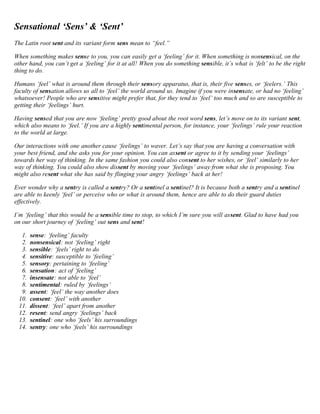
Sensational ‘Sens’ & ‘Sent’ 
The Latin root sent and its variant form sens mean to “feel.” 
When something makes sense to you, you can easily get a ‘feeling’ for it. When something is nonsensical, on the 
other hand, you can’t get a ‘feeling’ for it at all! When you do something sensible, it’s what is ‘felt’ to be the right 
thing to do. 
Humans ‘feel’ what is around them through their sensory apparatus, that is, their five senses, or ‘feelers.’ This 
faculty of sensation allows us all to ‘feel’ the world around us. Imagine if you were insensate, or had no ‘feeling’ 
whatsoever! People who are sensitive might prefer that, for they tend to ‘feel’ too much and so are susceptible to 
getting their ‘feelings’ hurt. 
Having sensed that you are now ‘feeling’ pretty good about the root word sens, let’s move on to its variant sent, 
which also means to ‘feel.’ If you are a highly sentimental person, for instance, your ‘feelings’ rule your reaction 
to the world at large. 
Our interactions with one another cause ‘feelings’ to waver. Let’s say that you are having a conversation with 
your best friend, and she asks you for your opinion. You can assent or agree to it by sending your ‘feelings’ 
towards her way of thinking. In the same fashion you could also consent to her wishes, or ‘feel’ similarly to her 
way of thinking. You could also show dissent by moving your ‘feelings’ away from what she is proposing. You 
might also resent what she has said by flinging your angry ‘feelings’ back at her! 
Ever wonder why a sentry is called a sentry? Or a sentinel a sentinel? It is because both a sentry and a sentinel 
are able to keenly ‘feel’ or perceive who or what is around them, hence are able to do their guard duties 
effectively. 
I’m ‘feeling’ that this would be a sensible time to stop, to which I’m sure you will assent. Glad to have had you 
on our short journey of ‘feeling’ out sens and sent! 
1. sense: ‘feeling’ faculty 
2. nonsensical: not ‘feeling’ right 
3. sensible: ‘feels’ right to do 
4. sensitive: susceptible to ‘feeling’ 
5. sensory: pertaining to ‘feeling’ 
6. sensation: act of ‘feeling’ 
7. insensate: not able to ‘feel’ 
8. sentimental: ruled by ‘feelings’ 
9. assent: ‘feel’ the way another does 
10. consent: ‘feel’ with another 
11. dissent: ‘feel’ apart from another 
12. resent: send angry ‘feelings’ back 
13. sentinel: one who ‘feels’ his surroundings 
14. sentry: one who ‘feels’ his surroundings
Sail into “Port” 
An important and widely used Latin root word is port, which means ‘carry.’ 
Humans ‘carry’ things from one place to another all the time. Portly humans, for instance, ‘carry’ a lot of body 
weight. When one nation imports goods from another nation, it ‘carries’ them into its own territory. On the other 
hand, to export goods is to ‘carry’ them out of one country to sell to another. Most of these goods are portable, or 
easily ‘carried’ from one country to the next. Human beings can also be deported from their own countries, being 
‘carried’ from one nation to another, usually for legal proceedings. 
When something is important, you want to ‘carry’ it towards yourself to tend to it. Reporters, or newspeople who 
‘carry’ back information to the public at large, often focusing on important concerns. In fact, reporters talk about 
sports a great deal, or those forms of entertainment that ‘carry’ you away from everyday activities. 
Transportation, or the act of ‘carrying’ people across from one place to another, forms the basis of much of 
everyday life. Cars support or ‘carry’ us in our need to go to far places quickly that walking just can’t 
accomplish. An even faster way to get from one place to another is via teleportation, or the ability to be ‘carried’ 
instantaneously from one place to another. 
Have you ever had a porter, or one who ‘carries’ luggage, help you at a hotel? An old-fashioned type of a leather 
suitcase is a portmanteau with which one can ‘carry’ a large amount of clothing. A portfolio is also a case in 
which you can ‘carry’ items, such as works of art or photographs; a portfolio also refers to the items put in the 
portable case. 
Import port into your brain, and it will ‘carry’ you far with knowledge of words! 
1. portly: refers to one who ‘carries’ much body weight 
2. import: ‘carry’ in 
3. export: ‘carry’ out 
4. portable: easily ‘carried’ 
5. deport: ‘carry’ from 
6. important: ‘carried’ in 
7. reporter: one who ‘carries’ back 
8. sport: ‘carries’ one away from everyday concerns 
9. transportation: act of ‘carrying’ across 
10. porter: one who ‘carries’ 
11. portmanteau: large ‘carrier’ of clothing 
12. portfolio: that which ‘carries’ items, or those items so ‘carried’
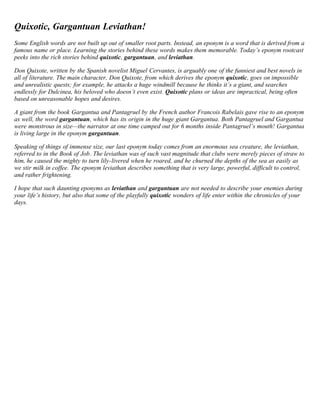
Quixotic, Gargantuan Leviathan! 
Some English words are not built up out of smaller root parts. Instead, an eponym is a word that is derived from a 
famous name or place. Learning the stories behind these words makes them memorable. Today’s eponym rootcast 
peeks into the rich stories behind quixotic, gargantuan, and leviathan. 
Don Quixote, written by the Spanish novelist Miguel Cervantes, is arguably one of the funniest and best novels in 
all of literature. The main character, Don Quixote, from which derives the eponym quixotic, goes on impossible 
and unrealistic quests; for example, he attacks a huge windmill because he thinks it’s a giant, and searches 
endlessly for Dulcinea, his beloved who doesn’t even exist. Quixotic plans or ideas are impractical, being often 
based on unreasonable hopes and desires. 
A giant from the book Gargantua and Pantagruel by the French author Francois Rabelais gave rise to an eponym 
as well, the word gargantuan, which has its origin in the huge giant Gargantua. Both Pantagruel and Gargantua 
were monstrous in size—the narrator at one time camped out for 6 months inside Pantagruel’s mouth! Gargantua 
is living large in the eponym gargantuan. 
Speaking of things of immense size, our last eponym today comes from an enormous sea creature, the leviathan, 
referred to in the Book of Job. The leviathan was of such vast magnitude that clubs were merely pieces of straw to 
him, he caused the mighty to turn lily-livered when he roared, and he churned the depths of the sea as easily as 
we stir milk in coffee. The eponym leviathan describes something that is very large, powerful, difficult to control, 
and rather frightening. 
I hope that such daunting eponyms as leviathan and gargantuan are not needed to describe your enemies during 
your life’s history, but also that some of the playfully quixotic wonders of life enter within the chronicles of your 
days.
Reverse Versus Obverse 
The Latin root word vers means ‘turned.’ 
Most people are not averse to, or “turned” away from, driving cars. Conversely, that is, thoroughly “turned” 
towards the opposite opinion, most people love cars. Always having a car almost seems irreversible these days— 
one cannot ever be “turned” back from owning one, at least if you need to get to work. 
We all know that the reverse side of a coin is the side that’s “turned” back from the viewer. But what’s the front 
side of the coin called? It’s the obverse, or the side “turned” towards you, that is, the “heads” side. 
So what does the Universe have to do with being “turned”? It is simply all of perceptible creation “turned” into 
one entirety. And a university? It is a place that has been “turned” into one area of learning for both 
undergraduate and graduate degrees. 
An adversary is someone who is “turned” against you. So, when we see Manchester United versus Chelsea on 
Fox, we know that those two teams are “turned” against each other in a soccer match. 
A couple’s anniversary marks that yet another year has “turned” since they’ve been married. Hopefully on 
anniversary days there will be plenty of loving conversation, being “turned” with another person while speaking. 
Perhaps there will even be some love poetry read, containing emotional verses, a “turning” or moving from one 
line of poetry to the next. Of course, the couple who has become divorced (vorc is a variant of vers), or “turned” 
apart from one another, perhaps celebrates that anniversary as well! 
I hope that the diverse examples and different versions, or ‘turnings,’ that I’ve given help you remember that vers 
means “turned,” aiding and abetting your success at a university and beyond! 
1. averse: ‘turned’ away 
2. converse: thoroughly ‘turned’ 
3. irreversible: not able to be ‘turned’ back 
4. reverse: ‘turned’ back 
5. obverse: ‘turned’ towards 
6. Universe: everything ‘turned’ into one whole thing 
7. adversary: one ‘turned’ against you 
8. versus: ‘turned’ against 
9. anniversary: another year ‘turned’ 
10. conversation: ‘turned’ with another while speaking 
11. verse: ‘turn’ of poetry 
12. divorce: having ‘turned’ apart from a spouse 
13. diverse: ‘turned’ apart 
14. version: a ‘turning’
Prefixes and the Prefix “In” 
Prefixes are key parts of English words. For instance, take the word prefix itself. Pre, which means “before,” is 
the prefix in the word prefix. Fix, which means “fastened,” is the “stem,” or primary part of the word. Thus, a 
prefix etymologically is that group of letters which is “fastened before” the stem of a word; that is, prefixes begin 
a word. 
Today we will focus on the prefix in, which can mean “in, on, or not.” 
Two highly used meanings of in are “in” or “on.” Let’s look at a few examples. In, for instance, can mean “in,” 
such as in the words inject, to throw “in,” and influx, to flow “in.” In can also mean “on,” used in such words 
as inscribe, to write “on,” and invoke, to call “on.” Hence, the first primary meanings of in are “in” or “on.” 
The English prefix in can also, however, mean “not.” This is a trickier part of this prefix, but once you get the 
hang of it, it’s highly valuable in decoding English vocabulary. Some examples of in meaning “not” include 
insane, or “not” sane, independent, or “not” dependent, and invalid, or “not” valid. 
By using common sense, context, or the process of elimination, you will find it easier to determine whether in 
means “in, on” or “not.” For example, inject, throw “in,” would make no sense as “not throw.” Conversely, the 
word insane makes little sense as “on” sane or sane “in;” rather “not” sane is the most obvious contextual 
choice. 
In our next rootcast we’ll discuss the prefix in again, paying attention to its spelling changes as it attaches to 
various different stems. Just remember for now that in can mean “in, on, into or not,” and you’ll have this prefix 
mastered “in” no time at all! 
1. inject: throw ‘in’ 
2. influx: flow ‘in’ 
3. inscribe: write ‘on’ 
4. invoke: call ‘on’ 
5. insane: ‘not’ sane 
6. independent: ‘not’ hanging from something 
7. invalid: ‘not’ valid
Plowing the Roots Field with "Tract"or 
The Latin root word tract means “drag” or “pull.” 
A tractor, for instance, “drags” or “pulls” heavy equipment, that is, it is a “dragger” of plows, combines, hay 
balers and the like. Smoothly working tractors are attractive farm implements; farmers are “dragged” or 
“pulled” to tractors since they so depend on them to get their heavy work done. A malfunctioning tractor detracts 
or “drags” from successful farm work being completed. No farmer wants a tractor that doesn’t work! 
When you subtract 3 from 5, you “drag” 3 away from 5, leaving but 2. Perhaps you learned how to subtract 
while in elementary school, unless of course you were highly distracted by other students, or “pulled” away by 
them. 
No one likes to have a tooth forcibly extracted, or “pulled” out by a dentist. In fact, there may have been a fair 
number of times when your parents found you to be intractable, or unable to be “dragged” to the dentist—in 
other words, you were being stubborn! They probably wished you would have been more tractable, that is, able to 
be “pulled” or managed more easily. 
Let’s continue on with the root word tract: “pull” or “drag.” Have you ever signed a contract? A contract is 
simply an agreement “pulled” together in a legal fashion. A contract is meant to keep the signers from retracting 
or “pulling” back on what they promised to do. And a contract often can prevent a protracted or “dragged” out 
legal battle that consumes a great deal of time. 
Do your running shoes have good traction, that is, are you able to “drag” them along the ground when you want 
to stop, or are you slipping and sliding everywhere? If the latter is the case, you might become distraught or 
emotionally “pulled” apart at the seams … time for a new pair! Note that traught is simply a variant of tract. 
I hope that you feel you’ve gained some traction by learning that tract means “drag” or “pull.” Now you will be 
able to easily extract meaning from English vocabulary words containing the root word tract! 
1. tractor: machine which ‘drags’ 
2. attractive: that which ‘pulls’ you 
3. detract: ‘drag’ from 
4. subtract: ‘drag’ away from 
5. distract: ‘pull’ away 
6. extract: ‘pull’ out 
7. intractable: not able to be ‘dragged’ 
8. tractable: able to be ‘pulled’ 
9. contract: agreements ‘pulled’ legally together 
10. retract: ‘pull’ back 
11. protracted: ‘dragged’ forth in time 
12. traction: quotient of ‘draggability’ 
13. distraught: ‘pulled’ apart emotionally
Different Spellings of the Prefix “In” 
Today we will focus on the different spelling changes of the English prefix in, which means “in, on, or not.” Not 
only do prefixes usually have several different meanings, but they also change their form to accommodate the 
stem to which they are attached. These spelling changes of prefixes primarily occur to make a word easier to say. 
The prefix in, for example, can exist in the following forms: il, im, in, ir, and ig. 
Take, for instance, the word “immutable.” Immutable consists of three morphemes: the prefix in-, the stem 
“mut,” and the suffix “-able.” Together they mean “not able to be changed.” Note that in has changed its 
spelling to im: it has undergone prefix assimilation so that the word is easier to say. Can you hear why 
“immutable” is preferable to “inmutable?” Or why the word “irresistible,” or “not able to be resisted,” is 
preferable to “inresistible?” 
Recalling that the prefix in can mean “in, on, or not,” let’s go through examples of the five forms “in” which in 
exists “in” English: 
Il: Examples include: illegal: “not legal;” illogical: “not logical;” and illegible: “not able to be read.” Note how 
the il spelling is preferable to inlegal, inlogical, or inlegible! In only changes to il when it precedes a stem 
beginning with the letter “l.” 
Im: Examples include: imbibe: “drink in;” implant: “set in;” and immortal: “not mortal.” In changes to im 
before stems that begin with “m,” “p,” or “b.” 
In: Examples include: innocent: “not guilty;” inculpate: “put the blame on;” and incisor: tooth that “cuts in.” 
Ir: Examples include: irrational: “not rational;” irrigate: “put a supply of water on;” and irregular: “not 
regular.” In only becomes ir prior to a stem that begins with “r.” 
Ig: Examples include: ignoble: “not noble;” ignore: “not pay heed to;” and ignominious: “not having a good 
name.” In changes to ig only before a stem beginning with “n.” 
A good way to remember that in can be spelled as il, im, in, ir and ig is through the mnemonic “LeMoN RiG!” If 
you are driving a big RiG carrying LeMoNade, you would want lots of yummy LeMoNs “in” your LeMoN 
RiG! 
The prefix in not only has three meanings: “in, on, or not,” but also has five ways it can be spelled: il, im, in, ir, 
and ig. Drive that around “in” your LeMoN RiG, and the decoding of English vocabulary will be like a Sunday 
drive “in” the country sipping LeMoNade! 
1. illegal: ‘not’ legal 
15. ignoble: ‘not’ noble 
2. illogical: ‘not’ logical 
illegible: 16. ignore: ‘not’ paying attention to 
3. ‘not’ able to be read 
4. immutable: ‘not’ able to be changed 
17. ignominious: ‘not’ having a good name 
5. imbibe: drink ‘in’ 
6. implant: set ‘in’ 
7. immortal: ‘not’ subject to death 
8. innocent: ‘not’ harmful 
9. inculpate: put the blame ‘on’ 
10. incisor: tooth that cuts ‘in’ 
11. irrational: ‘not’ reasonable 
12. irrigate: put water ‘on’ 
13. irresistible: ‘not’ able to be resisted 
14. irregular: ‘not’ following a pattern
Accept No Exceptions! 
The Latin root word cept means “taken.” 
If someone were to offer you 3,000,000 dollars, you would probably accept at once, having therefore “taken” that 
sum of money towards yourself. There might, however, be an exception to getting the money, or that which is 
“taken” out of the original promise. If, however, there were no exceptions, it would be an exceptional event, one 
“taken” out of ordinary circumstances! 
Deceptions occur when you are “taken” from the truth or reality of a given situation in some underhanded 
fashion. If you have ever been deceived, you were not perceptive enough, that is, the full knowledge or truth of 
your surroundings was not thoroughly “taken” in. Hopefully the next time you’ll be able to intercept any such 
trick before it happens, “taking” it between its origin and its end target! 
Let’s further reinforce the etymological concept that the root word cept means “taken.” 
Were you ever able to concoct a concept, or that which is thoroughly “taken” in your mind, before anyone else 
thought of the idea? You would then be responsible for the concept’s inception, “taken” in at its very start. You 
might then hope that other people would be receptive to your idea, or that they would “take” it back into their 
own minds for further consideration, and not reject it out of hand. 
Just what does it mean if you are susceptible to something? If you are susceptible to a disease, for instance, you 
are able to be “taken” under by it, contracting it despite your immune system’s attempt to fight it off. 
You can now confidently put the root word cept into your receptacle of knowledge, having “taken” it back into 
your brain and deposited it there for safekeeping. No longer will you suffer from verbal deception whenever you 
see a word with cept in it, for you have “taken” the bull by the horns, never to be “taken” in again—no 
exceptions! 
1. accept: ‘taken’ towards 
2. except: ‘taken’ from 
3. exceptional: ‘taken’ from the normal 
4. deception: ‘taken’ from the truth 
5. perceptive: having thoroughly ‘taken’ in one’s surroundings 
6. intercept: ‘taken’ between origin and target 
7. concept: thoroughly ‘taken’ or seized in one’s brain 
8. inception: ‘taken’ in at the beginning 
9. receptive: ‘taken’ back to oneself 
10. susceptible: able to be ‘taken’ under 
11. receptacle: container which “takes” something back into it for safekeeping
Take the Variants of “Cept” into Consideration 
When studying root words, there are often spelling variants for the same root. The primary root word cept: 
“taken,” for instance, present in the words concept and inception, has variant spellings of cap, cip, and ceiv. 
Cap, cip, and ceiv all mean “take” as well. 
Let’s begin with the root word cap, which means “take.” If you are capable of doing something, you are able to 
“take” it into hand. The capacity of a box or other container is the volume of objects that can be “taken” into it. 
If you become incapacitated, you can no longer effectively “take” what life throws at you because you have 
become deprived of strength in some way. And when you capture something? You, of course, “take” it. 
Cip is also a variant of cept, and also means “take.” A recipient of an award “takes” it back towards herself. An 
incipient project is “taken” in at its very beginning. Your principles are those moral standards that you always 
“take” first into consideration when deciding between right and wrong. And a disciple? She “takes” in 
knowledge. 
Our last variant of cept is ceiv. The letter “v” is interchangeable with the letter “p” across languages. For 
instance, the words “concept” and “conceive” simply switch the “p” and the “v” consonants—they are really 
different forms of the same word. Some examples of English words with the morpheme ceiv include conceive 
(thoroughly “take” an idea), deceive (to “take” someone away from the truth by tricking her), perceive (to 
thoroughly “take” in one’s surroundings), and receive (to “take” back to oneself). 
An easy mnemonic to remember that cept, cap, cip and ceiv all mean to “take” is the following: The recipients of 
exceptional caps “take” and receive them joyfully. 
Now that you know that cept, cap, cip and ceiv all mean to “take,” you will never be “taken” unawares by words 
that encapsulate them! 
1. concept: thoroughly ‘taken’ or seized in one’s brain 
2. inception: ‘taken’ in at the beginning 
3. capable: able to ‘take’ something and work effectively with it 
4. capacity: amount that can be ‘taken’ in 
5. incapacitated: not able to ‘take’ in life’s arrows 
6. recipient: one who ‘takes’ something back towards herself 
7. incipient: ‘taken’ in at the beginning 
8. principle: moral standard ‘taken’ first 
9. disciple: one who ‘takes’ in knowledge 
10. conceive: thoroughly ‘take’ an idea 
11. deceive: ‘take’ someone away from the truth 
12. perceive: thoroughly ‘take’ in one’s surroundings 
13. receive: to ‘take’ back to oneself
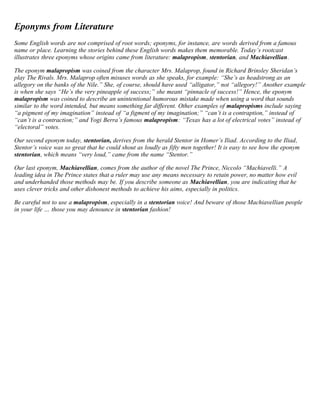
Eponyms from Literature 
Some English words are not comprised of root words; eponyms, for instance, are words derived from a famous 
name or place. Learning the stories behind these English words makes them memorable. Today’s rootcast 
illustrates three eponyms whose origins came from literature: malapropism, stentorian, and Machiavellian. 
The eponym malapropism was coined from the character Mrs. Malaprop, found in Richard Brinsley Sheridan’s 
play The Rivals. Mrs. Malaprop often misuses words as she speaks, for example: “She’s as headstrong as an 
allegory on the banks of the Nile.” She, of course, should have used “alligator,” not “allegory!” Another example 
is when she says “He’s the very pineapple of success;” she meant “pinnacle of success!” Hence, the eponym 
malapropism was coined to describe an unintentional humorous mistake made when using a word that sounds 
similar to the word intended, but means something far different. Other examples of malapropisms include saying 
“a pigment of my imagination” instead of “a figment of my imagination;” “can’t is a contraption,” instead of 
“can’t is a contraction;” and Yogi Berra’s famous malapropism: “Texas has a lot of electrical votes” instead of 
“electoral” votes. 
Our second eponym today, stentorian, derives from the herald Stentor in Homer’s Iliad. According to the Iliad, 
Stentor’s voice was so great that he could shout as loudly as fifty men together! It is easy to see how the eponym 
stentorian, which means “very loud,” came from the name “Stentor.” 
Our last eponym, Machiavellian, comes from the author of the novel The Prince, Niccolo “Machiavelli.” A 
leading idea in The Prince states that a ruler may use any means necessary to retain power, no matter how evil 
and underhanded those methods may be. If you describe someone as Machiavellian, you are indicating that he 
uses clever tricks and other dishonest methods to achieve his aims, especially in politics. 
Be careful not to use a malapropism, especially in a stentorian voice! And beware of those Machiavellian people 
in your life … those you may denounce in stentorian fashion!
Thoroughly Together With “Con-” 
Today we will focus on the prefix con-, which can mean “with” or “thoroughly.” Prefixes are morphemes which 
begin words, attaching to a word’s main part, or stem. 
One highly used meaning of the prefix con- is “with.” For instance, when you connect two objects, you link them 
“with” each other. When people convene at a particular place, they come there “with” others. In the same vein, 
when people congregate, they flock “with” each other. A consensus is a mutual feeling of agreement that people 
have “with” each other. And concord? Concord is agreement or harmony, or etymologically when one person’s 
“heart” is “with” another. 
If you know Spanish, you’ll remember that the preposition con means “with,” such as in the expressions: con 
mucho gusto (“with” much pleasure), or chile con carne (chili pepper “with” meat). This Spanish word came 
from the Latin root word con- as well. 
Prefixes, such as con-, can also act as intensives, which emphasize the meaning of the stem of the word to which 
they are attached. Intensive prefixes can functionally be translated as “thoroughly” to indicate that emphasis. For 
instance, when you conclude that something is true, you have “thoroughly” closed any debate on the issue of its 
truthfulness. When you convince someone of the truth of what you say, you “thoroughly” win him over. A 
consequence is a result which “thoroughly” follows you after you’ve done something. When you concede a point 
in a debate, you “thoroughly” yield to it. And concise wording? It has “thoroughly” cut away any unnecessary 
words, keeping what is said short and to the point. ’Nuff said! 
Hence we’ve come to the conclusion, or “thorough” closing of our rootcast for the day. Just remember that con-can 
mean “with” or “thoroughly,” and you’ll “thoroughly” master all those words “with” the prefix con- in 
them! 
1. connect: link ‘with’ another 
2. convene: come together ‘with’ others 
3. congregate: flock ‘with’ others 
4. consensus: feeling ‘with’ others 
5. concord: heart ‘with’ another 
6. conclude: ‘thoroughly’ close 
7. convince: ‘thoroughly’ win over 
8. consequence: effect which ‘thoroughly’ follows 
9. concede: ‘thoroughly’ yield 
10. concise: ‘thoroughly’ cut
Different Spellings of the Prefix “Con-” 
Today we will focus on the different spelling changes of the English prefix con-, which means “with” or 
“thoroughly.” Not only do prefixes usually have several different meanings, but they also change their form to 
accommodate the stem to which they are attached. These spelling changes of prefixes primarily occur to make a 
word easier to say. The prefix con-, for example, can exist in the following forms: co-, col-, com-, and cor-. 
Take, for instance, the word “cooperate.” Cooperate consists of three morphemes: the prefix con-, the stem or 
root “oper,” and the suffix “-ate.” Together they etymologically mean “to make work together.” Note that con-changed 
its spelling to co-: it has undergone prefix assimilation so that the word sounds better. Can you hear 
why “cooperate” is preferable to “conoperate?” 
Recalling that the prefix con- can mean “with” or “thoroughly,” let’s go through examples of the four spelling 
variants in which con- exists in English: 
Examples 
Co-cooperate: “to work with” and coexisting: “existing with.” Note how the “co-” spelling is preferable to 
conoperate or conexisting! 
Col-collaborate: “work with” and collapse: “thoroughly slip or fall.” 
Com-combat: “a fighting with;” companion: “one with whom one eats bread;” and complete: “to 
thoroughly fill.” 
Cor-correct: “make thoroughly right;” corrode: “thoroughly eat or gnaw away;” and correlate: “to relate 
with.” 
A good way to remember that con- can also exist as co-, col-, com-, and cor- is the following mnemonic: Cold 
Cola Comforts Your Core. 
Conclusion 
The prefix con- not only has two primary meanings: “with” and “thoroughly,” but also has four ways it can be 
spelled: co-, col-, com-, and cor-. This completes our comprehensive study of the prefix con-, “with” which you 
can now be “thoroughly” comfortable! 
1. cooperate: to work ‘with’ another 
2. coexisting: existing ‘with’ 
3. collaborate: to work ‘with’ another 
4. collapse: to ‘thoroughly’ fall 
5. combat: fight ‘with’ 
6. companion: one ‘with’ whom one eats bread 
7. complete: ‘thoroughly’ fill 
8. correct: make ‘thoroughly’ right 
9. corrode: ‘thoroughly’ eat away 
10. correlate: relate ‘with’
Hold a Perfect “Ten” 
The Latin root word ten means “hold.” Let’s see what we can do to “hold” the root ten firmly in your memory. 
Have you ever been a tenant in an apartment? If so, you know that, as a tenant, you were the “holder” of the 
lease. There was probably a maintenance crew that worked in the apartment complex where you lived. A 
maintenance crew “holds” everything in good order by means of regular repair. There may also have been tennis 
courts where you lived. The server in the original game of tennis used to shout the French command tenez!, or 
“Hold!” before he served to warn his opponent; tenez!, in turn, came from the Latin verb tenere, "to “hold.” 
A tenable theory is one that is able to be “held” because it is rationally defensible in an argument. Often people 
will put forth certain tenets when they argue, that is, beliefs or opinions that they “hold” as truths. People will 
often be very tenacious when defending those opinions, “holding” on to them and not letting go no matter what. 
A lieutenant is an officer who “holds” the place of another more senior officer, acting as his deputy. If you are a 
professor and have just been offered tenure at the university where you work, you are now able to permanently 
“hold” on to your position. The word tenor describes the male voice that “holds” the melody in a piece of music, 
or can refer to a line of thinking that “holds” throughout a written or spoken work. 
Last, but certainly not least, especially if you’re hungry, is the word sustenance. This word usually refers to food 
that sustains you, or “holds” you in good health. 
The ten words we’ve discussed can help you remember that the root word ten means “hold.” “Holding” the 
meaning of ten in mind will offer much sustenance to your vocabulary prowess! 
1. tenant: one who “holds” a lease 
2. maintenance: a “holding” of a property in good order 
3. tenable: of a position that can be “held” 
4. tenet: a belief or opinion that is “held” 
5. tenacious: a “holding” on to something 
6. lieutenant: “holds” the place of a superior officer 
7. tenure: permanent “holding” of a professorship 
8. tenor: male voice that “holds” the melodic line 
9. sustenance: food that “holds” your body in good health, or holds you from under, thus supporting you
Hold the Spelling Variants of “Ten” in Mind 
Spelling variants often occur to a primary root word. The root word ten: “hold,” for instance, present in the 
words tenant and maintenance, has variant spellings of tin, tain, and tent. Let’s see how these variants, which all 
also mean “hold,” play out in English vocabulary. 
Let’s begin with the root word tin, which means “hold.” A continent, for instance, is “held” together in one large 
land mass. Something that is pertinent or relevant to a situation thoroughly “holds” with it because it is an 
important part of it. If events happen on a continuous or continual basis they are being “held” without letting go. 
Continuous rain over a two day period would be “holding” with no breaks; continual rain would “hold” as well, 
but have brief respites. 
Another spelling variant of the English root ten is tain, which also means “hold.” When you retain control, you 
“hold” onto it. When you maintain your car, you “hold” it in good working condition. When you obtain an item, 
you then “hold” it. A container has a certain amount of space with which it can “hold” items. And just what is it 
that an entertainer does? She “holds” interest among an audience! 
Tent is also a variant of the root ten, which also means “hold.” One’s retention of factual information is how 
much data one can “hold” in one’s mind. The factual content of a book is how much information it “holds.” And 
what happens if you are put in detention at school? You are “held” from others in a separate room, usually for 
some sort of infraction of school rules. 
An easy way to remember that ten, tent, tin, and tain all mean to “hold” is by using the following memory hook: 
Ten Containers “Hold” the Discontented Tin Man. :( 
Now that you can retain the fact that the English root word ten means “hold,” it should really have a hold on 
you! You will find this information highly pertinent as your English vocabulary content begins to balloon! 
1. continent: large land mass ‘held’ together 
2. pertinent: of that which ‘holds’ with a given situation 
3. continuous: action ‘held’ together without a break 
4. continual: action ‘held’ together with occasional breaks 
5. retain: ‘hold’ back 
6. maintain: ‘hold’ in good condition 
7. obtain: get and therefore ‘hold’ 
8. contain: ‘hold’ together a certain amount of material 
9. entertain: ‘hold’ interest among people 
10. retention: ability to ‘hold’ information 
11. content: information that is ‘held’ together in a book 
12. detention: a ‘holding’ away from others
Vent No More with Ven 
The Latin root word ven and its variant vent both mean “come.” Let’s see how these Latin root words have 
“come” so fruitfully into the English language. 
Soccer fans often eagerly convene at stadiums, or “come” together there. The soccer stadium is an exciting 
venue, or place where people “come.” This place is often in a convenient part of a city, or a mutually agreeable 
place to “come” together for exciting matches. Afterwards, fans who have traveled far might want to bring home 
a souvenir, or etymologically an item which “comes” under your memory to support it in remembering where you 
went. 
French, Spanish, Italian, and Portuguese soccer fans all use the same word which means “to come:” venir! When 
Caesar said veni, vidi, vici (I came, I saw, I conquered), little did he know that his Latin language would have 
such a huge influence on the Romance languages! 
A primary focus of most companies is revenue, or that money which “comes” back from sales of products they 
manufacture. If the income stream is too low, the board may have to intervene or “come” between the CEO and 
her company to make needed changes. 
A variant of the root word ven is vent, which also means to “come.”An event is something that etymologically 
“comes” out, or “happens.” When you prevent something from happening, you “come” before it to stop it in its 
tracks. An invention is something “come” upon for the first time; that is, an inventor has a knack of inventing or 
“coming” upon things that no one else has thought of or found before. During an adventure, a knight “comes” 
upon many foes as he travels or “comes” to many places. And a convention? That’s a gathering where many 
people “come” together to talk about similar interests. 
I hope that you have now “come” to realize how important the root word ven and its variant vent have “come” 
to be in the construction of the English language. 
1. convene: to ‘come’ together 
2. venue: place where people ‘come’ 
3. convenient: of an agreeable place or time to ‘come’ together 
4. revenue: money which ‘comes’ back after selling products 
5. intervene: to ‘come’ between two things 
6. event: that which ‘comes’ out 
7. prevent: ‘come’ before 
8. invention: that which is ‘come’ upon for the first time 
9. inventor: one who ‘comes’ upon new things 
10. adventure: a ‘coming’ to people and places 
11. convention: a ‘coming’ together of people
Eponyms from Ancient Greece 
Some English words are not comprised of root words; eponyms, for instance, are words derived from a famous 
name or place. Today’s rootcast illustrates three eponyms whose origins arise from the history of ancient Greece: 
Pyrrhic, spartan, and epicurean. 
The eponym Pyrrhic derives from King Pyrrhus, a great Greek general, who fought the Romans in two close 
battles. Although Pyrrhus won both battles, he suffered such an irreplaceable loss of valued soldiers that it was as 
costly as if he had lost them both. Today a Pyrrhic victory, in turn, gets you what you want, but nevertheless at a 
very heavy price. Imagine becoming the CEO of a company at the expense of becoming estranged from your 
family. That would be a Pyrrhic victory. 
The eponym spartan derives from the ancient Spartans, the denizens of the ancient Greek city-state of Sparta. 
Spartans had an unusually harsh way of living; they were known for their extreme self-discipline, and the 
restraint they showed towards having unnecessary pleasures in life. If you lead a spartan lifestyle today, you 
avoid luxury and live in a rather severely simple way. No Ferraris or Godiva chocolates for the spartan amongst 
us, but rather an old bicycle and Ramen noodles! 
Our last eponym today, epicurean, stems from the philosopher Epicurus, who reputedly said that “The fountain 
and root of every good is the pleasure of the stomach.” Over time and much debate over what the actual teachings 
of Epicurus were, the meaning of epicurean settled as referring to someone who gets great pleasure in material 
and sensual things, especially the refined pleasures and knowledge of good food and drink. You might find an 
epicure at a tasting of fine wine and exquisite chocolate, for instance. 
Some of the historical characters of Greece still figure prominently in the English language. We are reminded of 
the war expertise of Pyrrhus, the self-denying Spartans, and the pleasure-seeking Epicurus each time we use the 
eponyms Pyrrhic, spartan, and epicurean.
TheRE and Back Again 
Today we will focus on the prefix re-, which can mean “back” or “again.” Prefixes are morphemes which begin 
words, attaching to a word’s main part, the “root” or “stem.” For instance, in the word return, re- is the prefix, 
and “turn” is the root or stem. 
One meaning of the prefix re- is “back.” For instance, when you reject a plan, you throw it “back.” When a 
man’s hair recedes, his hairline continues to move “back” as he loses hair. When you reduce the amount of 
money you spend, you lead it “back” to a smaller amount. When light reflects off a surface, it bends “back.” 
When you are returning home from an outing, you are turning “back” home. And when a criminal reverts to 
being good again, he turns “back” to morally upright behavior. 
Another primary meaning of the prefix re- is “again.” For instance, when you rearrange the furniture in a room, 
you arrange it “again” into a different configuration. A marathon runner can become rejuvenated or 
etymologically made young “again” by sleeping and eating after a long race. Some newts regenerate limbs once 
they’ve lost them; that is, they grow them “again.” When a teacher recapitulates something she’s just taught, she 
goes over it “again” by summarizing it. Some religious faiths believe in reincarnation, or the taking of a body 
“again” after death to live another life. 
In a few rare instances the prefix re- adds a “d” to make a word easier to say; this occurs before some vowels 
some of the time. The word redeem, for instance, as in to redeem a coupon, adds a “d” because reeem would 
have an unpronounceable 3 es. In the same vein, redundant is much better than “reundant.” 
Now your brain will never reject that the meaning of the prefix re- is “back” or “again.” Reflect upon re-, and 
your vocabulary prowess will never regress! 
1. reject: throw ‘back’ 
2. recede: move ‘back’ 
3. reduce: lead ‘back’ 
4. reflect: bend ‘back’ 
5. return: turn ‘back’ 
6. revert: turn ‘back’ 
7. rearrange: arrange ‘again’ 
8. rejuvenate: make young ‘again’ 
9. recapitulate: say ‘again’, going ‘back’ to the head of what you’re saying 
10. reincarnate: return into a body ‘again’ 
11. redeem: buy ‘back’ 
12. redundant: flow ‘again’ unnecessarily
Mal Mauls 
The Latin root word mal means “bad” or “evil.” 
Let’s first of all talk about the root mal when it means “bad.” Doctors have to deal with all kinds of problems that 
have the root word mal in them. For instance, someone may have a malfunctioning kidney, which is “badly” 
functioning. They may have to treat someone who has contracted malaria; doctors once believed that people 
could come down with malaria if they breathed in “bad” air. A baby may be born with a malformed or “badly” 
formed organ which may need immediate attention. Doctors may have to treat a child who is suffering from 
malnutrition, or “bad” nutrition. A surgeon might have to operate on someone with a malignant tumor, which is 
“bad” because it’s cancerous. Lastly, an unlucky physician may be subject to a malpractice suit if his work was 
“badly” done. 
Latin once again heavily influenced the Romance languages with the root mal: the Spanish words mal, malo, and 
mala, the French mal, and the Italian male all have something to do with “badness.” 
A more sinister meaning of mal is “evil.” The word dismal derived from the Latin dies malus meaning “evil day;” 
it is easy to see why the word dismal came from this. A malicious person does not think twice about performing 
“evil” deeds to hurt other people. A malefactor, or "evil"doer, is the opposite of a benefactor. Someone who is 
maleficent fully intends to do “evil.” When you malign another, you say “evil” things about him; that is, you act 
in a malignant, or “evil” fashion. 
Let’s end with a friendly benediction instead of a malediction: may mal no longer be “evil” or “bad” towards 
your vocabulary knowledge, but rather alert you to the fact that you might want to avoid anything in your path 
that needs a mal root word to describe it! 
1. malfunction: when something is functioning ‘badly’ 
2. malaria: a disease originally thought to be caused by ‘bad’ air 
3. malformed: ‘badly’ shaped 
4. malnutrition: a condition of ‘bad’ nutrition 
5. malnourished: ‘badly’ nourished 
6. malignant: of a “bad” tumor or of someone disposed to do “evil” 
7. malpractice: ‘bad’ medical practice 
8. dismal: etymologically of an ‘evil’ day 
9. malicious: prone to do ‘evil’ 
10. malefactor: one who does ‘evil’ things 
11. maleficent: a tendency to do ‘evil’ deeds 
12. malign: speak ‘evil’ about
Intense Prefixes 
Some prefixes highly emphasize roots of words to which they are attached, and are known as intensive prefixes. 
These prefixes can effectively be translated as “thoroughly” to highlight their intensive function. Today we will 
talk about the prefixes re- and de-, which can both act as intensive prefixes. 
The prefix re-, which can mean “back” or “again,” can also mean “thoroughly” when it acts as an intensive. For 
instance, the word resplendent means “thoroughly” shining or bright. If the word were “splendent,” it would 
simply mean “shining;” adding the intensive prefix re- onto “splendent” transforms the root “shine” into 
“thoroughly” shining, or “very” bright. 
Let’s take a look at a couple more examples using the intensive prefix re-. When a person is reticent, she is 
“thoroughly” silent because she is unwilling to share information about something. A musician’s repertoire is 
that list of music which he has “thoroughly” produced. And what do you do when you show a great deal of 
resolve? You “thoroughly” loosen or untie yourself toward the completion of a goal that you have set. 
A second example of an intensive is the prefix de-. While de- can mean “off” or “from,” it can also be used as an 
intensive, again usefully translated as “thoroughly.” For instance, when a fruit becomes desiccated, it has become 
“thoroughly” dried out. When you make a declaration, you make something “thoroughly” clear so that no one 
can mistake your meaning. A desolate person is “thoroughly” alone or lonely, whereas a desolate place is 
“thoroughly” remote, that is, by itself. When you demonstrate the effectiveness of something, you “thoroughly” 
show it. A deluge can “thoroughly” wash or bathe the land with all the rain that comes with it. And a depraved 
criminal? He is evil “through and through,” or “thoroughly” evil. 
Prefixes, when they act as intensives, emphasize and heighten the force of the primary meanings of words. Strive 
to recognize intensive prefixes, and you will “thoroughly” improve your vocabulary prowess! 
1. resplendent: ‘thoroughly’ shining 
2. reticent: ‘thoroughly’ silent 
3. repertoire: music ‘thoroughly’ learned 
4. resolve: ‘thoroughly’ loosen or untie 
5. desiccated: ‘thoroughly’ dried out 
6. declare: make ‘thoroughly’ clear 
7. desolate: ‘thoroughly’ alone, lonely, or remote 
8. demonstrate: ‘thoroughly’ show 
9. deluge: ‘thoroughly’ washes or bathes 
10. depraved: ‘thoroughly’ evil
The Fascinating Parts of Words 
Morphology is the study of how words are put together or “shaped” by using morphemes, which include prefixes, 
roots, and suffixes. Knowing the different morphemes in a word allows one to not only figure out its definition, but 
also determine whether it’s a noun, verb, or adjective. The words morphology and morpheme both come from the 
Greek root word morph meaning “shape;” morphology is therefore the study of the “shape” words take, whereas 
morphemes are those building blocks which “shape” the word. 
Morphemes include affixes, which are primarily prefixes and suffixes. Prefixes are those affixes which begin a 
word, adding meaning to the root to which they are attached. The root is the primary part of a word; it conveys 
most of the meaning of a word. Suffixes are those affixes which end words; they can add meaning, and usually 
determine the part of speech of a word, that is, whether the word is a noun, verb, adjective, or adverb. 
Let’s take an in-depth look at the morphology of two words: “inventor” and “convention.” The morphemes of 
“inventor” include the prefix in-, the root vent-, and the suffix -or. By putting together in- + vent + -or, the word 
“inventor” is formed. Since the prefix in here means “on” or “upon,” the root vent means “come,” and the suffix 
-or means “one who,” the meaning of “inventor” becomes “one who comes upon” something, or “finds” 
something for the first time. The suffix -or also indicates that “inventor” must be a noun. 
Let’s take a second look at morphology. What word is formed from the following three morphemes: the prefix 
con-, the root vent, and the suffix -ion? You got it, it’s “convention.” From the meanings of the three morphemes, 
we know that a “convention” is “the act of coming together;” we also know from the suffix that “convention” 
must be a noun. 
One fun word with 9 morphemes includes 3 prefixes: anti-, dis-, and e-, 1 root stabl, and 5 suffixes: -ish, -ment, - 
ar, -ian, and -ism! Although “antidisestablishmentarianism” might seem like a difficult word, once you parse it 
by analyzing its different morphemes it’s cut right down to size, making it easier to swallow. 
By figuring out the morphemes of words, they become transparent, their definitions easily remembered, and their 
parts of speech demystified. 
1. morphology: the study of how words are shaped, or put together 
2. morpheme: a piece of a word: prefix, root (stem), suffix 
3. affix: prefix or suffix 
4. prefix: a morpheme added in before the root of a word that adds meaning or emphasis 
5. suffix: a morpheme added after or “under” the root of a word that adds meaning to and/or indicates the 
part of speech of a word 
6. root: the primary part of a word which conveys most of a word’s meaning onto which affixes attach 
7. stem: another word for a “root” 
8. antidisestablishmentarianism: opposition to the withdrawal of support from a religious institution
Sid Sits with Sed 
The Latin root word sid and its variant sed both mean “sit.” 
Let’s first take a look at the root sid. Consider Sydney, a resident of a city, or that place where she “sits” back for 
a long time. She can “sit” in comfort at her residence, or that home where she is able to “sit” at leisure. Imagine 
that Sydney is president of a profitable company; as president, she “sits” in charge of her employees. In such a 
role she presides, or “sits” before everyone else as top dog. 
Consider Sydney’s dismay when she finds out that there is a dissident in her company, or one who “sits” apart 
from those around him because he holds different opinions. Sydney considers rebels like that insidious, or 
“sitting” in secret ambush to upend her. Sydney ensures that his dissension will soon subside, or “sit” or settle 
down, and eventually go away, by offering him more money. 
A variant of the root sid is sed, which also means “sit.” Do you know anyone who is a serious couch potato? He 
would be a good example of a sedentary person, or one who likes to “sit” around a lot. Has a doctor ever had to 
sedate you because you were too active? That sedative she gave you would cause you to settle or to “sit” down, 
forcing you to be inactive. 
You may have learned in geology that sediment is that particulate matter that eventually “sits” upon or settles to 
the bottom of a body of water. Sedimentary rock is formed from that settled dirt and debris that has “sat” there 
and eventually compacted after a long time. 
No longer will you have to “sit” down at a dictionary, thumbing through it to discover that sid and sed are both 
linguistically settled as “sit!” 
1. resident: one who ‘sits’ back somewhere 
2. residence: place where one ‘sits’ back 
3. president: one who ‘sits’ before 
4. preside: to ‘sit’ before 
5. dissident: one who ‘sits’ apart from others 
6. insidious: of one who ‘sits’ in ambush 
7. subside: to ‘sit’ under 
8. sedentary: of one who ‘sits’ often 
9. sedative: drug which causes one to ‘sit’ or settle down 
10. sediment: matter which ‘sits’ on the bottom of water 
11. sedimentary: type of rock formed from matter which has ‘sat’ on the bottom of a lake
On The Go 
The Latin root word ced means “go.” 
When one thing precedes another, it “goes” before it. In law, a precedent is a legal decision that has “gone” 
before or has been legally enacted in the past, and can now be used as a standard or example by which to judge 
current and future cases. Sometimes states threaten to secede, or “go” apart from the United States to form a 
separate nation; during the American Civil War, for instance, the South seceded or “went” apart from the Union, 
an act which began the Civil War. 
Antecede, like precede, also means “goes” before. An antecedent is an ancestor, or a person in your family who 
has “gone” before you. A grammatical antecedent is the noun that “goes” before the relative pronoun; for 
instance, in the sentence “I shuddered at the Balrog who ate Gandalf,” the antecedent is “Balrog,” to which the 
relative pronoun “who” refers. 
What happens when a man’s hair recedes? It begins to “go” back! Some may wish that destiny would intercede 
or “go” between them and their receding hair line, hoping for a miracle and sudden restoration. Others may opt 
for a medical procedure, or a “going” forth, in this case the grafting of hair upon their steadily balding pates. 
Some resigned men simply accede to the inevitable, valiantly “going” towards their hairless destiny. 
Enough has now been “said” about the root ced; it has “gone” towards your ears with plenty of procedural 
accuracy, so now I will “go” no further! 
1. precede: to ‘go’ before 
2. precedent: that which ‘goes’ before to set an example or standard to be subsequently followed 
3. secede: to ‘go’ apart 
4. antecedent: that which ‘goes’ before 
5. recede: to ‘go’ back 
6. intercede: to ‘go’ between 
7. procedure: a ‘going’ forth 
8. accede: to ‘go’ towards
Moving the Ced Procession 
When studying root words, there are often spelling variants to a primary root word. The root word ced: “go,” for 
instance, present in the words precede and recede, has variant spellings of cess and ceed, which also mean “go.” 
Let’s begin with cess, “go.” When you access your money at a bank, you “go” towards it. When you have an 
excess of that money, it has “gone” out of normal boundaries. In a recession the economy is “going” back. The 
economy, during such a financial downturn, is not experiencing much success, or ‘going’ up to its goal of ‘going’ 
forward. The Chairman of the Federal Reserve often finds it a necessity, or something with which one is not able 
to “go,” to stimulate the economy. Hopefully your ancestors, or the ones who have “gone” before you, left you 
enough cash to help weather such economic trials! 
Another spelling variant of the English root ced is ceed, which also means “go.” When you succeed at a task, you 
are able to “go” to the foot of it and accomplish it. When you proceed along a path, you “go” forth along it. And 
when you exceed the bounds of proper conduct? You “go” beyond them. 
An easy way to remember that ced, cess, and ceed all mean to “go” is by using the following memory hook: An 
excess of Excedrin succeeds in headaches “going” away! 
Now that you have succeeded in learning the variant spellings of the root word ced, you will confidently “go” 
towards vocabulary success! 
1. access: ‘going’ towards 
2. excess: ‘going’ out of normal limits 
3. recession: act of ‘going’ backwards 
4. success: ‘go’ up to a goal 
5. necessity: that with which one cannot ‘go’ without 
6. ancestor: one who has ‘gone’ before you 
7. succeed: ‘go’ to the foot of a goal 
8. proceed: ‘go’ forth 
9. exceed: ‘go’ out of normal boundaries
“Pre-”: The Prefix of Prefixes 
Today we will focus on the prefix pre-, which means “before.” Prefixes are morphemes which begin words, 
attaching to a word’s main part, or root, adding to the meaning of the word in some way. The word prefix itself 
has the prefix pre- in it. A prefix is an affix which is fastened or fixed “before” the primary root or stem of a 
word. 
When you try to prevent something, you come “before” it to put a halt to it, thereby keeping it from happening. 
Someone who is being precise cuts off all inaccuracies “beforehand” to keep only the exact facts. If you’re filled 
with prejudice towards a particular person, you have judged her “before” knowing her full story. 
When you preview a movie, you see it “beforehand” to see if it’s appropriate for younger viewers. By seeing the 
movie ahead of time, you don’t have to predict or say “beforehand” whether the movie is good or not, since not 
all predictions are accurate. In this way you prepare in advance, getting ready “before” it’s too late. This is a 
fine way of taking a precaution, or a being careful “beforehand.” 
Sometimes it’s hard for voters to know for whom they will prefer to vote, or which candidate they will carry 
“before” others when it comes to casting their ballot. It can be a hard choice to know for whom to vote for 
president, or that person who sits “before” us all governing the country. 
Hopefully this preview of the prefix pre- will lead towards precision “before” seeing any words with pre- in 
them! 
1. prefix: morpheme fastened ‘before’ a root of a word 
2. prevent: come ‘before’ 
3. precise: cut ‘before’ 
4. prejudice: judge ‘before’ 
5. preview: see ‘before’ 
6. predict: say ‘before’ 
7. prepare: get ready ‘before’ 
8. precaution: a being cautious ‘beforehand’ 
9. prefer: carry ‘before’ others 
10. president: leader who sits ‘before’ all others
Grad Steps on the Gress 
The Latin root word grad and its variant gress both mean “step.” 
Let’s make the grade and take the first “step” with the root word grad. A grad or graduate has taken the next 
“step” up the educational ladder. Along the path towards graduation a graduate has received a lot of grades, or 
“steps” indicating how well she did in a certain subject: an “A” being the highest “step,” an “F” the lowest. A 
grade school consists of several grades," or “steps,” in elementary education, usually consisting of kindergarten 
through fifth grade. When a student moves gradually from 1st-12th grade, she is taking things “step” by “step” 
by not skipping any grades. Along the way, a student might have used a centigrade thermometer in science class, 
which uses a scale consisting of 100 “steps,” or degrees. She may also have used a graduated cylinder, a 
measuring device used in chemistry with small “steps” of volume marked upon it. 
A common variant of grad is gress, which also means “step.” When you’ve made a lot of progress on a project, 
you’ve really “stepped” forward on it. Congress is a “stepping” together of elected officials who run our nation. 
If you are aggressive, you “step” towards someone with hostility. Sometimes aggressive people can overstep their 
boundaries and transgress upon another’s rights, or “step” across a line that should not be crossed. Speaking of 
crossing a line, an ingress is the entrance to a building where one “steps” in, or the act itself of “stepping” in; an 
egress, on the other hand, is the exit where one “steps” out, or the act of “stepping” out. 
Lest I digress by “stepping” outside the bounds of this presentation, I will now regress or “step” back from this 
presentation so I can congratulate all the new graduates of the root words grad and gress—“step” right up to get 
your diplomas! 
1. grade: an academic ‘step’ 
2. graduate: to take the next ‘step’ in one’s education, or one who has done so 
3. graduation: the act of taking the next ‘step’ in one’s education 
4. gradual: of moving slowly, ‘step’ by ‘step’ 
5. centigrade: heat measuring system possessing 100 ‘steps’ 
6. graduated: having ‘steps’ 
7. progress: a ‘stepping’ forward 
8. Congress: institution where lawmakers ‘step’ together 
9. aggressive: of ‘stepping’ towards another with hostility 
10. ingress: a ‘stepping’ in, or the entrance where one ‘steps’ in 
11. egress: a ‘stepping’ out, or the exit where one ‘steps’ out 
12. digress: a ‘stepping’ apart 
13. regress: a ‘stepping’ back
Don’t Shut Down “Clud” 
The Latin root word clud and its variants clus and clos all mean “shut.” 
Humans love to “shut” things and people both in and out. When you include someone in a group, you “shut” him 
in. When you exclude him, you “shut” him out. When you conclude that an idea is correct, you have thoroughly 
“shut” any debate on the issue of its truthfulness. And a secluded area? It is “shut” apart from civilization. 
The spelling variant clus also means “shut.” A recluse has “shut” himself back from civilization, preferring 
solitude. He wishes to live in seclusion, “shut” apart from society. His exclusion, or “shutting” out from society, 
would be on a purely voluntary basis. It is hard to know how a hermit arrives at such a conclusion, or act of 
thoroughly “shutting” out all possibilities except one, in this example of wanting complete solitude. 
A spelling variant of clus is clos, which also means “shut.” When you close a door, you of course “shut” it. When 
you enclose something, you “shut” it in. When there is closure at the end of a novel, the plot is all tidy and 
“shut,” that is, all loose ends are accounted for. And if someone you know is closed-minded? His mind is “shut” 
to new ideas. 
Time for me to “shut” up about clud, clus, and clos, otherwise Santa “Claus” may bring me nothing but "clutt"er 
and “clothes!” 
1. include: ‘shut’ in 
2. exclude: ‘shut’ out 
3. conclude: thoroughly ‘shut’ 
4. seclude: ‘shut’ apart 
5. recluse: person ‘shut’ back from civilization 
6. seclusion: a ‘shutting’ apart 
7. exclusion: a ‘shutting’ out 
8. conclusion: a thorough ‘shutting’ 
9. close: ‘shut’ 
10. enclose: ‘shut’ in 
11. closure: a ‘shutting’ of something, such as a book or school year 
12. closed-minded: having a mind that is ‘shut’ to new ideas
Recapping the Year 
This year we’ve covered Latin, Greek … and beyond with eponyms. You’ve seen infographics that get into 
assimilation rules and mnemonics. We’ve talked about prefixes (e.g.: pre-, re-, con-), stems (e.g.: ven, grad, sid), 
and variant forms (e.g.: fic, fect, fact). These episodes are all publicly archived and are worth studying a second 
or third time. We won’t remove anything here, so go ahead and bookmark them for future reference. 
We kicked off the series with one of our favorite roots, phil: “love.” Philadelphia, for instance, is the city of 
brotherly love. 
Like Philadelphia’s phil, many roots have a memorable—and often simple—word that you can use to remember 
the root. 
1. tract is to pull, like a tractor pulls a trailer 
2. mit is to send, like a radio transmits a signal 
3. fall is a trick, like in fallacy or false 
4. cis is to cut, like scissors “cutting” paper 
5. form means shape, just like the English form 
6. chron means “time,” just like chronometer, a keeper of “time” (just think of a watch!) 
7. graph is to write, as in paragraph 
8. ject is thrown, like a pilot who is ejected from his plane 
9. fer is carry, like a bus transfers people 
10. fact is make, like a factory which “makes” things 
11. bio is life, as in biography 
12. vert is to turn, as in inverted, or “turned” upside-down 
13. mal is bad or evil, as in malice 
14. cess is to go, as in kids “going” out to recess 
15. grad is to step, as in graduate to the next level 
16. -logy is to study, as in geology, biology, and psychology 
17. dict is to say: a dictionary says how to pronounce a word 
18. fin means end, as in final 
19. sens is to feel, as in the sensation of the warmth of fire 
20. port is to carry, like a porter who “carries” your luggage 
Stayed tuned for the next 50, as we make our way toward the century mark, or 100th rootcast. Be sure to tell your 
friends and teachers about Membean!
Take the “Trans” Train 
Today we will focus on the prefix trans- and its variant tra-, which mean “across.” Prefixes are morphemes 
which begin words, attaching to a word’s main part, or root, adding to the meaning of the word in some way. 
The carrying “across” of people from one place to another is transportation, which can occur in many kinds of 
vehicles. When you transfer money from checkings to savings, you carry it “across” from one account to the 
other. A translucent substance allows some light to go “across” it to the other side. A transparent substance 
allows all light to go “across” it. And a translation? It is a going “across” from one language into another. 
Imagine a transatlantic voyage, or one that goes “across” the Atlantic Ocean, made by a ship. This form of 
transit, or going “across” a passage, was once more common than it is now. When horrific storms came up on 
these long journeys, voyagers could often be transformed, their normal mode of behavior taken “across” into 
whole new forms of heroism and survival techniques. 
A variant of the prefix trans-, tra-, also means “across.” A trajectory is the path that a thrown object travels 
“across” during its journey. When you traverse a country, you travel “across” it. And when you traduce 
someone’s character, you lead it from its current good state “across” to one of dishonor or disgrace. 
Now you will be able to translate any word that you do not know with the prefix trans- in it into something having 
to do with going or being “across!” 
1. transportation: act of carrying ‘across’ 
2. transfer: carry ‘across’ 
3. translucent: of light going ‘across’ 
4. transparent: of light going fully ‘across’ 
5. translate: carry one language ‘across’ to another 
6. transatlantic: ‘across’ the Atlantic Ocean 
7. transit: a going ‘across’ 
8. transform: to go from one shape ‘across’ to another 
9. trajectory: path thrown ‘across’ 
10. traverse: turn ‘across’ 
11. traduce: lead ‘across’
Inter- Arresting 
Today we will focus on the prefix inter- which means “between.” Prefixes are morphemes which begin words, 
attaching to a word’s main part, or root, adding to the meaning of the word in some way. 
The Internet is a linked system of networks that communicate “between” each other, connecting computers on a 
global scale. The computers and networks are interconnected, or linked “between” themselves. All this occurs on 
an international scale, or “between” nations—it is possible for anyone anywhere to access the World Wide Web. 
People who work in large office buildings often have to send interoffice mail, or that correspondence that goes 
“between” different offices. Mail also travels in mail trucks along the interstates, or those highways that run 
“between” states. One finds many intersections along these highways, or those roads that cut “between” the 
interstates and head off in other directions. 
College football offers interscholastic competition, or those contests “between” different schools. Speaking of 
football, when a cornerback intercepts a pass, he seizes the ball “between” the quarterback and his intended 
receiver, getting the ball back for his team. Halftime at a football game is simply an intermission, or that time of 
rest which is sent “between” the end of one half and the start of another. The halftime interrupts the flow of the 
game, or bursts “between” it. 
Now that you have become interested in the prefix inter-, “between,” you can confidently interact with any word 
that comes your way with inter- in it! 
1. Internet: networks that exist ‘between’ each other 
2. interconnected: linked ‘between’ 
3. international: ‘between’ nations 
4. interoffice: ‘between’ offices 
5. interstate: ‘between’ states 
6. intersection: a cutting ‘between’ 
7. interscholastic: ‘between’ schools 
8. intercept: seize ‘between’ 
9. intermission: time sent ‘between’ 
10. interrupt: burst ‘between’ 
11. interested: be ‘between’ 
12. interact: act ‘between’
“Magn” the Magnificent 
The Latin root word magn means “great.” 
Everyone has used a magnifying glass, which makes something small “great” in size so as to be seen more easily. 
Telescopes use the same principle of magnification, or the making of something small and far away “great” and 
therefore more visible. Speaking of celestial objects, the magnitude of a star is how intense or “great” its 
brightness is, just like the magnitude of a problem is how “great” in scope it is. 
Someone who is magnanimous has a “great” soul, so is both generous and noble. When something is 
magnificent, it is “great” in some way. Speaking of being “great,” the Holy Roman Emperor Charlemagne had a 
Latin name as well, which was Carolus Magnus, or Charles the “Great.” 
There are a few common Latin phrases today that use the Latin adjective magnus, “great.” When your grade 
point average is between a 3.50 and 3.74 at graduation, you are said to graduate magna cum laude, or with 
“great” praise. A musician’s greatest work is her magnum opus, or singular “great” work. Probably one of the 
greatest legal documents of all time was Magna Carta, or “Great” Charter. 
And the word magnum itself, which is a form of the Latin adjective which means “great,” today refers to how 
“great” the size of a gun bullet is, such as .357 or .44. 
The magnitude of your vocabulary has now become magnified since you’ve learned that the English root word 
magn means “great.” 
1. magnifying glass: glass with makes a small object ‘great’ in size 
2. magnification: act of making something ‘great’ in size 
3. magnitude: ‘greatness’ of size 
4. magnificent: of something that is made ‘great’ 
5. magnanimous: of one who possesses a ‘great’ soul 
6. Charlemagne: Charles the ‘Great’ 
7. magna cum laude: with ‘great’ praise 
8. Magna Carta: ‘Great’ Charter 
9. magnum: indicates ‘greatness’ of a bullet’s size
Don’t “X” Out “Ex!” 
Prefixes are key morphemes in English vocabulary that begin words. The prefix ex-, with its variants e- and ec-, 
mean “out.” 
Ex- is the most common form of this prefix. For instance, when you exit a building, you go “out” of it. When you 
extend your hand in friendship towards another, you stretch it “out” towards that person. If something exceeds 
normal boundaries, it goes “out” of them. And when you exclude someone from a group, you shut him “out.” The 
prefix ex- most commonly occurs before a vowel, and select consonants, such as “t” and “c.” 
E- is a spelling variant of the prefix ex-, which also means “out.” When you eject someone from a game for being 
obnoxious, you throw him “out.” When a bulb emits light, it sends it “out.” When someone emigrates, he moves 
“out” of one country to live in another. And when you eradicate something? You tear it “out” by its root to get 
rid of it completely. The prefix e- always occurs before a consonant. 
The last form of the prefix ex- is ec-, which also means “out.” An eccentric person is unusual because she is 
“out” of the center of usual conduct. An appendectomy is a cutting “out” of the appendix, just as a tonsillectomy 
is a cutting “out” of the tonsils. And when someone is ecstatic about something that happened, she stands “out” 
of her normal state because she is so very excited. The ec- form of the prefix ex- always occurs before a 
consonant. 
We are now “out” of time. Never again will you leave “out,” eject, or exclude any words with e-, ec-, or ex-, 
making your mind ecstatic with vocabulary joy! 
1. exit: go ‘out’ 
2. extend: stretch ‘out’ 
3. exceed: go ‘out’ 
4. exclude: shut ‘out’ 
5. eject: throw ‘out’ 
6. emit: send ‘out’ 
7. emigrate: move ‘out’ 
8. eradicate: pull ‘out’ by the root 
9. eccentric: ‘out’ of center 
10. appendectomy: cutting the appendix ‘out’ 
11. tonsillectomy: cutting the tonsils ‘out’ 
12. ecstatic: of standing ‘out’ from a normal emotional state
Intensive Prefixes “E-” and “Ex-” 
Prefixes can emphasize roots of words to which they are attached; in this capacity they are known as intensive 
prefixes. Today we will explore the prefixes e- and ex-, which besides meaning “out” can also be translated as 
“thoroughly” when they act as intensives. 
The prefix ex-, most commonly meaning “out,” appears in such words as exit, goes “out,” and exclude, shut 
“out.” Ex-, however, can also act as an intensive, such as in the word exclaim, which means to “thoroughly” 
shout something out. Consider the exclamation point, which “thoroughly” emphasizes something you’ve said! 
When you have answered a difficult question exactly, you have completed it so “thoroughly” that it is precisely 
right. If the answer required such accuracy, you might be exhausted, or “thoroughly” drained, from the process. 
If your answer was indeed correct, however, you have a right to be exhilarated, or “thoroughly” cheerful! 
The prefix e-, a spelling variant of ex-, means “out” as well, such as in the words eject, or “throw out,” and 
emit, “send out.” However, e-, like ex-, can also act as an intensive. For instance, when you are ebullient about 
something, you are “thoroughly” bubbling over with enthusiasm. You might not be so enthusiastic if you were 
emaciated, or “thoroughly” thin. Hopefully you will be able to elude that unhealthy physical state, or 
“thoroughly” avoid it! 
We have seen that the prefixes e- and ex-, besides meaning “out,” can also act as intensives, emphasizing the 
roots to which they are attached. Now that this has been elucidated, or made “thoroughly” clear, you can 
intensify your prefix power! 
1. exit: go ‘out’ 
2. exclude: shut ‘out’ 
3. exclaim: ‘thoroughly’ shout 
4. exclamation: state of ‘thoroughly’ shouting 
5. exact: ‘thoroughly’ done 
6. exhausted: ‘thoroughly’ drained 
7. exhilarated: ‘thoroughly’ cheerful or happy 
8. eject: throw ‘out’ 
9. emit: send ‘out’ 
10. ebullient: ‘thoroughly’ bubbling over with enthusiasm 
11. emaciated: ‘thoroughly’ thin 
12. elude: ‘thoroughly’ trick 
13. elucidate: make ‘thoroughly’ clear
Etymology: Word Origins 
Etymology is that part of linguistics that studies word origins. By determining the origins of the morphemes that 
comprise English words, one is better able to determine and remember the dictionary definitions of words. 
Let’s take a look at two English words, one that derives from Latin, and one from Greek, the two languages that 
gave English most of its vocabulary. The word incontrovertible, for instance, has the following Latin-based 
morphemes in it: 
1. the prefix in- comes from the Latin word in, which in this case means “not.” 
2. the prefix contro- comes from the Latin word contra, “against.” 
3. the root or stem vert comes from the Latin verb verto, “turn.” 
4. the suffix -ible comes from the Latin adjective habilis, meaning “handy” or “capable of.” 
Hence, knowing the etymology or word origin of these four root words can give you insight into incontrovertible, 
which would etymologically mean “not capable of being turned against.” Since the dictionary definition of 
incontrovertible means “beyond dispute” or “unquestionable,” it is indeed “not capable of being turned 
against.” 
Now let’s take a look at the word metamorphosis, which has its origin in three Greek words: 
1. the prefix meta- comes from a Greek word meaning “beyond” or “change.” 
2. the root morph comes from a Greek word meaning “shape.” 
3. the suffix -osis comes from Greek as well, and means “state or process.” 
So, the English word metamorphosis would etymologically have something to do with the “process of changing 
shape.” We can easily see how the definition of the word “metamorphosis,” which means “change in appearance, 
character, or shape” is derived from this. 
By knowing a word’s etymology or word origin, one can more easily remember its dictionary definition.
Hang On and Weigh In! 
The Latin root word pend means “hang,” and its variant pens means “hang” or most often “weigh.” 
When you are dependent upon another person, for example, you “hang” from him. Of course, when you are 
completely independent, you do not “hang” from anyone or anything! When a patent is pending, it is “hanging” 
in limbo until the patent office decides on whether to grant the patent or not. A pendant “hangs” from a chain, 
whereas a pendulum hangs from a long thin rope that allows the weight to swing back and forth. The pendulum 
therefore is suspended from the rope, or “hangs” from it. And when you expend a lot of effort? You have “hung” 
it out there! 
The most common variant spelling of pend is pens, which can mean “hang,” as in the word suspense, for 
instance, which etymologically refers to “hanging” onto the edge of your seat during a thrilling movie. Most 
often, however, pens has the sense “weigh,” since when you originally “weighed” something you had to “hang” 
it upon scale. When you have a large expense, for instance, you have to “weigh” out a lot of money to pay for it. 
Something expensive would require a large “weighing” out of funds. When you receive a large compensation for 
a job you have done, it is a “weighing” together of money that is the agreed upon equivalent of the work you 
performed. And that pill dispenser you own? It “weighs” out just the right amount of medicine that you need per 
day. 
“Hang” on to the root pend, “weigh” carefully the root pens in your mind, and you will no longer be so 
dependent upon a dictionary, nor needlessly worried or pensive when you come across a new word! 
1. dependent: ‘hang’ from 
2. independent: not ‘hanging’ from 
3. pending: ‘hanging’ 
4. pendant: jewelry item which ‘hangs’ 
5. pendulum: swinging weight that ‘hangs’ from a rope 
6. suspend: ‘hang’ 
7. suspense: condition of ‘hanging’ 
8. expense: a ‘weighing’ out 
9. expensive: of a ‘weighing’ out a lot 
10. compensation: the act of ‘weighing’ together 
11. dispenser: that which ‘weighs’ out 
12. pensive: of a ‘weighing’ heavily on one’s mind
Pedal to the Podiatrist 
Sometimes English imports words from both Greek and Latin that mean the same thing. This has happened in the 
case of the Latin root word ped and the Greek root word pod, which both mean “foot.” 
Let’s first take a look at the Latin root word ped: “foot.” A pedal on a bike is for the “foot” to push on. A 
pedometer measures the number of “feet” that you have walked. Pedestrians walk around on their “feet.” 
Speaking of walking, since humans walk on two “feet,” we are known as bipeds. Some animals are similarly 
classified because of the number of feet that they have. Cattle, dogs, horses, sheep and the like are quadrupeds, 
etymologically meaning four “feet.” A centipede, likewise, is an insect with 100 “feet;” some centipedes actually 
do possess 100 “feet!” A millipede, on the other hand, supposedly has a thousand “feet.” In point of fact, 
millipedes usually have no more than 400 legs, although some of the very largest can have up to 750. 
Now let’s take a look at the Greek root word pod, which also means “foot.” A tripod, for instance, is a stand with 
three “feet” that holds a camera steady. A podium is a stand for lecturers that possesses one “foot” that holds it 
up. 
Ever wonder who is on the exact opposite side of the world that you are? That person would be at the antipodes 
of where you are, their “feet” placed exactly opposite yours. 
A podiatrist is a “foot” doctor. Imagine a podiatrist having to take care of a sauropod or lizard “foot,” those 
colossal dinosaurs such as the brachiosaurus or apatosaurus! And imagine if you only had a head and feet, and 
nothing in-between; you would then be a cephalopod or “head foot,” such as an octopus or squid. 
No need now to take a expedition to your dictionary the next time you come across words with ped and pod in 
them; now you can just put up your “feet” and smile! 
1. pedal: part of a bike for the ‘foot’ 
2. pedometer: instrument which measures the ‘feet’ that someone walks 
3. pedestrian: one who walks around on her ‘feet’ 
4. biped: animal which walks on two ‘feet’ 
5. quadruped: animal which walks on four ‘feet’ 
6. centipede: insect which has around 100 ‘feet’ 
7. millipede: insect that etymologically has 1000 ‘feet’ 
8. tripod: stand with three ‘feet’ 
9. podium: stand with one ‘foot’ 
10. antipodes: place on the Earth opposite one’s own ‘feet’ 
11. podiatrist: ‘foot’ doctor 
12. sauropod: lizard-‘footed’ dinosaur 
13. expedition: a freeing of the ‘feet’ to travel
Undertake the Sub Prefix Subway 
Prefixes are key morphemes in English vocabulary that begin words. The prefix sub-, with its variants suc-, suf-, 
sug-, sup-, and sur-, all mean “under.” 
Sub- is the most common form of this prefix. A submarine, for instance, travels “under” the sea. A subway is the 
way to travel “under” a city. When you have a subpar performance, it is “under” what it should be. When you 
subscribe to a magazine, you "under"write it so as to provide the writers of the magazine with money for their 
efforts. And a subterranean cave is “under” the earth. 
Sub- also has a large number of variant spellings, which not only all begin with su-, making them easy to spot, 
but also follow the rules of prefix assimilation, which makes the word easier to say. Let’s take a look at a number 
of these spelling variants so that you can get the hang of them. 
The prefix sub- changes naturally to suf-, which also means “under,” in front of roots that begin with an f. If a 
prefix begins or sits at the “top” of a word, a suffix is fixed “under” or “at the foot of” it. How silly “subfix” 
would sound! If something is sufficient, enough has been made or done “under” it to hold it up. Again, 
“subficient” just doesn’t work. And when one suffers, one carries “under” herself a heavy burden. Imagine our 
suffering if we had to say “I am subferring from a cold!” 
Let’s look at some other variants of sub-, which follow three common rules: 
1. All mean “under.” 
2. All begin with su-. 
3. All follow the rules of prefix assimilation. 
Succor: When you succor another person, you run “under” her in order to help her. 
Suggest: When you suggest something, you carry it “under” the notice of other people. 
Support: When someone supports you, she goes “under” you to carry you in some way. 
Surreal: Something surreal is not quite real, but is “under” that which is real, hence seems dreamlike. 
Don’t be taken “under” by words that contain sub-, but realize that sub- and its variants beginning with su- just 
want to take you “under” their linguistic wing! 
1. submarine: vehicle which goes ‘under’ the sea. 
2. subway: ’under’ground transportation 
3. subpar: of a performance that is ‘under’ what it should be 
4. subscribe: to ’under’write a magazine 
5. subterranean: pertaining to ‘under’ the ground 
6. suffix: morpheme fastened ‘under’ a word 
7. sufficient: a doing ‘under’ 
8. suffer: a carrying ‘under’ 
9. succor: a running ‘under’ 
10. suggest: a carrying ‘under’ 
11. support: a carrying ‘under’ 
12. surreal: ‘under’ reality
Superman Surpasses All Superheroes 
Prefixes are key morphemes in English vocabulary that begin words. The prefix super- and its variant sur- mean 
“over.” 
We all know that the DC Comics hero Superman is the hero who stands “over” all other men in power. He is the 
superstar in the DC Comics line of heroes, or the star that stands “over” other heroic stars, such as Batman and 
Wonder Woman. Speaking of superstars, the football game that stands “over” all other football games is, you got 
it, the Super Bowl. The Super Bowl features the superior teams from the AFC and the NFC divisions facing off 
against each other, that is, the two teams that stood “over” all the rest during the football season. 
School systems love to have members of management who stand “over” all others, such as superintendents, who 
are in charge of entire school systems. They supervise, or watch “over” the schools in their respective districts. 
A variant of the prefix super-, which also means “above,” is the morpheme sur-. For instance, a surname is that 
name which is “over” a family and thereby identifies it, or the family’s last name. The surface of something is 
etymologically the face that lies “over” what it’s covering. When you surpass everyone else’s SAT scores at your 
school, you pass “over” them all, thus getting the highest score. One who takes a survey of people wants to look 
“over” what they think. And have you ever been hit with a surcharge on your cell phone bill, those sneaky little 
charges that go “over” what you are supposed to pay? Sometimes you’d like to hit those kinds of charges “over” 
the head! 
Now that you have been surrounded with superlative examples of words which contain the prefixes super- and 
sur-, you will never again have to look those words “over” twice before knowing what they mean. That’s just 
supercalifragilisticexpialidocious! 
1. Superman: man ‘over’ all others 
2. superstar: star ‘over’ all other sports or music stars 
3. Super Bowl: football game ‘over’ all others 
4. superintendent: administrator ‘over’ an entire school system 
5. supervisor: one who watches ‘over’ others 
6. surname: name ‘over’ all in a family 
7. surface: layer lying ‘over’ something 
8. surpass: to pass ‘over’ others 
9. survey: look ‘over’ something 
10. surcharge: charge which is ‘over’ and ‘above’ a stated fee 
11. surround: a wave ‘over’ something that engulfs it 
12. superlative: of carrying ‘over’ and ‘above’
Round and Round in Circles 
The prefix circum- which means “around” and the Latin root word circ which mean “ring” both are influential 
in “rounding” out one’s knowledge of English vocabulary. Let’s take these related morphemes today for a quick 
spin. 
The prefix circum-, which means “around,” is featured in several commonly used English words. For example, 
circumstances are those things in life that are standing “around” you at any given time. When Ferdinand 
Magellan attempted to circumnavigate the globe, he tried to sail “around” it—the expedition he began made it 
all the way, but Ferdinand himself did not fully complete the circumnavigation. Anyone who has taken math has 
learned how to measure the circumference of a circle, or the distance that is carried “around” the circle. And if 
you try to circumvent a huge problem that you don’t want to face? You come or go “around” it! 
Now on to the root word circ which means “ring,” which is related to circum-; one does, after all, go “around” 
a “ring.” A circle, of course, is in the shape of a “ring.” A circus in ancient Rome was a racetrack for chariots, 
which itself was in the shape of a “ring.” The most famous of these circuses was the Circus Maximus, or very 
great “ring.” 
When blood circulates in your body, or aquarium water circulates through a filtering system, it forms a loop or 
“ring,” returning to the same place again and again. Thus the human circulatory system pertains to the blood 
flowing to and from the heart in a “ring”-like loop. An electrical circuit creates a flow of electricity, following a 
path which is like a “ring” in shape. And of course circuitry is simply a system or set of circuits which is running 
your computer or iPod or smartphone right now. 
I think that we’ve gone “around” enough with the prefix circum-, and have “rounded” out our “ring” that 
illustrates the Latin root circ. We wouldn’t want, after all, to get dizzy! 
1. circumstances: those events which stand ‘around’ you 
2. circumnavigate: to sail ‘around’ 
3. circumference: a bearing or carrying ‘around’ a circle 
4. circumvent: go or come ‘around’ 
5. circle: a figure in the shape of a ‘ring’ 
6. circus: Roman track in the shape of a ‘ring’ 
7. Circus Maximus: the biggest Roman ‘ring’ or chariot-racing track of all 
8. circulate: to move around in a loop or ‘ring’ 
9. circulatory: of moving about in a ‘ring’ 
10. circuit: path in the shape of a ‘ring’ 
11. circuitry: system of ‘ring’-shaped paths
Words from Literary History 
An eponym is an English word that is derived from a name, such as that of a person or place. Today we will 
explore three eponyms from literary history: serendipity, braggadocio, and bowdlerize. 
The eponym serendipity comes from an Old Persian fairy tale entitled The Three Princes of Serendip. In this tale, 
the three princes were always making lucky discoveries they weren’t looking for. The eponym serendipity, which 
means the good fortune that people unexpectedly encounter in finding or making interesting and valuable 
discoveries, is therefore clearly derived from the place name Serendip. Probably the best known example of 
scientific serendipity would be the serendipitous or accidental discovery of penicillin by Alexander Fleming from 
some mold growing in a petri dish. 
The eponym braggadocio comes from a character created by the English poet Edmund Spenser, who wrote the 
epic poem The Faerie Queene. In that poem, the vain and proud character Braggadocchio is boastful to the 
extreme, constantly bragging about how great he was. Thus, the eponym braggadocio was formed, referring to 
someone who constantly and annoyingly tells others how great he is. 
Our last eponym from literature today concerns a rather haughty man, Thomas Bowdler, who thought he could 
improve upon the immortal works of Shakespeare. Bowdler took it upon himself to cut out some of the lines that 
Shakespeare wrote because they did not meet his qualifications for “family values.” His new Family Shakespeare 
contained his rewritten versions that no longer contained supposedly inappropriate material. Hence, to 
bowdlerize a book, play, or other literary work is to remove parts of it that are considered by some to be indecent 
or offensive. Luckily this book was widely ridiculed, although is still worth a good laugh today. 
Don’t needlessly bowdlerize the size of your vocabulary, but rather increase it to warrant a little well-deserved 
braggadocio … what one knows often serendipitously allows new leaps in knowledge!
Propel Vocab Forward with Pro 
The English prefix pro- primarily means “forward,” but can also mean “for.” You’ll be a pro on the prefix pro-after 
this rootcast. 
Prolific are the uses of the English prefix pro- which means “forward.” For instance, when you have made good 
progress on completing something, you have stepped “forward” on it. When you make a promise, you send 
“forward” your good intentions to do something. And when you tend to procrastinate, you keep on putting things 
“forward” into tomorrow, thereby not getting them done. 
Pretend that you have created a new rocket propellant, or that fuel which pushes a rocket “forward” through 
space. This new product, or an item which a company has led “forward” by creating it, could be a big hit in the 
aerospace industry. To make it a hit, however, it’s got to be promoted, or its visibility moved “forward,” to those 
who would be interested in purchasing it. 
The prefix pro- can also mean “for.” In a sense, when you are “for” something, you push it “forward” in your 
column of likes. In the phrase “pro and con,” those people who are pro speak “for” something. A pronoun, words 
such as “I,” “you,” “he,” “she,” “it,” “we,” and “they,” stands in the place of or “for” a noun; for instance, 
the pronoun “I” stands for the speaker of this professional rootcast! And people who are pro-Apple are “for” 
Apple products, such as iPads, iPods, iMacs, etc. 
There are two heavily used Latin phrases that have come into English which use the word pro. A lawyer who does 
pro bono work does free volunteer legal work “for” the common good. A quid pro quo arrangement is a this 
“for” that situation, or a tit “for” tat; in other words, you do something “for” me, and I’ll do something “for” 
you. 
Now that you are professionals when it comes to recognizing that the prefix pro- means “forward” or “for,” I no 
longer need to provide any more examples “for” you! 
1. progress: step ‘forward’ 
2. promise: send an intention ‘forward’ 
3. procrastinate: put off or ‘forward’ into tomorrow 
4. propellant: fuel which pushes a vehicle ‘forward’ 
5. product: that which is led ‘forward’ by a company to sell 
6. promote: move ‘forward’ 
7. pro and con: ‘for’ and against 
8. pronoun: part of speech which stands in place of or ‘for’ a noun 
9. pro-Apple: ‘for’ Apple products 
10. pro bono: ‘for’ the common good 
11. quid pro quo: this ‘for’ that 
12. professional: one who has put ‘forth’ knowledge or advanced skills to the public 
13. pro: short for ‘professional’
No Opposition Against Contra 
The prefix contra- and its variant counter- mean “opposite” or “against.” Let’s take a look today to see just how 
productive instead of counterproductive we can get! 
First let’s take a look at the primary prefix contra-, which means “opposite” or “against.” When you contradict 
someone, you speak “against” what she says. Your opinion then offers a contrast to hers, which is an “opposite” 
way of looking at something. If you tend to contradict what others say often, you are a contrary person, often 
acting “against” others to be difficult, or in the “opposite” way that other people act. 
Now let’s move on to counter-, a variant of contra-, which also means “opposite” or “against.” If you counter 
an argument, you are providing an “opposite” viewpoint, thus going “against” what has been said. A weight or 
force that counterbalances another goes “against” it to even things up. When you counteract a proposal, you do 
things “against” it, just like counterattacking something is going “against” it after being attacked first. 
Have you ever considered that counterfeit and counterclockwise are related? When a crook makes counterfeit 
money, he makes money that is the “opposite” of genuine cash, whereas a counterclockwise motion goes in the 
“opposite” direction that a clock’s hands usually run. 
On two interesting side notes, a country is etymologically a land “opposite” another, in contrast to the land it is 
up “against.” Also, in the phrase “pros and cons,” cons is simply a shortening of the prefix contra-; if you’re 
offering the cons in an argument, you are going “against” something that has been proposed. 
Continuing at this point about the prefixes contra- and counter- meaning “oppposite” or “against” is 
contraindicated, simply because our encounter with them has been sufficient! 
1. contradict: speak ‘against’ 
2. contrast: that which stands ‘against’ something else, offering an ‘opposite’ viewpoint 
3. contrary: having the habit of often going ‘against’ what others do 
4. counter: to offer an ‘opposite’ opinion 
5. counterbalance: a weight or force placed ‘against’ another to even it out 
6. counteract: to do something ‘against’ or ‘opposite’ something else 
7. counterattack: to go ‘against’ something that has attacked you 
8. counterfeit: money that is made ‘opposite’ of real money 
9. counterclockwise: to move in a path ‘opposite’ that of a clock’s hands 
10. country: land ‘opposite’ another that butts up ‘against’ it 
11. con: evidence that speaks ‘against’ a proposal 
12. contraindicate: to indicate ‘against’ 
13. encounter: to run up “against”
One at a Time 
The prefix uni- which means “one” is an important prefix in the English language. Let’s see how this prefix 
works with more than just “one” example! 
A unicorn, for instance, is a mythological horse that had “one” horn sprouting from its forehead. The universe is 
etymologically all of perceptible creation turned into “one” entirety. A university is a place that has been turned 
into “one” area of learning for both undergraduate and graduate degrees. 
Imagine going to a circus. You might see performers doing stunts on unicycles, or bicycles with just “one” wheel 
instead of two. These performers would probably be in uniforms, so that they all appear to make “one” outward 
shape. They might also perform in a unified fashion, all doing the same moves at the same time. They might even 
sing in unison, all in “one” sound! 
A union of two people in marriage makes them “one” couple. Speaking of political unions, the states of the 
United States all form “one” nation. The motto of the United States is, appropriately, e pluribus unum, or “one” 
nation formed from many peoples. 
The Latin number unus, “one,” gave rise to many similar sounding number “ones” in the Romance languages. 
French has both un and une, Spanish has uno, and Italian likewise has uno, to name a few. The last two numbers 
remind us of the card game Uno, where each player tries to get down to “one” card before calling out “Uno!” 
I hope that this unique list of words which explain the “one” prefix uni- is helpful in your various subjects’ units 
in school! 
1. unicorn: horse with ‘one’ horn 
2. Universe: creation turned into ‘one’ totality 
3. university: ‘one’ area of academic learning for graduate and undergraduate degrees 
4. unicycle: bicycle with ‘one’ wheel instead of two 
5. uniform: clothes which give ‘one’ shape 
6. unified: made as ‘one’ 
7. unison: making ‘one’ sound 
8. union: a making of ‘one’ from different parts 
9. United States: states made into ‘one’ nation 
10. e pluribus unum: ‘one’ from many 
11. unique: pertaining to something of which there is only ‘one’ example 
12. unit: ‘one’ of a whole range of things
Mono a Mono 
The prefix mono- and its variant mon- mean “one.” Here is an anything but monotonous rootcast to teach you 
about these singular prefixes! 
Let’s first take a look at the prefix mono-, which means “one.” In the game Monopoly, for instance, the point of 
the game is to have “one” player eventually be the “one” controller of all the property on the board. A 
monologue is spoken by a comedian who is the “one” person speaking. Usually a train travels along two tracks; 
in contrast, a railway system that only uses one rail is a monorail. 
Has your teacher ever spoken in a monotone, over and over again in just “one” boring tone? Class might get 
pretty monotonous if you had a teacher like that! Imagine if this same teacher only used monosyllabic words, or 
words with only “one” syllable! 
Perhaps you’ve heard of people contracting the disease mono, also known as “the kissing disease.” Mono is 
short for mononucleosis, a disease with symptoms of extreme fatigue and signalled by a large concentration of 
white blood cells that have “single” or “one” nuclei. 
The prefix mono- can also exist as mon-, which also means “one.” For instance, a monk leads a solitary or 
single life, content by being just “one” and so not getting married. A monarch, such as “one” queen or king, 
presides over a monarchy, a system of government ruled by “one” ruler. 
You can now go mono a mono or “one on one” with any word containing the prefixes mono- or mon-, and not 
have to worry about being made a monkey by them! 
1. monopoly: control by ‘one’ 
2. monologue: speech given by ‘one’ person 
3. monorail: a train which uses ‘one’ rail instead of two tracks 
4. monotone: using ‘one’ tone only 
5. monotonous: of using ‘one’ tone only 
6. monosyllable: ‘one’ syllable 
7. mono: disease signalled by a large concentration of white blood cells that have ‘one’ nucleus 
8. monk: man committed to living as ‘one’ versus becoming married 
9. monarch: ‘one’ ruler 
10. monarchy: system of government using ‘one’ ruler
A Path Towards Feeling or Disease 
The Greek root word path can mean either “feeling” or “disease.” So as not to be apathetic in our “feelings” 
about path, let’s follow this short but informative “path” through its two meanings. 
We will first discuss the root word path when it means “feeling.” If you have sympathy for another person, you 
“feel” with her. Therefore, a sympathetic person can “feel” with another, but may not necessarily have 
experienced the same emotions herself. Empathy consists of mutually shared “feelings.” Thus, if you are an 
empathic or empathetic person, you “feel” and thus identify with another person’s woes because you have 
experienced similar “feelings” yourself. Apathy, on the other hand, is lack of “feeling” altogether. An apathetic 
person does not care at all about the “feelings” of another suffering human being. That doesn’t mean that he 
holds antipathy or a “feeling” against someone, however, as someone who is antipathetic might. 
Now let’s check out the cases where the root word path means “disease.” Notice that “disease” and “feeling” are 
related in terms of not “feeling” so well when you have a “disease.” Physicians know that pathology is the study 
of “disease.” Bacteria or viruses are pathogens that cause bodily “disease.” Psychiatrists are physicians who 
study “diseases” of the mind. A pathological liar has the “disease” of lying because she can’t help doing so 
repeatedly. A psychopath has a “diseased” mind, and so does inappropriate things in society. A sociopath is 
somewhat similar in that he has a “diseased” way of acting in society, as does a psychopath. Let’s not follow that 
twisted “path” to its conclusion, or we might get lost! 
I think that we now have a confident “feeling” that we have taken the correct path to knowing the root word path, 
and are no longer “ill at ease” or “dis-eased” when it comes to words containing it! 
1. sympathy: a ‘feeling’ with 
2. sympathetic: of ‘feeling’ with 
3. empathy: a ‘feeling’ like that in another 
4. empathic/empathetic: of a ‘feeling’ like that in another 
5. apathy: no ‘feeling’ 
6. apathetic: of no ‘feeling’ 
7. antipathy: a ‘feeling’ against someone or something 
8. antipathetic: of a ‘feeling’ against someone or something 
9. pathology: the study of ‘disease’ 
10. pathogen: microorganism which brings about ‘disease’ 
11. pathological: of a ‘diseased’ condition 
12. psychopath: one who has a ‘diseased’ mind 
13. sociopath: one who has a ‘diseased’ way of interacting in society
Poly- Wants Many Crackers! 
Prefixes are key morphemes in English vocabulary that begin words. Today we will polish up your understanding 
of the Greek prefix poly-, which will help you learn “many” English words! 
Math, especially the mathematics of geometry, uses a fair number of terms with the prefix poly- in them, which 
means “many.” For instance, a polygon is a two-dimensional figure which has “many” sides and angles. A 
pentagon, for instance, is a polygon that has five sides and five angles. A polyhedron is a three-dimensional figure 
with “many” flat faces and edges, such as a cube or pyramid. A mathematical polynomial has “many” terms, 
such as variables, constants, and exponents which are combined using addition, subtraction, and multiplication. 
Perhaps only a polymath, or one who knows “many” things, could understand all the ins and outs of polynomials! 
Linguists as well like to use the prefix poly-, which means “many.” For instance, a polysyllabic word has “many” 
syllables, such as the 19-syllable word pneumonoultramicroscopicsilicovolcanoconiosis, widely regarded as the 
longest word in the English language. A polyglot is someone who speaks “many” languages, in contrast to a 
monoglot, who only speaks one. 
Greek mythology was into polytheism, or the worship of “many” gods, such as Zeus, Athena, Poseidon, and 
Demeter. Some cultures accept polygamy, when one person is legally married to “many” mates. And someone 
who loves Polynesia gets to visit “many” islands! 
Enough of the “many” words that contain the key English prefix poly-! Now you know what would be meant by 
the expression “Polly wants polycrackers!” 
1. polygon: a two-dimensional figure that has ‘many’ sides and angles 
2. polyhedron: a three-dimensional figure that has ‘many’ faces and edges 
3. polynomial: a mathematical expression with ‘many’ terms 
4. polymath: person who knows ‘many’ things 
5. polysyllabic: containing ‘many’ syllables 
6. polyglot: person who speaks ‘many’ languages 
7. polytheism: the worship of ‘many’ gods 
8. polygamy: the marriage practice of having ‘many’ mates 
9. Polynesia: geographical area which has ‘many’ islands
Omega, Oh My! 
Prefixes are key morphemes in English vocabulary that begin words. I hope that today’s podcast on the prefix 
mega- will be a megahit, and so live “large” in your mind! 
The word mega is often used by itself simply to mean something that is “large.” A megaphone makes someone’s 
voice sound “large” or very loud. You might find a megaphone for sale at a megastore, or very “large” store. In 
turn, such a megastore might be located in a megalopolis, or very “large” city or collection of cities which form 
one “large” urban area. Speaking of constructions, everyone has seen Stonehenge, which is made up of very 
“large” stones called megaliths. 
Have you ever taken a megadose of megavitamins? If so, that would be a very “large” dose of some very “large” 
amounts of vitamins! 
A computer “byte” consists of just enough memory or storage to encode a single character, such as an “a” or 
“1.” Soon after the kilobyte, or unit of storage of 1000 bytes, came the megabyte, or “large” byte, which 
consisted of 1,000,000 bytes, a considerably “larger” unit of computer memory! We have long since gone past the 
megabyte, having forayed into the realms of the gigabyte (one billion bytes) and the terabyte (one trillion bytes). 
Watch out for the even “larger” petabyte and exabyte! 
Lastly, omega is the Greek letter which ended the Greek alphabet. It was the “large” or “long” “O,” in contrast 
to “omicron,” which was the “small” or “short” letter “o.” 
There is no doubt that we’ve gone “big” or “large” with the prefix mega-! We can now be megaprefix megastars 
because our knowledge of the prefix mega- is so “large!” 
1. megahit: ‘large’ hit or success 
2. mega: ‘large’ 
3. megaphone: instrument that makes a ‘large’ sound 
4. megastore: a very ‘large’ store 
5. megalopolis: a very ‘large’ city 
6. megalith: a very ‘large’ stone 
7. megadose: very ‘large’ dose 
8. megavitamin: a ‘large’ amount of vitamins 
9. megabyte: a ‘large’ number of bytes 
10. omega: Greek ‘large’ letter “O” 
11. megastar: a superstar who is even “larger” than other stars
Micro-: Not a “Small” Prefix 
Prefixes are key morphemes in English vocabulary that begin words. Today we will micromanage your learning 
in no “small” way to tell you all about the Greek prefix micro-! 
When someone refers to something as simply micro, she means that it is “small.” A microscope, for instance, 
enables a scientist to see “small” living organisms. Living creatures viewed under a microscope are called 
microorganisms, or very “small” one-celled creatures, such as viruses, fungi, and bacteria. Microbiologists study 
these “small” life forms, also known as microbes. 
Many inventions use the prefix micro- which means “small.” A microphone, for instance, makes a “small” voice 
louder, just like a microscope makes “small” images larger. A microwave is a relatively “small” radio wave, 
measuring in length from one millimeter to one meter; a microwave oven uses these “small” radio waves to heat 
food. A microprocessor is a “small” processor at the heart of a computer that performs such tasks as 
computation, communication, and multimedia functions. 
I hope that you have never been saddled with a boss who is a micromanager, or who likes to control every 
“small” aspect of everything that his employees do, no matter how “small!” 
Now the next time you speak into a microphone, peer into a microscope, or use a microwave, you will know that 
it is no “small” potatoes to know what micro- is all about! 
1. micro: ‘small’ 
2. microscope: instrument that makes ‘small’ things perceptible 
3. microorganism: very ‘small’ living creature consisting of one cell 
4. microbiologist: a scientist who studies ‘small’ living creatures 
5. microbe: very ‘small’ life form 
6. microphone: makes a ‘small’ voice loud 
7. microwave: ‘small’ radio wave 
8. microprocessor: ‘small’ computer processing unit 
9. micromanager: supervisor who looks at every ‘small’ thing her employees do
Don’t Hesitate over Her! 
The Latin root word her and its variant hes both mean “stick.” So as to not get in a “sticky” situation when 
seeing these root words, let’s take a short vocabulary journey to make these roots “stick” in your mind. 
First let’s take a look at the Latin root word her, which means “stick.” When glue adheres to paper, it “sticks” to 
it. Adherents of a particular political candidate are supporters because they etymologically “stick” to that 
politician. 
Your English teachers have probably talked about coherent essay writing, the “sticking” together of words in an 
economical, intelligible way. If you write or speak in an incoherent fashion, your words don’t “stick” together 
very well, causing confusion and a lack of clarity. The prose of excellent writers usually coheres, or “sticks” 
together flawlessly. 
Since that’s “stuck,” let’s move on to the variant hes, which also means “stick.” When you hesitate over a 
decision, you become “stuck” as to what to do, remaining undecided as to the proper course of action. Ever used 
super glue? You might be hesitant, or “sticking” in indecision, before using that adhesive, which “sticks” to 
practically anything, and is very hard to remove. 
Back to your English teacher. When she asks you to give a cohesive argument in a paper, she is asking that your 
words all “stick” together in a smooth flow, rather than adding in extra fluff. If indeed you do achieve cohesion 
of words, your entire essay exhibits the property of “sticking” together nicely, and you’ll probably get an A on it! 
Now that both her and hes are “sticking” nicely in your mind, you’ll no longer get “stuck” on her, even if it is 
Valentine’s Day! 
1. adhere: ‘stick’ to 
2. adherent: one who ‘sticks’ to someone else 
3. coherent: ‘sticking’ together 
4. incoherent: not sticking ‘together’ 
5. cohere: ‘stick’ together 
6. hesitate: to ‘stick’ in indecision 
7. hesitant: ‘sticking’ in indecision 
8. cohesive: of ‘sticking’ together 
9. cohesion: act of ‘sticking’ together
Anticipate Anti-! 
Prefixes are key morphemes in English vocabulary that begin words. No longer will you be anti the prefix anti-, 
even if it does mean “against” or “opposite”! 
Let’s first take a look at anti-, which usually means “against,” but can also mean “opposite.” If you are anti 
anything, you are “against” it. An antidote to a poison is a remedy given “against” the poison to stop if from 
killing you. An antibiotic is a drug that is given to provide a shield “against” harmful bacteria that has invaded 
your body. Similarly, liquids in car engines tend to freeze if antifreeze is not given as a protection “against” 
frigid winter temperatures. 
Sweat a lot? If so, you might want to use an antiperspirant, which will help shield you “against” perspiring. 
Perhaps someone who is antisocial, or “against” being social, wouldn’t care whether he’d use antiperspirant or 
not, since he wouldn’t be hanging around others anyway. 
Sometimes the i of anti- is left out; this tends to happen before vowels. This variant, ant, also means “opposite” 
or “against.” For instance, Antarctica is the land that is “opposite” to the Arctic on the globe. An antonym is a 
word that is “opposite” in meaning to another word, such as dark being the antonym of light. 
Would an antagonist of yours, or one who goes “against” you, offer you an antacid tablet or antimatter? If your 
stomach wasn’t feeling well because of too much acid in it, you would take an antacid, which would work 
“against” the acid to neutralize it. On the other hand, if you were to bring matter and antimatter, or the 
“opposite” of matter, together, they would annihilate each other in one huge explosion. Watch out if your 
antagonist is also a physicist! 
Now words with anti- or ant in them will no longer go “against” your vocabulary knowledge, but rather much the 
“opposite!” 
1. anti: ‘against’ 
2. antidote: remedy given ‘against’ a poison 
3. antibiotic: drug given ‘against’ the life-form bacteria which has invaded a body 
4. antifreeze: a liquid used ‘against’ the freezing of cars’ engines 
5. antiperspirant: product used to help fight ‘against’ perspiration 
6. antisocial: of going ‘against’ being social 
7. Antarctica: continent ‘opposite’ the Arctic on the globe 
8. antonym: word ‘opposite’ another in meaning 
9. antacid: tablet used ‘against’ stomach acid 
10. antagonist: one who goes ‘against’ another, usually the protagonist 
11. antimatter: matter that is the ‘opposite’ of normal matter
Nothing Phony About Phon! 
The Greek root word phon means “sound.” Let’s “sound” out the root word phon in the following podcast. 
There are many devices humans use that emit and change sound. For instance, a microphone helps your 
relatively small voice makes a larger “sound.” A megaphone makes the small “sound” of your voice very large. 
The word phone itself was originally short for telephone, a device which carries the “sound” of your voice over 
long distances. 
Music, as you might expect, has numerous words with the root phon in them, which means “sound.” A 
saxophone, for instance, was an instrument that made a “sound” characteristic of what Adolphe Sax, its inventor, 
was trying to reproduce. The sousaphone was invented by John Philip Sousa, who wanted to create a tuba that 
members of a marching band could carry while making that big, deep tuba “sound.” A xylophone makes its 
“sounds” by hitting a mallet on different lengths of wood. Many instruments which make “sound” together is a 
symphony. All these instruments can either be euphonious or good “sounding,” or they can make a cacophony, 
or horrible “sound” together. 
Linguists as well have made large use of the root phon when talking about the “sounds” made when speaking. 
The discipline of phonetics deals with the “sounds” of words and speech. The phonemes of the language are the 
different small pieces of “sound” that carry meaning. And homophones are words that “sound” the same but 
mean different things and are usually spelled differently, such as “deer” and “dear,” and “sweet” and “suite.” 
Enough “sounding” off about phon! Be happy that you didn’t have to listen to this on an old, scratchy 
phonograph record! 
1. microphone: device that makes the small ‘sound’ of a voice louder 
2. megaphone: device that makes a very big ‘sound’ when speaking into it 
3. phone: short for telephone 
4. telephone: device which carries ‘sound’ over long distances 
5. saxophone: instrument invented by Adolphe Sax 
6. sousaphone: instrument invented by John Philip Sousa 
7. xylophone: instrument which makes ‘sound’ via mallets hitting wood 
8. symphony: group of instruments which ‘sound’ together 
9. euphonious: of good ‘sound’ 
10. cacophony: a harsh, unpleasant ‘sound’ 
11. phonetics: study of the ‘sounds’ that words make 
12. phoneme: smallest units of ‘sound’ in words 
13. homophone: words that ‘sound’ the same but are different in meaning and usually spelling 
14. phonograph: device which played ‘sounds’ which were written on records
Double with Bi- and Di-! 
The English prefixes bi-, derived from Latin, and its Greek counterpart di- both mean “two.” These “two” 
prefixes are used commonly, especially bi-. 
Let’s begin with the frequently used English prefix bi-, which means “two.” A bicycle has “two” wheels. A biped, 
like homo sapiens, walks on only “two” feet, perfect for a bicycle! A biped also has a primary muscle known as a 
biceps, which has “two” heads that attach to bones in the upper arm. A biped also has binocular vision, which 
mean that she uses “two” eyes to see. And does a biped who is bilingual have “two” tongues? No … it just means 
that he speaks “two” languages fluently. 
Calendars have many events that use the prefix bi-, which means “two.” For instance, the bicentennial of an 
institution or nation is a celebration commemorating “two”-hundred years of existence. Two words that are easily 
confused are biannual and biennial. A biannual event happens “two” times every year, whereas a biennial 
celebration happens once every “two” years. You can remember the difference because alphabetically the “a” of 
biannual comes before the “e” of biennial, and also happens first in time. 
Now let’s go on to the Greek variant of bi-, or di-, which also means “two.” Carbon dioxide, or CO2, is a gas 
whose molecule has “two” oxygen atoms. If you are in a dilemma, you are unable to choose between “two” 
options, often both unappealing! A diphthong is a pair of or “two” vowels in a row in a word in the same syllable, 
such as “cloud” and “foil.” And a dipterous insect? It simply has “two” wings! 
Today you got “two” for your money with both bi- and di-. Now you no longer need to be “twice” shy with words 
such as bipartite and diphyllous, for you know that each has something “to” do with “two!” 
1. bicycle: vehicle with ‘two’ wheels 
2. biped: animal that walks on ‘two’ feet 
3. biceps: muscle with ‘two’ heads that attach to bone 
4. binocular: using ‘two’ eyes to see 
5. bilingual: of knowing ‘two’ languages fluently 
6. bicentennial: of a ‘two’ hundred year anniversary 
7. biannual: of happening ‘two’ times each year 
8. biennial: of happening once every ‘two’ years 
9. dioxide: having ‘two’ oxygen atoms 
10. dilemma: a situation with ‘two’ equal choices 
11. diphthong: ‘two’ vowels as one syllable 
12. dipterous: of ‘two’ wings 
13. bipartite: having ‘two’ parts 
14. diphyllous: having ‘two’ leaves
Manage Handy “Man” 
The Latin root word man means “hand.” This “handy” word root will let you manhandle English words with 
man in them! 
Let’s talk about the many “handy” man words one finds in the English language. One of the advantages that 
humankind has is an opposable thumb, which greatly helps with the ability to manipulate tools, or operate them 
with the “hands.” When the Industrial Revolution began, there was a lot of manual labor, or work by “hand.” 
When items were manufactured, they were primarily made by “hand.” Overseeing those workers was the 
manager, the one who “handled” the workers to get the most effective work out of them. The manager had to 
make sure that the right maneuvers were being performed by those workers, or the right work by their “hands.” 
And of course the manager could probably get more positive work out of the laborers if he were to stick to his 
manners, or the social “handiness” of saying such things as “please” and “thank you.” His manners would 
really have to be in tip-top shape when overseeing those who had to work with manure, etymologically animal 
fertilizer which is spread by “hand!” 
After all that difficult work by hand, what could be better than getting a manicure to take care of those hard-working 
“hands?” 
Can you guess what the words manacle and emancipation have in common with American History and with each 
other? When the slaves in the United States were freed by Lincoln’s Emancipation (etymologically “the taking of 
people’s ‘hands’ out of their restraints”) Proclamation, their actual and social manacles, or handcuffs that kept 
their “hands” bound in servitude, were forever taken away. The Emancipation Proclamation was a key 
manuscript, or document written by “hand,” that was issued in the midst of the American Civil War. 
I hope that you will now be able to automatically instead of manually know the “handy” root word man! 
1. manipulate: operate by ‘hand’ 
2. manual: of being done by ‘hand’ 
3. manufacture: make by ‘hand’ 
4. manage: lead by ‘hand’ 
5. maneuver: a working by ‘hand’ 
6. manners: social ‘handiness’ 
7. manure: animal fertilizer which is spread by ‘hand’ 
8. manicure: a taking care of the ‘hands’ 
9. manacle: a restraint that binds the ‘hands’ 
10. emancipation: a setting free of the ‘hands’ 
11. manuscript: document written by ‘hand’
Symply Synsational Together! 
The English prefix syn- along with its variant sym- mean “together.” Today we will synthesize what is known 
about these prefixes, making you sympathetic towards them! 
Let’s begin today with the more common prefix syn-, which means “together.” When two people possess synergy, 
they work well, creating positive, flowing energy “together.” When clocks are synchronized, their times are 
placed “together” so that they all show the same time. A synonym is a word that can be placed “together” with 
another because they have similar meanings. The syntax of a sentence is the way in which words are put 
“together” so that they make sense. 
A Jewish house of worship is called a synagogue, which etymologically means a place where people are led 
“together” to worship. And a synthesis? That would be a placing “together” of separate elements into a unified, 
intelligible whole. 
For the purposes of symmetry, let’s now move on to the most common variant of syn-, or sym-, which also means 
“together.” A symphony is the sounding “together” of many instruments. If you were to cut a figure which 
possesses perfect symmetry exactly in half, both halves would measure “together” perfectly equally. A symbol is a 
sign that stands for or represents something, thereby throwing the two “together.” 
Cold symptoms, such as a runny nose and coughing, are those results or indications that fall “together” with that 
particular viral disease. You might feel sympathy for someone suffering from cold symptoms, able to feel her 
suffering “together” with her. 
Your linguistic synapses will now fire at full capacity when thrown “together” with those simply sensational syn-and 
sym-! 
1. synergy: energy created ‘together’ with another 
2. synchronize: to place two clocks ‘together’ in time 
3. synonym: a word that can be placed ‘together’ with another due to closeness in meaning 
4. syntax: an arranging ‘together’ of words in a sentence to make it meaningful 
5. synagogue: a place where people are led ‘together’ for worship 
6. synthesis: a placing ‘together’ of separate elements into a unified whole 
7. symphony: a sounding ‘together’ of instruments 
8. symmetry: two objects which can be measured ‘together’ perfectly 
9. symbol: a sign thrown ‘together’ with that which it represents 
10. symptom: an indication that falls ‘together’ with an ailment or disease 
11. sympathy: a feeling of suffering ‘together’ with another person 
12. synapse: that which allows two nerves to join ‘together’
Triple Threat 
The English prefix tri-, derived from both Latin and Greek roots, means “three.” Let’s do a “triple double” by 
looking at these two root words that mean “three!” 
Math, as one might expect, often uses number prefixes, and the prefix tri- meaning “three” is no exception. A 
triangle is a figure with “three” angles. The branch of mathematics which primarily studies triangles is 
trigonometry, or the measurement of figures containing “three” angles. The number trillion, bandied about so 
much these days in the news, is the number 1000 times itself another “three” times. If you triple a trillion, you 
make it “three” times bigger! 
The Ironman triathlon consists of “three” grueling athletic contests: 2.4 miles of swimming, 112 miles of cycling, 
and a full marathon distance for running. Athletes participating in the Ironman could not do well without their 
triceps, or that muscle which attaches in “three” places on the back of the upper arm, opposite the biceps. Rest 
assured that these elite triathletes do not use tricycles, or a bicycle with “three” wheels, in the cycling part of the 
contest! 
The humanities as well love using the prefix tri-, or “three.” A trio is a musical group that consists of “three” 
singers. A triad can also refer to any group of “three.” The god Poseidon wielded the powerful trident, or mighty 
spear that had “three” prongs. A trilogy consists of a series of “three” books, such as in the series The Lord of 
the Rings. 
And last but not least, a dilemma perhaps doesn’t seem so bad when you have a trilemma on your hands instead, 
or a very difficult choice between “three” options instead of just two! 
Now you will no longer have to “try” to figure out what the English prefix tri- means, perhaps tripling your time 
saved by not having to look in the dictionary for all those once “trying” tri- words! 
1. triangle: geometrical figure with ‘3’ angles 
2. trigonometry: the mathematical study of figure with ‘3’ angles 
3. trillion: the number 1000 multiplied by itself another ‘3’ times 
4. triple: to multiply by ‘3’ 
5. triathlon: an athletic contest featuring ‘3’ primary events 
6. triceps: a muscle with ‘3’ heads, or places where it attaches 
7. tricycle: a bicycle with ‘3’ wheels 
8. trio: a group of ‘3’ singers 
9. triad: any group of ‘3’ 
10. trident: a spear with ‘3’ prongs 
11. trilogy: a series which consists of ‘3’ books 
12. trilemma: a choice you have to make between ‘3’ equally viable options
Biannual? Biennial? 
The Latin root word ann and its variant enn both mean “year.” These roots will stick in your head for “years” 
once you’ve finished listening to this podcast! 
Let’s begin with the Latin root ann which means “year.” An anniversary is simply a celebration of the turning of 
yet another “year.” An annual occurrence happens once “yearly.” In contrast, a biannual event happens twice 
per “year.” Historians and scholars often record historical occurrences in annals, which consist of a record of 
events which happened usually during a specific “year’s” time. 
Speaking of recording events, historical dates before the time of Christ’s birth were once commonly indicated by 
an “AD” appended to them. “AD” was Latin for Anno Domini, or in the “year” of the Lord, which specified any 
date that came after the agreed upon birth of Christ. That has now been superseded by CE, or in the “Common 
Era,” referring to the year 1 on. 
Now let’s take a look at the variant root enn, which also means “year.” Note that enn is used instead of ann 
when the spelling change will make a word sound better. A millennium is a period of 1000 “years;” 
“millannium” just sounds strange to the ear! A centennial celebration is used to mark a 100-“year” anniversary. 
A bicentennial is a period of 200 “years,” whereas a sesquicentennial marks a 150-“year” anniversary of a 
nation. An oddity in our calendar is Leap Day, an intercalary day inserted into the calendar on a quadrennial 
basis, or once every four “years.” And something that happens every “year?” That’s a perennial event! 
Now once again to the confusion over biannual and biennial. We’ve already learned that a biannual event occurs 
twice per “year,” which means that a biennial happening must occur once every two “years.” An easy way to 
distinguish the two is that the “a” of biAnnual comes before the “e” of biEnnial alphabetically. 
Now, even if we have a hard time remembering everything that happens during the “year,” we can at least 
remember that words that have ann and enn in them have something to do with a “year!” 
1. anniversary: the turning of a ‘year’ 
2. annual: of that which happens during a ‘year’ 
3. biannual: occurring twice per ‘year’ 
4. annals: record of the historical events of a ‘year’ in time 
5. Anno Domini: in the ‘year’ of the Lord 
6. millennium: a 1000-‘year’ period 
7. centennial: of a 100-‘year’ period 
8. bicentennial: of a 200-‘year’ period 
9. sesquicentennial: of a 150-‘year’ period 
10. quadrennial: happening once every four ‘years’ 
11. perennial: happening every ‘year’ 
12. biennial: happening once every two ‘years’
No Hippo Under Hypo! 
Prefixes are key morphemes in English vocabulary that begin words. The prefix hypo- means “under.” Let’s get 
"under"way with our discussion of hypo-! 
When a nurse uses a hypodermic needle, she wants to go “under” the skin to administer a shot. The word 
hypodermic is often shortened to hypo. Speaking of medical terminology, someone who is suffering from 
hypothermia has a body temperature that is considerably “under” 98.6 degrees,which often comes from being 
exposed to outside cold for too long. A hypoventilating patient is breathing too shallowly or “under” the normal 
rate of taking breaths. A hypochondriac, or one who is always very worried about his health, is etymologically 
suffering from being “under” his rib cartilage; the abdomen, “under” the ribs, was once believed to be the center 
of melancholy, which led to being depressed or overly anxious about overall health status. And a person who is 
suffering from hypothyroidism has a thyroid that is functioning “under” its normal capacity, causing symptoms of 
depression, fatigue, and hair loss, among other things. 
Let’s talk about two additional interesting words that come from hypo-, which means “under.” Every geometry 
student has heard of the hypotenuse of a triangle, but what does it have to do with “under?” The hypotenuse is 
the side of a right triangle that is stretched “under,” or opposite, the right angle. And what is someone like who is 
hypocritical? Someone is being a hypocrite if he is pretending to be something he is not, thus being “under” 
critical by choosing to conveniently ignore in himself what he might very well criticize in others. 
No hypocrisy was present in this podcast, for we did lay a solid foundation “under” your mind that the prefix 
hypo- means “under!” 
1. hypodermic: pertaining to ‘under’ the skin 
2. hypo: short for hypodermic 
3. hypothermia: condition of having a ‘low’ body temperature 
4. hypoventilation: a breathing ‘under’ the normal rate 
5. hypochondriac: one who is ’under’estimating his current health status as poorer than it really is 
6. hypothyroidism: disease when the thyroid gland is functioning ‘under’ its normal output of thyroxine 
7. hypotenuse: side of a right triangle that is stretched ‘under’ the right angle 
8. hypocritical: being ‘under’ critical of oneself when pretending to be something one is not
Overly Hyper! Whoa! 
Prefixes are key morphemes in English vocabulary that begin words. The prefix hyper- means “over;” today we 
will thoroughly go “over” the prefix hyper-! 
The prefix hyper-, which means “over,” is often used by itself; if you say that someone is being hyper, you mean 
that he is “overdoing” something, or that he is either high-strung or “overly” excitable. Someone who is 
hyperactive acts “overly” active, making things she does excessive in some way. 
Marketers tend to use hyperbole to “overly” emphasize how great a product is that they are selling, hence being 
“overly” praiseworthy of something that maybe isn’t all that great once you take a closer look. Talking in such an 
exaggerated fashion can lead to hype of that product, which is talking “over” much about it to generate public 
interest. 
Various medical conditions use the prefix hyper-, which means “over.” Someone who is suffering from 
hyperthermia has a body temperature that is significantly “over” the normal 98.6 degrees Fahrenheit. Someone 
who suffers from hypertension has blood pressure that is “overly” high. A hyperventilating patient breathes 
“over” the normal rate, producing excessive amounts of carbon dioxide. And the person who is hypersensitive is 
“overly” sensitive about issues that most people would relax about, and hence is quickly offended. 
I hope that you aren’t going to be hypercritical or “overly” critical about this podcast concerning the prefix 
hyper-, for I was hyperattentive when writing it! 
1. hyper: ‘overexcited’ 
2. hyperactive: ‘overly’ active 
3. hyperbole: ‘overly’ praising something 
4. hype: ‘overly’ publicizing something to promote a lot of public interest 
5. hyperthermia: condition of having a body temperature that is ‘over’ the normal 
6. hypertension: blood pressure that is considerably ‘over’ the normal 
7. hyperventilate: to breathe ‘over’ the normal rate 
8. hypersensitive: of feeling ‘overly’ emotional 
9. hypercritical: ‘overly’ critical
Scribes Write Scripts 
The Latin root word scrib and its variant script both mean “write.” Today we have “written” a unique podcast 
script to permanently “write” these roots into your memory! 
Let’s begin with the root scrib, which means “write.” A scribe used to be the primary “writer” of copies before 
the printing press was invented. A scribe would often transcribe documents, or make “written” copies of them. A 
bored scribe might scribble or carelessly “write” meaningless marks on what he is “writing.” Imagine if a scribe 
were given a task which was indescribable, or could not be “written” about at all! Now imagine once more if a 
scribe were asked to inscribe, or “write” letters on stone with only his usual pen! Perhaps a doctor would have to 
prescribe pain killers, or “write” a note beforehand, to ease his aching fingers—it’s rough “writing” on stone! 
Now let’s move on to the variant root script, which also means “write.” For instance, a script is simply a 
“written” text. Scribes often copied manuscripts, or documents once “written” by hand. These manuscripts 
“written” by scribes were often scriptures, or holy “writings.” 
Do you have a subscription to a magazine? If so, you have “underwritten” it to provide money for its production. 
If you need some medicine that is available by prescription only, you must receive a “written” document 
beforehand from a physician to get it. Have you ever needed a transcript from your school, or document 
“written” across to another to make a copy, to prove that you’ve taken a certain course? 
And just what does the abbreviation “PS” mean after a signature on a letter? It stands for the Latin post scriptum, 
or “postscript,” a further message which is “written” after the main body of the letter. 
I have now “written” more than enough about both scrib and script. Enough describing and description for 
today! 
1. scribe: a ‘writer’ of copies 
2. transcribe: to make a ‘written’ copy 
3. scribble: ‘write’ carelessly and aimlessly 
4. indescribable: not able to be ‘written’ about 
5. inscribe: ‘write’ on 
6. prescribe: ‘write’ beforehand 
7. script: a ‘written’ document 
8. manuscript: a document originally ‘written’ by hand 
9. scripture: holy ‘writings’ 
10. subscription: fee paid to a magazine to ‘underwrite’ its production 
11. prescription: document ‘written’ beforehand by a physician 
12. transcript: document ‘written’ across to another to form a copy 
13. postscript: extra words which are written after the main body of a letter
Lev Relieves! 
The English root word lev means “light in weight.” Today we will “lighten” your vocabulary load by teaching 
you all about the root lev! 
An easy way to remember that lev means “light” is through the word levitation, which is the act of someone’s 
body floating above the ground; a levitating body has been made very “light,” thus can be effortlessly raised, 
defying gravity! The body elevates above the ground, being made “light in weight” so that it is able to be raised. 
In a similar way, an elevator makes the people riding in it seemingly “light” in weight as they are lifted up and 
up. 
Have you ever used a lever to lift something heavy? A lever is used to make a heavy object seemingly “lighter” in 
weight so that it can be more easily raised. The idea of leverage comes from the principle of a lever; when a 
person has leverage in a situation, she has the power to influence events or people, making these situations 
“lighter” for her to change because of her ability to sway others. 
Have you ever been relieved about a dangerous situation? When you feel relieved, it’s as if a great weight is 
being lifted from your shoulders, hence giving you a feeling of becoming “light” with relief. People can often feel 
such relief when someone alleviates their problem, or makes it “lighter” in seriousness; for instance, people who 
take the painkiller Alleve “lighten” the pain of headaches. 
Information that is relevant to a situation is viewed as “raised” in importance or made “light” because it has 
something to do with the situation at hand, and thus is readily used. On the other hand, an irrelevant contribution 
to a project makes things “heavier” or not “light” because it has nothing at all to do with the project, thus 
making the project’s progress more difficult because it is being weighed down. 
Hopefully we have now levied enough relevant examples to make you feel quite “light” in your confidence 
concerning the root word lev! 
1. levitation: when a body is ‘light’ enough to float above the ground 
2. elevate: to raise something, thereby making it ‘light’ enough to do so 
3. elevator: that which makes a body ‘light’ enough to be raised 
4. lever: tool which makes a heavy object ‘light’ to lift 
5. leverage: having the power to raise what you’d like, thus making situations ‘light’ to control 
6. relieve: to make ‘light’ again 
7. alleviate: to make a troubling situation move towards being ‘light’ 
8. Alleve: painkiller which makes headache pain ‘lighter’ 
9. relevant: of a point which can be raised because it is ‘light’ 
10. irrelevant: of a point which should not be raised because it is not ‘light’ 
11. levy: to raise something because it has been made ‘light’
Son: Sounds Great! 
The Latin root word son means “sound.” Let’s “sound” out this root today! 
Many words come from the Latin root word son which means “sound.” For instance, a sonic boom is a very 
large “sound.” Sonar, originally “SOund Navigation And Ranging,” uses “sound” to detect objects under the 
water where they cannot be seen with the naked eye. 
As one might expect, musicians and poets have created words from the root word son which means “sound.” For 
instance, a sonata originally meant a piece of music whose “sound” is produced through instruments only; 
conversely, a cantata is a piece which is sung. Poets, on the other hand, write sonnets, or short poems which at 
root mean a little “sound” or little song. Assonance, a device used by poets, describes the repetition of vowel 
“sounds” in verse. Poets sometimes create effects of dissonance, or disagreeable “sound,” to describe a 
disturbing situation. 
Linguistics also has words that have to do with “sounding.” For instance, a consonant is a letter that must 
“sound” with a vowel because it has no “sound” by itself, which is why all words have vowels. 
Have you ever been with a group of people who have said something in unison? If so, you all “sounded” as one, 
or “sounded” together. Speaking of the word “sound” itself, it too comes from the root word son for obvious 
reasons. 
Enough “sounding” off about son. Now this root will resonate through your brain as you see the root word son, 
leading successfully to resounding recall! 
1. sonic: pertaining to ‘sound’ 
2. sonar: scientific tool to detect an object by using ‘sound’ 
3. sonata: a musical piece of instrumental ‘sound’ only 
4. sonnet: a short poem which therefore has little ‘sound’ 
5. assonance: a vowel ‘sound’ that occurs repeatedly in poetry 
6. dissonance: bad ‘sound’ 
7. consonant: letter which has to ‘sound’ with a vowel 
8. unison: ‘sounding’ as one 
9. sound: ‘sound’ 
10. resonate: to ‘sound’ again and again 
11. resounding: ‘sounding’ again and again
A-Not An-! 
The English prefix a- and its variant an- both mean “not.” Do “not” worry about suffering from amnesia about 
the meaning of this prefix after listening to this podcast! 
First let’s talk about the prefix a-, which means “not.” If someone is suffering from amnesia, he is “not” able to 
remember things. If you are apathetic about people or things, you do “not” care about them at all. In a related 
vein, someone who is asocial is “not” social, being “not” really interested in hanging out with other people. An 
apolitical person is, you guessed it, “not” interested in politics in the least. 
Have you ever considered whether or not God exists? If you are an atheist, you do “not” believe in a supreme 
being. Have you ever looked at an amoeba under a microscope? If so, you probably know that it is not defined by 
a single shape, but changes it constantly; therefore, it is considered to be amorphous, or does “not” have a fixed 
shape. Speaking of things scientific, at the time when the word atom was coined it was considered to be the 
smallest possible particle of matter, and therefore could “not” be cut. 
Now let’s move onto the variant of a-, or an-, which also means “not;” this variant appears before roots 
beginning with a vowel. Someone who is anemic does “not” have enough red blood cells. A person who takes 
ibuprofen or aspirin is looking to have her pain relieved; these pain killers are called analgesics, which help 
people “not” have pain. A state of anarchy in a country is a social situation where there is “not” a controlling 
central government. And if you want to be anonymous, you go around “not” giving out your true name, or any 
name at all. 
Now you will never again suffer from abulia, or “not” being able to make up your mind, at least when it comes to 
the prefixes a- and an-! 
1. amnesia: ‘not’ able to remember 
2. apathetic: ‘not’ caring 
3. asocial: ‘not’ social 
4. apolitical: ‘not’ political 
5. atheist: ‘not’ believing in a deity 
6. amorphous: ‘not’ having a shape 
7. atom: particle of matter which can “not” be cut 
8. anemia: having ‘not’ enough hemoglobin or red blood cells 
9. analgesic: pertains to ‘not’ having pain 
10. anarchy: a state of ‘not’ having a central ruling authority in a country or nation 
11. anonymous: ‘not’ having a name 
12. abulia: ‘not’ being able to make a decision
A Truly Very Good Root! 
The Latin root word ver means “truth” or “true.” Today we’ll take a very or “truly” close look at this Latin root 
—that’s the “truth!” 
When a jury gives a verdict in a court case, it says what it thinks is the “truth” about the guilt or innocence of the 
defendant. Sometimes that verdict is very hard to verify, or make “true” beyond the shadow of a doubt. Even with 
seemingly overwhelming evidence, a court case may ultimately be unverifiable, or cannot be made “true,” simply 
because all the facts may not have been brought to light. It’s no wonder that people will often contest the veracity 
or “truthfulness” of court proceedings, especially when one hears of those poor victims who spent many decades 
of their lives in prison when they were, in fact, innocent the entire time! 
The English word “very” functions as both an adverb and an adjective. When used as an adverb, such as very 
good or very clean, you mean that something is “very” good or “very” clean. The word very can also be used as 
an adjective. Imagine a knight saying to his squire, “Why, that’s the very sword I lost in my last battle!” In this 
case, the knight means that it’s the “true” or actual sword that he lost, not one that just looks like it. 
The root word ver is the basis of many words that have something to do with “truth” in the Romance languages as 
well. For instance, the Spanish word for “truth” is verdad, French for “truth” is verite, the Italian is verita, and 
the Portuguese is verdade. As you can see, the root word ver is “truly” handy not only in English, but in many 
other languages as well. 
I hope that you have “truly” enjoyed this podcast about the root word ver very much indeed! 
1. verdict: ‘true’ saying, or ‘truth’ said by a jury 
2. verify: to make sure something is ‘true’ 
3. unverifiable: of that which cannot be made certain that it is ‘true’ 
4. veracity: ‘truthfulness’ 
5. very: ‘truly’ (adv.) 
6. very: ‘true’ (adj.) 
7. verdad: Spanish word for ‘truth’ 
8. verite: French word for ‘truth’ 
9. verita: Italian word for ‘truth’ 
10. verdade: Portuguese word for ‘truth’
Name Dropping No More 
The root word nom means “name.” Today we will nominate a number of examples to help you recall that nom 
means “name.” 
Election season is in full swing. Many candidates have been nominated to run for political office; that is, they 
have been “named” as candidates. The nominee for the Republican party this year will probably be Mitt Romney, 
or the one “named” to run against President Obama in the fall election. 
Speaking of “names,” if you have taken biology in school you have more than likely heard your teacher talk about 
binomial nomenclature. This is a scientific method of “naming” all life in an organized format. The word 
binomial refers to the fact that each living thing has two “names;” nomenclature is the action of bringing 
“names” together that efficiently enables scientists to classify plants and animals. For instance, the official 
binomial nomenclature of the human race is homo sapiens, whereas the common dog is canis familiaris. 
Ever wonder what your math teacher was talking about when she mentioned the denominator during division? 
The denominator “names” the number of parts into which a whole is divided, such as the “2” in “1/2.” 
Biology teachers, math teachers … how about English teachers? The parts of speech “noun” and “pronoun” also 
come from the root word nom which means “name.” A “noun” is simply a “name” given to a person, place, 
thing, action, or quality, whereas a “pronoun” is a word which stands for the “name” of someone or something, 
such as “she” for “Sally” and “it” for “rain.” 
The Latin root word nom also has a large influence on the Romance languages. The French word for “name” is 
nom; you have probably heard of a nom de plume, or a pen “name” that an author will often adopt. The Spanish 
word for “name” is nombre, whereas both Italian and Portuguese use the word nome to mean “name.” 
Enough “name” dropping about the root word nom for today, lest this podcast be given the misnomer of being 
too “name” conscious! 
1. nominate: to ‘name’ 
2. nominee: one ‘named’ 
3. binomial: pertaining to two ‘names’ 
4. nomenclature: system for ‘naming’ 
5. denominator: ‘names’ thoroughly the number of parts into which a whole is divided 
6. noun: a ‘name’ for something 
7. pronoun: a word which stands for the ‘name’ of someone or something 
8. nom: ‘name’ (French) 
9. nom de plume: pen ‘name’ (French) 
10. nombre: ‘name’ (Spanish) 
11. nome: ‘name’ (Italian and Portuguese) 
12. misnomer: wrong ‘name’
Ad- Adds Up! 
Prefixes are key morphemes in English vocabulary that begin words. The prefix ad- means “to, towards;” today 
we will address increasing you vocabulary knowledge by looking “towards” this highly used prefix! 
When companies advertise their products, they are trying to turn your attention “towards” what they are selling. 
If their advertisements are effective, they are hoping that you will then adhere or stick “to” buying their products 
for years to come. If those commercials don’t work, they will probably adjust, or tilt “towards” a different way of 
telling you about their products that might be more effective. This is a way of adapting to a changing marketplace, 
or making things suitable “towards” the current way that people think. 
Many students spend a great deal of time in their quest to be admitted to college, thereby hoping to be sent 
“towards” their school of choice. To succeed in this sometimes daunting endeavor, many students adopt very 
studious habits, making the choice “towards” being the best student they can be. 
When you are on an adventure, many challenges and dangers come “towards” you. Before you set off on such a 
quest, you may want to ask an advisor, or someone who will look “towards” giving you helpful information. This 
advice will hopefully look “towards” solving any future issues you might have. 
Speaking of academic perils, parts of speech can send people into fits. If you take a look at them from an 
etymological point of view, however, they become quite easy. For instance, an adjective is simply a descriptive 
word thrown “towards” a noun, whereas an adverb is simply a word that sits near or “towards” a verb in order 
to describe it. 
I think that that’s enough examples thrown “towards” you of the prefix ad-; I wouldn’t want you to become an 
addict of just that prefix! 
1. advertise: turn ‘towards’ 
2. adhere: stick ‘to’ 
3. adjust: tilt ‘towards’ 
4. adapt: make suitable ‘towards’ 
5. admit: send ‘to’ 
6. adopt: to make a choice ‘towards’ 
7. adventure: a coming ‘towards’ 
8. advisor: one who looks ‘towards’ another person to help him 
9. advice: a looking ‘towards’ to help 
10. adverb: word ‘towards’ a verb or adjective 
11. adjective: word ‘towards’ a noun
Not in Name Only! 
The root word onym means “name.” Today we will no longer let words like synonym and antonym be without a 
“name” in your vocabulary! 
We have all heard of people who do not want others to know their true names. In order to accomplish this 
subterfuge, some go about anonymously, or without a “name” in order to keep their true “name” a secret. Yet 
others, such as authors, will adopt pseudonyms, or false “names,” to keep their true “names” from being known. 
Students realize the importance of knowing both synonyms and antonyms for the SAT and GRE. Synonyms have 
meanings that are the same or similar in “name,” such as “hot” and “scorching,” or “intelligent” and “smart.” 
Antonyms, on the other hand, have opposite “names,” such as “hot” and “cold,” or “up” and “down.” 
The primary identifier of a family is its “name.” The patronymic of a family is the “name” derived from the 
father, which generally becomes the surname of any of the family’s children. When a baby girl is “named” after 
her mother, she has received a metronymic. 
Now on to two more words that derive from the English root onym meaning “name.” A homonym describes a 
word whose “name” sounds like another’s but is different in meaning. For instance, the words “dear” as in 
“precious” and “deer” as in “a four-legged woodland creature with antlers” are homonyms because their 
“names” sound the same but they have different meanings. An eponym is an imaginary or real person’s “name” 
put upon a place. An example of an eponym is Europe, whose “name” came from the mythological bull Europa. 
Now no longer will the root word onym run around anonymously, having no “name,” since at least you will not 
be fooled! 
1. anonymous: without a ‘name’ 
2. pseudonym: false ‘name’ 
3. synonym: word that shares its ‘name’ together with another 
4. antonym: word whose ‘name’ is opposite another 
5. patronymic: the father’s ‘name’ 
6. metronymic: the mother’s ‘name’ 
7. homonym: word that has the same-sounding ‘name’ as another 
8. eponym: a “name” put upon a place
“Seeing” Provides Good Vision! 
The Latin roots vis and its variant vid both mean “see.” “See” how well you can mentally visualize these roots 
with the provided podcast! 
Let’s begin with the root vis, which means “see.” Your vision, of course, is your ability to “see.” A visual 
representation of something, like a picture, is something which you can “see.” Anything that is visible can be 
“seen,” whereas no one could ever “see” the Invisible Man! Imagine a teacher showing you an invisible visual— 
now that wouldn’t do much good! 
The original idea behind the formation of the word television was that pictures could be “seen” which were sent 
from far away (just like you can hear someone’s voice from far away by using a telephone). When experts advise 
you not to watch too much TV, they are telling you the way they “see” or view the downfalls of that activity. 
Speaking of screens, instead of using Facebook or FaceTime you could visit a friend in person, or go to “see” 
her; you could also receive a visitor yourself, that is, one who comes to “see” you! 
Let’s continue with the root vid, which also means “see.” When a video is playing on your iPad, you are “seeing” 
moving pictures. That video was taken with a video camera, a device which allows a user to record those images 
she “sees” fit to. A video game is “seen” on a screen as well, but is much more interactive in nature. 
Do you have a video game provider which “sees” to it that you can get any game you want? Perhaps you’ve 
played a whodunit video game that includes using evidence, or those visual items that are “seen” by a judge that 
help solve the crime, such as the murder weapon. 
We have now “seen” enough about both vis and vid. I hope that you have been provided with plenty of examples, 
lest I need to revise my podcast by having to “see” to it again! 
1. vision: power of ‘seeing’ 
2. visual: of ‘seeing’ 
3. visible: able to be ‘seen’ 
4. invisible: not able to be ‘seen’ 
5. television: device on which pictures are ‘seen’ from far away 
6. advise: to tell someone the way you ‘see’ towards a particular matter 
7. visit: to go to ‘see’ someone 
8. visitor: one who is ‘seen’ 
9. video: moving pictures ‘seen’ on a screen 
10. provider: one who ‘sees’ for you so that you have something you need 
11. evidence: items thoroughly or fully ‘seen’ in a court case 
12. revise: to ‘see’ to again
Capit Is Heads Above! 
The root word capit means “head.” Today we will undertake a capital podcast so that you can hold up your 
“head” when seeing words with capit in them! 
The capital of a state is its “head” city. The Capitol Building on Capitol Hill in Washington, D.C. is where 
Congress meets, the “head” lawmaking body of the United States; each state has its own capitol building as well, 
where laws are made by their respective state legislatures. 
A capital letter is always used at the beginning or “head” of a sentence. Proper nouns are capitalized to show 
that they are important, that is, are “heads” above more lowly nouns. Speaking of being “heads” above, the 
captain of a ship is, you guessed it, the “head” of a ship. The Latin root word capit also gave rise to the word for 
captain in numerous Romance languages, including the Spanish capitan, French capitaine, Italian capitano, and 
Portuguese capitao. 
A pirate captain might decapitate an enemy, or cut off his “head!” Pirates wear great hats, a little more glorified 
than say baseball *cap*s, which also sit on “heads.” 
When economists talk about per capita income, they are talking about the amount of money that each individual 
person makes, that is, they are counting by each and everyone’s “head.” When judges speak of capital 
punishment, they are referring to a severe penalty that mortally affects the “head” of a convicted criminal, thus 
ending his life. 
A couple of words that come from capit form interesting word histories. The word cattle, for instance, once 
referred to a farmer’s “head” or most valuable property; these bulls and cows were numbered in “head” of 
cattle. And a chapter in a book forms a “heading” for an important section. 
Hopefully I don’t have to recapitulate, or go back to the “head” point of this podcast, for your “head” to 
remember that capit means “head!” 
1. capital: ‘head’ city of a state 
2. Capitol Building: ‘head’ building of Congress 
3. Capitol Hill: ‘head’ hill in Washington, D.C. 
4. capital letter: used at the ‘head’ of a sentence, or for a ‘head’ noun 
5. captain: ‘head’ of something, like a ship 
6. capitan: Spanish word for ‘head’ of something 
7. capitaine: French word for ‘head’ of something 
8. capitano: Italian word for ‘head’ of something 
9. capitao: Portuguese word for ‘head’ of something 
10. decapitate: to cut off the ‘head’ 
11. cap: covering for the ‘head’ 
12. per capita: by the ‘head’ 
13. capital punishment: taking the ‘head,’ or the life, of a criminal 
14. cattle: ‘head’ property of a farmer 
15. chapter: ‘head’ of part of a book 
16. recapitulate: come back to the ‘head’ again
Recycling That Circle—Again! 
The root word cycl means “circle.” Today we will cycle through a number of examples that use the Greek root 
word cycl. 
The wheel, which is a “circle,” was one of the greatest inventions of all time. Cyclists are fond of using self-powered 
vehicles that use such rubbery and metallic “circles.” Consider the unicycle, which contains one such 
“circle,” the bicycle, which has two “circles,” and the tricycle, which has three. Then, of course, there is the 
motorcycle, whose “circles” or wheels are powered by engines so that a motorcyclist doesn’t have to pedal. 
The cycle of the seasons forms a “circle” running from winter through fall, and back to winter again, forming one 
great natural “circle.” The idea behind recycling is the “circling” of a product back to its original form in order 
to be used once again; for example, the plastic that forms a bottle can be “circled” back into yet another bottle. 
“Circles” can sometimes possess great energy or power, whether man-made or not. Consider, for example, that 
the most powerful of cyclones, better known as hurricanes, have a “circular” shape. A cyclotron is a “circular” 
apparatus that whizzes along atomic particles in a “circle,” which helps to determine the properties or physics of 
these particles. 
The encyclopedia was so named because it was thought to contain the general “circle” of knowledge that all 
children should know. For instance, in most encyclopedias there would be an entry for the Cyclops, that giant of 
Greek mythology that had one big eye in the shape of, you guessed it, a “circle.” Of course, there was more than 
one Cyclops, the plural of which is Cyclopes. Note that there is no such creature, mythological or otherwise, as a 
Cyclop! 
I hope that we have cycled through enough words today to help you remember that the Greek root word cycl 
means “circle.” Now go take a nice ride on your bicycle and enjoy the day! 
1. cyclist: one who pedals vehicles with “circles” as wheels 
2. unicycle: one-wheeled or “circled” vehicle 
3. bicycle: two-wheeled or “circled” vehicle 
4. tricycle: three-wheeled or “circled” vehicle 
5. motorcycle: motorized vehicle with two wheels or “circles” 
6. cycle: a period of events which “circle” back to an original state 
7. recycle: to “circle” back again 
8. cyclone: great “circular” storm 
9. cyclotron: an instrument used by physicists that accelerate particles in a “circle” 
10. encyclopedia: books which teach the whole “circle” of knowledge 
11. Cyclops: great mythological single “circle”-eyed giant 
12. Cyclopes: plural form of “Cyclops”
Solved by A Root Solution 
The Latin roots solv and its variant solut both mean “loosen.” Let’s absolutely resolve these roots right now in a 
resolute fashion! 
Let’s begin with the root solv, which means “loosen.” A problem or puzzle can be thought of as a knot. When you 
solve a problem, you “loosen” or untie that knot. When you show resolve in doing so, you are determined to 
“loosen” that knot no matter what. Once you resolve or set the task to “loosen” the puzzle, you can absolve or 
“loosen” yourself from this responsibility by using willpower to complete it. 
Chemistry labs often consist of dissolving different molecules. For instance, when you put sugar or salt into water, 
the molecules of these substances are said to dissolve, the bonds between their atoms becoming “loosened” or 
destroyed, causing them to disappear. A solvent, such as water, is that medium which “loosens” or unties those 
molecular bonds, hence bringing about the process of dissolving. A universal solvent is said to be something 
which can dissolve anything at all, but that of course is silly because then it would dissolve itself! 
Having solved solv, let’s move on to its variant solut, which also means “loosen.” Sticking for a moment more 
with chemistry, when you find a solution to a chemistry problem, you have “loosened” or untied it. If you have 
solved the problem absolutely, then you have been “loosened” from all error, and thus were completely correct! 
Many of us make New Year’s resolutions, or those promises which we are determined to keep, thereby having 
“loosened” ourselves from anything which might keep us from accomplishing them. For instance, you might make 
a resolution not to eat sugar. You would have to be entirely resolute to do that, having been “loosened” from 
anything that might get in your way of not doing so. Most of us, over time, become irresolute, no longer being 
“loosened” from all things that keep us from what we said we were going to do, and thus become tied to eating 
sugar once more. 
I hope that we have now solved any major dilemmas with this verbal solution to learning that the roots solv and 
solut mean “loosen.” An untied knot can be a great thing! 
1. solve: to ‘loosen’ a problem 
2. resolve: a determined ‘loosening’ back from all hindrances to do something 
3. resolve: to ‘loosen’ in a determined fashion 
4. absolve: to ‘loosen’ away from being responsible for something 
5. dissolve: ‘loosen’ or untie a bond 
6. solvent: substance which ‘loosens’ chemical bonds 
7. solution: a ‘loosening’ of a problem 
8. absolute: of being entirely ‘loosened’ away from all blockages to something 
9. resolute: of being ‘loosened’ back from all hindrances to accomplishing something 
10. resolution: the condition of being ‘loosened’ back from all hindrances to doing something 
11. irresolute: of not being ‘loosened’ back from all hindrances to doing something
Motor Along with Mot! 
The root word mot means “move.” Let’s really “move” on this motivational Latin roots podcast so as to motor 
through many English vocabulary words that have mot in them! 
Humans love to move, and to move fast. Automotives, or motorcars, a more formal word for car, were built with 
such “movement” in mind, allowing their drivers to “move” anywhere there is a road. Someone who drives such 
a motorcar or automotive is a motorist, the one who drives the “moving” vehicle. On a larger scale, a 
locomotive, or “engine” of a train, “moves” passenger or freight cars from one place to another. On a much 
smaller scale, a motorcycle is a small, two-wheeled vehicle that quickly “moves” a motorcyclist, or driver of the 
motorcycle, from one place to another. All of these various vehicles that “move” people or things are powered by 
motors, or machines which produce “movement” while consuming fuel. All motors are built to produce motion, 
or “movement” of some kind, often in the form of spinning. 
Ever wonder what the difference is between a hotel and a motel? Whereas a hotel lodges guests, a motel is 
specifically a type of hotel for motorists which provides for direct access to the parking space for each motorist’s 
motor vehicle. 
Let’s look at a few more words that also come from the Latin root mot meaning “move.” Most people who work 
are motivated, or “moved,” to make money. Because of this “moving” desire, people will often try to get 
promoted in their company, or “moved” forward in job rank. One of the greatest fears of an employee is to get 
demoted, or “moved” down from his current status. Employees can get pretty emotional, or strongly “moved,” 
when it comes to either a promotion or demotion! 
I think that we have now “moved” over enough material about the Latin root word mot. Now you no longer need 
to feel remote or “moved” back from the meanings of English words that have mot in them! 
1. automotive: car that “moves” by itself 
2. motorcar: car that “moves” 
3. motorist: one who “moves” a car by driving it 
4. locomotive: engine that “moves” freight cars 
5. motorcycle: two-wheeled vehicle that “moves” 
6. motorcyclist: the driver of a motorcycle 
7. motor: engine or machine that “moves” 
8. motion: the condition of “moving” 
9. motel: a hotel for “motorists” 
10. motivate: to “move” a person so that she will do something 
11. promote: to “move” forward 
12. demote: to “move” down or from a position 
13. promotion: a “moving” forward, as in social status 
14. demotion: a “moving” downward, as in social status 
15. emotional: pertaining to being strongly “moved” 
16. remote: that which is “moved” back
A Posting After “Post-” 
Prefixes are key morphemes in English vocabulary that begin words. The prefix post- means “after;” let’s not 
postpone learning about post- for another second! 
After a soccer match or football game there is often a postgame, or show “after” the game, during which time 
commentators provide a recap of the game. There might also be many postseason, or “after”-the-season shows 
which explore events of the past season. Sometimes sports seasons have to be postponed, or placed “after” when 
they were supposed to occur, usually because of contract negotiations. 
It’s funny how fast children grow up. Parents might remember their children being in postnatal care in the 
hospital, or care that is given to infants “after” birth. Those same parents’ children may now be in postgraduate 
studies, or advanced learning that takes place “after” graduation! Those children are the posterity of those 
parents, or those future generations who come “after” them. 
Some key Latin phrases use the Latin preposition post, or “after.” The abbreviation p.m., as in 10 p.m., stands for 
the Latin post meridiem, or “after noon,” just like a.m. is Latin for ante meridiem, or “before noon.” If someone 
were to die under unusual circumstances, a coroner would have to conduct a postmortem, or autopsy “after” 
death, to determine the cause of the death. And then, of course, there is the P.S. after the official close of a letter. 
“P.S.” comes from the Latin phrase post scriptum," or “after” that which has been written; this Latin phrase 
gave us the noun postscript, which is additional writing placed “after” the writer has signed her letter. Note that 
when someone postdates a letter, she puts on it a date “after” the actual date she wrote it; this can also occur 
with other documents, such as checks or invoices. 
Hopefully I won’t need a postscript to this podcast to remind you that the English prefix post- means “after!” 
May you ever “after” proceed in confidence in your reading of English vocabulary words with the prefix post- in 
them! 
1. postgame: “after” a game 
2. postseason: “after” a season 
3. postpone: to put “after” or later in time 
4. postnatal: pertaining to “after” birth 
5. postgraduate: pertaining to “after” graduation 
6. posterity: descendants who come “after” you 
7. post meridiem: “after” noon 
8. postmortem: of “after” death 
9. postscript: that which is written “after” the main body of a letter 
10. postdate: to place on a document a date which is “after” the date the document was created
A Multitude of “Multi-” Words 
Prefixes are key morphemes in English vocabulary that begin words. The prefix multi- means “many;” today we 
will multiply your vocabulary “many” times over by introducing you to the English prefix multi-! 
You’ve probably heard the English prefix multi- “many” times in school. For instance, in math class you learned 
about the operation multiplication, or the creation of “many” things from two numbers greater than one. In 
science class you may have had multiple choice questions, in which “many” possible answers are offered for a 
single question. In social studies you probably learned about multiculturalism, or the acceptance and awareness 
of “many” cultures within a given society. In art class you were probably encouraged to make multicolored 
artwork, or works comprised of “many” colors. In foreign language classes you became aware of people who are 
multilingual, or who can speak “many” languages. In computer class you were probably introduced to the 
concept of multimedia, or the use of “many” different types of media, such as text, audio, video, animation, still 
photos, etc. Hopefully you didn’t have to put up with too “many” other students, or a multitude of them, while 
you were trying to learn all these things! 
Hopefully after all that school you’ll have made a large amount of money, perhaps even becoming a 
multimillionaire, or someone who possesses “many” millions of dollars! You might even become the CEO of a 
multinational corporation, or one that does business in “many” nations. You will probably multitask, or perform 
“many” tasks at the same time on your way to the top, during which time you may need to take a multivitamin, or 
pill with “many” vitamins in it, to remain healthy! 
I hope that the “many” examples you’ve seen using the prefix multi- will, indeed, multiply your vocabulary 
“many” times over! 
1. multiple: “many” 
2. multiplication: the mathematical operation that makes “many” numbers from two or more smaller ones 
3. multiculturalism: the study of “many” cultures and the appreciation thereof 
4. multicolored: having “many” colors 
5. multilingual: pertaining to “many” languages 
6. multimedia: “many” different types of media 
7. multitude: “many” of something 
8. multimillionaire: one who possesses “many” millions of dollars 
9. multinational: of “many” nations 
10. multitask to perform “many” tasks at the same time 
11. multivitamin: a single capsule that contains “many” vitamins 
12. multiply: to make “many” things
Prim and Proper: First Things First! 
The Latin root prim which means “first” is an important root word in the English language. Here follows a great 
primer to introduce you to the primary meaning of prim! 
“First” off, the primary or “first” thing we must do is introduce English derivatives that come from prim 
meaning “first.” The “first” school that students attend is primary school. There, a primer is often used to teach 
the “first” key aspects of reading; just like a reading primer, a paint primer must be applied “first” to a wall to 
prepare it for the main paint. And, of course the primaries during election season, such as the New Hampshire 
primary and the Iowa primary, occur “first” before the main election in order to choose each party’s primary 
candidate. 
When it comes to math, we’ve all heard about prime numbers. Prime numbers are considered to be “first” in 
importance, for every number is either a prime number or a product of prime numbers,which gives them their 
fundamental or “first” status in mathematics. A prime or “first” example of prime numbers is the “first” ones 
that come to mind: 2, 3, 5, 7, 11, 13, and 17. Speaking of prime, a well pump must be primed before it can draw 
water; therefore, priming the pump is the “first” thing done to draw water from the well! 
The history of life has several words with prim meaning “first” in them. For instance, the history of primitive life 
deals with the “first” forms of life present on the planet. The primal or “first” era of the Earth saw no forms of 
life present at all. Of life forms today, the primates, which include homo sapiens, apes, and monkeys, are 
considered to be the “first” in importance of all the mammals. 
You’ve probably heard of prime time television shows. Shows televised during prime time, or time that is “first” 
in importance because most people watch TV then, are often the networks’ best offerings to the public. Speaking 
of other “firsts,” primogeniture stated that the king’s “first” son got to be the next king. A prima donna, or 
“first” lady, is the principal or “first” female singer in an opera. Perhaps a prima donna, if not too overbearingly 
egotistical, would be given a bouquet of primroses for a great performance, or those roses that bloom “first” in 
spring. Hopefully those primroses would be handed out during the premier of that opera, or its very “first” 
showing. 
Well, I am out of primo or “first”-rate examples of English words that have prim in them. Now go out and follow 
the primrose path! 
1. primary (adj.): of or pertaining to “first” things 
2. primer: paint applied “first,” or “first” reader 
3. primary (n.): “first” election in which main party candidates are chosen before the main election 
4. prime number: number that is mathematically “first” in fundamental importance 
5. prime example: example that is “first” in importance 
6. prime a pump: “first” thing that must be done to a pump to get it to draw water 
7. primitive: of “first” things, especially in terms of living creatures 
8. primal: of the very “first” times 
9. primate: mammal so named for being “first” in importance 
10. prime time: time that is “first” to watch for most television audiences 
11. primogeniture: rule that states the “first”-born son of a king gets to be the next king 
12. prima donna: “first” lady of an opera 
13. primrose: rose that blooms “first” in spring 
14. premier: a “first” showing of a theatrical production 
15. primo: “first”-rate
Medi No Middling Vocab Medic! 
The root word medi means “middle.” Let’s immediately start chatting about medi—no mediators needed here! 
When we speak of someone of medium height, we say that that person is somewhere in the “middle” of being tall 
and short, just like a stove setting that is at a medium temperature is between low and high heat. If you do a 
mediocre job of cooking, you just do it halfway, or in the “middle” of doing it poorly and doing it well. 
If you were to study the medieval world, you would be studying the “Middle” Ages, or that period of European 
history between or in the “middle” of the fall of Rome and the Renaissance. The most important body of water 
during the European Middle Ages was the Mediterranean sea, so named because it is in the “middle” of two 
continents: Europe and Africa. You might also study wars in which knights, when seriously wounded, would 
require immediate medical attention, or care that is not simply halfway or in the “middle” but rather urgently 
attended to. 
The media loves to cover all kinds of exciting news events. The media, or forms of communication such as 
television, newspapers, magazines, etc. is so called because it is in the “middle” of newsworthy events and the 
audience who receives information about them. Often the media will cover disputes between groups; these 
conflicts often require a mediator, or someone who goes into the “middle” of the conflicts to try to solve them 
peacefully. 
Last, but not least, is the mathematical concept of the median, which we all probably learned about when in 
“middle” or intermediate school. The median in a series of numbers is simply the number right in the “middle” 
of the others; for instance, in the sequence of numbers 1, 3, 7, 9, and 12, the number “7” is in the “middle” of the 
other numbers, just like the median strip of a highway is the paved or planted strip in the “middle” of the 
highway that separates traffic moving in opposite directions. 
We have certainly done no “middling” or mediocre job when it has come to learning about the root word medi 
meaning “middle.” Now you’ll be able to know words immediately that have the root medi in them! 
1. medium: in the “middle” of two extremes 
2. mediocre: of doing work in the “middle” between excellent and poor 
3. medieval: of the “Middle” Ages 
4. Mediterranean: the sea in the “middle” of the land 
5. immediate: not acting in a “middle” way, but doing it right away 
6. media: information sources in the “middle” of an event and the audience who learns about it 
7. mediator: one who is in the “middle” of a conflict who helps solve it 
8. intermediate: the “middle” state between two things, such as “middle” school 
9. median: the number in the “middle” of a sequence of numbers, or the strip in the highway “middle”
Drive Your"self" Through Words with Auto-! 
The English prefix auto- means “self.” After this podcast you will be autonomous in that you will be able to 
figure out all by your"self" what words mean with the prefix auto- in them! 
People often want the autograph of a famous person, or the written signature of the person her"self." People also 
want to read an autobiography of a famous person, or that person’s life history written by the person her"self." 
People love to move, and move fast. External power sources, such as horses or mules, were once used to power 
vehicles. Now, the automobile can move all by it"self," that is, under its own power. Other synonyms for the 
automobile include automotive and simply auto. When it comes to making automobiles, the process of automation 
uses robots or machines to assemble most of the autos rolling down the assembly line, thus getting the work done 
all by them"selves" with little human intervention. Another word for robot is automaton, or a mechanical device 
which can fully function by it"self" with minimal human interference. Perhaps car factories one day will be fully 
automated from start to finish, enabling machines to do the job entirely them"selves." If that were to be the case, 
the factory it"self" would be autonomous, or able to fully rule and conduct it"self" with no outside help 
whatsoever. 
Something even faster than an auto is a plane; planes are often put on autopilot, a function where they are able to 
fly them"selves," hence temporarily not requiring a human pilot. 
When something is done automatically, it is done all by it"self" with no outside prompting. For instance, you can 
set the thermostat in your house to turn on automatically when the temperature gets too cold or too hot. Another 
example of something happening automatically is the autofocus function on a camera, which enables the camera 
to focus all by it"self." 
Now you can be fully autocratic or able to rule by your"self" when it comes to words with the Greek prefix auto-in 
them! 
1. autograph: signature written by a person her"self" 
2. autobiography: life history written by the subject person her"self" 
3. automobile: car that moves by it"self" 
4. automotive: car that moves by it"self" 
5. auto: car that moves by it"self" 
6. automation: process which moves all by it"self" 
7. automaton: robot which moves by it"self" 
8. autonomous: of rule by the “self” 
9. autopilot: a setting on a plane where the plane flies it"self" 
10. automatic: of or pertaining to a process doing something by it"self" 
11. autofocus: a camera function where it focuses it"self" 
12. autocracy: a system of government where individual “selves” rule with no central authority
Deduce Derivatives with De-! 
Today we will focus on the prefix de-, which interchangeably means “off” or “from.” Let’s check out the 
following derivatives that depend upon the Latin preposition de-. 
When we study English vocabulary, we find that most English words are derived or come “from” Greek or Latin; 
these vocabulary words are called derivatives. These Latin and Greek roots help you decide, or cut “off” false 
meanings of the derivatives to arrive at a decision as to what the word means. 
We all depend, or hang “from” the ability of cars to take us from place to place. When you take your foot “off” 
the gas, your car begins to decelerate, or move down “from” its current speed to a slower velocity. This 
deceleration may be caused by a traffic jam, making you feel dejected or thrown “off” your customary good 
mood. There are, however, different degrees of such temporary depression; you could find that when deciduous 
trees’ leaves begin falling “off” in the autumn, your spirits sink. Or you could be demoted in your job, moved 
down “from” the position you currently enjoy; perhaps the boss thinks you are deficient in your job performance, 
doing things “off” of or “from” how they should be done. Worse yet, imagine if you were in Wonderland and the 
Queen of Hearts gave the order of “Off with his head!” Best to avoid such decapitation at all costs! 
Enough doom and gloom about the prefix de- which means “off” or “from.” Some people cannot drink caffeine 
but still love coffee and tea. Luckily both come in decaffeinated varieties, where the caffeine has been taken 
“from” the beans or leaves. Say you didn’t know if the coffee you were drinking was decaf or not. You could 
drink a little, and then deduce, or draw a conclusion “from” your symptoms as to whether or not it contains 
caffeine. Shaky? Energized? 
“Off” with this podcast! Enough of de- to fill up your day—I don’t want to detract or drag you “from” other 
activities for any longer! 
1. derive: to come “from” 
2. derivative: a word that has come “from” another language 
3. depend: hang “from” 
4. decide: to cut “off” false possibilities or poor options 
5. decision: a cutting “off” of all possiblities but one 
6. decelerate: to move down “from” the current speed to a slower one 
7. dejected: thrown “off” in spirits 
8. depression: pressed “off” or “from” a good mood 
9. deciduous: of leaves falling “from” a tree in autumn 
10. demote: to be moved down “from” a current job status 
11. deficient: of doing tasks “off” from how they should be done 
12. decapitate: to take “off” a head 
13. decaffeinated: state of caffeine having been taken “from” coffee beans or tea leaves 
14. deduce: to arrive at a conclusion by leading evidence “from” a given situation 
15. deduction: a leading “from” evidence to a conclusion 
16. detract: to drag “from”

Membean word roots

  • 1.
    Fascinated by Love? The root word phil comes from a Greek verb meaning to love. So, if your name is Philip, you are etymologically a ‘lover of horses!’ The city of Philadelphia is the city of ‘brotherly love.’ A philosopher is a ‘lover of wisdom;’ you will probably recognize the soph in the word philosopher—it means ‘wise.’ A philodendron is a type of plant that ‘loves trees’ because it curls up or twines around them as it climbs. Hemophiliacs are etymologically ‘lovers of blood.’ This does not mean that hemophiliacs are vampires, but rather that they ‘love blood’ because their platelets are ineffective at clotting wounds; they therefore lose a lot of blood when wounded, causing them to need more, hence ‘loving,’ and needing, extra. A philanthropist is etymologically a ‘lover of man(kind),’ that is, someone who is charitable to and does good deeds for the good of mankind as a whole. A lesser known word is philogynist, a ‘lover of women,’ that is, of all things related to the well-being of women in general (the gyn gives rise to gynecology as well). A philologist is a scholar of language who ‘loves words;’ your soft contact lenses are probably hydrophilic because they ‘love water,’ and a bibliophile ‘loves books’! These constitute but a few of the “lovely” words that use the root word phil! 1. Philip : A lover of horses 2. Philosopher : A lover of wisdom 3. Philodendron : Loves trees 4. Hemophiliac : A lover of blood 5. Philanthropist : A lover of mankind 6. Philologist : A lover of words Membean Word Root Of The Day Archive Numbers 1-99 For MP3 files and more information visit: http://www.membean.com/wrotds/archive http://feeds.feedburner.com/membean/MembeanWROTD
  • 2.
    Chop-chop, Cut-cut Theroot word cis and its variants cid and -cide come from a Latin root which means ‘cut’ or ‘kill.’ A decision, for instance, is a ‘cutting off’ of all possibilities except for one; if you are decisive you have ‘killed’ all other options. And scissors? They just ‘cut.’ Ever had an incision during surgery? That’s nothing but a ‘cutting into’ your body. On the other hand, if you excise text from a book, you are removing or ‘cutting out’ material from it. Many words in English also come from the root cid that is a variant of cis and disturbingly enough means ‘to kill.’ Cid typically appears in the form of the suffix -cide. Let’s take a look at just some of the English words that have this chilling suffix. Homicide means ‘killing a human,’ fratricide is ‘killing of a brother.’ Herbicides and pesticides are chemicals that are commonly used for ‘killing plants,’ and a hippopotomonstricide is the ‘killing of a giant hippopotamus.’ The legendary ‘Julius Caesar’ also shares this Latin root. The word part Caes in Caesar is believed to be a reference to Mr. Julius being cut from his mother’s womb, the first recorded cesarean section. We could go on and on, but in the spirit of conciseness we will ‘thoroughly cut’ any more words from this discussion and leave you with this incisive summary: When you see a cis or cid, tread carefully or sooner or later you just might just get ‘cut’ down to size! 1. Decision: a ‘cutting off’ 2. Decisive: ‘of a cutting off’ 3. Homicide: ‘killing of a human’ 4. Fratricide: ‘killing of a brother’ 5. Herbicide: ‘killing of a plant’ 6. Caesar: ‘cut’ from his mother’s womb 7. Concise: ‘thoroughly cut’ 8. Incisive: ‘cut into’
  • 3.
    Of Popes andTricky Pipes There are some truly interesting English vocabulary words that come from the roots fall and fals which mean to ‘trick.’ For instance, consider the word false. If an answer is false, it has tried to ‘trick’ someone into thinking it is true. When you falsify information, you ‘trick’ others into thinking something is true, when it, in fact, is not. A fallacy is a ‘deceptive’ belief or notion. In the same vein, a fallacious statement is misleading or trying to ‘trick’ its readers. If someone is infallible you mean that she cannot be ‘tricked,’ that is, she cannot make errors. The Pope is often considered infallible because he is believed to be unable to make errors when it comes to spiritual matters. The word fault comes from this root as well. If you are at fault in a matter, you were ‘tricked’ into doing the wrong thing, perhaps due to lack of good judgment. A fault in the earth is ‘tricking’ you because the ground there is not quite as solid as it appears to be. When someone defaults on a loan, she has ‘tricked’ the bank by not paying her loan installments on time. The most interesting etymology with this root is probably the word faucet (tap). Picture a closed faucet. It is ironically ‘tricking’ you into thinking there is no water available, although the pipe is actually full! 1. false: a ‘deceptive’ truth 2. falsify: to ‘make a trick’ 3. fallacious: ‘deceptive’ 4. fallacy: a ‘deceptive’ notion 5. infallible: ‘not capable of being tricked’ 6. fallible: ‘capable of being tricked’ 7. faucet: a ‘deceptive’ plumbing apparatus
  • 4.
    On a Mission The English root mit and its variant miss comes from a Latin word that means ‘to send.’ When a lightbulb emits light, what does it do? It simply ‘sends it out.’ If you are out on a mission, you’ve been ‘sent’ to do a task. If, however, you’ve been dismissed from that endeavor, you’ve been ‘sent away.’ If someone permits you to do something, you are ‘sent through’ to carry on. If you are confused by why mit and miss mean the same thing, just notice what happens when you add suffixes to the following mit words. Permit becomes permission, likewise emit becomes emission. Don’t “miss” that mit becomes a miss! Have you ever omitted anything from a test? If so, you have ‘sent it away.’ When you submit your answers, you ‘send them under’ for the inspection of the teacher. Hopefully all those tests that you have submitted as a student will allow you to be admitted, or ‘sent to’ a good college! Are you committed to anyone? If so, you have ‘sent together’ your life with another. And if you promise to love that person then you’ve sent forth your faithful love. Every comic book villain tries his best to contribute wholeheartedly to the demise of his chosen superhero, that is, to his permanent ‘sending away,’ or ‘death;’ the words superhero and demise don’t go together very well. Dr. Octopus could never ‘send away’ Spiderman, at least on a permanent basis! Has anyone ever been falsely submissive to you, seeming to ‘send’ himself ‘beneath’ your command? Have you ever tried to surmise, or ‘send over’ a guess about why someone is acting the way he does? Or have aliens attempted to transmit or ‘send across’ thoughts to you? Enough tranmission, or ‘sending across’ of questions! Submit the handy root mit to your memory, promise to remember it, and you will never have to admit to not knowing it again! 1. emit: ‘send out’ 2. omit: ‘send away’ 3. dismiss: ‘send away’ 4. permit: ‘send through’ 5. submit: ‘send under’ 6. commit: ‘send together’ 7. demise: ‘sent away’ 8. submissive: ‘send beneath’ 9. surmise: ‘send over’
  • 5.
    Keep in WordShape Using Good Verbal Form When we receive information, it is simply a description of something which gives a ‘shape’ to a given topic. An informant therefore gives a ‘shape’ to some fact, whereas if you are well informed you are in good ‘shape’ when it comes to facts. If something is deformed it is out of ‘shape’ in some way. Something malformed is ‘badly shaped.’ When we conform to another’s viewpoint, we give ourselves thoroughly to the ‘shape’ of someone else’s opinion or ideas. A nonconformist, on the other hand, does not give ‘shape’ to any widespread idea or opinion, but bucks current trends of thought. Of course, if you have to wear a uniform, everyone has but ‘one shape’! There are many different forms, or ‘shapes,’ in which this word is used, including the suffix ‘-form.’ For example, anything cruciform is ‘shaped’ like a cross, whereas writing that is cuneiform is ‘wedgelike in shape.’ Let’s talk science. When Isaac Newton gave the formula for gravitational force he was giving a scientific ‘shape’ to gravity. A formula in general is a mathematical equation which gives ‘shape’ to known rules or facts. But as we now know, Newton’s formula was misinformed or somewhat ‘badly shaped.’ It took the genius of Einstein to correctly transform or ‘shape’ Newton’s work ‘across’ into more precise scientific territory. There, that is plenty of information on form! I shall conform to preformed rules and formulate no more! 1. information: descriptive ‘shape’ 2. deformed: ‘out of shape’ 3. malformed: ‘badly shaped’ 4. conform: ‘thoroughly shape’ to others 5. nonconformist: ‘not thoroughly shaped’ to others 6. cruciform: ‘shaped like a cross’ 7. cuneiform: ‘shaped like a wedge’ 8. formula: mathematical ‘shape’ 9. transform: ‘shape across’
  • 6.
    Mental Cogs Cognition A Latin word meaning ‘to learn’ gives rise to the English word roots cogn and conn. We have much to ‘learn’ in this post, which may take some cognition on your part, or mental process of ‘learning.’ When a person recognizes another, he gets to ‘learn’ about her ‘again,’ since he has presumably met her before. The more we are cognizant, or ‘learned’ about our acquaintances, the more we continue to ‘learn’ about them. If you possess precognition, or ‘foreknowledge,’ you have ‘learned’ something ‘before’ most people would be able to, for you can foretell the future. Are you a cognoscente of French cuisine, ‘having learned’ all the ins and outs of haute cuisine? Or might you be a connoisseur of sushi, ‘knowing’ much of its fishy art? A typical military maneuver is to reconnoiter an area, ‘learning’ a little about it ‘beforehand’ in order to be more prepared when going there. This act usually involves a spy sneaking in incognito, or ‘not learned’ about by anyone. The spy gathers information in this reconnaissance mission, where things are ‘learned about before’ the whole army goes in to attack. Your cognitive or ‘learning’ cogs are now well greased, having been much enhanced by your handy recognition of the word root cogn. 1. cognition: ‘learning’ process 2. recognize: ‘learn again’ 3. cognizant: ‘learned’ 4. precognition: ‘learning beforehand’ 5. cognoscenti: those ‘having learned’ 6. connoisseur: one who has ‘learned’ 7. reconnoiter: ‘learn beforehand’ 8. incognito: ‘not learned’ about by others 9. reconnaissance: a ‘learning about before’ 10. cognitive: ‘pertaining to learning’
  • 7.
    Mighty Morph Awhile back I talked to you about the Latin root word ‘form’ which meant ‘shape.’ Its Greek counterpart morph, which also means ‘shape’, has contributed important words to the English language as well. Perhaps you’ve read the short story “The Metamorphosis” by Kafka. In that story, Gregor Samsa wakes up one morning, having undergone a startling metamorphosis, or ‘shape’ change. I’m not just talking about having a bad hair day—Gregor has metamorphosed or changed his ‘shape’ into a giant disgusting … bug! You may be most familiar with the metamorphosis that a caterpillar undergoes when its ‘shape’ turns into that of a butterfly. An amorphous, or ’shape’less blob was featured in the 1958 classic film The Blob starring Steve McQueen. A blob is naturally amorphous, since it has no predefined ‘shape,’ but rather constantly changes it. The Greek god Morpheus was the god of dreams. Morpheus ‘shaped’ dream images during sleep. The painkiller morphine sends you off into dreamland. A great movie character is Morpheus from The Matrix, who helps ‘shape’ the Matrix by dreaming it. In computer programming, you’ll learn in CS 101 the term polymorphism. It describes how objects can take on many ‘shapes’ by inheriting attributes from parent classes. Likewise, a wizard that casts a polymorph spell in Dungeons & Dragons can turn someone into many different ‘shapes,’ such as a toad or slug. You may recall from your biology classes that there are three primary classifications or ‘shapes’ into which human bodies can be categorized: endomorphs, mesomorphs, and ectomorphs. An endomorph has a little too much ‘shape’ to him, and could lose some weight. A mesomorph‘s body is in ’shape’ physically, being well- ‘shaped’ with muscle. An ectomorph, on the other hand, has too little ‘shape,’ and needs to gain some muscular definition. Many Greek gods are anthropomorphic, or ‘human-shaped:’ their true essence is that of light, but they appear as humans to mere mortals. Another word that ends in -morphic is zoomorphic, or ‘shaped’ like an animal. In linguistics, which Membean loves, we talk about morphemes a lot, which are simply the different ‘shapes’ that make up words, such as prefixes, stems, and suffixes. Morphology would then be the study of the ‘shape’ words take. I hope that you too now feel the mighty power of morph! 1. metamorphosis: ‘shape’ change 2. amorphous: not having a fixed ‘shape’ 3. Morpheus: god who ‘shaped’ dream images 4. polymorph: change into many ‘shapes’ 5. anthropomorphic: ‘human-shaped’ 6. morpheme: word ‘shape’ 7. morphology: study of the ‘shape’ words take
  • 8.
    Chronos, the Godof What? Let’s take a couple of minutes of your ‘time’ to talk about chron, the Greek root word for ‘time.’ Ever owned a Timex? Yes, you knew I was talking about watches, that is, keepers of ‘time.’ Watches are technically chronographs, or writers of ‘time’. The Chrono is one of Timex’s all-‘time’ bestsellers, meant to keep accurate ‘time’ to keep you on ‘time.’ In the same vein, some watches have stopwatches or chronometers, which measure how much ‘time’ has elapsed during an event. Ever watched synchronized swimmers in the Olympics? They all make their moves at the same ‘time.’ Synchronous events, therefore, happen at the same ‘time.’ You may have encountered the Greek god Chronos during your mythology studies, who was the god of ‘time.’ He is the origin of our depiction of Father ‘Time,’ and was often pictured with wings since ‘time’ tends to fly by. The Chronicles of Narnia by C.S. Lewis is a very popular series that you’ve probably read or watched. A chronicle is a record of historical events that happen over ‘time.’ Chronicles are kept in chronological order, that is, arranging events in the correct ‘time’ sequence in which they occurred. Ever watched a film in which there was something out of place, like a watch on the wrist of a Roman soldier, or a car speeding down a street during the Middle Ages? Those are both examples of anachronisms, or things that are placed in the wrong ‘time’ period. For you computer buffs, there’s a widely used Linux and Mac (UNIX) utility called cron; it manages how programs run, using a special syntax for specifying ‘time.’ People with acute symptoms of disease suffer for only a short time, but those with chronic ailments suffer over an extended period of ‘time.’ Hopefully neither you nor any of your cronies, or friends whom you have known for a long ‘time,’ are so afflicted! Well, to keep ‘in sync,’ or synchronized with the ‘time’ restraints for this podcast and blog, I’ll leave you in a ’time’ly fashion, lest Chronos swing his sickle and cut off my ‘time’ for me! 1. chronograph: writer of ‘time’ 2. chronometer: instrument that measures ‘time’ 3. synchronized: happens at the same ‘time’ 4. chronicle: events in ‘time’ 5. chronological: ‘time’ sequence 6. anachronism: wrong ‘time’ 7. chronic: pertaining to ‘time’ 8. crony: friend over ‘time’
  • 9.
    Graphic Writing Thereis much to say about the Greek root graph which means ‘to write,’ so let this ‘written’ discourse begin! One of the most common uses of this root is in the suffix -graphy. Geography is simply ‘writing’ about the physical characteristics of the Earth. A biography is ‘writing’ about someone’s life, whereas an autobiography is ‘writing’ about your own life. And a bibliography is a ‘written’ lists of books you’ve used when writing a paper. Many people ‘write’ in different ways. For instance, a calligrapher is one who ‘writes’ with beautiful hand- ‘writing.’ A choreographer, on the other hand, ‘writes’ dance steps. A cinematographer ‘writes’ scenes in a film by using a camera. ‘Writing’ with film is not unusual at all—consider the photographer, who expresses herself by ‘writing’ with light on film! Life was made much easier by transmitting messages via the telegraph, which ‘wrote’ at a distance. What do you do with graph paper, on which lines have already been ‘written’? You, of course, draw a graph, or ‘written’ diagram! Paragraphs are, of course, ‘written;’ paragraphs are so called, however, because they are ‘written’ alongside each other. When you ask someone for her autograph, you want her signature ‘written’ by herself. Graphic artists might be particularly good at that, since they deal with ‘written,’ vivid images on a daily basis. Unfortunately, some people have a habit of ‘writing’ graffiti where they shouldn’t! Enough ‘writing’ for the day, lest I run out of graphite in my e-pencil! 1. geography: Earth ‘writing’ 2. biography: ‘writing’ of someone’s life 3. bibliography: ‘writing’ about books used 4. calligraphy: beautiful ‘writing’ 5. choreography: the ‘writing’ of dance steps 6. cinematography: the ‘writing’ of film scenes 7. photography: the ‘writing’ of pictures using light 8. telegraph: ‘writing’ from afar 9. autograph: self ‘written’ 10. graffiti: ‘writing’ on walls
  • 10.
    ‘Ject’ is Nota Word Reject! Unless anyone raises serious objections, today we are going to talk about the Latin root word ject which means ‘throw.’ Do you remember when your classroom teacher used a projector, which ‘threw’ images up on a screen for a presentation? Sometimes students would object to this, or ‘throw’ their thoughts against it. Often students feel subjected to too many presentations, being too often ‘thrown’ under their boring burdens. Do you remember as a child getting an injection at the doctor’s office, where a nurse would ‘throw’ medicine into your arm with a shot? You might have tried to reject this attempt by ‘throwing’ it back at the shot giver. Often scared children interject or ‘throw’ between the shot and their bare arms many cries of terror and alarm, hoping to interrupt the progress of the painful syringe! Interestingly, our word jet comes from ject as well, for a jet plane is ‘thrown’ through the air by its engines. Jets often follow trajectories, or the paths across which they are ‘thrown.’ Sometimes a jet, or more often a ship at sea, is forced to jettison unwanted baggage, thereby ‘throwing’ it overboard. Another word for ‘throwing’ something out is ejecting it, such as ejecting a DVD or CD-ROM from a computer. Sometimes during a test we have to make a conjecture, or guess that is ‘thrown’ together based on the best available evidence. If we don’t guess correctly, we might become dejected, that is, ‘thrown’ or cast down, thus becoming depressed or blue. Now you’ll never have to reject or make a wild conjecture about an unknown word that contains the root word ject, for it has been permanently ‘thrown’ into your awareness of word roots! 1. projector: that which ‘throws’ forth 2. object: ‘throw’ in the way 3. subject: ‘throw’ under 4. injection: a ‘throwing’ in 5. reject: ‘throw’ back 6. interject: ‘throw’ between 7. jet: ‘thrown’ across the sky 8. trajectory: path ‘thrown’ across 9. jettison: ‘throw’ out 10. eject: ‘throw’ out 11. conjecture: guess ‘thrown’ together 12. dejected: ‘thrown’ down or off kilter
  • 11.
    Carry Me Fer(ry)! Today we will refer often to the Latin root word fer, which means to ‘carry.’ Have you recently been to the reference section in the library? Reference books ‘carry’ back their knowledge to you, the reader, much like a reporter carries back the news. When you transfer funds from one bank account to another, you ‘carry’ them across from one to the next. As you do this, you might have to refer, or ‘carry’ back your eyes to your financial statements to make sure you have enough money. If you don’t do this, you might have to suffer the consequences, or be ‘carried’ under a heavy burden. We all like to root for different teams at a soccer match, since we are all ‘carried’ apart to separate likes and dislikes; or, to say it in a different way, when one thing is different from another, it is ‘carried’ apart from it. We also all love the referees in a match when they ‘carry’ back a good ruling for our own team! Some people find one thing to be preferable to another, that is, ‘carried’ before something else. When you don’t prefer one thing to another, you are said to be indifferent, that is, you do not ‘carry’ one thing apart from another, but remain completely neutral. When a preference is stated, however, some are quite vociferous in stating it, ‘carrying’ their voices quite loudly for all to hear. Many seemingly unrelated words are related etymologically by this root word. Consider, for instance, the words conifer, referendum, circumference, and fertile. A conifer is a cone ‘carrying’ tree, that is, one that is cone ‘bearing.’ A referendum is a political or civic issue that is ‘carried’ back before the people for a vote. A circumference is the how far one must ‘carry’ a measurement around a circle. And a fertile apple tree? Its limbs ‘carry’ a lot of apples! People often defer to experts, ‘carrying’ themselves away to hear their opinions. To hear these experts, people often attend conferences, or a ‘carrying’ together of many people with the same interests. I think that it is now safe for me to infer that you will no longer need to refer to the dictionary to know that the root word fer can make a difference as you ‘carry’ on in your study of vocabulary! 1. transfer: ‘carry’ across 2. suffer: ‘carry’ under 3. different: ‘carried’ apart 4. refer: ‘carry’ back 5. prefer: ‘carry’ before 6. fertile: ‘carries’ much fruit 7. infer: ‘carry’ into 8. referendum: vote ‘carried’ back 9. circumference: a ‘carrying’ around 10. vociferous: voice ‘carrying’ 11. coniferous: cone ‘carrying’
  • 12.
    Dukes of ‘Duc’ If you are going to be the Duke or Duchess of Word Roots, you are doing to have to know that the Latin root words duc and duct mean to ‘lead.’ Speaking of those words duke and duchess, they, of course, were and still are ‘leaders’ in the British peerage system, ranking just below the Queen and right ahead of the Marquis and Marquess. Going from peers to repairs, today’s handyman can fix just about anything using duct tape. Duct tape was originally designed to be used with ducts, which simply refer to any tube or other enclosed passage which ‘leads’ air or fluid through it, such as the tear ducts in your eyes or the air conditioning ducts in your home. When you introduce two people, you ‘lead’ them into knowledge of one another. This, in turn, will hopefully produce, or ‘lead’ forth yet another friendship. And yes, a product is an item that has been ‘led’ forth by a company, usually to be sold. When you receive an education, you are ‘led’ forth into knowledge. For instance, you may recall when you learned what an aqueduct is, or bridgelike construction that ‘leads’ water over far distances. You may also have been taught how to use deductive reasoning, in which a conclusion is ‘led’ from a set of given facts. When you spend money, it is deducted from your checking account, or ‘led’ away from it. When the balance changes in this negative fashion, it is reduced, or ‘led’ backwards towards zero. When a criminal abducts someone, he ‘leads’ her away. This, of course, is bad conduct on his part, that is, not a way he should ‘lead’ or behave himself in public. On the other hand, when a conductor conducts, he skillfully ‘leads’ an orchestra to play well together. Now that you have been sufficiently introduced to this productive word root, you won’t have to be given an education about any subsequent word that has this root, for you have become the Duchess or Duke of duc: to ‘lead’! 1. duke: ‘leader’ 2. duchess: ‘leader’ 3. duct: tube which ‘leads’ a substance 4. aqueduct: structure which ‘leads’ water 5. introduce: ‘lead’ within 6. educate: ‘lead’ forth 7. abduct: ‘lead’ away 8. product: item ‘led’ forth 9. reduce: ‘lead’ back 10. conduct: thoroughly ‘lead’ 11. conductor: one who thoroughly ‘leads’ 12. deduct: ‘lead’ down from
  • 13.
    Carry That Lat(te)over Here! Today I’ll be discussing the relative importance of the Latin word root lat, which means to ‘carry.’ The relationship that you develop with another person is how you ‘carry’ back and forth your interactions with him or her. Is it one of love? One of dislike? Or a mixture of both? Speaking of relationships, you have learned in biology class that your relatives are those who are genetically ‘carried’ back to you. In turn, the relative importance of something is how strongly its influence is ‘carried’ back. When you hear your relatives relating stories to you, they are ‘carrying’ them back for your hopeful enjoyment. When you collate papers, you ‘carry’ them together for purposes of organization. For instance, you might have to organize a recent translation, or the ‘carrying’ across of words from one language into another, that you have recently completed. You might be elated, or ‘carried’ out of your normal emotional state to one of jubilation, by doing a great job on a project. Such a superlative job would have ‘carried’ that work over and above normal, everyday efforts. Just what do legislators do? Yep, you guessed it, they ‘carry’ laws into our society. A lesser known word that contains the root word lat is ablation, which refers to the ‘carrying’ away of something. Ablation can either be the slow erosion or ‘carrying’ away of parts of a glacier, or it can refer to a surgical procedure in which undesirable parts of the body are ‘carried’ away by cutting them out. So as not to make you late for your latte, I shall relate no more about lat, lest this turn out to be as long as the commentary on Einstein’s Theory of Special Relativity, ‘carrying’ you too far away from present concerns! 1. relative: one ‘carried’ back to you 2. relate: ‘carry’ back 3. collate: ‘carry’ together 4. legislate: ‘carry’ laws to creation 5. translate: ‘carry’ across from one language to another 6. elated: ‘carried’ out of a normal emotional state 7. superlative: ‘carried’ over and above
  • 14.
    Don’t make thismore dif’fic’ult than it should be. The Latin word root fic, meaning to ‘make,’ is one of the most significant roots in the English language. The word significant means something that ‘makes’ a mark. If something undergoes purification, it is ‘made’ pure. When a teacher undergoes the process of certification, she is ‘making’ herself ready to teach. The Pacific Ocean was so named by Ferdinand Magellan because it was ‘making’ peace, that is, there was calm weather for an extended period of time. The root fic meaning ‘make’ is also the stem in magnificent and deficient. If someone constructs something that is magnificent, she has ‘made’ it great in some way. However, if it is deficient, it is ‘made’ in such a way that it is somewhat lacking. Here are more words that are ‘made’ in some way. Something artificial is ‘made’ by the skill or art of humans, not by nature alone. A sacrifice is a ritual that is used to ‘make’ something holy to please the gods. There are two simple words that will help you remember that the word fic is ‘make’: difficult and efficient. A difficult task is hard to get done, meaning it’s hard to ‘make’ it happen. If you are efficient, on the other hand, you ‘make’ things happen quickly and easily. The root word fic meaning ‘make’ is a very productive root in English and you should make yourself comfortable with it. 1. purification: process of ‘making’ pure 2. certification: act of ‘making’ sure 3. pacification: act of ‘making’ peace 4. Pacific: ‘making’ peace 5. artificial: ‘made’ with human skill 6. magnificent: ‘made’ great 7. deficient: ‘made’ lacking or off of what it should be 8. sacrifice: ‘make’ holy 9. difficult: not ‘made’ easily 10. efficient: ‘makes’ thoroughly 11. beneficial: ‘making’ something good 12. significant: ‘making’ a mark
  • 15.
    Into the Fold The English stem plic comes from a Latin root word meaning ‘fold,’ as in to “bend over on itself” or “bend in two.” When you duplicate something, you ‘fold’ it twice, thus making two things. In the same way, if documents are in triplicate, they are ‘folded’ three times, or there are three copies of them. When you multiply two numbers, their product is a larger number, such as 9X7=63. If you think of each part of the product 63 as a ‘fold,’ multiplication makes many such ‘folds.’ If something is complicated, like a math problem, it is so thoroughly ‘folded’ that it is hard to unravel or un’fold’ it to make it clear. You might have quite a time trying to explicate a thorny problem, or ‘folding’ it out to reveal its solution. On the other hand, the origin of the word simplicity suggests being ‘folded’ only once, which is as clear as you can possibly get. When you replicate something, you ‘fold’ it again to make another one of it. For instance, a replica of a Roman coin is an identical ‘fold’ of it because it looks just like it. What are you doing if you are applying for a job? An applicant wishes to ‘fold’ herself into a particular institution, like a college or business. Thus she fills out an application in the hopes of ‘folding’ herself in where she wants to work! An accomplice to a crime is someone who has ‘folded’ himself towards the primary criminal, helping him either commit the crime or preparing the way for its completion. A person of this kind then would be complicit in the crime, choosing to be ‘folded’ in with it. Hopefully now you will no longer find complications but mere simplicity when you encounter an English word with the stem plic in it, since you have been ‘folded’ into the know! 1. duplicate: ‘fold’ twice 2. triplicate: ‘folded’ three times 3. multiplication: act of ‘folding’ many times 4. complicated: thoroughly ‘folded’ 5. explicate: ‘fold’ out 6. simplicity: ‘folded’ but once 7. replicate: ‘fold’ again 8. replica: that which is ‘folded’ again 9. application: act of ‘folding’ towards 10. accomplice: one ‘folded’ with another 11. complicit: ‘folded’ with another
  • 16.
    ‘Fact’ the WordFactory It’s a fact that the Latin root word fact has ‘made’ many words in English; in point of fact, it even means ‘made’ or ‘done.’ What is a fact? It is simply something that has been ‘made’ already, so it is real. Another way of thinking about a fact is that it’s a ‘done’ deal. Facts used for science or in a court of law must have been ‘made’ already for them to be useful. Hence, something factual has a basis in reality, that is, it has been ‘made’ or ‘done.’ A chocolate factory is a place where chocolate is ‘made.’ A place where cars are manufactured is an industrial setting where they are ‘made.’ Originally, something that was manufactured was ‘made’ exclusively by hand, such as clothing or shoes on a mass scale. An artifact is something ‘made’ by human skill or artistic know-how. Anthropologists are particularly interested in artifacts because they tell them things about the ancient cultures who ‘made’ these objects. A masterpiece might cause a budding tailor great satisfaction because it shows that he has ‘done’ enough to earn the rank of a master tailor. As a matter of fact, a masterpiece was an excellent piece of work created by an apprentice that was the deciding factor in earning the rank of master, that is, it would either ‘make’ him a master, or ‘do’ him in. Do you remember the Gorgon Medusa from Greek mythology? She was into petrifaction, or having people ‘made’ into stone by gazing upon them. This, of course, is the work of a malefactor, or one who ‘does’ evil to or ‘makes’ evil for another. A benefactor, on the other hand, only ‘does’ good things for someone else. Have you ever undergone the process of stupefaction, or being ‘made’ so completely amazed by something that it renders you stupid, or speechless momentarily? Like now? I hope that your newly gained factual knowledge of fact has ‘made’ serious inroads into your vocabulary satisfaction! ‘Done’! 1. fact: thing ‘made’ 2. factual: pertaining to a thing ‘made’ 3. factory: place where things are ‘made’ 4. manufacture: ‘make’ by hand 5. artifact: ‘made’ by human skill 6. satisfaction: ‘done’ enough 7. factor: ‘maker’ 8. petrifaction: ‘making’ stone 9. malefactor: evil-‘doer’ 10. benefactor: good-‘doer’ 11. stupefaction: ‘making’ amazed
  • 17.
    Living with ‘Bio’ The Greek root word bio means ‘life,’ and gives rise mostly to words from the realm of the ‘life’ sciences. We’ve all taken biology (or bio) classes, in which you learn all about ‘life.’ Biological processes have to do with the way ‘living’ organisms function. Microbiologists study small ‘life’ forms, such as bacteria, viruses, and other one-celled organisms. Speaking of life forms, amphibians, such as frogs and salamanders, can ‘live’ both in water and on land. Amphibious military vehicles, such as tanks, can also operate or ‘live’ in both water and on land. A biography (or bio) is a book that tells all about the events in someone’s ‘life,’ written by an author other than the subject of the ‘life’ history. An autobiography, on the other hand, is a history of a person’s ‘life’ written by that person. The adjective aerobic refers to the oxygen a ‘life’ form requires in order to ‘live.’ Aerobics are simply exercises which cause ‘living’ organisms, such as yourself, to breathe faster as your body consumes more oxygen. Anaerobic exercise almost completely depletes the oxygen from a ‘living’ organism’s body, such as an all-out sprint which leaves you gasping for air! Symbiotic organisms ‘live’ together, each needing the other to survive. An example of a mutually beneficial symbiosis or ‘living’ together is between the clownfish and the anemone (think “Finding Nemo”). In this relationship which increases survival rates, the clownfish gets a protective home, and the anemone gets cleaned by the clownfish. And just where can living organisms live and thrive? Why, in a biosphere of course, or those parts of the Earth that support and allow the existence of ‘life.’ You can now add the knowledge of this handy root word bio to your, well, knowledge bio, which will hopefully make the rest of your vocabulary ‘life’ a bit more livable! 1. biology: study of ‘life’ 2. microbiology: study of very small ‘life’ forms 3. amphibian: ‘life’ living in water and on land 4. biography: a ‘life’ history 5. symbiosis: two ‘life’ forms living together 6. aerobic: pertaining to air for ‘life’ to exist 7. anaerobic: lacking air for ‘life’ to exist 8. biosphere: part of the Earth where organisms ‘live’
  • 18.
    Log In! TheGreek root word log means ‘word,’ and its variant suffix -logy means ‘study (of).’ The captains on Star Trek, whether Kirk or Picard or Janeway, are constantly entering data or ‘words’ into their captain’s log, telling about their journeys through space. A catalog is similar in idea, for it contains a thorough listing of ‘words’ which describe items for sale. A dialogue consists of the ‘words’ spoken between two people. A monologue, on the other hand, is those ‘words’ spoken by one person alone, usually as part of a play or stand-up comedy routine. Many literature students have read Chaucer’s “General Prologue,” which are those ‘words’ spoken before the main poem begins. An epilogue, on the other hand, contains those ‘words’ written after a novel or play has ended, giving a little more information as to the future lives of the characters. Let’s tackle two harder words. A logophile is someone who loves ‘words.’ Someone who is afflicted with logorrhea, on the other hand, loves to hear himself speaking ‘words’ and just won’t shut up! Now on to a few of the many English words which end in -logy, ‘study (of).’ Biology is the ‘study’ of life. In turn, zoology is the ‘study’ of animals. Etymology is the study of the origin of words. And genealogy is the ‘study’ of your origins, that is, the people to whom you are related. I could go on forever with the thousands of words that use the suffix -logy—humans love to ‘study’ things! Now would be the logical time to stop! Wait! There was another one! I’ll leave you with that epilogue to end our discussion of the ‘study’ of the ‘word’ log! Log out! 1. log: book of ‘words’ 2. catalog: listing of ‘words’ 3. dialogue: ‘words’ between people 4. monologue: ‘words’ of one person 5. prologue: ‘word’ beforehand 6. epilogue: after’word’ 7. logophile: ‘word’ lover 8. logorrhea: ‘word’ diarrhea 9. biology: ‘study’ of life 10. zoology: ‘study’ of animals 11. etymology: ‘study’ of the origin of words 12. genealogy: ‘study’ of one’s family history
  • 19.
    ‘Fect’: Done toPerfection The English word root fect means ‘make’ or ‘do.’ If something is perfect, is is thoroughly ‘done,’ or cannot be ‘made’ any better than it already is. Someone who is effective can get things ‘done,’ and might even do things perfectly. The verb affect and the noun effect often give students and adults alike conniption fits. Let’s clear this up here and now. When you affect someone, you have ‘done’ something to her. An effect, on the other hand, is a result of something that has been ‘done.’ Thus, you could affect someone by something that you have ‘done,’ with the resulting effect being either positive or negative. Remember the prefects in Harry Potter, the older students put in charge of Hufflepuff, Gryffindor, Slytherin, and Ravenclaw? A prefect is ‘made’ the head or put in charge of people. We might hope that such leaders wouldn’t have too many defects, or aspects that ‘make’ them filled with troublesome shortcomings. When a disease infects you, it ‘makes’ its way into your body. So a disease can be infectious, but so too can enthusiasm. I hope an infection of enthusiasm rather than a disease ‘makes’ its way into you! Ever eat a confection in a refectory? Huh? First of all, a confection is a dessert that is thoroughly ‘done’ so as to be as tasty and appealing as possible. A refectory is a large dining room at a college where hungry students are ‘made’ new again, that is, refreshed with lots of nourishing food. So, I’ll take a guess that you probably have had a confection in a refectory! I hope that your mind now has been thoroughly infected with fect, having been ‘made’ perfectly aware of its effective power for learning English vocabulary! 1. perfect: thoroughly ‘made’ 2. effective: able to get things ‘done’ 3. affect: ‘done’ towards 4. effect: result ‘made’ by ‘doing’ something 5. prefect: ‘made’ in charge, thus ‘made’ to rule before others 6. defect: ‘done’ not quite right 7. infected: ‘made’ inroads into your body 8. confection: dessert thoroughly ‘done’ 9. refectory: place where you are ‘made’ new again
  • 20.
    Dictionaries Say ItAll! The Latin root word dict and its variant dic both mean ‘say.’ Let me ‘say’ a few words about this useful English word root. Have you ever considered what the origin of the word dictionary actually is? Dictionaries help with the pronunciation, or correct ‘saying’ of words, besides giving other word information such as definitions and word origins. Are you addicted to reading the dictionary? If so, you have ‘said’ or declared your love for it. Some people try to predict events before they happen, thereby ‘saying’ what will occur before they actually do. The prediction is often wrong, thus is contradicted or ‘spoken’ against by what actually happens. Did your school have a valedictorian who ‘said’ the farewell address at your high school graduation? If so, she may have dictated or ‘said’ her speech to a friend, who wrote it out for her. The speech itself was probably dedicated or ‘said’ for the members of her graduating class. A verdict is the truth ‘said’ by a jury who determines whether a defendant put on trial in a court of law is innocent or guilty. If the defendant is vindicated, he is ‘said’ to be free of all charges that had been placed against him. The jury may just as well, however, indicate or ‘say’ that he is guilty! Only the unwise would question what a dictator ‘says,’ for he gets the final ‘say’ in everything. In fact, speaking up in such a way might put you in quite the predicament or dangerous situation, for you would have ‘said’ something before you thought about what its consequences might entail! I have now dedicated quite enough time to ‘saying’ things about the root words dict and dic. But go ahead and thumb through your dictionary and see how many more words it indicates have this useful root! 1. dictionary: tells how to ‘say’ words 2. addict: ‘speaks’ heavily towards something 3. predict: ‘say’ beforehand 4. contradict: ‘say’ against 5. valedictorian: one who ‘says’ farewell 6. dictate: ‘say’ words to another 7. dedicate: to ‘say’ for another 8. verdict: ‘speaking’ of the truth 9. vindicate: ‘say’ to be free from something 10. indicate: ‘say’ to make known 11. dictator: ‘sayer’ of rules 12. predicament: result when one ‘speaks’ too quickly, or before she should
  • 21.
    ‘Vert’ Convert TheLatin root word vert means ‘turn.’ For instance, when you invert something, you ‘turn’ it on its head, or upside-down. When you revert to the beginning, you ‘turn’ back to it. When a robber diverts the police, he ‘turns’ them away from what he is in the process of doing. Imagine that you are standing on top of a very tall cliff. If you are afraid of heights, you might avert your eyes, ‘turning’ them away in fear. You might also be afraid of the completely vertical drop, ‘turned’ perpendicular to the earth. You also might experience vertigo, or a wild ‘turning’ in your head which makes you dizzy. At this point it would probably be very easy for someone to convert or thoroughly ‘turn’ you towards the idea of never approaching a cliff again! Are you an extrovert or its opposite, an introvert? An extrovert is someone who is ‘turned’ outward towards other people. An introvert, on the other hand, is ‘turned’ more within, preferring his or her own company to that of others. Let’s take yet another ‘turn’ at learning that vert means ‘turn.’ You might think that it would be a bad thing if one of your vertebrae were ‘turned.’ It would keep a chiropractor in business! All kidding aside, vertebrae originally referred to bones upon which other bones can ‘turn.’ The purpose of advertisements is to ‘turn’ the attention of potential customers towards a certain product or service. One must be careful, however, not to be perverted, or thoroughly ‘turned’ from normal thrifty behavior into buying something you would be better off without! Now your vocabulary will go vertical since you have learned so much about the root word vert—‘turn’ your attention towards this root, and you cannot help but be diverted towards word excellence! 1. invert: ‘turn’ upside-down, or on its head 2. revert: ‘turn’ back 3. divert: ‘turn’ from 4. avert: ‘turn’ away 5. vertical: ‘turned’ up 6. vertigo: ‘turning’ dizzily 7. convert: thoroughly ‘turn’ 8. extrovert: ‘turned’ outwards 9. introvert: ‘turned’ within 10. vertebrae: bones which ‘turn’ upon each other 11. advertisement: that which ‘turns’ you towards a product 12. pervert: to thoroughly ‘turn’ away from normal behavior
  • 22.
    Prefix Assimilation: MangledLetters To expand your vocabulary skills it’s essential to learn some basic linguistic concepts. Understanding the role of these concepts in the development of English word structure will allow you to spell, learn, remember and decode words easily. Starting today some of our rootcasts will introduce these concepts in a simple, non-technical way. You’re probably aware that prefixes are the small roots at the front of words. For example in the words control and conquer the prefix is con- meaning ‘with’ or ‘thoroughly’. But con- is also the prefix root in the words comply, collect and correct! In these words notice that the letter n of con changes forming new prefixes com-, col- and cor-. These are just disguised versions of con-. This shape-changing process is known as prefix assimilation. Fortunately, there are just a few rules to learn to be able to recognize the most common prefix assimilations. We’ll cover two of these rules: Rule 1 : When a prefix ending with the letter n butts up against a root that start with the letters b, m, or p, the n becomes an m. in + balance → imbalance in + mobile → immobile in + possible → impossible con + bine → combine con + mit → commit con + ply → comply Rule 2: When a prefix ending with a letter n butts up again a root that starts with a r or l , then n disappears and the r or l doubles. in + legal → illegal in + regular → irregular con + late → collate con + rect → correct Now that you know these rules can you guess the prefix root in “symphony” ? We have an infographic on our website that captures these rules simply, and we also have a simple mnemonic trick to help you remember these rules. Use the mnemonic n-BiMPLeR to remember that the letter n changes when followed by one of the letters BMPLR
  • 23.
    The Final Word The Latin root word fin means an ‘end,’ as in a ‘boundary’ or ‘limit.’ All students know that a final exam is taken at the ‘end’ of a course. Likewise, all those who go to a music concert know that the finale marks the ‘end’ of a composition. When you enter a race, the finish line marks the ‘end’ of it. Something that is infinite in size has no ‘end’ at all. The idea behind infinity is that there is no ‘end’ or ‘limit’ to it whatsoever! Whereas infinity indicates incomprehensibly boundless size, something that has no ‘end’ about how small it can be is infinitesimal. When something’s size is confined, however, it has a thorough ‘end,’ for a ‘boundary’ has been set up around it. So, what exactly is a definition? A dictionary definition marks the ‘end’ or ‘limit’ to the meanings that a given word has! If the description of something is indefinite, on the other hand, it has no perceivable ‘end’ or ‘boundary,’ and thus is unclear. Let’s continue with some more examples of English vocabulary which illustrate that the Latin root word fin means ‘end.’ If your teacher says that you have done a fine job on something, she means that it has been nicely finished, or given a grand ‘end,’ just as a well-sharpened pencil has a fine or finished point, being given a perfect ‘end.’ An oil refinery refines or processes oil to its usable ‘end.’ Since there ultimately is a finite amount of oil, that is, there will eventually be an ‘end’ to it, oil refineries will not be around forever. Have you ever met someone who is really picky, or really finicky? A finicky person’s ‘boundaries’ are a little too fine, since they are so very difficult to please—there is no ‘end’ to a finicky person’s demands! OK, I will now bring an ‘end’ to this discussion, since we are finally done! Now you will be well prepared for defining words that use fin, knowing exactly what their ‘ends’ or ‘limits’ are! 1. final: pertaining to an ‘end’ 2. finale: an ‘end’ to something 3. finish: an ‘end’ 4. infinite: having no ‘end’ or ‘limit’ 5. infinity: mathematical entity having no ‘end’ 6. infinitesimal: pertaining to something having no ‘end’ to its smallness 7. confine: provide a thorough ‘boundary’ for, or ‘end’ beyond which one cannot pass 8. definition: a ‘boundary’ or ‘end’ for the meaning of a word 9. indefinite: not having an ‘end’ or ‘boundary’ 10. fine: brought to a good ‘end’ 11. refinery: industrial plant where a crude substance is processed thoroughly to a usable ‘end’ 12. finite: quality of having an ‘end’ to something 13. finicky: pertaining to someone who has too many ‘limiting’ boundaries
  • 24.
    Sensational ‘Sens’ &‘Sent’ The Latin root sent and its variant form sens mean to “feel.” When something makes sense to you, you can easily get a ‘feeling’ for it. When something is nonsensical, on the other hand, you can’t get a ‘feeling’ for it at all! When you do something sensible, it’s what is ‘felt’ to be the right thing to do. Humans ‘feel’ what is around them through their sensory apparatus, that is, their five senses, or ‘feelers.’ This faculty of sensation allows us all to ‘feel’ the world around us. Imagine if you were insensate, or had no ‘feeling’ whatsoever! People who are sensitive might prefer that, for they tend to ‘feel’ too much and so are susceptible to getting their ‘feelings’ hurt. Having sensed that you are now ‘feeling’ pretty good about the root word sens, let’s move on to its variant sent, which also means to ‘feel.’ If you are a highly sentimental person, for instance, your ‘feelings’ rule your reaction to the world at large. Our interactions with one another cause ‘feelings’ to waver. Let’s say that you are having a conversation with your best friend, and she asks you for your opinion. You can assent or agree to it by sending your ‘feelings’ towards her way of thinking. In the same fashion you could also consent to her wishes, or ‘feel’ similarly to her way of thinking. You could also show dissent by moving your ‘feelings’ away from what she is proposing. You might also resent what she has said by flinging your angry ‘feelings’ back at her! Ever wonder why a sentry is called a sentry? Or a sentinel a sentinel? It is because both a sentry and a sentinel are able to keenly ‘feel’ or perceive who or what is around them, hence are able to do their guard duties effectively. I’m ‘feeling’ that this would be a sensible time to stop, to which I’m sure you will assent. Glad to have had you on our short journey of ‘feeling’ out sens and sent! 1. sense: ‘feeling’ faculty 2. nonsensical: not ‘feeling’ right 3. sensible: ‘feels’ right to do 4. sensitive: susceptible to ‘feeling’ 5. sensory: pertaining to ‘feeling’ 6. sensation: act of ‘feeling’ 7. insensate: not able to ‘feel’ 8. sentimental: ruled by ‘feelings’ 9. assent: ‘feel’ the way another does 10. consent: ‘feel’ with another 11. dissent: ‘feel’ apart from another 12. resent: send angry ‘feelings’ back 13. sentinel: one who ‘feels’ his surroundings 14. sentry: one who ‘feels’ his surroundings
  • 25.
    Sail into “Port” An important and widely used Latin root word is port, which means ‘carry.’ Humans ‘carry’ things from one place to another all the time. Portly humans, for instance, ‘carry’ a lot of body weight. When one nation imports goods from another nation, it ‘carries’ them into its own territory. On the other hand, to export goods is to ‘carry’ them out of one country to sell to another. Most of these goods are portable, or easily ‘carried’ from one country to the next. Human beings can also be deported from their own countries, being ‘carried’ from one nation to another, usually for legal proceedings. When something is important, you want to ‘carry’ it towards yourself to tend to it. Reporters, or newspeople who ‘carry’ back information to the public at large, often focusing on important concerns. In fact, reporters talk about sports a great deal, or those forms of entertainment that ‘carry’ you away from everyday activities. Transportation, or the act of ‘carrying’ people across from one place to another, forms the basis of much of everyday life. Cars support or ‘carry’ us in our need to go to far places quickly that walking just can’t accomplish. An even faster way to get from one place to another is via teleportation, or the ability to be ‘carried’ instantaneously from one place to another. Have you ever had a porter, or one who ‘carries’ luggage, help you at a hotel? An old-fashioned type of a leather suitcase is a portmanteau with which one can ‘carry’ a large amount of clothing. A portfolio is also a case in which you can ‘carry’ items, such as works of art or photographs; a portfolio also refers to the items put in the portable case. Import port into your brain, and it will ‘carry’ you far with knowledge of words! 1. portly: refers to one who ‘carries’ much body weight 2. import: ‘carry’ in 3. export: ‘carry’ out 4. portable: easily ‘carried’ 5. deport: ‘carry’ from 6. important: ‘carried’ in 7. reporter: one who ‘carries’ back 8. sport: ‘carries’ one away from everyday concerns 9. transportation: act of ‘carrying’ across 10. porter: one who ‘carries’ 11. portmanteau: large ‘carrier’ of clothing 12. portfolio: that which ‘carries’ items, or those items so ‘carried’
  • 26.
    Quixotic, Gargantuan Leviathan! Some English words are not built up out of smaller root parts. Instead, an eponym is a word that is derived from a famous name or place. Learning the stories behind these words makes them memorable. Today’s eponym rootcast peeks into the rich stories behind quixotic, gargantuan, and leviathan. Don Quixote, written by the Spanish novelist Miguel Cervantes, is arguably one of the funniest and best novels in all of literature. The main character, Don Quixote, from which derives the eponym quixotic, goes on impossible and unrealistic quests; for example, he attacks a huge windmill because he thinks it’s a giant, and searches endlessly for Dulcinea, his beloved who doesn’t even exist. Quixotic plans or ideas are impractical, being often based on unreasonable hopes and desires. A giant from the book Gargantua and Pantagruel by the French author Francois Rabelais gave rise to an eponym as well, the word gargantuan, which has its origin in the huge giant Gargantua. Both Pantagruel and Gargantua were monstrous in size—the narrator at one time camped out for 6 months inside Pantagruel’s mouth! Gargantua is living large in the eponym gargantuan. Speaking of things of immense size, our last eponym today comes from an enormous sea creature, the leviathan, referred to in the Book of Job. The leviathan was of such vast magnitude that clubs were merely pieces of straw to him, he caused the mighty to turn lily-livered when he roared, and he churned the depths of the sea as easily as we stir milk in coffee. The eponym leviathan describes something that is very large, powerful, difficult to control, and rather frightening. I hope that such daunting eponyms as leviathan and gargantuan are not needed to describe your enemies during your life’s history, but also that some of the playfully quixotic wonders of life enter within the chronicles of your days.
  • 27.
    Reverse Versus Obverse The Latin root word vers means ‘turned.’ Most people are not averse to, or “turned” away from, driving cars. Conversely, that is, thoroughly “turned” towards the opposite opinion, most people love cars. Always having a car almost seems irreversible these days— one cannot ever be “turned” back from owning one, at least if you need to get to work. We all know that the reverse side of a coin is the side that’s “turned” back from the viewer. But what’s the front side of the coin called? It’s the obverse, or the side “turned” towards you, that is, the “heads” side. So what does the Universe have to do with being “turned”? It is simply all of perceptible creation “turned” into one entirety. And a university? It is a place that has been “turned” into one area of learning for both undergraduate and graduate degrees. An adversary is someone who is “turned” against you. So, when we see Manchester United versus Chelsea on Fox, we know that those two teams are “turned” against each other in a soccer match. A couple’s anniversary marks that yet another year has “turned” since they’ve been married. Hopefully on anniversary days there will be plenty of loving conversation, being “turned” with another person while speaking. Perhaps there will even be some love poetry read, containing emotional verses, a “turning” or moving from one line of poetry to the next. Of course, the couple who has become divorced (vorc is a variant of vers), or “turned” apart from one another, perhaps celebrates that anniversary as well! I hope that the diverse examples and different versions, or ‘turnings,’ that I’ve given help you remember that vers means “turned,” aiding and abetting your success at a university and beyond! 1. averse: ‘turned’ away 2. converse: thoroughly ‘turned’ 3. irreversible: not able to be ‘turned’ back 4. reverse: ‘turned’ back 5. obverse: ‘turned’ towards 6. Universe: everything ‘turned’ into one whole thing 7. adversary: one ‘turned’ against you 8. versus: ‘turned’ against 9. anniversary: another year ‘turned’ 10. conversation: ‘turned’ with another while speaking 11. verse: ‘turn’ of poetry 12. divorce: having ‘turned’ apart from a spouse 13. diverse: ‘turned’ apart 14. version: a ‘turning’
  • 28.
    Prefixes and thePrefix “In” Prefixes are key parts of English words. For instance, take the word prefix itself. Pre, which means “before,” is the prefix in the word prefix. Fix, which means “fastened,” is the “stem,” or primary part of the word. Thus, a prefix etymologically is that group of letters which is “fastened before” the stem of a word; that is, prefixes begin a word. Today we will focus on the prefix in, which can mean “in, on, or not.” Two highly used meanings of in are “in” or “on.” Let’s look at a few examples. In, for instance, can mean “in,” such as in the words inject, to throw “in,” and influx, to flow “in.” In can also mean “on,” used in such words as inscribe, to write “on,” and invoke, to call “on.” Hence, the first primary meanings of in are “in” or “on.” The English prefix in can also, however, mean “not.” This is a trickier part of this prefix, but once you get the hang of it, it’s highly valuable in decoding English vocabulary. Some examples of in meaning “not” include insane, or “not” sane, independent, or “not” dependent, and invalid, or “not” valid. By using common sense, context, or the process of elimination, you will find it easier to determine whether in means “in, on” or “not.” For example, inject, throw “in,” would make no sense as “not throw.” Conversely, the word insane makes little sense as “on” sane or sane “in;” rather “not” sane is the most obvious contextual choice. In our next rootcast we’ll discuss the prefix in again, paying attention to its spelling changes as it attaches to various different stems. Just remember for now that in can mean “in, on, into or not,” and you’ll have this prefix mastered “in” no time at all! 1. inject: throw ‘in’ 2. influx: flow ‘in’ 3. inscribe: write ‘on’ 4. invoke: call ‘on’ 5. insane: ‘not’ sane 6. independent: ‘not’ hanging from something 7. invalid: ‘not’ valid
  • 29.
    Plowing the RootsField with "Tract"or The Latin root word tract means “drag” or “pull.” A tractor, for instance, “drags” or “pulls” heavy equipment, that is, it is a “dragger” of plows, combines, hay balers and the like. Smoothly working tractors are attractive farm implements; farmers are “dragged” or “pulled” to tractors since they so depend on them to get their heavy work done. A malfunctioning tractor detracts or “drags” from successful farm work being completed. No farmer wants a tractor that doesn’t work! When you subtract 3 from 5, you “drag” 3 away from 5, leaving but 2. Perhaps you learned how to subtract while in elementary school, unless of course you were highly distracted by other students, or “pulled” away by them. No one likes to have a tooth forcibly extracted, or “pulled” out by a dentist. In fact, there may have been a fair number of times when your parents found you to be intractable, or unable to be “dragged” to the dentist—in other words, you were being stubborn! They probably wished you would have been more tractable, that is, able to be “pulled” or managed more easily. Let’s continue on with the root word tract: “pull” or “drag.” Have you ever signed a contract? A contract is simply an agreement “pulled” together in a legal fashion. A contract is meant to keep the signers from retracting or “pulling” back on what they promised to do. And a contract often can prevent a protracted or “dragged” out legal battle that consumes a great deal of time. Do your running shoes have good traction, that is, are you able to “drag” them along the ground when you want to stop, or are you slipping and sliding everywhere? If the latter is the case, you might become distraught or emotionally “pulled” apart at the seams … time for a new pair! Note that traught is simply a variant of tract. I hope that you feel you’ve gained some traction by learning that tract means “drag” or “pull.” Now you will be able to easily extract meaning from English vocabulary words containing the root word tract! 1. tractor: machine which ‘drags’ 2. attractive: that which ‘pulls’ you 3. detract: ‘drag’ from 4. subtract: ‘drag’ away from 5. distract: ‘pull’ away 6. extract: ‘pull’ out 7. intractable: not able to be ‘dragged’ 8. tractable: able to be ‘pulled’ 9. contract: agreements ‘pulled’ legally together 10. retract: ‘pull’ back 11. protracted: ‘dragged’ forth in time 12. traction: quotient of ‘draggability’ 13. distraught: ‘pulled’ apart emotionally
  • 30.
    Different Spellings ofthe Prefix “In” Today we will focus on the different spelling changes of the English prefix in, which means “in, on, or not.” Not only do prefixes usually have several different meanings, but they also change their form to accommodate the stem to which they are attached. These spelling changes of prefixes primarily occur to make a word easier to say. The prefix in, for example, can exist in the following forms: il, im, in, ir, and ig. Take, for instance, the word “immutable.” Immutable consists of three morphemes: the prefix in-, the stem “mut,” and the suffix “-able.” Together they mean “not able to be changed.” Note that in has changed its spelling to im: it has undergone prefix assimilation so that the word is easier to say. Can you hear why “immutable” is preferable to “inmutable?” Or why the word “irresistible,” or “not able to be resisted,” is preferable to “inresistible?” Recalling that the prefix in can mean “in, on, or not,” let’s go through examples of the five forms “in” which in exists “in” English: Il: Examples include: illegal: “not legal;” illogical: “not logical;” and illegible: “not able to be read.” Note how the il spelling is preferable to inlegal, inlogical, or inlegible! In only changes to il when it precedes a stem beginning with the letter “l.” Im: Examples include: imbibe: “drink in;” implant: “set in;” and immortal: “not mortal.” In changes to im before stems that begin with “m,” “p,” or “b.” In: Examples include: innocent: “not guilty;” inculpate: “put the blame on;” and incisor: tooth that “cuts in.” Ir: Examples include: irrational: “not rational;” irrigate: “put a supply of water on;” and irregular: “not regular.” In only becomes ir prior to a stem that begins with “r.” Ig: Examples include: ignoble: “not noble;” ignore: “not pay heed to;” and ignominious: “not having a good name.” In changes to ig only before a stem beginning with “n.” A good way to remember that in can be spelled as il, im, in, ir and ig is through the mnemonic “LeMoN RiG!” If you are driving a big RiG carrying LeMoNade, you would want lots of yummy LeMoNs “in” your LeMoN RiG! The prefix in not only has three meanings: “in, on, or not,” but also has five ways it can be spelled: il, im, in, ir, and ig. Drive that around “in” your LeMoN RiG, and the decoding of English vocabulary will be like a Sunday drive “in” the country sipping LeMoNade! 1. illegal: ‘not’ legal 15. ignoble: ‘not’ noble 2. illogical: ‘not’ logical illegible: 16. ignore: ‘not’ paying attention to 3. ‘not’ able to be read 4. immutable: ‘not’ able to be changed 17. ignominious: ‘not’ having a good name 5. imbibe: drink ‘in’ 6. implant: set ‘in’ 7. immortal: ‘not’ subject to death 8. innocent: ‘not’ harmful 9. inculpate: put the blame ‘on’ 10. incisor: tooth that cuts ‘in’ 11. irrational: ‘not’ reasonable 12. irrigate: put water ‘on’ 13. irresistible: ‘not’ able to be resisted 14. irregular: ‘not’ following a pattern
  • 31.
    Accept No Exceptions! The Latin root word cept means “taken.” If someone were to offer you 3,000,000 dollars, you would probably accept at once, having therefore “taken” that sum of money towards yourself. There might, however, be an exception to getting the money, or that which is “taken” out of the original promise. If, however, there were no exceptions, it would be an exceptional event, one “taken” out of ordinary circumstances! Deceptions occur when you are “taken” from the truth or reality of a given situation in some underhanded fashion. If you have ever been deceived, you were not perceptive enough, that is, the full knowledge or truth of your surroundings was not thoroughly “taken” in. Hopefully the next time you’ll be able to intercept any such trick before it happens, “taking” it between its origin and its end target! Let’s further reinforce the etymological concept that the root word cept means “taken.” Were you ever able to concoct a concept, or that which is thoroughly “taken” in your mind, before anyone else thought of the idea? You would then be responsible for the concept’s inception, “taken” in at its very start. You might then hope that other people would be receptive to your idea, or that they would “take” it back into their own minds for further consideration, and not reject it out of hand. Just what does it mean if you are susceptible to something? If you are susceptible to a disease, for instance, you are able to be “taken” under by it, contracting it despite your immune system’s attempt to fight it off. You can now confidently put the root word cept into your receptacle of knowledge, having “taken” it back into your brain and deposited it there for safekeeping. No longer will you suffer from verbal deception whenever you see a word with cept in it, for you have “taken” the bull by the horns, never to be “taken” in again—no exceptions! 1. accept: ‘taken’ towards 2. except: ‘taken’ from 3. exceptional: ‘taken’ from the normal 4. deception: ‘taken’ from the truth 5. perceptive: having thoroughly ‘taken’ in one’s surroundings 6. intercept: ‘taken’ between origin and target 7. concept: thoroughly ‘taken’ or seized in one’s brain 8. inception: ‘taken’ in at the beginning 9. receptive: ‘taken’ back to oneself 10. susceptible: able to be ‘taken’ under 11. receptacle: container which “takes” something back into it for safekeeping
  • 32.
    Take the Variantsof “Cept” into Consideration When studying root words, there are often spelling variants for the same root. The primary root word cept: “taken,” for instance, present in the words concept and inception, has variant spellings of cap, cip, and ceiv. Cap, cip, and ceiv all mean “take” as well. Let’s begin with the root word cap, which means “take.” If you are capable of doing something, you are able to “take” it into hand. The capacity of a box or other container is the volume of objects that can be “taken” into it. If you become incapacitated, you can no longer effectively “take” what life throws at you because you have become deprived of strength in some way. And when you capture something? You, of course, “take” it. Cip is also a variant of cept, and also means “take.” A recipient of an award “takes” it back towards herself. An incipient project is “taken” in at its very beginning. Your principles are those moral standards that you always “take” first into consideration when deciding between right and wrong. And a disciple? She “takes” in knowledge. Our last variant of cept is ceiv. The letter “v” is interchangeable with the letter “p” across languages. For instance, the words “concept” and “conceive” simply switch the “p” and the “v” consonants—they are really different forms of the same word. Some examples of English words with the morpheme ceiv include conceive (thoroughly “take” an idea), deceive (to “take” someone away from the truth by tricking her), perceive (to thoroughly “take” in one’s surroundings), and receive (to “take” back to oneself). An easy mnemonic to remember that cept, cap, cip and ceiv all mean to “take” is the following: The recipients of exceptional caps “take” and receive them joyfully. Now that you know that cept, cap, cip and ceiv all mean to “take,” you will never be “taken” unawares by words that encapsulate them! 1. concept: thoroughly ‘taken’ or seized in one’s brain 2. inception: ‘taken’ in at the beginning 3. capable: able to ‘take’ something and work effectively with it 4. capacity: amount that can be ‘taken’ in 5. incapacitated: not able to ‘take’ in life’s arrows 6. recipient: one who ‘takes’ something back towards herself 7. incipient: ‘taken’ in at the beginning 8. principle: moral standard ‘taken’ first 9. disciple: one who ‘takes’ in knowledge 10. conceive: thoroughly ‘take’ an idea 11. deceive: ‘take’ someone away from the truth 12. perceive: thoroughly ‘take’ in one’s surroundings 13. receive: to ‘take’ back to oneself
  • 33.
    Eponyms from Literature Some English words are not comprised of root words; eponyms, for instance, are words derived from a famous name or place. Learning the stories behind these English words makes them memorable. Today’s rootcast illustrates three eponyms whose origins came from literature: malapropism, stentorian, and Machiavellian. The eponym malapropism was coined from the character Mrs. Malaprop, found in Richard Brinsley Sheridan’s play The Rivals. Mrs. Malaprop often misuses words as she speaks, for example: “She’s as headstrong as an allegory on the banks of the Nile.” She, of course, should have used “alligator,” not “allegory!” Another example is when she says “He’s the very pineapple of success;” she meant “pinnacle of success!” Hence, the eponym malapropism was coined to describe an unintentional humorous mistake made when using a word that sounds similar to the word intended, but means something far different. Other examples of malapropisms include saying “a pigment of my imagination” instead of “a figment of my imagination;” “can’t is a contraption,” instead of “can’t is a contraction;” and Yogi Berra’s famous malapropism: “Texas has a lot of electrical votes” instead of “electoral” votes. Our second eponym today, stentorian, derives from the herald Stentor in Homer’s Iliad. According to the Iliad, Stentor’s voice was so great that he could shout as loudly as fifty men together! It is easy to see how the eponym stentorian, which means “very loud,” came from the name “Stentor.” Our last eponym, Machiavellian, comes from the author of the novel The Prince, Niccolo “Machiavelli.” A leading idea in The Prince states that a ruler may use any means necessary to retain power, no matter how evil and underhanded those methods may be. If you describe someone as Machiavellian, you are indicating that he uses clever tricks and other dishonest methods to achieve his aims, especially in politics. Be careful not to use a malapropism, especially in a stentorian voice! And beware of those Machiavellian people in your life … those you may denounce in stentorian fashion!
  • 34.
    Thoroughly Together With“Con-” Today we will focus on the prefix con-, which can mean “with” or “thoroughly.” Prefixes are morphemes which begin words, attaching to a word’s main part, or stem. One highly used meaning of the prefix con- is “with.” For instance, when you connect two objects, you link them “with” each other. When people convene at a particular place, they come there “with” others. In the same vein, when people congregate, they flock “with” each other. A consensus is a mutual feeling of agreement that people have “with” each other. And concord? Concord is agreement or harmony, or etymologically when one person’s “heart” is “with” another. If you know Spanish, you’ll remember that the preposition con means “with,” such as in the expressions: con mucho gusto (“with” much pleasure), or chile con carne (chili pepper “with” meat). This Spanish word came from the Latin root word con- as well. Prefixes, such as con-, can also act as intensives, which emphasize the meaning of the stem of the word to which they are attached. Intensive prefixes can functionally be translated as “thoroughly” to indicate that emphasis. For instance, when you conclude that something is true, you have “thoroughly” closed any debate on the issue of its truthfulness. When you convince someone of the truth of what you say, you “thoroughly” win him over. A consequence is a result which “thoroughly” follows you after you’ve done something. When you concede a point in a debate, you “thoroughly” yield to it. And concise wording? It has “thoroughly” cut away any unnecessary words, keeping what is said short and to the point. ’Nuff said! Hence we’ve come to the conclusion, or “thorough” closing of our rootcast for the day. Just remember that con-can mean “with” or “thoroughly,” and you’ll “thoroughly” master all those words “with” the prefix con- in them! 1. connect: link ‘with’ another 2. convene: come together ‘with’ others 3. congregate: flock ‘with’ others 4. consensus: feeling ‘with’ others 5. concord: heart ‘with’ another 6. conclude: ‘thoroughly’ close 7. convince: ‘thoroughly’ win over 8. consequence: effect which ‘thoroughly’ follows 9. concede: ‘thoroughly’ yield 10. concise: ‘thoroughly’ cut
  • 35.
    Different Spellings ofthe Prefix “Con-” Today we will focus on the different spelling changes of the English prefix con-, which means “with” or “thoroughly.” Not only do prefixes usually have several different meanings, but they also change their form to accommodate the stem to which they are attached. These spelling changes of prefixes primarily occur to make a word easier to say. The prefix con-, for example, can exist in the following forms: co-, col-, com-, and cor-. Take, for instance, the word “cooperate.” Cooperate consists of three morphemes: the prefix con-, the stem or root “oper,” and the suffix “-ate.” Together they etymologically mean “to make work together.” Note that con-changed its spelling to co-: it has undergone prefix assimilation so that the word sounds better. Can you hear why “cooperate” is preferable to “conoperate?” Recalling that the prefix con- can mean “with” or “thoroughly,” let’s go through examples of the four spelling variants in which con- exists in English: Examples Co-cooperate: “to work with” and coexisting: “existing with.” Note how the “co-” spelling is preferable to conoperate or conexisting! Col-collaborate: “work with” and collapse: “thoroughly slip or fall.” Com-combat: “a fighting with;” companion: “one with whom one eats bread;” and complete: “to thoroughly fill.” Cor-correct: “make thoroughly right;” corrode: “thoroughly eat or gnaw away;” and correlate: “to relate with.” A good way to remember that con- can also exist as co-, col-, com-, and cor- is the following mnemonic: Cold Cola Comforts Your Core. Conclusion The prefix con- not only has two primary meanings: “with” and “thoroughly,” but also has four ways it can be spelled: co-, col-, com-, and cor-. This completes our comprehensive study of the prefix con-, “with” which you can now be “thoroughly” comfortable! 1. cooperate: to work ‘with’ another 2. coexisting: existing ‘with’ 3. collaborate: to work ‘with’ another 4. collapse: to ‘thoroughly’ fall 5. combat: fight ‘with’ 6. companion: one ‘with’ whom one eats bread 7. complete: ‘thoroughly’ fill 8. correct: make ‘thoroughly’ right 9. corrode: ‘thoroughly’ eat away 10. correlate: relate ‘with’
  • 36.
    Hold a Perfect“Ten” The Latin root word ten means “hold.” Let’s see what we can do to “hold” the root ten firmly in your memory. Have you ever been a tenant in an apartment? If so, you know that, as a tenant, you were the “holder” of the lease. There was probably a maintenance crew that worked in the apartment complex where you lived. A maintenance crew “holds” everything in good order by means of regular repair. There may also have been tennis courts where you lived. The server in the original game of tennis used to shout the French command tenez!, or “Hold!” before he served to warn his opponent; tenez!, in turn, came from the Latin verb tenere, "to “hold.” A tenable theory is one that is able to be “held” because it is rationally defensible in an argument. Often people will put forth certain tenets when they argue, that is, beliefs or opinions that they “hold” as truths. People will often be very tenacious when defending those opinions, “holding” on to them and not letting go no matter what. A lieutenant is an officer who “holds” the place of another more senior officer, acting as his deputy. If you are a professor and have just been offered tenure at the university where you work, you are now able to permanently “hold” on to your position. The word tenor describes the male voice that “holds” the melody in a piece of music, or can refer to a line of thinking that “holds” throughout a written or spoken work. Last, but certainly not least, especially if you’re hungry, is the word sustenance. This word usually refers to food that sustains you, or “holds” you in good health. The ten words we’ve discussed can help you remember that the root word ten means “hold.” “Holding” the meaning of ten in mind will offer much sustenance to your vocabulary prowess! 1. tenant: one who “holds” a lease 2. maintenance: a “holding” of a property in good order 3. tenable: of a position that can be “held” 4. tenet: a belief or opinion that is “held” 5. tenacious: a “holding” on to something 6. lieutenant: “holds” the place of a superior officer 7. tenure: permanent “holding” of a professorship 8. tenor: male voice that “holds” the melodic line 9. sustenance: food that “holds” your body in good health, or holds you from under, thus supporting you
  • 37.
    Hold the SpellingVariants of “Ten” in Mind Spelling variants often occur to a primary root word. The root word ten: “hold,” for instance, present in the words tenant and maintenance, has variant spellings of tin, tain, and tent. Let’s see how these variants, which all also mean “hold,” play out in English vocabulary. Let’s begin with the root word tin, which means “hold.” A continent, for instance, is “held” together in one large land mass. Something that is pertinent or relevant to a situation thoroughly “holds” with it because it is an important part of it. If events happen on a continuous or continual basis they are being “held” without letting go. Continuous rain over a two day period would be “holding” with no breaks; continual rain would “hold” as well, but have brief respites. Another spelling variant of the English root ten is tain, which also means “hold.” When you retain control, you “hold” onto it. When you maintain your car, you “hold” it in good working condition. When you obtain an item, you then “hold” it. A container has a certain amount of space with which it can “hold” items. And just what is it that an entertainer does? She “holds” interest among an audience! Tent is also a variant of the root ten, which also means “hold.” One’s retention of factual information is how much data one can “hold” in one’s mind. The factual content of a book is how much information it “holds.” And what happens if you are put in detention at school? You are “held” from others in a separate room, usually for some sort of infraction of school rules. An easy way to remember that ten, tent, tin, and tain all mean to “hold” is by using the following memory hook: Ten Containers “Hold” the Discontented Tin Man. :( Now that you can retain the fact that the English root word ten means “hold,” it should really have a hold on you! You will find this information highly pertinent as your English vocabulary content begins to balloon! 1. continent: large land mass ‘held’ together 2. pertinent: of that which ‘holds’ with a given situation 3. continuous: action ‘held’ together without a break 4. continual: action ‘held’ together with occasional breaks 5. retain: ‘hold’ back 6. maintain: ‘hold’ in good condition 7. obtain: get and therefore ‘hold’ 8. contain: ‘hold’ together a certain amount of material 9. entertain: ‘hold’ interest among people 10. retention: ability to ‘hold’ information 11. content: information that is ‘held’ together in a book 12. detention: a ‘holding’ away from others
  • 38.
    Vent No Morewith Ven The Latin root word ven and its variant vent both mean “come.” Let’s see how these Latin root words have “come” so fruitfully into the English language. Soccer fans often eagerly convene at stadiums, or “come” together there. The soccer stadium is an exciting venue, or place where people “come.” This place is often in a convenient part of a city, or a mutually agreeable place to “come” together for exciting matches. Afterwards, fans who have traveled far might want to bring home a souvenir, or etymologically an item which “comes” under your memory to support it in remembering where you went. French, Spanish, Italian, and Portuguese soccer fans all use the same word which means “to come:” venir! When Caesar said veni, vidi, vici (I came, I saw, I conquered), little did he know that his Latin language would have such a huge influence on the Romance languages! A primary focus of most companies is revenue, or that money which “comes” back from sales of products they manufacture. If the income stream is too low, the board may have to intervene or “come” between the CEO and her company to make needed changes. A variant of the root word ven is vent, which also means to “come.”An event is something that etymologically “comes” out, or “happens.” When you prevent something from happening, you “come” before it to stop it in its tracks. An invention is something “come” upon for the first time; that is, an inventor has a knack of inventing or “coming” upon things that no one else has thought of or found before. During an adventure, a knight “comes” upon many foes as he travels or “comes” to many places. And a convention? That’s a gathering where many people “come” together to talk about similar interests. I hope that you have now “come” to realize how important the root word ven and its variant vent have “come” to be in the construction of the English language. 1. convene: to ‘come’ together 2. venue: place where people ‘come’ 3. convenient: of an agreeable place or time to ‘come’ together 4. revenue: money which ‘comes’ back after selling products 5. intervene: to ‘come’ between two things 6. event: that which ‘comes’ out 7. prevent: ‘come’ before 8. invention: that which is ‘come’ upon for the first time 9. inventor: one who ‘comes’ upon new things 10. adventure: a ‘coming’ to people and places 11. convention: a ‘coming’ together of people
  • 39.
    Eponyms from AncientGreece Some English words are not comprised of root words; eponyms, for instance, are words derived from a famous name or place. Today’s rootcast illustrates three eponyms whose origins arise from the history of ancient Greece: Pyrrhic, spartan, and epicurean. The eponym Pyrrhic derives from King Pyrrhus, a great Greek general, who fought the Romans in two close battles. Although Pyrrhus won both battles, he suffered such an irreplaceable loss of valued soldiers that it was as costly as if he had lost them both. Today a Pyrrhic victory, in turn, gets you what you want, but nevertheless at a very heavy price. Imagine becoming the CEO of a company at the expense of becoming estranged from your family. That would be a Pyrrhic victory. The eponym spartan derives from the ancient Spartans, the denizens of the ancient Greek city-state of Sparta. Spartans had an unusually harsh way of living; they were known for their extreme self-discipline, and the restraint they showed towards having unnecessary pleasures in life. If you lead a spartan lifestyle today, you avoid luxury and live in a rather severely simple way. No Ferraris or Godiva chocolates for the spartan amongst us, but rather an old bicycle and Ramen noodles! Our last eponym today, epicurean, stems from the philosopher Epicurus, who reputedly said that “The fountain and root of every good is the pleasure of the stomach.” Over time and much debate over what the actual teachings of Epicurus were, the meaning of epicurean settled as referring to someone who gets great pleasure in material and sensual things, especially the refined pleasures and knowledge of good food and drink. You might find an epicure at a tasting of fine wine and exquisite chocolate, for instance. Some of the historical characters of Greece still figure prominently in the English language. We are reminded of the war expertise of Pyrrhus, the self-denying Spartans, and the pleasure-seeking Epicurus each time we use the eponyms Pyrrhic, spartan, and epicurean.
  • 40.
    TheRE and BackAgain Today we will focus on the prefix re-, which can mean “back” or “again.” Prefixes are morphemes which begin words, attaching to a word’s main part, the “root” or “stem.” For instance, in the word return, re- is the prefix, and “turn” is the root or stem. One meaning of the prefix re- is “back.” For instance, when you reject a plan, you throw it “back.” When a man’s hair recedes, his hairline continues to move “back” as he loses hair. When you reduce the amount of money you spend, you lead it “back” to a smaller amount. When light reflects off a surface, it bends “back.” When you are returning home from an outing, you are turning “back” home. And when a criminal reverts to being good again, he turns “back” to morally upright behavior. Another primary meaning of the prefix re- is “again.” For instance, when you rearrange the furniture in a room, you arrange it “again” into a different configuration. A marathon runner can become rejuvenated or etymologically made young “again” by sleeping and eating after a long race. Some newts regenerate limbs once they’ve lost them; that is, they grow them “again.” When a teacher recapitulates something she’s just taught, she goes over it “again” by summarizing it. Some religious faiths believe in reincarnation, or the taking of a body “again” after death to live another life. In a few rare instances the prefix re- adds a “d” to make a word easier to say; this occurs before some vowels some of the time. The word redeem, for instance, as in to redeem a coupon, adds a “d” because reeem would have an unpronounceable 3 es. In the same vein, redundant is much better than “reundant.” Now your brain will never reject that the meaning of the prefix re- is “back” or “again.” Reflect upon re-, and your vocabulary prowess will never regress! 1. reject: throw ‘back’ 2. recede: move ‘back’ 3. reduce: lead ‘back’ 4. reflect: bend ‘back’ 5. return: turn ‘back’ 6. revert: turn ‘back’ 7. rearrange: arrange ‘again’ 8. rejuvenate: make young ‘again’ 9. recapitulate: say ‘again’, going ‘back’ to the head of what you’re saying 10. reincarnate: return into a body ‘again’ 11. redeem: buy ‘back’ 12. redundant: flow ‘again’ unnecessarily
  • 41.
    Mal Mauls TheLatin root word mal means “bad” or “evil.” Let’s first of all talk about the root mal when it means “bad.” Doctors have to deal with all kinds of problems that have the root word mal in them. For instance, someone may have a malfunctioning kidney, which is “badly” functioning. They may have to treat someone who has contracted malaria; doctors once believed that people could come down with malaria if they breathed in “bad” air. A baby may be born with a malformed or “badly” formed organ which may need immediate attention. Doctors may have to treat a child who is suffering from malnutrition, or “bad” nutrition. A surgeon might have to operate on someone with a malignant tumor, which is “bad” because it’s cancerous. Lastly, an unlucky physician may be subject to a malpractice suit if his work was “badly” done. Latin once again heavily influenced the Romance languages with the root mal: the Spanish words mal, malo, and mala, the French mal, and the Italian male all have something to do with “badness.” A more sinister meaning of mal is “evil.” The word dismal derived from the Latin dies malus meaning “evil day;” it is easy to see why the word dismal came from this. A malicious person does not think twice about performing “evil” deeds to hurt other people. A malefactor, or "evil"doer, is the opposite of a benefactor. Someone who is maleficent fully intends to do “evil.” When you malign another, you say “evil” things about him; that is, you act in a malignant, or “evil” fashion. Let’s end with a friendly benediction instead of a malediction: may mal no longer be “evil” or “bad” towards your vocabulary knowledge, but rather alert you to the fact that you might want to avoid anything in your path that needs a mal root word to describe it! 1. malfunction: when something is functioning ‘badly’ 2. malaria: a disease originally thought to be caused by ‘bad’ air 3. malformed: ‘badly’ shaped 4. malnutrition: a condition of ‘bad’ nutrition 5. malnourished: ‘badly’ nourished 6. malignant: of a “bad” tumor or of someone disposed to do “evil” 7. malpractice: ‘bad’ medical practice 8. dismal: etymologically of an ‘evil’ day 9. malicious: prone to do ‘evil’ 10. malefactor: one who does ‘evil’ things 11. maleficent: a tendency to do ‘evil’ deeds 12. malign: speak ‘evil’ about
  • 42.
    Intense Prefixes Someprefixes highly emphasize roots of words to which they are attached, and are known as intensive prefixes. These prefixes can effectively be translated as “thoroughly” to highlight their intensive function. Today we will talk about the prefixes re- and de-, which can both act as intensive prefixes. The prefix re-, which can mean “back” or “again,” can also mean “thoroughly” when it acts as an intensive. For instance, the word resplendent means “thoroughly” shining or bright. If the word were “splendent,” it would simply mean “shining;” adding the intensive prefix re- onto “splendent” transforms the root “shine” into “thoroughly” shining, or “very” bright. Let’s take a look at a couple more examples using the intensive prefix re-. When a person is reticent, she is “thoroughly” silent because she is unwilling to share information about something. A musician’s repertoire is that list of music which he has “thoroughly” produced. And what do you do when you show a great deal of resolve? You “thoroughly” loosen or untie yourself toward the completion of a goal that you have set. A second example of an intensive is the prefix de-. While de- can mean “off” or “from,” it can also be used as an intensive, again usefully translated as “thoroughly.” For instance, when a fruit becomes desiccated, it has become “thoroughly” dried out. When you make a declaration, you make something “thoroughly” clear so that no one can mistake your meaning. A desolate person is “thoroughly” alone or lonely, whereas a desolate place is “thoroughly” remote, that is, by itself. When you demonstrate the effectiveness of something, you “thoroughly” show it. A deluge can “thoroughly” wash or bathe the land with all the rain that comes with it. And a depraved criminal? He is evil “through and through,” or “thoroughly” evil. Prefixes, when they act as intensives, emphasize and heighten the force of the primary meanings of words. Strive to recognize intensive prefixes, and you will “thoroughly” improve your vocabulary prowess! 1. resplendent: ‘thoroughly’ shining 2. reticent: ‘thoroughly’ silent 3. repertoire: music ‘thoroughly’ learned 4. resolve: ‘thoroughly’ loosen or untie 5. desiccated: ‘thoroughly’ dried out 6. declare: make ‘thoroughly’ clear 7. desolate: ‘thoroughly’ alone, lonely, or remote 8. demonstrate: ‘thoroughly’ show 9. deluge: ‘thoroughly’ washes or bathes 10. depraved: ‘thoroughly’ evil
  • 43.
    The Fascinating Partsof Words Morphology is the study of how words are put together or “shaped” by using morphemes, which include prefixes, roots, and suffixes. Knowing the different morphemes in a word allows one to not only figure out its definition, but also determine whether it’s a noun, verb, or adjective. The words morphology and morpheme both come from the Greek root word morph meaning “shape;” morphology is therefore the study of the “shape” words take, whereas morphemes are those building blocks which “shape” the word. Morphemes include affixes, which are primarily prefixes and suffixes. Prefixes are those affixes which begin a word, adding meaning to the root to which they are attached. The root is the primary part of a word; it conveys most of the meaning of a word. Suffixes are those affixes which end words; they can add meaning, and usually determine the part of speech of a word, that is, whether the word is a noun, verb, adjective, or adverb. Let’s take an in-depth look at the morphology of two words: “inventor” and “convention.” The morphemes of “inventor” include the prefix in-, the root vent-, and the suffix -or. By putting together in- + vent + -or, the word “inventor” is formed. Since the prefix in here means “on” or “upon,” the root vent means “come,” and the suffix -or means “one who,” the meaning of “inventor” becomes “one who comes upon” something, or “finds” something for the first time. The suffix -or also indicates that “inventor” must be a noun. Let’s take a second look at morphology. What word is formed from the following three morphemes: the prefix con-, the root vent, and the suffix -ion? You got it, it’s “convention.” From the meanings of the three morphemes, we know that a “convention” is “the act of coming together;” we also know from the suffix that “convention” must be a noun. One fun word with 9 morphemes includes 3 prefixes: anti-, dis-, and e-, 1 root stabl, and 5 suffixes: -ish, -ment, - ar, -ian, and -ism! Although “antidisestablishmentarianism” might seem like a difficult word, once you parse it by analyzing its different morphemes it’s cut right down to size, making it easier to swallow. By figuring out the morphemes of words, they become transparent, their definitions easily remembered, and their parts of speech demystified. 1. morphology: the study of how words are shaped, or put together 2. morpheme: a piece of a word: prefix, root (stem), suffix 3. affix: prefix or suffix 4. prefix: a morpheme added in before the root of a word that adds meaning or emphasis 5. suffix: a morpheme added after or “under” the root of a word that adds meaning to and/or indicates the part of speech of a word 6. root: the primary part of a word which conveys most of a word’s meaning onto which affixes attach 7. stem: another word for a “root” 8. antidisestablishmentarianism: opposition to the withdrawal of support from a religious institution
  • 44.
    Sid Sits withSed The Latin root word sid and its variant sed both mean “sit.” Let’s first take a look at the root sid. Consider Sydney, a resident of a city, or that place where she “sits” back for a long time. She can “sit” in comfort at her residence, or that home where she is able to “sit” at leisure. Imagine that Sydney is president of a profitable company; as president, she “sits” in charge of her employees. In such a role she presides, or “sits” before everyone else as top dog. Consider Sydney’s dismay when she finds out that there is a dissident in her company, or one who “sits” apart from those around him because he holds different opinions. Sydney considers rebels like that insidious, or “sitting” in secret ambush to upend her. Sydney ensures that his dissension will soon subside, or “sit” or settle down, and eventually go away, by offering him more money. A variant of the root sid is sed, which also means “sit.” Do you know anyone who is a serious couch potato? He would be a good example of a sedentary person, or one who likes to “sit” around a lot. Has a doctor ever had to sedate you because you were too active? That sedative she gave you would cause you to settle or to “sit” down, forcing you to be inactive. You may have learned in geology that sediment is that particulate matter that eventually “sits” upon or settles to the bottom of a body of water. Sedimentary rock is formed from that settled dirt and debris that has “sat” there and eventually compacted after a long time. No longer will you have to “sit” down at a dictionary, thumbing through it to discover that sid and sed are both linguistically settled as “sit!” 1. resident: one who ‘sits’ back somewhere 2. residence: place where one ‘sits’ back 3. president: one who ‘sits’ before 4. preside: to ‘sit’ before 5. dissident: one who ‘sits’ apart from others 6. insidious: of one who ‘sits’ in ambush 7. subside: to ‘sit’ under 8. sedentary: of one who ‘sits’ often 9. sedative: drug which causes one to ‘sit’ or settle down 10. sediment: matter which ‘sits’ on the bottom of water 11. sedimentary: type of rock formed from matter which has ‘sat’ on the bottom of a lake
  • 45.
    On The Go The Latin root word ced means “go.” When one thing precedes another, it “goes” before it. In law, a precedent is a legal decision that has “gone” before or has been legally enacted in the past, and can now be used as a standard or example by which to judge current and future cases. Sometimes states threaten to secede, or “go” apart from the United States to form a separate nation; during the American Civil War, for instance, the South seceded or “went” apart from the Union, an act which began the Civil War. Antecede, like precede, also means “goes” before. An antecedent is an ancestor, or a person in your family who has “gone” before you. A grammatical antecedent is the noun that “goes” before the relative pronoun; for instance, in the sentence “I shuddered at the Balrog who ate Gandalf,” the antecedent is “Balrog,” to which the relative pronoun “who” refers. What happens when a man’s hair recedes? It begins to “go” back! Some may wish that destiny would intercede or “go” between them and their receding hair line, hoping for a miracle and sudden restoration. Others may opt for a medical procedure, or a “going” forth, in this case the grafting of hair upon their steadily balding pates. Some resigned men simply accede to the inevitable, valiantly “going” towards their hairless destiny. Enough has now been “said” about the root ced; it has “gone” towards your ears with plenty of procedural accuracy, so now I will “go” no further! 1. precede: to ‘go’ before 2. precedent: that which ‘goes’ before to set an example or standard to be subsequently followed 3. secede: to ‘go’ apart 4. antecedent: that which ‘goes’ before 5. recede: to ‘go’ back 6. intercede: to ‘go’ between 7. procedure: a ‘going’ forth 8. accede: to ‘go’ towards
  • 46.
    Moving the CedProcession When studying root words, there are often spelling variants to a primary root word. The root word ced: “go,” for instance, present in the words precede and recede, has variant spellings of cess and ceed, which also mean “go.” Let’s begin with cess, “go.” When you access your money at a bank, you “go” towards it. When you have an excess of that money, it has “gone” out of normal boundaries. In a recession the economy is “going” back. The economy, during such a financial downturn, is not experiencing much success, or ‘going’ up to its goal of ‘going’ forward. The Chairman of the Federal Reserve often finds it a necessity, or something with which one is not able to “go,” to stimulate the economy. Hopefully your ancestors, or the ones who have “gone” before you, left you enough cash to help weather such economic trials! Another spelling variant of the English root ced is ceed, which also means “go.” When you succeed at a task, you are able to “go” to the foot of it and accomplish it. When you proceed along a path, you “go” forth along it. And when you exceed the bounds of proper conduct? You “go” beyond them. An easy way to remember that ced, cess, and ceed all mean to “go” is by using the following memory hook: An excess of Excedrin succeeds in headaches “going” away! Now that you have succeeded in learning the variant spellings of the root word ced, you will confidently “go” towards vocabulary success! 1. access: ‘going’ towards 2. excess: ‘going’ out of normal limits 3. recession: act of ‘going’ backwards 4. success: ‘go’ up to a goal 5. necessity: that with which one cannot ‘go’ without 6. ancestor: one who has ‘gone’ before you 7. succeed: ‘go’ to the foot of a goal 8. proceed: ‘go’ forth 9. exceed: ‘go’ out of normal boundaries
  • 47.
    “Pre-”: The Prefixof Prefixes Today we will focus on the prefix pre-, which means “before.” Prefixes are morphemes which begin words, attaching to a word’s main part, or root, adding to the meaning of the word in some way. The word prefix itself has the prefix pre- in it. A prefix is an affix which is fastened or fixed “before” the primary root or stem of a word. When you try to prevent something, you come “before” it to put a halt to it, thereby keeping it from happening. Someone who is being precise cuts off all inaccuracies “beforehand” to keep only the exact facts. If you’re filled with prejudice towards a particular person, you have judged her “before” knowing her full story. When you preview a movie, you see it “beforehand” to see if it’s appropriate for younger viewers. By seeing the movie ahead of time, you don’t have to predict or say “beforehand” whether the movie is good or not, since not all predictions are accurate. In this way you prepare in advance, getting ready “before” it’s too late. This is a fine way of taking a precaution, or a being careful “beforehand.” Sometimes it’s hard for voters to know for whom they will prefer to vote, or which candidate they will carry “before” others when it comes to casting their ballot. It can be a hard choice to know for whom to vote for president, or that person who sits “before” us all governing the country. Hopefully this preview of the prefix pre- will lead towards precision “before” seeing any words with pre- in them! 1. prefix: morpheme fastened ‘before’ a root of a word 2. prevent: come ‘before’ 3. precise: cut ‘before’ 4. prejudice: judge ‘before’ 5. preview: see ‘before’ 6. predict: say ‘before’ 7. prepare: get ready ‘before’ 8. precaution: a being cautious ‘beforehand’ 9. prefer: carry ‘before’ others 10. president: leader who sits ‘before’ all others
  • 48.
    Grad Steps onthe Gress The Latin root word grad and its variant gress both mean “step.” Let’s make the grade and take the first “step” with the root word grad. A grad or graduate has taken the next “step” up the educational ladder. Along the path towards graduation a graduate has received a lot of grades, or “steps” indicating how well she did in a certain subject: an “A” being the highest “step,” an “F” the lowest. A grade school consists of several grades," or “steps,” in elementary education, usually consisting of kindergarten through fifth grade. When a student moves gradually from 1st-12th grade, she is taking things “step” by “step” by not skipping any grades. Along the way, a student might have used a centigrade thermometer in science class, which uses a scale consisting of 100 “steps,” or degrees. She may also have used a graduated cylinder, a measuring device used in chemistry with small “steps” of volume marked upon it. A common variant of grad is gress, which also means “step.” When you’ve made a lot of progress on a project, you’ve really “stepped” forward on it. Congress is a “stepping” together of elected officials who run our nation. If you are aggressive, you “step” towards someone with hostility. Sometimes aggressive people can overstep their boundaries and transgress upon another’s rights, or “step” across a line that should not be crossed. Speaking of crossing a line, an ingress is the entrance to a building where one “steps” in, or the act itself of “stepping” in; an egress, on the other hand, is the exit where one “steps” out, or the act of “stepping” out. Lest I digress by “stepping” outside the bounds of this presentation, I will now regress or “step” back from this presentation so I can congratulate all the new graduates of the root words grad and gress—“step” right up to get your diplomas! 1. grade: an academic ‘step’ 2. graduate: to take the next ‘step’ in one’s education, or one who has done so 3. graduation: the act of taking the next ‘step’ in one’s education 4. gradual: of moving slowly, ‘step’ by ‘step’ 5. centigrade: heat measuring system possessing 100 ‘steps’ 6. graduated: having ‘steps’ 7. progress: a ‘stepping’ forward 8. Congress: institution where lawmakers ‘step’ together 9. aggressive: of ‘stepping’ towards another with hostility 10. ingress: a ‘stepping’ in, or the entrance where one ‘steps’ in 11. egress: a ‘stepping’ out, or the exit where one ‘steps’ out 12. digress: a ‘stepping’ apart 13. regress: a ‘stepping’ back
  • 49.
    Don’t Shut Down“Clud” The Latin root word clud and its variants clus and clos all mean “shut.” Humans love to “shut” things and people both in and out. When you include someone in a group, you “shut” him in. When you exclude him, you “shut” him out. When you conclude that an idea is correct, you have thoroughly “shut” any debate on the issue of its truthfulness. And a secluded area? It is “shut” apart from civilization. The spelling variant clus also means “shut.” A recluse has “shut” himself back from civilization, preferring solitude. He wishes to live in seclusion, “shut” apart from society. His exclusion, or “shutting” out from society, would be on a purely voluntary basis. It is hard to know how a hermit arrives at such a conclusion, or act of thoroughly “shutting” out all possibilities except one, in this example of wanting complete solitude. A spelling variant of clus is clos, which also means “shut.” When you close a door, you of course “shut” it. When you enclose something, you “shut” it in. When there is closure at the end of a novel, the plot is all tidy and “shut,” that is, all loose ends are accounted for. And if someone you know is closed-minded? His mind is “shut” to new ideas. Time for me to “shut” up about clud, clus, and clos, otherwise Santa “Claus” may bring me nothing but "clutt"er and “clothes!” 1. include: ‘shut’ in 2. exclude: ‘shut’ out 3. conclude: thoroughly ‘shut’ 4. seclude: ‘shut’ apart 5. recluse: person ‘shut’ back from civilization 6. seclusion: a ‘shutting’ apart 7. exclusion: a ‘shutting’ out 8. conclusion: a thorough ‘shutting’ 9. close: ‘shut’ 10. enclose: ‘shut’ in 11. closure: a ‘shutting’ of something, such as a book or school year 12. closed-minded: having a mind that is ‘shut’ to new ideas
  • 50.
    Recapping the Year This year we’ve covered Latin, Greek … and beyond with eponyms. You’ve seen infographics that get into assimilation rules and mnemonics. We’ve talked about prefixes (e.g.: pre-, re-, con-), stems (e.g.: ven, grad, sid), and variant forms (e.g.: fic, fect, fact). These episodes are all publicly archived and are worth studying a second or third time. We won’t remove anything here, so go ahead and bookmark them for future reference. We kicked off the series with one of our favorite roots, phil: “love.” Philadelphia, for instance, is the city of brotherly love. Like Philadelphia’s phil, many roots have a memorable—and often simple—word that you can use to remember the root. 1. tract is to pull, like a tractor pulls a trailer 2. mit is to send, like a radio transmits a signal 3. fall is a trick, like in fallacy or false 4. cis is to cut, like scissors “cutting” paper 5. form means shape, just like the English form 6. chron means “time,” just like chronometer, a keeper of “time” (just think of a watch!) 7. graph is to write, as in paragraph 8. ject is thrown, like a pilot who is ejected from his plane 9. fer is carry, like a bus transfers people 10. fact is make, like a factory which “makes” things 11. bio is life, as in biography 12. vert is to turn, as in inverted, or “turned” upside-down 13. mal is bad or evil, as in malice 14. cess is to go, as in kids “going” out to recess 15. grad is to step, as in graduate to the next level 16. -logy is to study, as in geology, biology, and psychology 17. dict is to say: a dictionary says how to pronounce a word 18. fin means end, as in final 19. sens is to feel, as in the sensation of the warmth of fire 20. port is to carry, like a porter who “carries” your luggage Stayed tuned for the next 50, as we make our way toward the century mark, or 100th rootcast. Be sure to tell your friends and teachers about Membean!
  • 51.
    Take the “Trans”Train Today we will focus on the prefix trans- and its variant tra-, which mean “across.” Prefixes are morphemes which begin words, attaching to a word’s main part, or root, adding to the meaning of the word in some way. The carrying “across” of people from one place to another is transportation, which can occur in many kinds of vehicles. When you transfer money from checkings to savings, you carry it “across” from one account to the other. A translucent substance allows some light to go “across” it to the other side. A transparent substance allows all light to go “across” it. And a translation? It is a going “across” from one language into another. Imagine a transatlantic voyage, or one that goes “across” the Atlantic Ocean, made by a ship. This form of transit, or going “across” a passage, was once more common than it is now. When horrific storms came up on these long journeys, voyagers could often be transformed, their normal mode of behavior taken “across” into whole new forms of heroism and survival techniques. A variant of the prefix trans-, tra-, also means “across.” A trajectory is the path that a thrown object travels “across” during its journey. When you traverse a country, you travel “across” it. And when you traduce someone’s character, you lead it from its current good state “across” to one of dishonor or disgrace. Now you will be able to translate any word that you do not know with the prefix trans- in it into something having to do with going or being “across!” 1. transportation: act of carrying ‘across’ 2. transfer: carry ‘across’ 3. translucent: of light going ‘across’ 4. transparent: of light going fully ‘across’ 5. translate: carry one language ‘across’ to another 6. transatlantic: ‘across’ the Atlantic Ocean 7. transit: a going ‘across’ 8. transform: to go from one shape ‘across’ to another 9. trajectory: path thrown ‘across’ 10. traverse: turn ‘across’ 11. traduce: lead ‘across’
  • 52.
    Inter- Arresting Todaywe will focus on the prefix inter- which means “between.” Prefixes are morphemes which begin words, attaching to a word’s main part, or root, adding to the meaning of the word in some way. The Internet is a linked system of networks that communicate “between” each other, connecting computers on a global scale. The computers and networks are interconnected, or linked “between” themselves. All this occurs on an international scale, or “between” nations—it is possible for anyone anywhere to access the World Wide Web. People who work in large office buildings often have to send interoffice mail, or that correspondence that goes “between” different offices. Mail also travels in mail trucks along the interstates, or those highways that run “between” states. One finds many intersections along these highways, or those roads that cut “between” the interstates and head off in other directions. College football offers interscholastic competition, or those contests “between” different schools. Speaking of football, when a cornerback intercepts a pass, he seizes the ball “between” the quarterback and his intended receiver, getting the ball back for his team. Halftime at a football game is simply an intermission, or that time of rest which is sent “between” the end of one half and the start of another. The halftime interrupts the flow of the game, or bursts “between” it. Now that you have become interested in the prefix inter-, “between,” you can confidently interact with any word that comes your way with inter- in it! 1. Internet: networks that exist ‘between’ each other 2. interconnected: linked ‘between’ 3. international: ‘between’ nations 4. interoffice: ‘between’ offices 5. interstate: ‘between’ states 6. intersection: a cutting ‘between’ 7. interscholastic: ‘between’ schools 8. intercept: seize ‘between’ 9. intermission: time sent ‘between’ 10. interrupt: burst ‘between’ 11. interested: be ‘between’ 12. interact: act ‘between’
  • 53.
    “Magn” the Magnificent The Latin root word magn means “great.” Everyone has used a magnifying glass, which makes something small “great” in size so as to be seen more easily. Telescopes use the same principle of magnification, or the making of something small and far away “great” and therefore more visible. Speaking of celestial objects, the magnitude of a star is how intense or “great” its brightness is, just like the magnitude of a problem is how “great” in scope it is. Someone who is magnanimous has a “great” soul, so is both generous and noble. When something is magnificent, it is “great” in some way. Speaking of being “great,” the Holy Roman Emperor Charlemagne had a Latin name as well, which was Carolus Magnus, or Charles the “Great.” There are a few common Latin phrases today that use the Latin adjective magnus, “great.” When your grade point average is between a 3.50 and 3.74 at graduation, you are said to graduate magna cum laude, or with “great” praise. A musician’s greatest work is her magnum opus, or singular “great” work. Probably one of the greatest legal documents of all time was Magna Carta, or “Great” Charter. And the word magnum itself, which is a form of the Latin adjective which means “great,” today refers to how “great” the size of a gun bullet is, such as .357 or .44. The magnitude of your vocabulary has now become magnified since you’ve learned that the English root word magn means “great.” 1. magnifying glass: glass with makes a small object ‘great’ in size 2. magnification: act of making something ‘great’ in size 3. magnitude: ‘greatness’ of size 4. magnificent: of something that is made ‘great’ 5. magnanimous: of one who possesses a ‘great’ soul 6. Charlemagne: Charles the ‘Great’ 7. magna cum laude: with ‘great’ praise 8. Magna Carta: ‘Great’ Charter 9. magnum: indicates ‘greatness’ of a bullet’s size
  • 54.
    Don’t “X” Out“Ex!” Prefixes are key morphemes in English vocabulary that begin words. The prefix ex-, with its variants e- and ec-, mean “out.” Ex- is the most common form of this prefix. For instance, when you exit a building, you go “out” of it. When you extend your hand in friendship towards another, you stretch it “out” towards that person. If something exceeds normal boundaries, it goes “out” of them. And when you exclude someone from a group, you shut him “out.” The prefix ex- most commonly occurs before a vowel, and select consonants, such as “t” and “c.” E- is a spelling variant of the prefix ex-, which also means “out.” When you eject someone from a game for being obnoxious, you throw him “out.” When a bulb emits light, it sends it “out.” When someone emigrates, he moves “out” of one country to live in another. And when you eradicate something? You tear it “out” by its root to get rid of it completely. The prefix e- always occurs before a consonant. The last form of the prefix ex- is ec-, which also means “out.” An eccentric person is unusual because she is “out” of the center of usual conduct. An appendectomy is a cutting “out” of the appendix, just as a tonsillectomy is a cutting “out” of the tonsils. And when someone is ecstatic about something that happened, she stands “out” of her normal state because she is so very excited. The ec- form of the prefix ex- always occurs before a consonant. We are now “out” of time. Never again will you leave “out,” eject, or exclude any words with e-, ec-, or ex-, making your mind ecstatic with vocabulary joy! 1. exit: go ‘out’ 2. extend: stretch ‘out’ 3. exceed: go ‘out’ 4. exclude: shut ‘out’ 5. eject: throw ‘out’ 6. emit: send ‘out’ 7. emigrate: move ‘out’ 8. eradicate: pull ‘out’ by the root 9. eccentric: ‘out’ of center 10. appendectomy: cutting the appendix ‘out’ 11. tonsillectomy: cutting the tonsils ‘out’ 12. ecstatic: of standing ‘out’ from a normal emotional state
  • 55.
    Intensive Prefixes “E-”and “Ex-” Prefixes can emphasize roots of words to which they are attached; in this capacity they are known as intensive prefixes. Today we will explore the prefixes e- and ex-, which besides meaning “out” can also be translated as “thoroughly” when they act as intensives. The prefix ex-, most commonly meaning “out,” appears in such words as exit, goes “out,” and exclude, shut “out.” Ex-, however, can also act as an intensive, such as in the word exclaim, which means to “thoroughly” shout something out. Consider the exclamation point, which “thoroughly” emphasizes something you’ve said! When you have answered a difficult question exactly, you have completed it so “thoroughly” that it is precisely right. If the answer required such accuracy, you might be exhausted, or “thoroughly” drained, from the process. If your answer was indeed correct, however, you have a right to be exhilarated, or “thoroughly” cheerful! The prefix e-, a spelling variant of ex-, means “out” as well, such as in the words eject, or “throw out,” and emit, “send out.” However, e-, like ex-, can also act as an intensive. For instance, when you are ebullient about something, you are “thoroughly” bubbling over with enthusiasm. You might not be so enthusiastic if you were emaciated, or “thoroughly” thin. Hopefully you will be able to elude that unhealthy physical state, or “thoroughly” avoid it! We have seen that the prefixes e- and ex-, besides meaning “out,” can also act as intensives, emphasizing the roots to which they are attached. Now that this has been elucidated, or made “thoroughly” clear, you can intensify your prefix power! 1. exit: go ‘out’ 2. exclude: shut ‘out’ 3. exclaim: ‘thoroughly’ shout 4. exclamation: state of ‘thoroughly’ shouting 5. exact: ‘thoroughly’ done 6. exhausted: ‘thoroughly’ drained 7. exhilarated: ‘thoroughly’ cheerful or happy 8. eject: throw ‘out’ 9. emit: send ‘out’ 10. ebullient: ‘thoroughly’ bubbling over with enthusiasm 11. emaciated: ‘thoroughly’ thin 12. elude: ‘thoroughly’ trick 13. elucidate: make ‘thoroughly’ clear
  • 56.
    Etymology: Word Origins Etymology is that part of linguistics that studies word origins. By determining the origins of the morphemes that comprise English words, one is better able to determine and remember the dictionary definitions of words. Let’s take a look at two English words, one that derives from Latin, and one from Greek, the two languages that gave English most of its vocabulary. The word incontrovertible, for instance, has the following Latin-based morphemes in it: 1. the prefix in- comes from the Latin word in, which in this case means “not.” 2. the prefix contro- comes from the Latin word contra, “against.” 3. the root or stem vert comes from the Latin verb verto, “turn.” 4. the suffix -ible comes from the Latin adjective habilis, meaning “handy” or “capable of.” Hence, knowing the etymology or word origin of these four root words can give you insight into incontrovertible, which would etymologically mean “not capable of being turned against.” Since the dictionary definition of incontrovertible means “beyond dispute” or “unquestionable,” it is indeed “not capable of being turned against.” Now let’s take a look at the word metamorphosis, which has its origin in three Greek words: 1. the prefix meta- comes from a Greek word meaning “beyond” or “change.” 2. the root morph comes from a Greek word meaning “shape.” 3. the suffix -osis comes from Greek as well, and means “state or process.” So, the English word metamorphosis would etymologically have something to do with the “process of changing shape.” We can easily see how the definition of the word “metamorphosis,” which means “change in appearance, character, or shape” is derived from this. By knowing a word’s etymology or word origin, one can more easily remember its dictionary definition.
  • 57.
    Hang On andWeigh In! The Latin root word pend means “hang,” and its variant pens means “hang” or most often “weigh.” When you are dependent upon another person, for example, you “hang” from him. Of course, when you are completely independent, you do not “hang” from anyone or anything! When a patent is pending, it is “hanging” in limbo until the patent office decides on whether to grant the patent or not. A pendant “hangs” from a chain, whereas a pendulum hangs from a long thin rope that allows the weight to swing back and forth. The pendulum therefore is suspended from the rope, or “hangs” from it. And when you expend a lot of effort? You have “hung” it out there! The most common variant spelling of pend is pens, which can mean “hang,” as in the word suspense, for instance, which etymologically refers to “hanging” onto the edge of your seat during a thrilling movie. Most often, however, pens has the sense “weigh,” since when you originally “weighed” something you had to “hang” it upon scale. When you have a large expense, for instance, you have to “weigh” out a lot of money to pay for it. Something expensive would require a large “weighing” out of funds. When you receive a large compensation for a job you have done, it is a “weighing” together of money that is the agreed upon equivalent of the work you performed. And that pill dispenser you own? It “weighs” out just the right amount of medicine that you need per day. “Hang” on to the root pend, “weigh” carefully the root pens in your mind, and you will no longer be so dependent upon a dictionary, nor needlessly worried or pensive when you come across a new word! 1. dependent: ‘hang’ from 2. independent: not ‘hanging’ from 3. pending: ‘hanging’ 4. pendant: jewelry item which ‘hangs’ 5. pendulum: swinging weight that ‘hangs’ from a rope 6. suspend: ‘hang’ 7. suspense: condition of ‘hanging’ 8. expense: a ‘weighing’ out 9. expensive: of a ‘weighing’ out a lot 10. compensation: the act of ‘weighing’ together 11. dispenser: that which ‘weighs’ out 12. pensive: of a ‘weighing’ heavily on one’s mind
  • 58.
    Pedal to thePodiatrist Sometimes English imports words from both Greek and Latin that mean the same thing. This has happened in the case of the Latin root word ped and the Greek root word pod, which both mean “foot.” Let’s first take a look at the Latin root word ped: “foot.” A pedal on a bike is for the “foot” to push on. A pedometer measures the number of “feet” that you have walked. Pedestrians walk around on their “feet.” Speaking of walking, since humans walk on two “feet,” we are known as bipeds. Some animals are similarly classified because of the number of feet that they have. Cattle, dogs, horses, sheep and the like are quadrupeds, etymologically meaning four “feet.” A centipede, likewise, is an insect with 100 “feet;” some centipedes actually do possess 100 “feet!” A millipede, on the other hand, supposedly has a thousand “feet.” In point of fact, millipedes usually have no more than 400 legs, although some of the very largest can have up to 750. Now let’s take a look at the Greek root word pod, which also means “foot.” A tripod, for instance, is a stand with three “feet” that holds a camera steady. A podium is a stand for lecturers that possesses one “foot” that holds it up. Ever wonder who is on the exact opposite side of the world that you are? That person would be at the antipodes of where you are, their “feet” placed exactly opposite yours. A podiatrist is a “foot” doctor. Imagine a podiatrist having to take care of a sauropod or lizard “foot,” those colossal dinosaurs such as the brachiosaurus or apatosaurus! And imagine if you only had a head and feet, and nothing in-between; you would then be a cephalopod or “head foot,” such as an octopus or squid. No need now to take a expedition to your dictionary the next time you come across words with ped and pod in them; now you can just put up your “feet” and smile! 1. pedal: part of a bike for the ‘foot’ 2. pedometer: instrument which measures the ‘feet’ that someone walks 3. pedestrian: one who walks around on her ‘feet’ 4. biped: animal which walks on two ‘feet’ 5. quadruped: animal which walks on four ‘feet’ 6. centipede: insect which has around 100 ‘feet’ 7. millipede: insect that etymologically has 1000 ‘feet’ 8. tripod: stand with three ‘feet’ 9. podium: stand with one ‘foot’ 10. antipodes: place on the Earth opposite one’s own ‘feet’ 11. podiatrist: ‘foot’ doctor 12. sauropod: lizard-‘footed’ dinosaur 13. expedition: a freeing of the ‘feet’ to travel
  • 59.
    Undertake the SubPrefix Subway Prefixes are key morphemes in English vocabulary that begin words. The prefix sub-, with its variants suc-, suf-, sug-, sup-, and sur-, all mean “under.” Sub- is the most common form of this prefix. A submarine, for instance, travels “under” the sea. A subway is the way to travel “under” a city. When you have a subpar performance, it is “under” what it should be. When you subscribe to a magazine, you "under"write it so as to provide the writers of the magazine with money for their efforts. And a subterranean cave is “under” the earth. Sub- also has a large number of variant spellings, which not only all begin with su-, making them easy to spot, but also follow the rules of prefix assimilation, which makes the word easier to say. Let’s take a look at a number of these spelling variants so that you can get the hang of them. The prefix sub- changes naturally to suf-, which also means “under,” in front of roots that begin with an f. If a prefix begins or sits at the “top” of a word, a suffix is fixed “under” or “at the foot of” it. How silly “subfix” would sound! If something is sufficient, enough has been made or done “under” it to hold it up. Again, “subficient” just doesn’t work. And when one suffers, one carries “under” herself a heavy burden. Imagine our suffering if we had to say “I am subferring from a cold!” Let’s look at some other variants of sub-, which follow three common rules: 1. All mean “under.” 2. All begin with su-. 3. All follow the rules of prefix assimilation. Succor: When you succor another person, you run “under” her in order to help her. Suggest: When you suggest something, you carry it “under” the notice of other people. Support: When someone supports you, she goes “under” you to carry you in some way. Surreal: Something surreal is not quite real, but is “under” that which is real, hence seems dreamlike. Don’t be taken “under” by words that contain sub-, but realize that sub- and its variants beginning with su- just want to take you “under” their linguistic wing! 1. submarine: vehicle which goes ‘under’ the sea. 2. subway: ’under’ground transportation 3. subpar: of a performance that is ‘under’ what it should be 4. subscribe: to ’under’write a magazine 5. subterranean: pertaining to ‘under’ the ground 6. suffix: morpheme fastened ‘under’ a word 7. sufficient: a doing ‘under’ 8. suffer: a carrying ‘under’ 9. succor: a running ‘under’ 10. suggest: a carrying ‘under’ 11. support: a carrying ‘under’ 12. surreal: ‘under’ reality
  • 60.
    Superman Surpasses AllSuperheroes Prefixes are key morphemes in English vocabulary that begin words. The prefix super- and its variant sur- mean “over.” We all know that the DC Comics hero Superman is the hero who stands “over” all other men in power. He is the superstar in the DC Comics line of heroes, or the star that stands “over” other heroic stars, such as Batman and Wonder Woman. Speaking of superstars, the football game that stands “over” all other football games is, you got it, the Super Bowl. The Super Bowl features the superior teams from the AFC and the NFC divisions facing off against each other, that is, the two teams that stood “over” all the rest during the football season. School systems love to have members of management who stand “over” all others, such as superintendents, who are in charge of entire school systems. They supervise, or watch “over” the schools in their respective districts. A variant of the prefix super-, which also means “above,” is the morpheme sur-. For instance, a surname is that name which is “over” a family and thereby identifies it, or the family’s last name. The surface of something is etymologically the face that lies “over” what it’s covering. When you surpass everyone else’s SAT scores at your school, you pass “over” them all, thus getting the highest score. One who takes a survey of people wants to look “over” what they think. And have you ever been hit with a surcharge on your cell phone bill, those sneaky little charges that go “over” what you are supposed to pay? Sometimes you’d like to hit those kinds of charges “over” the head! Now that you have been surrounded with superlative examples of words which contain the prefixes super- and sur-, you will never again have to look those words “over” twice before knowing what they mean. That’s just supercalifragilisticexpialidocious! 1. Superman: man ‘over’ all others 2. superstar: star ‘over’ all other sports or music stars 3. Super Bowl: football game ‘over’ all others 4. superintendent: administrator ‘over’ an entire school system 5. supervisor: one who watches ‘over’ others 6. surname: name ‘over’ all in a family 7. surface: layer lying ‘over’ something 8. surpass: to pass ‘over’ others 9. survey: look ‘over’ something 10. surcharge: charge which is ‘over’ and ‘above’ a stated fee 11. surround: a wave ‘over’ something that engulfs it 12. superlative: of carrying ‘over’ and ‘above’
  • 61.
    Round and Roundin Circles The prefix circum- which means “around” and the Latin root word circ which mean “ring” both are influential in “rounding” out one’s knowledge of English vocabulary. Let’s take these related morphemes today for a quick spin. The prefix circum-, which means “around,” is featured in several commonly used English words. For example, circumstances are those things in life that are standing “around” you at any given time. When Ferdinand Magellan attempted to circumnavigate the globe, he tried to sail “around” it—the expedition he began made it all the way, but Ferdinand himself did not fully complete the circumnavigation. Anyone who has taken math has learned how to measure the circumference of a circle, or the distance that is carried “around” the circle. And if you try to circumvent a huge problem that you don’t want to face? You come or go “around” it! Now on to the root word circ which means “ring,” which is related to circum-; one does, after all, go “around” a “ring.” A circle, of course, is in the shape of a “ring.” A circus in ancient Rome was a racetrack for chariots, which itself was in the shape of a “ring.” The most famous of these circuses was the Circus Maximus, or very great “ring.” When blood circulates in your body, or aquarium water circulates through a filtering system, it forms a loop or “ring,” returning to the same place again and again. Thus the human circulatory system pertains to the blood flowing to and from the heart in a “ring”-like loop. An electrical circuit creates a flow of electricity, following a path which is like a “ring” in shape. And of course circuitry is simply a system or set of circuits which is running your computer or iPod or smartphone right now. I think that we’ve gone “around” enough with the prefix circum-, and have “rounded” out our “ring” that illustrates the Latin root circ. We wouldn’t want, after all, to get dizzy! 1. circumstances: those events which stand ‘around’ you 2. circumnavigate: to sail ‘around’ 3. circumference: a bearing or carrying ‘around’ a circle 4. circumvent: go or come ‘around’ 5. circle: a figure in the shape of a ‘ring’ 6. circus: Roman track in the shape of a ‘ring’ 7. Circus Maximus: the biggest Roman ‘ring’ or chariot-racing track of all 8. circulate: to move around in a loop or ‘ring’ 9. circulatory: of moving about in a ‘ring’ 10. circuit: path in the shape of a ‘ring’ 11. circuitry: system of ‘ring’-shaped paths
  • 62.
    Words from LiteraryHistory An eponym is an English word that is derived from a name, such as that of a person or place. Today we will explore three eponyms from literary history: serendipity, braggadocio, and bowdlerize. The eponym serendipity comes from an Old Persian fairy tale entitled The Three Princes of Serendip. In this tale, the three princes were always making lucky discoveries they weren’t looking for. The eponym serendipity, which means the good fortune that people unexpectedly encounter in finding or making interesting and valuable discoveries, is therefore clearly derived from the place name Serendip. Probably the best known example of scientific serendipity would be the serendipitous or accidental discovery of penicillin by Alexander Fleming from some mold growing in a petri dish. The eponym braggadocio comes from a character created by the English poet Edmund Spenser, who wrote the epic poem The Faerie Queene. In that poem, the vain and proud character Braggadocchio is boastful to the extreme, constantly bragging about how great he was. Thus, the eponym braggadocio was formed, referring to someone who constantly and annoyingly tells others how great he is. Our last eponym from literature today concerns a rather haughty man, Thomas Bowdler, who thought he could improve upon the immortal works of Shakespeare. Bowdler took it upon himself to cut out some of the lines that Shakespeare wrote because they did not meet his qualifications for “family values.” His new Family Shakespeare contained his rewritten versions that no longer contained supposedly inappropriate material. Hence, to bowdlerize a book, play, or other literary work is to remove parts of it that are considered by some to be indecent or offensive. Luckily this book was widely ridiculed, although is still worth a good laugh today. Don’t needlessly bowdlerize the size of your vocabulary, but rather increase it to warrant a little well-deserved braggadocio … what one knows often serendipitously allows new leaps in knowledge!
  • 63.
    Propel Vocab Forwardwith Pro The English prefix pro- primarily means “forward,” but can also mean “for.” You’ll be a pro on the prefix pro-after this rootcast. Prolific are the uses of the English prefix pro- which means “forward.” For instance, when you have made good progress on completing something, you have stepped “forward” on it. When you make a promise, you send “forward” your good intentions to do something. And when you tend to procrastinate, you keep on putting things “forward” into tomorrow, thereby not getting them done. Pretend that you have created a new rocket propellant, or that fuel which pushes a rocket “forward” through space. This new product, or an item which a company has led “forward” by creating it, could be a big hit in the aerospace industry. To make it a hit, however, it’s got to be promoted, or its visibility moved “forward,” to those who would be interested in purchasing it. The prefix pro- can also mean “for.” In a sense, when you are “for” something, you push it “forward” in your column of likes. In the phrase “pro and con,” those people who are pro speak “for” something. A pronoun, words such as “I,” “you,” “he,” “she,” “it,” “we,” and “they,” stands in the place of or “for” a noun; for instance, the pronoun “I” stands for the speaker of this professional rootcast! And people who are pro-Apple are “for” Apple products, such as iPads, iPods, iMacs, etc. There are two heavily used Latin phrases that have come into English which use the word pro. A lawyer who does pro bono work does free volunteer legal work “for” the common good. A quid pro quo arrangement is a this “for” that situation, or a tit “for” tat; in other words, you do something “for” me, and I’ll do something “for” you. Now that you are professionals when it comes to recognizing that the prefix pro- means “forward” or “for,” I no longer need to provide any more examples “for” you! 1. progress: step ‘forward’ 2. promise: send an intention ‘forward’ 3. procrastinate: put off or ‘forward’ into tomorrow 4. propellant: fuel which pushes a vehicle ‘forward’ 5. product: that which is led ‘forward’ by a company to sell 6. promote: move ‘forward’ 7. pro and con: ‘for’ and against 8. pronoun: part of speech which stands in place of or ‘for’ a noun 9. pro-Apple: ‘for’ Apple products 10. pro bono: ‘for’ the common good 11. quid pro quo: this ‘for’ that 12. professional: one who has put ‘forth’ knowledge or advanced skills to the public 13. pro: short for ‘professional’
  • 64.
    No Opposition AgainstContra The prefix contra- and its variant counter- mean “opposite” or “against.” Let’s take a look today to see just how productive instead of counterproductive we can get! First let’s take a look at the primary prefix contra-, which means “opposite” or “against.” When you contradict someone, you speak “against” what she says. Your opinion then offers a contrast to hers, which is an “opposite” way of looking at something. If you tend to contradict what others say often, you are a contrary person, often acting “against” others to be difficult, or in the “opposite” way that other people act. Now let’s move on to counter-, a variant of contra-, which also means “opposite” or “against.” If you counter an argument, you are providing an “opposite” viewpoint, thus going “against” what has been said. A weight or force that counterbalances another goes “against” it to even things up. When you counteract a proposal, you do things “against” it, just like counterattacking something is going “against” it after being attacked first. Have you ever considered that counterfeit and counterclockwise are related? When a crook makes counterfeit money, he makes money that is the “opposite” of genuine cash, whereas a counterclockwise motion goes in the “opposite” direction that a clock’s hands usually run. On two interesting side notes, a country is etymologically a land “opposite” another, in contrast to the land it is up “against.” Also, in the phrase “pros and cons,” cons is simply a shortening of the prefix contra-; if you’re offering the cons in an argument, you are going “against” something that has been proposed. Continuing at this point about the prefixes contra- and counter- meaning “oppposite” or “against” is contraindicated, simply because our encounter with them has been sufficient! 1. contradict: speak ‘against’ 2. contrast: that which stands ‘against’ something else, offering an ‘opposite’ viewpoint 3. contrary: having the habit of often going ‘against’ what others do 4. counter: to offer an ‘opposite’ opinion 5. counterbalance: a weight or force placed ‘against’ another to even it out 6. counteract: to do something ‘against’ or ‘opposite’ something else 7. counterattack: to go ‘against’ something that has attacked you 8. counterfeit: money that is made ‘opposite’ of real money 9. counterclockwise: to move in a path ‘opposite’ that of a clock’s hands 10. country: land ‘opposite’ another that butts up ‘against’ it 11. con: evidence that speaks ‘against’ a proposal 12. contraindicate: to indicate ‘against’ 13. encounter: to run up “against”
  • 65.
    One at aTime The prefix uni- which means “one” is an important prefix in the English language. Let’s see how this prefix works with more than just “one” example! A unicorn, for instance, is a mythological horse that had “one” horn sprouting from its forehead. The universe is etymologically all of perceptible creation turned into “one” entirety. A university is a place that has been turned into “one” area of learning for both undergraduate and graduate degrees. Imagine going to a circus. You might see performers doing stunts on unicycles, or bicycles with just “one” wheel instead of two. These performers would probably be in uniforms, so that they all appear to make “one” outward shape. They might also perform in a unified fashion, all doing the same moves at the same time. They might even sing in unison, all in “one” sound! A union of two people in marriage makes them “one” couple. Speaking of political unions, the states of the United States all form “one” nation. The motto of the United States is, appropriately, e pluribus unum, or “one” nation formed from many peoples. The Latin number unus, “one,” gave rise to many similar sounding number “ones” in the Romance languages. French has both un and une, Spanish has uno, and Italian likewise has uno, to name a few. The last two numbers remind us of the card game Uno, where each player tries to get down to “one” card before calling out “Uno!” I hope that this unique list of words which explain the “one” prefix uni- is helpful in your various subjects’ units in school! 1. unicorn: horse with ‘one’ horn 2. Universe: creation turned into ‘one’ totality 3. university: ‘one’ area of academic learning for graduate and undergraduate degrees 4. unicycle: bicycle with ‘one’ wheel instead of two 5. uniform: clothes which give ‘one’ shape 6. unified: made as ‘one’ 7. unison: making ‘one’ sound 8. union: a making of ‘one’ from different parts 9. United States: states made into ‘one’ nation 10. e pluribus unum: ‘one’ from many 11. unique: pertaining to something of which there is only ‘one’ example 12. unit: ‘one’ of a whole range of things
  • 66.
    Mono a Mono The prefix mono- and its variant mon- mean “one.” Here is an anything but monotonous rootcast to teach you about these singular prefixes! Let’s first take a look at the prefix mono-, which means “one.” In the game Monopoly, for instance, the point of the game is to have “one” player eventually be the “one” controller of all the property on the board. A monologue is spoken by a comedian who is the “one” person speaking. Usually a train travels along two tracks; in contrast, a railway system that only uses one rail is a monorail. Has your teacher ever spoken in a monotone, over and over again in just “one” boring tone? Class might get pretty monotonous if you had a teacher like that! Imagine if this same teacher only used monosyllabic words, or words with only “one” syllable! Perhaps you’ve heard of people contracting the disease mono, also known as “the kissing disease.” Mono is short for mononucleosis, a disease with symptoms of extreme fatigue and signalled by a large concentration of white blood cells that have “single” or “one” nuclei. The prefix mono- can also exist as mon-, which also means “one.” For instance, a monk leads a solitary or single life, content by being just “one” and so not getting married. A monarch, such as “one” queen or king, presides over a monarchy, a system of government ruled by “one” ruler. You can now go mono a mono or “one on one” with any word containing the prefixes mono- or mon-, and not have to worry about being made a monkey by them! 1. monopoly: control by ‘one’ 2. monologue: speech given by ‘one’ person 3. monorail: a train which uses ‘one’ rail instead of two tracks 4. monotone: using ‘one’ tone only 5. monotonous: of using ‘one’ tone only 6. monosyllable: ‘one’ syllable 7. mono: disease signalled by a large concentration of white blood cells that have ‘one’ nucleus 8. monk: man committed to living as ‘one’ versus becoming married 9. monarch: ‘one’ ruler 10. monarchy: system of government using ‘one’ ruler
  • 67.
    A Path TowardsFeeling or Disease The Greek root word path can mean either “feeling” or “disease.” So as not to be apathetic in our “feelings” about path, let’s follow this short but informative “path” through its two meanings. We will first discuss the root word path when it means “feeling.” If you have sympathy for another person, you “feel” with her. Therefore, a sympathetic person can “feel” with another, but may not necessarily have experienced the same emotions herself. Empathy consists of mutually shared “feelings.” Thus, if you are an empathic or empathetic person, you “feel” and thus identify with another person’s woes because you have experienced similar “feelings” yourself. Apathy, on the other hand, is lack of “feeling” altogether. An apathetic person does not care at all about the “feelings” of another suffering human being. That doesn’t mean that he holds antipathy or a “feeling” against someone, however, as someone who is antipathetic might. Now let’s check out the cases where the root word path means “disease.” Notice that “disease” and “feeling” are related in terms of not “feeling” so well when you have a “disease.” Physicians know that pathology is the study of “disease.” Bacteria or viruses are pathogens that cause bodily “disease.” Psychiatrists are physicians who study “diseases” of the mind. A pathological liar has the “disease” of lying because she can’t help doing so repeatedly. A psychopath has a “diseased” mind, and so does inappropriate things in society. A sociopath is somewhat similar in that he has a “diseased” way of acting in society, as does a psychopath. Let’s not follow that twisted “path” to its conclusion, or we might get lost! I think that we now have a confident “feeling” that we have taken the correct path to knowing the root word path, and are no longer “ill at ease” or “dis-eased” when it comes to words containing it! 1. sympathy: a ‘feeling’ with 2. sympathetic: of ‘feeling’ with 3. empathy: a ‘feeling’ like that in another 4. empathic/empathetic: of a ‘feeling’ like that in another 5. apathy: no ‘feeling’ 6. apathetic: of no ‘feeling’ 7. antipathy: a ‘feeling’ against someone or something 8. antipathetic: of a ‘feeling’ against someone or something 9. pathology: the study of ‘disease’ 10. pathogen: microorganism which brings about ‘disease’ 11. pathological: of a ‘diseased’ condition 12. psychopath: one who has a ‘diseased’ mind 13. sociopath: one who has a ‘diseased’ way of interacting in society
  • 68.
    Poly- Wants ManyCrackers! Prefixes are key morphemes in English vocabulary that begin words. Today we will polish up your understanding of the Greek prefix poly-, which will help you learn “many” English words! Math, especially the mathematics of geometry, uses a fair number of terms with the prefix poly- in them, which means “many.” For instance, a polygon is a two-dimensional figure which has “many” sides and angles. A pentagon, for instance, is a polygon that has five sides and five angles. A polyhedron is a three-dimensional figure with “many” flat faces and edges, such as a cube or pyramid. A mathematical polynomial has “many” terms, such as variables, constants, and exponents which are combined using addition, subtraction, and multiplication. Perhaps only a polymath, or one who knows “many” things, could understand all the ins and outs of polynomials! Linguists as well like to use the prefix poly-, which means “many.” For instance, a polysyllabic word has “many” syllables, such as the 19-syllable word pneumonoultramicroscopicsilicovolcanoconiosis, widely regarded as the longest word in the English language. A polyglot is someone who speaks “many” languages, in contrast to a monoglot, who only speaks one. Greek mythology was into polytheism, or the worship of “many” gods, such as Zeus, Athena, Poseidon, and Demeter. Some cultures accept polygamy, when one person is legally married to “many” mates. And someone who loves Polynesia gets to visit “many” islands! Enough of the “many” words that contain the key English prefix poly-! Now you know what would be meant by the expression “Polly wants polycrackers!” 1. polygon: a two-dimensional figure that has ‘many’ sides and angles 2. polyhedron: a three-dimensional figure that has ‘many’ faces and edges 3. polynomial: a mathematical expression with ‘many’ terms 4. polymath: person who knows ‘many’ things 5. polysyllabic: containing ‘many’ syllables 6. polyglot: person who speaks ‘many’ languages 7. polytheism: the worship of ‘many’ gods 8. polygamy: the marriage practice of having ‘many’ mates 9. Polynesia: geographical area which has ‘many’ islands
  • 69.
    Omega, Oh My! Prefixes are key morphemes in English vocabulary that begin words. I hope that today’s podcast on the prefix mega- will be a megahit, and so live “large” in your mind! The word mega is often used by itself simply to mean something that is “large.” A megaphone makes someone’s voice sound “large” or very loud. You might find a megaphone for sale at a megastore, or very “large” store. In turn, such a megastore might be located in a megalopolis, or very “large” city or collection of cities which form one “large” urban area. Speaking of constructions, everyone has seen Stonehenge, which is made up of very “large” stones called megaliths. Have you ever taken a megadose of megavitamins? If so, that would be a very “large” dose of some very “large” amounts of vitamins! A computer “byte” consists of just enough memory or storage to encode a single character, such as an “a” or “1.” Soon after the kilobyte, or unit of storage of 1000 bytes, came the megabyte, or “large” byte, which consisted of 1,000,000 bytes, a considerably “larger” unit of computer memory! We have long since gone past the megabyte, having forayed into the realms of the gigabyte (one billion bytes) and the terabyte (one trillion bytes). Watch out for the even “larger” petabyte and exabyte! Lastly, omega is the Greek letter which ended the Greek alphabet. It was the “large” or “long” “O,” in contrast to “omicron,” which was the “small” or “short” letter “o.” There is no doubt that we’ve gone “big” or “large” with the prefix mega-! We can now be megaprefix megastars because our knowledge of the prefix mega- is so “large!” 1. megahit: ‘large’ hit or success 2. mega: ‘large’ 3. megaphone: instrument that makes a ‘large’ sound 4. megastore: a very ‘large’ store 5. megalopolis: a very ‘large’ city 6. megalith: a very ‘large’ stone 7. megadose: very ‘large’ dose 8. megavitamin: a ‘large’ amount of vitamins 9. megabyte: a ‘large’ number of bytes 10. omega: Greek ‘large’ letter “O” 11. megastar: a superstar who is even “larger” than other stars
  • 70.
    Micro-: Not a“Small” Prefix Prefixes are key morphemes in English vocabulary that begin words. Today we will micromanage your learning in no “small” way to tell you all about the Greek prefix micro-! When someone refers to something as simply micro, she means that it is “small.” A microscope, for instance, enables a scientist to see “small” living organisms. Living creatures viewed under a microscope are called microorganisms, or very “small” one-celled creatures, such as viruses, fungi, and bacteria. Microbiologists study these “small” life forms, also known as microbes. Many inventions use the prefix micro- which means “small.” A microphone, for instance, makes a “small” voice louder, just like a microscope makes “small” images larger. A microwave is a relatively “small” radio wave, measuring in length from one millimeter to one meter; a microwave oven uses these “small” radio waves to heat food. A microprocessor is a “small” processor at the heart of a computer that performs such tasks as computation, communication, and multimedia functions. I hope that you have never been saddled with a boss who is a micromanager, or who likes to control every “small” aspect of everything that his employees do, no matter how “small!” Now the next time you speak into a microphone, peer into a microscope, or use a microwave, you will know that it is no “small” potatoes to know what micro- is all about! 1. micro: ‘small’ 2. microscope: instrument that makes ‘small’ things perceptible 3. microorganism: very ‘small’ living creature consisting of one cell 4. microbiologist: a scientist who studies ‘small’ living creatures 5. microbe: very ‘small’ life form 6. microphone: makes a ‘small’ voice loud 7. microwave: ‘small’ radio wave 8. microprocessor: ‘small’ computer processing unit 9. micromanager: supervisor who looks at every ‘small’ thing her employees do
  • 71.
    Don’t Hesitate overHer! The Latin root word her and its variant hes both mean “stick.” So as to not get in a “sticky” situation when seeing these root words, let’s take a short vocabulary journey to make these roots “stick” in your mind. First let’s take a look at the Latin root word her, which means “stick.” When glue adheres to paper, it “sticks” to it. Adherents of a particular political candidate are supporters because they etymologically “stick” to that politician. Your English teachers have probably talked about coherent essay writing, the “sticking” together of words in an economical, intelligible way. If you write or speak in an incoherent fashion, your words don’t “stick” together very well, causing confusion and a lack of clarity. The prose of excellent writers usually coheres, or “sticks” together flawlessly. Since that’s “stuck,” let’s move on to the variant hes, which also means “stick.” When you hesitate over a decision, you become “stuck” as to what to do, remaining undecided as to the proper course of action. Ever used super glue? You might be hesitant, or “sticking” in indecision, before using that adhesive, which “sticks” to practically anything, and is very hard to remove. Back to your English teacher. When she asks you to give a cohesive argument in a paper, she is asking that your words all “stick” together in a smooth flow, rather than adding in extra fluff. If indeed you do achieve cohesion of words, your entire essay exhibits the property of “sticking” together nicely, and you’ll probably get an A on it! Now that both her and hes are “sticking” nicely in your mind, you’ll no longer get “stuck” on her, even if it is Valentine’s Day! 1. adhere: ‘stick’ to 2. adherent: one who ‘sticks’ to someone else 3. coherent: ‘sticking’ together 4. incoherent: not sticking ‘together’ 5. cohere: ‘stick’ together 6. hesitate: to ‘stick’ in indecision 7. hesitant: ‘sticking’ in indecision 8. cohesive: of ‘sticking’ together 9. cohesion: act of ‘sticking’ together
  • 72.
    Anticipate Anti-! Prefixesare key morphemes in English vocabulary that begin words. No longer will you be anti the prefix anti-, even if it does mean “against” or “opposite”! Let’s first take a look at anti-, which usually means “against,” but can also mean “opposite.” If you are anti anything, you are “against” it. An antidote to a poison is a remedy given “against” the poison to stop if from killing you. An antibiotic is a drug that is given to provide a shield “against” harmful bacteria that has invaded your body. Similarly, liquids in car engines tend to freeze if antifreeze is not given as a protection “against” frigid winter temperatures. Sweat a lot? If so, you might want to use an antiperspirant, which will help shield you “against” perspiring. Perhaps someone who is antisocial, or “against” being social, wouldn’t care whether he’d use antiperspirant or not, since he wouldn’t be hanging around others anyway. Sometimes the i of anti- is left out; this tends to happen before vowels. This variant, ant, also means “opposite” or “against.” For instance, Antarctica is the land that is “opposite” to the Arctic on the globe. An antonym is a word that is “opposite” in meaning to another word, such as dark being the antonym of light. Would an antagonist of yours, or one who goes “against” you, offer you an antacid tablet or antimatter? If your stomach wasn’t feeling well because of too much acid in it, you would take an antacid, which would work “against” the acid to neutralize it. On the other hand, if you were to bring matter and antimatter, or the “opposite” of matter, together, they would annihilate each other in one huge explosion. Watch out if your antagonist is also a physicist! Now words with anti- or ant in them will no longer go “against” your vocabulary knowledge, but rather much the “opposite!” 1. anti: ‘against’ 2. antidote: remedy given ‘against’ a poison 3. antibiotic: drug given ‘against’ the life-form bacteria which has invaded a body 4. antifreeze: a liquid used ‘against’ the freezing of cars’ engines 5. antiperspirant: product used to help fight ‘against’ perspiration 6. antisocial: of going ‘against’ being social 7. Antarctica: continent ‘opposite’ the Arctic on the globe 8. antonym: word ‘opposite’ another in meaning 9. antacid: tablet used ‘against’ stomach acid 10. antagonist: one who goes ‘against’ another, usually the protagonist 11. antimatter: matter that is the ‘opposite’ of normal matter
  • 73.
    Nothing Phony AboutPhon! The Greek root word phon means “sound.” Let’s “sound” out the root word phon in the following podcast. There are many devices humans use that emit and change sound. For instance, a microphone helps your relatively small voice makes a larger “sound.” A megaphone makes the small “sound” of your voice very large. The word phone itself was originally short for telephone, a device which carries the “sound” of your voice over long distances. Music, as you might expect, has numerous words with the root phon in them, which means “sound.” A saxophone, for instance, was an instrument that made a “sound” characteristic of what Adolphe Sax, its inventor, was trying to reproduce. The sousaphone was invented by John Philip Sousa, who wanted to create a tuba that members of a marching band could carry while making that big, deep tuba “sound.” A xylophone makes its “sounds” by hitting a mallet on different lengths of wood. Many instruments which make “sound” together is a symphony. All these instruments can either be euphonious or good “sounding,” or they can make a cacophony, or horrible “sound” together. Linguists as well have made large use of the root phon when talking about the “sounds” made when speaking. The discipline of phonetics deals with the “sounds” of words and speech. The phonemes of the language are the different small pieces of “sound” that carry meaning. And homophones are words that “sound” the same but mean different things and are usually spelled differently, such as “deer” and “dear,” and “sweet” and “suite.” Enough “sounding” off about phon! Be happy that you didn’t have to listen to this on an old, scratchy phonograph record! 1. microphone: device that makes the small ‘sound’ of a voice louder 2. megaphone: device that makes a very big ‘sound’ when speaking into it 3. phone: short for telephone 4. telephone: device which carries ‘sound’ over long distances 5. saxophone: instrument invented by Adolphe Sax 6. sousaphone: instrument invented by John Philip Sousa 7. xylophone: instrument which makes ‘sound’ via mallets hitting wood 8. symphony: group of instruments which ‘sound’ together 9. euphonious: of good ‘sound’ 10. cacophony: a harsh, unpleasant ‘sound’ 11. phonetics: study of the ‘sounds’ that words make 12. phoneme: smallest units of ‘sound’ in words 13. homophone: words that ‘sound’ the same but are different in meaning and usually spelling 14. phonograph: device which played ‘sounds’ which were written on records
  • 74.
    Double with Bi-and Di-! The English prefixes bi-, derived from Latin, and its Greek counterpart di- both mean “two.” These “two” prefixes are used commonly, especially bi-. Let’s begin with the frequently used English prefix bi-, which means “two.” A bicycle has “two” wheels. A biped, like homo sapiens, walks on only “two” feet, perfect for a bicycle! A biped also has a primary muscle known as a biceps, which has “two” heads that attach to bones in the upper arm. A biped also has binocular vision, which mean that she uses “two” eyes to see. And does a biped who is bilingual have “two” tongues? No … it just means that he speaks “two” languages fluently. Calendars have many events that use the prefix bi-, which means “two.” For instance, the bicentennial of an institution or nation is a celebration commemorating “two”-hundred years of existence. Two words that are easily confused are biannual and biennial. A biannual event happens “two” times every year, whereas a biennial celebration happens once every “two” years. You can remember the difference because alphabetically the “a” of biannual comes before the “e” of biennial, and also happens first in time. Now let’s go on to the Greek variant of bi-, or di-, which also means “two.” Carbon dioxide, or CO2, is a gas whose molecule has “two” oxygen atoms. If you are in a dilemma, you are unable to choose between “two” options, often both unappealing! A diphthong is a pair of or “two” vowels in a row in a word in the same syllable, such as “cloud” and “foil.” And a dipterous insect? It simply has “two” wings! Today you got “two” for your money with both bi- and di-. Now you no longer need to be “twice” shy with words such as bipartite and diphyllous, for you know that each has something “to” do with “two!” 1. bicycle: vehicle with ‘two’ wheels 2. biped: animal that walks on ‘two’ feet 3. biceps: muscle with ‘two’ heads that attach to bone 4. binocular: using ‘two’ eyes to see 5. bilingual: of knowing ‘two’ languages fluently 6. bicentennial: of a ‘two’ hundred year anniversary 7. biannual: of happening ‘two’ times each year 8. biennial: of happening once every ‘two’ years 9. dioxide: having ‘two’ oxygen atoms 10. dilemma: a situation with ‘two’ equal choices 11. diphthong: ‘two’ vowels as one syllable 12. dipterous: of ‘two’ wings 13. bipartite: having ‘two’ parts 14. diphyllous: having ‘two’ leaves
  • 75.
    Manage Handy “Man” The Latin root word man means “hand.” This “handy” word root will let you manhandle English words with man in them! Let’s talk about the many “handy” man words one finds in the English language. One of the advantages that humankind has is an opposable thumb, which greatly helps with the ability to manipulate tools, or operate them with the “hands.” When the Industrial Revolution began, there was a lot of manual labor, or work by “hand.” When items were manufactured, they were primarily made by “hand.” Overseeing those workers was the manager, the one who “handled” the workers to get the most effective work out of them. The manager had to make sure that the right maneuvers were being performed by those workers, or the right work by their “hands.” And of course the manager could probably get more positive work out of the laborers if he were to stick to his manners, or the social “handiness” of saying such things as “please” and “thank you.” His manners would really have to be in tip-top shape when overseeing those who had to work with manure, etymologically animal fertilizer which is spread by “hand!” After all that difficult work by hand, what could be better than getting a manicure to take care of those hard-working “hands?” Can you guess what the words manacle and emancipation have in common with American History and with each other? When the slaves in the United States were freed by Lincoln’s Emancipation (etymologically “the taking of people’s ‘hands’ out of their restraints”) Proclamation, their actual and social manacles, or handcuffs that kept their “hands” bound in servitude, were forever taken away. The Emancipation Proclamation was a key manuscript, or document written by “hand,” that was issued in the midst of the American Civil War. I hope that you will now be able to automatically instead of manually know the “handy” root word man! 1. manipulate: operate by ‘hand’ 2. manual: of being done by ‘hand’ 3. manufacture: make by ‘hand’ 4. manage: lead by ‘hand’ 5. maneuver: a working by ‘hand’ 6. manners: social ‘handiness’ 7. manure: animal fertilizer which is spread by ‘hand’ 8. manicure: a taking care of the ‘hands’ 9. manacle: a restraint that binds the ‘hands’ 10. emancipation: a setting free of the ‘hands’ 11. manuscript: document written by ‘hand’
  • 76.
    Symply Synsational Together! The English prefix syn- along with its variant sym- mean “together.” Today we will synthesize what is known about these prefixes, making you sympathetic towards them! Let’s begin today with the more common prefix syn-, which means “together.” When two people possess synergy, they work well, creating positive, flowing energy “together.” When clocks are synchronized, their times are placed “together” so that they all show the same time. A synonym is a word that can be placed “together” with another because they have similar meanings. The syntax of a sentence is the way in which words are put “together” so that they make sense. A Jewish house of worship is called a synagogue, which etymologically means a place where people are led “together” to worship. And a synthesis? That would be a placing “together” of separate elements into a unified, intelligible whole. For the purposes of symmetry, let’s now move on to the most common variant of syn-, or sym-, which also means “together.” A symphony is the sounding “together” of many instruments. If you were to cut a figure which possesses perfect symmetry exactly in half, both halves would measure “together” perfectly equally. A symbol is a sign that stands for or represents something, thereby throwing the two “together.” Cold symptoms, such as a runny nose and coughing, are those results or indications that fall “together” with that particular viral disease. You might feel sympathy for someone suffering from cold symptoms, able to feel her suffering “together” with her. Your linguistic synapses will now fire at full capacity when thrown “together” with those simply sensational syn-and sym-! 1. synergy: energy created ‘together’ with another 2. synchronize: to place two clocks ‘together’ in time 3. synonym: a word that can be placed ‘together’ with another due to closeness in meaning 4. syntax: an arranging ‘together’ of words in a sentence to make it meaningful 5. synagogue: a place where people are led ‘together’ for worship 6. synthesis: a placing ‘together’ of separate elements into a unified whole 7. symphony: a sounding ‘together’ of instruments 8. symmetry: two objects which can be measured ‘together’ perfectly 9. symbol: a sign thrown ‘together’ with that which it represents 10. symptom: an indication that falls ‘together’ with an ailment or disease 11. sympathy: a feeling of suffering ‘together’ with another person 12. synapse: that which allows two nerves to join ‘together’
  • 77.
    Triple Threat TheEnglish prefix tri-, derived from both Latin and Greek roots, means “three.” Let’s do a “triple double” by looking at these two root words that mean “three!” Math, as one might expect, often uses number prefixes, and the prefix tri- meaning “three” is no exception. A triangle is a figure with “three” angles. The branch of mathematics which primarily studies triangles is trigonometry, or the measurement of figures containing “three” angles. The number trillion, bandied about so much these days in the news, is the number 1000 times itself another “three” times. If you triple a trillion, you make it “three” times bigger! The Ironman triathlon consists of “three” grueling athletic contests: 2.4 miles of swimming, 112 miles of cycling, and a full marathon distance for running. Athletes participating in the Ironman could not do well without their triceps, or that muscle which attaches in “three” places on the back of the upper arm, opposite the biceps. Rest assured that these elite triathletes do not use tricycles, or a bicycle with “three” wheels, in the cycling part of the contest! The humanities as well love using the prefix tri-, or “three.” A trio is a musical group that consists of “three” singers. A triad can also refer to any group of “three.” The god Poseidon wielded the powerful trident, or mighty spear that had “three” prongs. A trilogy consists of a series of “three” books, such as in the series The Lord of the Rings. And last but not least, a dilemma perhaps doesn’t seem so bad when you have a trilemma on your hands instead, or a very difficult choice between “three” options instead of just two! Now you will no longer have to “try” to figure out what the English prefix tri- means, perhaps tripling your time saved by not having to look in the dictionary for all those once “trying” tri- words! 1. triangle: geometrical figure with ‘3’ angles 2. trigonometry: the mathematical study of figure with ‘3’ angles 3. trillion: the number 1000 multiplied by itself another ‘3’ times 4. triple: to multiply by ‘3’ 5. triathlon: an athletic contest featuring ‘3’ primary events 6. triceps: a muscle with ‘3’ heads, or places where it attaches 7. tricycle: a bicycle with ‘3’ wheels 8. trio: a group of ‘3’ singers 9. triad: any group of ‘3’ 10. trident: a spear with ‘3’ prongs 11. trilogy: a series which consists of ‘3’ books 12. trilemma: a choice you have to make between ‘3’ equally viable options
  • 78.
    Biannual? Biennial? TheLatin root word ann and its variant enn both mean “year.” These roots will stick in your head for “years” once you’ve finished listening to this podcast! Let’s begin with the Latin root ann which means “year.” An anniversary is simply a celebration of the turning of yet another “year.” An annual occurrence happens once “yearly.” In contrast, a biannual event happens twice per “year.” Historians and scholars often record historical occurrences in annals, which consist of a record of events which happened usually during a specific “year’s” time. Speaking of recording events, historical dates before the time of Christ’s birth were once commonly indicated by an “AD” appended to them. “AD” was Latin for Anno Domini, or in the “year” of the Lord, which specified any date that came after the agreed upon birth of Christ. That has now been superseded by CE, or in the “Common Era,” referring to the year 1 on. Now let’s take a look at the variant root enn, which also means “year.” Note that enn is used instead of ann when the spelling change will make a word sound better. A millennium is a period of 1000 “years;” “millannium” just sounds strange to the ear! A centennial celebration is used to mark a 100-“year” anniversary. A bicentennial is a period of 200 “years,” whereas a sesquicentennial marks a 150-“year” anniversary of a nation. An oddity in our calendar is Leap Day, an intercalary day inserted into the calendar on a quadrennial basis, or once every four “years.” And something that happens every “year?” That’s a perennial event! Now once again to the confusion over biannual and biennial. We’ve already learned that a biannual event occurs twice per “year,” which means that a biennial happening must occur once every two “years.” An easy way to distinguish the two is that the “a” of biAnnual comes before the “e” of biEnnial alphabetically. Now, even if we have a hard time remembering everything that happens during the “year,” we can at least remember that words that have ann and enn in them have something to do with a “year!” 1. anniversary: the turning of a ‘year’ 2. annual: of that which happens during a ‘year’ 3. biannual: occurring twice per ‘year’ 4. annals: record of the historical events of a ‘year’ in time 5. Anno Domini: in the ‘year’ of the Lord 6. millennium: a 1000-‘year’ period 7. centennial: of a 100-‘year’ period 8. bicentennial: of a 200-‘year’ period 9. sesquicentennial: of a 150-‘year’ period 10. quadrennial: happening once every four ‘years’ 11. perennial: happening every ‘year’ 12. biennial: happening once every two ‘years’
  • 79.
    No Hippo UnderHypo! Prefixes are key morphemes in English vocabulary that begin words. The prefix hypo- means “under.” Let’s get "under"way with our discussion of hypo-! When a nurse uses a hypodermic needle, she wants to go “under” the skin to administer a shot. The word hypodermic is often shortened to hypo. Speaking of medical terminology, someone who is suffering from hypothermia has a body temperature that is considerably “under” 98.6 degrees,which often comes from being exposed to outside cold for too long. A hypoventilating patient is breathing too shallowly or “under” the normal rate of taking breaths. A hypochondriac, or one who is always very worried about his health, is etymologically suffering from being “under” his rib cartilage; the abdomen, “under” the ribs, was once believed to be the center of melancholy, which led to being depressed or overly anxious about overall health status. And a person who is suffering from hypothyroidism has a thyroid that is functioning “under” its normal capacity, causing symptoms of depression, fatigue, and hair loss, among other things. Let’s talk about two additional interesting words that come from hypo-, which means “under.” Every geometry student has heard of the hypotenuse of a triangle, but what does it have to do with “under?” The hypotenuse is the side of a right triangle that is stretched “under,” or opposite, the right angle. And what is someone like who is hypocritical? Someone is being a hypocrite if he is pretending to be something he is not, thus being “under” critical by choosing to conveniently ignore in himself what he might very well criticize in others. No hypocrisy was present in this podcast, for we did lay a solid foundation “under” your mind that the prefix hypo- means “under!” 1. hypodermic: pertaining to ‘under’ the skin 2. hypo: short for hypodermic 3. hypothermia: condition of having a ‘low’ body temperature 4. hypoventilation: a breathing ‘under’ the normal rate 5. hypochondriac: one who is ’under’estimating his current health status as poorer than it really is 6. hypothyroidism: disease when the thyroid gland is functioning ‘under’ its normal output of thyroxine 7. hypotenuse: side of a right triangle that is stretched ‘under’ the right angle 8. hypocritical: being ‘under’ critical of oneself when pretending to be something one is not
  • 80.
    Overly Hyper! Whoa! Prefixes are key morphemes in English vocabulary that begin words. The prefix hyper- means “over;” today we will thoroughly go “over” the prefix hyper-! The prefix hyper-, which means “over,” is often used by itself; if you say that someone is being hyper, you mean that he is “overdoing” something, or that he is either high-strung or “overly” excitable. Someone who is hyperactive acts “overly” active, making things she does excessive in some way. Marketers tend to use hyperbole to “overly” emphasize how great a product is that they are selling, hence being “overly” praiseworthy of something that maybe isn’t all that great once you take a closer look. Talking in such an exaggerated fashion can lead to hype of that product, which is talking “over” much about it to generate public interest. Various medical conditions use the prefix hyper-, which means “over.” Someone who is suffering from hyperthermia has a body temperature that is significantly “over” the normal 98.6 degrees Fahrenheit. Someone who suffers from hypertension has blood pressure that is “overly” high. A hyperventilating patient breathes “over” the normal rate, producing excessive amounts of carbon dioxide. And the person who is hypersensitive is “overly” sensitive about issues that most people would relax about, and hence is quickly offended. I hope that you aren’t going to be hypercritical or “overly” critical about this podcast concerning the prefix hyper-, for I was hyperattentive when writing it! 1. hyper: ‘overexcited’ 2. hyperactive: ‘overly’ active 3. hyperbole: ‘overly’ praising something 4. hype: ‘overly’ publicizing something to promote a lot of public interest 5. hyperthermia: condition of having a body temperature that is ‘over’ the normal 6. hypertension: blood pressure that is considerably ‘over’ the normal 7. hyperventilate: to breathe ‘over’ the normal rate 8. hypersensitive: of feeling ‘overly’ emotional 9. hypercritical: ‘overly’ critical
  • 81.
    Scribes Write Scripts The Latin root word scrib and its variant script both mean “write.” Today we have “written” a unique podcast script to permanently “write” these roots into your memory! Let’s begin with the root scrib, which means “write.” A scribe used to be the primary “writer” of copies before the printing press was invented. A scribe would often transcribe documents, or make “written” copies of them. A bored scribe might scribble or carelessly “write” meaningless marks on what he is “writing.” Imagine if a scribe were given a task which was indescribable, or could not be “written” about at all! Now imagine once more if a scribe were asked to inscribe, or “write” letters on stone with only his usual pen! Perhaps a doctor would have to prescribe pain killers, or “write” a note beforehand, to ease his aching fingers—it’s rough “writing” on stone! Now let’s move on to the variant root script, which also means “write.” For instance, a script is simply a “written” text. Scribes often copied manuscripts, or documents once “written” by hand. These manuscripts “written” by scribes were often scriptures, or holy “writings.” Do you have a subscription to a magazine? If so, you have “underwritten” it to provide money for its production. If you need some medicine that is available by prescription only, you must receive a “written” document beforehand from a physician to get it. Have you ever needed a transcript from your school, or document “written” across to another to make a copy, to prove that you’ve taken a certain course? And just what does the abbreviation “PS” mean after a signature on a letter? It stands for the Latin post scriptum, or “postscript,” a further message which is “written” after the main body of the letter. I have now “written” more than enough about both scrib and script. Enough describing and description for today! 1. scribe: a ‘writer’ of copies 2. transcribe: to make a ‘written’ copy 3. scribble: ‘write’ carelessly and aimlessly 4. indescribable: not able to be ‘written’ about 5. inscribe: ‘write’ on 6. prescribe: ‘write’ beforehand 7. script: a ‘written’ document 8. manuscript: a document originally ‘written’ by hand 9. scripture: holy ‘writings’ 10. subscription: fee paid to a magazine to ‘underwrite’ its production 11. prescription: document ‘written’ beforehand by a physician 12. transcript: document ‘written’ across to another to form a copy 13. postscript: extra words which are written after the main body of a letter
  • 82.
    Lev Relieves! TheEnglish root word lev means “light in weight.” Today we will “lighten” your vocabulary load by teaching you all about the root lev! An easy way to remember that lev means “light” is through the word levitation, which is the act of someone’s body floating above the ground; a levitating body has been made very “light,” thus can be effortlessly raised, defying gravity! The body elevates above the ground, being made “light in weight” so that it is able to be raised. In a similar way, an elevator makes the people riding in it seemingly “light” in weight as they are lifted up and up. Have you ever used a lever to lift something heavy? A lever is used to make a heavy object seemingly “lighter” in weight so that it can be more easily raised. The idea of leverage comes from the principle of a lever; when a person has leverage in a situation, she has the power to influence events or people, making these situations “lighter” for her to change because of her ability to sway others. Have you ever been relieved about a dangerous situation? When you feel relieved, it’s as if a great weight is being lifted from your shoulders, hence giving you a feeling of becoming “light” with relief. People can often feel such relief when someone alleviates their problem, or makes it “lighter” in seriousness; for instance, people who take the painkiller Alleve “lighten” the pain of headaches. Information that is relevant to a situation is viewed as “raised” in importance or made “light” because it has something to do with the situation at hand, and thus is readily used. On the other hand, an irrelevant contribution to a project makes things “heavier” or not “light” because it has nothing at all to do with the project, thus making the project’s progress more difficult because it is being weighed down. Hopefully we have now levied enough relevant examples to make you feel quite “light” in your confidence concerning the root word lev! 1. levitation: when a body is ‘light’ enough to float above the ground 2. elevate: to raise something, thereby making it ‘light’ enough to do so 3. elevator: that which makes a body ‘light’ enough to be raised 4. lever: tool which makes a heavy object ‘light’ to lift 5. leverage: having the power to raise what you’d like, thus making situations ‘light’ to control 6. relieve: to make ‘light’ again 7. alleviate: to make a troubling situation move towards being ‘light’ 8. Alleve: painkiller which makes headache pain ‘lighter’ 9. relevant: of a point which can be raised because it is ‘light’ 10. irrelevant: of a point which should not be raised because it is not ‘light’ 11. levy: to raise something because it has been made ‘light’
  • 83.
    Son: Sounds Great! The Latin root word son means “sound.” Let’s “sound” out this root today! Many words come from the Latin root word son which means “sound.” For instance, a sonic boom is a very large “sound.” Sonar, originally “SOund Navigation And Ranging,” uses “sound” to detect objects under the water where they cannot be seen with the naked eye. As one might expect, musicians and poets have created words from the root word son which means “sound.” For instance, a sonata originally meant a piece of music whose “sound” is produced through instruments only; conversely, a cantata is a piece which is sung. Poets, on the other hand, write sonnets, or short poems which at root mean a little “sound” or little song. Assonance, a device used by poets, describes the repetition of vowel “sounds” in verse. Poets sometimes create effects of dissonance, or disagreeable “sound,” to describe a disturbing situation. Linguistics also has words that have to do with “sounding.” For instance, a consonant is a letter that must “sound” with a vowel because it has no “sound” by itself, which is why all words have vowels. Have you ever been with a group of people who have said something in unison? If so, you all “sounded” as one, or “sounded” together. Speaking of the word “sound” itself, it too comes from the root word son for obvious reasons. Enough “sounding” off about son. Now this root will resonate through your brain as you see the root word son, leading successfully to resounding recall! 1. sonic: pertaining to ‘sound’ 2. sonar: scientific tool to detect an object by using ‘sound’ 3. sonata: a musical piece of instrumental ‘sound’ only 4. sonnet: a short poem which therefore has little ‘sound’ 5. assonance: a vowel ‘sound’ that occurs repeatedly in poetry 6. dissonance: bad ‘sound’ 7. consonant: letter which has to ‘sound’ with a vowel 8. unison: ‘sounding’ as one 9. sound: ‘sound’ 10. resonate: to ‘sound’ again and again 11. resounding: ‘sounding’ again and again
  • 84.
    A-Not An-! TheEnglish prefix a- and its variant an- both mean “not.” Do “not” worry about suffering from amnesia about the meaning of this prefix after listening to this podcast! First let’s talk about the prefix a-, which means “not.” If someone is suffering from amnesia, he is “not” able to remember things. If you are apathetic about people or things, you do “not” care about them at all. In a related vein, someone who is asocial is “not” social, being “not” really interested in hanging out with other people. An apolitical person is, you guessed it, “not” interested in politics in the least. Have you ever considered whether or not God exists? If you are an atheist, you do “not” believe in a supreme being. Have you ever looked at an amoeba under a microscope? If so, you probably know that it is not defined by a single shape, but changes it constantly; therefore, it is considered to be amorphous, or does “not” have a fixed shape. Speaking of things scientific, at the time when the word atom was coined it was considered to be the smallest possible particle of matter, and therefore could “not” be cut. Now let’s move onto the variant of a-, or an-, which also means “not;” this variant appears before roots beginning with a vowel. Someone who is anemic does “not” have enough red blood cells. A person who takes ibuprofen or aspirin is looking to have her pain relieved; these pain killers are called analgesics, which help people “not” have pain. A state of anarchy in a country is a social situation where there is “not” a controlling central government. And if you want to be anonymous, you go around “not” giving out your true name, or any name at all. Now you will never again suffer from abulia, or “not” being able to make up your mind, at least when it comes to the prefixes a- and an-! 1. amnesia: ‘not’ able to remember 2. apathetic: ‘not’ caring 3. asocial: ‘not’ social 4. apolitical: ‘not’ political 5. atheist: ‘not’ believing in a deity 6. amorphous: ‘not’ having a shape 7. atom: particle of matter which can “not” be cut 8. anemia: having ‘not’ enough hemoglobin or red blood cells 9. analgesic: pertains to ‘not’ having pain 10. anarchy: a state of ‘not’ having a central ruling authority in a country or nation 11. anonymous: ‘not’ having a name 12. abulia: ‘not’ being able to make a decision
  • 85.
    A Truly VeryGood Root! The Latin root word ver means “truth” or “true.” Today we’ll take a very or “truly” close look at this Latin root —that’s the “truth!” When a jury gives a verdict in a court case, it says what it thinks is the “truth” about the guilt or innocence of the defendant. Sometimes that verdict is very hard to verify, or make “true” beyond the shadow of a doubt. Even with seemingly overwhelming evidence, a court case may ultimately be unverifiable, or cannot be made “true,” simply because all the facts may not have been brought to light. It’s no wonder that people will often contest the veracity or “truthfulness” of court proceedings, especially when one hears of those poor victims who spent many decades of their lives in prison when they were, in fact, innocent the entire time! The English word “very” functions as both an adverb and an adjective. When used as an adverb, such as very good or very clean, you mean that something is “very” good or “very” clean. The word very can also be used as an adjective. Imagine a knight saying to his squire, “Why, that’s the very sword I lost in my last battle!” In this case, the knight means that it’s the “true” or actual sword that he lost, not one that just looks like it. The root word ver is the basis of many words that have something to do with “truth” in the Romance languages as well. For instance, the Spanish word for “truth” is verdad, French for “truth” is verite, the Italian is verita, and the Portuguese is verdade. As you can see, the root word ver is “truly” handy not only in English, but in many other languages as well. I hope that you have “truly” enjoyed this podcast about the root word ver very much indeed! 1. verdict: ‘true’ saying, or ‘truth’ said by a jury 2. verify: to make sure something is ‘true’ 3. unverifiable: of that which cannot be made certain that it is ‘true’ 4. veracity: ‘truthfulness’ 5. very: ‘truly’ (adv.) 6. very: ‘true’ (adj.) 7. verdad: Spanish word for ‘truth’ 8. verite: French word for ‘truth’ 9. verita: Italian word for ‘truth’ 10. verdade: Portuguese word for ‘truth’
  • 86.
    Name Dropping NoMore The root word nom means “name.” Today we will nominate a number of examples to help you recall that nom means “name.” Election season is in full swing. Many candidates have been nominated to run for political office; that is, they have been “named” as candidates. The nominee for the Republican party this year will probably be Mitt Romney, or the one “named” to run against President Obama in the fall election. Speaking of “names,” if you have taken biology in school you have more than likely heard your teacher talk about binomial nomenclature. This is a scientific method of “naming” all life in an organized format. The word binomial refers to the fact that each living thing has two “names;” nomenclature is the action of bringing “names” together that efficiently enables scientists to classify plants and animals. For instance, the official binomial nomenclature of the human race is homo sapiens, whereas the common dog is canis familiaris. Ever wonder what your math teacher was talking about when she mentioned the denominator during division? The denominator “names” the number of parts into which a whole is divided, such as the “2” in “1/2.” Biology teachers, math teachers … how about English teachers? The parts of speech “noun” and “pronoun” also come from the root word nom which means “name.” A “noun” is simply a “name” given to a person, place, thing, action, or quality, whereas a “pronoun” is a word which stands for the “name” of someone or something, such as “she” for “Sally” and “it” for “rain.” The Latin root word nom also has a large influence on the Romance languages. The French word for “name” is nom; you have probably heard of a nom de plume, or a pen “name” that an author will often adopt. The Spanish word for “name” is nombre, whereas both Italian and Portuguese use the word nome to mean “name.” Enough “name” dropping about the root word nom for today, lest this podcast be given the misnomer of being too “name” conscious! 1. nominate: to ‘name’ 2. nominee: one ‘named’ 3. binomial: pertaining to two ‘names’ 4. nomenclature: system for ‘naming’ 5. denominator: ‘names’ thoroughly the number of parts into which a whole is divided 6. noun: a ‘name’ for something 7. pronoun: a word which stands for the ‘name’ of someone or something 8. nom: ‘name’ (French) 9. nom de plume: pen ‘name’ (French) 10. nombre: ‘name’ (Spanish) 11. nome: ‘name’ (Italian and Portuguese) 12. misnomer: wrong ‘name’
  • 87.
    Ad- Adds Up! Prefixes are key morphemes in English vocabulary that begin words. The prefix ad- means “to, towards;” today we will address increasing you vocabulary knowledge by looking “towards” this highly used prefix! When companies advertise their products, they are trying to turn your attention “towards” what they are selling. If their advertisements are effective, they are hoping that you will then adhere or stick “to” buying their products for years to come. If those commercials don’t work, they will probably adjust, or tilt “towards” a different way of telling you about their products that might be more effective. This is a way of adapting to a changing marketplace, or making things suitable “towards” the current way that people think. Many students spend a great deal of time in their quest to be admitted to college, thereby hoping to be sent “towards” their school of choice. To succeed in this sometimes daunting endeavor, many students adopt very studious habits, making the choice “towards” being the best student they can be. When you are on an adventure, many challenges and dangers come “towards” you. Before you set off on such a quest, you may want to ask an advisor, or someone who will look “towards” giving you helpful information. This advice will hopefully look “towards” solving any future issues you might have. Speaking of academic perils, parts of speech can send people into fits. If you take a look at them from an etymological point of view, however, they become quite easy. For instance, an adjective is simply a descriptive word thrown “towards” a noun, whereas an adverb is simply a word that sits near or “towards” a verb in order to describe it. I think that that’s enough examples thrown “towards” you of the prefix ad-; I wouldn’t want you to become an addict of just that prefix! 1. advertise: turn ‘towards’ 2. adhere: stick ‘to’ 3. adjust: tilt ‘towards’ 4. adapt: make suitable ‘towards’ 5. admit: send ‘to’ 6. adopt: to make a choice ‘towards’ 7. adventure: a coming ‘towards’ 8. advisor: one who looks ‘towards’ another person to help him 9. advice: a looking ‘towards’ to help 10. adverb: word ‘towards’ a verb or adjective 11. adjective: word ‘towards’ a noun
  • 88.
    Not in NameOnly! The root word onym means “name.” Today we will no longer let words like synonym and antonym be without a “name” in your vocabulary! We have all heard of people who do not want others to know their true names. In order to accomplish this subterfuge, some go about anonymously, or without a “name” in order to keep their true “name” a secret. Yet others, such as authors, will adopt pseudonyms, or false “names,” to keep their true “names” from being known. Students realize the importance of knowing both synonyms and antonyms for the SAT and GRE. Synonyms have meanings that are the same or similar in “name,” such as “hot” and “scorching,” or “intelligent” and “smart.” Antonyms, on the other hand, have opposite “names,” such as “hot” and “cold,” or “up” and “down.” The primary identifier of a family is its “name.” The patronymic of a family is the “name” derived from the father, which generally becomes the surname of any of the family’s children. When a baby girl is “named” after her mother, she has received a metronymic. Now on to two more words that derive from the English root onym meaning “name.” A homonym describes a word whose “name” sounds like another’s but is different in meaning. For instance, the words “dear” as in “precious” and “deer” as in “a four-legged woodland creature with antlers” are homonyms because their “names” sound the same but they have different meanings. An eponym is an imaginary or real person’s “name” put upon a place. An example of an eponym is Europe, whose “name” came from the mythological bull Europa. Now no longer will the root word onym run around anonymously, having no “name,” since at least you will not be fooled! 1. anonymous: without a ‘name’ 2. pseudonym: false ‘name’ 3. synonym: word that shares its ‘name’ together with another 4. antonym: word whose ‘name’ is opposite another 5. patronymic: the father’s ‘name’ 6. metronymic: the mother’s ‘name’ 7. homonym: word that has the same-sounding ‘name’ as another 8. eponym: a “name” put upon a place
  • 89.
    “Seeing” Provides GoodVision! The Latin roots vis and its variant vid both mean “see.” “See” how well you can mentally visualize these roots with the provided podcast! Let’s begin with the root vis, which means “see.” Your vision, of course, is your ability to “see.” A visual representation of something, like a picture, is something which you can “see.” Anything that is visible can be “seen,” whereas no one could ever “see” the Invisible Man! Imagine a teacher showing you an invisible visual— now that wouldn’t do much good! The original idea behind the formation of the word television was that pictures could be “seen” which were sent from far away (just like you can hear someone’s voice from far away by using a telephone). When experts advise you not to watch too much TV, they are telling you the way they “see” or view the downfalls of that activity. Speaking of screens, instead of using Facebook or FaceTime you could visit a friend in person, or go to “see” her; you could also receive a visitor yourself, that is, one who comes to “see” you! Let’s continue with the root vid, which also means “see.” When a video is playing on your iPad, you are “seeing” moving pictures. That video was taken with a video camera, a device which allows a user to record those images she “sees” fit to. A video game is “seen” on a screen as well, but is much more interactive in nature. Do you have a video game provider which “sees” to it that you can get any game you want? Perhaps you’ve played a whodunit video game that includes using evidence, or those visual items that are “seen” by a judge that help solve the crime, such as the murder weapon. We have now “seen” enough about both vis and vid. I hope that you have been provided with plenty of examples, lest I need to revise my podcast by having to “see” to it again! 1. vision: power of ‘seeing’ 2. visual: of ‘seeing’ 3. visible: able to be ‘seen’ 4. invisible: not able to be ‘seen’ 5. television: device on which pictures are ‘seen’ from far away 6. advise: to tell someone the way you ‘see’ towards a particular matter 7. visit: to go to ‘see’ someone 8. visitor: one who is ‘seen’ 9. video: moving pictures ‘seen’ on a screen 10. provider: one who ‘sees’ for you so that you have something you need 11. evidence: items thoroughly or fully ‘seen’ in a court case 12. revise: to ‘see’ to again
  • 90.
    Capit Is HeadsAbove! The root word capit means “head.” Today we will undertake a capital podcast so that you can hold up your “head” when seeing words with capit in them! The capital of a state is its “head” city. The Capitol Building on Capitol Hill in Washington, D.C. is where Congress meets, the “head” lawmaking body of the United States; each state has its own capitol building as well, where laws are made by their respective state legislatures. A capital letter is always used at the beginning or “head” of a sentence. Proper nouns are capitalized to show that they are important, that is, are “heads” above more lowly nouns. Speaking of being “heads” above, the captain of a ship is, you guessed it, the “head” of a ship. The Latin root word capit also gave rise to the word for captain in numerous Romance languages, including the Spanish capitan, French capitaine, Italian capitano, and Portuguese capitao. A pirate captain might decapitate an enemy, or cut off his “head!” Pirates wear great hats, a little more glorified than say baseball *cap*s, which also sit on “heads.” When economists talk about per capita income, they are talking about the amount of money that each individual person makes, that is, they are counting by each and everyone’s “head.” When judges speak of capital punishment, they are referring to a severe penalty that mortally affects the “head” of a convicted criminal, thus ending his life. A couple of words that come from capit form interesting word histories. The word cattle, for instance, once referred to a farmer’s “head” or most valuable property; these bulls and cows were numbered in “head” of cattle. And a chapter in a book forms a “heading” for an important section. Hopefully I don’t have to recapitulate, or go back to the “head” point of this podcast, for your “head” to remember that capit means “head!” 1. capital: ‘head’ city of a state 2. Capitol Building: ‘head’ building of Congress 3. Capitol Hill: ‘head’ hill in Washington, D.C. 4. capital letter: used at the ‘head’ of a sentence, or for a ‘head’ noun 5. captain: ‘head’ of something, like a ship 6. capitan: Spanish word for ‘head’ of something 7. capitaine: French word for ‘head’ of something 8. capitano: Italian word for ‘head’ of something 9. capitao: Portuguese word for ‘head’ of something 10. decapitate: to cut off the ‘head’ 11. cap: covering for the ‘head’ 12. per capita: by the ‘head’ 13. capital punishment: taking the ‘head,’ or the life, of a criminal 14. cattle: ‘head’ property of a farmer 15. chapter: ‘head’ of part of a book 16. recapitulate: come back to the ‘head’ again
  • 91.
    Recycling That Circle—Again! The root word cycl means “circle.” Today we will cycle through a number of examples that use the Greek root word cycl. The wheel, which is a “circle,” was one of the greatest inventions of all time. Cyclists are fond of using self-powered vehicles that use such rubbery and metallic “circles.” Consider the unicycle, which contains one such “circle,” the bicycle, which has two “circles,” and the tricycle, which has three. Then, of course, there is the motorcycle, whose “circles” or wheels are powered by engines so that a motorcyclist doesn’t have to pedal. The cycle of the seasons forms a “circle” running from winter through fall, and back to winter again, forming one great natural “circle.” The idea behind recycling is the “circling” of a product back to its original form in order to be used once again; for example, the plastic that forms a bottle can be “circled” back into yet another bottle. “Circles” can sometimes possess great energy or power, whether man-made or not. Consider, for example, that the most powerful of cyclones, better known as hurricanes, have a “circular” shape. A cyclotron is a “circular” apparatus that whizzes along atomic particles in a “circle,” which helps to determine the properties or physics of these particles. The encyclopedia was so named because it was thought to contain the general “circle” of knowledge that all children should know. For instance, in most encyclopedias there would be an entry for the Cyclops, that giant of Greek mythology that had one big eye in the shape of, you guessed it, a “circle.” Of course, there was more than one Cyclops, the plural of which is Cyclopes. Note that there is no such creature, mythological or otherwise, as a Cyclop! I hope that we have cycled through enough words today to help you remember that the Greek root word cycl means “circle.” Now go take a nice ride on your bicycle and enjoy the day! 1. cyclist: one who pedals vehicles with “circles” as wheels 2. unicycle: one-wheeled or “circled” vehicle 3. bicycle: two-wheeled or “circled” vehicle 4. tricycle: three-wheeled or “circled” vehicle 5. motorcycle: motorized vehicle with two wheels or “circles” 6. cycle: a period of events which “circle” back to an original state 7. recycle: to “circle” back again 8. cyclone: great “circular” storm 9. cyclotron: an instrument used by physicists that accelerate particles in a “circle” 10. encyclopedia: books which teach the whole “circle” of knowledge 11. Cyclops: great mythological single “circle”-eyed giant 12. Cyclopes: plural form of “Cyclops”
  • 92.
    Solved by ARoot Solution The Latin roots solv and its variant solut both mean “loosen.” Let’s absolutely resolve these roots right now in a resolute fashion! Let’s begin with the root solv, which means “loosen.” A problem or puzzle can be thought of as a knot. When you solve a problem, you “loosen” or untie that knot. When you show resolve in doing so, you are determined to “loosen” that knot no matter what. Once you resolve or set the task to “loosen” the puzzle, you can absolve or “loosen” yourself from this responsibility by using willpower to complete it. Chemistry labs often consist of dissolving different molecules. For instance, when you put sugar or salt into water, the molecules of these substances are said to dissolve, the bonds between their atoms becoming “loosened” or destroyed, causing them to disappear. A solvent, such as water, is that medium which “loosens” or unties those molecular bonds, hence bringing about the process of dissolving. A universal solvent is said to be something which can dissolve anything at all, but that of course is silly because then it would dissolve itself! Having solved solv, let’s move on to its variant solut, which also means “loosen.” Sticking for a moment more with chemistry, when you find a solution to a chemistry problem, you have “loosened” or untied it. If you have solved the problem absolutely, then you have been “loosened” from all error, and thus were completely correct! Many of us make New Year’s resolutions, or those promises which we are determined to keep, thereby having “loosened” ourselves from anything which might keep us from accomplishing them. For instance, you might make a resolution not to eat sugar. You would have to be entirely resolute to do that, having been “loosened” from anything that might get in your way of not doing so. Most of us, over time, become irresolute, no longer being “loosened” from all things that keep us from what we said we were going to do, and thus become tied to eating sugar once more. I hope that we have now solved any major dilemmas with this verbal solution to learning that the roots solv and solut mean “loosen.” An untied knot can be a great thing! 1. solve: to ‘loosen’ a problem 2. resolve: a determined ‘loosening’ back from all hindrances to do something 3. resolve: to ‘loosen’ in a determined fashion 4. absolve: to ‘loosen’ away from being responsible for something 5. dissolve: ‘loosen’ or untie a bond 6. solvent: substance which ‘loosens’ chemical bonds 7. solution: a ‘loosening’ of a problem 8. absolute: of being entirely ‘loosened’ away from all blockages to something 9. resolute: of being ‘loosened’ back from all hindrances to accomplishing something 10. resolution: the condition of being ‘loosened’ back from all hindrances to doing something 11. irresolute: of not being ‘loosened’ back from all hindrances to doing something
  • 93.
    Motor Along withMot! The root word mot means “move.” Let’s really “move” on this motivational Latin roots podcast so as to motor through many English vocabulary words that have mot in them! Humans love to move, and to move fast. Automotives, or motorcars, a more formal word for car, were built with such “movement” in mind, allowing their drivers to “move” anywhere there is a road. Someone who drives such a motorcar or automotive is a motorist, the one who drives the “moving” vehicle. On a larger scale, a locomotive, or “engine” of a train, “moves” passenger or freight cars from one place to another. On a much smaller scale, a motorcycle is a small, two-wheeled vehicle that quickly “moves” a motorcyclist, or driver of the motorcycle, from one place to another. All of these various vehicles that “move” people or things are powered by motors, or machines which produce “movement” while consuming fuel. All motors are built to produce motion, or “movement” of some kind, often in the form of spinning. Ever wonder what the difference is between a hotel and a motel? Whereas a hotel lodges guests, a motel is specifically a type of hotel for motorists which provides for direct access to the parking space for each motorist’s motor vehicle. Let’s look at a few more words that also come from the Latin root mot meaning “move.” Most people who work are motivated, or “moved,” to make money. Because of this “moving” desire, people will often try to get promoted in their company, or “moved” forward in job rank. One of the greatest fears of an employee is to get demoted, or “moved” down from his current status. Employees can get pretty emotional, or strongly “moved,” when it comes to either a promotion or demotion! I think that we have now “moved” over enough material about the Latin root word mot. Now you no longer need to feel remote or “moved” back from the meanings of English words that have mot in them! 1. automotive: car that “moves” by itself 2. motorcar: car that “moves” 3. motorist: one who “moves” a car by driving it 4. locomotive: engine that “moves” freight cars 5. motorcycle: two-wheeled vehicle that “moves” 6. motorcyclist: the driver of a motorcycle 7. motor: engine or machine that “moves” 8. motion: the condition of “moving” 9. motel: a hotel for “motorists” 10. motivate: to “move” a person so that she will do something 11. promote: to “move” forward 12. demote: to “move” down or from a position 13. promotion: a “moving” forward, as in social status 14. demotion: a “moving” downward, as in social status 15. emotional: pertaining to being strongly “moved” 16. remote: that which is “moved” back
  • 94.
    A Posting After“Post-” Prefixes are key morphemes in English vocabulary that begin words. The prefix post- means “after;” let’s not postpone learning about post- for another second! After a soccer match or football game there is often a postgame, or show “after” the game, during which time commentators provide a recap of the game. There might also be many postseason, or “after”-the-season shows which explore events of the past season. Sometimes sports seasons have to be postponed, or placed “after” when they were supposed to occur, usually because of contract negotiations. It’s funny how fast children grow up. Parents might remember their children being in postnatal care in the hospital, or care that is given to infants “after” birth. Those same parents’ children may now be in postgraduate studies, or advanced learning that takes place “after” graduation! Those children are the posterity of those parents, or those future generations who come “after” them. Some key Latin phrases use the Latin preposition post, or “after.” The abbreviation p.m., as in 10 p.m., stands for the Latin post meridiem, or “after noon,” just like a.m. is Latin for ante meridiem, or “before noon.” If someone were to die under unusual circumstances, a coroner would have to conduct a postmortem, or autopsy “after” death, to determine the cause of the death. And then, of course, there is the P.S. after the official close of a letter. “P.S.” comes from the Latin phrase post scriptum," or “after” that which has been written; this Latin phrase gave us the noun postscript, which is additional writing placed “after” the writer has signed her letter. Note that when someone postdates a letter, she puts on it a date “after” the actual date she wrote it; this can also occur with other documents, such as checks or invoices. Hopefully I won’t need a postscript to this podcast to remind you that the English prefix post- means “after!” May you ever “after” proceed in confidence in your reading of English vocabulary words with the prefix post- in them! 1. postgame: “after” a game 2. postseason: “after” a season 3. postpone: to put “after” or later in time 4. postnatal: pertaining to “after” birth 5. postgraduate: pertaining to “after” graduation 6. posterity: descendants who come “after” you 7. post meridiem: “after” noon 8. postmortem: of “after” death 9. postscript: that which is written “after” the main body of a letter 10. postdate: to place on a document a date which is “after” the date the document was created
  • 95.
    A Multitude of“Multi-” Words Prefixes are key morphemes in English vocabulary that begin words. The prefix multi- means “many;” today we will multiply your vocabulary “many” times over by introducing you to the English prefix multi-! You’ve probably heard the English prefix multi- “many” times in school. For instance, in math class you learned about the operation multiplication, or the creation of “many” things from two numbers greater than one. In science class you may have had multiple choice questions, in which “many” possible answers are offered for a single question. In social studies you probably learned about multiculturalism, or the acceptance and awareness of “many” cultures within a given society. In art class you were probably encouraged to make multicolored artwork, or works comprised of “many” colors. In foreign language classes you became aware of people who are multilingual, or who can speak “many” languages. In computer class you were probably introduced to the concept of multimedia, or the use of “many” different types of media, such as text, audio, video, animation, still photos, etc. Hopefully you didn’t have to put up with too “many” other students, or a multitude of them, while you were trying to learn all these things! Hopefully after all that school you’ll have made a large amount of money, perhaps even becoming a multimillionaire, or someone who possesses “many” millions of dollars! You might even become the CEO of a multinational corporation, or one that does business in “many” nations. You will probably multitask, or perform “many” tasks at the same time on your way to the top, during which time you may need to take a multivitamin, or pill with “many” vitamins in it, to remain healthy! I hope that the “many” examples you’ve seen using the prefix multi- will, indeed, multiply your vocabulary “many” times over! 1. multiple: “many” 2. multiplication: the mathematical operation that makes “many” numbers from two or more smaller ones 3. multiculturalism: the study of “many” cultures and the appreciation thereof 4. multicolored: having “many” colors 5. multilingual: pertaining to “many” languages 6. multimedia: “many” different types of media 7. multitude: “many” of something 8. multimillionaire: one who possesses “many” millions of dollars 9. multinational: of “many” nations 10. multitask to perform “many” tasks at the same time 11. multivitamin: a single capsule that contains “many” vitamins 12. multiply: to make “many” things
  • 96.
    Prim and Proper:First Things First! The Latin root prim which means “first” is an important root word in the English language. Here follows a great primer to introduce you to the primary meaning of prim! “First” off, the primary or “first” thing we must do is introduce English derivatives that come from prim meaning “first.” The “first” school that students attend is primary school. There, a primer is often used to teach the “first” key aspects of reading; just like a reading primer, a paint primer must be applied “first” to a wall to prepare it for the main paint. And, of course the primaries during election season, such as the New Hampshire primary and the Iowa primary, occur “first” before the main election in order to choose each party’s primary candidate. When it comes to math, we’ve all heard about prime numbers. Prime numbers are considered to be “first” in importance, for every number is either a prime number or a product of prime numbers,which gives them their fundamental or “first” status in mathematics. A prime or “first” example of prime numbers is the “first” ones that come to mind: 2, 3, 5, 7, 11, 13, and 17. Speaking of prime, a well pump must be primed before it can draw water; therefore, priming the pump is the “first” thing done to draw water from the well! The history of life has several words with prim meaning “first” in them. For instance, the history of primitive life deals with the “first” forms of life present on the planet. The primal or “first” era of the Earth saw no forms of life present at all. Of life forms today, the primates, which include homo sapiens, apes, and monkeys, are considered to be the “first” in importance of all the mammals. You’ve probably heard of prime time television shows. Shows televised during prime time, or time that is “first” in importance because most people watch TV then, are often the networks’ best offerings to the public. Speaking of other “firsts,” primogeniture stated that the king’s “first” son got to be the next king. A prima donna, or “first” lady, is the principal or “first” female singer in an opera. Perhaps a prima donna, if not too overbearingly egotistical, would be given a bouquet of primroses for a great performance, or those roses that bloom “first” in spring. Hopefully those primroses would be handed out during the premier of that opera, or its very “first” showing. Well, I am out of primo or “first”-rate examples of English words that have prim in them. Now go out and follow the primrose path! 1. primary (adj.): of or pertaining to “first” things 2. primer: paint applied “first,” or “first” reader 3. primary (n.): “first” election in which main party candidates are chosen before the main election 4. prime number: number that is mathematically “first” in fundamental importance 5. prime example: example that is “first” in importance 6. prime a pump: “first” thing that must be done to a pump to get it to draw water 7. primitive: of “first” things, especially in terms of living creatures 8. primal: of the very “first” times 9. primate: mammal so named for being “first” in importance 10. prime time: time that is “first” to watch for most television audiences 11. primogeniture: rule that states the “first”-born son of a king gets to be the next king 12. prima donna: “first” lady of an opera 13. primrose: rose that blooms “first” in spring 14. premier: a “first” showing of a theatrical production 15. primo: “first”-rate
  • 97.
    Medi No MiddlingVocab Medic! The root word medi means “middle.” Let’s immediately start chatting about medi—no mediators needed here! When we speak of someone of medium height, we say that that person is somewhere in the “middle” of being tall and short, just like a stove setting that is at a medium temperature is between low and high heat. If you do a mediocre job of cooking, you just do it halfway, or in the “middle” of doing it poorly and doing it well. If you were to study the medieval world, you would be studying the “Middle” Ages, or that period of European history between or in the “middle” of the fall of Rome and the Renaissance. The most important body of water during the European Middle Ages was the Mediterranean sea, so named because it is in the “middle” of two continents: Europe and Africa. You might also study wars in which knights, when seriously wounded, would require immediate medical attention, or care that is not simply halfway or in the “middle” but rather urgently attended to. The media loves to cover all kinds of exciting news events. The media, or forms of communication such as television, newspapers, magazines, etc. is so called because it is in the “middle” of newsworthy events and the audience who receives information about them. Often the media will cover disputes between groups; these conflicts often require a mediator, or someone who goes into the “middle” of the conflicts to try to solve them peacefully. Last, but not least, is the mathematical concept of the median, which we all probably learned about when in “middle” or intermediate school. The median in a series of numbers is simply the number right in the “middle” of the others; for instance, in the sequence of numbers 1, 3, 7, 9, and 12, the number “7” is in the “middle” of the other numbers, just like the median strip of a highway is the paved or planted strip in the “middle” of the highway that separates traffic moving in opposite directions. We have certainly done no “middling” or mediocre job when it has come to learning about the root word medi meaning “middle.” Now you’ll be able to know words immediately that have the root medi in them! 1. medium: in the “middle” of two extremes 2. mediocre: of doing work in the “middle” between excellent and poor 3. medieval: of the “Middle” Ages 4. Mediterranean: the sea in the “middle” of the land 5. immediate: not acting in a “middle” way, but doing it right away 6. media: information sources in the “middle” of an event and the audience who learns about it 7. mediator: one who is in the “middle” of a conflict who helps solve it 8. intermediate: the “middle” state between two things, such as “middle” school 9. median: the number in the “middle” of a sequence of numbers, or the strip in the highway “middle”
  • 98.
    Drive Your"self" ThroughWords with Auto-! The English prefix auto- means “self.” After this podcast you will be autonomous in that you will be able to figure out all by your"self" what words mean with the prefix auto- in them! People often want the autograph of a famous person, or the written signature of the person her"self." People also want to read an autobiography of a famous person, or that person’s life history written by the person her"self." People love to move, and move fast. External power sources, such as horses or mules, were once used to power vehicles. Now, the automobile can move all by it"self," that is, under its own power. Other synonyms for the automobile include automotive and simply auto. When it comes to making automobiles, the process of automation uses robots or machines to assemble most of the autos rolling down the assembly line, thus getting the work done all by them"selves" with little human intervention. Another word for robot is automaton, or a mechanical device which can fully function by it"self" with minimal human interference. Perhaps car factories one day will be fully automated from start to finish, enabling machines to do the job entirely them"selves." If that were to be the case, the factory it"self" would be autonomous, or able to fully rule and conduct it"self" with no outside help whatsoever. Something even faster than an auto is a plane; planes are often put on autopilot, a function where they are able to fly them"selves," hence temporarily not requiring a human pilot. When something is done automatically, it is done all by it"self" with no outside prompting. For instance, you can set the thermostat in your house to turn on automatically when the temperature gets too cold or too hot. Another example of something happening automatically is the autofocus function on a camera, which enables the camera to focus all by it"self." Now you can be fully autocratic or able to rule by your"self" when it comes to words with the Greek prefix auto-in them! 1. autograph: signature written by a person her"self" 2. autobiography: life history written by the subject person her"self" 3. automobile: car that moves by it"self" 4. automotive: car that moves by it"self" 5. auto: car that moves by it"self" 6. automation: process which moves all by it"self" 7. automaton: robot which moves by it"self" 8. autonomous: of rule by the “self” 9. autopilot: a setting on a plane where the plane flies it"self" 10. automatic: of or pertaining to a process doing something by it"self" 11. autofocus: a camera function where it focuses it"self" 12. autocracy: a system of government where individual “selves” rule with no central authority
  • 99.
    Deduce Derivatives withDe-! Today we will focus on the prefix de-, which interchangeably means “off” or “from.” Let’s check out the following derivatives that depend upon the Latin preposition de-. When we study English vocabulary, we find that most English words are derived or come “from” Greek or Latin; these vocabulary words are called derivatives. These Latin and Greek roots help you decide, or cut “off” false meanings of the derivatives to arrive at a decision as to what the word means. We all depend, or hang “from” the ability of cars to take us from place to place. When you take your foot “off” the gas, your car begins to decelerate, or move down “from” its current speed to a slower velocity. This deceleration may be caused by a traffic jam, making you feel dejected or thrown “off” your customary good mood. There are, however, different degrees of such temporary depression; you could find that when deciduous trees’ leaves begin falling “off” in the autumn, your spirits sink. Or you could be demoted in your job, moved down “from” the position you currently enjoy; perhaps the boss thinks you are deficient in your job performance, doing things “off” of or “from” how they should be done. Worse yet, imagine if you were in Wonderland and the Queen of Hearts gave the order of “Off with his head!” Best to avoid such decapitation at all costs! Enough doom and gloom about the prefix de- which means “off” or “from.” Some people cannot drink caffeine but still love coffee and tea. Luckily both come in decaffeinated varieties, where the caffeine has been taken “from” the beans or leaves. Say you didn’t know if the coffee you were drinking was decaf or not. You could drink a little, and then deduce, or draw a conclusion “from” your symptoms as to whether or not it contains caffeine. Shaky? Energized? “Off” with this podcast! Enough of de- to fill up your day—I don’t want to detract or drag you “from” other activities for any longer! 1. derive: to come “from” 2. derivative: a word that has come “from” another language 3. depend: hang “from” 4. decide: to cut “off” false possibilities or poor options 5. decision: a cutting “off” of all possiblities but one 6. decelerate: to move down “from” the current speed to a slower one 7. dejected: thrown “off” in spirits 8. depression: pressed “off” or “from” a good mood 9. deciduous: of leaves falling “from” a tree in autumn 10. demote: to be moved down “from” a current job status 11. deficient: of doing tasks “off” from how they should be done 12. decapitate: to take “off” a head 13. decaffeinated: state of caffeine having been taken “from” coffee beans or tea leaves 14. deduce: to arrive at a conclusion by leading evidence “from” a given situation 15. deduction: a leading “from” evidence to a conclusion 16. detract: to drag “from”