
Knowledge Management Managing Knowledge Worker Chapter 1  Nisha Hariyani
Agenda What is knowledge? What is knowledge management? Who are knowledge workers?
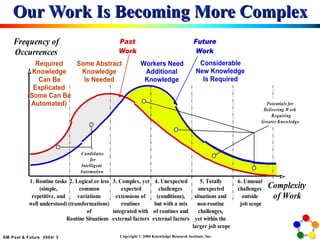
Our Work Is Becoming More Complex
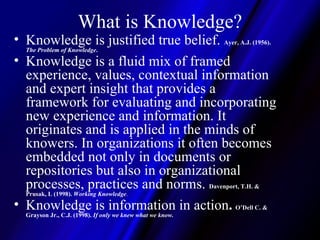
What is Knowledge? Knowledge is justified true belief.  Ayer, A.J. (1956).  The Problem of Knowledge . Knowledge is a fluid mix of framed experience, values, contextual information and expert insight that provides a framework for evaluating and incorporating new experience and information. It originates and is applied in the minds of knowers. In organizations it often becomes embedded not only in documents or repositories but also in organizational processes, practices and norms.  Davenport, T.H. & Prusak, L (1998).  Working Knowledge . Knowledge is information in action .   O’Dell C. & Grayson Jr., C.J.   (1998).  If only we knew what we know.
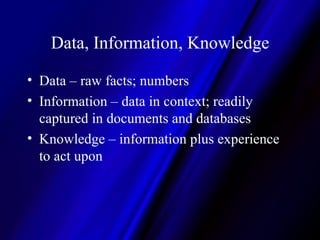
Data, Information, Knowledge Data – raw facts; numbers Information – data in context; readily captured in documents and databases Knowledge – information plus experience to act upon
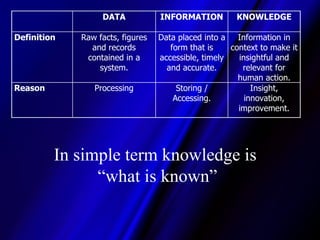
In simple term knowledge is  “what is known”
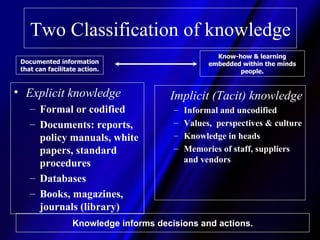
Explicit knowledge Formal or codified Documents: reports, policy manuals, white papers, standard procedures Databases Books, magazines, journals (library) Two Classification of knowledge Implicit (Tacit) knowledge Informal and uncodified Values,  perspectives & culture Knowledge in heads Memories of staff, suppliers and vendors Documented information that can facilitate action. Know-how & learning embedded within the minds people. Knowledge informs decisions and actions.
Type of Knowledge There are Six Types of Knowledge that Knowledge Management application contains:  Descriptive:  Info on Past Present & Future or Hypothetical states of relevance concerned with KNOWING WHAT Procedural Knowledge:  Specifies Step by step procedures of accomplishing task that is KNOWING HOW Reasoning Knowledge:  Evaluating Conclusions that are valid for set of circumstances that is KNOWING WHY
Presentation Knowledge:  it is Concern with Method of Delivery of Knowledge; Communication Linguistics Knowledge:  interprets Communication  Assimilative Knowledge:  Maintaining and Improving Knowledge
Other Classification Advantage Knowledge – knowledge to provide competitive advantage Base knowledge – knowledge that is integral to an organization Trivial Knowledge – Knowledge that has no major impact on organization.
What is Knowledge Management? Knowledge management is a process that helps organization identify, select, organization disseminate and transfer important information and expertise that are a part of the organizational memory that typically resides within an organization in an unstructured manner. This enables effective and efficient problem solving, dynamic learning, strategic panning and decision making.
Knowledge management focuses on identifying knowledge, explicating it in a way so that it can be shared in a formal manner, and thus reusing it.
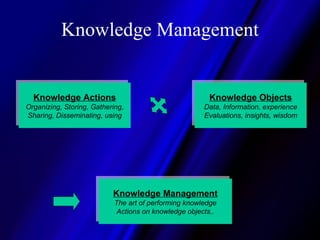
Knowledge Management Knowledge Actions Organizing, Storing, Gathering, Sharing, Disseminating, using Knowledge Objects Data, Information, experience Evaluations, insights, wisdom Knowledge Management The art of performing knowledge Actions on knowledge objects..
Goals and objectives of KM The goal of KM as a process is to improve the Organization’s ability to execute its core processes more efficiently. Objectives: Create knowledge repository Improve knowledge asset Enhance the knowledge environment Manage knowledge as an asset.
Goals or imperatives of KM Transform Knowledge to add value  Leverage Knowledge strategic to business Use knowledge to provide a competitive advantage.
KM Activities Externalization:  eg: databases, workflow technologies, document management systems.  Internalization:  is the process of identifying knowledge, usually explicit, relevant to a particular user’s need.  Intermediation : Brokering process for matching a knowledge seeker with the best source of knowledge by tracking experience and interest of individuals Cognition:  knowledge exchanged preceding three processes. Most difficult to automate.
Who are Knowledge Workers? Peter Drucker: “a Knowledge Worker is anyone who works for a living at the tasks of developing and or using knowledge. For example a knowledge worker might be someone who works at any of the tasks of planning, acquiring, searching, analyzing, organizing, storing, programming, distributing, marketing, or otherwise contributing to the transformation and commerce of information and those who work at using the knowledge so produced.
Role of knowledge workers They help in knowledge creation & its use in Knowledge oriented workplace. They plan and programme how to use knowledge and where to use it They acquire analyze and organize information which is required for their jobs and make provisions for the easy flow of knowledge. Knowledge workers use intellige4nce in creating and innovating new things.
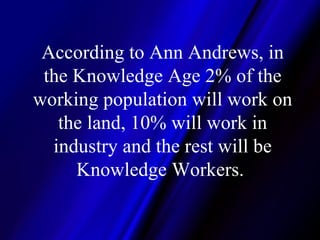
According to Ann Andrews, in the Knowledge Age 2% of the working population will work on the land, 10% will work in industry and the rest will be Knowledge Workers.
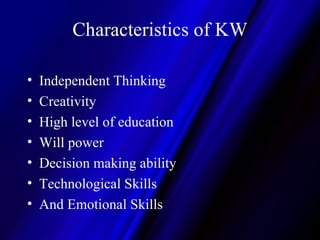
Characteristics of KW Independent Thinking Creativity High level of education Will power Decision making ability  Technological Skills And Emotional Skills
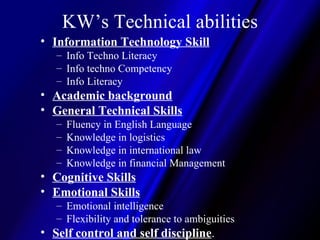
KW’s Technical abilities Information Technology Skill Info Techno Literacy Info techno Competency Info Literacy Academic background General Technical Skills Fluency in English Language Knowledge in logistics Knowledge in international law Knowledge in financial Management Cognitive Skills Emotional Skills Emotional intelligence  Flexibility and tolerance to ambiguities  Self control and self discipline .
The End to chapter No: 1

Knowledge Management Chapter 1

  • 1.
    Knowledge Management ManagingKnowledge Worker Chapter 1 Nisha Hariyani
  • 2.
    Agenda What isknowledge? What is knowledge management? Who are knowledge workers?
  • 3.
    Our Work IsBecoming More Complex
  • 4.
    What is Knowledge?Knowledge is justified true belief. Ayer, A.J. (1956). The Problem of Knowledge . Knowledge is a fluid mix of framed experience, values, contextual information and expert insight that provides a framework for evaluating and incorporating new experience and information. It originates and is applied in the minds of knowers. In organizations it often becomes embedded not only in documents or repositories but also in organizational processes, practices and norms. Davenport, T.H. & Prusak, L (1998). Working Knowledge . Knowledge is information in action . O’Dell C. & Grayson Jr., C.J. (1998). If only we knew what we know.
  • 5.
    Data, Information, KnowledgeData – raw facts; numbers Information – data in context; readily captured in documents and databases Knowledge – information plus experience to act upon
  • 6.
    In simple termknowledge is “what is known”
  • 7.
    Explicit knowledge Formalor codified Documents: reports, policy manuals, white papers, standard procedures Databases Books, magazines, journals (library) Two Classification of knowledge Implicit (Tacit) knowledge Informal and uncodified Values, perspectives & culture Knowledge in heads Memories of staff, suppliers and vendors Documented information that can facilitate action. Know-how & learning embedded within the minds people. Knowledge informs decisions and actions.
  • 8.
    Type of KnowledgeThere are Six Types of Knowledge that Knowledge Management application contains: Descriptive: Info on Past Present & Future or Hypothetical states of relevance concerned with KNOWING WHAT Procedural Knowledge: Specifies Step by step procedures of accomplishing task that is KNOWING HOW Reasoning Knowledge: Evaluating Conclusions that are valid for set of circumstances that is KNOWING WHY
  • 9.
    Presentation Knowledge: it is Concern with Method of Delivery of Knowledge; Communication Linguistics Knowledge: interprets Communication Assimilative Knowledge: Maintaining and Improving Knowledge
  • 10.
    Other Classification AdvantageKnowledge – knowledge to provide competitive advantage Base knowledge – knowledge that is integral to an organization Trivial Knowledge – Knowledge that has no major impact on organization.
  • 11.
    What is KnowledgeManagement? Knowledge management is a process that helps organization identify, select, organization disseminate and transfer important information and expertise that are a part of the organizational memory that typically resides within an organization in an unstructured manner. This enables effective and efficient problem solving, dynamic learning, strategic panning and decision making.
  • 12.
    Knowledge management focuseson identifying knowledge, explicating it in a way so that it can be shared in a formal manner, and thus reusing it.
  • 13.
    Knowledge Management KnowledgeActions Organizing, Storing, Gathering, Sharing, Disseminating, using Knowledge Objects Data, Information, experience Evaluations, insights, wisdom Knowledge Management The art of performing knowledge Actions on knowledge objects..
  • 14.
    Goals and objectivesof KM The goal of KM as a process is to improve the Organization’s ability to execute its core processes more efficiently. Objectives: Create knowledge repository Improve knowledge asset Enhance the knowledge environment Manage knowledge as an asset.
  • 15.
    Goals or imperativesof KM Transform Knowledge to add value Leverage Knowledge strategic to business Use knowledge to provide a competitive advantage.
  • 16.
    KM Activities Externalization: eg: databases, workflow technologies, document management systems. Internalization: is the process of identifying knowledge, usually explicit, relevant to a particular user’s need. Intermediation : Brokering process for matching a knowledge seeker with the best source of knowledge by tracking experience and interest of individuals Cognition: knowledge exchanged preceding three processes. Most difficult to automate.
  • 17.
    Who are KnowledgeWorkers? Peter Drucker: “a Knowledge Worker is anyone who works for a living at the tasks of developing and or using knowledge. For example a knowledge worker might be someone who works at any of the tasks of planning, acquiring, searching, analyzing, organizing, storing, programming, distributing, marketing, or otherwise contributing to the transformation and commerce of information and those who work at using the knowledge so produced.
  • 18.
    Role of knowledgeworkers They help in knowledge creation & its use in Knowledge oriented workplace. They plan and programme how to use knowledge and where to use it They acquire analyze and organize information which is required for their jobs and make provisions for the easy flow of knowledge. Knowledge workers use intellige4nce in creating and innovating new things.
  • 19.
    According to AnnAndrews, in the Knowledge Age 2% of the working population will work on the land, 10% will work in industry and the rest will be Knowledge Workers.
  • 20.
    Characteristics of KWIndependent Thinking Creativity High level of education Will power Decision making ability Technological Skills And Emotional Skills
  • 21.
    KW’s Technical abilitiesInformation Technology Skill Info Techno Literacy Info techno Competency Info Literacy Academic background General Technical Skills Fluency in English Language Knowledge in logistics Knowledge in international law Knowledge in financial Management Cognitive Skills Emotional Skills Emotional intelligence Flexibility and tolerance to ambiguities Self control and self discipline .
  • 22.
    The End tochapter No: 1