Northern Renaissance Art
       N. Europe and Spain,
              1500 to 1600


Gardner’s Art Through the Ages,
              13e, Chapter 23


                             1
Europe in the 16th Century


                             2
Goals
• Identify artists from the 16th century Spain and Northern Europe
• Understand the artistic styles in Spain and Northern Europe
• Recognize and cite artistic terminology from this period
• Understand the consequences of the Protestant Reformation and
  the Catholic Counter-Reformation


                                                                     3
23.1 Art in the Holy Roman Empire
       during the 16th Century

• Understand German culture and artistic styles
• Identify representative German artists from the 16th century
• Recognize and cite artistic terminology from this period


                                                                 4
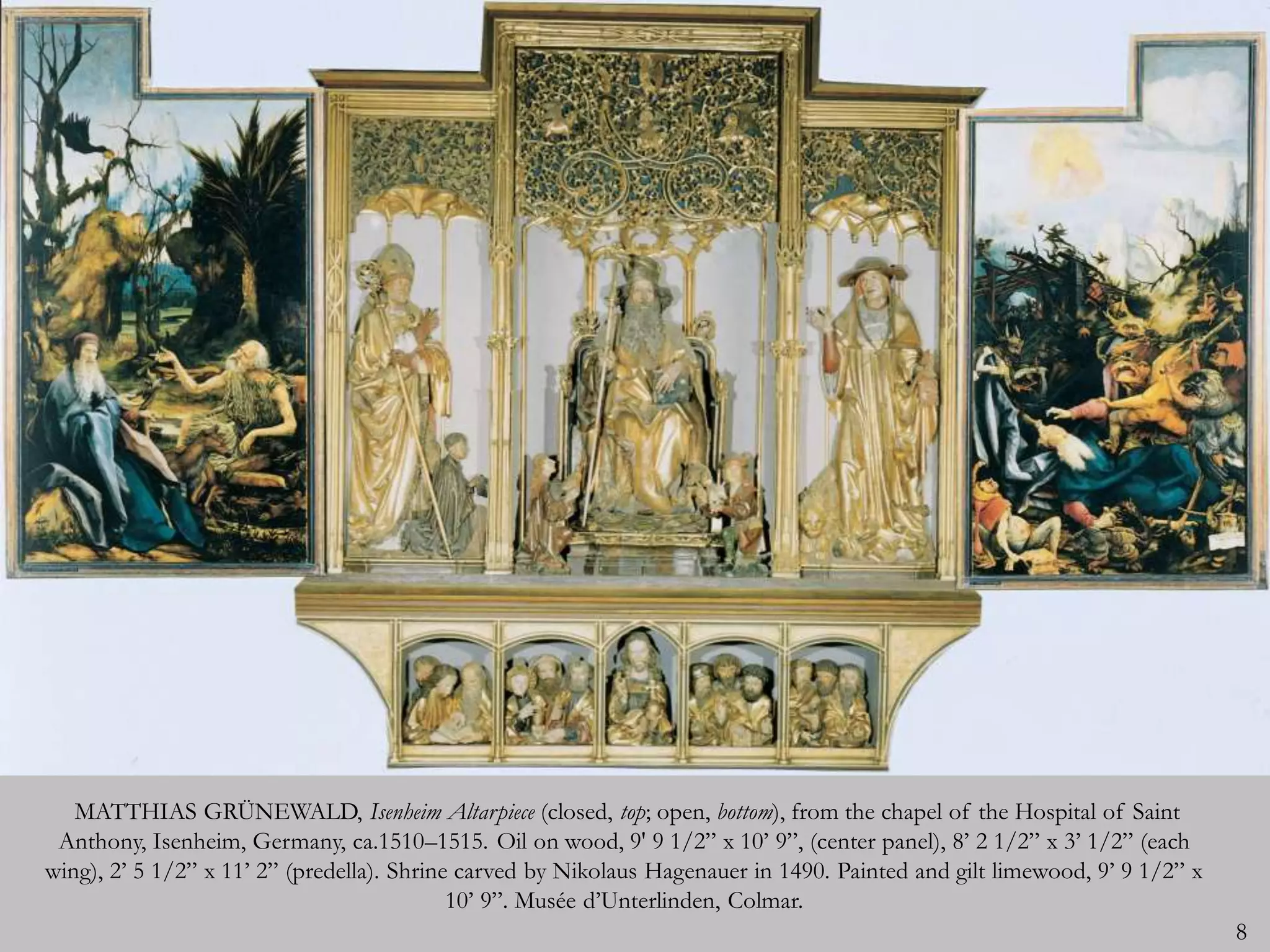
MATTHIAS GRÜNEWALD, Isenheim Altarpiece (closed, top; open, bottom), from the chapel of the Hospital of Saint Anthony, Isenheim, Germany,
ca.1510–1515. Oil on wood, 9' 9 1/2” x 10’ 9”, (center panel), 8’ 2 1/2” x 3’ 1/2” (each wing), 2’ 5 1/2” x 11’ 2” (predella). Shrine carved by Nikolaus
                        Hagenauer in 1490. Painted and gilt limewood, 9’ 9 1/2” x 10’ 9”. Musée d’Unterlinden, Colmar.

                    The Isenheim Altarpiece includes an enormous graphic account of the Crucifixion.
                               The lamb can be interpreted to symbolize the Son of God
                                                                                                                                                      5
MATTHIAS GRÜNEWALD, Isenheim Altarpiece (first opened), from the chapel of the Hospital of Saint Anthony, Isenheim, Germany, ca.1510–1515.
Oil on wood, 9' 9 1/2” x 10’ 9”, (center panel), 8’ 2 1/2” x 3’ 1/2” (each wing), 2’ 5 1/2” x 11’ 2” (predella). Shrine carved by Nikolaus Hagenauer in
                                                  1490. Painted and gilt limewood, 9’ 9 1/2” x 10’ 9”.
                                                             Musée d’Unterlinden, Colmar.

  In Grünewald's Isenheim Altarpiece, the artist has used specific references, saints and symbols to depict pain, suffering, and
     salvation and redemption. The following were included in the Altarpiece: The Annunciation, Nativity, Lamentation,
                            Entombment, Crucifixion, Resurrection, and portraits of its patrons.                                 6
The major
    stylistic changes
    in Northern
    Renaissance art
    first occurred in
    Germany.


MATTHIAS GRÜNEWALD, The Risen Christ, Isenheim Altarpiece (open, top right-side), from the chapel of the Hospital of Saint
           Anthony, Isenheim, Germany, ca.1510–1515. Oil on wood Musée d’Unterlinden, Colmar.
  This radiant image of the resurrection was meant to give hope to the suffering and dying patients at the hospital.
                                                                                                                         7
MATTHIAS GRÜNEWALD, Isenheim Altarpiece (closed, top; open, bottom), from the chapel of the Hospital of Saint
 Anthony, Isenheim, Germany, ca.1510–1515. Oil on wood, 9' 9 1/2” x 10’ 9”, (center panel), 8’ 2 1/2” x 3’ 1/2” (each
wing), 2’ 5 1/2” x 11’ 2” (predella). Shrine carved by Nikolaus Hagenauer in 1490. Painted and gilt limewood, 9’ 9 1/2” x
                                            10’ 9”. Musée d’Unterlinden, Colmar.
                                                                                                                            8
HANS BALDUNG GRIEN, Witches’ Sabbath, 1510.
Chiaroscuro woodcut, 1’ 2 7/8” X 10 ¼”. British
Museum, London.


                                                  9
Albrecht Durer
              “Leonardo of the North”
• Travelled widely through Europe and became an international
  celebrity
• Took trips to Italy to study Renaissance art
• First artist to synthesize Northern European stylistic features
  (intricate detail, realistic rendering of objects, symbols hidden as
  everyday objects) and blend them with Italian features (classical
  body types, linear perspective) - admired the work of Leonardo
• First artist to keep a thorough record of his life (self-portraits,
  treatises on his thoughts, and a diary)
• Important graphic artist - best known for his engravings
• Influenced significantly by Martin Luther and Protestant
  Reformation

                                                                         10
A nonreligious still-
    life, The Great Piece
    of Turf is a precise
    and scientifically
    accurate rendering of a
    small botanical
    landscape. It heeded
    Leonardo’s notion that
    "observation yielded
    truth."


ALBRECHT DÜRER, Great Piece of Turf,
1503. Watercolor, 1’ 3/4” x 1’ 3/8”.
Albertina, Vienna.


                                       11
Albrecht Durer
  made the first series
  of self-portraits in
  western art.


ALBRECHT DÜRER, Self-Portrait


                                12
Albrecht Durer is
     considered one of the
     greatest printmakers of
     all time.
     In this engraving, he
     demonstrated his blend
     of the influence of Italian
     art with Northern
     European traditions.


ALBRECHT DÜRER, The Fall of Man
(Adam and Eve), 1504. Engraving,
9 7/8” x 7 5/8”. Museum of Fine Arts,
Boston (centennial gift of Landon T. Clay).

                                              13
Durer's Knight, Death,
   and Devil is a
   metaphor for the knight
   as a soldier of God.
   The mounted Christian
   knight displays a
   monumental strength
   and character
   reminiscent of
   Verrocchio.


ALBRECHT DÜRER,
Knight, Death, and the Devil, 1513.
Engraving, 9 5/8” x 7 3/8”.
Metropolitan Museum of Art, New York.

                                        14
Albrecht Durer was
     one of the first to
     considered “the artist”
     to be an educated and
     cultured gentleman.


ALBRECHT DÜRER, Four Apostles, 1526.
Oil on wood, each panel 7’ 1” x 2’ 6”. Alte
Pinakothek, Munich.


                                              15
23.2 Protestant Reformation

• Understand the consequences of the Protestant
  Reformation and the Catholic Counter-Reformation

• Observe how Protestantism affected the role and
  imagery of art


                                                     16
LUCAS CRANACH THE ELDER, Allegory of Law and Grace, ca. 1530. Woodcut, 10 5/8” x 1’ 3/4”. British Museum, London.
In Allegory of Law and Grace, Lucas Cranach the Elder has depicted the differences between the Roman Catholic Church and
the followers of Martin Luther. This woodcut was dubbed with the title, "painter of the Reformation."
                                                                                                                       17
The Bavarian painter,
    Albrecht Altdorfer, is
    credited with creating the
    first 'true landscape'
    painting.

    The Battle of Issus by
    Altdorfer includes his use
    of the birds-eye viewpoint.


ALBRECHT ALTDORFER, The Battle of Issus,
1529. Oil on wood, 5’ 2 1/4” x 3’ 11 1/4”.
Alte Pinakothek, Munich.


                                             18
Hans Holbein
  specialized in
  portraiture.

  An anamorphic
  symbol appears in
  Holbein's French
  Ambassadors.
  When viewed from
  below left and at
  an acute angle a
  skull appears.


HANS HOLBEIN THE
YOUNGER, The French
Ambassadors, 1533. Oil and
tempera on wood, approx.
6’ 8” x 6’ 9 1/2”. National
Gallery, London.


                              19
23.3 Art in France
          during the 16th Century
• Understand the French culture and artistic styles
• Identify representative French artists from the 16th century
• Recognize and cite artistic terminology from this period


                                                                 20
JEAN CLOUET, Francis I, ca. 1525–1530.
Tempera and oil on wood, approx. 3’ 2” x 2’ 5”.
Louvre, Paris.


                                                  21
Château de Chambord, Chambord, France, begun 1519.
                                                     22
PIERRE LESCOT, west wing of the Cour Carre (Square Court) of the Louvre, Paris, France, begun 1546.

                                                                                                      23
23.4 Art in the Netherlands
        during the 16th Century
• Understand Dutch culture and artistic styles
• Identify representative Dutch artists from the 16th century
• Recognize and cite artistic terminology from this period


                                                                24
HIERONYMUS BOSCH, Garden of Earthly Delights, 1505-1510. Oil on wood,
center panel 7’ 2 5/8” X 6’ 4 ¾”, each wing 7’ 2 5/8” X 3’ 2 ¼”. Museo del Prado, Madrid.


                                                                                            25
JAN GOSSAERT Neptune and Amphitrite, ca. 1516.
Oil on wood, 6’ 2” x 4’ 3/4”.
Gemäldegalerie, Staatliche Museen, Berlin.


                                                 26
Quinten Massys
  was willing to
  explore the
  various styles of
  the fifteenth and
  sixteenth centuries.
  This exploration
  can be seen in
  Money-Changer
  and His Wife.
  The artist has given
  us an image of a
  professional man
  transacting
  business. He has
  provided insight
  into the secular life
  of the Netherlands.


QUINTEN MASSYS,
Money-Changer and His Wife,
1514. Oil on wood,
2’ 3 3/4” x 2’ 2 3/8”.
Louvre, Paris.

                              27
PIETER AERTSEN, Butcher’s Stall, 1551. Oil on wood, 4’ 3/8” x 6’ 5 3/4”. Uppsala University Art Collection, Uppsala.
 In Pieter Aertsen's Meat Still-Life, the artist has created what appears to be a descriptive genre scene, a butcher's shop
    displaying its products, as well as fish and pretzels. This work also has embedded religious references within it.
                                                                                                                              28
CATERINA VAN HEMESSEN, Self-
Portrait, 1548. Oil on panel, 1’ x 9 7/8”.
Kunstmuseum, Öffentliche
Kunstsammlung Basel.

                                             29
Attributed to LEVINA TEERLINC.
Elizabeth I as a Princess, ca. 1559.
Oil on wood, 3’ 6 3/4” x 2’ 8 1/4”.
The Royal Collection, Windsor Castle,
Windsor, England.

                                        30
JOACHIM PATINIR, Landscape with Saint Jerome, ca. 1520–1524. Oil on wood, 2’ 5 1/8” x 2’ 11 7/8”. Museo del Prado, Madrid.
                                                                                                                        31
PIETER BRUEGEL THE ELDER, Netherlandish Proverbs, 1559. Oil on wood, 3’ 10” x 5’ 4 1/8”.
                  Gemäldegalerie, Staatliche Museen, Berlin.                               32
In Bruegel's Netherlandish Proverbs, the artist has depicted the
   Netherlandish obsession with proverbs. The scene is busy with
   a topsy-turvy multiplicity of figures and activities. It is
   reminiscent of Bosch.

In Hunters in the Snow, the artist has captured the atmosphere of a
   cold winter's day. The landscape is snow-covered and stark with
   the returning hunters wearily trudging home. It is reminiscent
   of earlier renditions of seasons. Limbourg Brothers' Les Très
   Riches Heures du Duc de Berry also described the seasons and
   might have been influential in the conception of this work.
PIETER BRUEGEL THE ELDER, Hunters in the Snow, 1565. Oil on wood, approx. 3’ 10 1/8” x 5’ 3 3/4”.
 Pieter Bruegel traveled to Italy yet chose not to incorporate classical elements into his work.
                   He did a series of six paintings showing seasonal changes.
                                                                                                    34
23.5 Art in Spain
          during the 16th Century
• Understand Spanish culture and artistic styles
• Identify representative Spanish artists from the 16th century
• Recognize and cite artistic terminology from this period


                                                                  35
Portal, Colegio de San Gregorio,
Valladolid, Spain, ca. 1498.

                                   36
Portal, Casa de Montejo,
Merida, Mexico, 1549.


                           37
Juan de Herrera and Juan Bautista de Toledo, El Escorial, near Madrid, Spain, ca. 1563–1584
                      (detail of an anonymous 18th-century painting).


                                                                                              38
In El Greco's Burial
     of Count Orgaz, the
     artist has successfully
     merged his early and
     late styles.

     He combined
     expressive, elongated
     figures with rich
     color and realism in
     this one work.


EL GRECO, The Burial of Count Orgaz,
1586. Oil on canvas, 16’ x 12’.
Santo Tomé, Toledo.


                                       39
Discussion Questions

 How does art influence or reflect religion? How does
  Protestant art differ from Catholic art during the
  Reformation and Counter Reformation?

 Does religion influence art today? If so, how? How
  prevalent is religious art today? Why?


                                                         40

Northern Renaissance Art

  • 1.
    Northern Renaissance Art N. Europe and Spain, 1500 to 1600 Gardner’s Art Through the Ages, 13e, Chapter 23 1
  • 2.
    Europe in the16th Century 2
  • 3.
    Goals • Identify artistsfrom the 16th century Spain and Northern Europe • Understand the artistic styles in Spain and Northern Europe • Recognize and cite artistic terminology from this period • Understand the consequences of the Protestant Reformation and the Catholic Counter-Reformation 3
  • 4.
    23.1 Art inthe Holy Roman Empire during the 16th Century • Understand German culture and artistic styles • Identify representative German artists from the 16th century • Recognize and cite artistic terminology from this period 4
  • 5.
    MATTHIAS GRÜNEWALD, IsenheimAltarpiece (closed, top; open, bottom), from the chapel of the Hospital of Saint Anthony, Isenheim, Germany, ca.1510–1515. Oil on wood, 9' 9 1/2” x 10’ 9”, (center panel), 8’ 2 1/2” x 3’ 1/2” (each wing), 2’ 5 1/2” x 11’ 2” (predella). Shrine carved by Nikolaus Hagenauer in 1490. Painted and gilt limewood, 9’ 9 1/2” x 10’ 9”. Musée d’Unterlinden, Colmar. The Isenheim Altarpiece includes an enormous graphic account of the Crucifixion. The lamb can be interpreted to symbolize the Son of God 5
  • 6.
    MATTHIAS GRÜNEWALD, IsenheimAltarpiece (first opened), from the chapel of the Hospital of Saint Anthony, Isenheim, Germany, ca.1510–1515. Oil on wood, 9' 9 1/2” x 10’ 9”, (center panel), 8’ 2 1/2” x 3’ 1/2” (each wing), 2’ 5 1/2” x 11’ 2” (predella). Shrine carved by Nikolaus Hagenauer in 1490. Painted and gilt limewood, 9’ 9 1/2” x 10’ 9”. Musée d’Unterlinden, Colmar. In Grünewald's Isenheim Altarpiece, the artist has used specific references, saints and symbols to depict pain, suffering, and salvation and redemption. The following were included in the Altarpiece: The Annunciation, Nativity, Lamentation, Entombment, Crucifixion, Resurrection, and portraits of its patrons. 6
  • 7.
    The major stylistic changes in Northern Renaissance art first occurred in Germany. MATTHIAS GRÜNEWALD, The Risen Christ, Isenheim Altarpiece (open, top right-side), from the chapel of the Hospital of Saint Anthony, Isenheim, Germany, ca.1510–1515. Oil on wood Musée d’Unterlinden, Colmar. This radiant image of the resurrection was meant to give hope to the suffering and dying patients at the hospital. 7
  • 8.
    MATTHIAS GRÜNEWALD, IsenheimAltarpiece (closed, top; open, bottom), from the chapel of the Hospital of Saint Anthony, Isenheim, Germany, ca.1510–1515. Oil on wood, 9' 9 1/2” x 10’ 9”, (center panel), 8’ 2 1/2” x 3’ 1/2” (each wing), 2’ 5 1/2” x 11’ 2” (predella). Shrine carved by Nikolaus Hagenauer in 1490. Painted and gilt limewood, 9’ 9 1/2” x 10’ 9”. Musée d’Unterlinden, Colmar. 8
  • 9.
    HANS BALDUNG GRIEN,Witches’ Sabbath, 1510. Chiaroscuro woodcut, 1’ 2 7/8” X 10 ¼”. British Museum, London. 9
  • 10.
    Albrecht Durer “Leonardo of the North” • Travelled widely through Europe and became an international celebrity • Took trips to Italy to study Renaissance art • First artist to synthesize Northern European stylistic features (intricate detail, realistic rendering of objects, symbols hidden as everyday objects) and blend them with Italian features (classical body types, linear perspective) - admired the work of Leonardo • First artist to keep a thorough record of his life (self-portraits, treatises on his thoughts, and a diary) • Important graphic artist - best known for his engravings • Influenced significantly by Martin Luther and Protestant Reformation 10
  • 11.
    A nonreligious still- life, The Great Piece of Turf is a precise and scientifically accurate rendering of a small botanical landscape. It heeded Leonardo’s notion that "observation yielded truth." ALBRECHT DÜRER, Great Piece of Turf, 1503. Watercolor, 1’ 3/4” x 1’ 3/8”. Albertina, Vienna. 11
  • 12.
    Albrecht Durer made the first series of self-portraits in western art. ALBRECHT DÜRER, Self-Portrait 12
  • 13.
    Albrecht Durer is considered one of the greatest printmakers of all time. In this engraving, he demonstrated his blend of the influence of Italian art with Northern European traditions. ALBRECHT DÜRER, The Fall of Man (Adam and Eve), 1504. Engraving, 9 7/8” x 7 5/8”. Museum of Fine Arts, Boston (centennial gift of Landon T. Clay). 13
  • 14.
    Durer's Knight, Death, and Devil is a metaphor for the knight as a soldier of God. The mounted Christian knight displays a monumental strength and character reminiscent of Verrocchio. ALBRECHT DÜRER, Knight, Death, and the Devil, 1513. Engraving, 9 5/8” x 7 3/8”. Metropolitan Museum of Art, New York. 14
  • 15.
    Albrecht Durer was one of the first to considered “the artist” to be an educated and cultured gentleman. ALBRECHT DÜRER, Four Apostles, 1526. Oil on wood, each panel 7’ 1” x 2’ 6”. Alte Pinakothek, Munich. 15
  • 16.
    23.2 Protestant Reformation •Understand the consequences of the Protestant Reformation and the Catholic Counter-Reformation • Observe how Protestantism affected the role and imagery of art 16
  • 17.
    LUCAS CRANACH THEELDER, Allegory of Law and Grace, ca. 1530. Woodcut, 10 5/8” x 1’ 3/4”. British Museum, London. In Allegory of Law and Grace, Lucas Cranach the Elder has depicted the differences between the Roman Catholic Church and the followers of Martin Luther. This woodcut was dubbed with the title, "painter of the Reformation." 17
  • 18.
    The Bavarian painter, Albrecht Altdorfer, is credited with creating the first 'true landscape' painting. The Battle of Issus by Altdorfer includes his use of the birds-eye viewpoint. ALBRECHT ALTDORFER, The Battle of Issus, 1529. Oil on wood, 5’ 2 1/4” x 3’ 11 1/4”. Alte Pinakothek, Munich. 18
  • 19.
    Hans Holbein specialized in portraiture. An anamorphic symbol appears in Holbein's French Ambassadors. When viewed from below left and at an acute angle a skull appears. HANS HOLBEIN THE YOUNGER, The French Ambassadors, 1533. Oil and tempera on wood, approx. 6’ 8” x 6’ 9 1/2”. National Gallery, London. 19
  • 20.
    23.3 Art inFrance during the 16th Century • Understand the French culture and artistic styles • Identify representative French artists from the 16th century • Recognize and cite artistic terminology from this period 20
  • 21.
    JEAN CLOUET, FrancisI, ca. 1525–1530. Tempera and oil on wood, approx. 3’ 2” x 2’ 5”. Louvre, Paris. 21
  • 22.
    Château de Chambord,Chambord, France, begun 1519. 22
  • 23.
    PIERRE LESCOT, westwing of the Cour Carre (Square Court) of the Louvre, Paris, France, begun 1546. 23
  • 24.
    23.4 Art inthe Netherlands during the 16th Century • Understand Dutch culture and artistic styles • Identify representative Dutch artists from the 16th century • Recognize and cite artistic terminology from this period 24
  • 25.
    HIERONYMUS BOSCH, Gardenof Earthly Delights, 1505-1510. Oil on wood, center panel 7’ 2 5/8” X 6’ 4 ¾”, each wing 7’ 2 5/8” X 3’ 2 ¼”. Museo del Prado, Madrid. 25
  • 26.
    JAN GOSSAERT Neptuneand Amphitrite, ca. 1516. Oil on wood, 6’ 2” x 4’ 3/4”. Gemäldegalerie, Staatliche Museen, Berlin. 26
  • 27.
    Quinten Massys was willing to explore the various styles of the fifteenth and sixteenth centuries. This exploration can be seen in Money-Changer and His Wife. The artist has given us an image of a professional man transacting business. He has provided insight into the secular life of the Netherlands. QUINTEN MASSYS, Money-Changer and His Wife, 1514. Oil on wood, 2’ 3 3/4” x 2’ 2 3/8”. Louvre, Paris. 27
  • 28.
    PIETER AERTSEN, Butcher’sStall, 1551. Oil on wood, 4’ 3/8” x 6’ 5 3/4”. Uppsala University Art Collection, Uppsala. In Pieter Aertsen's Meat Still-Life, the artist has created what appears to be a descriptive genre scene, a butcher's shop displaying its products, as well as fish and pretzels. This work also has embedded religious references within it. 28
  • 29.
    CATERINA VAN HEMESSEN,Self- Portrait, 1548. Oil on panel, 1’ x 9 7/8”. Kunstmuseum, Öffentliche Kunstsammlung Basel. 29
  • 30.
    Attributed to LEVINATEERLINC. Elizabeth I as a Princess, ca. 1559. Oil on wood, 3’ 6 3/4” x 2’ 8 1/4”. The Royal Collection, Windsor Castle, Windsor, England. 30
  • 31.
    JOACHIM PATINIR, Landscapewith Saint Jerome, ca. 1520–1524. Oil on wood, 2’ 5 1/8” x 2’ 11 7/8”. Museo del Prado, Madrid. 31
  • 32.
    PIETER BRUEGEL THEELDER, Netherlandish Proverbs, 1559. Oil on wood, 3’ 10” x 5’ 4 1/8”. Gemäldegalerie, Staatliche Museen, Berlin. 32
  • 33.
    In Bruegel's NetherlandishProverbs, the artist has depicted the Netherlandish obsession with proverbs. The scene is busy with a topsy-turvy multiplicity of figures and activities. It is reminiscent of Bosch. In Hunters in the Snow, the artist has captured the atmosphere of a cold winter's day. The landscape is snow-covered and stark with the returning hunters wearily trudging home. It is reminiscent of earlier renditions of seasons. Limbourg Brothers' Les Très Riches Heures du Duc de Berry also described the seasons and might have been influential in the conception of this work.
  • 34.
    PIETER BRUEGEL THEELDER, Hunters in the Snow, 1565. Oil on wood, approx. 3’ 10 1/8” x 5’ 3 3/4”. Pieter Bruegel traveled to Italy yet chose not to incorporate classical elements into his work. He did a series of six paintings showing seasonal changes. 34
  • 35.
    23.5 Art inSpain during the 16th Century • Understand Spanish culture and artistic styles • Identify representative Spanish artists from the 16th century • Recognize and cite artistic terminology from this period 35
  • 36.
    Portal, Colegio deSan Gregorio, Valladolid, Spain, ca. 1498. 36
  • 37.
    Portal, Casa deMontejo, Merida, Mexico, 1549. 37
  • 38.
    Juan de Herreraand Juan Bautista de Toledo, El Escorial, near Madrid, Spain, ca. 1563–1584 (detail of an anonymous 18th-century painting). 38
  • 39.
    In El Greco'sBurial of Count Orgaz, the artist has successfully merged his early and late styles. He combined expressive, elongated figures with rich color and realism in this one work. EL GRECO, The Burial of Count Orgaz, 1586. Oil on canvas, 16’ x 12’. Santo Tomé, Toledo. 39
  • 40.
    Discussion Questions  Howdoes art influence or reflect religion? How does Protestant art differ from Catholic art during the Reformation and Counter Reformation?  Does religion influence art today? If so, how? How prevalent is religious art today? Why? 40