Sandrine Le Bail AP Art History 
Early Renaissance 
in Northern Europe 
15th century
Europe in the 15th century 
Burgundian Netherlands = 
Belgium, the Netherlands, 
Luxembourg and Northern 
France
Flanders in the 15th century 
The most powerful rulers north of the Alps 
during the first three-quarter of the 15th century 
were the dukes of Burgundy. They controlled 
Flanders, which derived its wealth from wool 
and banking, and were great art patrons.
Flanders in the 15th century 
• Active and prosperous capitalist society 
• Emergence of a new social class 
• Importance of art and patronage to show the 
new wealth
Oil Revolution 
• In Italy: tempera – egg 
• Oil paint produces exceptionally rich colors 
• imitate natural hues and tones 
• Enamel-like surfaces 
• Sharp details 
• Good conservation in wet climates 
• Slow drying – more possibilities for 
“pentimenti”
Oil painting 
Flemish painters popularized the use of oil 
paints on wood panels. By superimposing 
translucent glazes, they created richer colors 
than possible using tempera or fresco.
International Gothic until 1450 
• Courtly, elegant 
• Natural details 
• Splendid costumes 
• Abundance of gold 
• Architecture carefully rendered 
• Opening up walls
Northern painting 
• Opened the walls 
• High horizon 
• Lot of symbolism 
• Interest for the details and everyday reality 
• Not interested by geometrical perspective like 
Italian
Early Netherlandish 
1420-1550
Painters you have to know for the 
exam 
• Limbourg Brothers 
• Robert Campin 
• Jan Van Eyck 
• Rogier Van Weyden 
• Hans Memling 
• Hugo van der Goes
Limbourg Brothers, 
Les très riches heures du Duc de Berry, 
1413-1416 
Book of hours – illuminated manuscript, prayer 
book organized according to the liturgical 
calendra 
International gothic 
Patron: Jean de Berry 
Manuscript illumination
January 
Astrological sign associated 
to each month 
Jean’s coat of arms 
Jean de Berry is giving out New year’s 
gifts
May
October 
Louvre
Robert Campin 
Master of Flémalle
Robert Campin (Master of Flémalle), 
The Mérode Altarpiece, 1425-1428 
Triptych
Robert Campin, The Mérode 
Altarpiece, 1425-1428 
Donors Annunciation S. Joseph
Robert Campin, The Mérode 
Altarpiece, 1425-1428 
• Triptych 
• Presence of the patrons 
• Meticulous handling of paint 
• Three dimensional figures modeled with light and 
shade 
• Intricate details 
• Symbolism 
• Annunciation set in a middle-class Flemish home
Altarpieces 
A major art form in churches and private homes 
alike was the altarpiece with folding wings. In 
Robert Campin’s Mérode altarpiece, the 
Annunciation takes place in a Flemish house. 
The work’s donors, depicted on the left wing are 
anachronistically present as witnesses to the 
sacred event. Typical of “Northern Renaissance” 
painting, the everyday objects depicted often 
have symbolic significance.
Jan Van Eyck 
c.1390-1441
Jan van Eyck,The Ghent Altarpiece 
(1432) 
(on the altar of S. Bavon,Ghent) 
Polyptych Oil painting
God 
The Ghent Altar (1432) 
Virgin Mary 
S. John 
Adam 
Eve 
Choir of 
Angels 
Judges and Knights Adoration of the lamb by All Saints 
Hermits and 
pilgrims
Holy Spirit 
Fountain of life 
Apostles and martyrs 
Priests 
Old Testament and Pagan figures 
who merited Salvation 
Virgins
S. Bavon 
Cathedral 
Great details 
Extreme realism 
Lamb of God
Adam 
and 
Eve
S. John Evangelist with 
a chalice = grisaille 
and 
Donor’s wife 
Annunciation 
S. John the 
Baptist with a 
lamb = grisaille 
and 
donor 
Prophets and sibyls
Jan van Eyck,The Ghent Altarpiece 
(1432) 
• Polyptych for the altar of S. Bavon, Ghent 
• Great detail 
• Extreme realism 
• The work inspired many other artists to 
achieve perfect realism
Jan Van Eyck, 
The Arnolfini 
Portrait, 
(or Arnolfini 
Wedding) 
1434.
One candle burning = 
presence of Christ 
S. Margaret = patron of 
women in childbirth 
Fruits = abundance 
Shoes off – holy ground 
Dog = fidelity
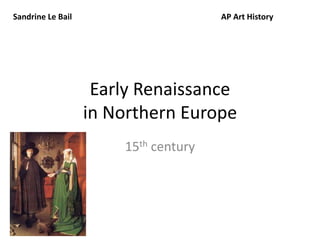
Jan Van Eyck, The Arnolfini Portrait, 
(or ArnolfiniWedding) 
1434 
• Many hidden symbols 
• Great attention to details 
• Bright colors (oil painting)
Rogier van der Weyden 
Brussels 
c.1399-1463
Rogier Van der Weyden, The Descent 
of the Cross, c.1435-1438
Rogier Van der Weyden, The Descent 
of the Cross, c.1435-1438 
• Commissioned for the chapel of the 
Confraternity of the Archers of Leuven 
• Shallow stage for figures into a confining 
space 
• Figures almost life-sized 
• Great attention to details 
• Strong emotional impact 
• Figures in mirrored composition
Rogier Van 
der Weyden, 
St. Luke 
depicting 
the Virgin, 
c.1435-1440
Hans Memling 
Bruges
Portraits 
Memling is famous for his portraits. 
Jan van Eyck, Rogier van der Weyden, and others 
established portraiture as an important art form 
in 15th century Flanders. Their subject were 
successful businessmen, both Flemish and 
foreign.
Hans Memling, Portraits of Tommaso 
and Maria Portinari, 1470
Hans 
Memling, 
Portrait of a 
man 
holding a 
coin, 1474
Hugo van der Goes
Hugo van der Goes, Portinari 
Altarpiece, c.1476 
Triptych 
Donor: Tommaso Portinari for the family chapel of Sant’Egidio in Florence
Hugo van der Goes, Portinari 
Altarpiece, c.1476 
• Deep and rich colors 
• Figures at different scales 
• Abundance of symbols
Characteristics of “early 
Netherlandish” 
• Extensive details 
• Luminous colors 
• Desire to capture everyday life through 
landscapes, genres, still lives and portraits 
• Desire to break the barrier between real world 
and the painted world through the use of trompe 
l’oeil and the depiction of reflective surfaces 
• Many hidden symbols 
• Impact on Italian Art
Main subject Matters 
• Religious 
• Portraits

hajff

  • 1.
    Sandrine Le BailAP Art History Early Renaissance in Northern Europe 15th century
  • 2.
    Europe in the15th century Burgundian Netherlands = Belgium, the Netherlands, Luxembourg and Northern France
  • 3.
    Flanders in the15th century The most powerful rulers north of the Alps during the first three-quarter of the 15th century were the dukes of Burgundy. They controlled Flanders, which derived its wealth from wool and banking, and were great art patrons.
  • 4.
    Flanders in the15th century • Active and prosperous capitalist society • Emergence of a new social class • Importance of art and patronage to show the new wealth
  • 5.
    Oil Revolution •In Italy: tempera – egg • Oil paint produces exceptionally rich colors • imitate natural hues and tones • Enamel-like surfaces • Sharp details • Good conservation in wet climates • Slow drying – more possibilities for “pentimenti”
  • 6.
    Oil painting Flemishpainters popularized the use of oil paints on wood panels. By superimposing translucent glazes, they created richer colors than possible using tempera or fresco.
  • 7.
    International Gothic until1450 • Courtly, elegant • Natural details • Splendid costumes • Abundance of gold • Architecture carefully rendered • Opening up walls
  • 8.
    Northern painting •Opened the walls • High horizon • Lot of symbolism • Interest for the details and everyday reality • Not interested by geometrical perspective like Italian
  • 9.
  • 10.
    Painters you haveto know for the exam • Limbourg Brothers • Robert Campin • Jan Van Eyck • Rogier Van Weyden • Hans Memling • Hugo van der Goes
  • 11.
    Limbourg Brothers, Lestrès riches heures du Duc de Berry, 1413-1416 Book of hours – illuminated manuscript, prayer book organized according to the liturgical calendra International gothic Patron: Jean de Berry Manuscript illumination
  • 12.
    January Astrological signassociated to each month Jean’s coat of arms Jean de Berry is giving out New year’s gifts
  • 13.
  • 14.
  • 15.
  • 16.
    Robert Campin (Masterof Flémalle), The Mérode Altarpiece, 1425-1428 Triptych
  • 17.
    Robert Campin, TheMérode Altarpiece, 1425-1428 Donors Annunciation S. Joseph
  • 21.
    Robert Campin, TheMérode Altarpiece, 1425-1428 • Triptych • Presence of the patrons • Meticulous handling of paint • Three dimensional figures modeled with light and shade • Intricate details • Symbolism • Annunciation set in a middle-class Flemish home
  • 22.
    Altarpieces A majorart form in churches and private homes alike was the altarpiece with folding wings. In Robert Campin’s Mérode altarpiece, the Annunciation takes place in a Flemish house. The work’s donors, depicted on the left wing are anachronistically present as witnesses to the sacred event. Typical of “Northern Renaissance” painting, the everyday objects depicted often have symbolic significance.
  • 23.
    Jan Van Eyck c.1390-1441
  • 24.
    Jan van Eyck,TheGhent Altarpiece (1432) (on the altar of S. Bavon,Ghent) Polyptych Oil painting
  • 25.
    God The GhentAltar (1432) Virgin Mary S. John Adam Eve Choir of Angels Judges and Knights Adoration of the lamb by All Saints Hermits and pilgrims
  • 26.
    Holy Spirit Fountainof life Apostles and martyrs Priests Old Testament and Pagan figures who merited Salvation Virgins
  • 27.
    S. Bavon Cathedral Great details Extreme realism Lamb of God
  • 30.
  • 31.
    S. John Evangelistwith a chalice = grisaille and Donor’s wife Annunciation S. John the Baptist with a lamb = grisaille and donor Prophets and sibyls
  • 32.
    Jan van Eyck,TheGhent Altarpiece (1432) • Polyptych for the altar of S. Bavon, Ghent • Great detail • Extreme realism • The work inspired many other artists to achieve perfect realism
  • 33.
    Jan Van Eyck, The Arnolfini Portrait, (or Arnolfini Wedding) 1434.
  • 34.
    One candle burning= presence of Christ S. Margaret = patron of women in childbirth Fruits = abundance Shoes off – holy ground Dog = fidelity
  • 36.
    Jan Van Eyck,The Arnolfini Portrait, (or ArnolfiniWedding) 1434 • Many hidden symbols • Great attention to details • Bright colors (oil painting)
  • 37.
    Rogier van derWeyden Brussels c.1399-1463
  • 38.
    Rogier Van derWeyden, The Descent of the Cross, c.1435-1438
  • 44.
    Rogier Van derWeyden, The Descent of the Cross, c.1435-1438 • Commissioned for the chapel of the Confraternity of the Archers of Leuven • Shallow stage for figures into a confining space • Figures almost life-sized • Great attention to details • Strong emotional impact • Figures in mirrored composition
  • 45.
    Rogier Van derWeyden, St. Luke depicting the Virgin, c.1435-1440
  • 49.
  • 50.
    Portraits Memling isfamous for his portraits. Jan van Eyck, Rogier van der Weyden, and others established portraiture as an important art form in 15th century Flanders. Their subject were successful businessmen, both Flemish and foreign.
  • 51.
    Hans Memling, Portraitsof Tommaso and Maria Portinari, 1470
  • 52.
    Hans Memling, Portraitof a man holding a coin, 1474
  • 53.
  • 54.
    Hugo van derGoes, Portinari Altarpiece, c.1476 Triptych Donor: Tommaso Portinari for the family chapel of Sant’Egidio in Florence
  • 58.
    Hugo van derGoes, Portinari Altarpiece, c.1476 • Deep and rich colors • Figures at different scales • Abundance of symbols
  • 59.
    Characteristics of “early Netherlandish” • Extensive details • Luminous colors • Desire to capture everyday life through landscapes, genres, still lives and portraits • Desire to break the barrier between real world and the painted world through the use of trompe l’oeil and the depiction of reflective surfaces • Many hidden symbols • Impact on Italian Art
  • 60.
    Main subject Matters • Religious • Portraits

Editor's Notes

  • #3 Flanders – Belgium and Holland
  • #12 Limbourg bro _ 3 brothers: Paul, Herman and Jean Very expensive For every month – activities of the month – show off yje patron’s wealth Jean de Berry : great connoisseur
  • #13 Naturalism of the scene Details / material Aproach, aproac in golden letters Sill life
  • #15 Peasants tilling the field
  • #17 MET For private devotion (small scale) Each panel is seen form a different point of view Light unify
  • #18 MET Donors, middle class people kneeling before the holy scene (wife added after wedding) Floor rise slightly when the roof is pretty horizontal Takes place in an everyday Flemish interior Humanization of the figure Steeply rising ground line – figures too large for the architecture they sit in
  • #19 In his carpentry workshop Mouse trap – capturing the devil
  • #21 Towel and bassin – purity Flowers with 3 buds – trinity Mary in the floor – humilty Angel with a cross through the windorw Candelstick – Mary holds Jesus in her womb
  • #24 Work in Burgondy for Philip the Good 1430 – moved to bruges and got married
  • #25 Still in the cathedral of Saint Bavon, Ghent 24 pannels with hinges Oil painting – glowing surface Tiny brushes Medium and technique merge with technique
  • #26 Still in the cathedral of Saint Bavon, Ghent
  • #27 Fountain of life – wash away the sins
  • #29 Richness Detail of jewel and gold tracery
  • #31 Illusionistic niches Realistic From life model? Elongated Portrait like
  • #32 Tchalice Donor = Jodocus Vidj Taste fro open landsacpe and gothic basin
  • #34 National Gallery in London Description of the material Reference to the woman fertility
  • #35 Custom of burning a candle on the first night of a wedding Not pregnant
  • #36 2 figures Convexe mirror Passion of Christ and a On the top “Jan Van Eyck fuit hic” God’s eye?
  • #38 Trained with Campin Contemporary of Van Eyck Stylistic elements of Northern renaissance and tremendous emotion
  • #39 In Madrid, Prado Space occupied by 10 monumental figures Golden background Colour are deep and lustrous Skull = Adam Jesus’s sacrifice is necessary Donors_ crossbow guilt
  • #40 Strong emotional impact of the scene Parallele of the figures Mary and Christ St John and Mary Magdalen Difference of texture (heavy angular draperies) Curves unit the setting within a compressed setting S Shape
  • #41 Great attention to details
  • #46 Fine Art museum Boston Illusion of great distance
  • #47 Psychological depiction of the mother-child relationship
  • #48 Self portrait of Rogier? Saint Luke ‘s guild
  • #52 Bruges – lot of trade and intense exchange with Italy Three quarter Italian bankers and trademen are important patrons for art Small scale – bring back to Italy and model for Italian artists Portinari – managed the Medici bank in Bruges For his wedding with Maria Originally a triptych
  • #53 With landscape
  • #55 Uffizi, Florence Chapel for the larger Florence’s largest hospital Maternity hospital Continuous landscape on the 3 pannels Rich colours
  • #56 Light modeled the figures Christ on a sheaf of wheat – sacredness of the Eucharist Different scale of the people Great influence for Italian art
  • #57 Tension / anxiety Variety of the expression
  • #58 Plants with medical value and symbolic association Sapnish earthware typical from Northern countries with vine – symbol of the sacrifice of Christ Flowers: red _ nail flower Columbine – Mary’s suffering and humility