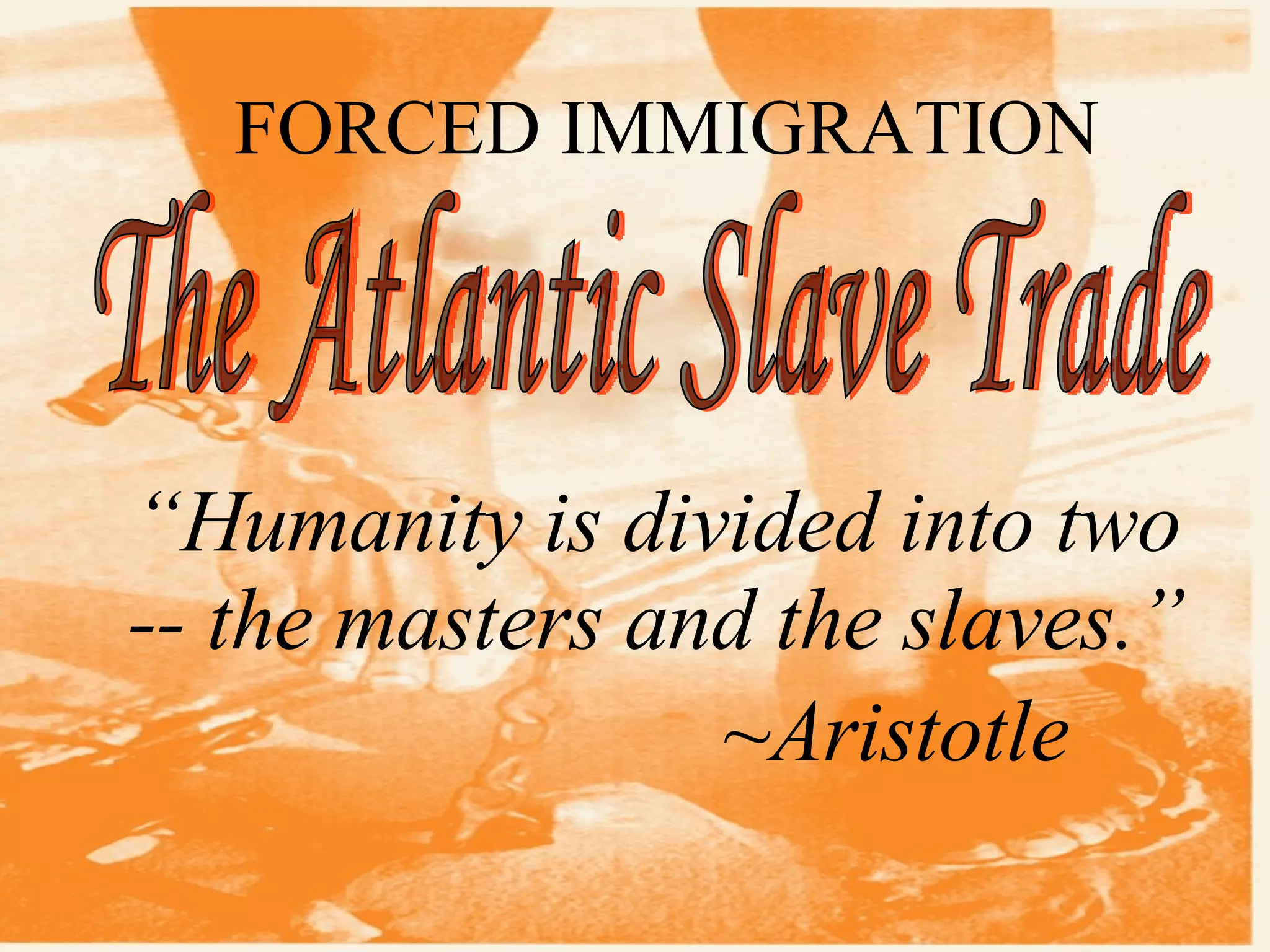
FORCED IMMIGRATION The Atlantic Slave Trade “ Humanity is divided into two -- the masters and the slaves.” ~Aristotle
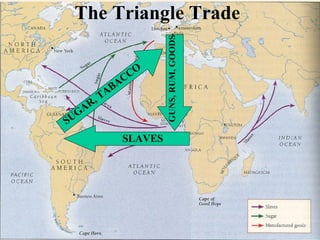
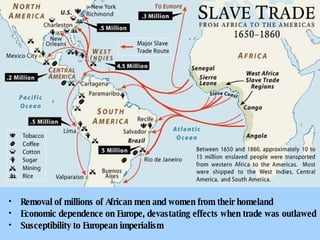
The potential wealth to be made from slavery led to the triangular trade between  ________________________________________. The Transatlantic Slave Trade Europe, Africa and the Americas. Europeans were able to sell manufactured goods in exchange for  ____________  and luxury items. raw materials
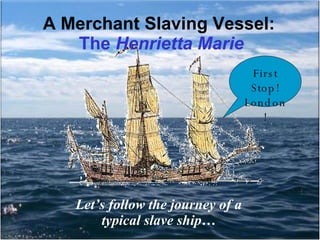
A Merchant Slaving Vessel:  The  Henrietta Marie Let’s follow the journey of a typical slave ship… First Stop! London!
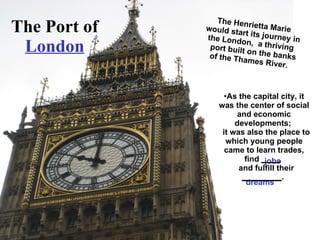
The Port of  London The Henrietta Marie would start its journey in the London,  a thriving    port built on the banks of the Thames River.  jobs dreams As the capital city, it was the center of social and economic developments;    it was also the place to which young people came to learn trades, find  ____ ,    and fulfill their  _________ .
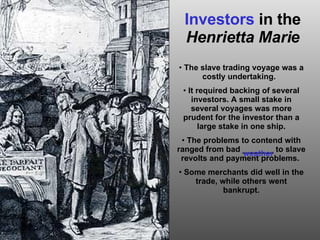
Investors  in the  Henrietta Marie The slave trading voyage was a costly undertaking.  It required backing of several investors. A small stake in several voyages was more prudent for the investor than a large stake in one ship. The problems to contend with ranged from bad _______ to slave revolts and payment problems.  Some merchants did well in the trade, while others went bankrupt. weather
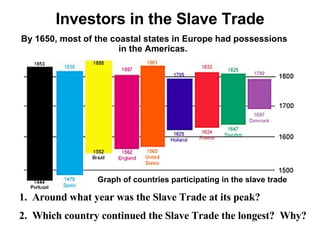
Investors in the Slave Trade 1.  Around what year was the Slave Trade at its peak? 2.  Which country continued the Slave Trade the longest?  Why? By 1650, most of the coastal states in Europe had possessions in the Americas.  Graph of countries participating in the slave trade
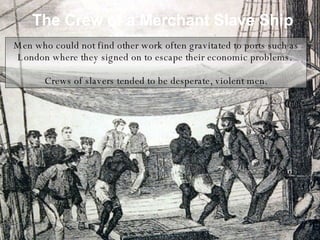
The Crew of a Merchant Slave Ship Men who could not find other work often gravitated to ports such as London where they signed on to escape their economic problems.  Crews of slavers tended to be desperate, violent men.
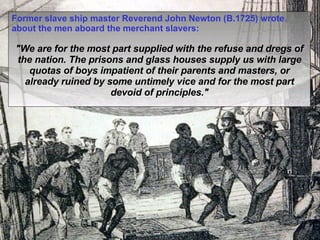
Former slave ship master Reverend John Newton (B.1725) wrote about the men aboard the merchant slavers: "We are for the most part supplied with the refuse and dregs of the nation. The prisons and glass houses supply us with large quotas of boys impatient of their parents and masters, or already ruined by some untimely vice and for the most part devoid of principles."
 
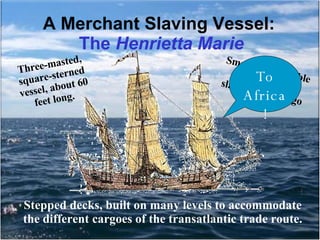
A Merchant Slaving Vessel:  The  Henrietta Marie Three-masted, square-sterned vessel, about 60 feet long.  Small ship, capable of holding 200 slaves in her cargo area.   Stepped decks, built on many levels to accommodate the different cargoes of the transatlantic trade route. To Africa!
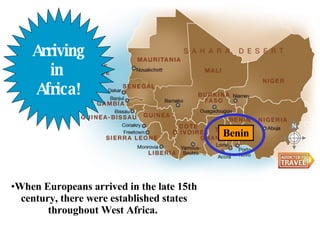
When Europeans arrived in the late 15th century, there were established states throughout West Africa.  Arriving in  Africa! Benin
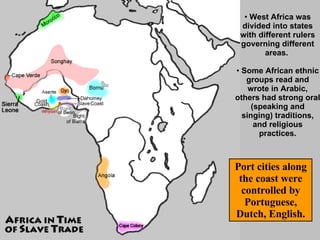
Port cities along the coast were controlled by Portuguese, Dutch, English. West Africa was divided into states with different rulers governing different areas.  Some African ethnic groups read and wrote in Arabic, others had strong oral (speaking and singing) traditions, and religious practices.
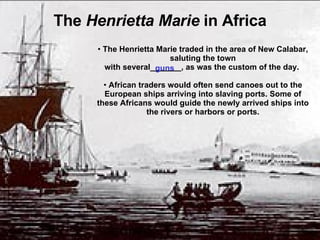
The  Henrietta Marie  in Africa guns The Henrietta Marie traded in the area of New Calabar, saluting the town with several_______, as was the custom of the day.  African traders would often send canoes out to the European ships arriving into slaving ports. Some of these Africans would guide the newly arrived ships into the rivers or harbors or ports.
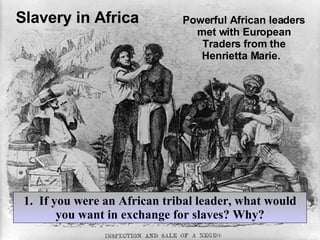
Slavery in Africa 1.  If you were an African tribal leader, what would you want in exchange for slaves? Why? Powerful African leaders met with European Traders from the Henrietta Marie.
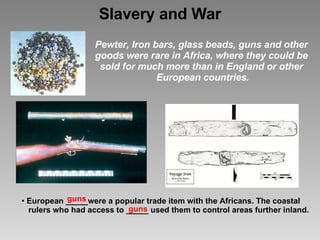
Slavery and War Pewter, Iron bars, glass beads, guns and other    goods were rare in Africa, where they could be    sold for much more than in England or other    European countries. guns guns European _____were a popular trade item with the Africans. The coastal    rulers who had access to _____ used them to control areas further inland.
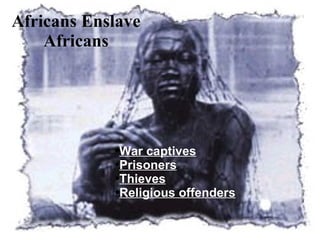
Africans Enslave Africans War captives Prisoners Thieves Religious offenders
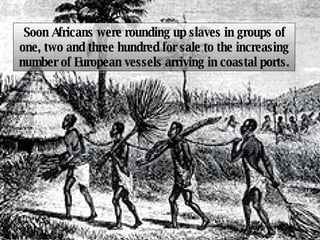
Soon Africans were rounding up slaves in groups of one, two and three hundred for sale to the increasing number of European vessels arriving in coastal ports.
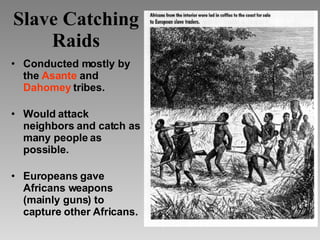
Slave Catching Raids Conducted mostly by the  Asante  and  Dahomey  tribes. Would attack neighbors and catch as many people as possible. Europeans gave Africans weapons (mainly guns) to capture other Africans.
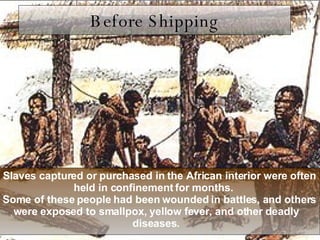
Before Shipping Slaves captured or purchased in the African interior were often held in confinement for months.  Some of these people had been wounded in battles, and others were exposed to smallpox, yellow fever, and other deadly diseases.
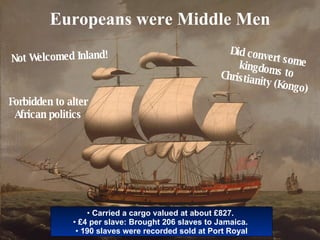
Europeans were Middle Men Not Welcomed Inland! Did convert some kingdoms to Christianity (Kongo) Forbidden to alter African politics Carried a cargo valued at about £827.  £4 per slave: Brought 206 slaves to Jamaica.  190 slaves were recorded sold at Port Royal
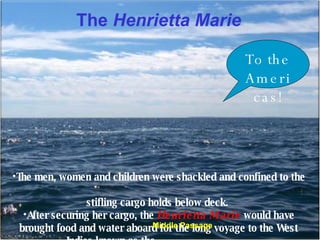
The  Henrietta Marie The men, women and children were shackled and confined to the  stifling cargo holds below deck.  After securing her cargo, the  Henrietta Marie  would have brought food and water aboard for the long voyage to the West Indies known as the _________________. To the Americas! Middle Passage
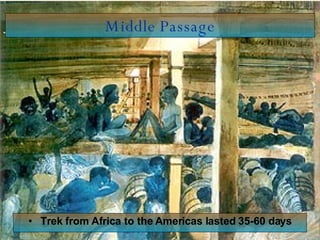
Trek from Africa to the Americas lasted 35-60 days Middle Passage
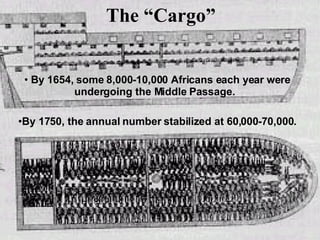
The “Cargo” By 1654, some 8,000-10,000 Africans each year were undergoing the Middle Passage.  By 1750, the annual number stabilized at 60,000-70,000.
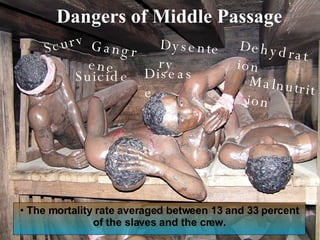
Dangers of Middle Passage Scurvy Dysentery Gangrene Dehydration Suicide Disease Malnutrition The mortality rate averaged between 13 and 33 percent of the slaves and the crew.
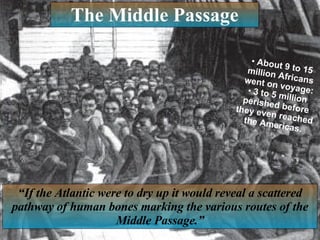
The Middle Passage “ If the Atlantic were to dry up it would reveal a scattered pathway of human bones marking the various routes of the Middle Passage.” About 9 to 15 million Africans went on voyage: 3 to 5 million perished before they even reached the Americas.
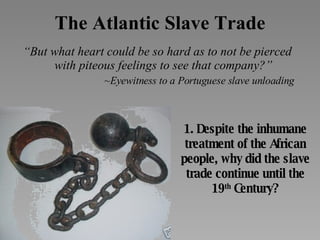
The Atlantic Slave Trade “ But what heart could be so hard as to not be pierced with piteous feelings to see that company?” ~Eyewitness to a Portuguese slave unloading 1. Despite the inhumane treatment of the African people, why did the slave trade continue until the 19 th  Century?
The Triangle Trade SUGAR, TABACCO SLAVES GUNS, RUM, GOODS
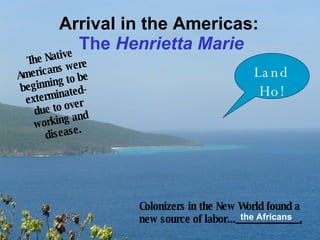
Arrival in the Americas:  The  Henrietta Marie The Native Americans were beginning to be exterminated-due to over working and disease. Land Ho! Colonizers in the New World found a new source of labor... ____________. the Africans
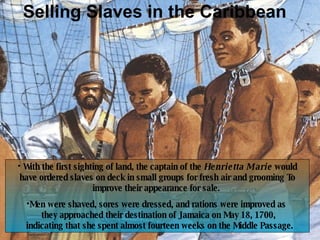
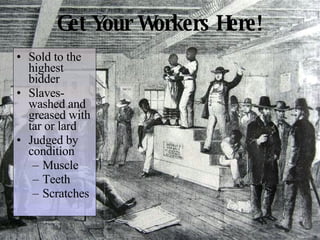
Selling Slaves in the Caribbean   With the first sighting of land, the captain of the  Henrietta Marie  would have ordered slaves on deck in small groups for fresh air and grooming To improve their appearance for sale.  Men were shaved, sores were dressed, and rations were improved as    they approached their destination of Jamaica on May 18, 1700,    indicating that she spent almost fourteen weeks on the Middle Passage.
Get Your Workers Here! Sold to the highest bidder Slaves-washed and greased with tar or lard Judged by condition Muscle Teeth Scratches
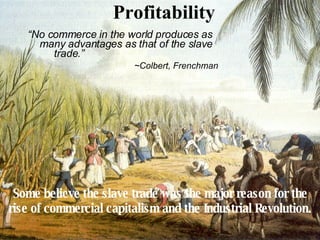
Profitability “ No commerce in the world produces as many advantages as that of the slave trade.”    ~Colbert, Frenchman Some believe the slave trade was the major reason for the rise of commercial capitalism and the Industrial Revolution.
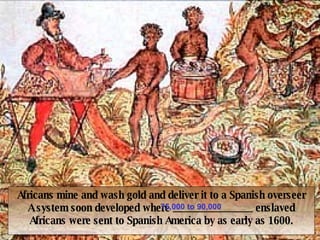
Forced Migration of Africans Africans mine and wash gold and deliver it to a Spanish overseer A system soon developed where _______________ enslaved Africans were sent to Spanish America by as early as 1600. 75,000 to 90,000
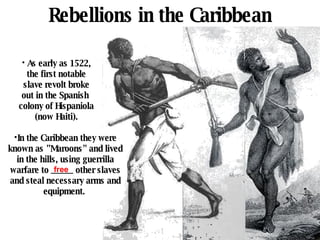
Rebellions in the Caribbean In the Caribbean they were known as "Maroons" and lived in the hills, using guerrilla warfare to _____ other slaves and steal necessary arms and equipment.  free As early as 1522, the first notable slave revolt broke out in the Spanish  colony of Hispaniola (now Haiti).
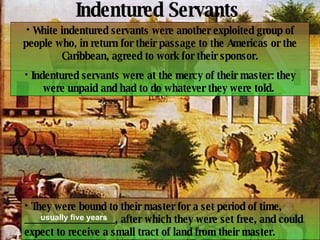
Indentured Servants White indentured servants were another exploited group of people who, in return for their passage to the Americas or the Caribbean, agreed to work for their sponsor. Indentured servants were at the mercy of their master: they were unpaid and had to do whatever they were told.  They were bound to their master for a set period of time, _________________, after which they were set free, and could expect to receive a small tract of land from their master.  usually five years
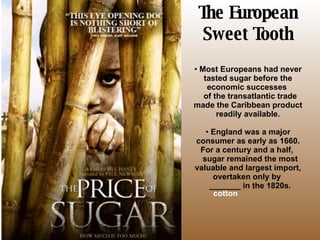
The European Sweet Tooth cotton Most Europeans had never tasted sugar before the economic successes    of the transatlantic trade made the Caribbean product readily available. England was a major consumer as early as 1660. For a century and a half,    sugar remained the most valuable and largest import, overtaken only by    _______ in the 1820s.
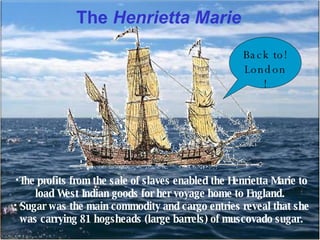
The  Henrietta Marie The profits from the sale of slaves enabled the Henrietta Marie to load West Indian goods for her voyage home to England.  Sugar was the main commodity and cargo entries reveal that she was carrying 81 hogsheads (large barrels) of muscovado sugar. Back to! London!
Removal of millions of African men and women from their homeland Economic dependence on Europe, devastating effects when trade was outlawed Susceptibility to European imperialism

Transatlantic slave trade

  • 1.
    FORCED IMMIGRATION TheAtlantic Slave Trade “ Humanity is divided into two -- the masters and the slaves.” ~Aristotle
  • 2.
    The potential wealthto be made from slavery led to the triangular trade between ________________________________________. The Transatlantic Slave Trade Europe, Africa and the Americas. Europeans were able to sell manufactured goods in exchange for ____________ and luxury items. raw materials
  • 3.
    A Merchant SlavingVessel: The Henrietta Marie Let’s follow the journey of a typical slave ship… First Stop! London!
  • 4.
    The Port of London The Henrietta Marie would start its journey in the London, a thriving port built on the banks of the Thames River. jobs dreams As the capital city, it was the center of social and economic developments; it was also the place to which young people came to learn trades, find ____ , and fulfill their _________ .
  • 5.
    Investors inthe Henrietta Marie The slave trading voyage was a costly undertaking. It required backing of several investors. A small stake in several voyages was more prudent for the investor than a large stake in one ship. The problems to contend with ranged from bad _______ to slave revolts and payment problems. Some merchants did well in the trade, while others went bankrupt. weather
  • 6.
    Investors in theSlave Trade 1. Around what year was the Slave Trade at its peak? 2. Which country continued the Slave Trade the longest? Why? By 1650, most of the coastal states in Europe had possessions in the Americas. Graph of countries participating in the slave trade
  • 7.
    The Crew ofa Merchant Slave Ship Men who could not find other work often gravitated to ports such as London where they signed on to escape their economic problems. Crews of slavers tended to be desperate, violent men.
  • 8.
    Former slave shipmaster Reverend John Newton (B.1725) wrote about the men aboard the merchant slavers: "We are for the most part supplied with the refuse and dregs of the nation. The prisons and glass houses supply us with large quotas of boys impatient of their parents and masters, or already ruined by some untimely vice and for the most part devoid of principles."
  • 9.
  • 10.
    A Merchant SlavingVessel: The Henrietta Marie Three-masted, square-sterned vessel, about 60 feet long. Small ship, capable of holding 200 slaves in her cargo area. Stepped decks, built on many levels to accommodate the different cargoes of the transatlantic trade route. To Africa!
  • 11.
    When Europeans arrivedin the late 15th century, there were established states throughout West Africa. Arriving in Africa! Benin
  • 12.
    Port cities alongthe coast were controlled by Portuguese, Dutch, English. West Africa was divided into states with different rulers governing different areas. Some African ethnic groups read and wrote in Arabic, others had strong oral (speaking and singing) traditions, and religious practices.
  • 13.
    The HenriettaMarie in Africa guns The Henrietta Marie traded in the area of New Calabar, saluting the town with several_______, as was the custom of the day. African traders would often send canoes out to the European ships arriving into slaving ports. Some of these Africans would guide the newly arrived ships into the rivers or harbors or ports.
  • 14.
    Slavery in Africa1. If you were an African tribal leader, what would you want in exchange for slaves? Why? Powerful African leaders met with European Traders from the Henrietta Marie.
  • 15.
    Slavery and WarPewter, Iron bars, glass beads, guns and other goods were rare in Africa, where they could be sold for much more than in England or other European countries. guns guns European _____were a popular trade item with the Africans. The coastal rulers who had access to _____ used them to control areas further inland.
  • 16.
    Africans Enslave AfricansWar captives Prisoners Thieves Religious offenders
  • 17.
    Soon Africans wererounding up slaves in groups of one, two and three hundred for sale to the increasing number of European vessels arriving in coastal ports.
  • 18.
    Slave Catching RaidsConducted mostly by the Asante and Dahomey tribes. Would attack neighbors and catch as many people as possible. Europeans gave Africans weapons (mainly guns) to capture other Africans.
  • 19.
    Before Shipping Slavescaptured or purchased in the African interior were often held in confinement for months. Some of these people had been wounded in battles, and others were exposed to smallpox, yellow fever, and other deadly diseases.
  • 20.
    Europeans were MiddleMen Not Welcomed Inland! Did convert some kingdoms to Christianity (Kongo) Forbidden to alter African politics Carried a cargo valued at about £827. £4 per slave: Brought 206 slaves to Jamaica. 190 slaves were recorded sold at Port Royal
  • 21.
    The HenriettaMarie The men, women and children were shackled and confined to the stifling cargo holds below deck. After securing her cargo, the Henrietta Marie would have brought food and water aboard for the long voyage to the West Indies known as the _________________. To the Americas! Middle Passage
  • 22.
    Trek from Africato the Americas lasted 35-60 days Middle Passage
  • 23.
    The “Cargo” By1654, some 8,000-10,000 Africans each year were undergoing the Middle Passage. By 1750, the annual number stabilized at 60,000-70,000.
  • 24.
    Dangers of MiddlePassage Scurvy Dysentery Gangrene Dehydration Suicide Disease Malnutrition The mortality rate averaged between 13 and 33 percent of the slaves and the crew.
  • 25.
    The Middle Passage“ If the Atlantic were to dry up it would reveal a scattered pathway of human bones marking the various routes of the Middle Passage.” About 9 to 15 million Africans went on voyage: 3 to 5 million perished before they even reached the Americas.
  • 26.
    The Atlantic SlaveTrade “ But what heart could be so hard as to not be pierced with piteous feelings to see that company?” ~Eyewitness to a Portuguese slave unloading 1. Despite the inhumane treatment of the African people, why did the slave trade continue until the 19 th Century?
  • 27.
    The Triangle TradeSUGAR, TABACCO SLAVES GUNS, RUM, GOODS
  • 28.
    Arrival in theAmericas: The Henrietta Marie The Native Americans were beginning to be exterminated-due to over working and disease. Land Ho! Colonizers in the New World found a new source of labor... ____________. the Africans
  • 29.
    Selling Slaves inthe Caribbean With the first sighting of land, the captain of the Henrietta Marie would have ordered slaves on deck in small groups for fresh air and grooming To improve their appearance for sale. Men were shaved, sores were dressed, and rations were improved as they approached their destination of Jamaica on May 18, 1700, indicating that she spent almost fourteen weeks on the Middle Passage.
  • 30.
    Get Your WorkersHere! Sold to the highest bidder Slaves-washed and greased with tar or lard Judged by condition Muscle Teeth Scratches
  • 31.
    Profitability “ Nocommerce in the world produces as many advantages as that of the slave trade.” ~Colbert, Frenchman Some believe the slave trade was the major reason for the rise of commercial capitalism and the Industrial Revolution.
  • 32.
    Forced Migration ofAfricans Africans mine and wash gold and deliver it to a Spanish overseer A system soon developed where _______________ enslaved Africans were sent to Spanish America by as early as 1600. 75,000 to 90,000
  • 33.
    Rebellions in theCaribbean In the Caribbean they were known as "Maroons" and lived in the hills, using guerrilla warfare to _____ other slaves and steal necessary arms and equipment. free As early as 1522, the first notable slave revolt broke out in the Spanish colony of Hispaniola (now Haiti).
  • 34.
    Indentured Servants Whiteindentured servants were another exploited group of people who, in return for their passage to the Americas or the Caribbean, agreed to work for their sponsor. Indentured servants were at the mercy of their master: they were unpaid and had to do whatever they were told. They were bound to their master for a set period of time, _________________, after which they were set free, and could expect to receive a small tract of land from their master. usually five years
  • 35.
    The European SweetTooth cotton Most Europeans had never tasted sugar before the economic successes of the transatlantic trade made the Caribbean product readily available. England was a major consumer as early as 1660. For a century and a half, sugar remained the most valuable and largest import, overtaken only by _______ in the 1820s.
  • 36.
    The HenriettaMarie The profits from the sale of slaves enabled the Henrietta Marie to load West Indian goods for her voyage home to England. Sugar was the main commodity and cargo entries reveal that she was carrying 81 hogsheads (large barrels) of muscovado sugar. Back to! London!
  • 37.
    Removal of millionsof African men and women from their homeland Economic dependence on Europe, devastating effects when trade was outlawed Susceptibility to European imperialism