Equilibrium
▪ vestibular apparatus - equilibrium
receptors in the semicircular canals and
vestibule
–send signals to the brain that initiate reflexes
needed to make the simplest changes in
position as well as more complex moves
Equilibrium
Two Functional Parts
▪ Static Equilibrium (Vestibule) - monitor linear
acceleration and the position of the head with
respect to gravity (constant)
▪ Dynamic Equilibrium (Semicircular Canals) -
monitor changes in head rotation
Structure of Crista
Ampullaris
Static Equilibrium
 Maculae
– receptors in
the vestibule
 Report on the
position of the
head
 Send
information via
the vestibular
nerve
Static Equilibrium
 Anatomy of the Maculae
 Hair cells are embedded in the otolithic
membrane
 Otoliths (tiny stones made of calcium salts) float
in a gel around the hair cells
 respond to static equilibrium cues relative to
the position of the head in space
 Movements cause otoliths to bend the hair cells
Function of Maculae
Diagrammatic view of
part of a macula
Function of Maculae
When the head is tipped, the maculae are stimulated by movement of the
otoliths in the gelatinous otolithic membrane in the direction of
gravitational pull, which creates a pull on the hair cells.
Dynamic Equilibrium
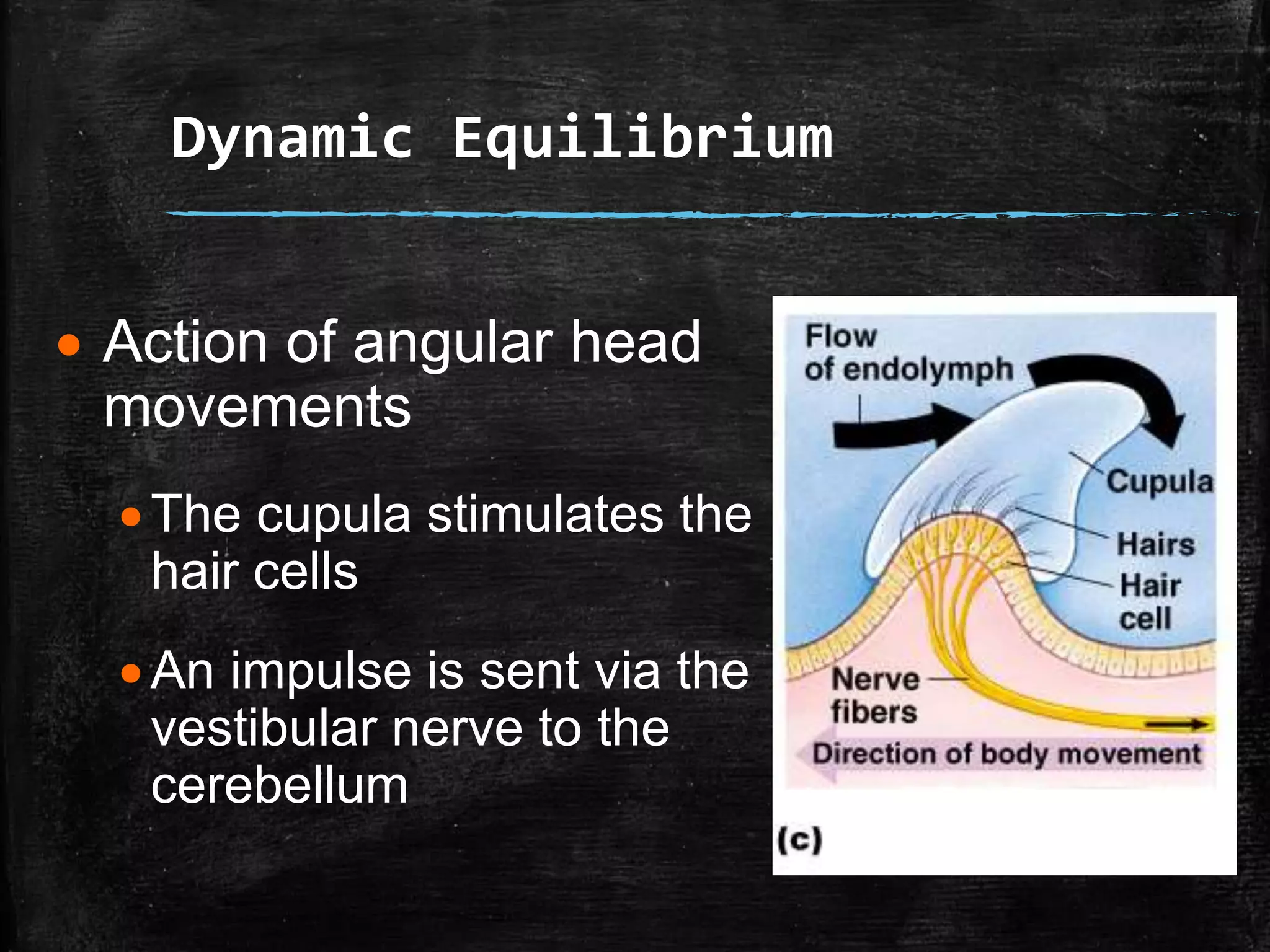
 Crista ampullaris
– receptors in the
semicircular canals
Tuft of hair cells
Cupula (gelatinous cap)
covers the hair cells
Dynamic Equilibrium
 Action of angular head
movements
The cupula stimulates the
hair cells
An impulse is sent via the
vestibular nerve to the
cerebellum
Crista Ampullaris
Recap
▪ What sense do the vestibule and semicircular canals
serve?
– Balance or equilibrium.
▪ Benji is enjoying a boat ride until a storm suddenly
descends on the bay. So he is nauseated and can
barely stand up. Which equilibrium receptors – static
or dynamic – are operating furiously during such a
rough voyage?
– Dynamic receptors located in the semicircular canals (crista
ampullaris).
Recap
▪ What are otoliths, and what is their
role in equilibrium?
– Otoliths are tiny stones made of calcium
salts which are located in the maculae of
the vestibule.They respond to static
equilibrium cues relative to the position
of the head in space.
Hearing
 Spiral Organ of Corti
 Located within the cochlear duct
 Hearing receptors = hair cells on the basilar
membrane
 Gel-like tectorial membrane is capable of
bending hair cells
 Cochlear nerve attached to hair cells transmits
nerve impulses to auditory cortex on temporal
lobe – interpretation of sound or hearing occurs
Anatomy of the cochlea. (a) Lateral view of part of the internal ear
with a wedge-shaped section removed from the cochlea.
Anatomy of the cochlea. (b) Magnified cross section of one turn of the
cochlea, showing the relationship of the three scalae.This cross section has
been rotated from its position in (a). (c) Detailed structure of the spiral organ.
Mechanisms of Hearing
Vibrations from
sound waves move
tectorial membrane
 (pass through the
endolymph fluid
filling the
membranous
labyrinth in the
cochlear duct)
Mechanisms of Hearing
▪ Length of fibers spanning the basilar membrane “tunes”
specific regions to vibrate at specific frequencies
High-Pitched
Sounds
Low-Pitched
Sounds
disturb the shorter affect longer
stiffer fibers of the basilar
membrane
more floppy fibers
stimulate receptor cells
close to the oval window
activated specific hair cells
further along the cochlea
Mechanisms of Hearing
 An action potential starts
in the cochlear nerve (a
division of cranial nerve
VIII – vestibulocochlear
nerve)
 The signal is transmitted
to the midbrain (for
auditory reflexes and then
directed to the auditory
cortex of the temporal
lobe)
Mechanisms of Hearing
▪ Continued stimulation can
lead to adaptation
–(over stimulation to the brain
makes it stop interpreting the
sounds)
Hearing and Equilibrium Deficits
▪ Tuning fork or audiometry testing
– try to diagnose ear problems or
hearing deficits
▪ Deafness – hearing loss of any
degree-from a slight loss to a
total inability to hear sound
1. Conduction Deafness
2. Sensorineural Deafness
Hearing Deficits
▪ Temporary or Permanent Conduction
Deafness
– something interferes with the conduction of sound
vibrations to the fluids of the inner ear
– Causes
▪ build up of earwax
▪ fussion of ossicles (otosclerosis)
▪ ruptured eardrum
▪ otitis media (middle ear inflammation)
– still be able to hear by bone conduction (hearing aids)
Hearing Deficits
▪ Sensorineural Deafness
– degeneration or damage to the receptor
cells in the spiral organ of Corti, to the
cochlear nerve, or neurons of the auditory
cortex
– Causes
▪ Extended listening to excessively loud sounds
▪ Problem with nervous system structures
– Can’t hear better by either conduction
route
Equilibrium Deficits
▪ Nausea, dizziness, and problems in
maintaing balance
–Impulses from the vestibular apparatus
“disagree” with what we see (visual input)
–Strange eye movements (jerky or rolling)
▪ Meniere’s Syndrome
Equilibrium Deficits
▪ Meniere’s Syndrome
– Suspected causes
▪ Arteriosclerosis, degeneration of cranial nerveVIII,
and increased pressure of the inner ear fluids
– Progressive deafness occurs
– Nauseted and howling or ringing sounds in the
ears and vertigo (a sensation of spinning)
– So severe = cannot stand up without
discomfort
– Anti-motion sickness drugs = decrease
discomfort

Special Senses - Equilibrium and Hearing

  • 1.
    Equilibrium ▪ vestibular apparatus- equilibrium receptors in the semicircular canals and vestibule –send signals to the brain that initiate reflexes needed to make the simplest changes in position as well as more complex moves
  • 2.
    Equilibrium Two Functional Parts ▪Static Equilibrium (Vestibule) - monitor linear acceleration and the position of the head with respect to gravity (constant) ▪ Dynamic Equilibrium (Semicircular Canals) - monitor changes in head rotation
  • 3.
  • 4.
    Static Equilibrium  Maculae –receptors in the vestibule  Report on the position of the head  Send information via the vestibular nerve
  • 5.
    Static Equilibrium  Anatomyof the Maculae  Hair cells are embedded in the otolithic membrane  Otoliths (tiny stones made of calcium salts) float in a gel around the hair cells  respond to static equilibrium cues relative to the position of the head in space  Movements cause otoliths to bend the hair cells
  • 6.
    Function of Maculae Diagrammaticview of part of a macula
  • 7.
    Function of Maculae Whenthe head is tipped, the maculae are stimulated by movement of the otoliths in the gelatinous otolithic membrane in the direction of gravitational pull, which creates a pull on the hair cells.
  • 8.
    Dynamic Equilibrium  Cristaampullaris – receptors in the semicircular canals Tuft of hair cells Cupula (gelatinous cap) covers the hair cells
  • 9.
    Dynamic Equilibrium  Actionof angular head movements The cupula stimulates the hair cells An impulse is sent via the vestibular nerve to the cerebellum
  • 10.
  • 12.
    Recap ▪ What sensedo the vestibule and semicircular canals serve? – Balance or equilibrium. ▪ Benji is enjoying a boat ride until a storm suddenly descends on the bay. So he is nauseated and can barely stand up. Which equilibrium receptors – static or dynamic – are operating furiously during such a rough voyage? – Dynamic receptors located in the semicircular canals (crista ampullaris).
  • 13.
    Recap ▪ What areotoliths, and what is their role in equilibrium? – Otoliths are tiny stones made of calcium salts which are located in the maculae of the vestibule.They respond to static equilibrium cues relative to the position of the head in space.
  • 14.
    Hearing  Spiral Organof Corti  Located within the cochlear duct  Hearing receptors = hair cells on the basilar membrane  Gel-like tectorial membrane is capable of bending hair cells  Cochlear nerve attached to hair cells transmits nerve impulses to auditory cortex on temporal lobe – interpretation of sound or hearing occurs
  • 15.
    Anatomy of thecochlea. (a) Lateral view of part of the internal ear with a wedge-shaped section removed from the cochlea.
  • 16.
    Anatomy of thecochlea. (b) Magnified cross section of one turn of the cochlea, showing the relationship of the three scalae.This cross section has been rotated from its position in (a). (c) Detailed structure of the spiral organ.
  • 17.
    Mechanisms of Hearing Vibrationsfrom sound waves move tectorial membrane  (pass through the endolymph fluid filling the membranous labyrinth in the cochlear duct)
  • 18.
    Mechanisms of Hearing ▪Length of fibers spanning the basilar membrane “tunes” specific regions to vibrate at specific frequencies High-Pitched Sounds Low-Pitched Sounds disturb the shorter affect longer stiffer fibers of the basilar membrane more floppy fibers stimulate receptor cells close to the oval window activated specific hair cells further along the cochlea
  • 19.
    Mechanisms of Hearing An action potential starts in the cochlear nerve (a division of cranial nerve VIII – vestibulocochlear nerve)  The signal is transmitted to the midbrain (for auditory reflexes and then directed to the auditory cortex of the temporal lobe)
  • 20.
    Mechanisms of Hearing ▪Continued stimulation can lead to adaptation –(over stimulation to the brain makes it stop interpreting the sounds)
  • 21.
    Hearing and EquilibriumDeficits ▪ Tuning fork or audiometry testing – try to diagnose ear problems or hearing deficits ▪ Deafness – hearing loss of any degree-from a slight loss to a total inability to hear sound 1. Conduction Deafness 2. Sensorineural Deafness
  • 22.
    Hearing Deficits ▪ Temporaryor Permanent Conduction Deafness – something interferes with the conduction of sound vibrations to the fluids of the inner ear – Causes ▪ build up of earwax ▪ fussion of ossicles (otosclerosis) ▪ ruptured eardrum ▪ otitis media (middle ear inflammation) – still be able to hear by bone conduction (hearing aids)
  • 23.
    Hearing Deficits ▪ SensorineuralDeafness – degeneration or damage to the receptor cells in the spiral organ of Corti, to the cochlear nerve, or neurons of the auditory cortex – Causes ▪ Extended listening to excessively loud sounds ▪ Problem with nervous system structures – Can’t hear better by either conduction route
  • 24.
    Equilibrium Deficits ▪ Nausea,dizziness, and problems in maintaing balance –Impulses from the vestibular apparatus “disagree” with what we see (visual input) –Strange eye movements (jerky or rolling) ▪ Meniere’s Syndrome
  • 25.
    Equilibrium Deficits ▪ Meniere’sSyndrome – Suspected causes ▪ Arteriosclerosis, degeneration of cranial nerveVIII, and increased pressure of the inner ear fluids – Progressive deafness occurs – Nauseted and howling or ringing sounds in the ears and vertigo (a sensation of spinning) – So severe = cannot stand up without discomfort – Anti-motion sickness drugs = decrease discomfort