Thalamus
Dr. Pandian M.
Assistant Professor
Dept. of Physiology
ZMCH, Dahod.
Diancephalon – interbrain
- Thalamus
- Medial & lat geniculate bodies
- Pineal body – melatonin secretion
- Hypothalamus
- Subthalamus
Introducton:-
o Placed in the centre of cerebral hemisphere
o Neurons project to various areas of cortex
o Input from sensory system, motor structures
ARAS and cortex
THALAMUS & CORTEX WORK AS SINGLE UNIT
THALAMUS (integration of Inputs)
THALAMUS
Intermediate
mass
Third ventricle
Anterior
• Part of diecephalon
• Clusters of nuclei
• Medially lines 3rd ventricle
•Laterally lines Internal capsule
Ext.
medullary
lamina
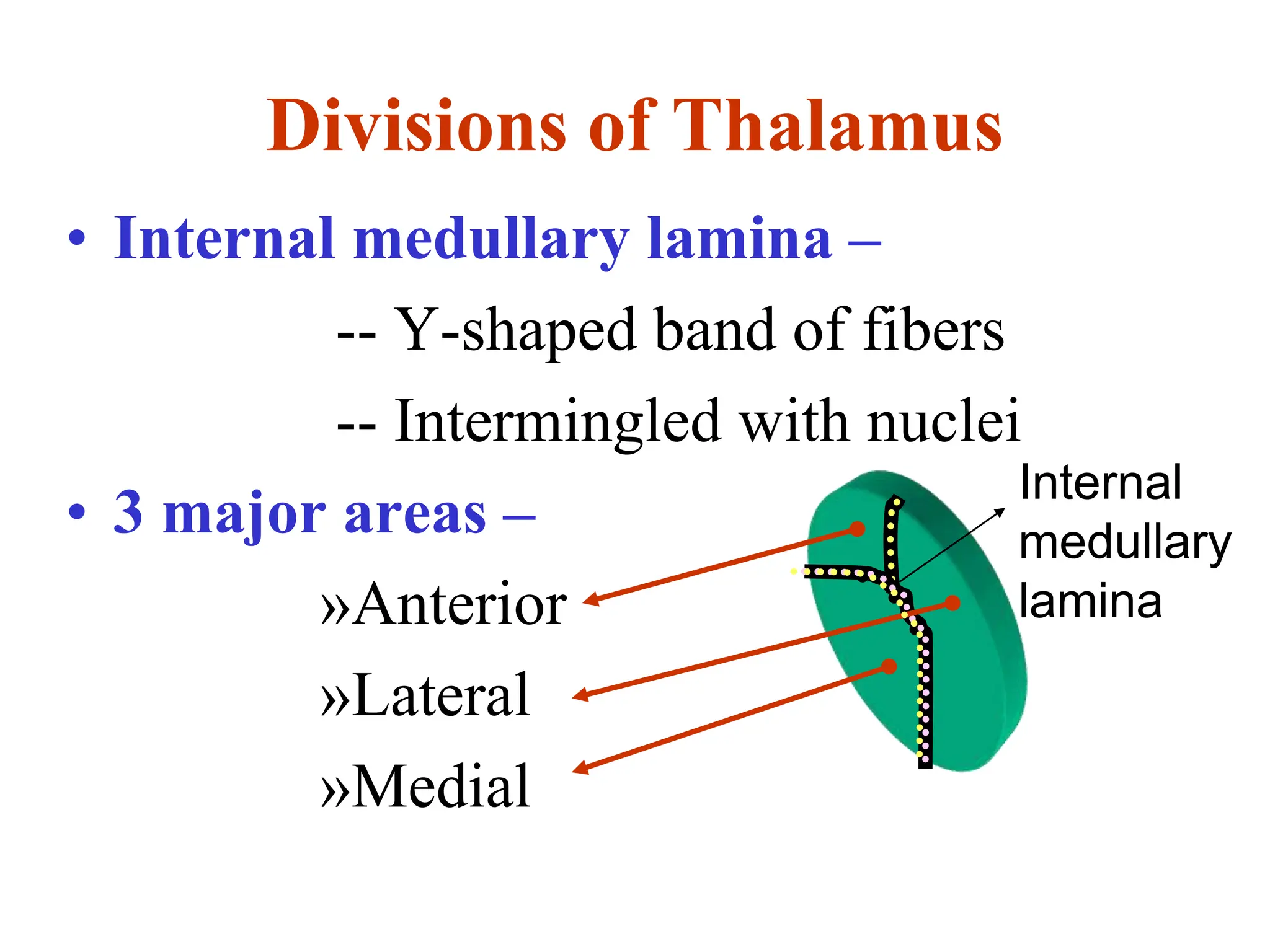
• Internal medullary lamina –
-- Y-shaped band of fibers
-- Intermingled with nuclei
• 3 major areas –
»Anterior
»Lateral
»Medial
Divisions of Thalamus
Internal
medullary
lamina
Anatomical Subdivisions of Thalamus
Ant. N.
Lat.gr. Med. Gr.
Ventral gr. Dorsal gr.
Ventroanterior
Ventrolat.
Ventroposterior
LGB
MGB
Dorsolat.
Posterolat.
Pulvinar
Dorsomedial
Centromedial
Midline
intralaminar
I. Lateral group
A. Ventral nuclei
Ventroanterior ( BG)
Ventrolateral (cerebellum&
BG)
Ventro posterior
VPL VPM
Med. & Lat. Geniculate bodies
(Control vol. movements)
(vol. movements)
(Main sensory
relay)
(Auditory and visual relay)
Ventral nuclei
Dorsal nuclei
Nucleus Input output Function
VA BG, prefrontal Pre motor
cortex
Vol.
Movements
VL Cerebellum, GPi,
area 4,6
Motor cortex
Primary, PMA
Vol.
Movements
VPL &
VPM
Somatosensory
pathway
Sensory cortex
(1,3 &2)
Specific
Sensory
relay
LGB Visual input Primary visual
cortex
Visual relay
MGB Auditory input Primary
aud. area
Auditory
relay
B. Dorsal Group Dorsolateral (LD)
(Speech)
Posterolateral (LP)
(control of motor
functions)
Pulvinar
(integration of
sensations)
II. Dorsal Group
Nucleus Input Output Function
Pulvinar
(large in man)
LGN, MGN.,
sup.colliculi
Asso. & visual
Cortex
PTO
Cortex
Visual
attention
Dorsolateralis
(LD)
Uncertain Cingulate
gyrus
Speech
formation
Posterolateralis
(LP)
Visual,
association
areas, pulvinar,
VPL
PTO
Cortex
Motor
function
II. MEDIAL GROUP Dorsomedial
(emotional feeling
with sensations,
personality,
procedural
memory)
Intralaminar N.
(alerting effect)
Midline N.
(visceral sensation)
Centromedian N.
II. MEDIAL GROUP
• A) Intralaminar nuclei
• Input from ARAS, BG,
• output to Prefrontal cortex
• Integration of somatic sensation, and alerting
effect
• B) Midline Nuclei
• Input from sensory pathways, reticular formation
And from locus ceruleus (noradrenergic) and
raphe nuclei (serotonergic)
• output to hypothalamus, and Neocortex
• Integration of visceral sensation, arousal
C) Dorsomedial Nuclei
• Input from amygdala, hypothalamus
• Project to frontal association area
• Emotional feeling with sensation
& personality, procedural memory
D) Centromedial Nucleus - ??
III. ANTERIOR GROUP
• Anterior Nuclei
(Attention Memory and
Emotions)
Input from Mammillothalamic Tract
Project to cingulate gyrus
– part of Papez circuit
Functional groups of thalamic nuclei
I. – Sensory relay nuclei
II. - Association nuclei
III. – Nonspecific nuclei
IV. – Motor nuclei
Specific nuclei Nonspecific nuclei
I. Sensory nuclei –
 Ventrobasal complex (VP), LGB, MGB
 Input – ML, STT, Corticothalamic
 Projection – Somatosensory Cx
II. Association nuclei –
• Pulvinar, DL, PL, DM
• Input - Sensory Cx, Asso. Cx,
Limbic system
• Projection – Asso. Cx, Limbic system
III. Nonspecific nuclei – (emotions, arousal)
• Midline, Intralaminar
• Input – STT, RF, corticothalamic
• Projection – Diffusely to Cx, limbic system
IV. Motor nuclei -
 VA, VL
 Input - GP, Prefrontal Cx.,
dentatothalamic ( cerebellum)
 Projection – premotor Cx, P.moror Cx.
THALAMOCORTICAL UNIT / SYSTEM
Thalamus plays imp. role in all major divisions
of nervous system viz. sensory, motor &
motivational.
All nuclear groups have to & fro connections
with cerebral Cx. Thus thalamus and Cx
function as one unit.
Probably thalamus prepares a crude blue print
of final product achieved by the Cx.
FUNCTIONS OF THALAMUS
1. Sensory relay station and modulating centre
2. Maintenance of conscious alert state
3. Subcortical perception of pain,temp.,crude touch
4. Control of muscular movements
5. Visual attention and visually guided movements –(pulvinar)
6. Integrating centre for sleep
7. Recent memory and emotions
8. Concerned with speech
9. Synchronization of EEG
THALAMIC SYNDROME – (of Dejerine – Roussy)
• Blockage of Thalamogeniculate artery- branch of post.
Cerebral artery
• Damage to VP & posterolateral nucleus of dorsal group
• Symptoms on opposite side & accompanied by
emotional disturbance.
• Involvement of sensory, motor and emotional functions
Sensory effects – on opposite side
temporory loss of discrimination, localization
stereognosis
permanent loss of kinesthetic sensations results
in ataxia
After few weeks over reaction to painful stimuli –
thalamic pain
Thalamic phantom limbs –Alien hand syndrome
Pt. finds difficulty in locating his own hand when the
eyes are closed. He catches in air to locate them or
illusion that limb is lost..
• Motor effects –
»Due to involvement of dentato-thalamico-
cortical fibers
»Muscle weakness,
»Intention tremors
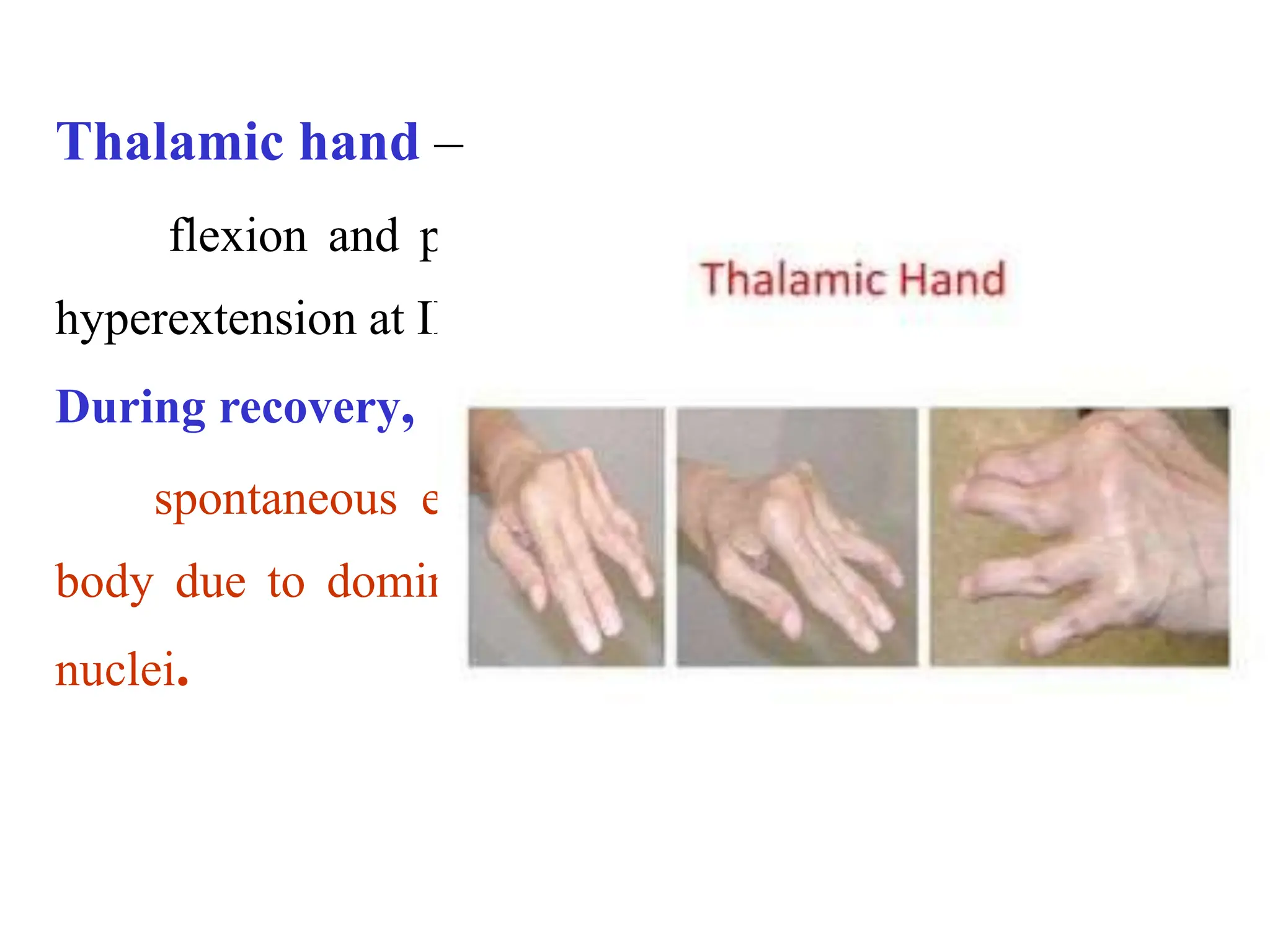
»Thalamic hand
»Choreoathetosis- involvement of fibers from
globus pallidus
• Emotional effects –
intense emotions - pleasant or unpleasant
Thalamic hand –
flexion and pronation at wrist, flexion at MP joint,
hyperextension at IP joint.
During recovery,
spontaneous excruciating pain on opposite side of
body due to dominance of pain fibers ending on medial
nuclei.
References
• Text book of Medical Physiology 14th edition
Guyton & Hall
• Ganong's Review of Medical Physiology, 26 edition.
• Human Physiology
– Vander
• Text book of Medical Physiology
– Indukurana
• Principles of Anatomy and Physiology
– Totora
• Hutchinson Clinical Methods
• Net source for pictures
THANK YOU . . .

Thalamus .ppt

  • 1.
    Thalamus Dr. Pandian M. AssistantProfessor Dept. of Physiology ZMCH, Dahod.
  • 2.
    Diancephalon – interbrain -Thalamus - Medial & lat geniculate bodies - Pineal body – melatonin secretion - Hypothalamus - Subthalamus
  • 3.
    Introducton:- o Placed inthe centre of cerebral hemisphere o Neurons project to various areas of cortex o Input from sensory system, motor structures ARAS and cortex THALAMUS & CORTEX WORK AS SINGLE UNIT THALAMUS (integration of Inputs)
  • 4.
    THALAMUS Intermediate mass Third ventricle Anterior • Partof diecephalon • Clusters of nuclei • Medially lines 3rd ventricle •Laterally lines Internal capsule Ext. medullary lamina
  • 5.
    • Internal medullarylamina – -- Y-shaped band of fibers -- Intermingled with nuclei • 3 major areas – »Anterior »Lateral »Medial Divisions of Thalamus Internal medullary lamina
  • 6.
    Anatomical Subdivisions ofThalamus Ant. N. Lat.gr. Med. Gr. Ventral gr. Dorsal gr. Ventroanterior Ventrolat. Ventroposterior LGB MGB Dorsolat. Posterolat. Pulvinar Dorsomedial Centromedial Midline intralaminar
  • 7.
    I. Lateral group A.Ventral nuclei Ventroanterior ( BG) Ventrolateral (cerebellum& BG) Ventro posterior VPL VPM Med. & Lat. Geniculate bodies (Control vol. movements) (vol. movements) (Main sensory relay) (Auditory and visual relay) Ventral nuclei Dorsal nuclei
  • 8.
    Nucleus Input outputFunction VA BG, prefrontal Pre motor cortex Vol. Movements VL Cerebellum, GPi, area 4,6 Motor cortex Primary, PMA Vol. Movements VPL & VPM Somatosensory pathway Sensory cortex (1,3 &2) Specific Sensory relay LGB Visual input Primary visual cortex Visual relay MGB Auditory input Primary aud. area Auditory relay
  • 9.
    B. Dorsal GroupDorsolateral (LD) (Speech) Posterolateral (LP) (control of motor functions) Pulvinar (integration of sensations)
  • 10.
    II. Dorsal Group NucleusInput Output Function Pulvinar (large in man) LGN, MGN., sup.colliculi Asso. & visual Cortex PTO Cortex Visual attention Dorsolateralis (LD) Uncertain Cingulate gyrus Speech formation Posterolateralis (LP) Visual, association areas, pulvinar, VPL PTO Cortex Motor function
  • 11.
    II. MEDIAL GROUPDorsomedial (emotional feeling with sensations, personality, procedural memory) Intralaminar N. (alerting effect) Midline N. (visceral sensation) Centromedian N.
  • 12.
    II. MEDIAL GROUP •A) Intralaminar nuclei • Input from ARAS, BG, • output to Prefrontal cortex • Integration of somatic sensation, and alerting effect • B) Midline Nuclei • Input from sensory pathways, reticular formation And from locus ceruleus (noradrenergic) and raphe nuclei (serotonergic) • output to hypothalamus, and Neocortex • Integration of visceral sensation, arousal
  • 13.
    C) Dorsomedial Nuclei •Input from amygdala, hypothalamus • Project to frontal association area • Emotional feeling with sensation & personality, procedural memory D) Centromedial Nucleus - ??
  • 14.
    III. ANTERIOR GROUP •Anterior Nuclei (Attention Memory and Emotions) Input from Mammillothalamic Tract Project to cingulate gyrus – part of Papez circuit
  • 15.
    Functional groups ofthalamic nuclei I. – Sensory relay nuclei II. - Association nuclei III. – Nonspecific nuclei IV. – Motor nuclei Specific nuclei Nonspecific nuclei
  • 16.
    I. Sensory nuclei–  Ventrobasal complex (VP), LGB, MGB  Input – ML, STT, Corticothalamic  Projection – Somatosensory Cx II. Association nuclei – • Pulvinar, DL, PL, DM • Input - Sensory Cx, Asso. Cx, Limbic system • Projection – Asso. Cx, Limbic system
  • 17.
    III. Nonspecific nuclei– (emotions, arousal) • Midline, Intralaminar • Input – STT, RF, corticothalamic • Projection – Diffusely to Cx, limbic system IV. Motor nuclei -  VA, VL  Input - GP, Prefrontal Cx., dentatothalamic ( cerebellum)  Projection – premotor Cx, P.moror Cx.
  • 18.
    THALAMOCORTICAL UNIT /SYSTEM Thalamus plays imp. role in all major divisions of nervous system viz. sensory, motor & motivational. All nuclear groups have to & fro connections with cerebral Cx. Thus thalamus and Cx function as one unit. Probably thalamus prepares a crude blue print of final product achieved by the Cx.
  • 19.
    FUNCTIONS OF THALAMUS 1.Sensory relay station and modulating centre 2. Maintenance of conscious alert state 3. Subcortical perception of pain,temp.,crude touch 4. Control of muscular movements 5. Visual attention and visually guided movements –(pulvinar) 6. Integrating centre for sleep 7. Recent memory and emotions 8. Concerned with speech 9. Synchronization of EEG
  • 20.
    THALAMIC SYNDROME –(of Dejerine – Roussy) • Blockage of Thalamogeniculate artery- branch of post. Cerebral artery • Damage to VP & posterolateral nucleus of dorsal group • Symptoms on opposite side & accompanied by emotional disturbance. • Involvement of sensory, motor and emotional functions
  • 21.
    Sensory effects –on opposite side temporory loss of discrimination, localization stereognosis permanent loss of kinesthetic sensations results in ataxia After few weeks over reaction to painful stimuli – thalamic pain Thalamic phantom limbs –Alien hand syndrome Pt. finds difficulty in locating his own hand when the eyes are closed. He catches in air to locate them or illusion that limb is lost..
  • 22.
    • Motor effects– »Due to involvement of dentato-thalamico- cortical fibers »Muscle weakness, »Intention tremors »Thalamic hand »Choreoathetosis- involvement of fibers from globus pallidus • Emotional effects – intense emotions - pleasant or unpleasant
  • 23.
    Thalamic hand – flexionand pronation at wrist, flexion at MP joint, hyperextension at IP joint. During recovery, spontaneous excruciating pain on opposite side of body due to dominance of pain fibers ending on medial nuclei.
  • 24.
    References • Text bookof Medical Physiology 14th edition Guyton & Hall • Ganong's Review of Medical Physiology, 26 edition. • Human Physiology – Vander • Text book of Medical Physiology – Indukurana • Principles of Anatomy and Physiology – Totora • Hutchinson Clinical Methods • Net source for pictures
  • 25.