VESTIBULAR
SYSTEM AND
HEARING
PHYSIOLOGY
A D A M B I L S K I
SOUND
Hearing belongs to vibrational senses, as sound is a vibration
that typically propagates as an audible wave of pressure,
through a transmission medium such as a gas, liquid or solid.
Humans can only hear sound waves as distinct pitches when
the frequency lies between about 20 Hz and 20 kHz.
EAR
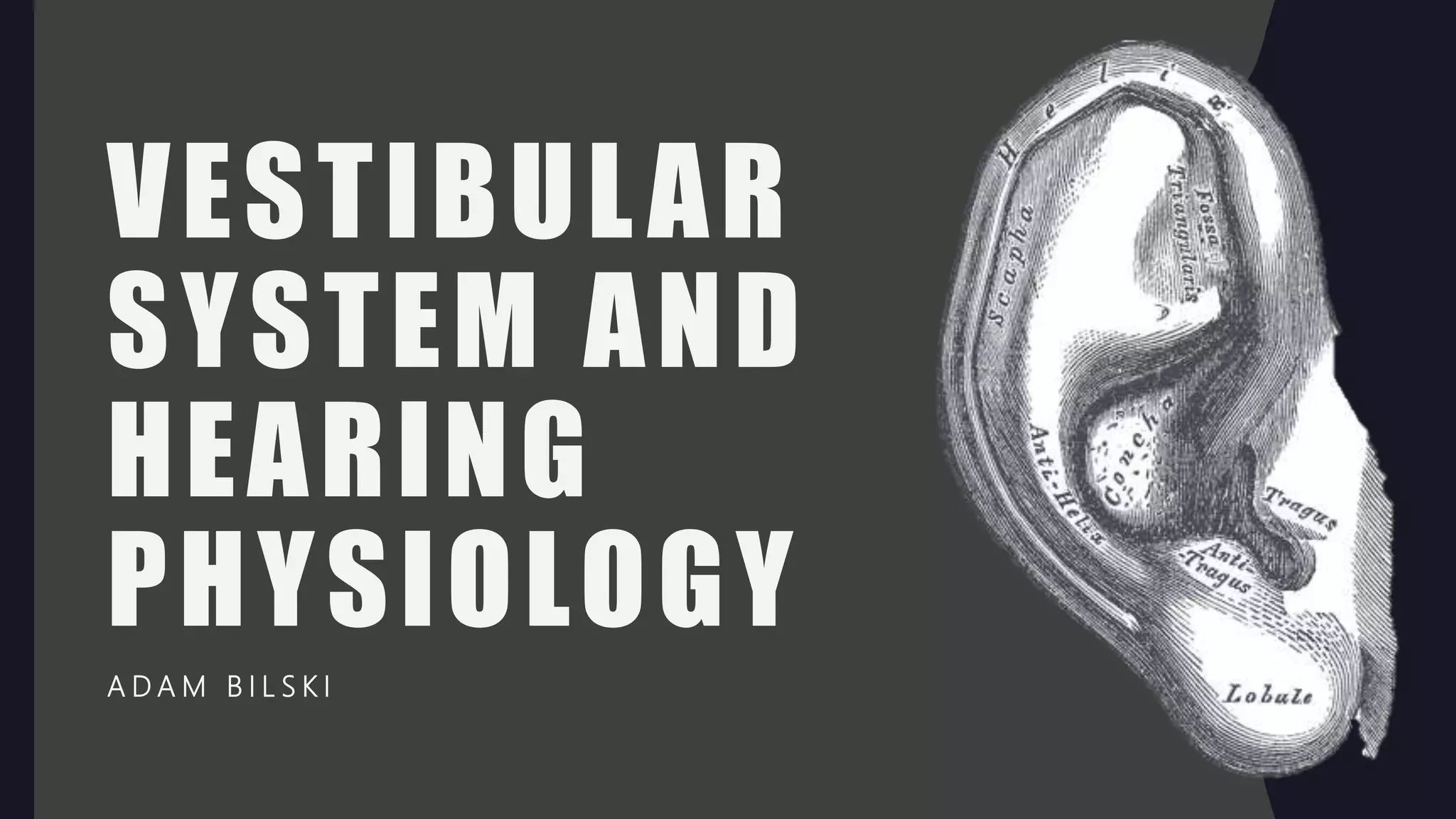
• In mammals ear = hearing + balance
• 3 parts – outer ear (pinna/auricle, ear canal and membrane), middle ear
(tympanic cav., 3 ossicles), inner ear (semicircular canals, utricle, saccule,
cochlea)
• Location of ears on both sides of head – binaural hearing
HEARING
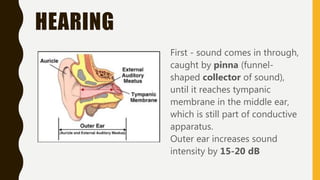
First - sound comes in through,
caught by pinna (funnel-
shaped collector of sound),
until it reaches tympanic
membrane in the middle ear,
which is still part of conductive
apparatus.
Outer ear increases sound
intensity by 15-20 dB
HEARING
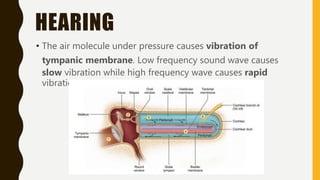
• The air molecule under pressure causes vibration of
tympanic membrane. Low frequency sound wave causes
slow vibration while high frequency wave causes rapid
vibration.
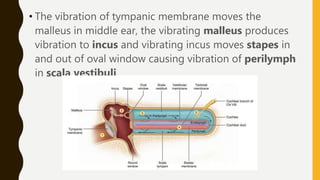
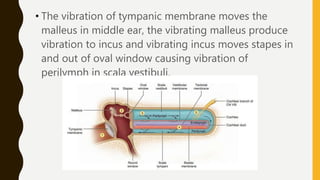
• The vibration of tympanic membrane moves the
malleus in middle ear, the vibrating malleus produces
vibration to incus and vibrating incus moves stapes in
and out of oval window causing vibration of perilymph
in scala vestibuli.
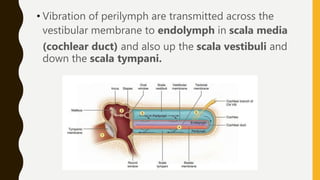
• Vibration of perilymph are transmitted across the
vestibular membrane to endolymph in scala media
(cochlear duct) and also up the scala vestibuli and
down the scala tympani.
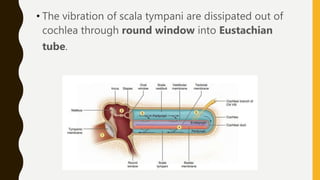
• The vibration of scala tympani are dissipated out of
cochlea through round window into Eustachian
tube.
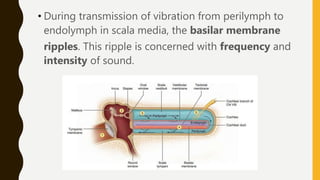
• During transmission of vibration from perilymph to
endolymph in scala media, the basilar membrane
ripples. This ripple is concerned with frequency and
intensity of sound.
• The vibration of tympanic membrane moves the
malleus in middle ear, the vibrating malleus produce
vibration to incus and vibrating incus moves stapes in
and out of oval window causing vibration of
perilymph in scala vestibuli.
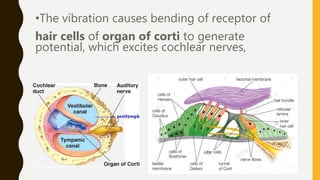
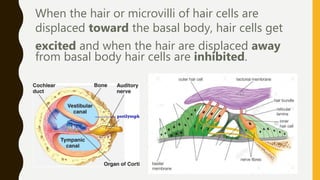
•The vibration causes bending of receptor of
hair cells of organ of corti to generate
potential, which excites cochlear nerves,
When the hair or microvilli of hair cells are
displaced toward the basal body, hair cells get
excited and when the hair are displaced away
from basal body hair cells are inhibited.
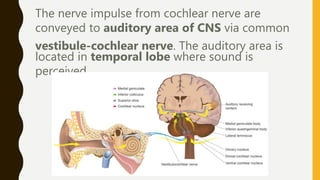
The nerve impulse from cochlear nerve are
conveyed to auditory area of CNS via common
vestibule-cochlear nerve. The auditory area is
located in temporal lobe where sound is
perceived.
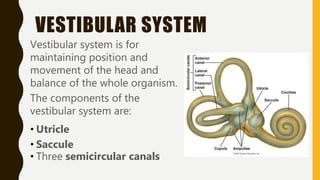
VESTIBULAR SYSTEM
Vestibular system is for
maintaining position and
movement of the head and
balance of the whole organism.
The components of the
vestibular system are:
• Utricle
• Saccule
• Three semicircular canals
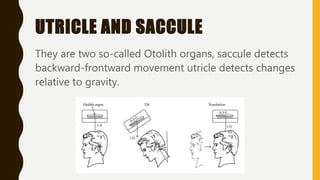
UTRICLE AND SACCULE
They are two so-called Otolith organs, saccule detects
backward-frontward movement utricle detects changes
relative to gravity.
OTHOLITS
Calcium carbonate crystals in contact with hair cells,
reacting to change of position of head with movement,
changing position of hair cells.,
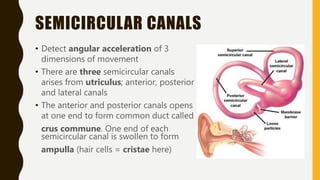
SEMICIRCULAR CANALS
• Detect angular acceleration of 3
dimensions of movement
• There are three semicircular canals
arises from utriculus; anterior, posterior
and lateral canals
• The anterior and posterior canals opens
at one end to form common duct called
crus commune. One end of each
semicircular canal is swollen to form
ampulla (hair cells = cristae here)
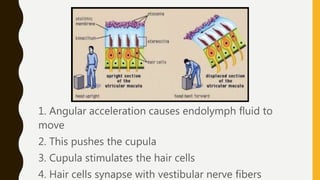
1. Angular acceleration causes endolymph fluid to
move
2. This pushes the cupula
3. Cupula stimulates the hair cells
4. Hair cells synapse with vestibular nerve fibers
The parietal vestibular field is in the
frontal lobe.
Another center is localized in area 7 in
the posterior parietal cortex. Many
cortical vestibular neurons respond to
proprioceptive stimulation - the
rotation of joints - as well.
THANK YOU FOR
ATTENTION 

Hearing and vestibular system - simple basics

  • 1.
  • 2.
    SOUND Hearing belongs tovibrational senses, as sound is a vibration that typically propagates as an audible wave of pressure, through a transmission medium such as a gas, liquid or solid. Humans can only hear sound waves as distinct pitches when the frequency lies between about 20 Hz and 20 kHz.
  • 3.
    EAR • In mammalsear = hearing + balance • 3 parts – outer ear (pinna/auricle, ear canal and membrane), middle ear (tympanic cav., 3 ossicles), inner ear (semicircular canals, utricle, saccule, cochlea) • Location of ears on both sides of head – binaural hearing
  • 4.
    HEARING First - soundcomes in through, caught by pinna (funnel- shaped collector of sound), until it reaches tympanic membrane in the middle ear, which is still part of conductive apparatus. Outer ear increases sound intensity by 15-20 dB
  • 5.
    HEARING • The airmolecule under pressure causes vibration of tympanic membrane. Low frequency sound wave causes slow vibration while high frequency wave causes rapid vibration.
  • 6.
    • The vibrationof tympanic membrane moves the malleus in middle ear, the vibrating malleus produces vibration to incus and vibrating incus moves stapes in and out of oval window causing vibration of perilymph in scala vestibuli.
  • 7.
    • Vibration ofperilymph are transmitted across the vestibular membrane to endolymph in scala media (cochlear duct) and also up the scala vestibuli and down the scala tympani.
  • 8.
    • The vibrationof scala tympani are dissipated out of cochlea through round window into Eustachian tube.
  • 9.
    • During transmissionof vibration from perilymph to endolymph in scala media, the basilar membrane ripples. This ripple is concerned with frequency and intensity of sound.
  • 10.
    • The vibrationof tympanic membrane moves the malleus in middle ear, the vibrating malleus produce vibration to incus and vibrating incus moves stapes in and out of oval window causing vibration of perilymph in scala vestibuli.
  • 11.
    •The vibration causesbending of receptor of hair cells of organ of corti to generate potential, which excites cochlear nerves,
  • 12.
    When the hairor microvilli of hair cells are displaced toward the basal body, hair cells get excited and when the hair are displaced away from basal body hair cells are inhibited.
  • 13.
    The nerve impulsefrom cochlear nerve are conveyed to auditory area of CNS via common vestibule-cochlear nerve. The auditory area is located in temporal lobe where sound is perceived.
  • 14.
    VESTIBULAR SYSTEM Vestibular systemis for maintaining position and movement of the head and balance of the whole organism. The components of the vestibular system are: • Utricle • Saccule • Three semicircular canals
  • 15.
    UTRICLE AND SACCULE Theyare two so-called Otolith organs, saccule detects backward-frontward movement utricle detects changes relative to gravity.
  • 16.
    OTHOLITS Calcium carbonate crystalsin contact with hair cells, reacting to change of position of head with movement, changing position of hair cells.,
  • 17.
    SEMICIRCULAR CANALS • Detectangular acceleration of 3 dimensions of movement • There are three semicircular canals arises from utriculus; anterior, posterior and lateral canals • The anterior and posterior canals opens at one end to form common duct called crus commune. One end of each semicircular canal is swollen to form ampulla (hair cells = cristae here)
  • 18.
    1. Angular accelerationcauses endolymph fluid to move 2. This pushes the cupula 3. Cupula stimulates the hair cells 4. Hair cells synapse with vestibular nerve fibers
  • 19.
    The parietal vestibularfield is in the frontal lobe. Another center is localized in area 7 in the posterior parietal cortex. Many cortical vestibular neurons respond to proprioceptive stimulation - the rotation of joints - as well.
  • 20.