SAFETY IN THE WORKSHOP IT IS IN YOUR HANDS
DEFINING AN ACCIDENT An accident is an unplanned, uncontrolled event caused by unsafe acts and unsafe conditions. All South African safety regulations are based on the Occupational Health and Safety (OHS) Act No. 85 of 1993.
What are the causes of accidents? Poor housekeeping Loose clothing Improper use of tools Inaccurate setting-up of machines
House Keeping Good housekeeping means working tidily and orderly.  Always work neatly and return materials and tools to their proper places.  Keep working areas unobstructed at all times; when using a machine, keep an unobstructed space (of 2,25 m2) around the machine.  Grease, oil, tools, loose objects and materials lying around can easily cause a fall. A clean, orderly workshop is a safe workshop. Also maintain floors, walkways, stairways and gangways, ensuring they are skidfree (and leak-free) and clear of obstructions.
House Keeping
Protective clothing
Protective clothing When welding, you need to protect your eyes and respiratory system, as well as your body and your clothing.  You should protect yourself against heat, flying particles that are incandescent (glowing with heat) and radiation. You should always: wear safety goggles when using a grinding machine or lathe, or when chipping not wear loose clothing, jewellery, ornaments, a watch or key chain, or a strap when working close to moving machinery.  
Bench Work
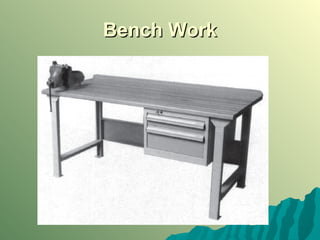
Bench Work THE ACT REFERS TO THESE PRECAUTIONS: Make sure that sharp points of tools and material do not stick out from your workbench. When chipping metal with a chisel, chip in a direction so that cut-off material cannot hit anyone. For your own protection, use a guard where necessary. Do not use chisels with mushroomed heads. Ensure that rolling stock cannot roll off the  workbench and injure your feet. Also place heavy  objects away from the edge of the bench so that they don’t fall.
Bench Work Right-handed people should cut with a hacksaw on the right-hand side of the vice. If the blade breaks, your hand will move safely  away  from the vice and the work piece. Ensure that files have handles. When using a hammer make sure the head is securely fixed. Don’t put sharp or pointed tools in your pockets. Don’t strike hard metals directly with a hammer – the metal may splinter and injure someone. Place a piece of soft material (such as copper) over the metal to act as a shield.
Bench Work You should always: Wear safety goggles when using a grinding machine or lathe, or when chipping Do not wear loose clothing, jewellery, ornaments, a watch or key chain, or a strap when working close to moving machinery.
Assessment Name five safety precautions to observe when working at a workbench. Pg 22
Bench Grinder
Bench Grinder Only use a machine once the guards are correctly fitted. Check that there is no oil or grease on the floor around the machine. Check that the tool rest is not more than 3 mm from the grinding wheel surface. When starting the machine, don’t stand in front of the wheel. Before you start grinding, let the machine idle for a few seconds. If the wheel is running unevenly, dress it with an emery-wheel dresser. Grind only on the face of a straight grinding wheel and never on the side. Use the various wheels only for their intended purpose.
Bench Grinder Approach the wheel carefully and gradually, and don’t ‘jab’ materials onto it. Never ‘force grind’ so that you slow or stop the motor. Adjust the tool rest only when the wheel is stationary. Clamp work pieces and holding devices safety and firmly. Never allow the wheel to stand in cutting fluid as this may cause it to run ‘off balance’ when you switch it on again
Grinding Wheels All power-operated grinding machines should be clearly marked with the recommended speed (in revolutions per minute) of the spindle.  This speed should not allow the peripheral speed of the wheel to exceed the manufacturer’s recommendation. Every grinding wheel should have a guard that can withstand the force of a rupturing wheel. Bench grinders should have a transparent shield to protect an operator’s eyes. Each machine must carry a notice prohibiting persons from performing, inspecting or observing grinding work without suitable protection for the eyes.
Mounting of a Grinding Wheel Select the correct type of wheel for the job. Inspect the wheel for cracks and tap it to apply the ‘ringing test’. Never use a grinding wheel which is damaged or which is not properly dressed. Make sure that the wheel’s speed does not exceed the manufacturer’s recommendation. On the left is an example of a manufacturer’s recommendation. Never force the wheel onto the spindle. Use only one smooth paper spacer on each side of the wheel.
Mounting of a Grinding Wheel Use true and correctly recessed flanges of the same size and at least one third the diameter of the wheel. Gently tighten the grinding wheel with a spanner only enough to hold it firmly. Replace the guards correctly. Stand aside and set the machine in motion. Let the machine idle before you dress the wheel, using an emery-wheel dresser. Finally stop the machine and reset the tool rest to within 2 mm of the wheel surface. Ensure that the tool rest is parallel to the wheel surface.
Grinders Every grinding wheel should have a guard that can withstand the force of a rupturing wheel. Bench grinders should have a transparent shield to protect an operator’s eyes. Each machine must carry a notice prohibiting persons from performing, inspecting or observing grinding work without suitable protection for the eyes.
Assessment Name five safety precautions to observe when working with a grinding wheel. Name five steps to follow when installing a grinding wheel. Pg 25
Drill Press
Drill Press Always observe the following: Choose the correctly sharpened drill for the type of work you need to do and the material you are about to drill. Do not leave the key in the chuck when you are not at the machine. Never leave the machine running if unattended. Clamp the work piece securely to the table and do not hold it by hand. Never attempt to stop the work piece by hand if it slips from the clamp.
Drill Press A drill should run at the correct speed for the job. Don’t force a drill into the work piece – this may cause broken or splintered drills and possible   injury. Use a brush or wooden rod to remove chips from the drill – and not your fingers, waste or rags. When reaching around a revolving drill, be careful that your clothes do not get caught in the drill or drill chuck.
Portable Electric Tools Portable electric tools must be earthed if they are not double insulated.  They should be correctly maintained.  Their flexible cords should be undamaged and their plugs in good order.
Milling Machine and Lathe
Milling Machine and Lathe Observe the following precautions: Make sure that all guards are in place. Don’t use a machine or come close to its moving parts while wearing loose clothing. Keep any  cleaning material such as waste and rags away from rotating parts. Check that there is no oil or grease on the floor around the machine. Don’t leave spanners or keys on rotary parts. Always disconnect, remove or stand clear of hand wheels, levers   or chuck keys before setting your machine or feeds in motion.
Milling Machine and Lathe Never apply a wrench to revolving work. Always clamp work pieces and holding devices safely and firmly. A loose fit, especially of spanners and keys, may cause slipping and result in injury. Do not use your hands to remove cuttings while a machine is in motion. Use a wire hook or a brush once the machine has stopped. Never adjust the cutting tool while a machine is running.
Milling Machine and Lathe Resist the habit of leaning on machinery. This dangerous ‘automatic’ practice often results in serious injury. Don’t attempt to stop a machine by placing your hand on the chuck while the machine is slowing down. Give attention to cutting-fluid control before switching on a machine.
Assessment Name four safety precautions to follow when working with a lathe or a milling machine. Name five safety precautions to follow when working with a drill press. State two safety precautions for each of the following: transmission belts projecting shaft ends revolving shafts general machine protection. Pg 27
Shears, Guillotines and Presses Where the opening at the point of operation (cutting) of a pair of shears, or a guillotine or a press is greater than 10 mm, the machine should have either a fixed guard which prevents hands or fingers reaching through, over, under or around the guard A self-adjusting guard which automatically adjusts to the thickness of the material being worked, can also used. Some machines have manual or automatic moving guards which completely enclose the point of operation so that the working stroke cannot be opened unless the ram or blade is stationary.
Shears, Guillotines and Presses Another safety device is the automatic sweep-away or push-away which pushes any part of the operator’s body out of the danger zone when the working stroke starts. Today there are electronic presence-sensing devices which stop the working stroke if the device senses any foreign object in the danger zone.
Stacking Articles Stacks which consist of successive tiers on top of one another should not be built unless: they are under the personal supervision of a qualified person the base is level and strong enough the articles in the lower tiers are capable of carrying the weight of the articles stacked above them
Stacking Articles
Stacking Articles Stacks should also not be built unless:  all the articles in a single tier are of the same size, shape and mass pallets and containers are in good condition the support structure used for the stacking is structurally satisfactory to support the articles to be stacked on it
Stacking Articles
Stacking Articles An employer must ensure that: persons engaged in stacking operations are safe stacks that are in danger of collapsing are dismantled immediately the stability of stacks is not endangered by vehicles or other machinery or persons moving past them.
Assessment Name four safety precautions that must be observed when considering each of the following: stacking of articles ventilation lighting machine tools arc welding and gas welding. Pg 29
Responsibility The Act places the person in charge of machinery responsible for safety. This person must: Install and properly maintain the machine Repair machinery Ensure that safety appliances, devices and guards are in good condition and properly used Stop anyone from using a dangerous machine.
Obedience to Instructions Use machines according to the manufacturers’ instructions. Don’t use a machine without your teacher’s supervision
Restricted Admittance Only people authorised by the user or entitled by law should enter a workshop. Each workshop should have a notice announcing this ruling .
Floors All workshop floors should be level, clean, non-slippery and, as far as possible, free from chips or loose material.
Lighting There must be adequate illumination (lighting) in the workplace. The glare in any workplace must be reduced to a level that does not impair vision. The lighting on rotating machinery must not cause a stroboscopic (flashing) effect. Lights and lamps must be kept clean and maintained. Artificial light must not shine in a machine operator’s eyes.
Dangerous Places All elevated platforms, openings in floors, pits, trap holes and other dangerous places should be securely fenced or protected to prevent accidents.
First aid, emergency equipment and procedures Injuries and emergencies should be dealt with swiftly and carefully. Where more than five employees are employed at a workplace, the employer must provide an accessible first aid box. The Act states what the box should contain and that the whereabouts of the first aid box be clearly sign-posted.
Assessment State two safety precautions to be observed when practising first aid in a workplace. Pg 30
Colour coding and signs All colours are based on the SANS Code 1091 colour coding.
Colour coding Blue The colour blue is used as a colour-code indicator on pipelines carrying drinkable water and should not be used on machinery. Green Emerald green is used to identify: the location of first aid equipment emergency exits and safety areas informatory signs (such as signs for toilets and parking areas) starting devices on electrical equipment miscellaneous safety conditions.
Colour coding Red Signal red is used to identify: Danger fire protection stopping devices. Yellow Yellow is used for housekeeping markings such as identifying  crane lifting  hooks, changes in floor level and similar tripping hazards, and low head room, indicate ‘No parking’ areas on the floor below fire equipment and electrical switchgear panels .
Colour coding Orange The colour orange is used to identify: electrical switchgear electrical services exposed and rotating machine parts (for example if a casing or guard is not completely closed).
Assessment Name the five basic colours that are used to give information in the workplace, and give three examples of this colour coding. Pg 32

Mechanical Technology Grade 12 Chapter 3 Safety In The Workshop

  • 1.
    SAFETY IN THEWORKSHOP IT IS IN YOUR HANDS
  • 2.
    DEFINING AN ACCIDENTAn accident is an unplanned, uncontrolled event caused by unsafe acts and unsafe conditions. All South African safety regulations are based on the Occupational Health and Safety (OHS) Act No. 85 of 1993.
  • 3.
    What are thecauses of accidents? Poor housekeeping Loose clothing Improper use of tools Inaccurate setting-up of machines
  • 4.
    House Keeping Goodhousekeeping means working tidily and orderly. Always work neatly and return materials and tools to their proper places. Keep working areas unobstructed at all times; when using a machine, keep an unobstructed space (of 2,25 m2) around the machine. Grease, oil, tools, loose objects and materials lying around can easily cause a fall. A clean, orderly workshop is a safe workshop. Also maintain floors, walkways, stairways and gangways, ensuring they are skidfree (and leak-free) and clear of obstructions.
  • 5.
  • 6.
  • 7.
    Protective clothing Whenwelding, you need to protect your eyes and respiratory system, as well as your body and your clothing. You should protect yourself against heat, flying particles that are incandescent (glowing with heat) and radiation. You should always: wear safety goggles when using a grinding machine or lathe, or when chipping not wear loose clothing, jewellery, ornaments, a watch or key chain, or a strap when working close to moving machinery.  
  • 8.
  • 9.
    Bench Work THEACT REFERS TO THESE PRECAUTIONS: Make sure that sharp points of tools and material do not stick out from your workbench. When chipping metal with a chisel, chip in a direction so that cut-off material cannot hit anyone. For your own protection, use a guard where necessary. Do not use chisels with mushroomed heads. Ensure that rolling stock cannot roll off the workbench and injure your feet. Also place heavy objects away from the edge of the bench so that they don’t fall.
  • 10.
    Bench Work Right-handedpeople should cut with a hacksaw on the right-hand side of the vice. If the blade breaks, your hand will move safely away from the vice and the work piece. Ensure that files have handles. When using a hammer make sure the head is securely fixed. Don’t put sharp or pointed tools in your pockets. Don’t strike hard metals directly with a hammer – the metal may splinter and injure someone. Place a piece of soft material (such as copper) over the metal to act as a shield.
  • 11.
    Bench Work Youshould always: Wear safety goggles when using a grinding machine or lathe, or when chipping Do not wear loose clothing, jewellery, ornaments, a watch or key chain, or a strap when working close to moving machinery.
  • 12.
    Assessment Name fivesafety precautions to observe when working at a workbench. Pg 22
  • 13.
  • 14.
    Bench Grinder Onlyuse a machine once the guards are correctly fitted. Check that there is no oil or grease on the floor around the machine. Check that the tool rest is not more than 3 mm from the grinding wheel surface. When starting the machine, don’t stand in front of the wheel. Before you start grinding, let the machine idle for a few seconds. If the wheel is running unevenly, dress it with an emery-wheel dresser. Grind only on the face of a straight grinding wheel and never on the side. Use the various wheels only for their intended purpose.
  • 15.
    Bench Grinder Approachthe wheel carefully and gradually, and don’t ‘jab’ materials onto it. Never ‘force grind’ so that you slow or stop the motor. Adjust the tool rest only when the wheel is stationary. Clamp work pieces and holding devices safety and firmly. Never allow the wheel to stand in cutting fluid as this may cause it to run ‘off balance’ when you switch it on again
  • 16.
    Grinding Wheels Allpower-operated grinding machines should be clearly marked with the recommended speed (in revolutions per minute) of the spindle. This speed should not allow the peripheral speed of the wheel to exceed the manufacturer’s recommendation. Every grinding wheel should have a guard that can withstand the force of a rupturing wheel. Bench grinders should have a transparent shield to protect an operator’s eyes. Each machine must carry a notice prohibiting persons from performing, inspecting or observing grinding work without suitable protection for the eyes.
  • 17.
    Mounting of aGrinding Wheel Select the correct type of wheel for the job. Inspect the wheel for cracks and tap it to apply the ‘ringing test’. Never use a grinding wheel which is damaged or which is not properly dressed. Make sure that the wheel’s speed does not exceed the manufacturer’s recommendation. On the left is an example of a manufacturer’s recommendation. Never force the wheel onto the spindle. Use only one smooth paper spacer on each side of the wheel.
  • 18.
    Mounting of aGrinding Wheel Use true and correctly recessed flanges of the same size and at least one third the diameter of the wheel. Gently tighten the grinding wheel with a spanner only enough to hold it firmly. Replace the guards correctly. Stand aside and set the machine in motion. Let the machine idle before you dress the wheel, using an emery-wheel dresser. Finally stop the machine and reset the tool rest to within 2 mm of the wheel surface. Ensure that the tool rest is parallel to the wheel surface.
  • 19.
    Grinders Every grindingwheel should have a guard that can withstand the force of a rupturing wheel. Bench grinders should have a transparent shield to protect an operator’s eyes. Each machine must carry a notice prohibiting persons from performing, inspecting or observing grinding work without suitable protection for the eyes.
  • 20.
    Assessment Name fivesafety precautions to observe when working with a grinding wheel. Name five steps to follow when installing a grinding wheel. Pg 25
  • 21.
  • 22.
    Drill Press Alwaysobserve the following: Choose the correctly sharpened drill for the type of work you need to do and the material you are about to drill. Do not leave the key in the chuck when you are not at the machine. Never leave the machine running if unattended. Clamp the work piece securely to the table and do not hold it by hand. Never attempt to stop the work piece by hand if it slips from the clamp.
  • 23.
    Drill Press Adrill should run at the correct speed for the job. Don’t force a drill into the work piece – this may cause broken or splintered drills and possible injury. Use a brush or wooden rod to remove chips from the drill – and not your fingers, waste or rags. When reaching around a revolving drill, be careful that your clothes do not get caught in the drill or drill chuck.
  • 24.
    Portable Electric ToolsPortable electric tools must be earthed if they are not double insulated. They should be correctly maintained. Their flexible cords should be undamaged and their plugs in good order.
  • 25.
  • 26.
    Milling Machine andLathe Observe the following precautions: Make sure that all guards are in place. Don’t use a machine or come close to its moving parts while wearing loose clothing. Keep any cleaning material such as waste and rags away from rotating parts. Check that there is no oil or grease on the floor around the machine. Don’t leave spanners or keys on rotary parts. Always disconnect, remove or stand clear of hand wheels, levers or chuck keys before setting your machine or feeds in motion.
  • 27.
    Milling Machine andLathe Never apply a wrench to revolving work. Always clamp work pieces and holding devices safely and firmly. A loose fit, especially of spanners and keys, may cause slipping and result in injury. Do not use your hands to remove cuttings while a machine is in motion. Use a wire hook or a brush once the machine has stopped. Never adjust the cutting tool while a machine is running.
  • 28.
    Milling Machine andLathe Resist the habit of leaning on machinery. This dangerous ‘automatic’ practice often results in serious injury. Don’t attempt to stop a machine by placing your hand on the chuck while the machine is slowing down. Give attention to cutting-fluid control before switching on a machine.
  • 29.
    Assessment Name foursafety precautions to follow when working with a lathe or a milling machine. Name five safety precautions to follow when working with a drill press. State two safety precautions for each of the following: transmission belts projecting shaft ends revolving shafts general machine protection. Pg 27
  • 30.
    Shears, Guillotines andPresses Where the opening at the point of operation (cutting) of a pair of shears, or a guillotine or a press is greater than 10 mm, the machine should have either a fixed guard which prevents hands or fingers reaching through, over, under or around the guard A self-adjusting guard which automatically adjusts to the thickness of the material being worked, can also used. Some machines have manual or automatic moving guards which completely enclose the point of operation so that the working stroke cannot be opened unless the ram or blade is stationary.
  • 31.
    Shears, Guillotines andPresses Another safety device is the automatic sweep-away or push-away which pushes any part of the operator’s body out of the danger zone when the working stroke starts. Today there are electronic presence-sensing devices which stop the working stroke if the device senses any foreign object in the danger zone.
  • 32.
    Stacking Articles Stackswhich consist of successive tiers on top of one another should not be built unless: they are under the personal supervision of a qualified person the base is level and strong enough the articles in the lower tiers are capable of carrying the weight of the articles stacked above them
  • 33.
  • 34.
    Stacking Articles Stacksshould also not be built unless: all the articles in a single tier are of the same size, shape and mass pallets and containers are in good condition the support structure used for the stacking is structurally satisfactory to support the articles to be stacked on it
  • 35.
  • 36.
    Stacking Articles Anemployer must ensure that: persons engaged in stacking operations are safe stacks that are in danger of collapsing are dismantled immediately the stability of stacks is not endangered by vehicles or other machinery or persons moving past them.
  • 37.
    Assessment Name foursafety precautions that must be observed when considering each of the following: stacking of articles ventilation lighting machine tools arc welding and gas welding. Pg 29
  • 38.
    Responsibility The Actplaces the person in charge of machinery responsible for safety. This person must: Install and properly maintain the machine Repair machinery Ensure that safety appliances, devices and guards are in good condition and properly used Stop anyone from using a dangerous machine.
  • 39.
    Obedience to InstructionsUse machines according to the manufacturers’ instructions. Don’t use a machine without your teacher’s supervision
  • 40.
    Restricted Admittance Onlypeople authorised by the user or entitled by law should enter a workshop. Each workshop should have a notice announcing this ruling .
  • 41.
    Floors All workshopfloors should be level, clean, non-slippery and, as far as possible, free from chips or loose material.
  • 42.
    Lighting There mustbe adequate illumination (lighting) in the workplace. The glare in any workplace must be reduced to a level that does not impair vision. The lighting on rotating machinery must not cause a stroboscopic (flashing) effect. Lights and lamps must be kept clean and maintained. Artificial light must not shine in a machine operator’s eyes.
  • 43.
    Dangerous Places Allelevated platforms, openings in floors, pits, trap holes and other dangerous places should be securely fenced or protected to prevent accidents.
  • 44.
    First aid, emergencyequipment and procedures Injuries and emergencies should be dealt with swiftly and carefully. Where more than five employees are employed at a workplace, the employer must provide an accessible first aid box. The Act states what the box should contain and that the whereabouts of the first aid box be clearly sign-posted.
  • 45.
    Assessment State twosafety precautions to be observed when practising first aid in a workplace. Pg 30
  • 46.
    Colour coding andsigns All colours are based on the SANS Code 1091 colour coding.
  • 47.
    Colour coding BlueThe colour blue is used as a colour-code indicator on pipelines carrying drinkable water and should not be used on machinery. Green Emerald green is used to identify: the location of first aid equipment emergency exits and safety areas informatory signs (such as signs for toilets and parking areas) starting devices on electrical equipment miscellaneous safety conditions.
  • 48.
    Colour coding RedSignal red is used to identify: Danger fire protection stopping devices. Yellow Yellow is used for housekeeping markings such as identifying crane lifting hooks, changes in floor level and similar tripping hazards, and low head room, indicate ‘No parking’ areas on the floor below fire equipment and electrical switchgear panels .
  • 49.
    Colour coding OrangeThe colour orange is used to identify: electrical switchgear electrical services exposed and rotating machine parts (for example if a casing or guard is not completely closed).
  • 50.
    Assessment Name thefive basic colours that are used to give information in the workplace, and give three examples of this colour coding. Pg 32